
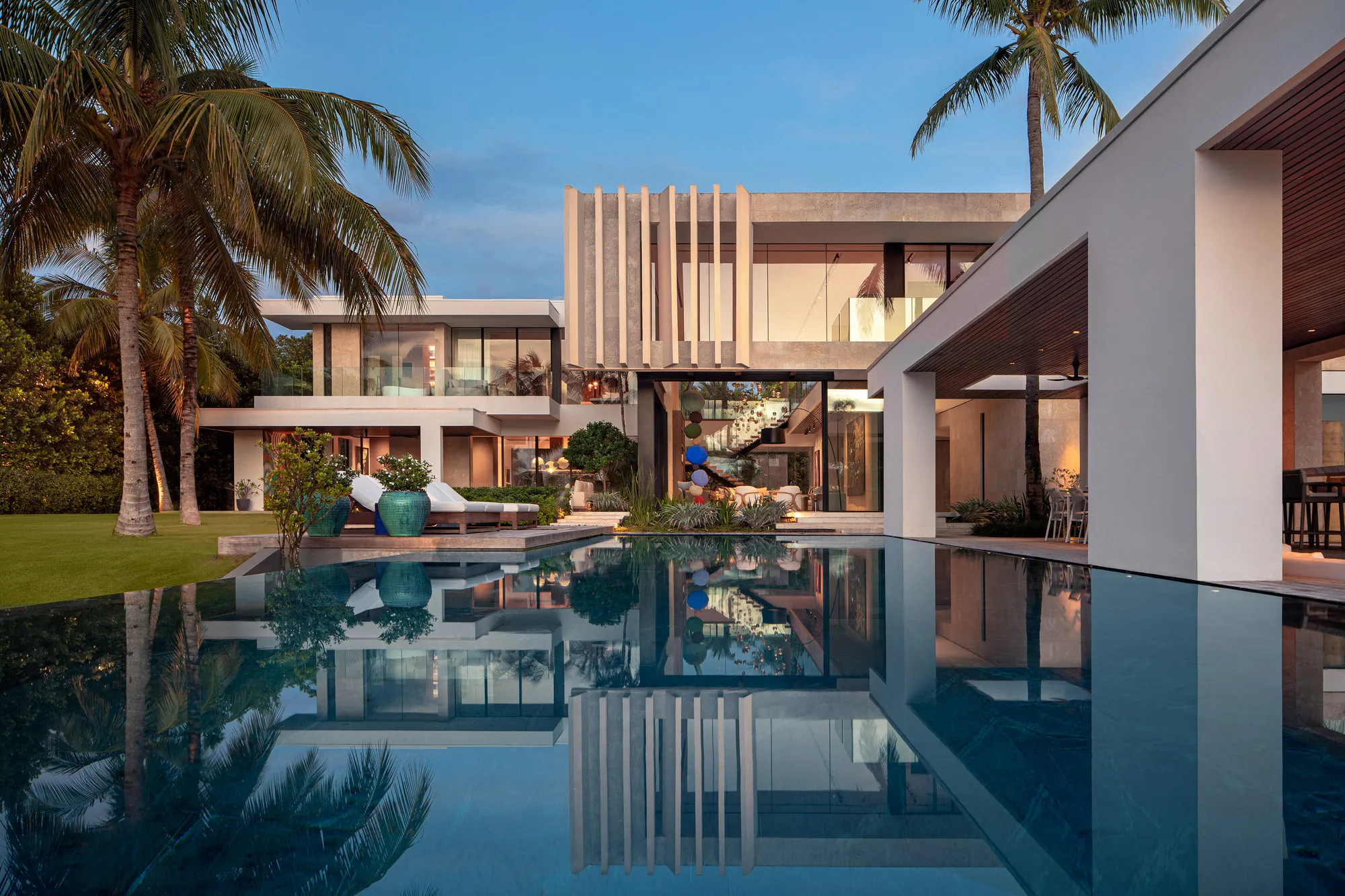
SAOTA Grounds a Bahamian Canal Estate in Coral Stone and Quiet Reverence
Villa Lyla layers locally quarried coral stone, timber screens, and native gardens across a Nassau waterfront site to honor memory and place.


Named for the homeowner's late daughter, Villa Lyla carries a weight that no material schedule can fully describe. Yet the architecture by SAOTA manages to hold that weight without heaviness, distributing it across a sequence of coral stone volumes, planted courtyards, and timber-screened pavilions that move from a quiet Nassau street down to a private canal dock. The estate reads less as a single building than as a small settlement, each wing calibrated to a specific relationship with water, sky, or garden.
What makes this project genuinely interesting is the discipline behind its generosity. At 1,203 square meters, the program is substantial, but the plan never reads as a single mass. SAOTA, led by Mark Bullivant, Dominik George, and Brigitte Stevens, broke the house into distinct pavilions connected by courtyards and reflecting pools, so that light, air, and vegetation pass through the built fabric almost continuously. The result is a house that belongs to its site rather than sitting on it, a distinction that matters enormously in a climate where the wrong orientation or the wrong wall can turn a room into an oven.
Coral Stone as Both Material and Idea
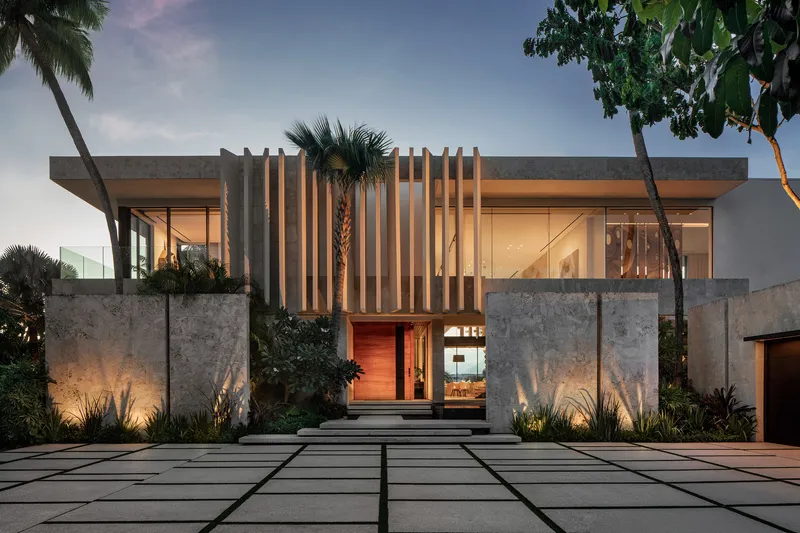
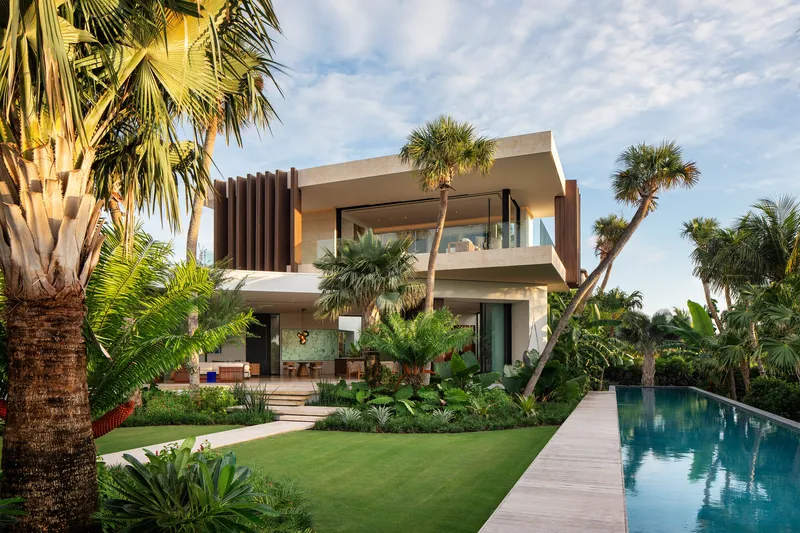
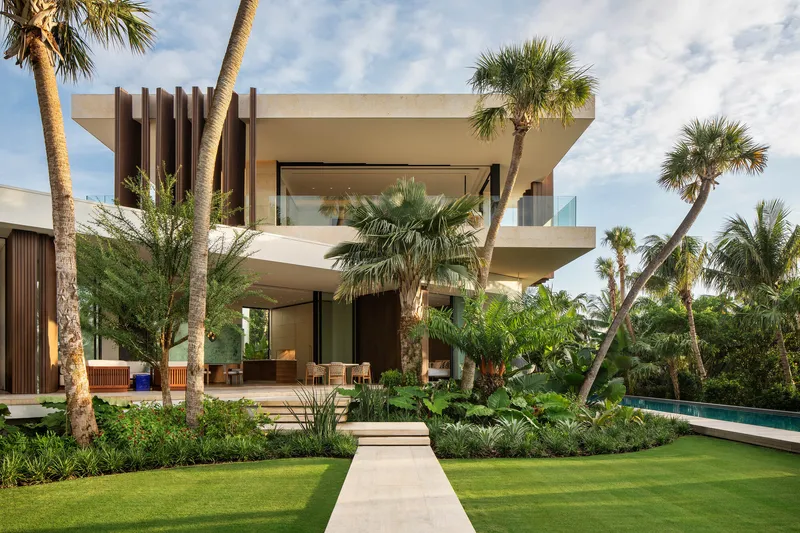
The defining material choice here is locally quarried coral stone, used in oversized fins and contrasting textures that reference the island's own geology. These are not decorative cladding panels; they are thick, tactile walls that provide thermal mass, modulate daylight, and frame views with a precision that owes as much to climate engineering as to composition. At dusk, the stone catches warm light while the vertical timber louvers behind it fall into shadow, creating a layered facade that shifts mood across the day.
The decision to source stone locally is more than an ethical footnote. It ties the building's palette directly to the Bahamian landscape, so the house reads as continuous with its ground rather than imported onto it. When combined with the textured masonry and timber ceilings inside, the material language stays remarkably consistent without becoming monotonous.
A Journey from Street to Water
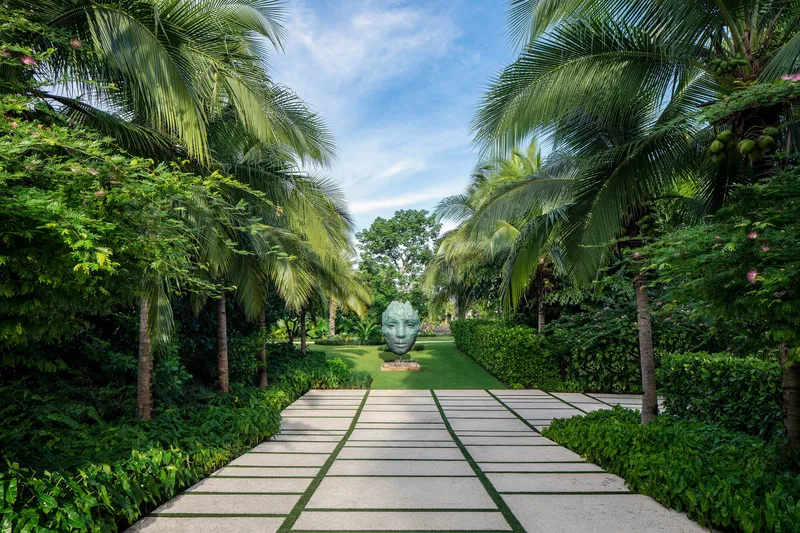
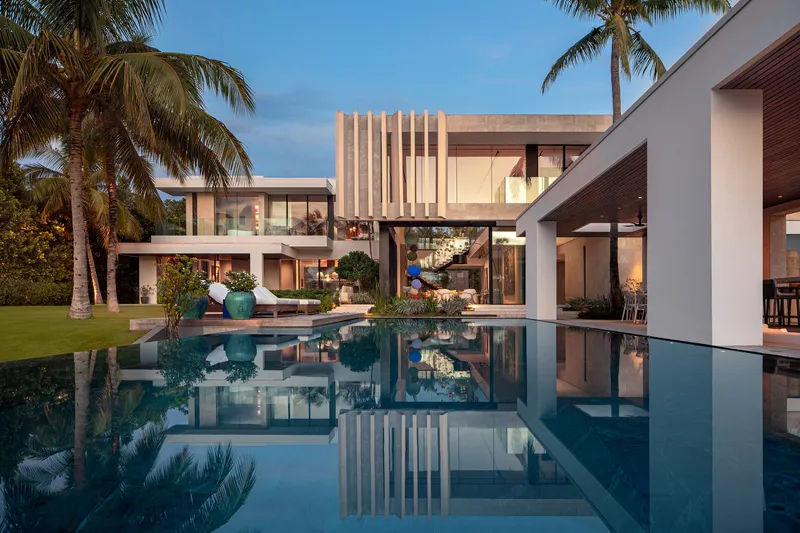
SAOTA organized Villa Lyla as a procession. You arrive from the street, pass through a controlled entry sequence of stone walls and timber screens, and are gradually drawn through a series of courtyards, planted paths, and water features until you reach the canal edge. The axial planning is deliberate: sightlines punch through the house so that even from the entry, you sense the water beyond. A paved garden path with grass joints leads past a sculptural head by Lionel Smit, one of several artworks embedded into the landscape as waypoints.
Raymond Jungles, responsible for the landscape design, deserves significant credit for making this sequence feel inevitable rather than staged. Native species create dense, wind-filtering edges that give privacy while maintaining ecological resilience in a humid coastal climate. The gardens are not ornamental buffer zones; they are the connective tissue of the entire plan.
Living Spaces Open to Everything
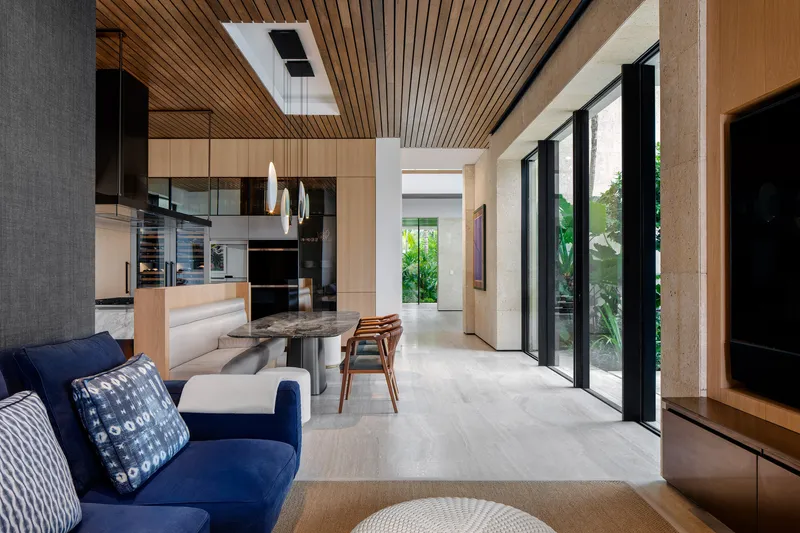
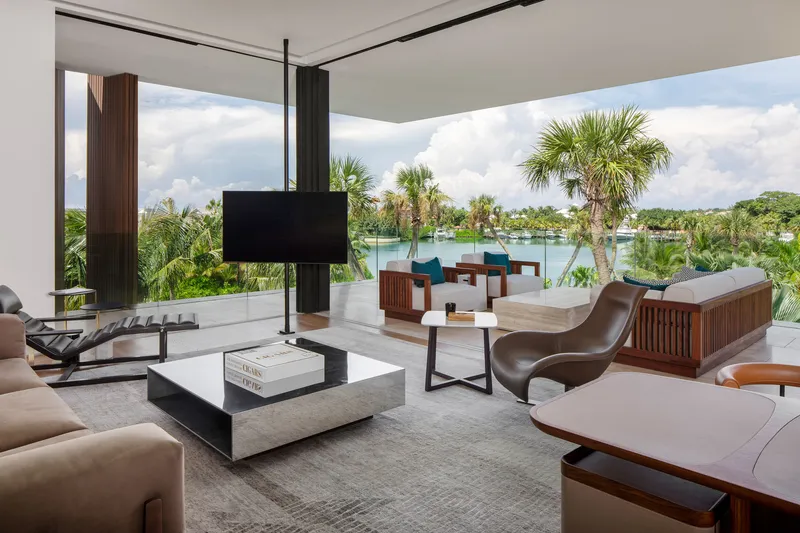
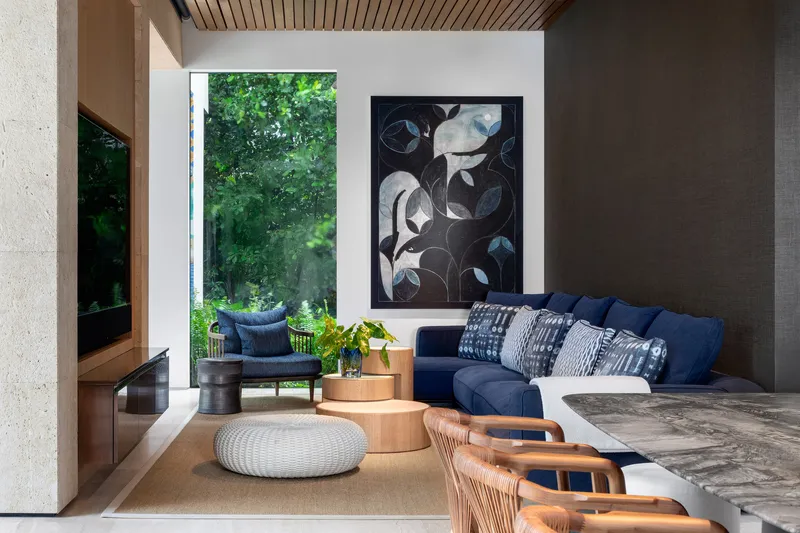
The social core of the house collapses the distinction between inside and outside. Floor-to-ceiling glazing, much of it operable, opens the living and dining areas to gardens and water on multiple sides. Slatted timber ceilings run continuously from interior to exterior, erasing the threshold line and extending the perceived volume of each room well into the landscape. Generous overhangs cast deep shade over the terraces, creating an intermediate zone that is neither fully enclosed nor fully exposed.
Cross-ventilation is not an afterthought here; it is a primary design driver. The operable glass panels and the orientation of the volumes allow air to move freely through the house, reducing dependence on mechanical cooling. In a climate as warm and humid as Nassau's, this kind of passive strategy separates serious tropical architecture from projects that merely look tropical.
The Waterfront and Its Pavilions
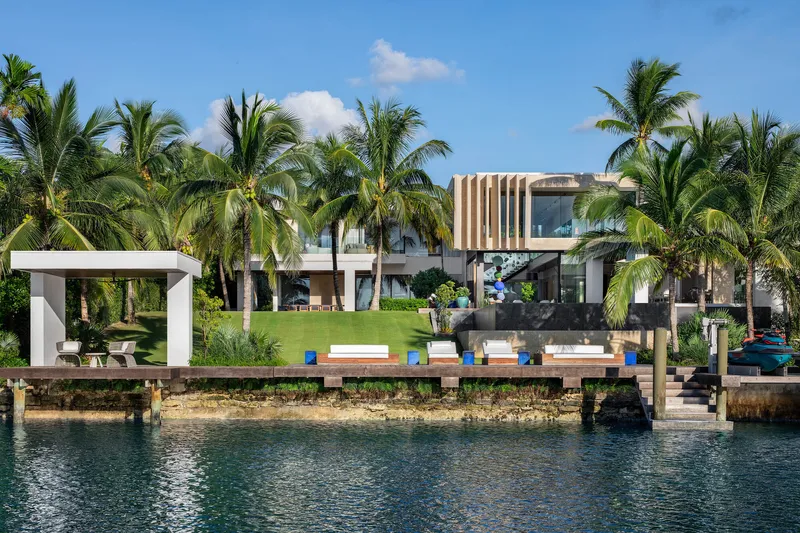
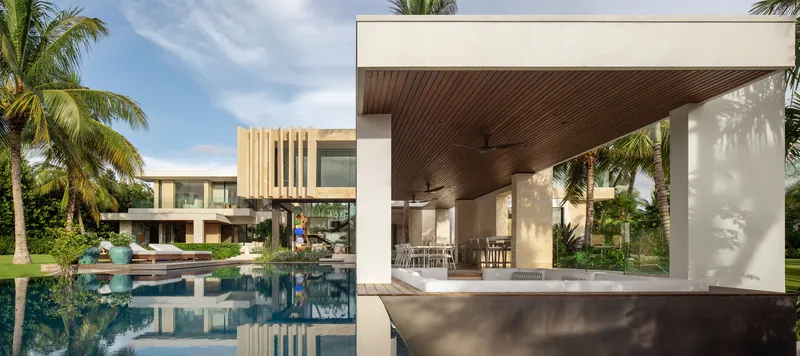
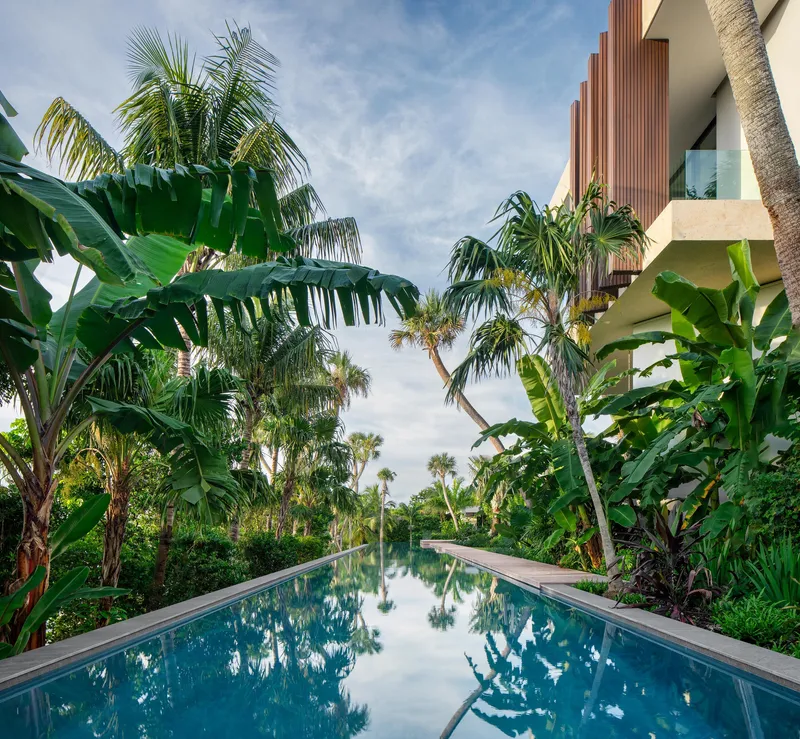
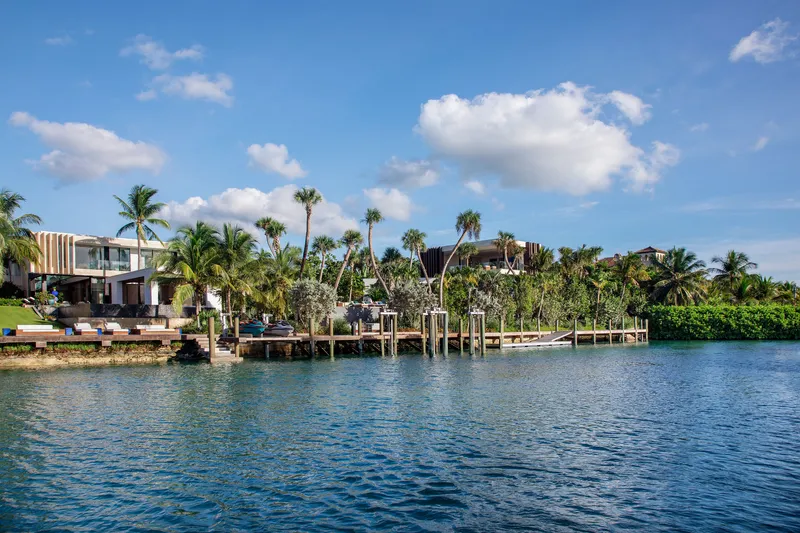
From the canal side, Villa Lyla presents as a cluster of pavilions rather than a monolithic facade. A freestanding guest and office pavilion sits apart from the main house, framed by coconut palms and connected to a timber dock with direct boat access. The lap pool extends through dense tropical plantings, its surface reflecting banana leaves and palm trunks in a way that collapses the boundary between cultivated water and wild vegetation.
The poolside pavilion, with its timber-lined ceiling and white walls, functions as an outdoor living room that mediates between the pool, the garden, and the canal. It is the kind of space that justifies living in the tropics: open on all sides, shaded above, with nothing between you and the water but a few meters of stone deck.
Private Quarters and Interior Craft
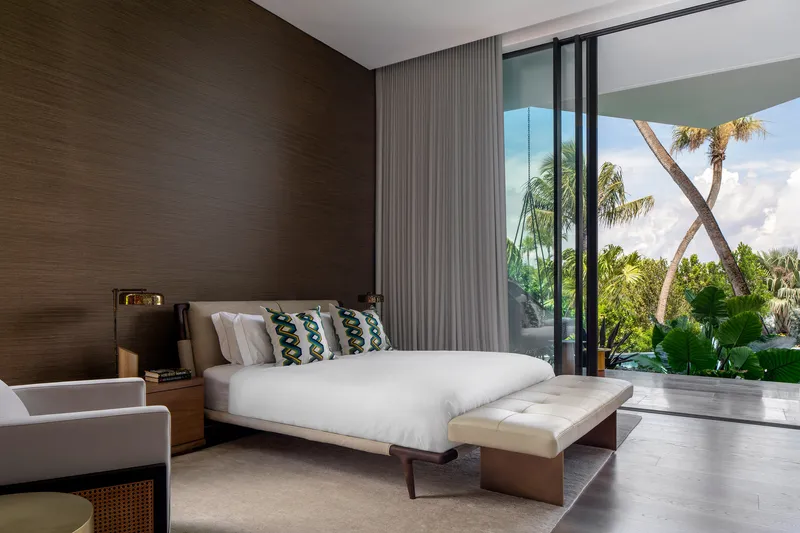
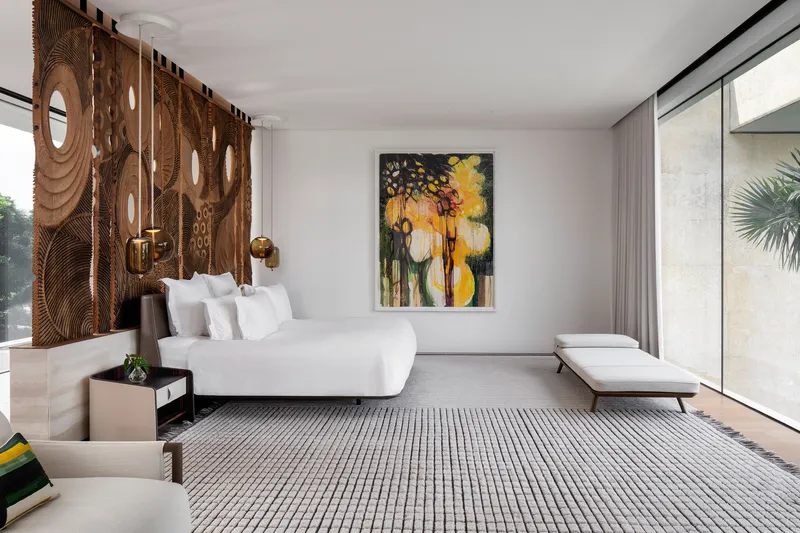
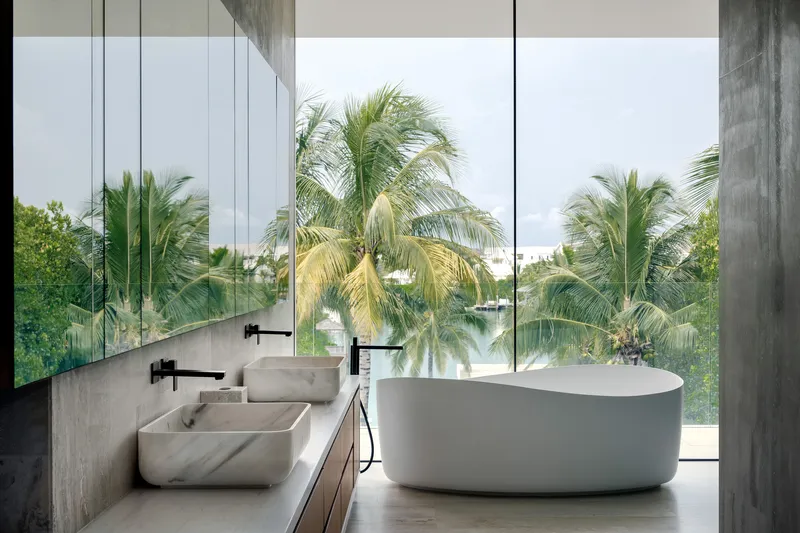
The bedrooms, designed in collaboration with interior studio ARRCC, pull back from the openness of the social spaces without losing their connection to the landscape. Ribbed wood headboard walls and carved timber screens give each room a distinct tactile identity, while full-height sliding glass partitions open onto palm-shaded balconies. The bathrooms continue this logic: a freestanding tub and dual stone basins face directly onto floor-to-ceiling glass framing palm canopies, treating bathing as an extension of the garden experience.
Interiors incorporate works by Bahamian artists, including pieces by the late John Beadle, grounding the decorative program in local culture rather than a generic resort aesthetic. It is a subtle but important decision that reinforces the house's commitment to place.
Dusk Reveals the Architecture
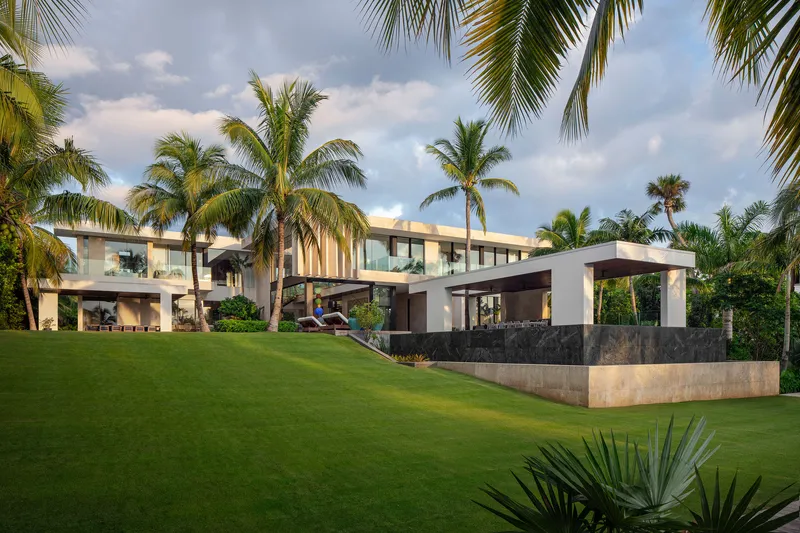
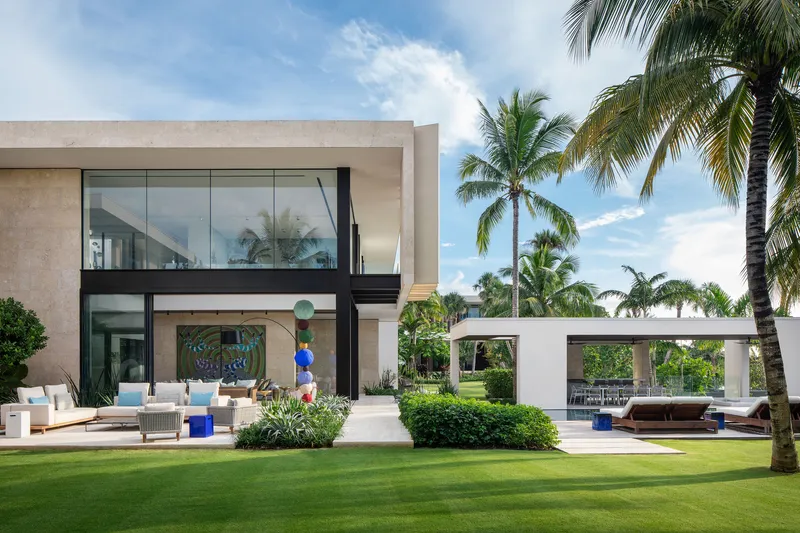
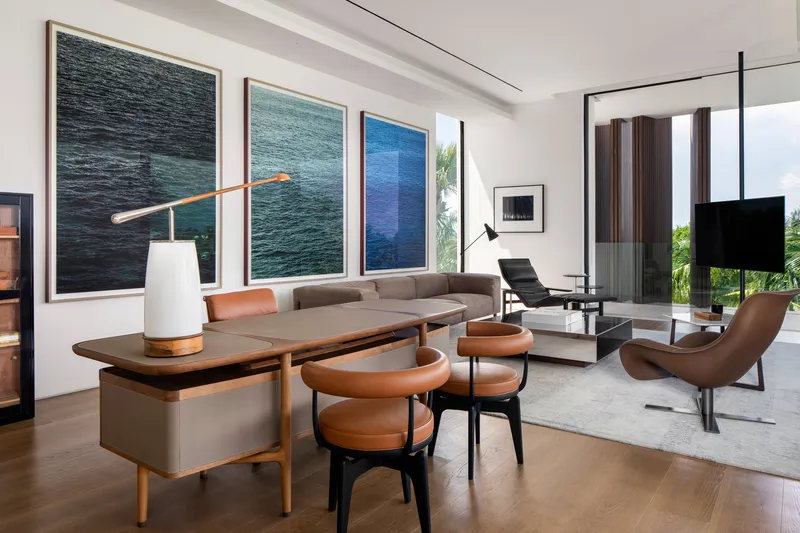
Villa Lyla is a house that improves as the light drops. At sunset, the stacked volumes with their timber screens and deep overhangs become lanterns, their interiors glowing warmly against the darkening garden. The layered composition that can feel almost too quiet in midday sun suddenly snaps into focus, each volume distinct in silhouette, each courtyard a pocket of soft reflected light. LUX Populi Hollander Design handled the lighting, and the restraint is notable: no theatrical washes, no uplighting drama, just enough illumination to reveal the spatial depth that the architecture has been quietly producing all day.
Plans and Drawings
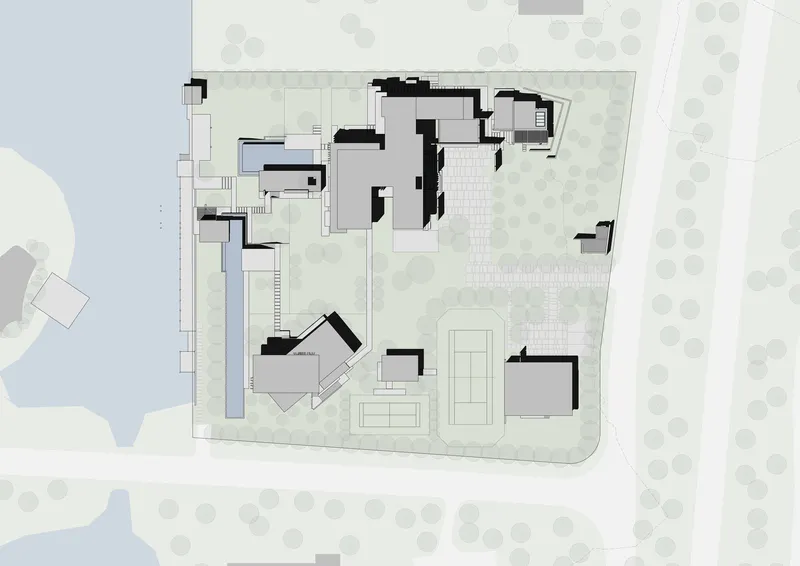
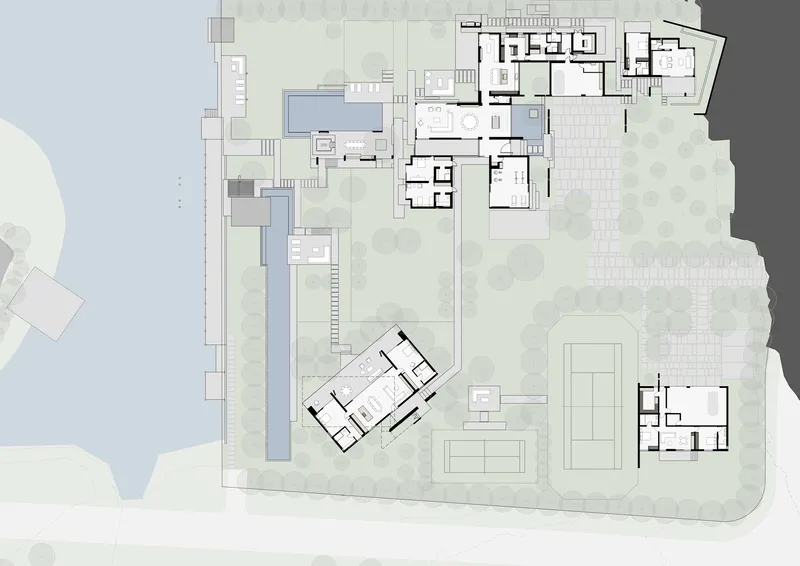
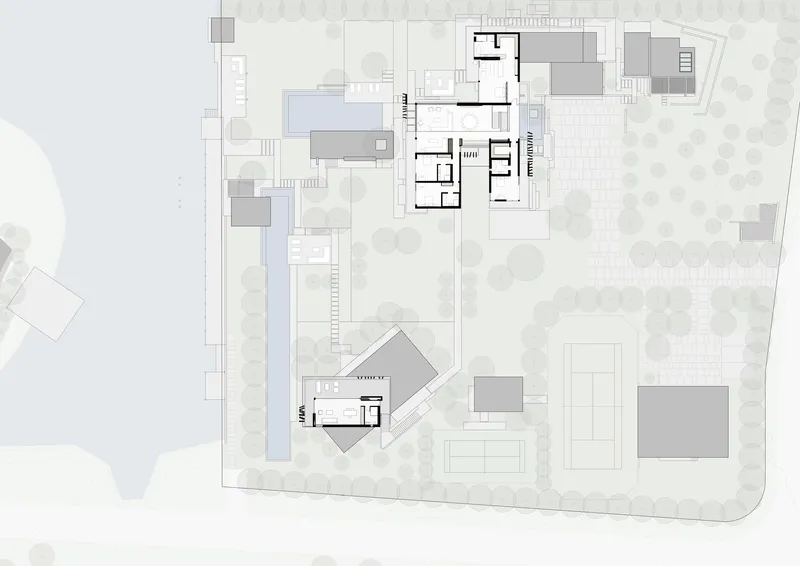
The upper level floor plan confirms what the photographs suggest: the estate is organized as a loose constellation of volumes distributed across the site rather than a compact footprint. Social and private wings are separated by courtyards and planted zones, with the guest pavilion clearly detached from the main house. The plan's deliberate porosity, the gaps between built volumes filled with landscape, is what allows every room to enjoy multiple orientations and natural ventilation paths.
Why This Project Matters
Villa Lyla matters because it demonstrates that large-scale residential architecture in the tropics does not have to choose between environmental responsibility and spatial ambition. SAOTA's decision to fragment the program into pavilions, to use locally quarried coral stone as both structure and identity, and to treat landscape as an equal partner in the plan produces a house that is climatically effective, materially grounded, and spatially generous all at once. In a region where resort pastiche remains the default, this is a house that takes the Bahamas seriously as a context.
There is also the question of memory. A house named for a lost child carries an emotional charge that architecture alone cannot resolve, but it can acknowledge. The quiet procession from street to water, the careful framing of sky and vegetation, the spaces that are open without being exposed: these are architectural decisions that create room for reflection without forcing it. Villa Lyla does not shout its grief. It holds it, gently, in coral stone and filtered light.
Villa Lyla by SAOTA (Mark Bullivant, Dominik George, Brigitte Stevens), with interior décor by ARRCC and landscape by Raymond Jungles. Nassau, Bahamas. 1,203 m². Completed 2025. Photography by Adam Letch.
About the Studio
Share Your Own Work on uni.xyz
If projects like this are the kind of work you want to make, uni.xyz is a place to publish your own, find collaborators, and enter design competitions.




Popular Articles
Popular articles from the community


Conexión: Biophilic Design Reimagines High-Rise Living in Hong Kong
Conexión reimagines high-rise living in Hong Kong through biophilic design, green facades, shared spaces, daylight, water and nature within.

Riyadh For All: Intergenerational Urban Design for Active Aging in Rabat
Riyadh For All reimagines urban design in Rabat with intergenerational co-living, adaptive courtyards, and Moroccan cultural exchange today.

The Earth Pod: 3D Printed Homes for Resilient Refugee Communities
The Earth Pod reimagines refugee housing through 3D printed homes made from clay, combining resilience, self-sufficiency, and rapid shelter.

The Ocean Hive: Sustainable Architecture for a Self-Sufficient Civilization at Sea
The Ocean Hive imagines sustainable architecture at sea, where modular habitats, algae, wave power and ocean waste sustain a growing colony.


Similar Reads
You might also enjoy these articles

Bao Huynh Watercolor Atelier: A Serene Art Retreat in Hội An
Bao Huynh Watercolor Atelier in Hội An blends multifunctional art spaces, sustainable design, local materials, and family-friendly living in a serene environment.

Atelier Macri Concept Store Interior Design by CASE-REAL
Atelier Macri store features a "ko" counter, walnut wood details, cork displays, blending retail, gallery, and seamless customer experiences.

Manuel Vargas Izquierdo Stadium and High-Performance Sports Center: Architectural Excellence in Jalpa de Méndez
The Manuel Vargas Izquierdo Stadium blends sustainable design, inclusive sports facilities, and cultural-inspired architecture, revitalizing Jalpa de Méndez’s public spaces.

KAKR Buluh Awar Hall: Revitalizing Community and Ecology Through Bamboo Architecture
Community built bamboo hall revitalizes Buluh Awar village, empowering youth, restoring ecology, celebrating vernacular craftsmanship through sustainable architecture and culture.




Comments (0)
Please login or sign up to add comments
No comments yet. Be the first to comment!