

Scenic Architecture Office Lifts an Entire Sports Complex Above a Shanghai School's Playing Field
The Anna Pao Sohmen Centre at YK Pao School stacks six levels of athletics, making, and gathering on a tight campus site.


On a constrained campus in Shanghai, Scenic Architecture Office faced a familiar problem with an unfamiliar answer: where do you put a swimming pool, basketball courts, maker spaces, and a rooftop playground when the school already occupies every available square meter? You raise the entire building off the ground, preserve the playing field underneath, and let students run beneath a hovering volume held aloft by angled concrete columns. The Anna Pao Sohmen Centre at YK Pao School, completed in 2025, is a 2,473 square meter vertical stack that reads less like a gymnasium and more like a small campus compressed into a single section.
What makes the project genuinely interesting is not just the structural bravado of the cantilever but the density of program packed into such a compact footprint. A basement pool, a ground-level assembly hall, a mezzanine with table tennis, a full basketball court on the third floor, maker studios on the fourth, and a rooftop court and ceremonial deck at the top. The building borrows from Chinese garden design to keep these stacked programs feeling open and interconnected rather than claustrophobic. Maritime references nod to the legacy of YK Pao, the shipping magnate whose family founded the school. It is a building that takes its obligations seriously: to the school's history, to its constrained site, and to the sheer number of things students need to do in a day.
Lifting the Ground Plane
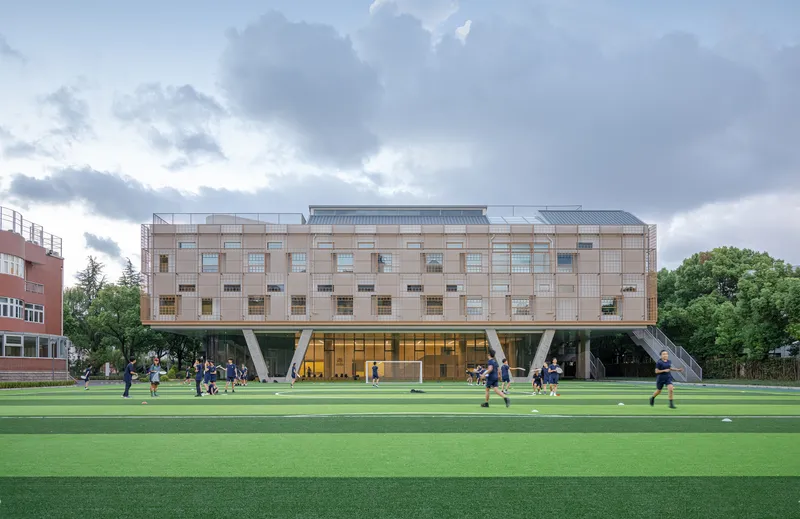
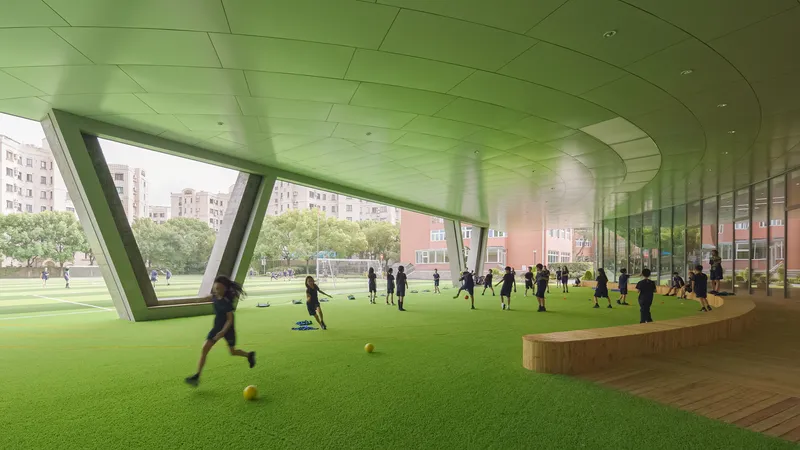
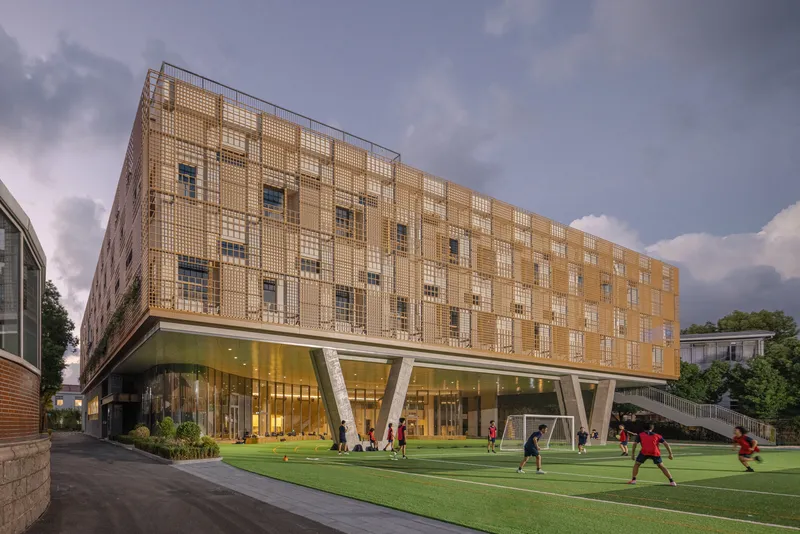
The defining gesture of the Anna Pao Sohmen Centre is the way its upper mass floats above the synthetic turf field. Angled concrete columns carry the load while keeping the ground level open and breathable. Students play beneath the building as much as inside it. The green ceiling of the underside extends the field's color palette upward, turning what could have been a dark, utilitarian underbelly into something closer to a covered park. At dusk, when the glazed ground level glows and the perforated facade catches artificial light, the building appears to hover over the campus like a lantern.
This is a pragmatic move disguised as an expressive one. By lifting the volume, Scenic Architecture Office effectively doubled the usable ground area, giving the school both a protected outdoor field and the enclosed program above. It is a lesson in site economy that more schools with limited land should study.
A Facade That Breathes
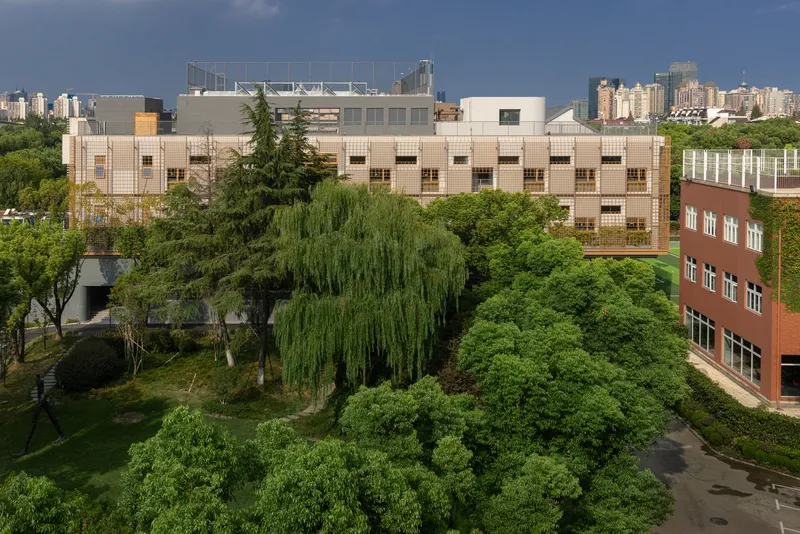
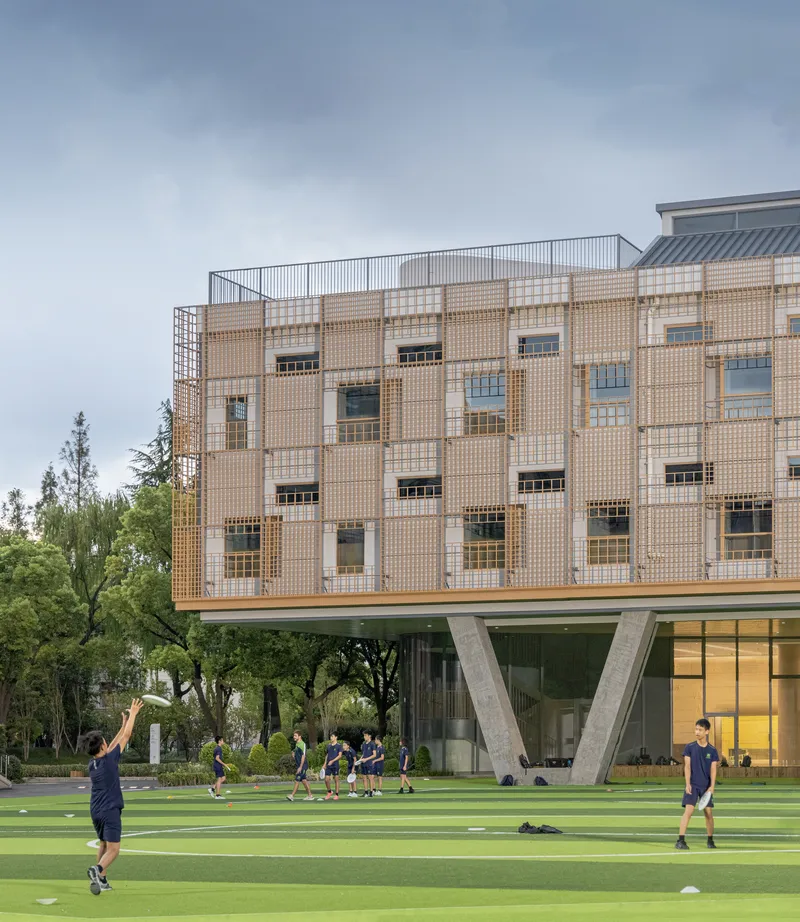
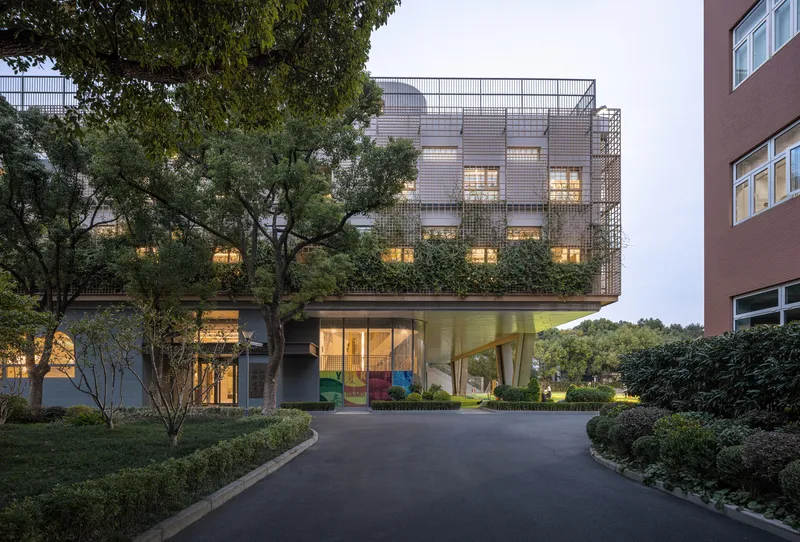
The building's perforated aluminium lattice skin does more than provide texture. On the west face, windmill jasmine climbs the lattice, filtering harsh afternoon sun through a living screen that will thicken over the years. The idea draws inspiration from the Austrian artist Hundertwasser, who advocated for greenery as a building's skin. Here, the reference is subtle rather than flamboyant: the lattice is restrained in its pattern, and the planting is calibrated to Shanghai's climate rather than deployed as ornamentation.
From above, the tiled and perforated panels sit within a canopy of mature willows and deciduous trees, embedding the building in its campus landscape rather than asserting dominance over it. The aerial view reveals how carefully the rectangular footprint was threaded between existing structures and planting. This is not a building that arrived on site with a bulldozer; it negotiated its way in.
Water, Light, and the Pool Below Grade
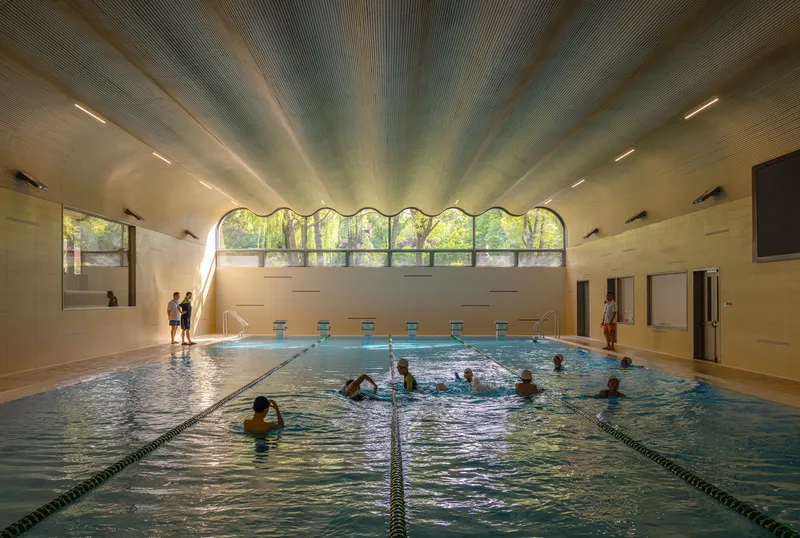
Burying the swimming pool in the basement is a common strategy, but the quality of light Scenic Architecture Office brings into this space is not common at all. Arched clerestory windows run along the pool's length, and timber ceiling beams catch and diffuse natural light so that the room reads as generous rather than subterranean. The maritime legacy of YK Pao finds its most literal expression here, where water, light, and timber converge.
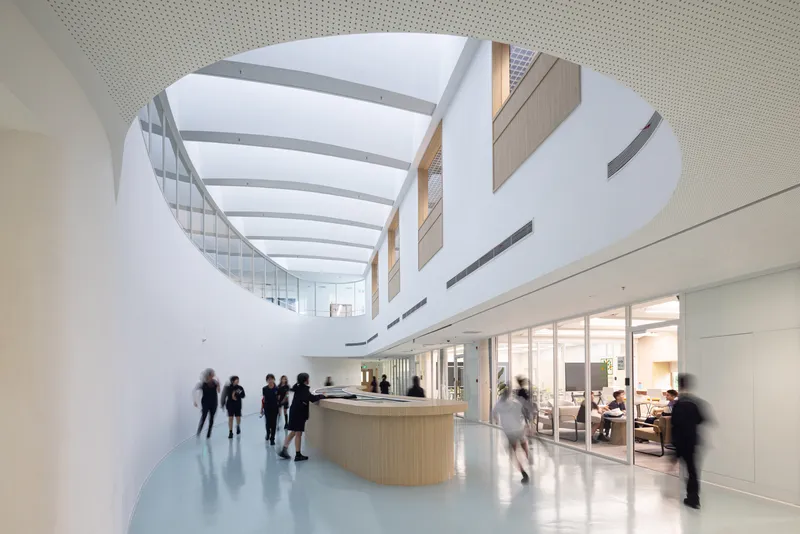
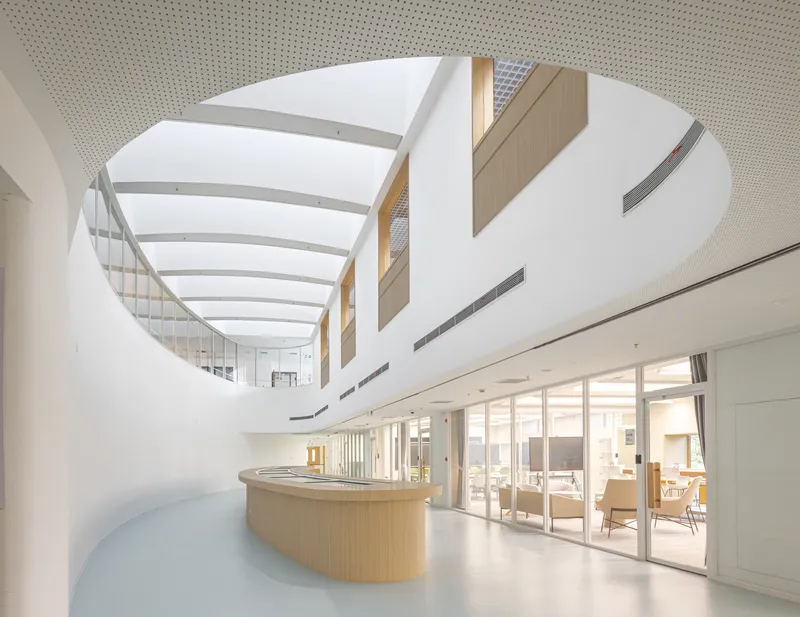
One level up, the lobby introduces a curved timber reception desk beneath an oval skylight with exposed ribs. The daylit atrium acts as a decompression chamber between the field outside and the vertical stack of programs above. The curved geometries, visible again in the white atrium's flowing walls, echo the garden-influenced circulation strategy that Scenic Architecture Office uses to connect floors without relying on monotonous corridors.
Courts and Classrooms in the Sky
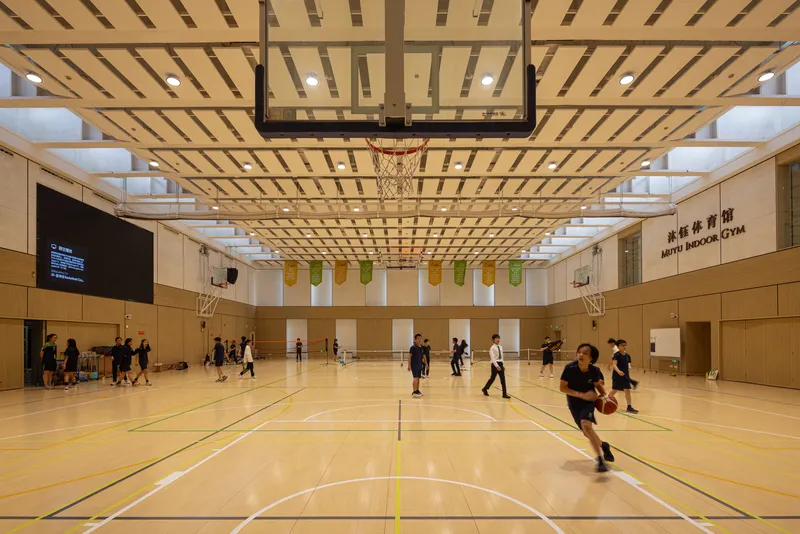

The basketball court on the third floor is a highlight: a full-sized hardwood floor under a timber-slatted ceiling with colored panel accents that keep the space from feeling institutional. This is a room designed to be loud and active, and the warm materiality of the ceiling absorbs both sound and visual severity. On the fourth floor, maker spaces, studios, offices, and an exhibition greenhouse line the perimeter, turning the upper reaches of the building into a creative layer distinct from the athletic floors below.
The programmatic logic is clear: wet and heavy uses sit low, active sports occupy the middle, and quieter creative work rises to the top, where light and views are best. The rooftop adds yet another basketball court and a ceremonial deck, ensuring that even the building's fifth facade contributes to school life. Solar equipment on the roof signals a genuine, if modest, commitment to sustainability.
Plans and Drawings

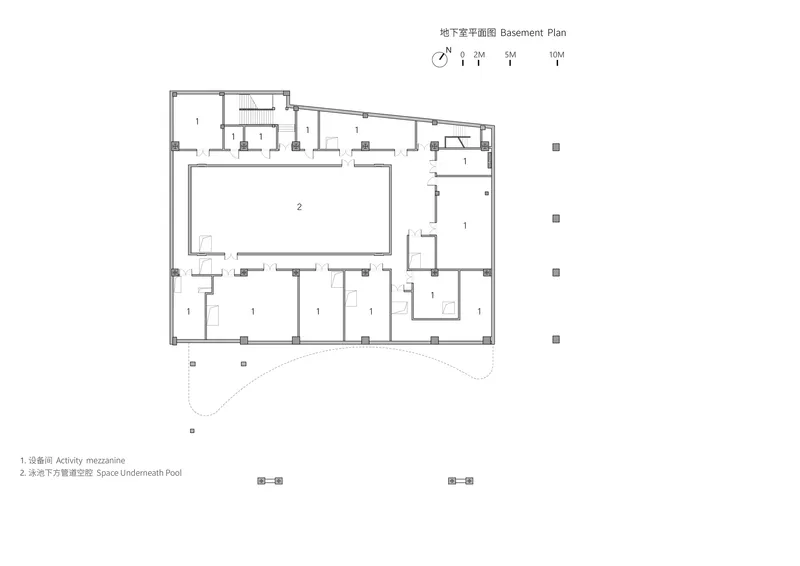


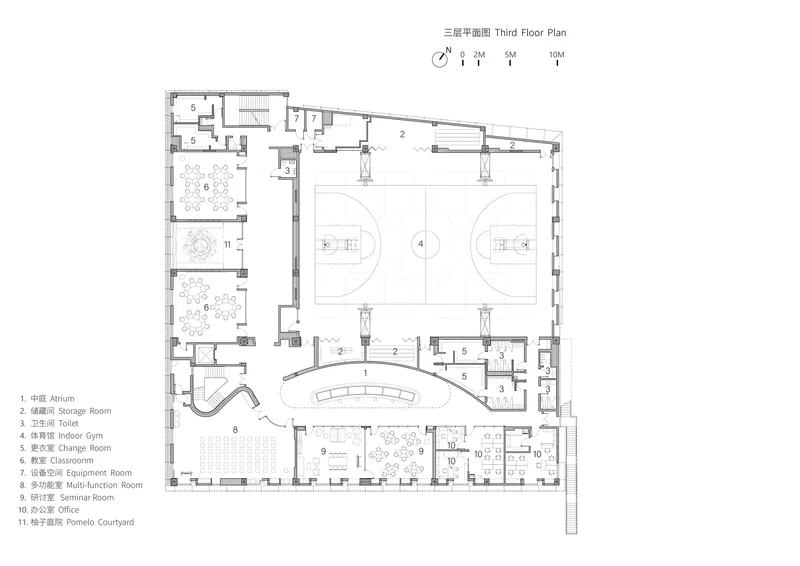
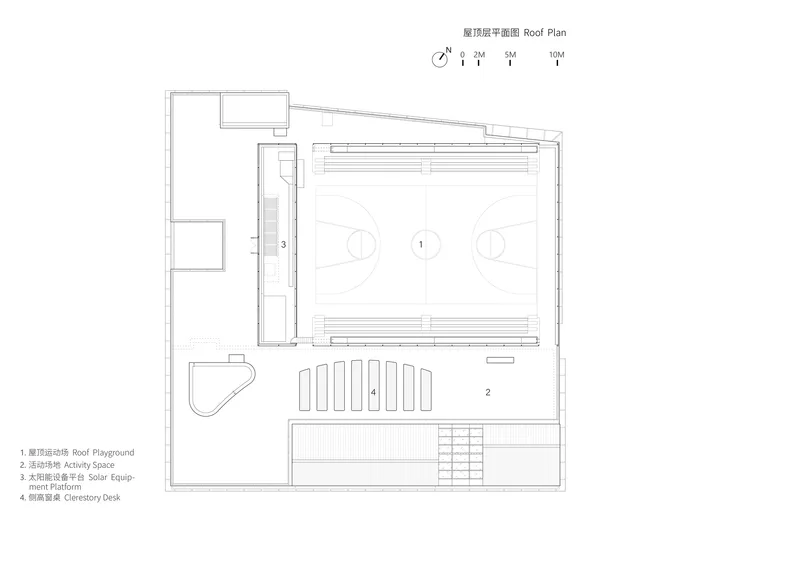
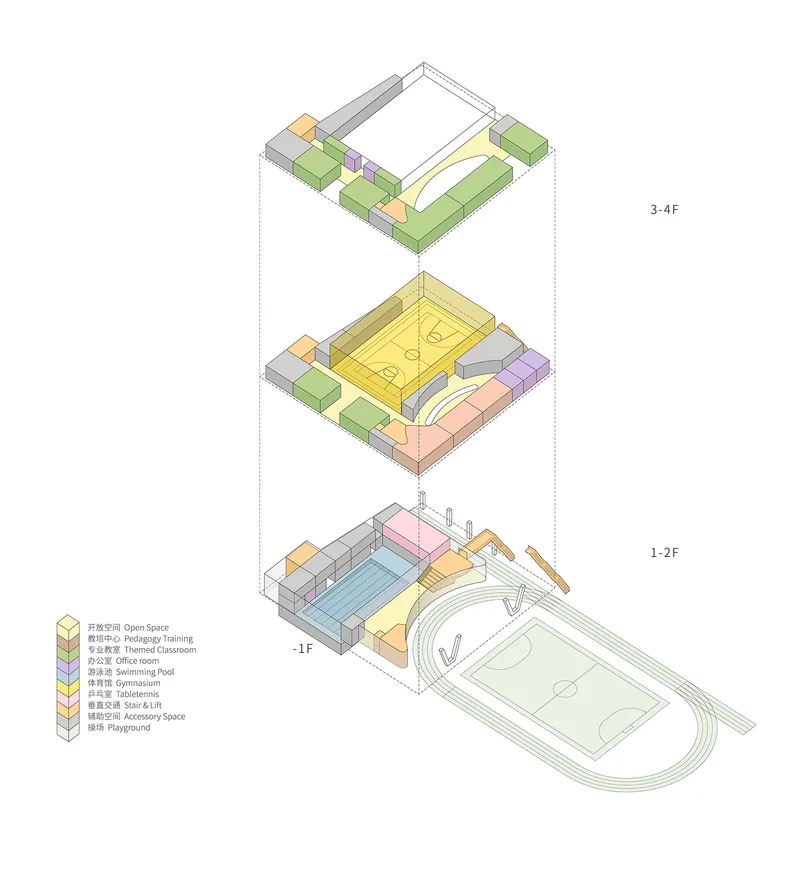


The exploded axonometric diagrams are the clearest articulation of the building's ambition. Color-coded by program, the stacked floor plates reveal just how much the architects compressed into a single rectangular footprint. The section drawing is equally telling: a courtyard tree punctures the interior, stepped floors create visual connections between levels, and the relationship between the submerged pool and the rooftop deck becomes legible as a single continuous vertical experience. The bilingual labels on the plans speak to the school's international character and the cross-cultural design thinking that shaped the project.
Why This Project Matters
The Anna Pao Sohmen Centre is a case study in doing more with less site. Rather than sprawling across the campus or demolishing existing buildings, Scenic Architecture Office built upward and lifted the ground level free for outdoor play. The result is a building that adds six levels of program while actually increasing the usable outdoor area. That inversion of the typical footprint equation is the project's most replicable idea, and it deserves attention from any school or institution wrestling with limited land.
Beyond the structural strategy, the building succeeds because it treats each floor as a distinct environment rather than a repeated plate. The timber-lined pool, the curved atrium, the slatted basketball court, and the rooftop greenhouse each have their own material identity and spatial character. Students move through the building not as a stack of identical levels but as a sequence of rooms calibrated to different activities and moods. That attentiveness to experience, floor by floor, is what separates this from a utilitarian sports hall and elevates it into something worth studying.
Anna Pao Sohmen Centre at YK Pao School by Scenic Architecture Office. Located in Shanghai, China. 2,473 m². Completed 2025. Photography by Shengliang Su Interior.
About the Studio
Share Your Own Work on uni.xyz
If projects like this are the kind of work you want to make, uni.xyz is a place to publish your own, find collaborators, and enter design competitions.


Popular Articles
Popular articles from the community


Aquadapt: An Underwater Habitat That Rewrites Its Rooms by the Hour
Curved modules ring the seabed while one shell shifts from breakfast room to cinema, farm and football pitch as residents' needs change.

Opera on the Sea: Driftwood Logic Shapes a Timber Opera House on Estonia's Coast
Trevor Orgill's opera house translates the entangled drift of floating timber into a civic building where wood, water, and music converge.


David Ortega Stacks a Two-Story Mexico City Penthouse Around a Steel Stair and a Pergola-Shaded Roof Terrace
In Colonia Roma, a 300 m² penthouse uses oak joinery, a planted steel stair and a slatted roof pergola to make a new-build apartment feel like a house.

ETEH Reworks the Shared Spaces of São Domingos School in Brazil Around Timber, Color and Hanging Plants
At São Domingos School in Brazil, 436 m² of hall, refectory and library are recast with timber joinery, a yellow and blue code and trailing greenery.

Similar Reads
You might also enjoy these articles

LAVA Architecten Gives Vocational Education a Sawtooth-Roofed Face on a Mechelen School Campus
In Mechelen, Belgium, a 2,053 m² STEM school on a 6×6 m grid turns workshops and classrooms into rooms that can be rearranged as teaching changes.

KEMA Studio Turns a Derelict Marvila Attic into a 60 m² Lighthouse Apartment Above Lisbon
In Lisbon's Marvila district, a rebuilt roof, four skylights and two plywood volumes turn an unlivable attic into a bright home facing the Tagus.

Pixel Gardens: One Repeated Module Stacked Into a Terraced Social Housing Tower for Famagusta
Salem Bader's shortlisted housing tower builds a vertical neighbourhood from one repeated module, offsetting units to carve terraces, light and air.

Bao Huynh Watercolor Atelier: A Serene Art Retreat in Hội An
Bao Huynh Watercolor Atelier in Hội An blends multifunctional art spaces, sustainable design, local materials, and family-friendly living in a serene environment.


Comments (0)
Please login or sign up to add comments
No comments yet. Be the first to comment!