
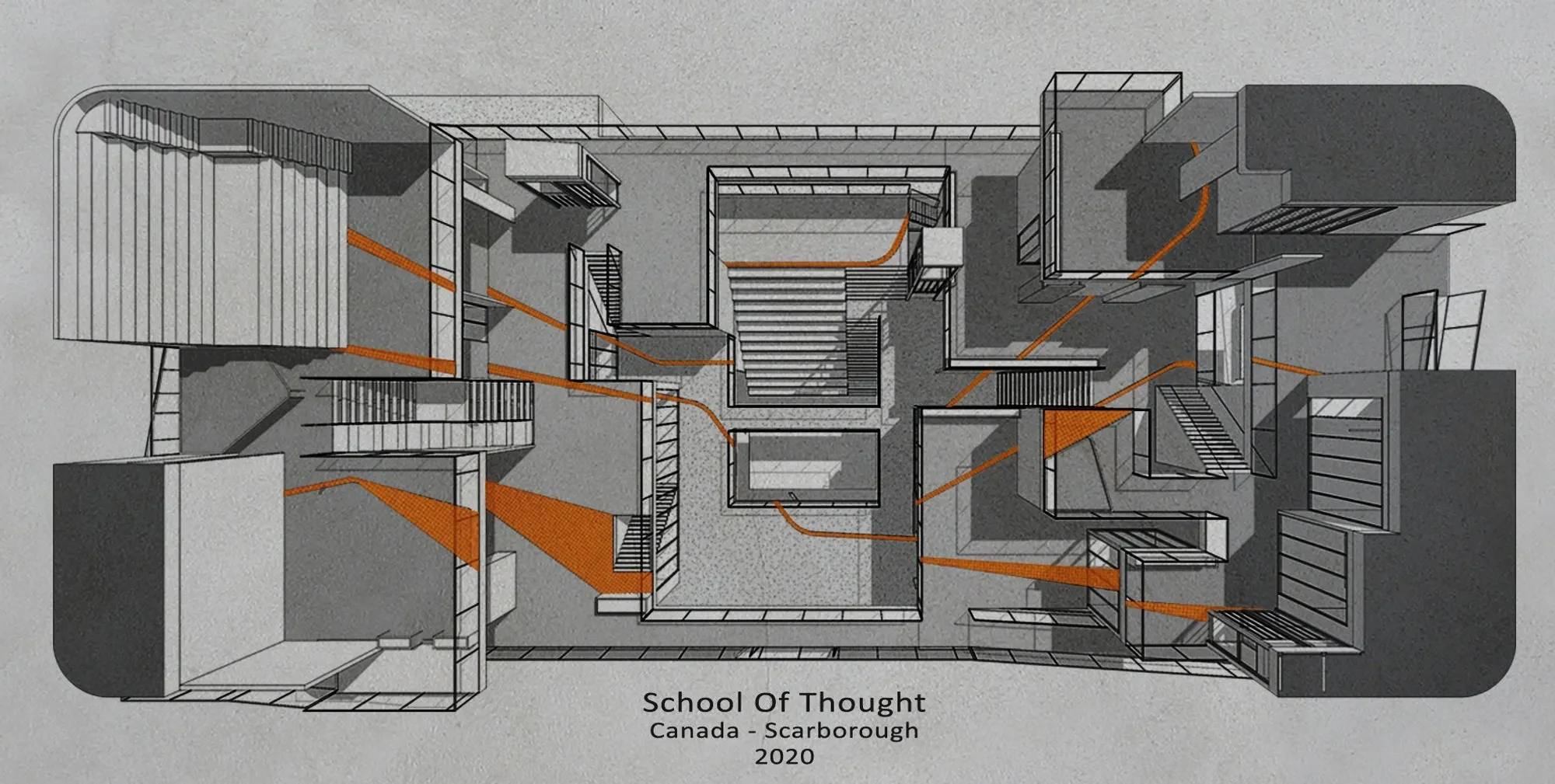
School Of Thought by Mojtaba Hooshangianshirazi, Rokhsareh Shakibayi, Hilda Khozaee, and Monire Vkh
A future-ready sustainable school architecture project blending open learning, nature, collaboration, and student-centered education.


The global pandemic transformed the way people think about education, collaboration, and human interaction. During the uncertainty of COVID-19, architecture became more than the design of buildings. It became a tool to rethink how people live, learn, communicate, and grow together. The project School Of Thought, designed by Mojtaba Hooshangianshirazi, Rokhsareh Shakibayi, Hilda Khozaee, and Monire Vkh, responds directly to these challenges through a progressive vision of sustainable school architecture.
As a shortlisted entry in the School Of Thought 2020 competition, the proposal reimagines the contemporary high school as an adaptive educational ecosystem where students are placed at the center of every spatial and social interaction. Inspired by the principles of the Reggio Emilia educational philosophy, the project creates a flexible environment that encourages independence, creativity, collaboration, and emotional development.
Rather than treating education as a rigid classroom-based system, the design transforms learning into a continuous experience integrated with public life, nature, social interaction, and self-discovery.

Reimagining Educational Architecture After the Pandemic
The pandemic exposed many limitations in conventional school design. Closed classrooms, isolated circulation systems, and inflexible educational spaces struggled to adapt to changing social and environmental conditions. School Of Thought challenges these outdated models by introducing a highly interconnected educational environment focused on openness, movement, and adaptability.
The project proposes a school that operates more like a living urban organism than a traditional institution. Learning spaces are distributed across multiple levels and connected through open circulation systems, communal gathering areas, workshops, recreational zones, and green courtyards. This spatial strategy encourages students to interact naturally with each other and their surroundings throughout the day.
The architects envisioned the school as a place where students can gain independence while remaining connected to a supportive collective environment. Private zones allow focused learning and reflection, while open collaborative areas encourage communication, teamwork, and public engagement.
This balance between individuality and community forms the foundation of the project’s architectural identity.
Sustainable School Architecture Integrated with Nature
One of the strongest aspects of the proposal is its integration of landscape and environmental systems into the educational experience. Instead of separating architecture from nature, the project treats green spaces as an essential component of learning.
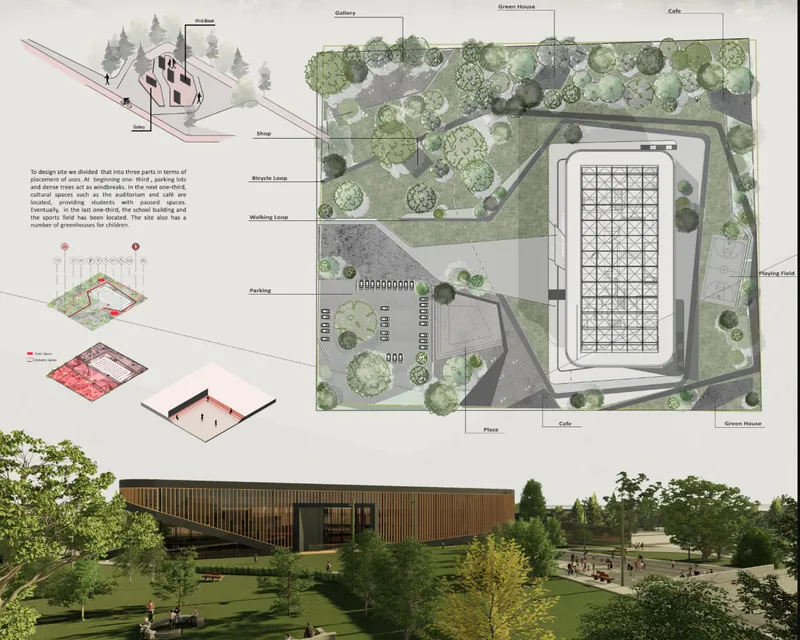
The masterplan carefully divides the site into multiple experiential zones. Public areas, bicycle paths, walking loops, recreational courts, greenhouse spaces, and outdoor plazas create a layered educational landscape where movement and interaction become part of daily life.
The building itself is partially embedded into the site, reducing visual impact while improving environmental performance. The architecture responds to climate conditions through passive design strategies, including controlled daylighting, natural ventilation, shaded facades, and thermal buffering systems.
A double-skin facade wraps the structure, filtering sunlight while allowing air circulation around the building envelope. This strategy improves thermal comfort and reduces energy consumption while creating a visually dynamic exterior identity.
The use of landscape terraces, internal gardens, and open social spaces also enhances psychological well-being by introducing natural light, vegetation, and visual openness throughout the educational environment.
A Student-Centered Learning Environment
At the core of the project lies a radical rethinking of educational space planning. Instead of organizing the school around repetitive classrooms and corridors, the architects designed a system of interconnected learning sectors that support multiple teaching methods and social experiences.
The proposal divides spaces into student sectors and learning sectors, each containing different functions that support both academic and personal growth.
The student-focused zones include entrepreneurial facilities, game clubs, galleries, sports areas, cafes, and collaborative social spaces. These functions encourage students to develop communication skills, leadership abilities, creativity, and self-confidence beyond conventional academic learning.
The learning-focused sectors contain classrooms, workshops, amphitheaters, laboratories, and research spaces designed for flexible educational use. Open visual connections between levels and departments promote transparency and interaction while reducing feelings of isolation often associated with institutional environments.
The project strongly reflects Reggio Emilia educational principles by allowing architecture itself to become part of the learning process. Students are encouraged to engage with their environment, explore different forms of interaction, and develop social awareness through spatial experience.
Architecture Designed Around Movement and Interaction
Movement plays a central role in the project’s spatial organization. The architects intentionally avoided creating static corridors or isolated classroom blocks. Instead, circulation becomes a dynamic social experience where learning can happen anywhere.
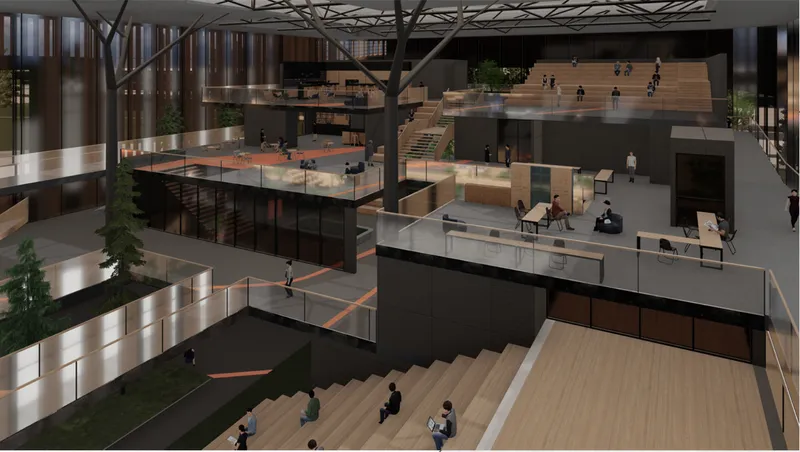
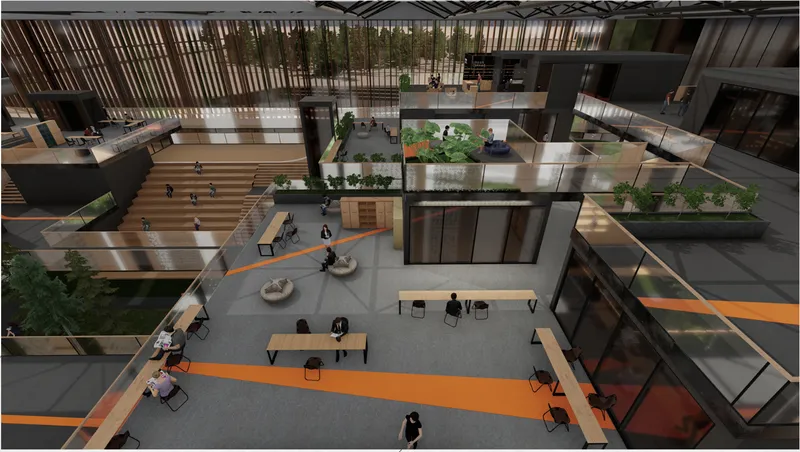
Vertical and horizontal circulation systems intersect throughout the building, connecting educational spaces with public functions, amphitheaters, terraces, and collaborative zones. Staircases are treated not only as movement systems but also as gathering spaces where students can interact informally.
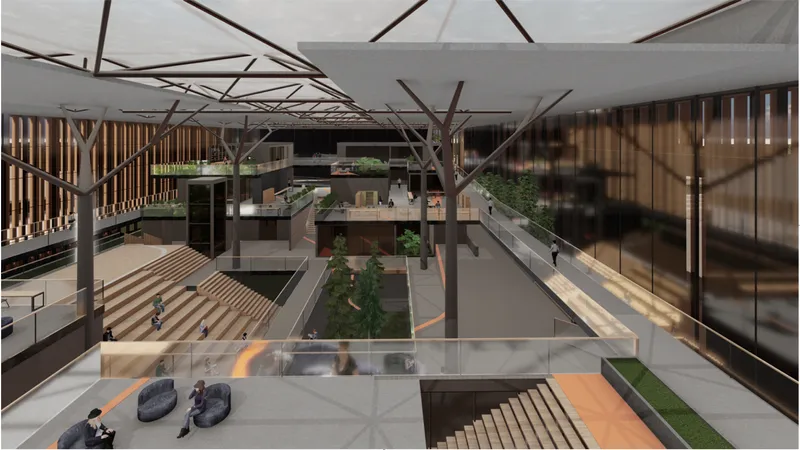
The central atrium acts as the social heart of the building. Filled with natural light and surrounded by layered learning platforms, the space creates constant visual connectivity between users. Students can see activities happening across multiple levels, encouraging curiosity, participation, and collective engagement.
Interior spaces are intentionally flexible and adaptable. Furniture systems and modular educational areas allow spaces to transform according to different teaching methods, workshops, group activities, or public events.
This flexibility ensures that the architecture can evolve alongside future educational needs.
The Relationship Between Public Space and Education
Unlike conventional schools that isolate themselves from the surrounding community, School Of Thought creates strong relationships between educational and public functions.
The project includes cultural facilities, cafes, galleries, sports spaces, amphitheaters, and open public plazas that encourage interaction between students and the larger community. This approach transforms the school into a civic hub rather than a closed institutional object.
By integrating public life into the educational environment, students gain exposure to social diversity, collaborative culture, and real-world experiences. The design supports entrepreneurial thinking, communication skills, and collective responsibility by allowing educational activities to extend beyond classroom boundaries.
The architecture becomes an interface between learning and society.
Flexible Educational Spaces for the Future
The proposal acknowledges that future generations will require skills that extend beyond traditional academic systems. Automation, digital transformation, remote learning, and changing professional environments demand more adaptable educational models.
In response, the project creates spaces that encourage experimentation, innovation, and interdisciplinary collaboration. Workshops, creative studios, discussion areas, presentation spaces, and research environments support multiple forms of learning simultaneously.
Students are encouraged to explore their individual interests while also developing teamwork and communication abilities necessary for future professional environments.
The architecture reflects this adaptability through modular planning systems and flexible interior layouts capable of evolving over time.
Materiality and Architectural Expression
Visually, the project balances minimal contemporary architecture with warm natural materiality. The exterior facade combines dark structural framing with vertical wooden fins that soften the scale of the building while creating rhythmic transparency.
Large glazed surfaces strengthen visual connections between interior activities and surrounding landscapes. At night, the illuminated building transforms into a glowing educational landmark embedded within the natural site.
Internally, the open atrium, layered platforms, exposed structural systems, and integrated greenery create a civic atmosphere closer to a cultural center than a traditional school building.
The result is an environment that feels open, inclusive, and emotionally engaging.
Redefining the Future of Educational Architecture
School Of Thought demonstrates how sustainable school architecture can move beyond environmental performance and become a catalyst for social, emotional, and intellectual development.
By combining student-centered pedagogy, flexible learning systems, public engagement, and environmentally responsive design, the project proposes a new model for future educational environments.
Designed during one of the most challenging global periods in recent history, the project reflects optimism, adaptability, and resilience. It shows how architecture can actively shape healthier and more collaborative futures for education.
Through its integration of nature, openness, movement, and community interaction, School Of Thought becomes more than a school. It becomes an evolving platform for human growth, creativity, and collective learning.




Popular Articles
Popular articles from the community


The Earth Pod: 3D Printed Homes for Resilient Refugee Communities
The Earth Pod reimagines refugee housing through 3D printed homes made from clay, combining resilience, self-sufficiency, and rapid shelter.

Conexión: Biophilic Design Reimagines High-Rise Living in Hong Kong
Conexión reimagines high-rise living in Hong Kong through biophilic design, green facades, shared spaces, daylight, water and nature within.

Hill & Cross Opera: Sculptural Opera House Architecture Shaped by Tallinn’s Landscape and Identity
Hill & Cross Opera reimagines opera house architecture in Tallinn through its sculptural hill, civic plaza, glass wave and a luminous cross.
EW PARK: Sustainable Architecture Reimagines the Future of Urban Parking
EW PARK reimagines city parking as a modular wooden tower combining automation, solar energy, electric mobility, and adaptable urban design.

Similar Reads
You might also enjoy these articles

Eco Chapel: A Green Architecture Pavilion Designed in Symbiosis with the Forest
Eco Chapel uses green architecture to weave prayer, learning and reuse into a forest pavilion shaped by modular hexagonal canopies for life.
Kaffeebühnen: Coffee Shop Architecture Designed as a Civic Stage Between Vienna’s City and Park
Kaffeebühnen turns coffee shop architecture into a civic stage, linking Vienna’s park edge, urban life, warm timber yards, and coffee craft.
Healing Façade: Sustainable Architecture for Reforestation, Community, and Sacred Ecology in Ethiopia
Healing Façade reimagines sustainable architecture as a living wall that restores soil, catches water and renews Ethiopia's forest churches.


Urban Forest: A Vertical Ecosystem for 5,000 Workers in Singapore's Changi Business Park
Radially stacked pods and layered green decks turn a 7-acre plot into 47 acres of ecological workspace projected for 2040.


Explore Conceptual Architecture Competitions
Discover active competitions in this discipline


Challenge to design luxury tourism on rails


VR headsets Storefront design competition

Designing a staircase for a client
Comments (0)
Please login or sign up to add comments
No comments yet. Be the first to comment!