
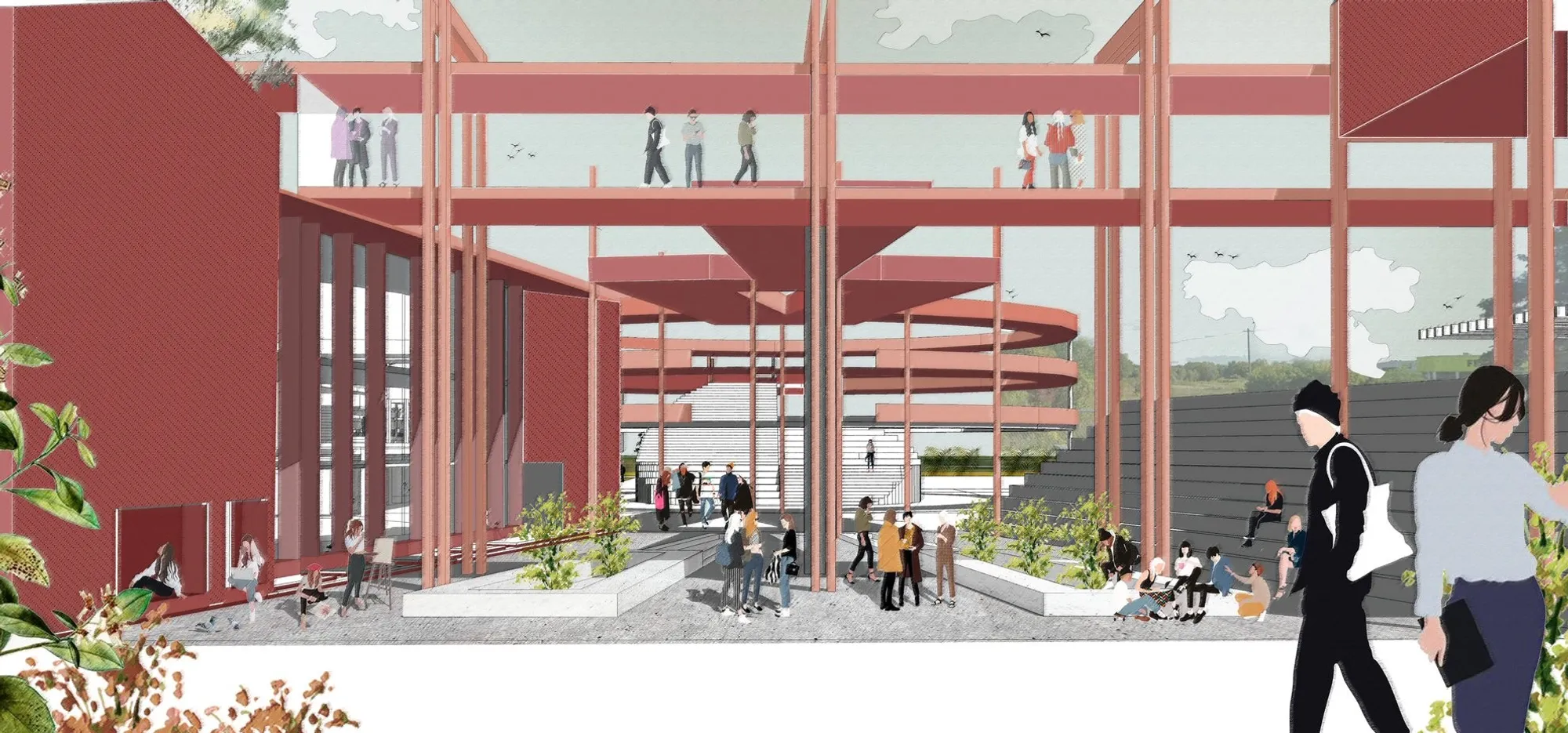
School of Thought – Museum of Learning
A visionary school architecture project transforming education through observation, collaboration, flexible learning spaces, and urban engagement.


The future of education is no longer confined within four classroom walls. Contemporary learning environments are rapidly evolving into dynamic ecosystems where architecture itself becomes an active participant in the educational process. “School of Thought – Museum of Learning” explores this transformation through an innovative school architecture proposal that reimagines how students learn, interact, observe, and engage with their surroundings.
Designed by Abigail Hilario,Stefi Lee, and Huiyu Jiang, this Honorable Mention entry in the School Of Thought 2020 competition presents a progressive educational model rooted in observational learning and social interaction. The project challenges the conventional structure of institutional education by integrating multifunctional spaces, occupiable transitional zones, and collaborative public environments into the school’s architectural language.
At its core, the project proposes that learning is not limited to classrooms or formal teaching methods. Instead, knowledge is cultivated through observation, participation, interaction, and spatial experience. The architecture reflects this philosophy by creating an environment where every circulation path, stairway, courtyard, bridge, and open platform becomes part of the learning journey.
Rethinking Educational Architecture
Traditional educational architecture often separates learning spaces from social and public interaction. Classrooms remain isolated units while corridors and transitional areas are treated merely as circulation spaces. “Museum of Learning” rejects this hierarchy entirely.
The project envisions a learning environment where students continuously encounter moments of discovery. Spaces are intentionally designed to encourage visibility, interaction, and inspiration. The architecture enables students to observe activities happening around them, creating opportunities for spontaneous learning experiences beyond formal instruction.
This approach aligns with emerging trends in innovative school architecture where flexibility, collaboration, and social engagement play a critical role in educational development. The design promotes a fluid relationship between private learning environments and open communal spaces, allowing students to move seamlessly between focused study and collaborative interaction.
The concept of the school as a “museum of learning” is particularly significant. Museums are spaces of curiosity, exploration, and observation. By applying these qualities to educational architecture, the project transforms the school into a living exhibition of learning processes, creativity, and student engagement.
Learning Through Observation and Engagement
The project’s strongest architectural idea lies in its emphasis on observational learning. Rather than hiding learning activities behind enclosed walls, the design introduces transparency and visibility throughout the campus.
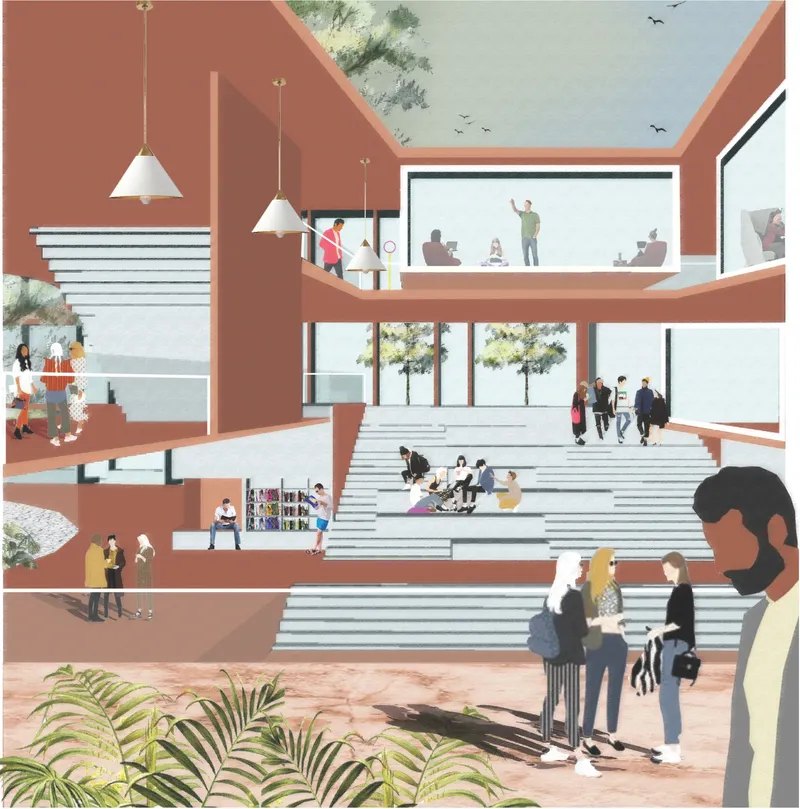
Open atriums, interconnected circulation paths, outdoor seating zones, bridges, and layered spatial arrangements allow students to witness different forms of learning in progress. These visual connections foster inspiration and encourage curiosity among students.
The design team carefully considered spatial hierarchy to balance openness with privacy. While collaborative spaces encourage interaction, quieter learning zones still provide areas for concentration and focused study. This layered approach creates a nuanced educational environment capable of supporting diverse learning styles.
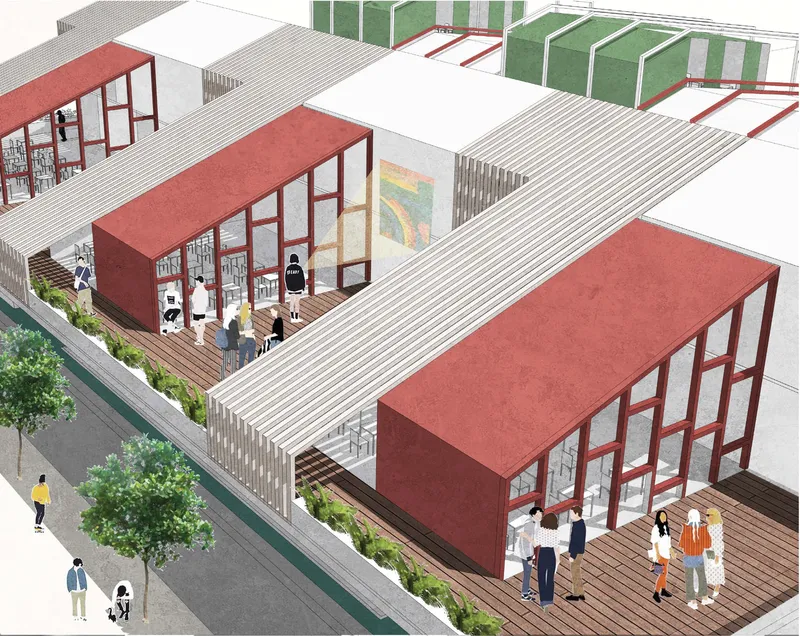
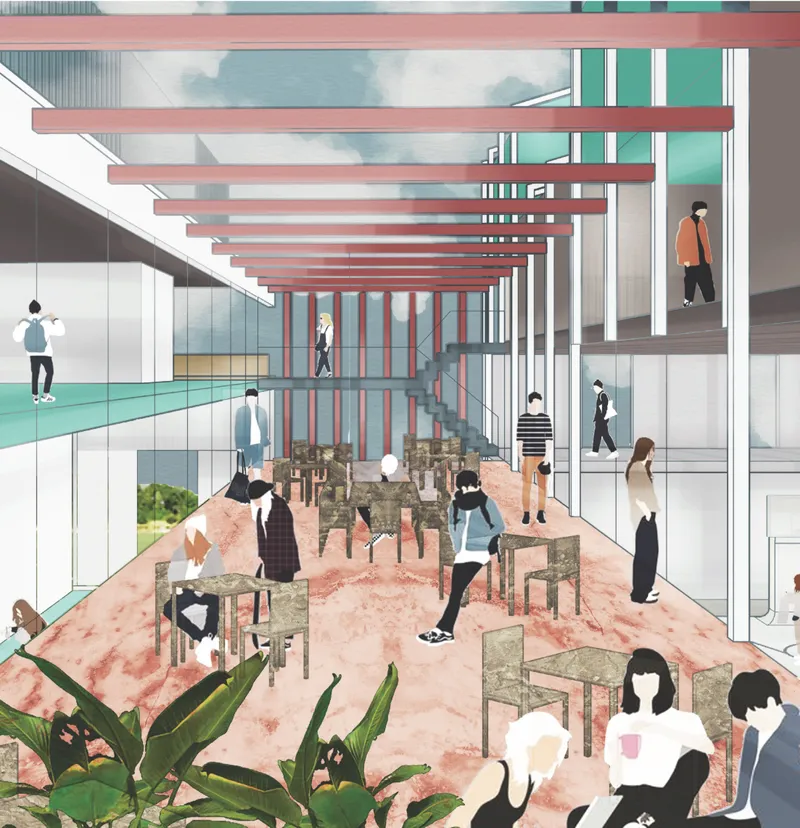
Integrated furniture, occupiable stairs, rooftop classrooms, and multifunctional corridors further reinforce the idea that every part of the building contributes to education. Transitional spaces become destinations rather than merely passages between rooms.
The project also explores the psychological impact of architectural openness. By allowing students to observe others learning, performing, collaborating, and engaging socially, the school creates an atmosphere of continuous intellectual stimulation.
Architecture Beyond the Classroom
One of the most compelling aspects of the project is its rejection of rigid educational typologies. The design expands learning into spaces traditionally overlooked within institutional architecture.
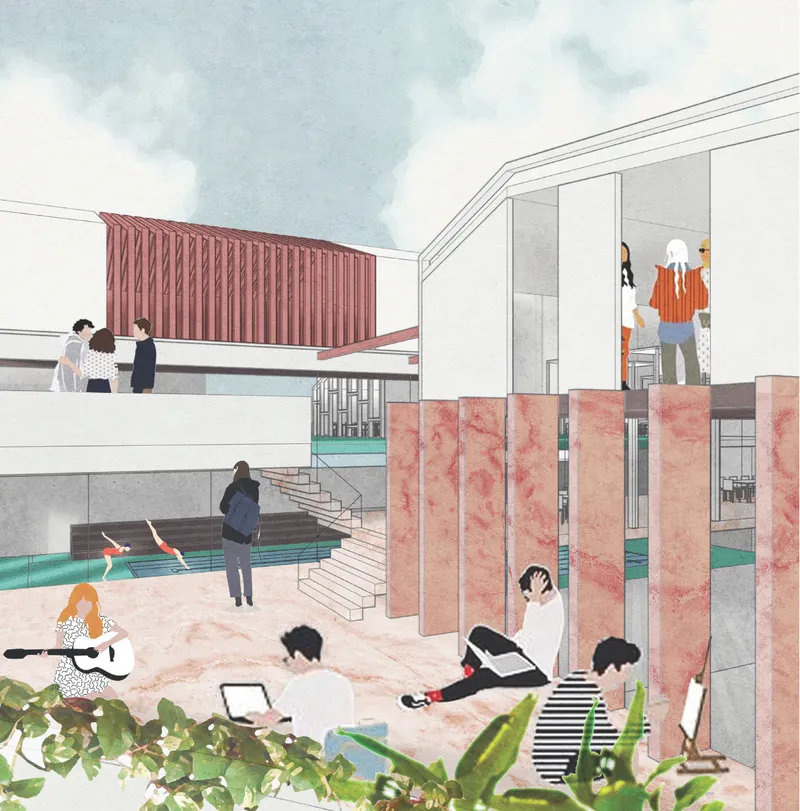
Stairs become gathering areas. Hallways become social platforms. Bridges transform into observation decks. Outdoor plazas function as performance and collaboration spaces. The architecture continuously blurs the boundary between educational, civic, and cultural environments.
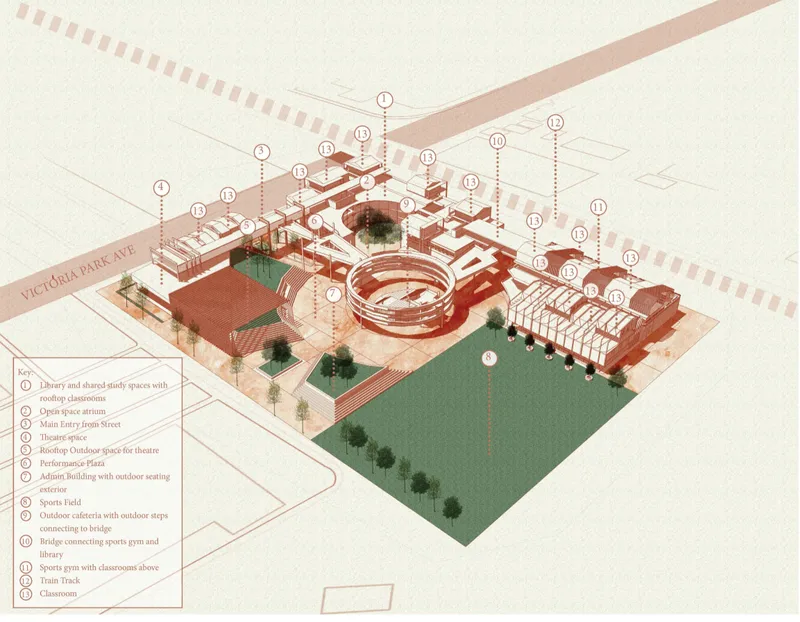
The theatre space plays a particularly important role within the project. Its exterior façade doubles as seating overlooking a public performance plaza, allowing students to showcase talents and engage with broader audiences. This integration of public performance and education strengthens the school’s role as a community-oriented institution.
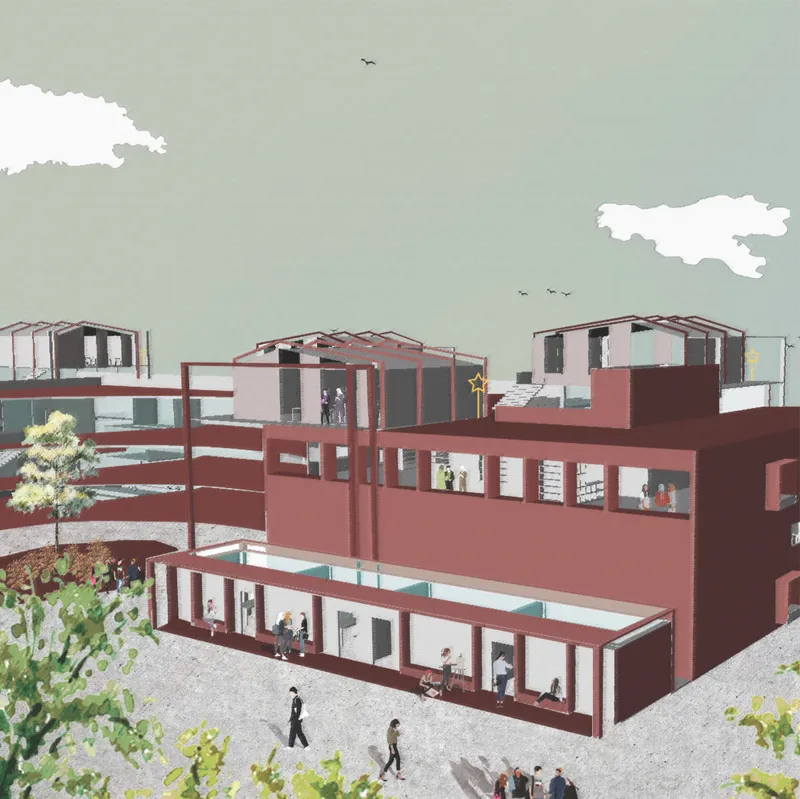
Similarly, rooftop outdoor spaces connected to classrooms introduce opportunities for informal learning, interaction, and reflection. These elevated environments encourage students to engage with nature, urban surroundings, and one another in less structured settings.
The sports gym, classrooms, library, shared study spaces, and performance areas are interconnected through bridges and open circulation systems that maximize visibility and connectivity across the campus.
This multifunctional strategy reflects contemporary architectural discourse surrounding adaptive educational environments, where flexibility and spatial diversity enhance learning outcomes.
Urban Design and Spatial Connectivity
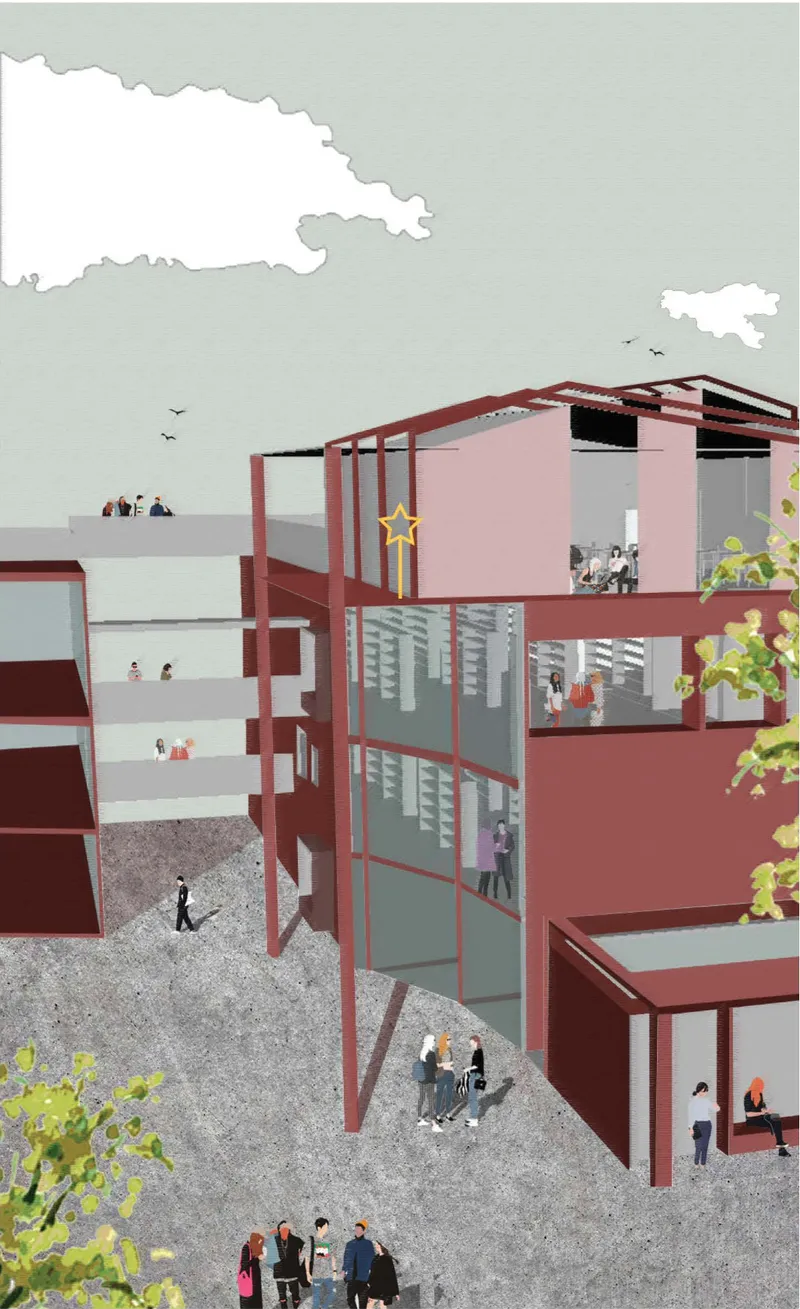
The project demonstrates a sophisticated understanding of urban integration and spatial sequencing. Rather than functioning as an isolated institutional object, the school engages directly with its urban surroundings.
The entrance sequence is carefully orchestrated through visual corridors leading toward the central plaza, creating a sense of invitation and openness from the street. Clear openings and strategic buffers establish a balance between accessibility and privacy.
The plaza itself acts as the social heart of the campus. Surrounding buildings frame the open space while bridges and elevated pathways create layered visual experiences across the site. This arrangement generates a vibrant public atmosphere within the school environment.
Landscape design also contributes significantly to the project’s spatial identity. Green spaces, outdoor seating areas, rooftop platforms, and tree-lined circulation paths soften the institutional character of the campus and introduce moments of calm within the active environment.
The architectural language borrows from museums, civic spaces, and public urban environments rather than traditional school typologies. This cross-disciplinary influence allows the project to feel culturally engaging rather than strictly institutional.
By incorporating elements of urban design into educational architecture, the proposal encourages students to develop a stronger connection with public life, community interaction, and collective experience.
Flexible and Future-Oriented Learning Environments
As educational systems continue evolving, adaptability has become one of the most important considerations in school design. “Museum of Learning” addresses this challenge by creating highly flexible spaces capable of supporting changing pedagogical methods.
The architecture supports both formal and informal learning models. Spaces can accommodate lectures, performances, collaborative workshops, independent study, and public events simultaneously.
This flexibility ensures that the school remains responsive to future educational needs rather than becoming obsolete within rigid institutional frameworks.
The project’s emphasis on multifunctionality also improves spatial efficiency. Transitional areas are no longer wasted circulation zones but become productive environments that contribute to student engagement and interaction.
The result is a learning ecosystem where architecture actively shapes educational experiences instead of passively containing them.
Redefining the School as a Social Institution
Beyond pedagogy and spatial innovation, the project redefines the cultural role of the school itself. Rather than functioning solely as an educational facility, the architecture positions the school as a civic and social institution.
Public plazas, performance spaces, collaborative environments, and transparent learning zones encourage interaction between students, educators, and the wider community. The campus becomes an active urban destination capable of hosting cultural activities, social gatherings, and creative exchange.
This approach reflects broader architectural conversations surrounding schools as community infrastructure rather than isolated academic compounds.
The design recognizes that education extends beyond curriculum delivery. Social interaction, observation, collaboration, creativity, and public participation are equally important aspects of intellectual growth.
By embedding these values into the architectural framework, “Museum of Learning” presents a compelling vision for the future of innovative school architecture.
A New Vision for Educational Architecture
“School of Thought – Museum of Learning” demonstrates how architecture can fundamentally transform educational experiences. Through openness, flexibility, observation, and spatial interaction, the project creates a learning environment where every space contributes to intellectual and social development.
Its integration of urban design principles, multifunctional programming, collaborative environments, and observational learning strategies positions the proposal as a forward-thinking model for future schools.
More importantly, the project challenges architects and educators to reconsider what educational spaces should represent in contemporary society. Rather than designing buildings that simply contain classrooms, the proposal advocates for environments that inspire curiosity, creativity, engagement, and continuous learning.
As educational paradigms continue shifting toward more interactive and socially connected models, projects like “Museum of Learning” highlight the transformative power of architecture in shaping how future generations learn and interact with the world around them.




Popular Articles
Popular articles from the community


The Ocean Hive: Sustainable Architecture for a Self-Sufficient Civilization at Sea
The Ocean Hive imagines sustainable architecture at sea, where modular habitats, algae, wave power and ocean waste sustain a growing colony.

The Musturak Paradise: Senior Living Architecture for a Connected Future in Temara, Morocco
The Musturak Paradise reimagines senior living architecture in Temara via private homes, social spaces, culture, community, and shared care.

Conexión: Biophilic Design Reimagines High-Rise Living in Hong Kong
Conexión reimagines high-rise living in Hong Kong through biophilic design, green facades, shared spaces, daylight, water and nature within.

The Earth Pod: 3D Printed Homes for Resilient Refugee Communities
The Earth Pod reimagines refugee housing through 3D printed homes made from clay, combining resilience, self-sufficiency, and rapid shelter.


Similar Reads
You might also enjoy these articles

Eco Chapel: A Green Architecture Pavilion Designed in Symbiosis with the Forest
Eco Chapel uses green architecture to weave prayer, learning and reuse into a forest pavilion shaped by modular hexagonal canopies for life.
Kaffeebühnen: Coffee Shop Architecture Designed as a Civic Stage Between Vienna’s City and Park
Kaffeebühnen turns coffee shop architecture into a civic stage, linking Vienna’s park edge, urban life, warm timber yards, and coffee craft.
Healing Façade: Sustainable Architecture for Reforestation, Community, and Sacred Ecology in Ethiopia
Healing Façade reimagines sustainable architecture as a living wall that restores soil, catches water and renews Ethiopia's forest churches.


Urban Forest: A Vertical Ecosystem for 5,000 Workers in Singapore's Changi Business Park
Radially stacked pods and layered green decks turn a 7-acre plot into 47 acres of ecological workspace projected for 2040.


Explore Architecture Competitions
Discover active competitions in this discipline



Challenge to reimagine the Iron Throne


Photograph architecture without architects


Illustrate the lost glory of Angkor Wat - Render Challenge


Design challenge to reuse E-waste
Comments (0)
Please login or sign up to add comments
No comments yet. Be the first to comment!