

Schuchovski Arquitetura Cantilevers a Timber-Lined Villa Over Curitiba's Steep Terrain
Guaimbê House uses prestressed slabs and a ventilated travertine facade to frame garden and city views on a challenging slope.


Building on a steep urban lot flanked by neighbors on both sides is a constraint that usually produces defensive architecture: closed walls, minimal fenestration, rooms turned inward. Schuchovski Arquitetura, led by Eliza Schuchovski, took the opposite approach with Guaimbê House. The 1,211 m² residence in Curitiba, Brazil, deploys an L-shaped orthogonal volume that pushes a five-meter cantilever over the terrain, orients its largest openings toward the north for sun and breeze, and wraps nearly every room in views of a private garden and the distant city skyline. The result is a house that feels extroverted despite sitting on a site that demanded discipline.
What makes Guaimbê genuinely interesting is how its structural ambitions serve a domestic idea rather than spectacle. The clients, returning to Schuchovski after their first home, asked for openness and minimal compartmentalization: they wanted to see the garden from every room. That brief set off a chain of structural decisions, from root stake foundations to prestressed slabs that reduce beam depth and enable free spans, to a ventilated facade of silver travertine marble. Each technical choice traces back to a single spatial priority, and the architecture is better for that legibility.
An L-Shape Against the Slope
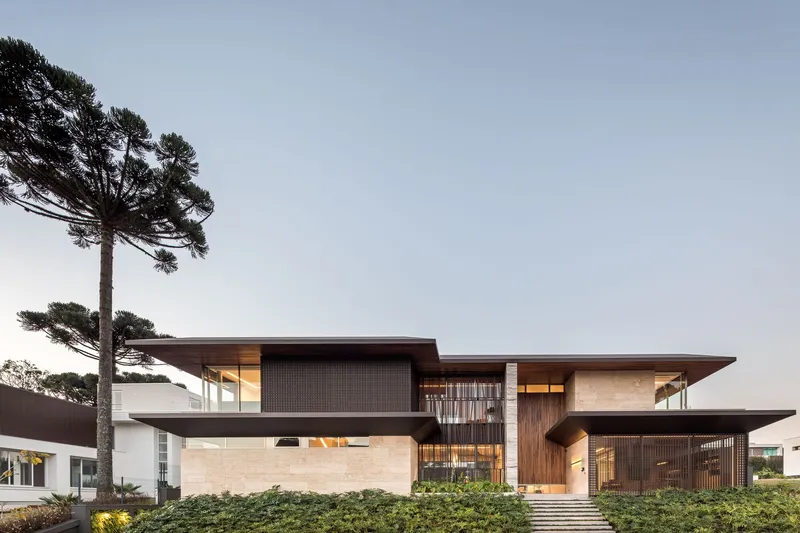
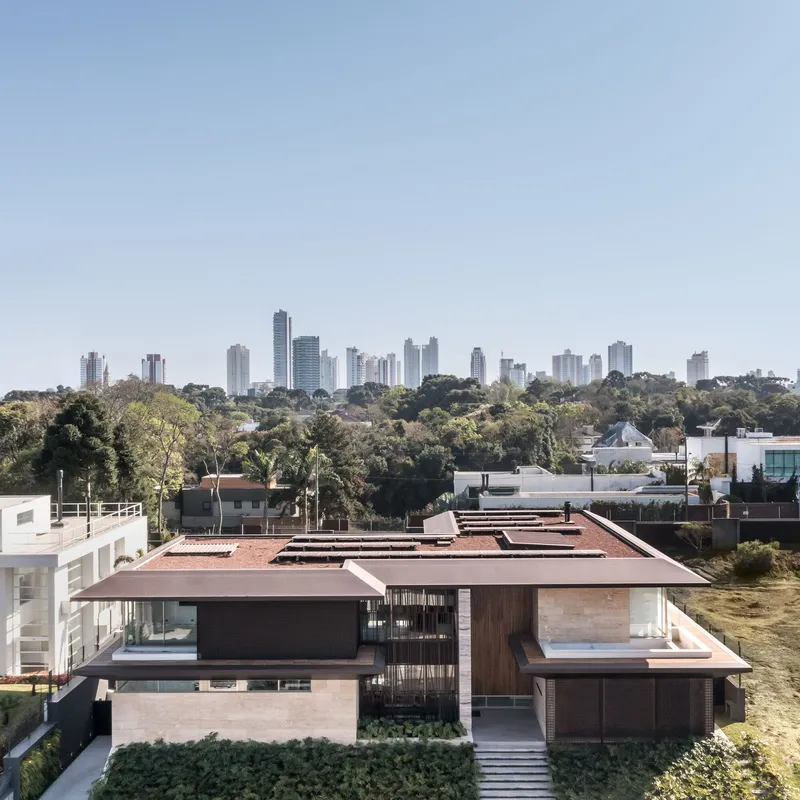
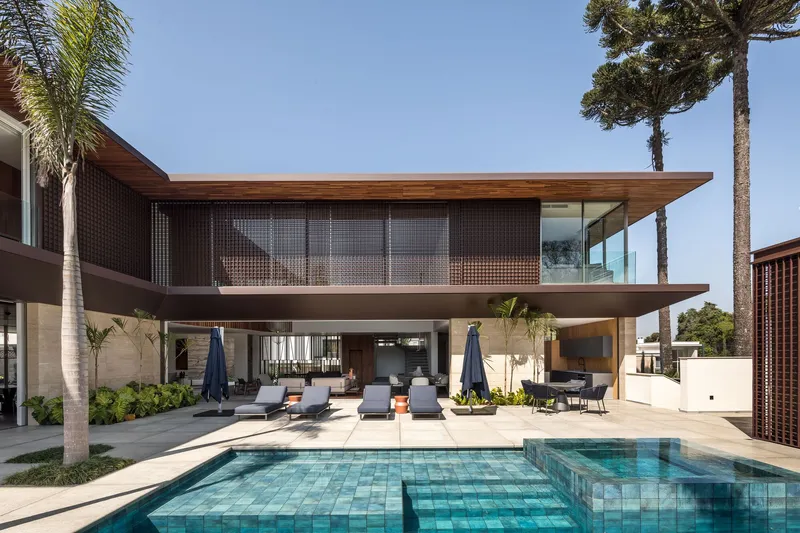
From the street, Guaimbê presents itself as a stack of horizontal planes: stone cladding, timber screens, and a cantilevered upper volume wrapped in ACM panels finished to resemble Corten steel. The stepped terracotta roofscape reads almost flat from a distance, an illusion maintained by the deep eaves that tilt slightly in what Schuchovski describes as an allusion to oriental architecture. The L-shaped plan turns its back on the neighboring parcels and directs its energy downhill, where the terrain drops away and the garden and pool occupy a terraced shelf.
The foundation strategy is notable. The rough, sloping ground required security surveys at multiple points before root stake foundations were selected as the viable option. That groundwork is invisible, but it underwrites everything above, particularly the five-meter cantilever of the master suite volume that extends over the land and accentuates the sense of the house reaching toward the view.
Timber as Spatial Glue
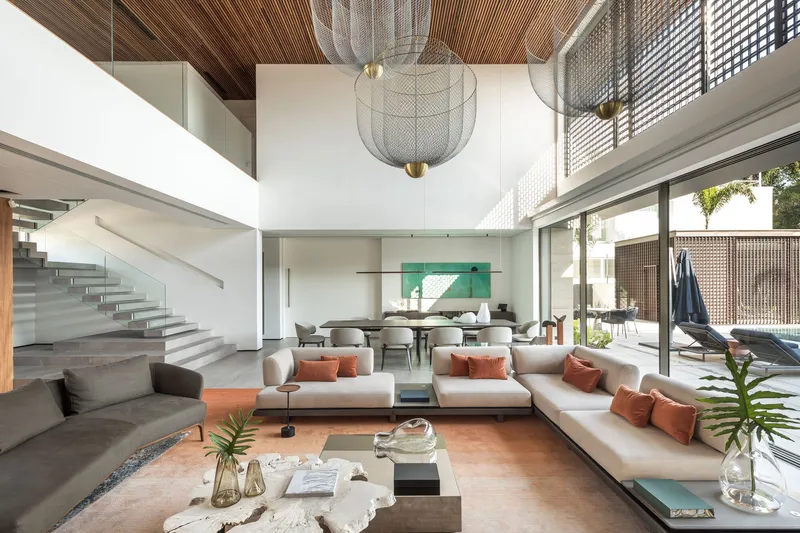
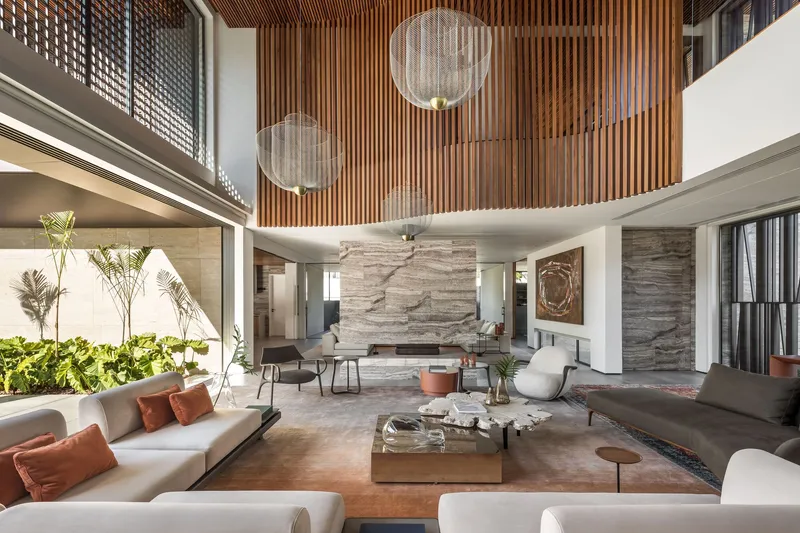
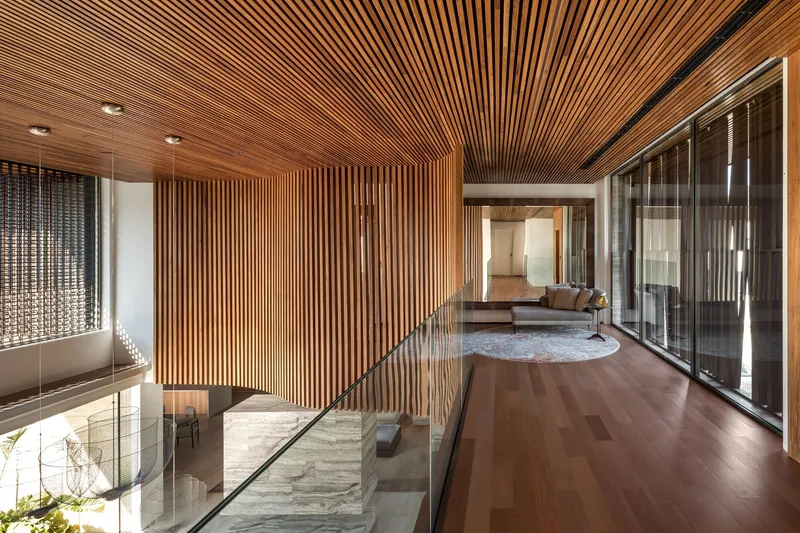
Freijó wood dominates the interior language. It lines ceilings, wraps joinery, forms slatted screens, and in one of the house's strongest moves, crosses through glass planes so that the timber datum continues unbroken from inside to outside. The effect is not merely decorative. By maintaining the same material overhead as you pass from an enclosed living room through sliding glass into a covered terrace, the architecture dissolves the threshold. You stop reading walls and start reading the garden.
The double-height living space is where this strategy pays off most clearly. A curved timber slat ceiling hovers above, spherical pendants drop into the void, and a floating white staircase connects the social ground floor to the upper walkway. From the walkway, framed by timber slats on ceiling and walls, you look down into the living volume and out to the pool terrace and palms beyond. It is a sequence of layered depths, and the wood holds it together like a binding thread.
The Ventilated Facade and Climate Logic
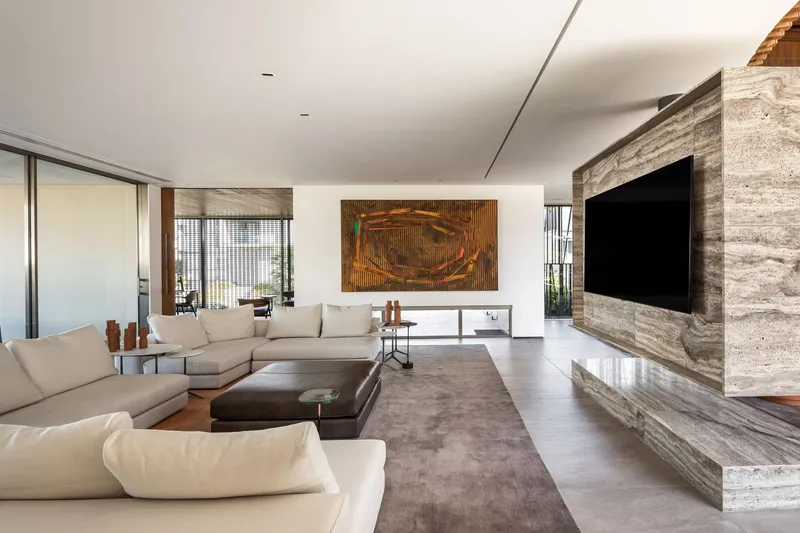
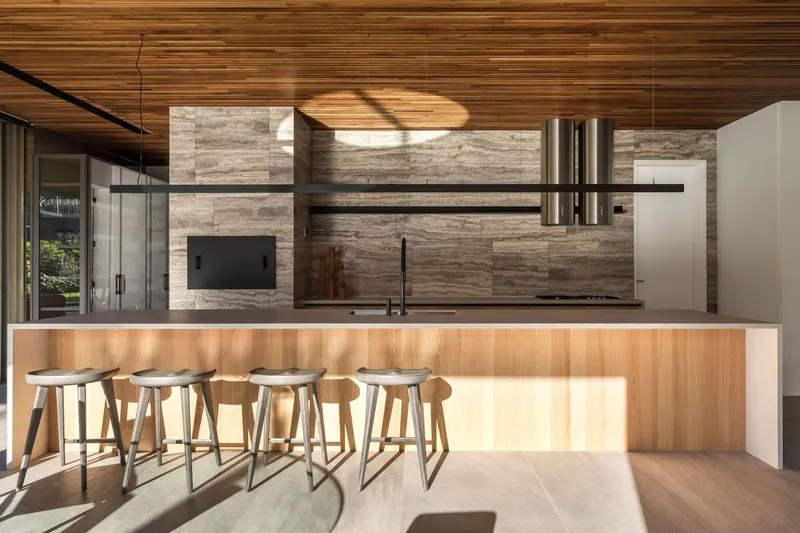
Silver travertine marble appears both inside and out, but it is the ventilated facade system that deserves attention. The marble panels are fixed by metallic inserts with an air gap behind, creating a cavity that provides thermal comfort and prevents the cracking and infiltration that plague solid stone cladding in Curitiba's humid subtropical climate. It is a rain-screen principle executed in a material more commonly associated with Italian lobbies than Brazilian residential envelopes.
The broader climate strategy is thorough without being performative. The house faces north to capture the sunniest orientation, deep overhangs keep direct sun off the glass, photovoltaic panels and storage batteries push toward energy sufficiency, and rainwater collection handles irrigation. Electric vehicle charging stations round out the sustainability checklist. None of this is the point of the architecture, but all of it makes the openness sustainable rather than merely dramatic.
Living on the Ground Floor
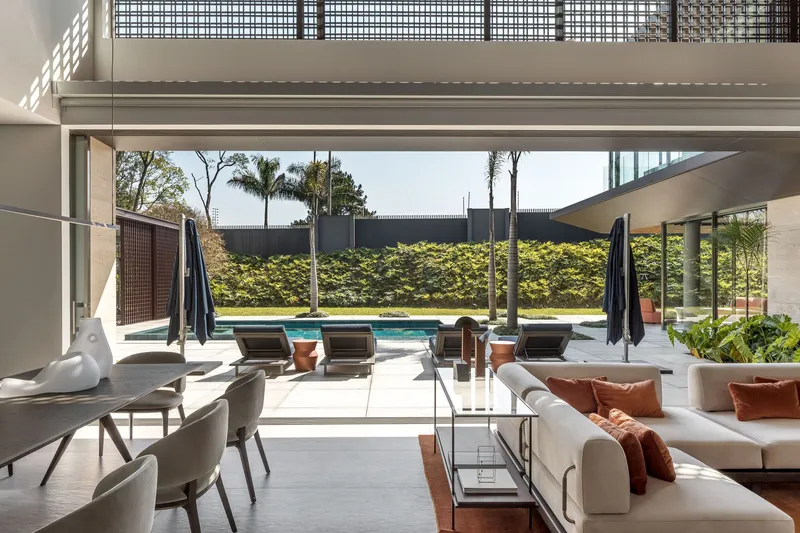
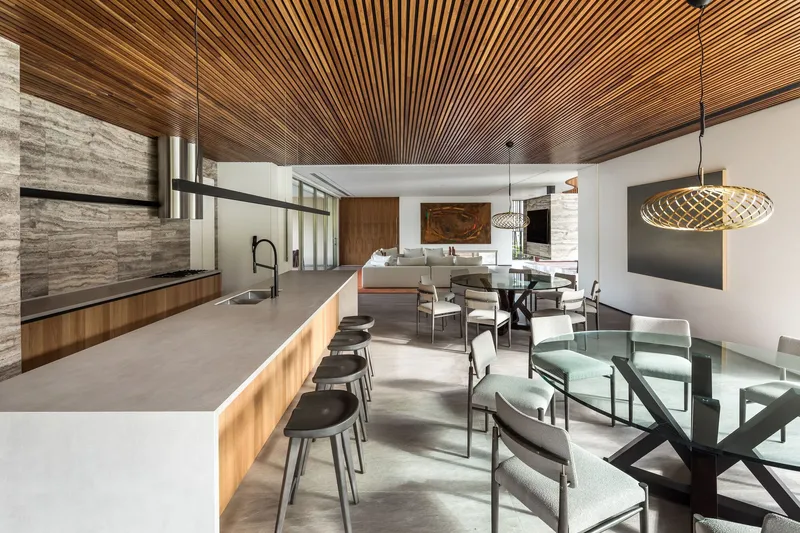
The main axis of the ground floor runs through kitchen, dining room, living room, and home theater in a continuous sequence. Prestressed slabs enable large spaces between pillars, and the pillars themselves are tucked inside walls adjacent to large glass frames that carry structural loads. The result is a ground floor that feels genuinely free-plan: no awkward columns in the middle of rooms, no interrupted sightlines.
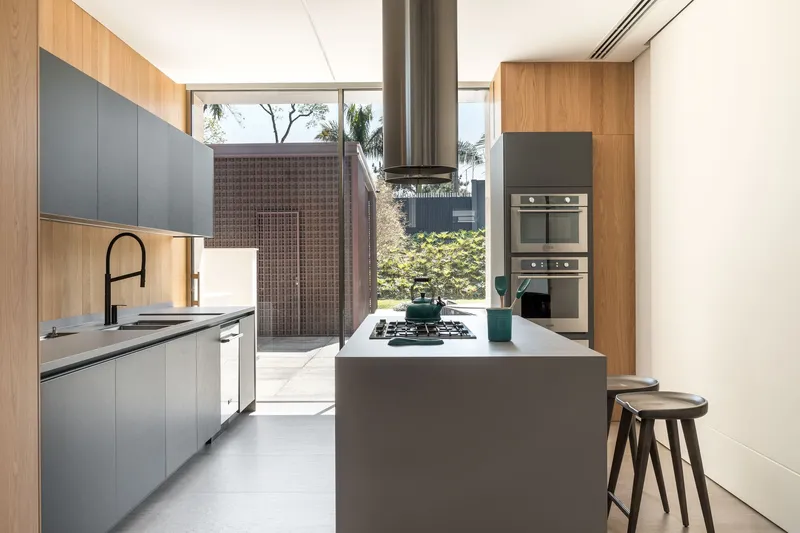
The kitchen sits at the heart of this sequence, anchored by a long island with a timber base and a stainless steel hood suspended from the slatted ceiling above. Behind it, a striated travertine feature wall catches afternoon light. To one side, the gourmet space extends through the garden and past the pool, blurring the distinction between cooking and outdoor living. The patterned courtyard wall visible from the kitchen counter introduces geometry into an otherwise fluid plan, providing a visual anchor without creating a barrier.
Pool, Terrace, and the In-Between
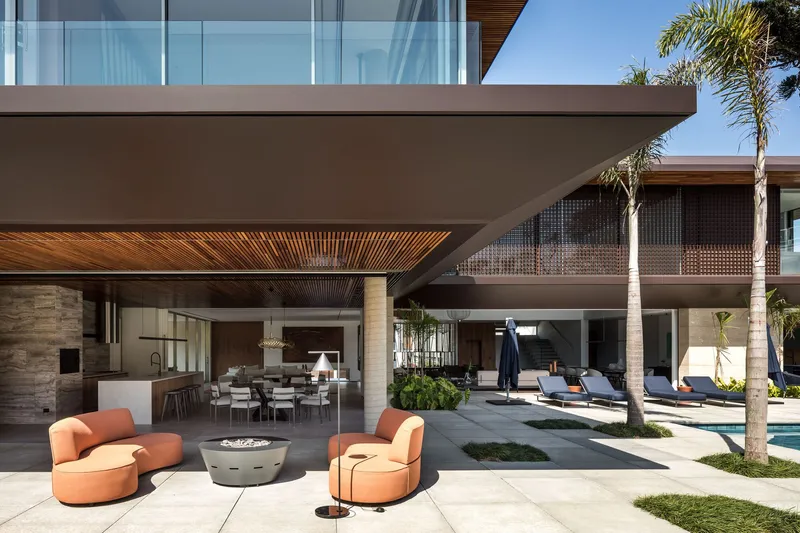
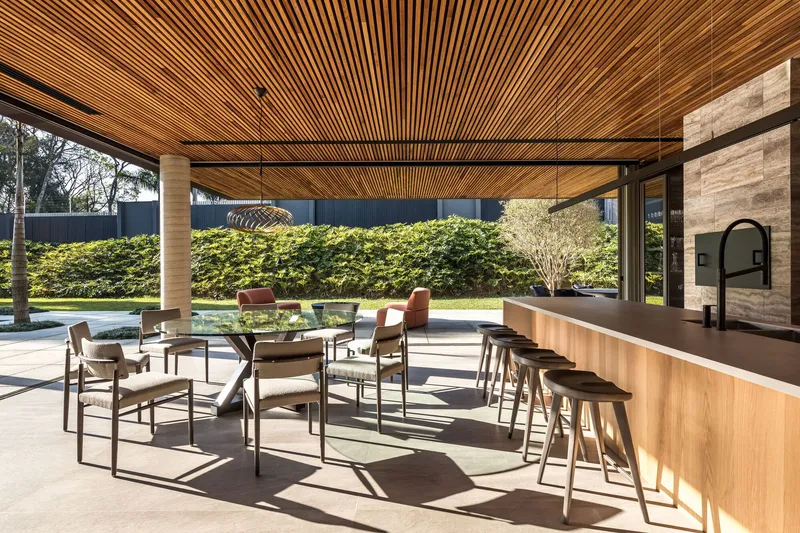
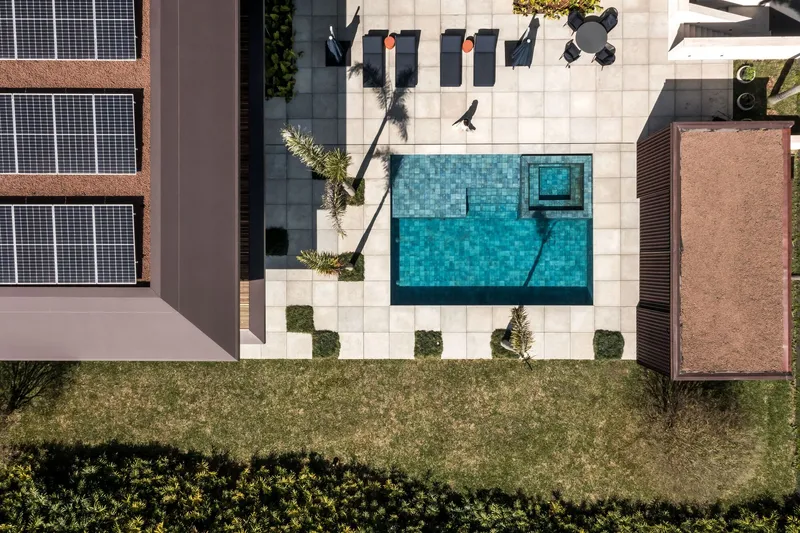
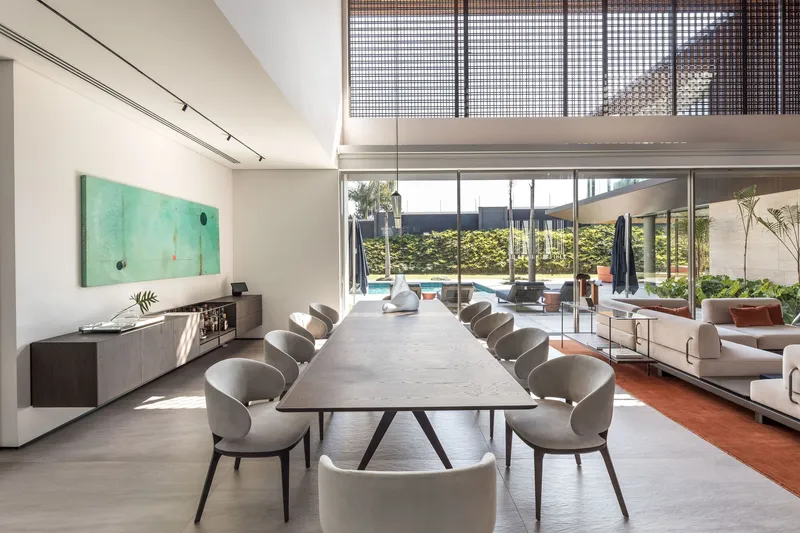
The covered outdoor terrace is where the architecture's material palette converges most naturally. Stone columns support the timber slatted ceiling, which extends from the interior dining area outward past the pool lounge. Cement boards set between grass strips form the pool deck paving, a quiet detail that softens the hardscape and ties the built surfaces to the manicured hedge and lawn beyond. The outdoor dining table sits beneath perforated metal screens, catching filtered light and maintaining privacy from neighbors without sacrificing the sense of openness.
Seen from above, the pool deck organizes itself around white pavers and landscaped beds, with lounge furniture scaled to the generous proportions of the terrace. The wood deck flaps, supported by triangular metal parts fixed to the main structure, add a lightweight counterpoint to the heavy concrete and stone below.
Private Rooms Above
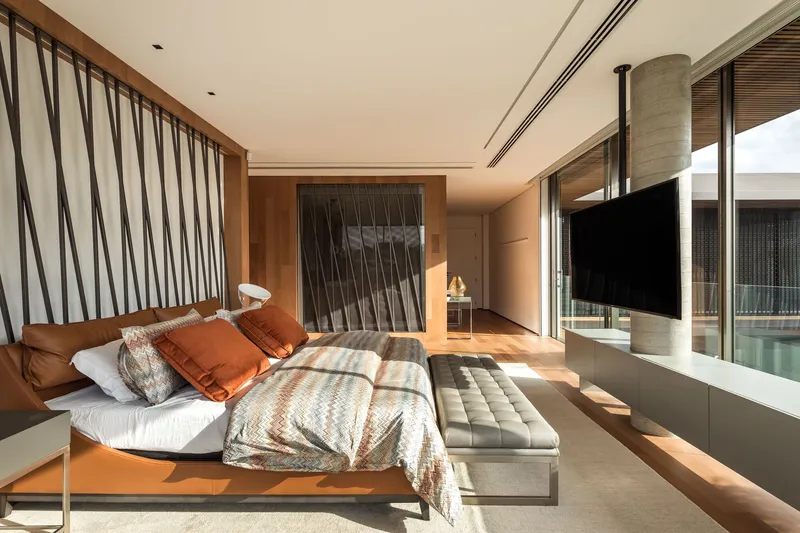
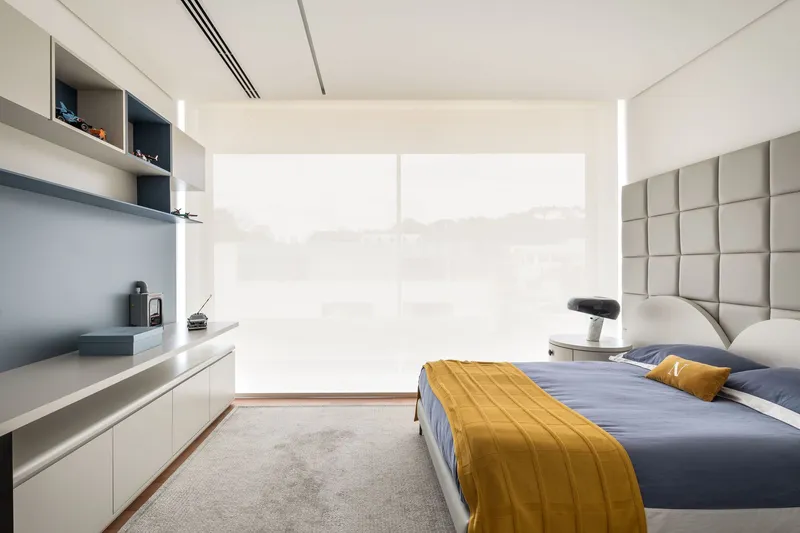
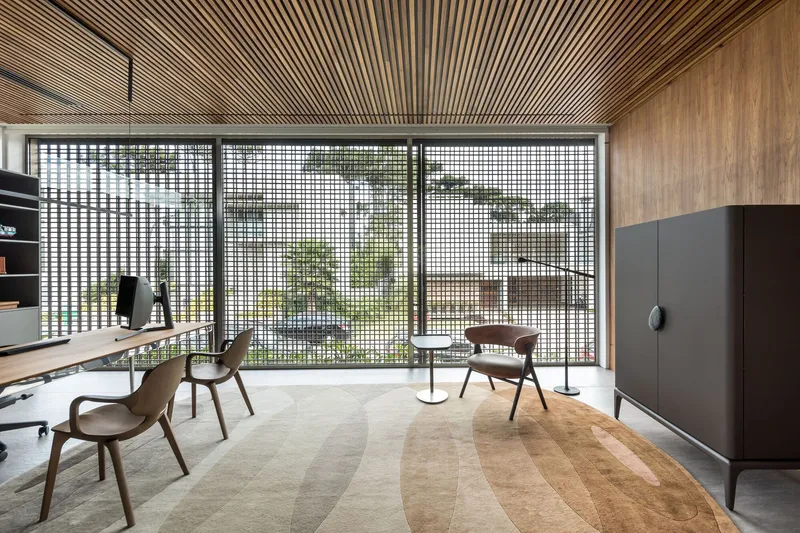
The upper floor contains the guest bedroom, a cinema, the son's suites, and the master suite, all connected by a walkway that runs through the double-height void. Tauari wood flooring warms the intimate areas, distinguishing them from the concrete ground floor. In one bedroom, a diagonal timber slat screen mediates between the glass wall and the pool terrace, filtering light into warm stripes that shift through the day. In another, an upholstered headboard faces a translucent window wall that softens the incoming daylight to a diffuse glow.
The study is a concentrated moment. A radiating timber slat ceiling fans out above a gridded metal screen wall that opens to greenery. It is a small room with a high degree of material resolution, and it captures the house's essential idea in miniature: frame a view, wrap it in wood, let the light in.
Dusk Presence
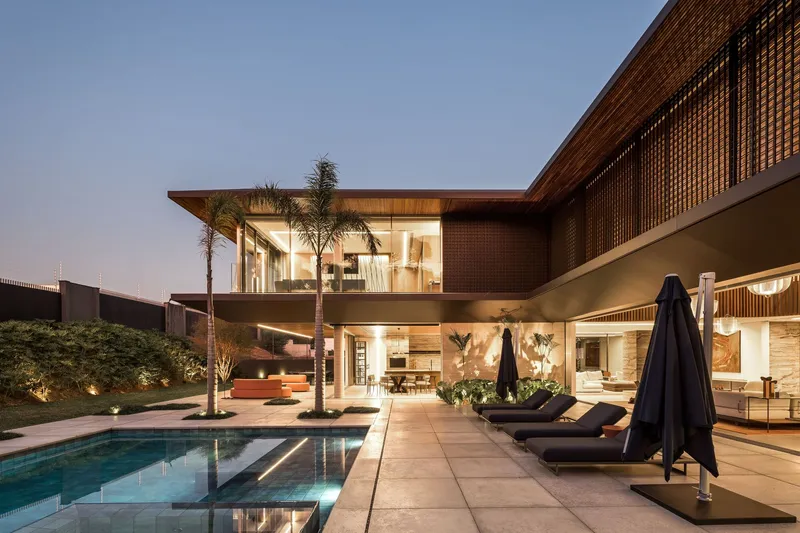
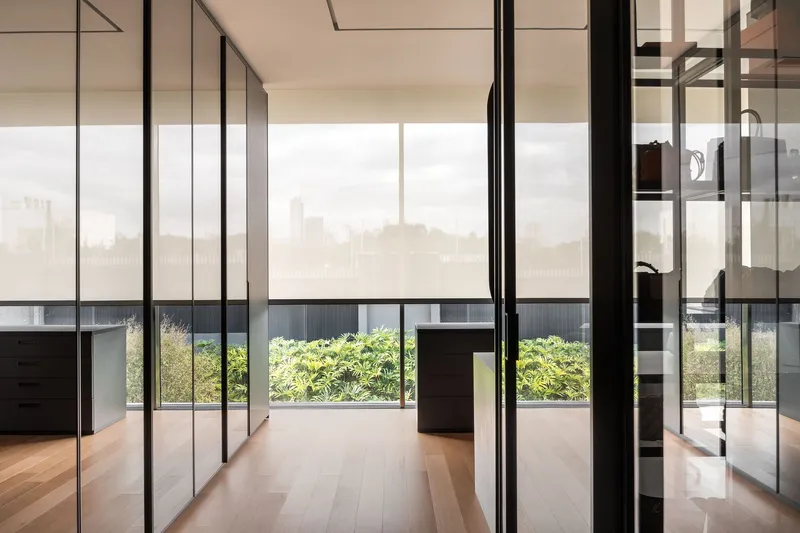
At dusk, Guaimbê reveals its second character. The glazed facades glow against the timber screen walls, and the cantilever reads as a floating volume suspended above the illuminated pool terrace. The horizontal proportions that felt grounded during the day now feel lifted, the deep eaves dissolving into the evening sky. It is a house that changes register with the light, which is the payoff for all those carefully oriented openings and calibrated overhangs.
Plans and Drawings
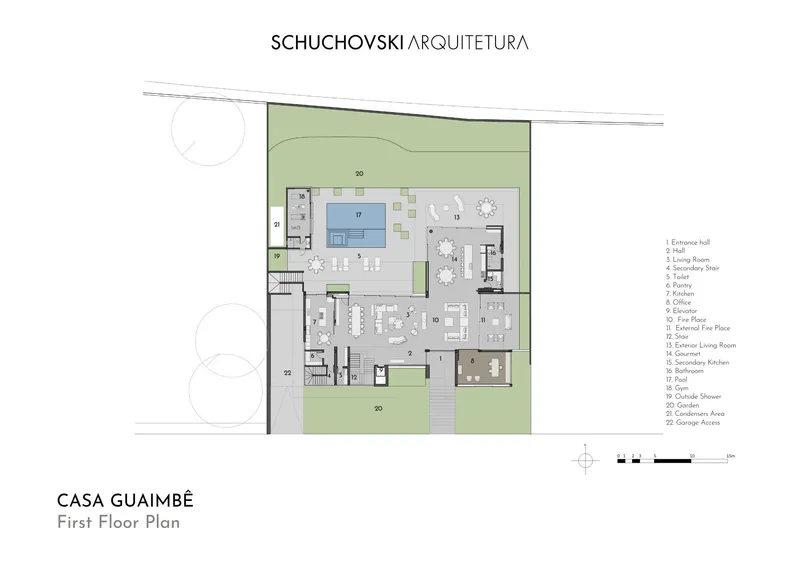
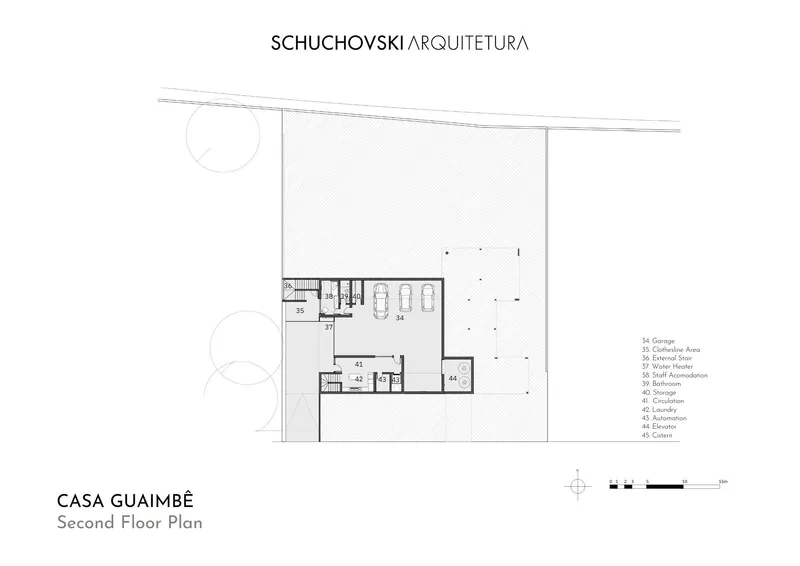
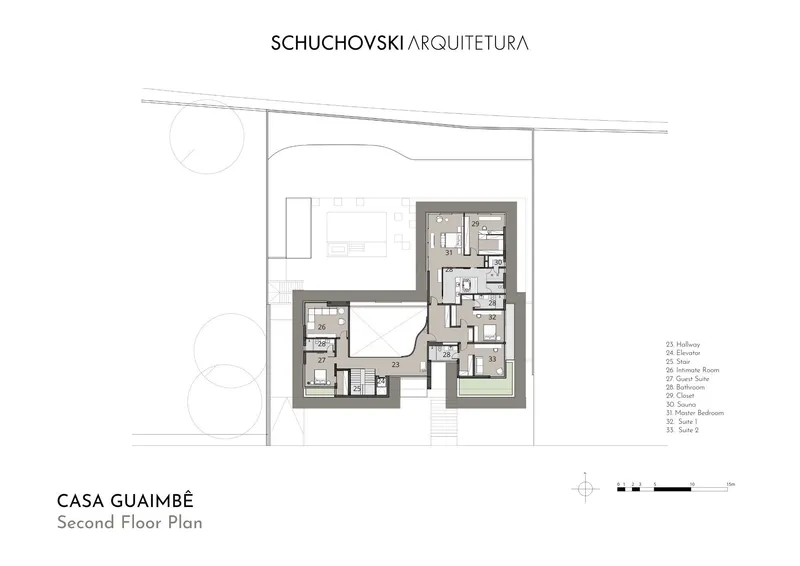
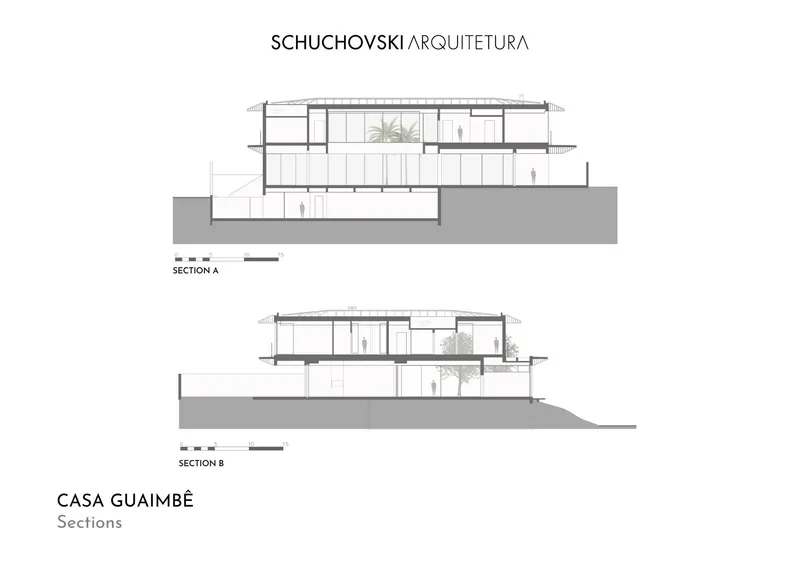
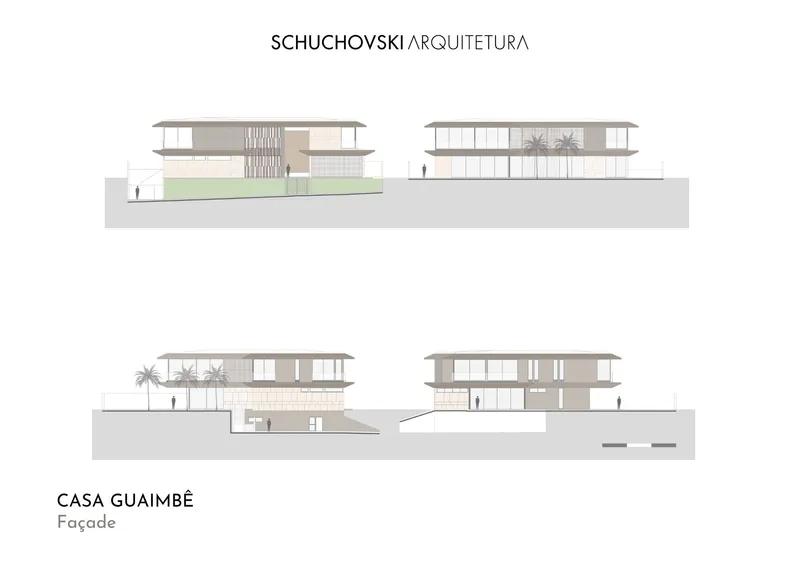
The floor plans confirm the clarity of the L-shaped organization. The ground floor arranges open living spaces around the pool and courtyard, while the upper floor groups private rooms around a central void. The section drawings are particularly revealing: they show how the two-story volumes with flat roofs sit into the sloping terrain, the cantilever extending over the downhill grade, and the double-height spaces that connect the two levels. The four elevation drawings illustrate the horizontal composition of layered volumes punctuated by palm trees, a silhouette that reads consistently from every approach.
Why This Project Matters
Guaimbê House succeeds because it treats structural ambition as a servant of spatial desire. The prestressed slabs, the root stake foundations, the ventilated travertine facade: none of these are innovations in themselves, but they are deployed with precision toward a single goal. The clients wanted to see their garden from every room, and Schuchovski engineered a house that delivers on that promise without resorting to the glass-box-on-a-hillside cliché. The L-shaped plan, the privacy it secures from flanking neighbors, and the cantilever that reaches toward the view all follow from the brief.
More broadly, the project demonstrates that sustainability features and sensory richness are not competing agendas. Photovoltaic panels coexist with Freijó wood ceilings. Rainwater collection sits alongside a marble ventilated facade. The house does not advertise its green credentials, nor does it hide them. It simply integrates them into an architecture that prioritizes the experience of being in a room, looking out at a garden, in a specific city in southern Brazil. That integration, rather than any single gesture, is what makes Guaimbê worth studying.
Guaimbê House by Schuchovski Arquitetura (lead architect Eliza Schuchovski), Curitiba, Brazil. 1,211 m². Completed 2022. Photography by Eduardo Macarios.
About the Studio
Share Your Own Work on uni.xyz
If projects like this are the kind of work you want to make, uni.xyz is a place to publish your own, find collaborators, and enter design competitions.


Popular Articles
Popular articles from the community


LT2A and OPEN Architectes Thread a Brick and Glass High School Through a Wooded Belgian Campus
In Braine-l'Alleud, a 3,000 m² wing for Collège Cardinal Mercier pairs pale brick with a glazed colonnade, deferring to a small chapel and a dense wood.

Jaramillo Van Sluys Arquitectura and Urbanismo Turn a Demolished Registry Lot in Quito into an Orchard Plaza
In Quito's Centro Histórico, a 2,800 m² plaza exposes the San Agustín convent wall and redraws its lost Augustinian orchard in volcanic stone.

Cube Design Draws an Ecological Corridor Between Two Shenzhen Hills with the Nankai Building
Beside Shenzhen's container docks, the Nankai Building pairs stacked balconies with a climbing green screen to connect two hillsides across its height.

Juan García Correa, John González and Claudia Rueda Sink a Circular Amphitheater into a Manizales Engineering Building
On the La Nubia campus in Manizales, Colombia, the S1 Building folds labs and offices into a hillside of ramped lawns that double as a campus route.

Similar Reads
You might also enjoy these articles


LAVA Architecten Gives Vocational Education a Sawtooth-Roofed Face on a Mechelen School Campus
In Mechelen, Belgium, a 2,053 m² STEM school on a 6×6 m grid turns workshops and classrooms into rooms that can be rearranged as teaching changes.

KEMA Studio Turns a Derelict Marvila Attic into a 60 m² Lighthouse Apartment Above Lisbon
In Lisbon's Marvila district, a rebuilt roof, four skylights and two plywood volumes turn an unlivable attic into a bright home facing the Tagus.

Pixel Gardens: One Repeated Module Stacked Into a Terraced Social Housing Tower for Famagusta
Salem Bader's shortlisted housing tower builds a vertical neighbourhood from one repeated module, offsetting units to carve terraces, light and air.

Bao Huynh Watercolor Atelier: A Serene Art Retreat in Hội An
Bao Huynh Watercolor Atelier in Hội An blends multifunctional art spaces, sustainable design, local materials, and family-friendly living in a serene environment.

Explore Residential Building Competitions
Discover active competitions in this discipline

Challenge to design mud housing for contemporary communities

Challenge to reimagine the Iron Throne

Photograph architecture without architects

Illustrate the lost glory of Angkor Wat - Render Challenge
Comments (0)
Please login or sign up to add comments
No comments yet. Be the first to comment!