
SCOB Tucks a 300-Seat Amphitheatre into the Clearings of Catalonia's Santa Clotilde Gardens
An open-air theatre in Lloret de Mar extends the noucentista logic of one of Spain's most visited historic landscapes.


The Santa Clotilde Gardens in Lloret de Mar, designed by landscape architect Rubió i Tudurí, are one of Catalonia's most treasured noucentista compositions, drawing more than 130,000 visitors a year across nearly 27,000 square metres of manicured woodland and Mediterranean terraces. Adding anything to a site this loaded with cultural gravity is a high-wire act. SCOB, led by Sergi Carulla and Oscar Blasco, chose the only defensible strategy: extend the spatial logic already present rather than compete with it.
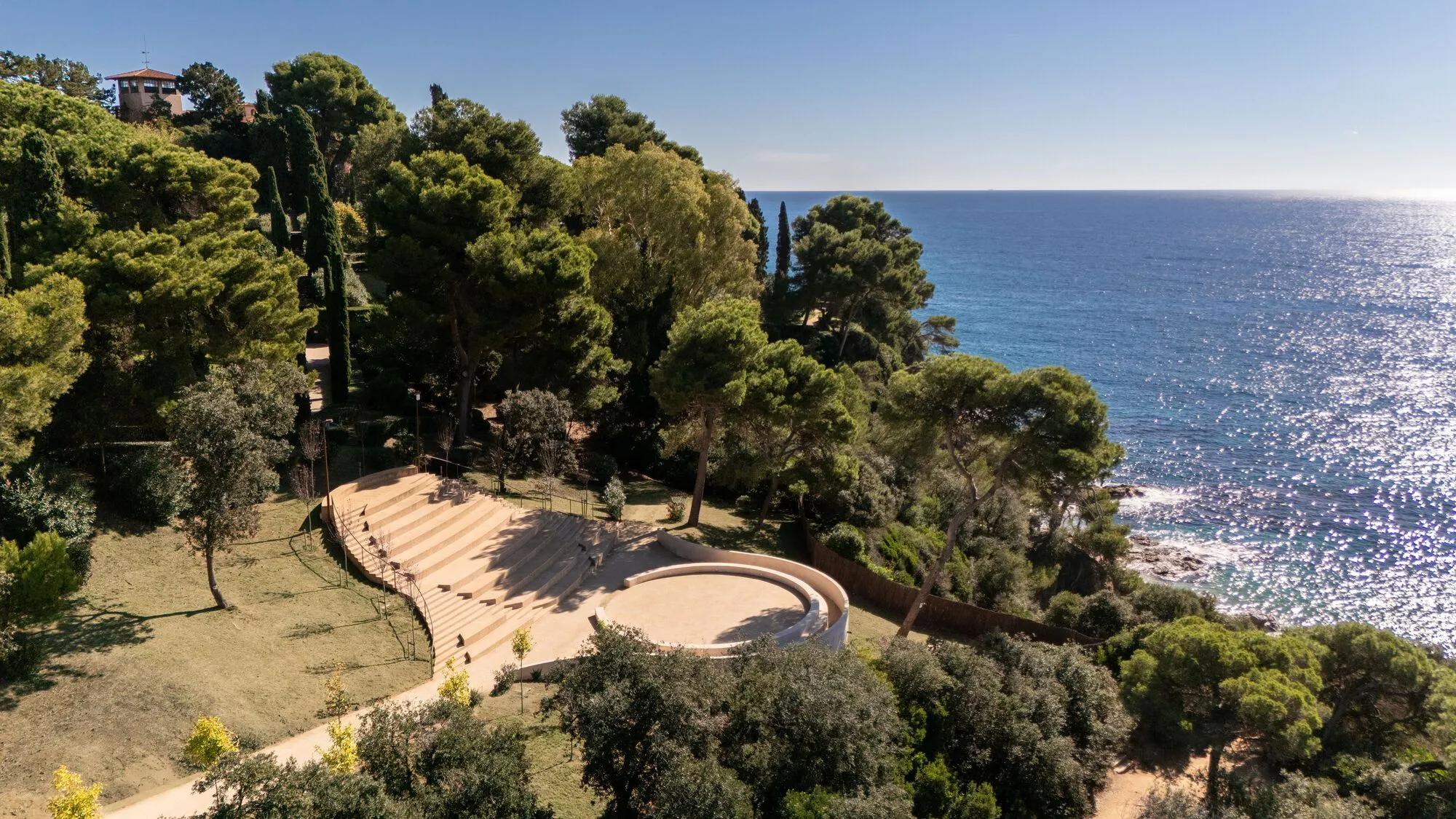
The result, completed in 2025, is a 5,500 square metre landscape intervention that slots a circular open-air amphitheatre, a service building, and a dressing-room volume into existing clearings at the gardens' western edge, overlooking Cala Boadella and the sea beyond. No trees were removed. No earthworks reshaped the topography. What makes the project compelling is not its restraint alone, but the way that restraint produces a genuinely theatrical experience: the Mediterranean itself becomes the permanent backdrop, and every material decision ties the new work back to the historic garden's own vocabulary.
Reading the Land Instead of Reshaping It
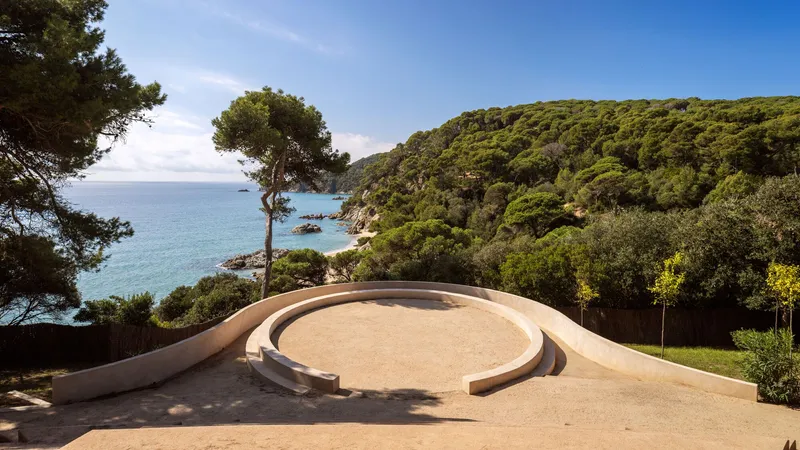
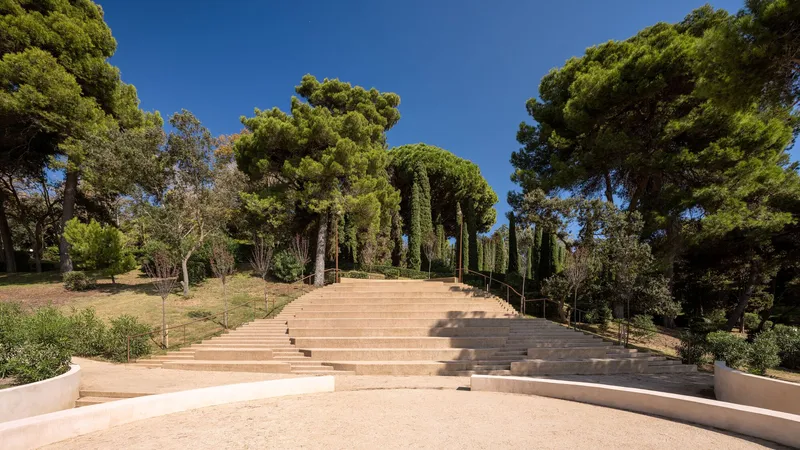
The amphitheatre seats roughly 300 people on terraces that follow the natural slope of the site as it descends toward the coast. Rather than excavating a bowl, SCOB adapted the existing grade, letting the incline do the work of generating sightlines. Stepped terraces ascend through groves of pine and cypress, so the canopy overhead filters light and frames the stage below. The circular stage itself is defined by a continuous bench and a perimeter ha-ha, a sunken wall that separates performers from the landscape without introducing a visible barrier. It is an old trick borrowed from English garden design, but here it serves a distinctly Mediterranean purpose: keeping the horizon line clean so sea and mountains read as scenography.
Sablón Everywhere: A Single Material as Unifying Thread
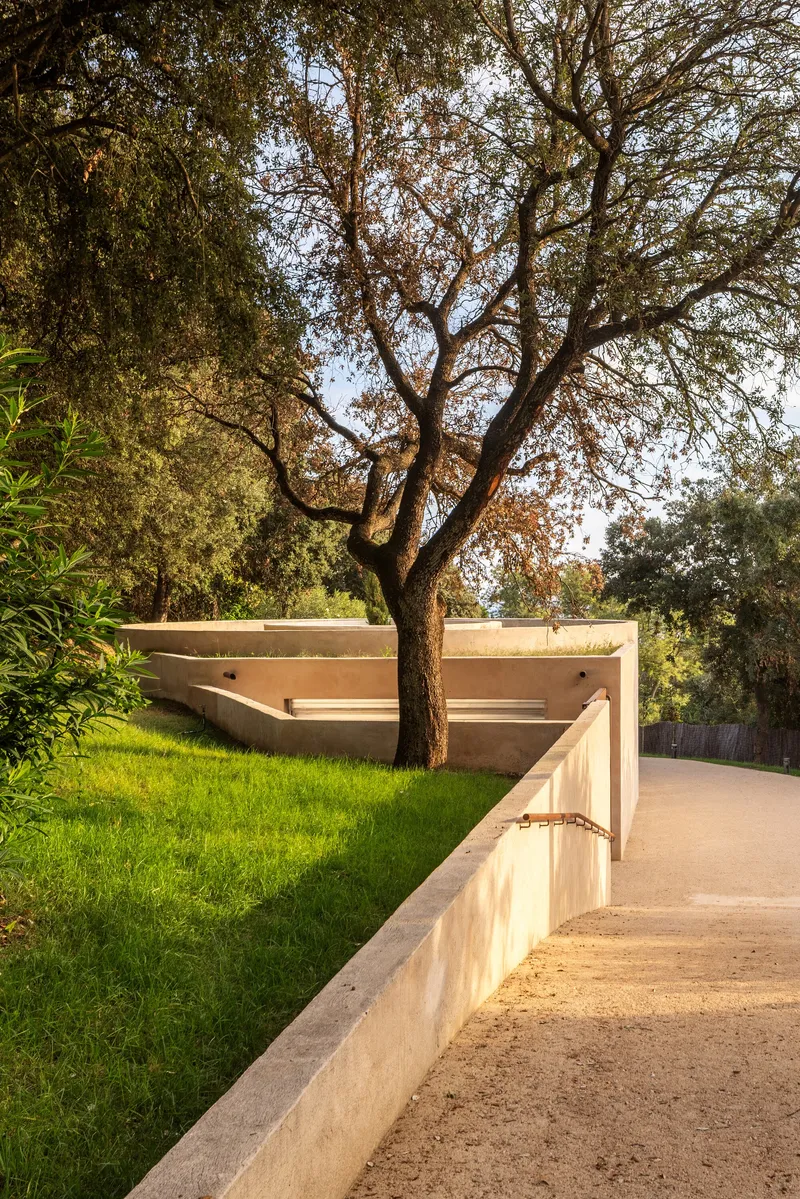
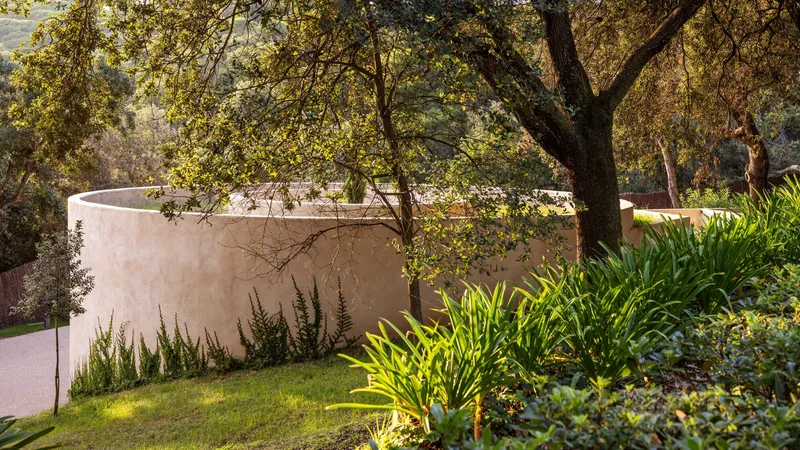
The most quietly radical decision here is the commitment to sablón, the decomposed-granite earth already present in the gardens' original paving and walls. SCOB uses it not just as ground cover but as the primary finish for seating terraces, retaining walls, and lime plaster surfaces throughout. Sandstone detailing reinforces the continuity. The effect is less "new building" and more "geological extension": the intervention reads as though the hillside simply organized itself into seats and pathways.
Climbing plants are already beginning to colonize the curved plastered walls, and planted beds of grasses and palms soften the edges where architecture meets woodland. Give it five years and the boundary between garden and theatre will blur further, which is clearly the intent.
Two Circular Pavilions in the Canopy
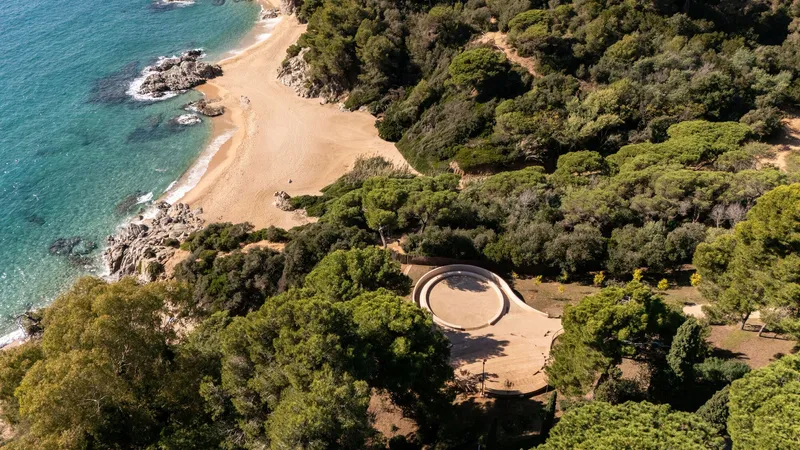
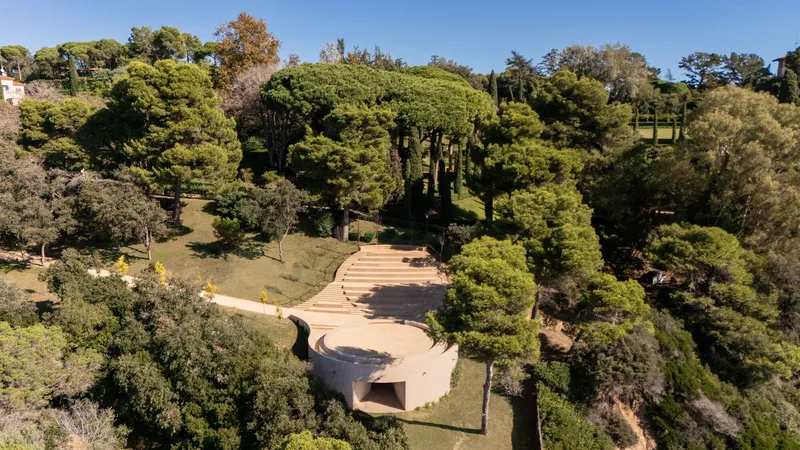
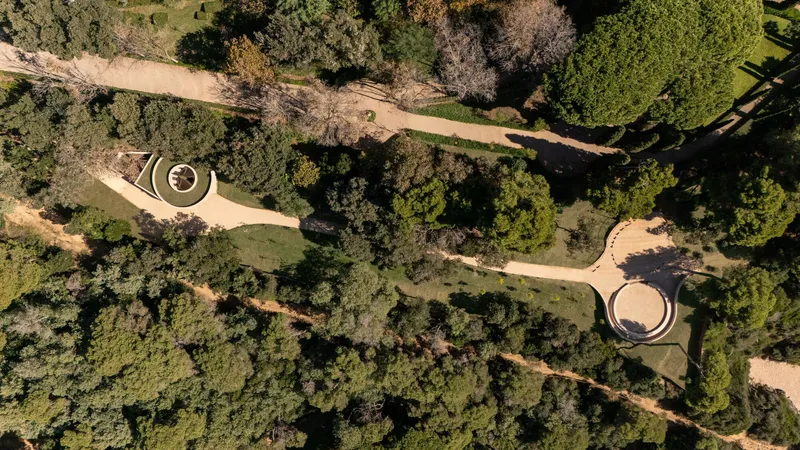
Away from the amphitheatre, SCOB placed two small circular structures, a service building and a dressing-room volume, in separate clearings connected by a winding path that follows the minimal slope line toward the sea. Both buildings are circular in plan, echoing the garden's existing geometric language of rounds and arcs. The service building is organized around a central courtyard with an axial cypress planted at its core, an unmistakable nod to the formal garden tradition that Rubió i Tudurí established a century ago.
Drone views reveal the pavilions as near-invisible interventions. Green roofs on the service building merge with the surrounding canopy, and the cantilevered roof terrace reads as a continuation of the forest floor rather than an imposition on it. The decision to locate both volumes in pre-existing openings rather than clearing new ground is the kind of discipline that separates genuine landscape sensitivity from marketing copy about "respecting nature."
The Sunken Courtyard as Threshold
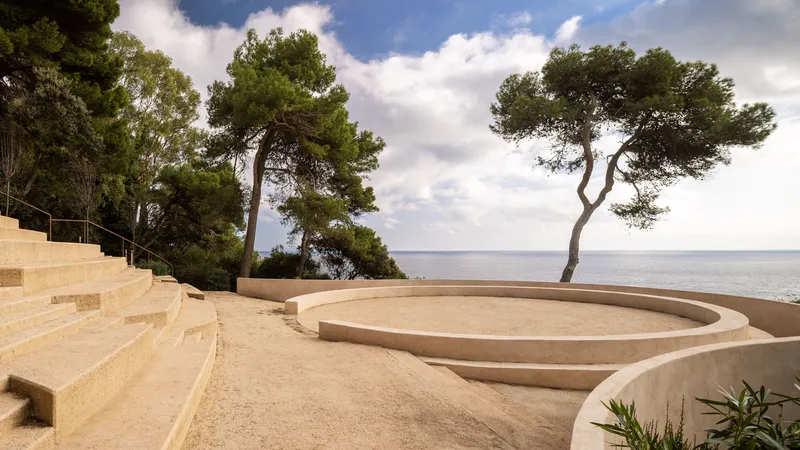
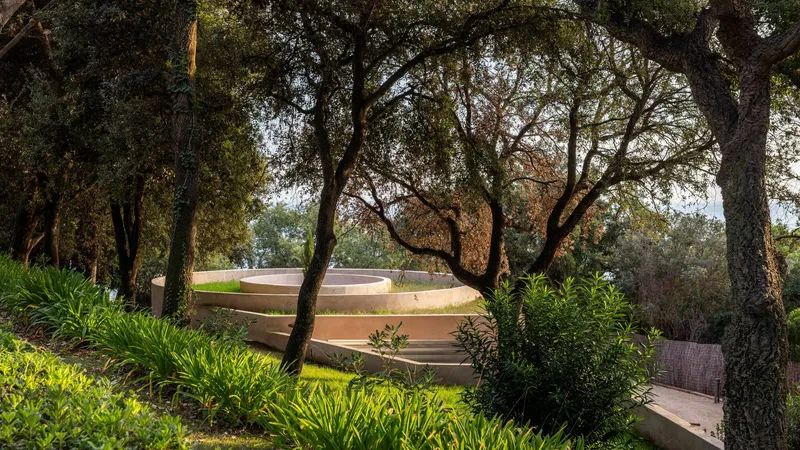
One of the project's strongest spatial moments is the circular sunken courtyard, framed by stepped sand-colored walls and open to the sky. It functions as a transitional space between the public garden and the performance zone, a place to gather, wait, or simply register the shift from strolling visitor to seated audience. The proportions feel deliberately compressed: walls rise just high enough to block lateral views and focus attention upward toward the pine canopy and clouds.
Viewed at dusk through the gnarled trunks that surround it, the courtyard takes on an almost archaeological quality, as though it had been excavated rather than built. That ambiguity is the project's signature. SCOB designed these forms and geometries to dialogue with the circular elements already embedded in the early-twentieth-century garden, so the new work feels less like an addition and more like a latent possibility finally realized.
Noucentisme as Operating System
SCOB explicitly frames the project within Novecentismo, the early-twentieth-century Catalan movement that championed order, clarity, proportion, and a return to Mediterranean roots. Where modernism in Barcelona often meant rupture, noucentisme meant continuity: a belief that new work should refine inherited forms rather than reject them. The amphitheatre embodies this philosophy. Its geometry is orderly without being rigid. Its materials are local without being folksy. Its relationship to the landscape is deferential without being timid.
The tradition of ars topiaria, the sculpting of vegetation into architectural form, also haunts the design. Hedges and tree lines act as walls; the canopy serves as a ceiling. Architecture and landscape share duties equally, which is precisely what Rubió i Tudurí intended for the original garden. SCOB's contribution is to demonstrate that this principle can accommodate a genuinely functional performance space without losing its poetic charge.
Plans and Drawings
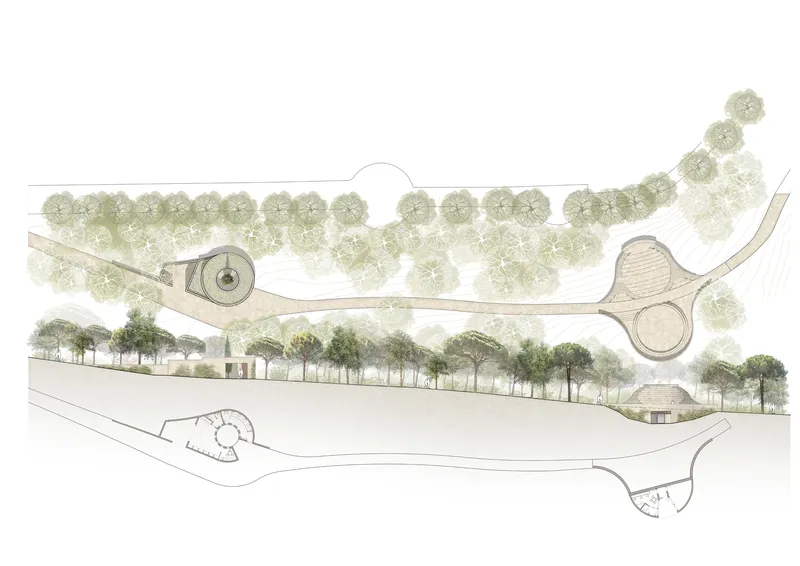
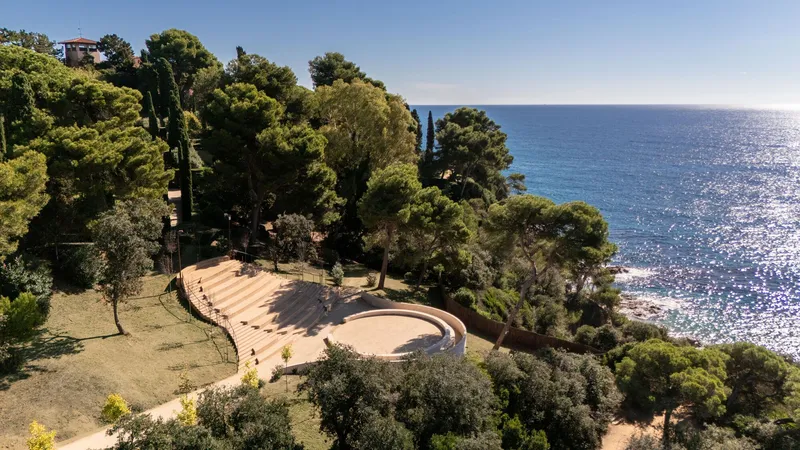
The site plan makes explicit what the photographs only suggest: every new path curves to avoid existing trunks, and both circular pavilions sit in clearings that pre-date the intervention. The aerial view paired with the drawing reveals the project's organizational logic. The amphitheatre, courtyard, service building, and dressing rooms form a loose constellation within the woodland, connected not by axes but by the contour lines of the terrain itself. The rows of existing trees appear on the plan as a kind of pre-given order that the architecture simply accepts.
Why This Project Matters
Heritage landscapes are notoriously difficult to intervene in. The standard outcomes are either bland invisibility, where the new work is so cautious it contributes nothing, or assertive insertion that treats the historic setting as a pedestal for contemporary ambition. SCOB avoids both traps by treating the garden's original design philosophy as a live operating system rather than a museum artifact. The noucentista principles of order, material honesty, and topographic respect are not merely referenced; they are deployed as active design tools to solve real problems like sightlines, acoustic containment, backstage logistics, and crowd circulation.
The project also offers a persuasive case for the power of a single-material strategy. By committing to sablón across nearly every surface, SCOB achieved a unity that no palette of finishes could replicate. It is a lesson in how limitation generates atmosphere. For a 300-seat theatre that will host performances against a backdrop of sea, pine, and sky, atmosphere is not a luxury. It is the program.
Theater in the Santa Clotilde Gardens, designed by SCOB (Sergi Carulla & Oscar Blasco). Lloret de Mar, Spain. 5,500 m². Completed 2025. Photography by Judith Casas.
About the Studio
Share Your Own Work on uni.xyz
If projects like this are the kind of work you want to make, uni.xyz is a place to publish your own, find collaborators, and enter design competitions.




Popular Articles
Popular articles from the community


The Earth Pod: 3D Printed Homes for Resilient Refugee Communities
The Earth Pod reimagines refugee housing through 3D printed homes made from clay, combining resilience, self-sufficiency, and rapid shelter.
EW PARK: Sustainable Architecture Reimagines the Future of Urban Parking
EW PARK reimagines city parking as a modular wooden tower combining automation, solar energy, electric mobility, and adaptable urban design.

Hill & Cross Opera: Sculptural Opera House Architecture Shaped by Tallinn’s Landscape and Identity
Hill & Cross Opera reimagines opera house architecture in Tallinn through its sculptural hill, civic plaza, glass wave and a luminous cross.

The Musturak Paradise: Senior Living Architecture for a Connected Future in Temara, Morocco
The Musturak Paradise reimagines senior living architecture in Temara via private homes, social spaces, culture, community, and shared care.
Similar Reads
You might also enjoy these articles

Bao Huynh Watercolor Atelier: A Serene Art Retreat in Hội An
Bao Huynh Watercolor Atelier in Hội An blends multifunctional art spaces, sustainable design, local materials, and family-friendly living in a serene environment.

Atelier Macri Concept Store Interior Design by CASE-REAL
Atelier Macri store features a "ko" counter, walnut wood details, cork displays, blending retail, gallery, and seamless customer experiences.

Manuel Vargas Izquierdo Stadium and High-Performance Sports Center: Architectural Excellence in Jalpa de Méndez
The Manuel Vargas Izquierdo Stadium blends sustainable design, inclusive sports facilities, and cultural-inspired architecture, revitalizing Jalpa de Méndez’s public spaces.

KAKR Buluh Awar Hall: Revitalizing Community and Ecology Through Bamboo Architecture
Community built bamboo hall revitalizes Buluh Awar village, empowering youth, restoring ecology, celebrating vernacular craftsmanship through sustainable architecture and culture.





Comments (0)
Please login or sign up to add comments
No comments yet. Be the first to comment!