
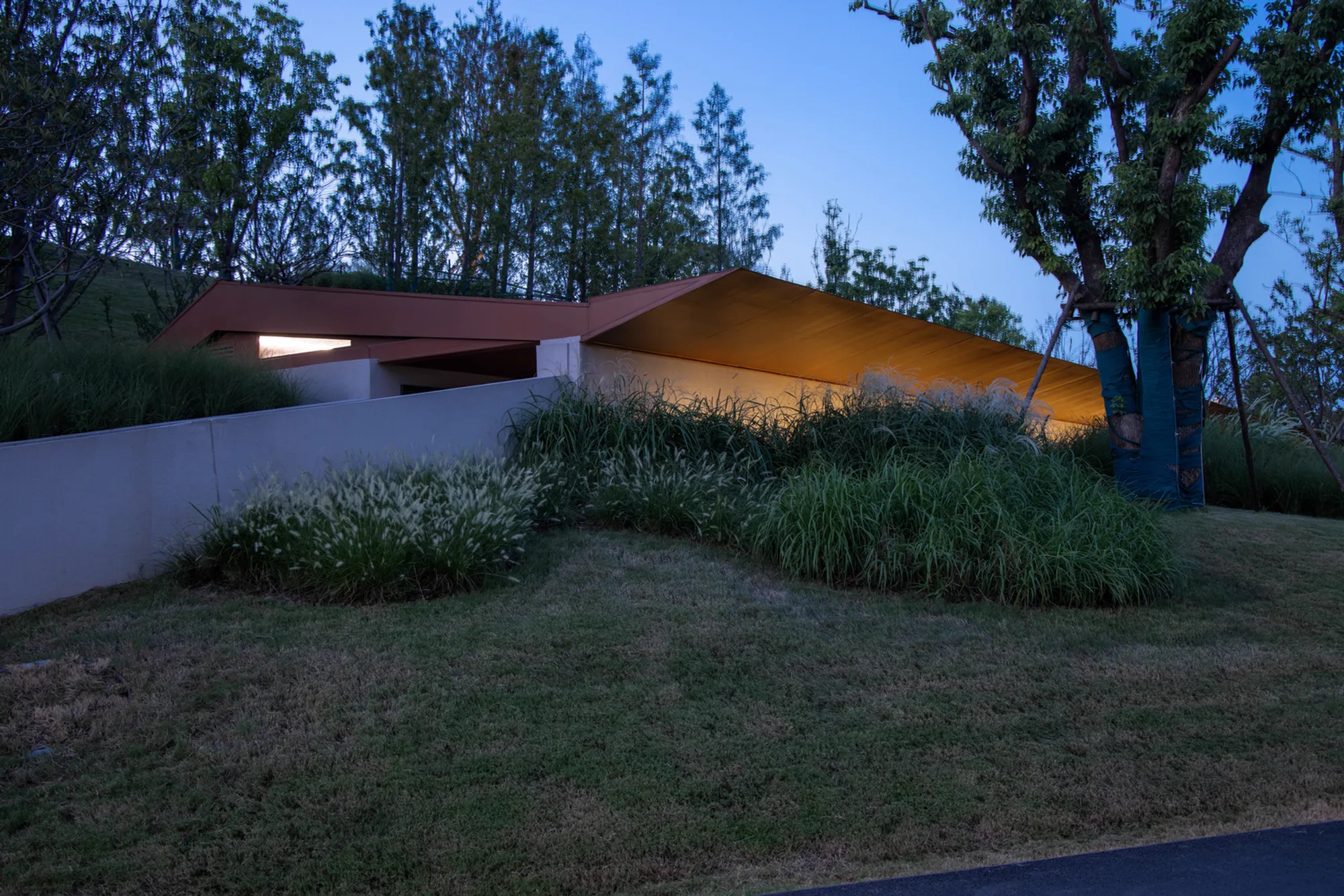
Second Restroom on Wuhan Luke Island by Atelier Palimpsest
A semi-subterranean restroom on Wuhan Luke Island by Atelier Palimpsest, combining weathering steel, natural light, and multifunctional public design.


Reimagining the Public Restroom: From Utility to Urban Waystation
The Second Restroom on Wuhan Luke Island by Atelier Palimpsest challenges the conventional idea of public restrooms as purely utilitarian spaces. What began as a client request for an event storage facility gradually evolved into a multi-functional public building, integrating a temporary office space and rest areas within its compact structure.
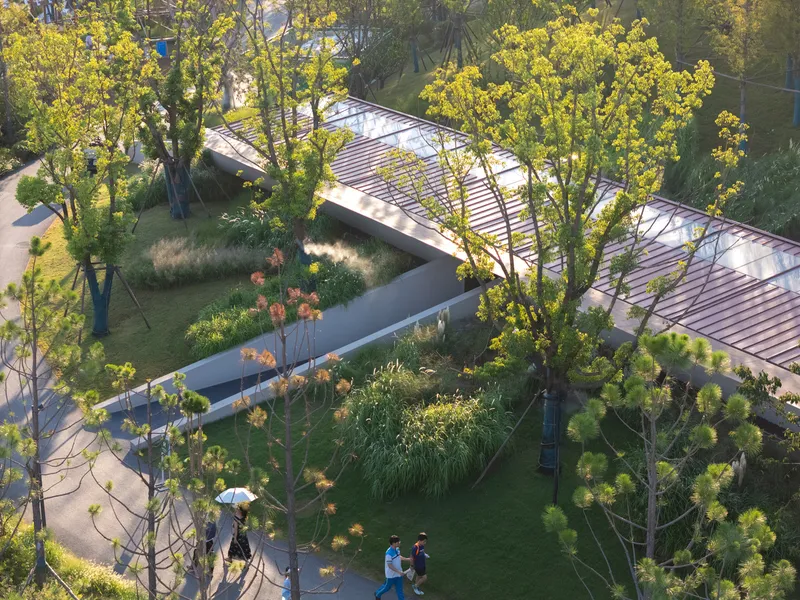
This adaptive approach reflects the studio’s broader exploration into how small-scale public infrastructure can serve as community waystations—spaces that provide rest, functionality, and architectural identity within the urban fabric. Through a series of similar commissions, Atelier Palimpsest continues to transform simple restroom programs into architectural experiments in civic design.
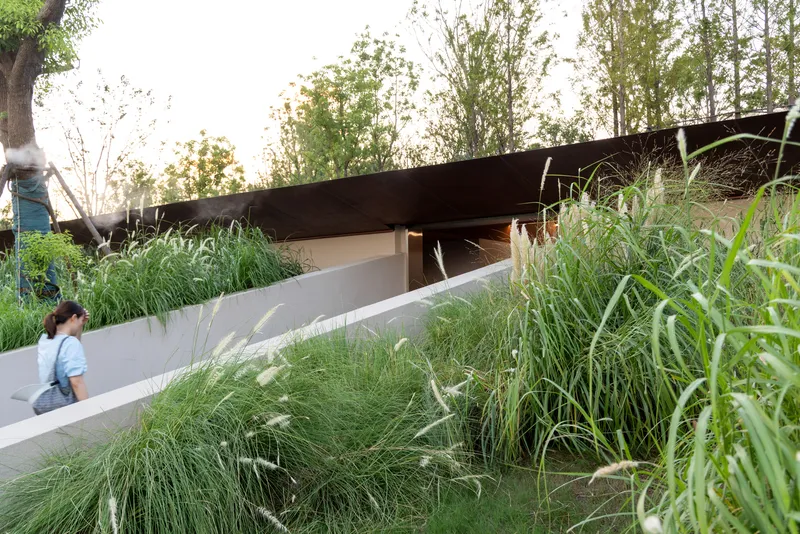
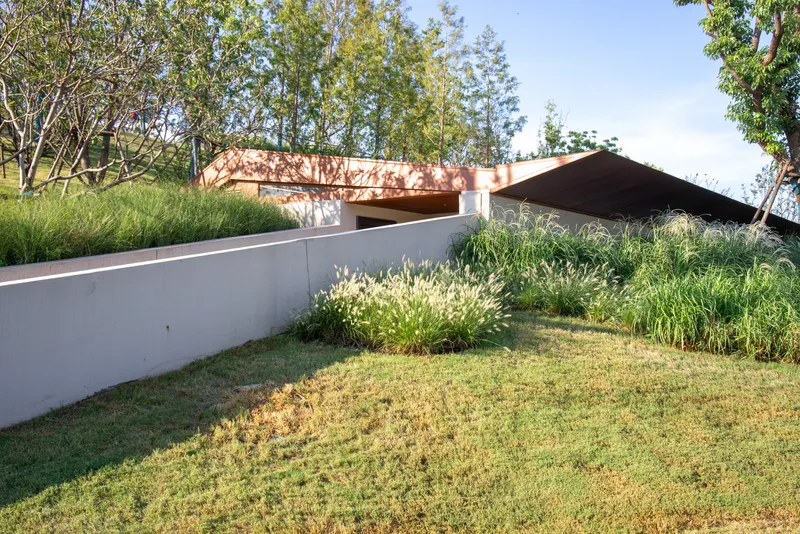
Grassland Floating Corridor: The Roof as Landscape
At the heart of the design lies the poetic idea of a “Grassland Floating Corridor.” Inspired by the open landscape of Luke Island, the architects envisioned a light, transparent volume resting gently above the grass.
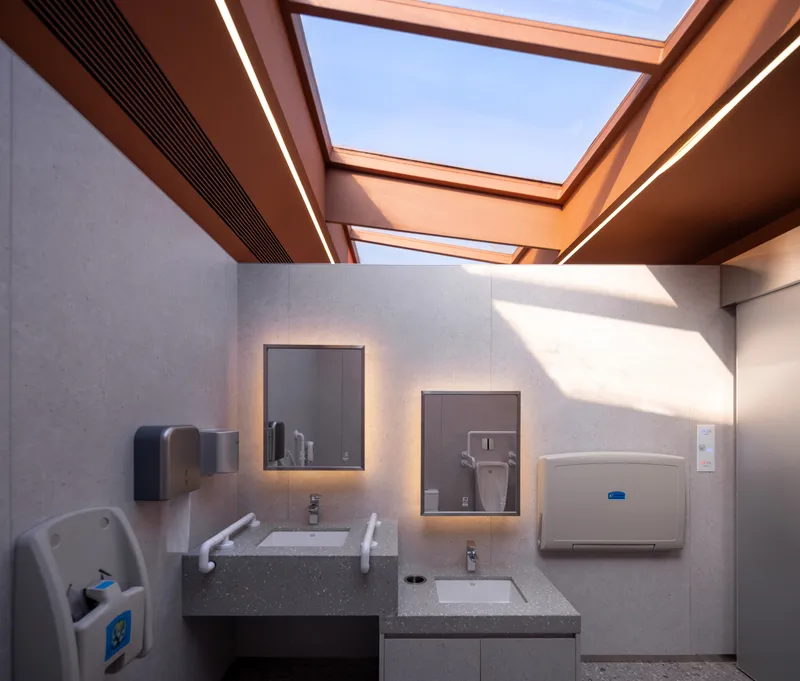
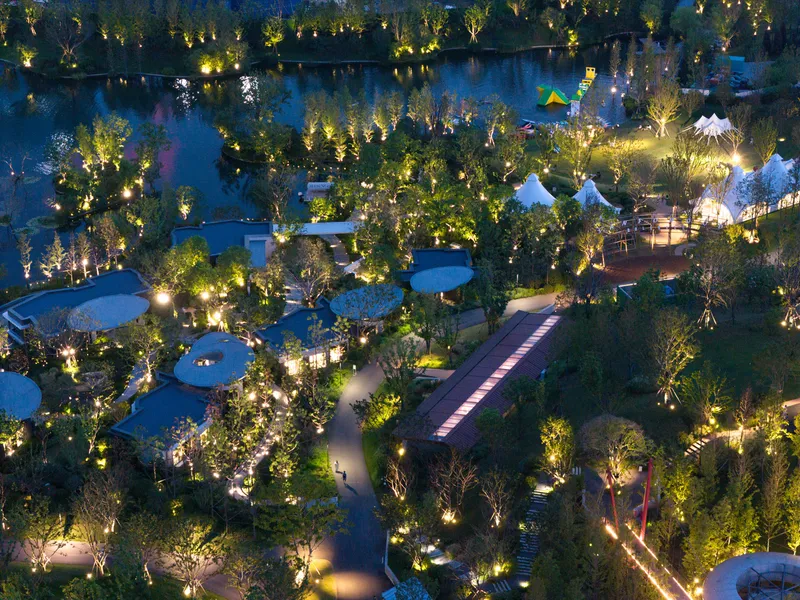
As the project evolved, this corridor concept was abstracted into a floating roofline—a single continuous eave extending nearly forty meters in length. To achieve this visual precision, the design team adjusted the roof’s thickness, creating a gradient that thins and thickens rhythmically, while the exposed steel structure supports both skylights and HVAC integration.
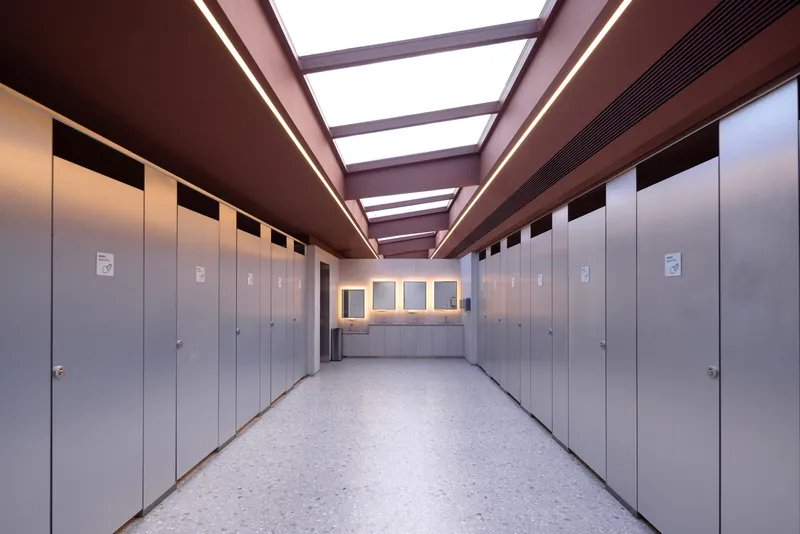
The ceiling and roof merge seamlessly, concealing mechanical systems and creating a refined architectural rhythm. A double-layer façade cleverly hides drainage lines while maintaining the purity of the linear form.
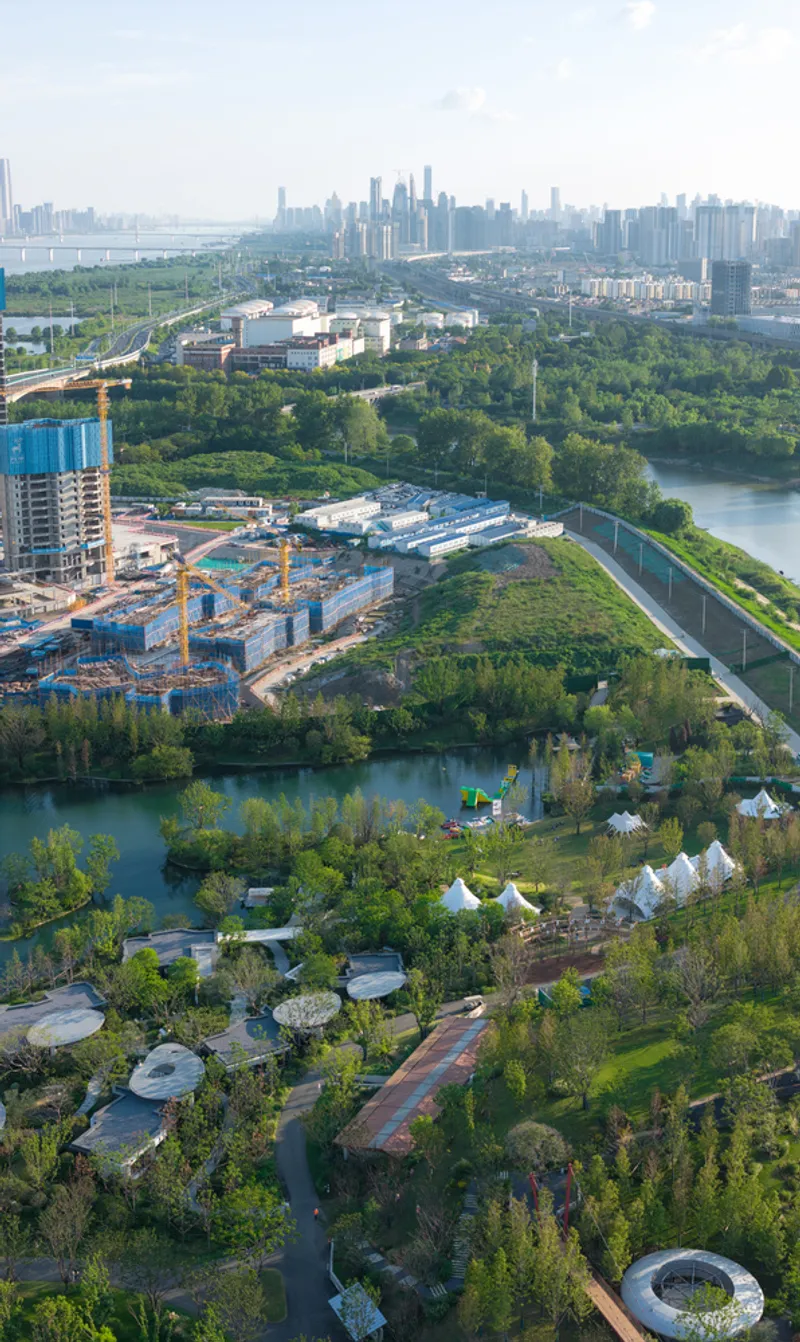
Material Expression: Weathering Steel and Temporal Change
The design’s dominant visual element—the roof—underwent extensive material study. The architects compared stainless steel, weathering steel, and patinated copper, evaluating not only their durability but also their evolving visual character over time.
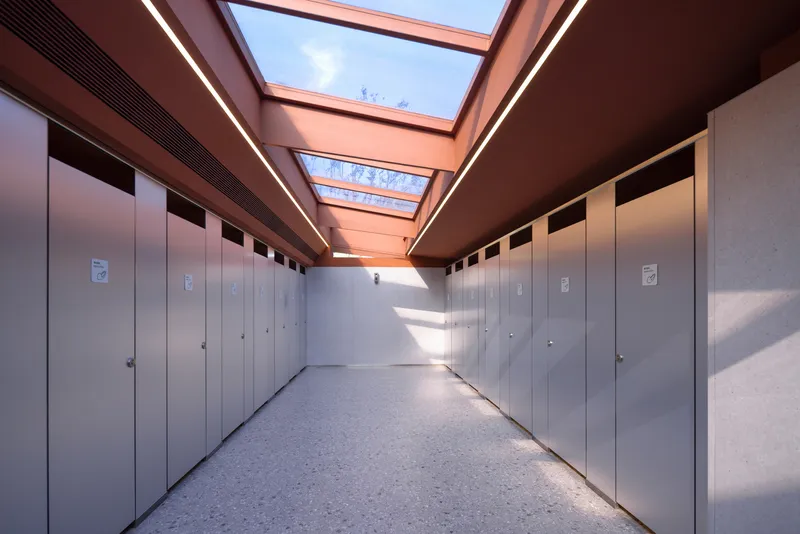
Given the restroom’s temporary lifespan of ten years, the selected weathering steel offers a dynamic surface that naturally changes color and texture through oxidation. This aging process gives the building a temporal beauty, reflecting the passage of time and the changing environment of Luke Island.
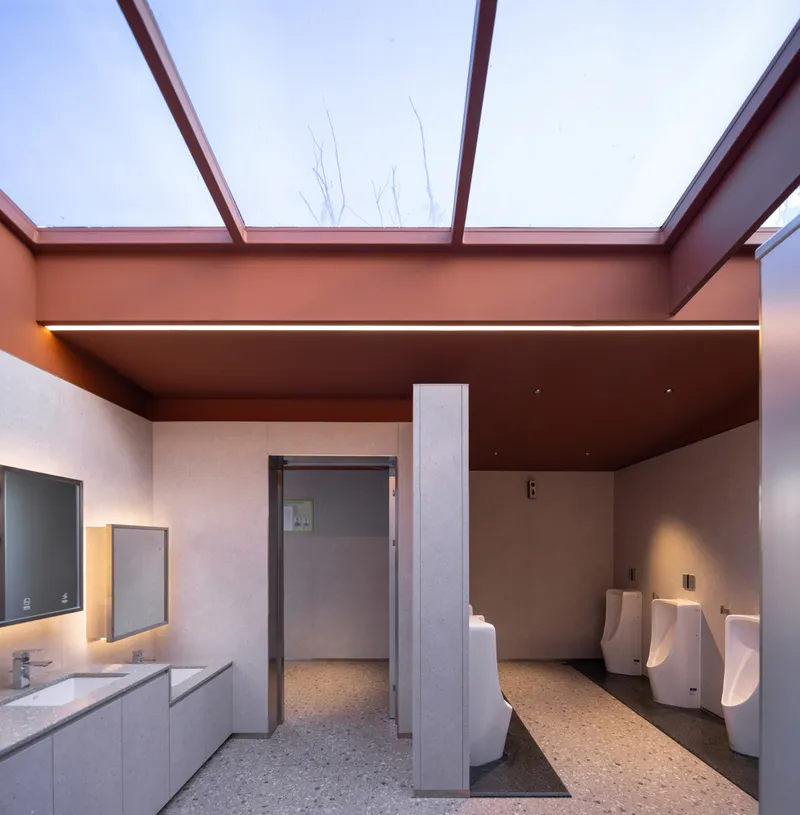
While patinated copper initially appealed for its elegance, the team favored weathering steel for its warmer tones and for ensuring pleasant interior lighting, particularly within spaces where natural reflection and facial light were carefully considered.
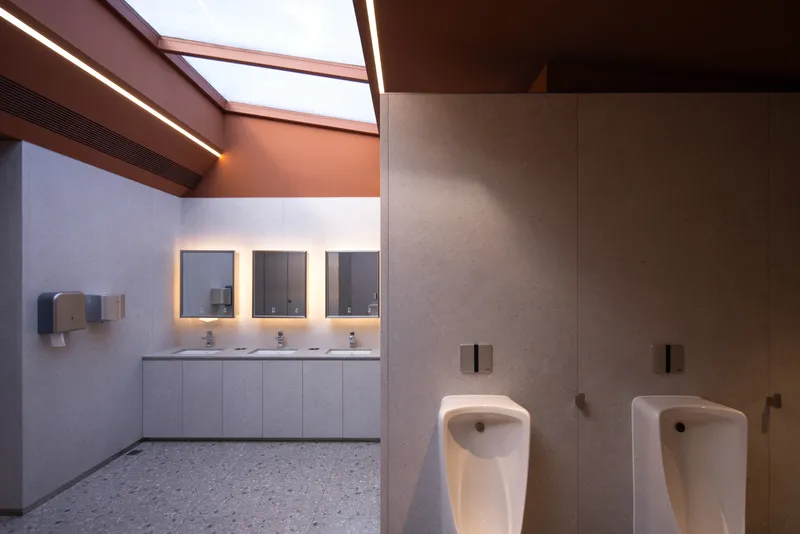
The Grotto Concept: Cooling Refuge in a Hot Climate
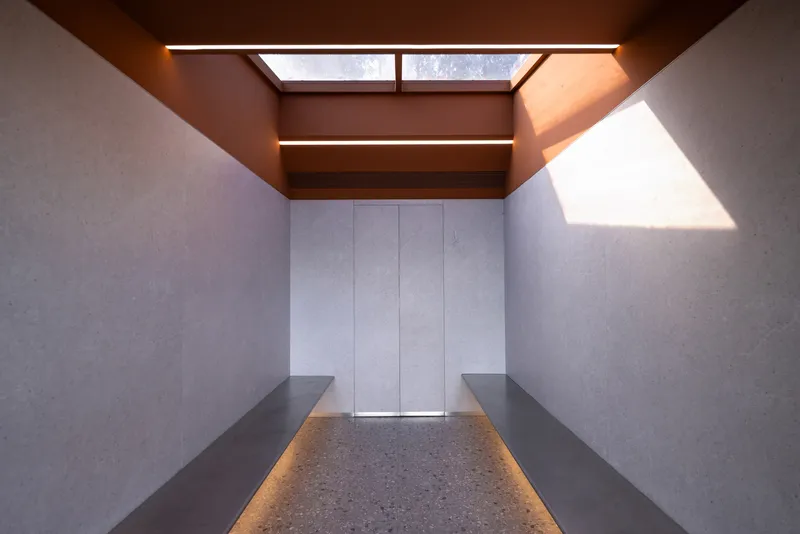
Embedded partially underground, the restroom’s semi-subterranean form inspired the interior concept of a “grotto.” This metaphor became both a spatial and climatic strategy, addressing Wuhan’s humid, hot summers by using the earth’s natural insulation to maintain cooler indoor temperatures.
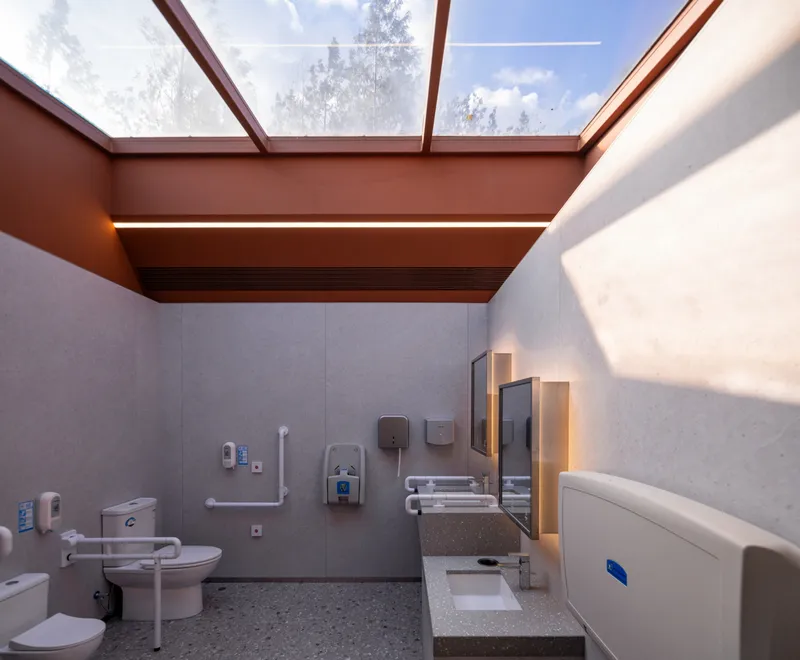
Originally, the design called for dark, rough stone textures to create an immersive “deep grotto” atmosphere. However, for cost efficiency and ease of maintenance, the final interior employs carbon crystal panels and terrazzo slabs, balancing practicality with aesthetic subtlety. The resulting “shallow grotto” ambience softens the underground feel while preserving a tactile material quality enhanced by daylight from above.
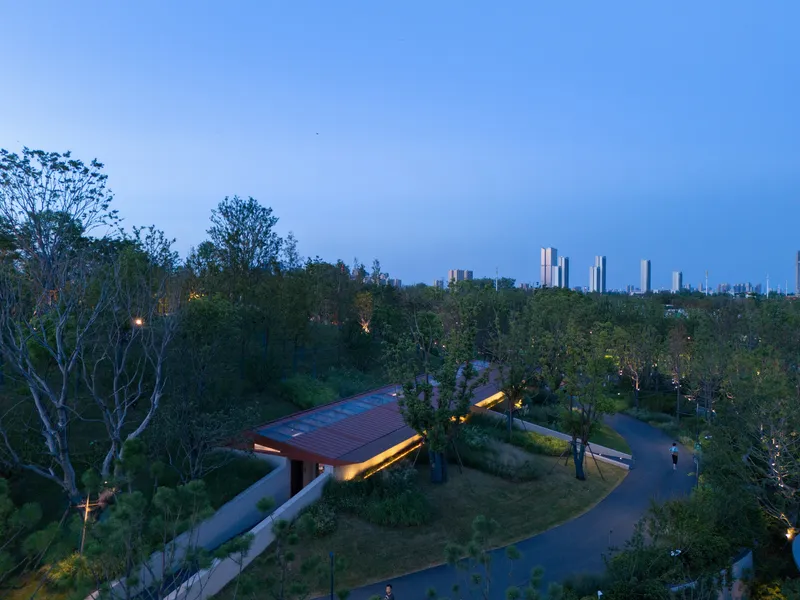
Light as a Spatial Narrative
A continuous skylight runs along the entire 40-meter roof, transforming the restroom into a luminous linear space. This strip of daylight defines the building’s spatial narrative—a sense of infinite continuity between interior and sky.
At night, uplighting beneath the eaves transforms the floating roof into a glowing horizon line, subtly emphasizing the architecture’s horizontality. Indoors, linear vents, lighting tracks, and the skylight itself align to strengthen the corridor-like rhythm, creating a poetic contrast between the subterranean grotto and the boundless light above.
A Prototype for Public Infrastructure
The Second Restroom on Wuhan Luke Island stands as more than a functional facility—it is a prototype for small-scale civic architecture. By layering public amenities, structural clarity, and material expressiveness, Atelier Palimpsest demonstrates how design can elevate everyday infrastructure into spatial and experiential landmarks.
In transforming a restroom into an architectural waystation, the project redefines how the built environment can serve both human comfort and landscape continuity within a single, compact form.
Meta Description (SEO)
Discover the Second Restroom on Wuhan Luke Island by Atelier Palimpsest—a semi-subterranean public facility blending weathering steel, natural light, and minimalist design to redefine civic infrastructure in Wuhan, China.



Popular Articles
Popular articles from the community


Hill & Cross Opera: Sculptural Opera House Architecture Shaped by Tallinn’s Landscape and Identity
Hill & Cross Opera reimagines opera house architecture in Tallinn through its sculptural hill, civic plaza, glass wave and a luminous cross.

Co-life: Sustainable Architecture for Age-Friendly Community Living
Co-life reimagines sustainable architecture for seniors through courtyards, rammed earth, shared gardens, and spaces designed for belonging.

Conexión: Biophilic Design Reimagines High-Rise Living in Hong Kong
Conexión reimagines high-rise living in Hong Kong through biophilic design, green facades, shared spaces, daylight, water and nature within.

Lunar Spiral: Space Architecture Shaped by the Mathematics of the Universe
Lunar Spiral reimagines space architecture through Fibonacci geometry, lunar regolith, levitating habitats, and self-sustaining Moon living.

Similar Reads
You might also enjoy these articles


Hodi-Mandai Geram
Project Function: Preservation and revitalization of the Intangible heritage and socio-spatial identity of the Hodi by Housing, Cultural Memory Center, Sacred Grove, landscape, local tourism economy


Olio Towers: A Mid-Rise for Performers That Fuses Housing, Rehearsal, and Stage
Located blocks from Houston's Theater District, this modular tower stacks living units around a central performance atrium.

Oasis: Modular Green Housing Carved into Dhaka's Urban Fabric
A shortlisted Plugin Housing entry reclaims unauthorized settlements in Dhaka with stepped concrete volumes, green roofs, and ventilation-driven design.

Black Hole: A Floating Megastructure for the Post-Physical Era
Emiliano Mazzarotto envisions a spherical, self-scaling arena where e-sports, digital hotels, and holographic stadiums replace traditional public space.

Explore Landscape Design Competitions
Discover active competitions in this discipline



Challenge to reimagine the Iron Throne


Photograph architecture without architects


Illustrate the lost glory of Angkor Wat - Render Challenge


Design challenge to reuse E-waste
Comments (0)
Please login or sign up to add comments
No comments yet. Be the first to comment!