
SEE(K)DER: Lifting Agriculture 20 Meters Above Hong Kong's Polluted Streets
A vertical farming tower escapes the toxic lower atmosphere of Central Hong Kong to cultivate food, research, and community in the sky.


What if the solution to urban food scarcity isn't finding more land, but abandoning the ground altogether? In Central Hong Kong, where air pollution routinely exceeds safe thresholds and the density of the built environment leaves zero room for conventional agriculture, SEE(K)DER proposes something radical: raise the primary ground plane 20 meters into the sky and start farming there. The toxic air that pools at street level becomes irrelevant when your crops sit above it.
Designed by P G and Pelin Yalçın, SEE(K)DER was shortlisted in the Seed Bank competition on uni.xyz. The project takes Hong Kong's Central district, one of the most tightly packed urban fabrics on the planet, and reimagines it as a vertically stratified agricultural ecosystem. Rather than treating the city as hostile to nature, the designers treat altitude as the design variable that reconciles density with cultivation.
A Structural Spine Organizes Floating Volumes
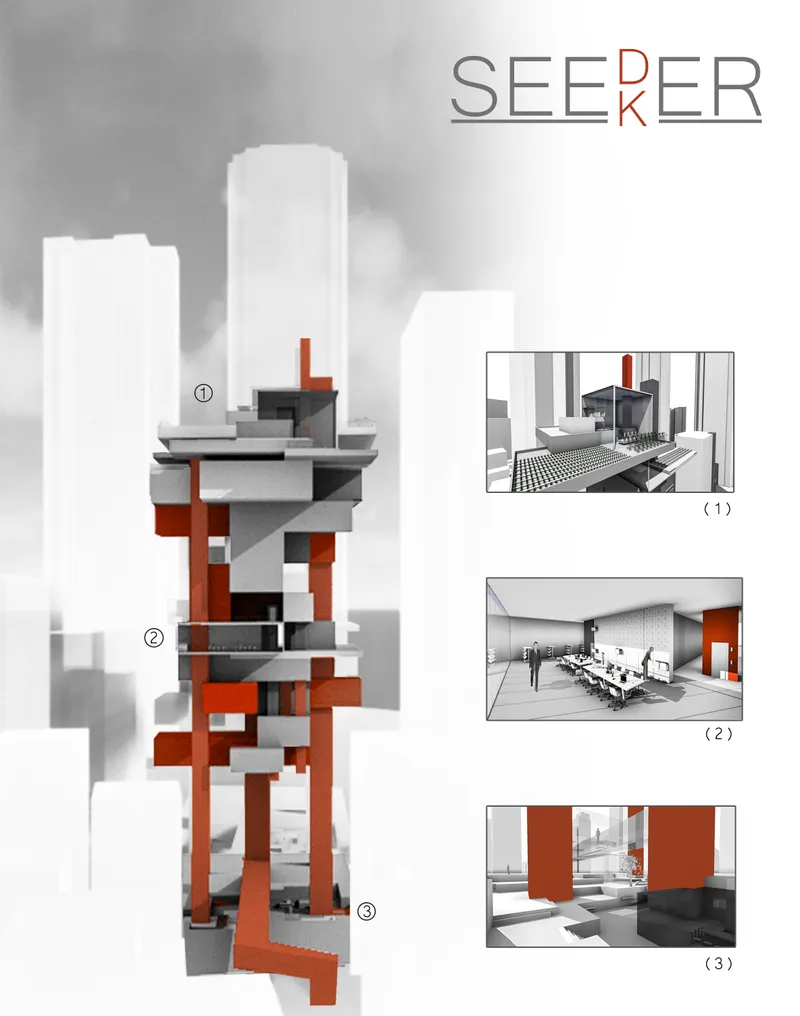
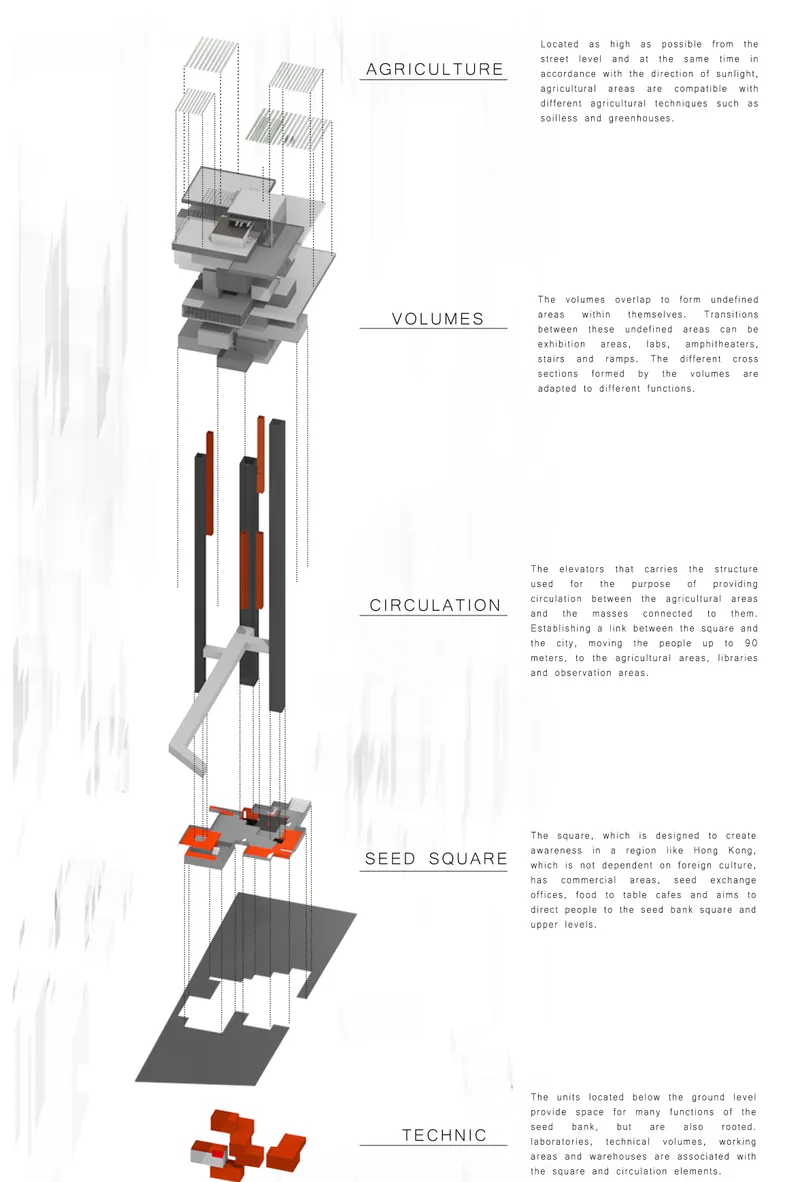
The tower's organizational logic is legible at a glance in the axonometric drawings. A central structural spine serves as both circulation core and service backbone, connecting a series of floating volumes that read as distinct programmatic blocks: agricultural plots, living areas, research labs, observation spaces, and seed exchange hubs. Each volume is positioned according to sunlight availability and functional need, which means the tower isn't a uniform extrusion but a calibrated stack of red and grey components interspersed through white masses.
The exploded axonometric breaks the system into its constituent layers: agriculture at the top for optimal solar exposure and air quality, adaptable volumes in the middle, multiple circulation cores, the Seed Square at ground level, and a technical substructure below grade. What makes this decomposition compelling is that each layer operates with a degree of independence. Human movement, product transport, and water circulation are handled by separate vertical cores, a separation that ensures sanitation and makes the system scalable for larger urban applications.
Interior Atriums That Feel Like Vertical Parks
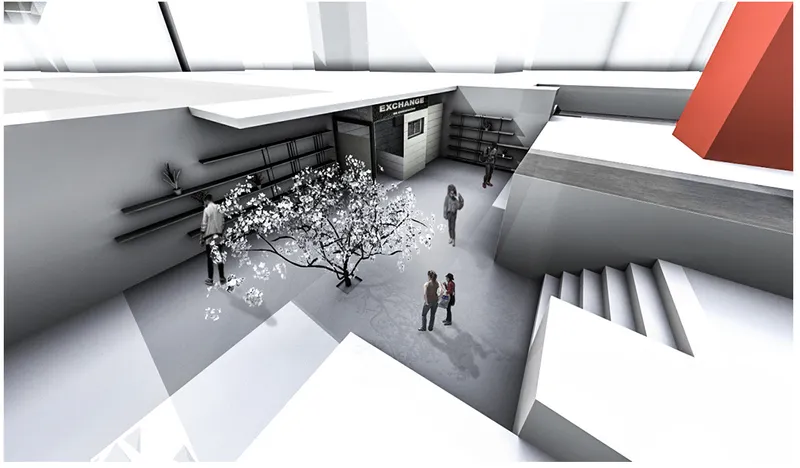
The rendered interior view reveals what these floating volumes actually feel like from the inside. A multi-level atrium opens vertically, connected by angular staircases that create sightlines across floors. A flowering tree anchors the space, making the point that this is not a sterile lab or a utilitarian greenhouse but a communal environment where agriculture, education, and daily life overlap. Figures populate the terraces and walkways, suggesting a building that functions less like a tower and more like a vertical village.
Terraced Farming Above the Pollution Line

The section perspective is where the project's ambition becomes spatially tangible. Terraced planted levels step upward, each receiving direct sunlight, while a red vertical circulation element threads through the section like a visible artery. The highest levels are dedicated to soilless and greenhouse-based agriculture, strategically placed where air quality is cleanest and solar exposure is greatest. These farms connect directly to communal spaces and food labs, enabling farm-to-table practices without ever leaving the building. The section also makes clear how the 20-meter elevation of the primary ground plane creates a distinct atmospheric break from the street below.
Seed Square: Where the Tower Meets the City
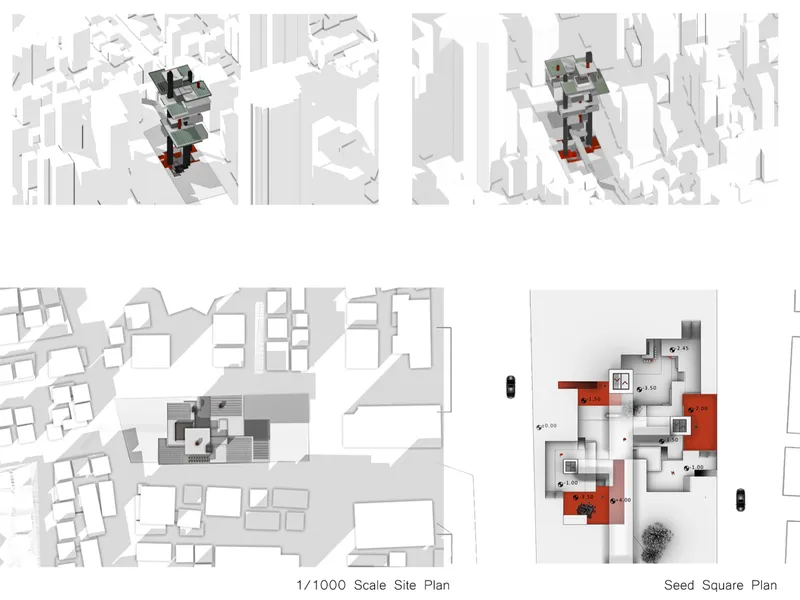
At the base of the tower, the Seed Square acts as a civic plaza and social node designed to draw people into the vertical ecosystem. The site plan drawings show the tower in its urban context, surrounded by the dense high-rises of Central Hong Kong, while the detailed plan reveals the ground-level programme: seed exchange offices, urban cafes, and small shops promoting sustainable consumption. It is the public front of an otherwise vertical operation, and its role as an entry point is critical. Beneath the Seed Square, a technical substructure hosts labs, warehouses, and service functions that keep the agricultural cycles running.
The adaptability of the volumes above the Seed Square deserves attention. Exhibition spaces, research zones, amphitheaters, and educational facilities are all accommodated within forms that shift dynamically based on the sun's angle and user needs. SEE(K)DER is not designed as a fixed programme tower but as a living framework that evolves seasonally and socially.
Why This Project Matters
The most provocative move here is not the vertical farming itself, which has been explored extensively in speculative architecture, but the decision to treat altitude as a design resource. By identifying the 20-meter threshold as the line where air quality becomes viable for agriculture, P G and Pelin Yalçın ground their speculation in a measurable environmental condition. The tower is not tall for the sake of ambition; it is tall because the air at ground level is unfit for growing food.
SEE(K)DER also resists the common trap of treating vertical farms as sealed, technocratic machines. The integration of public programme at the base, communal atriums in the middle, and open greenhouse terraces at the top creates a social gradient that mirrors the atmospheric one. It argues that urban agriculture cannot succeed as infrastructure alone; it needs the civic framework to sustain public engagement and cultural meaning. In the context of the Seed Bank competition, which asked designers to rethink how cities store and distribute biological resources, this entry offers a compelling answer: stack the entire system vertically and let people live inside it.
View the Full Project
About the Designers
Designers: P G, Pelin Yalçın
Enter a Design Competition on uni.xyz
uni.xyz runs architecture and design competitions year-round that reward proposals with spatial conviction and real site intelligence.
Project credits: SEE(K)DER by P G, Pelin Yalçın Seed Bank (uni.xyz).



Popular Articles
Popular articles from the community


Conexión: Biophilic Design Reimagines High-Rise Living in Hong Kong
Conexión reimagines high-rise living in Hong Kong through biophilic design, green facades, shared spaces, daylight, water and nature within.

Co-life: Sustainable Architecture for Age-Friendly Community Living
Co-life reimagines sustainable architecture for seniors through courtyards, rammed earth, shared gardens, and spaces designed for belonging.

Co-Life: Senior Housing Design That Reconnects Older Adults With the City
Co-Life reimagines senior housing design through healing gardens, shared streets, workshops, and a sustainable community across generations.

The Ocean Hive: Sustainable Architecture for a Self-Sufficient Civilization at Sea
The Ocean Hive imagines sustainable architecture at sea, where modular habitats, algae, wave power and ocean waste sustain a growing colony.


Similar Reads
You might also enjoy these articles

Day and Night Park: A Time-Based Urban Newsstand in Beijing
A temporary urban newsstand in Beijing blending travel, light, and reading through poetic colors, compact form, and community-focused design.

Modernist Patio Renovation in El Masnou, Barcelona by Oliver Segura Arquitectura + Cebrià Arquitectura
Modernist patio renovation blending tradition and innovation with a movable pool, leveled floors, and Catalan materials in El Masnou.

Alto Residencial Coop: Cooperative Housing Development in Santiago de Compostela by Carbajo Barrios Arquitectos
A linear cooperative housing complex blending white volumes and perforated metal façades, enhancing community living, natural light, privacy, and urban integration.
Vil Genis School by BPA ARCHITECTURE – Massy, France
Vil Genis School in Massy, France, features sustainable design, south-facing classrooms, community integration, accessible spaces, and modern educational architecture.




Comments (0)
Please login or sign up to add comments
No comments yet. Be the first to comment!