
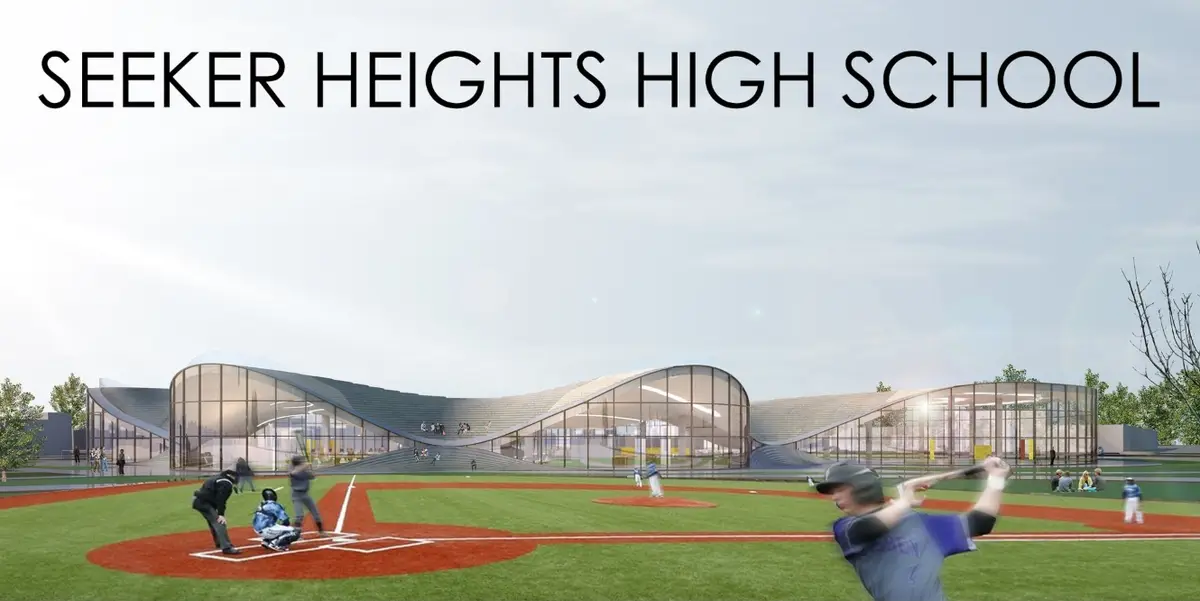
Seeker Heights High School: A Winning School That Trades Corridors for a Public Green Roof
A School Of Thought 2020 winner that wraps a wall-free learning field around a central Media Center and lifts a contoured green roof for the community.


Most schools are planned as a sequence of locked rooms strung along a corridor, a plan that quietly teaches students to sit still and wait for the bell. Seeker Heights High School starts from the opposite premise. Its students are called Seekers, its teachers become mentors, and its architecture removes the permanent walls that would otherwise decide how learning is allowed to happen. Above it all, a rippling green roof turns the school into a piece of landscape that the surrounding community can share.
Designed by Abolfazl Mekanik, Razi Shoaee and Mohsen Rezaie, the project was named the Winner of School Of Thought 2020. The team frames the brief around a pointed question: what should a school actually prepare students for? Their answer favours curiosity, collaboration and self-discovery over standardized memorization, and they translate that answer into open-field, project-based learning spaces that students can shape around their own interests and ambitions.
A Contoured Roof That Behaves Like a Park
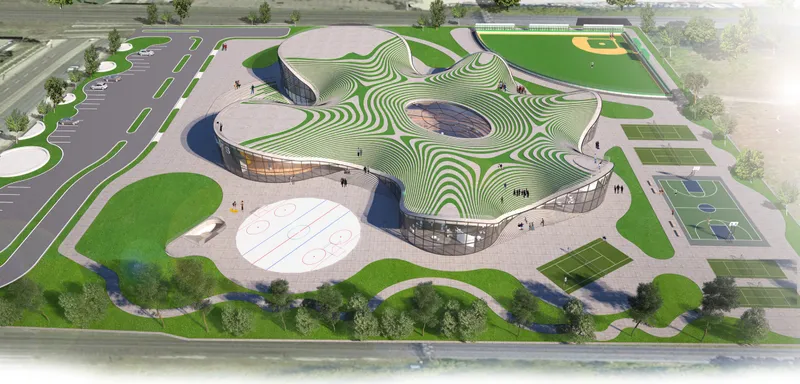
From above, the building barely reads as a building. Its roof is a field of green stripes that follow flowing, contour-like lines, so the mass seems to rise out of the ground instead of sitting on it. The aerial view places it among an ice rink, tennis courts, a basketball court and a baseball field, and the roof slips into that sporting landscape as one more surface for people to occupy. The designers treat it as an environmental layer and as public, communal space at once, which is the project's sharpest move: the school's largest surface belongs to the neighbourhood as much as to its students.
That decision does real work. A rooftop that invites the public establishes a landmark without relying on height or monumentality, and it sets up the everyday overlap between students and local residents that the team describes as central to the brief. The undulating geometry blurs the edge between architecture and ground, and in doing so it softens the institutional boundary a school usually draws around itself.
Glass Edges That Keep the Inside on Display
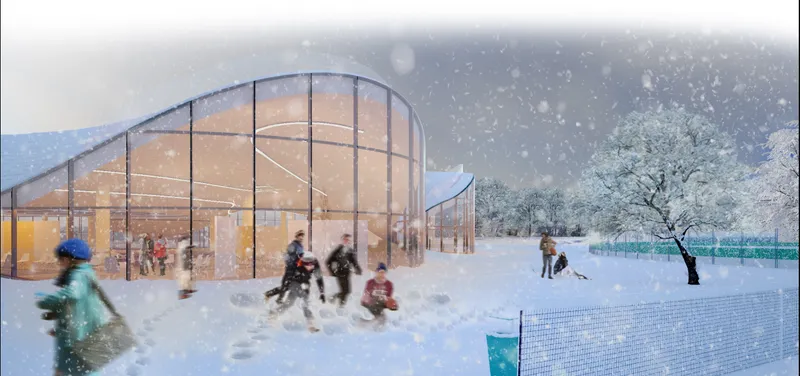
At ground level the curvilinear form opens into long runs of curved glazing. In the winter rendering the facade glows warm while children in coats run through falling snow past a frosted tree, a scene that shows how transparency operates in both directions. From outside, the activity within is visible and approachable; from inside, students keep a constant visual connection to the seasons and the street. The designers use these large glazed facades to pull natural light deep into the plan, linking openness as an idea to the well-being of the people inside.
The curve matters as much as the glass. A building with no hard corners produces circulation with no hard endpoints, and the team describes a continuous movement system that replaces compartmentalized corridors with interconnected zones. Moving through the school becomes part of the social life of the school, where chance encounters are built into the route rather than left to the cafeteria.
A Sunken Core and Studios Without Fixed Walls
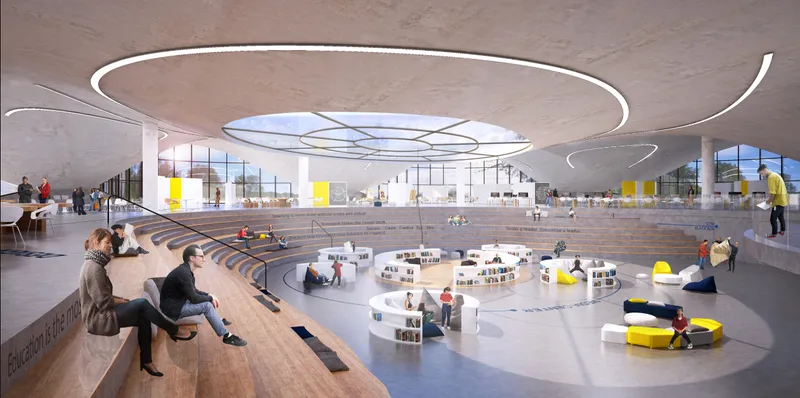
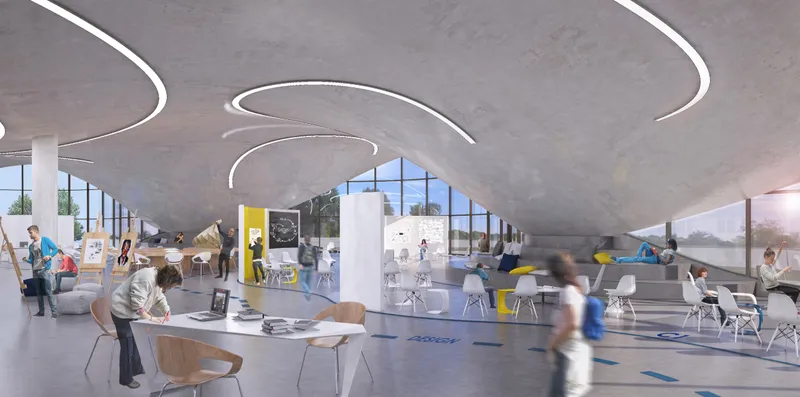
The interiors show where the pedagogy settles into form. A sunken reading hall steps down in timber tiered seating, ringed by round white bookshelves and lit by a circular skylight above, so reading, gathering and informal presentation can all happen on the same terraces. It matches the role the team gives to the Media Center, which sits at the heart of the plan as the intellectual and social nucleus. Around that hub they arrange discussion wings, collaborative workspaces, maker spaces, commons and open learning zones, a sequence organized by kinds of activity rather than subjects or grade levels.
The studio view extends that logic. Under a sweeping concrete ceiling hung with ring lights, easels and white tables sit loosely among wooden chairs while students pass through in daylight. Nothing here looks permanent, and that is deliberate: without fixed partitions, the school can be reconfigured as educational and community needs change. It is the spatial counterpart to the team's rejection of repetitive homework in favour of real-life projects, and to their recasting of teachers as mentors who guide individual learning journeys instead of lecturing from the front of a room.
Why This Project Matters
Seeker Heights is convincing because its architecture and its pedagogy describe the same thing. Removing permanent walls means little if the timetable still sorts students into boxes, and student-centred learning stays abstract if the building keeps funnelling everyone down corridors. Here the open plan, the continuous circulation and the central Media Center each turn the educational argument into a spatial one, which is likely why the jury singled it out among the School Of Thought 2020 entries.
The roof carries the larger lesson. By handing its biggest surface to the public, the project treats the school as civic infrastructure rather than a sealed institution, a place where learning spills into the neighbourhood and the neighbourhood is welcome back in. Questions of acoustics, supervision and phasing would need resolving in a built version, but as a proposition it shows clearly that how we arrange space can change how young people learn to think.
View the Full Project
About the Designers
Designers: Abolfazl Mekanik, Razi Shoaee, Mohsen Rezaie
Enter a Design Competition on uni.xyz
uni.xyz runs architecture and design competitions year-round that reward proposals with spatial conviction and real site intelligence.
Project credits: Seeker Heights High School by Abolfazl Mekanik, Razi Shoaee, Mohsen Rezaie School Of Thought 2020 (uni.xyz).


Popular Articles
Popular articles from the community


Architekt Andreas Gruber Scatters 23 Dark Timber Chalets Across a South Tyrolean Forest Edge
In Molini di Tures, Amonti Chalets breaks a resort into a hamlet of gabled timber houses, with parking, storage and services pushed into the slope.

longwave studio Reorganizes a 112 m² Tainan Apartment Around the Daily Routines of a Family and Two Cats
In Tainan, Taiwan, birch plywood, rust-red furniture and a freestanding plaster wall link arrival, storage, work and family life in one apartment.

David Macias Steps a Doorless Stone and Plaster House Down a Tropical Colombian Hillside
In the humid hills of Colombia, Threshold House replaces the front door with an open void and terraces its 850 m² down the slope instead of fighting it.

Juan García Correa, John González and Claudia Rueda Sink a Circular Amphitheater into a Manizales Engineering Building
On the La Nubia campus in Manizales, Colombia, the S1 Building folds labs and offices into a hillside of ramped lawns that double as a campus route.

Similar Reads
You might also enjoy these articles
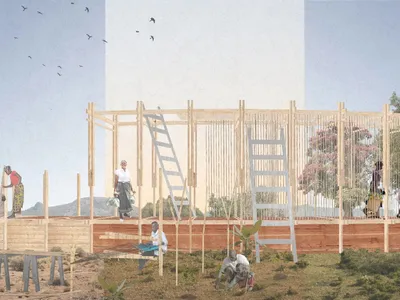
Healing Façade: A Modular Chapel System That Restores Ethiopia's Sacred Forests
Winner of the Eco-Chapel competition, this circular timber façade collects water from air to rebuild soil and reforest degraded Ethiopian landscapes.
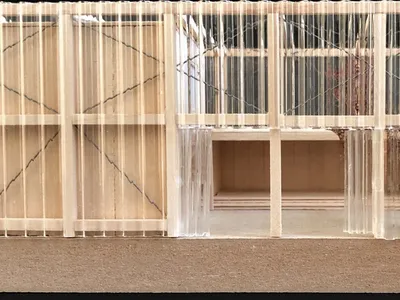
Kaffeebühnen: Where Coffee Shop Architecture Becomes a Civic Stage in Vienna
A linear sequence of timber boxes, transparent shells, and open yards turns the Viennese café tradition into a public performance space.
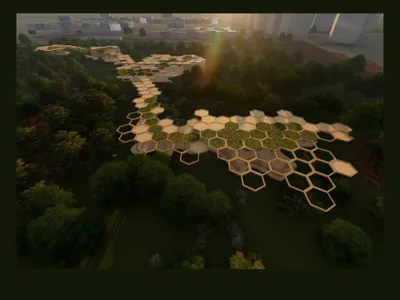
Eco Chapel: A Modular Forest Pavilion That Grows Like the Landscape It Protects
Hexagonal timber modules weave through existing trees, turning a chapel into a living system for prayer, education, and reforestation.


Urban Forest: A Vertical Ecosystem for 5,000 Workers in Singapore's Changi Business Park
Radially stacked pods and layered green decks turn a 7-acre plot into 47 acres of ecological workspace projected for 2040.

Explore Blocs Competitions
Discover active competitions in this discipline

Challenge to design public laboratory

Challenge to reimagine the Iron Throne

Photograph architecture without architects

Illustrate the lost glory of Angkor Wat - Render Challenge
Comments (0)
Please login or sign up to add comments
No comments yet. Be the first to comment!