
JOHO Architecture Gives a Fractured Korean Golf Clubhouse a Unified Timber Identity
A hybrid expansion in Gangwon-do, South Korea, turns a disjointed clubhouse into a campus organized by wood, light, and a new master plan axis.


Golf clubhouses rarely get serious architectural attention. They tend to accumulate mass over decades: a wing here, a locker room there, materials that have nothing to say to each other. The Seolhaeone Clubhouse in Gangwon-do, South Korea, was exactly that kind of building before JOHO Architecture was brought in to address an expansion triggered by new golf course holes. What principal Jeong Hoon Lee and his team delivered between 2020 and 2022 was not a cosmetic facelift but a full-scale master plan reconfiguration, one that reorganizes circulation, doubles the locker capacity through vertical expansion, and, most critically, introduces a material and formal language that ties an entire resort campus together.
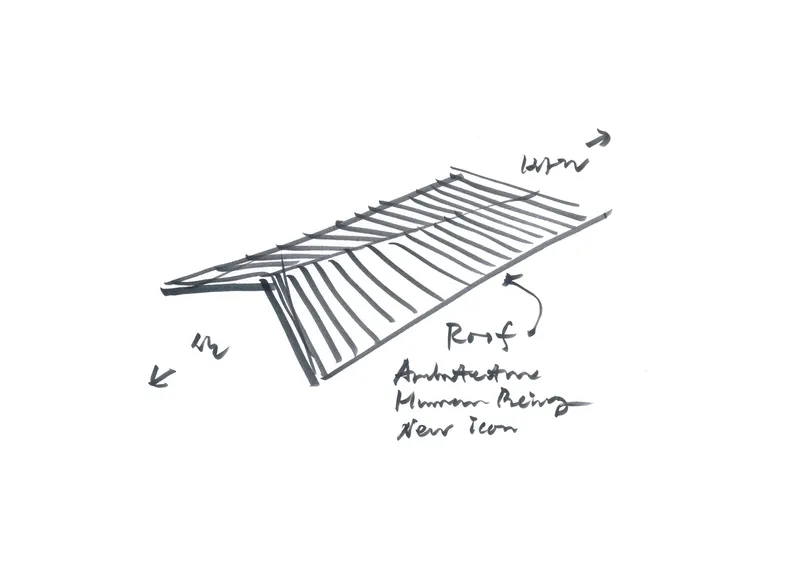
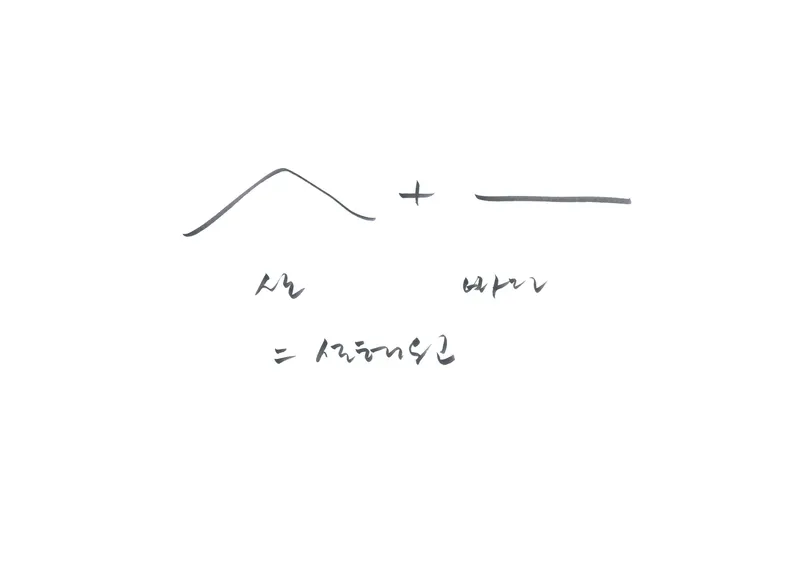
The interesting move here is the refusal to treat the expansion as additive. Instead of grafting new volumes onto an existing mess, JOHO rethought the hierarchy of the whole site, connecting the clubhouse to the adjacent Seolhae hot springs and golf hotel with a timber colonnade that functions as a new organizational spine. The roof, a hybrid of gable and flat forms, becomes a legible symbol from the approach road. It is a project about giving a place an identity it never had.
A Timber Canopy as Threshold
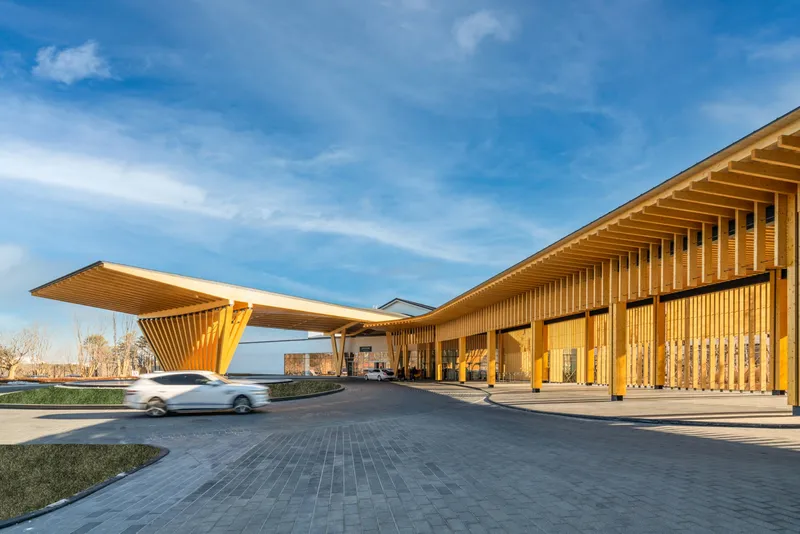
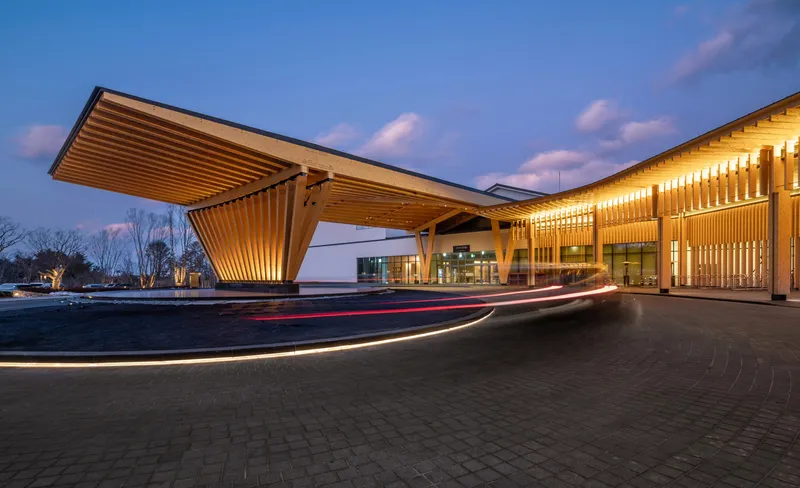
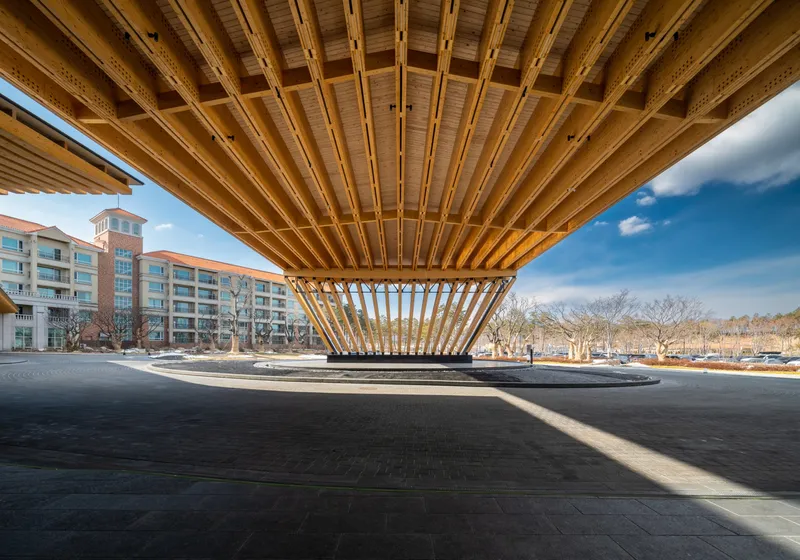
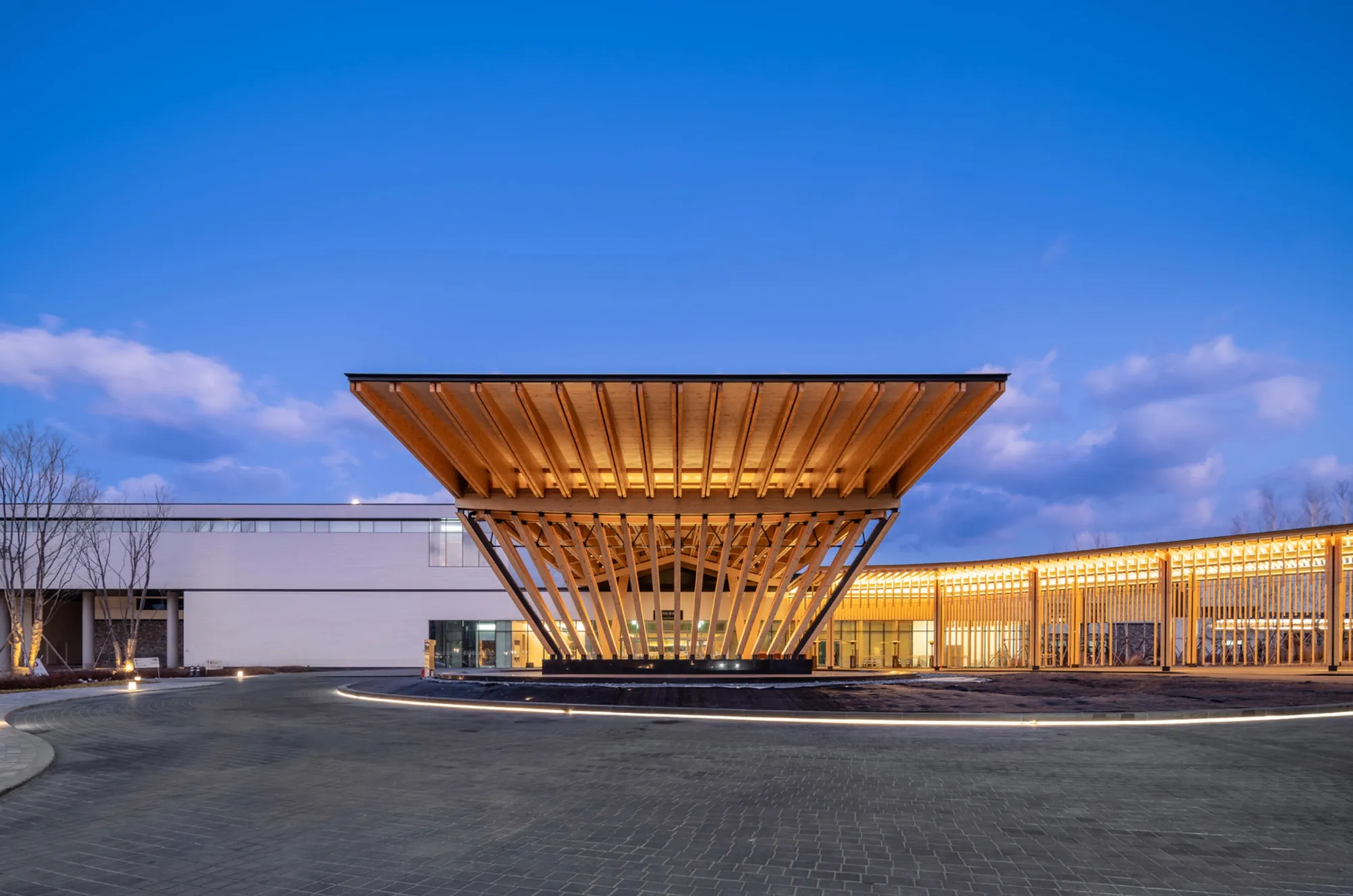
The arrival sequence is the first thing JOHO redesigned. A generous timber canopy with radiating glulam beams extends over the drop-off zone, its tapered profile directing guests toward glazed entry doors. At dusk, vehicle headlights streak beneath the cantilevered structure, and the soffit glows warm against the cold mountain air. The canopy is not decorative; it signals the transition from car to building and sets the material tone for everything that follows.
The underside reveals the structural honesty of the approach. Exposed joists and slats create a rhythmic pattern overhead, visible from the road and from the lobby within. Compared to the blank concrete and mismatched cladding of the original building, this single gesture does an enormous amount of work.
The Colonnade as Campus Connector
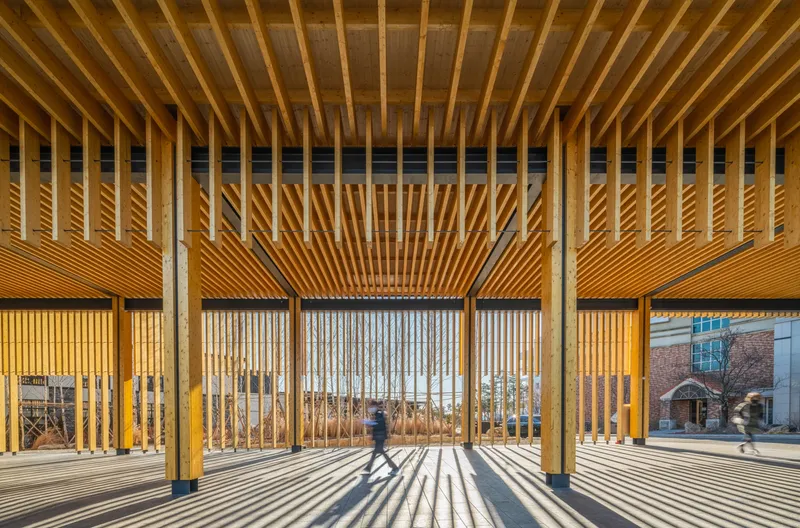
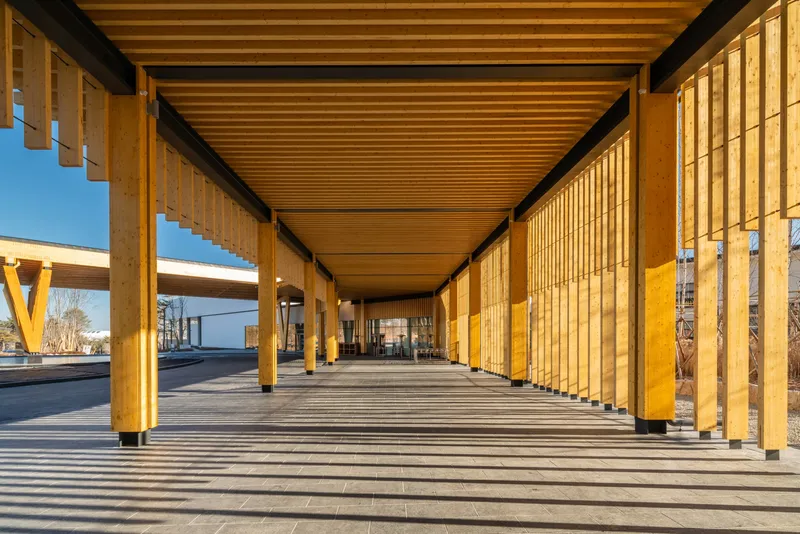
The wooden corridor linking the clubhouse, hot springs, and hotel is the most consequential piece of the master plan. It is not merely a covered walkway; it establishes a legible axis that organizes what was previously a cluster of buildings with no clear relationship. Vertical timber slats define the walls, casting parallel shadow stripes across the stone pavement that shift throughout the day.
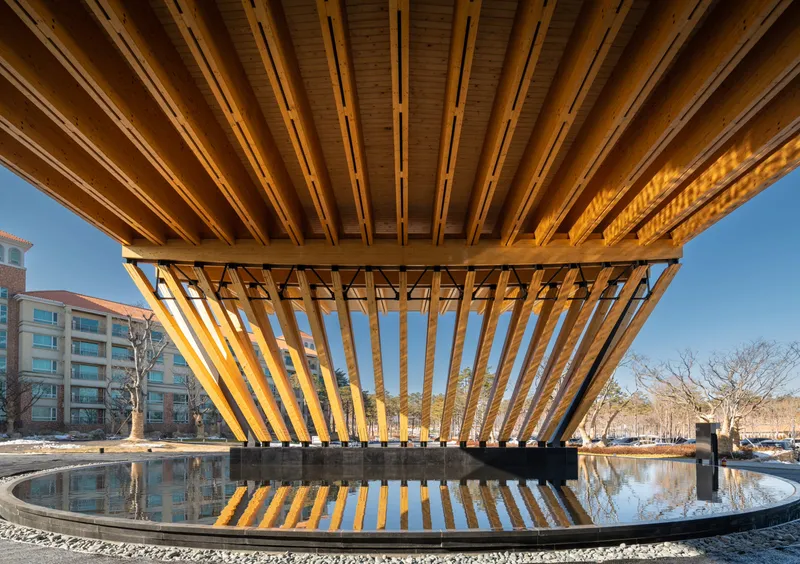
At the reflecting pool, the colonnade becomes almost landscape. Timber beams and slats are doubled in the shallow water below, blurring the boundary between structure and surface. The slatted enclosure filters wind and light without sealing the corridor off from the surrounding terrain, a decision that keeps the passage feeling generous rather than utilitarian.
Interior Light through Layered Skylights
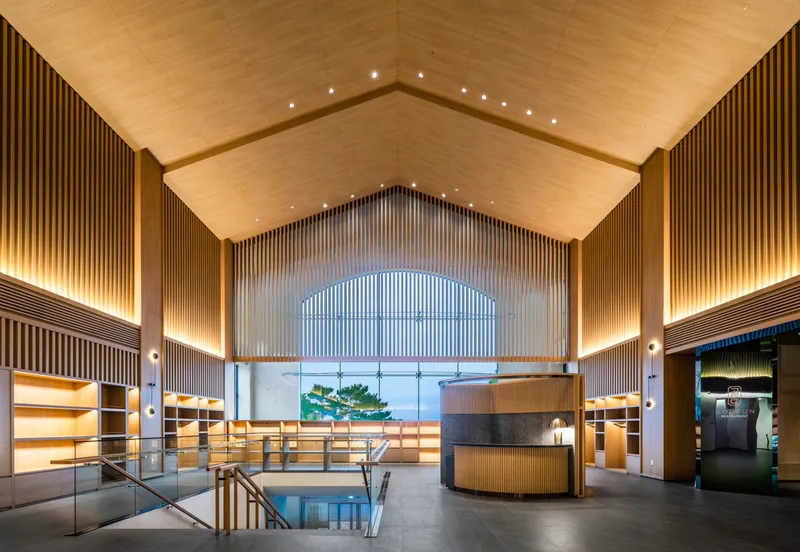
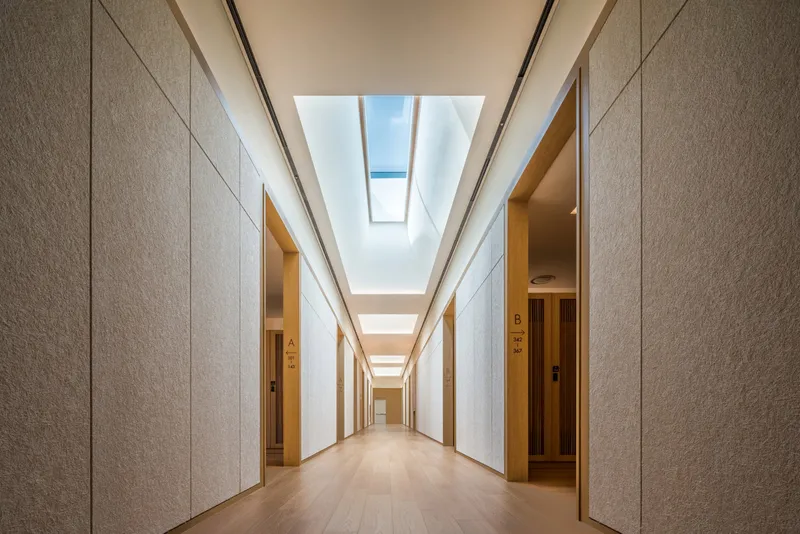
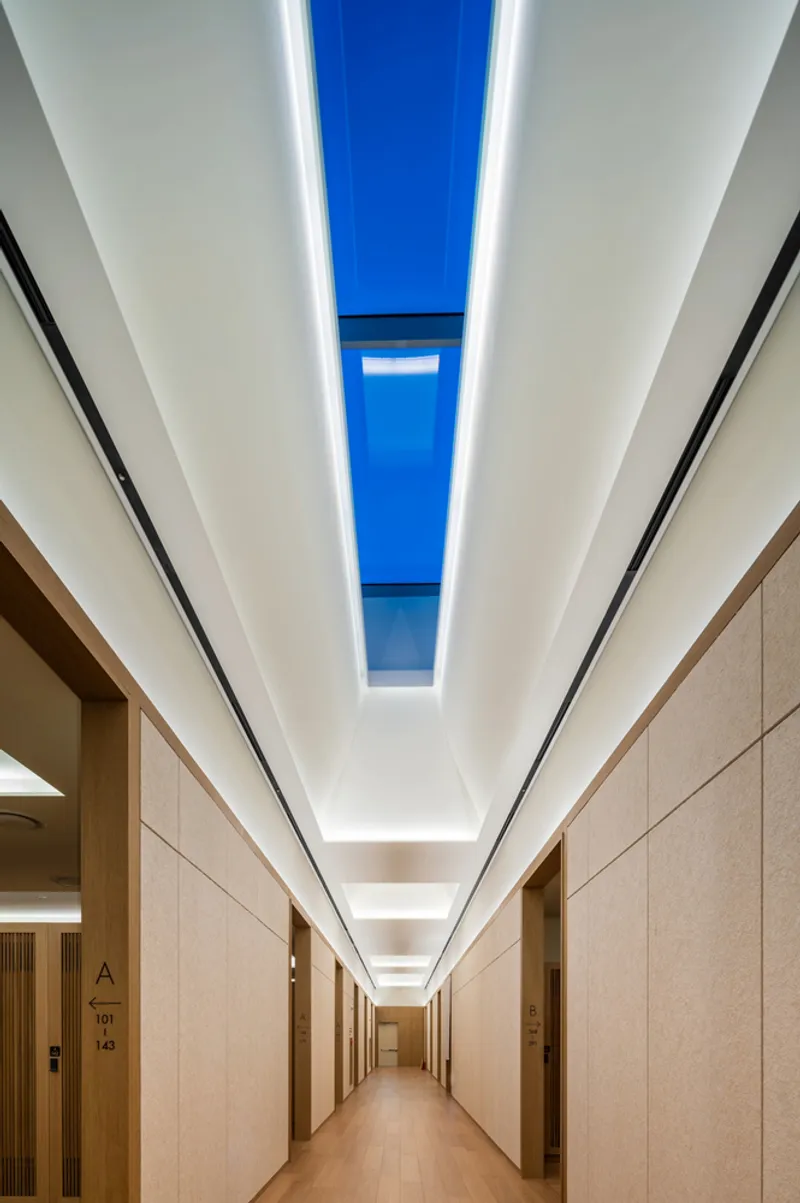
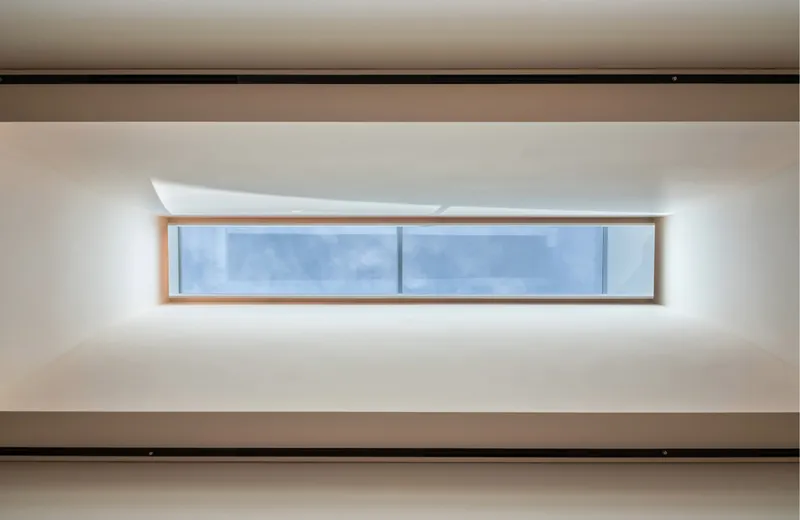
JOHO's daylighting strategy is one of the project's quieter triumphs. Because the roof combines gable and flat profiles at different heights, the architects were able to insert skylights of varying depths into the resulting level changes. The result is not a single flood of overhead light but a graduated series of illumination events: narrow slot openings that draw blue sky down into corridors, wider cuts that wash textured stone walls, and a vaulted timber ceiling in the reception lobby that catches and diffuses light from an arched window.
The linear skylights in the corridor sections deserve particular attention. Set between white ceiling planes and black structural beams, they create a precise architectural moment with minimal means. Light enters as a controlled line, reinforcing the directionality of circulation rather than competing with it.
Dining and Social Spaces
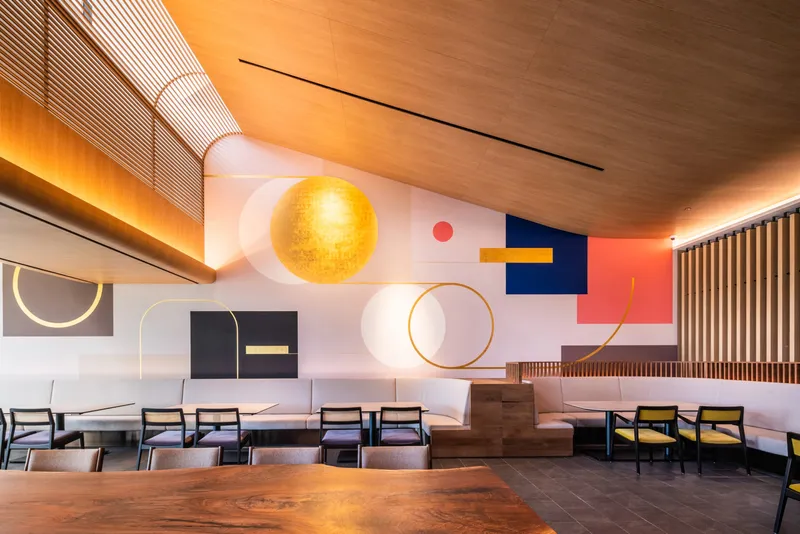
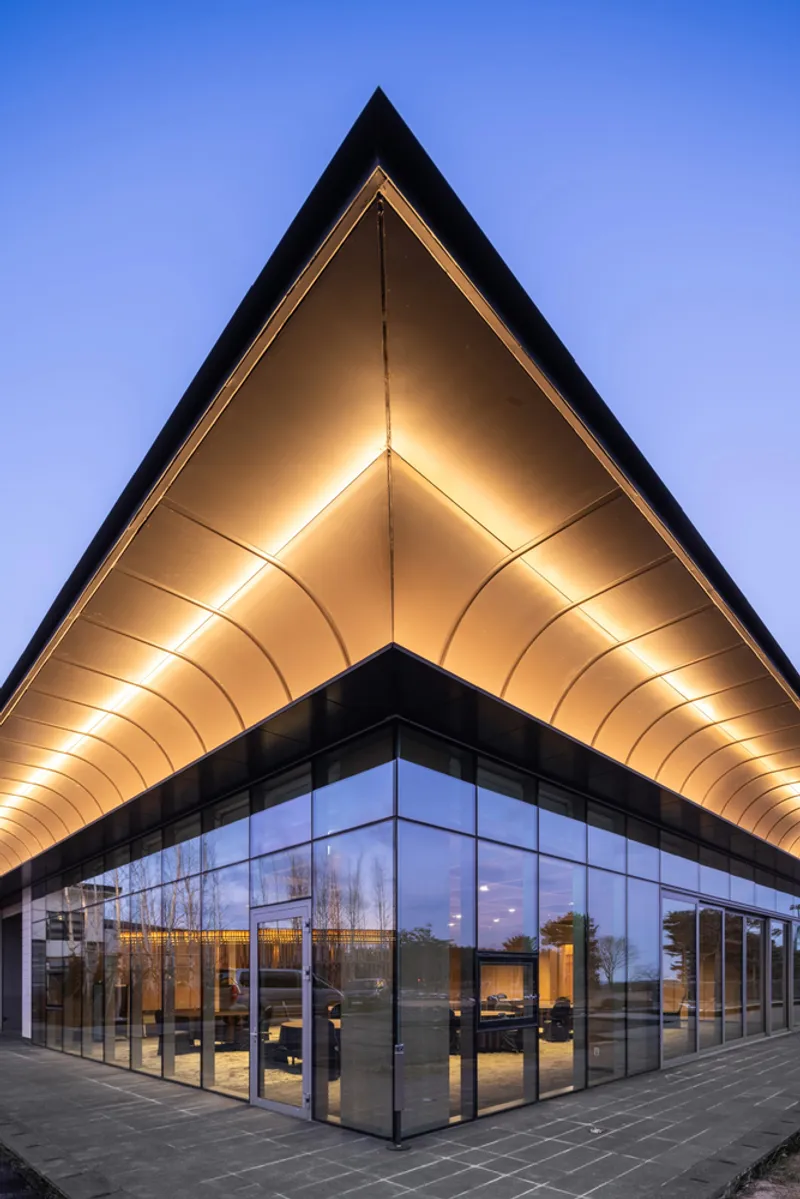
The expanded restaurant on the eastern side opens through full-height glazing to the golf course, a straightforward move that earns its place through careful execution. The dining hall interior pairs geometric wall graphics with a timber-clad curved ceiling and perimeter cove lighting, achieving atmosphere without resorting to opulence. This is a golf club, not a museum, and JOHO calibrates the register accordingly.
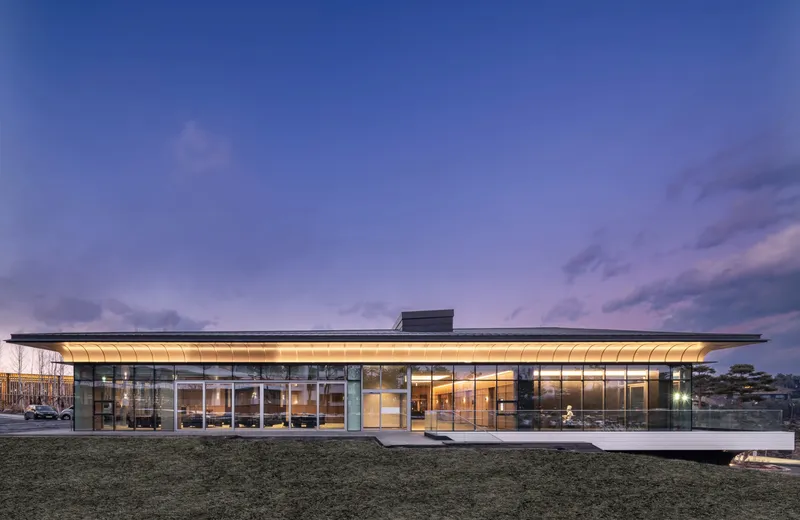
The glass-wrapped pavilion volume, visible at twilight as a lantern against the darkening landscape, houses additional dining and social functions. Its cantilevered roof and vaulted timber soffit are consistent with the canopy language at the entrance, tying the expanded program back to the project's material thesis. The continuity is the point: every new piece speaks the same language.
Facade Duality: West and East
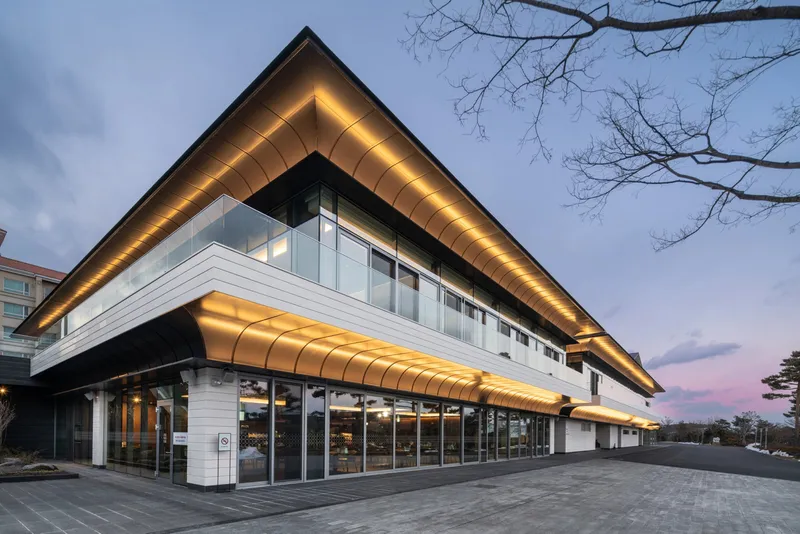
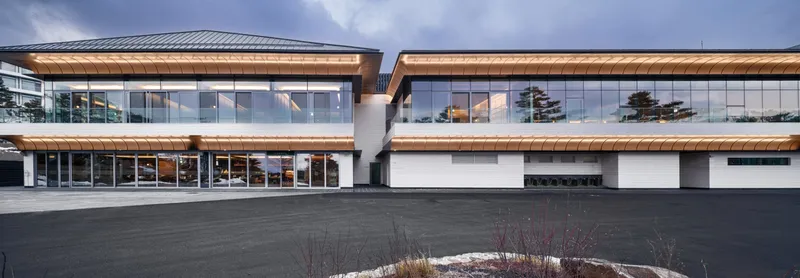
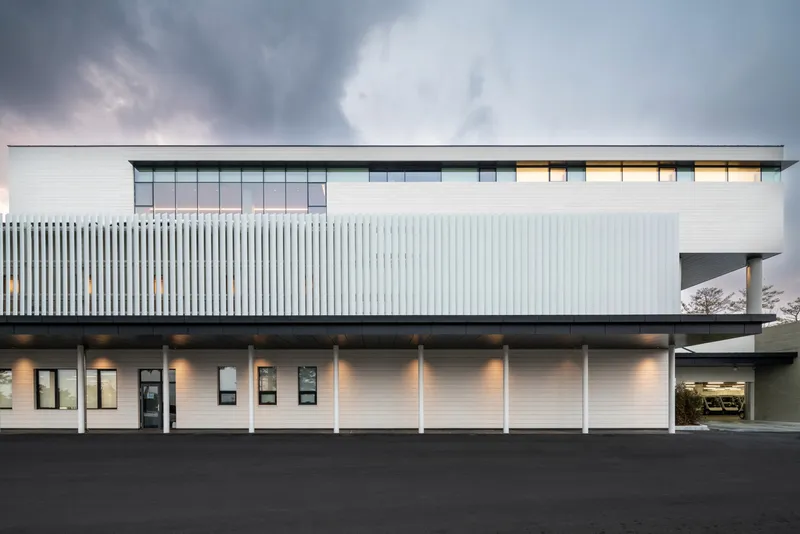
The project reads differently depending on which side you approach. The western facade, the primary arrival face, is defined by timber warmth: wood cladding, glulam structure, and the deep shadow of the entry canopy. The eastern facade, facing the starter house and the course beyond, shifts to a cooler register with curved metal eaves and white-paneled surfaces punctuated by vertical louvers. The duality is deliberate, reflecting the different programs and orientations each face serves.
The two-story section with continuous glazing and timber soffits facing an interior courtyard bridges these two languages. Sparse planting beds in the courtyard keep the composition disciplined. JOHO resisted the temptation to apply one material strategy everywhere, and the building is stronger for it.
Reflecting Pool and Roof Geometry
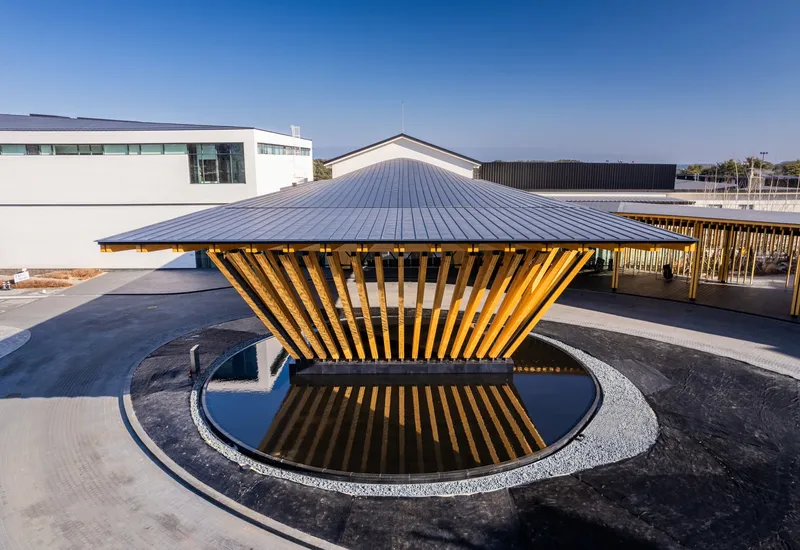
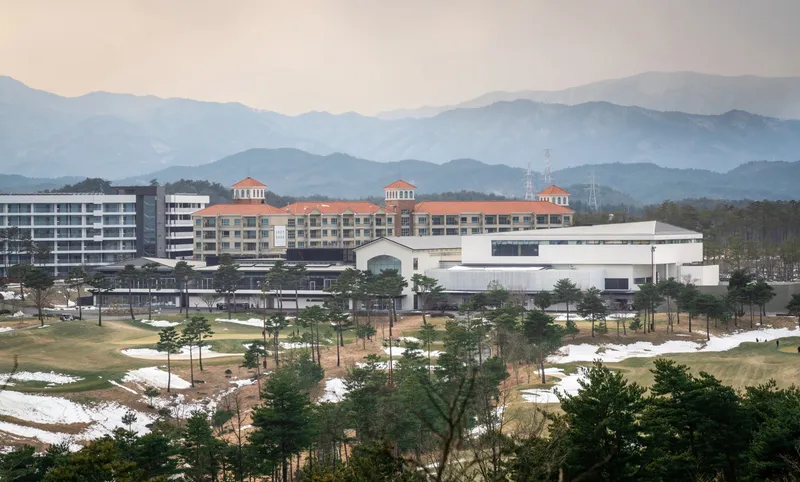
Seen from above, the freestanding timber canopy sits beside a circular reflecting pool that anchors the composition and provides a visual pause in the arrival sequence. The ribbed metal roof reads as a precise geometric object against the organic topography of the site. The wider view, with the white box volume set against hazy mountains and surrounding residential blocks, makes the scale of the intervention clear. At over 13,500 square meters of gross floor area on a 25,000-square-meter site, the building holds its ground without overwhelming the landscape.
Plans and Drawings
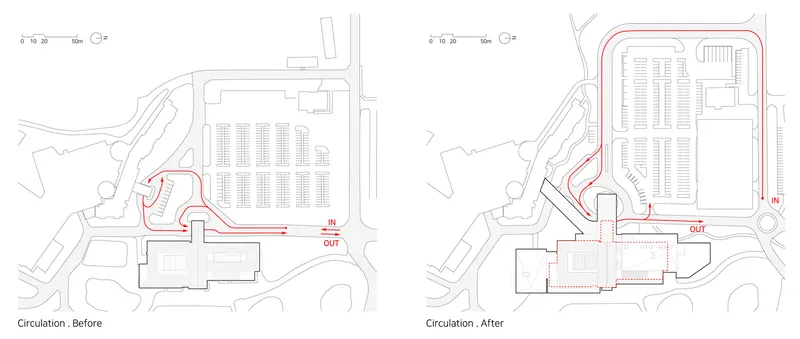
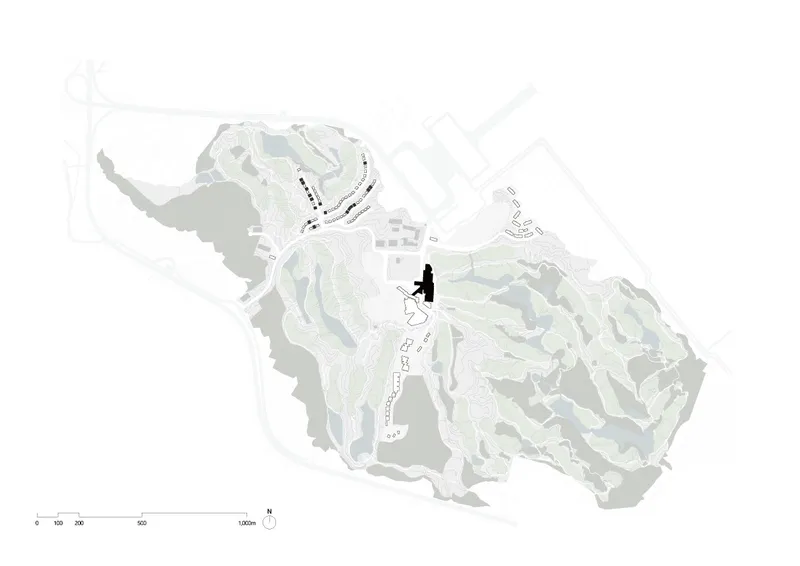
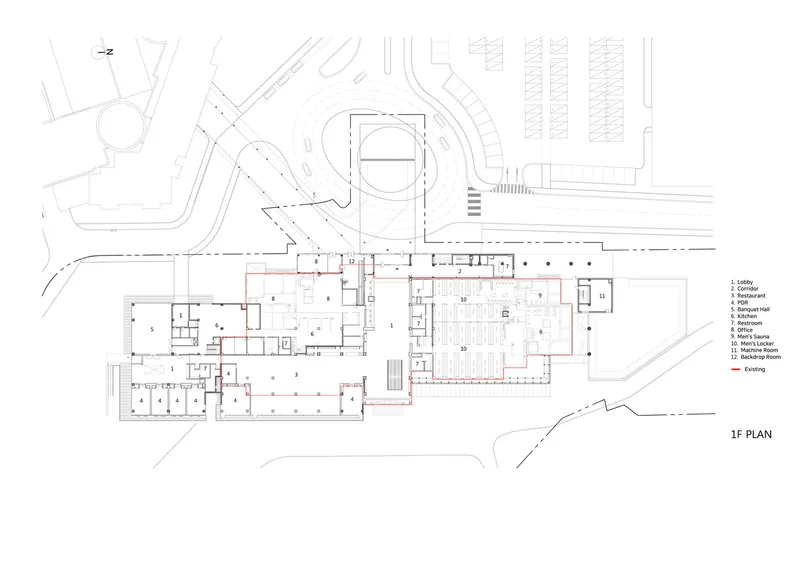
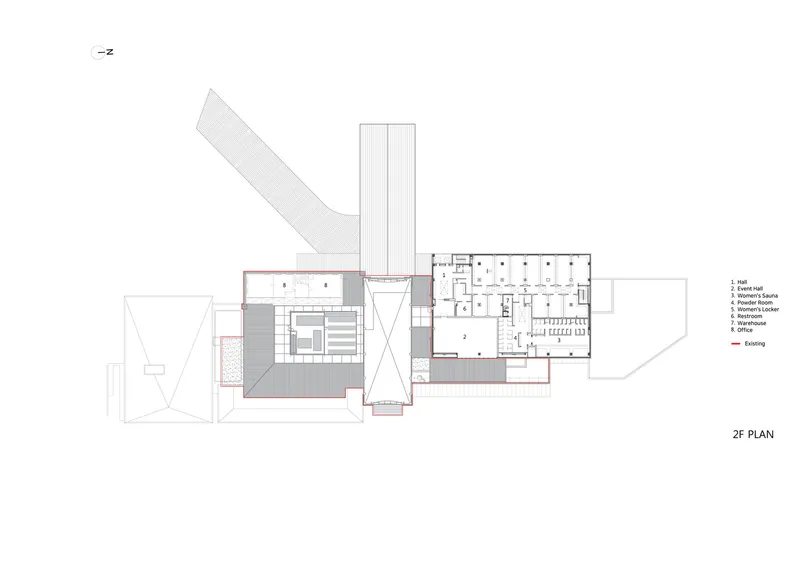
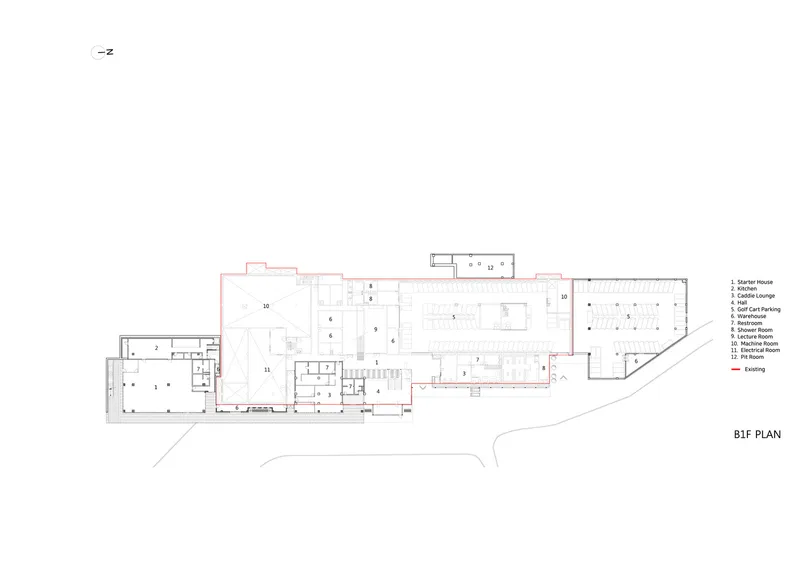
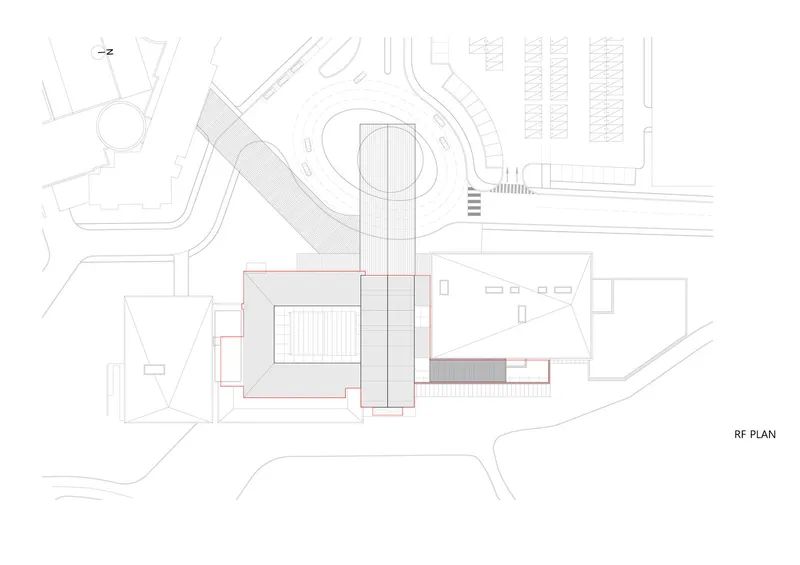
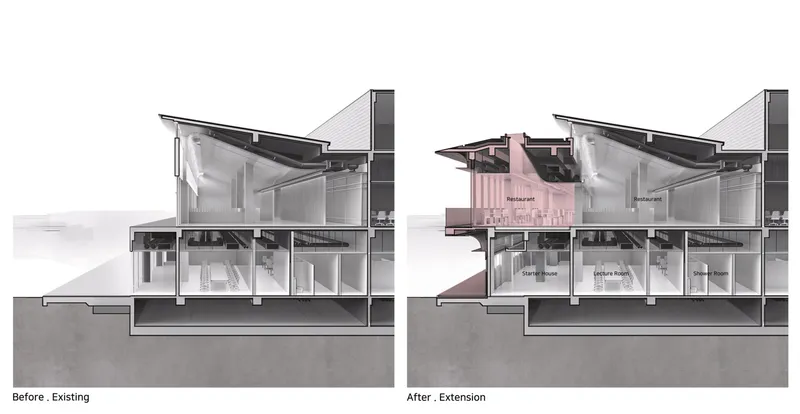
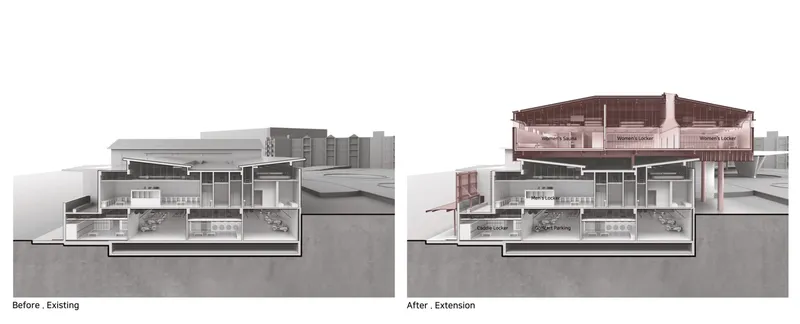
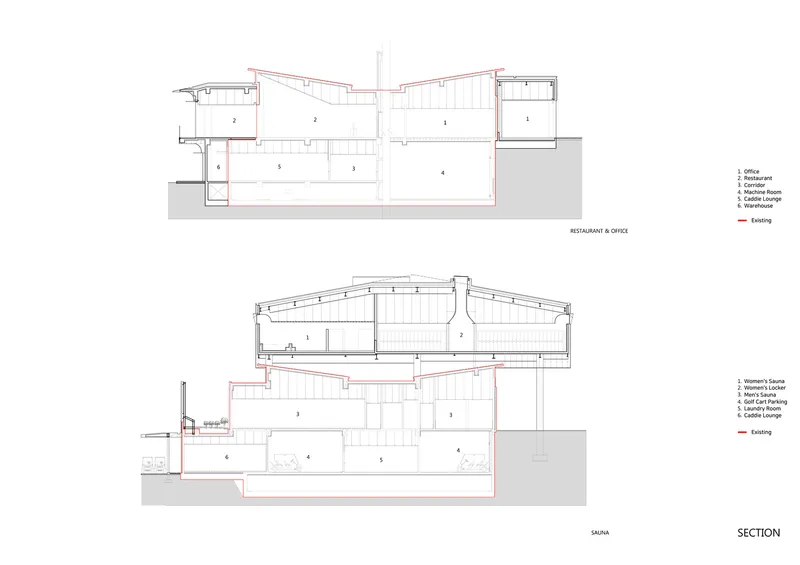
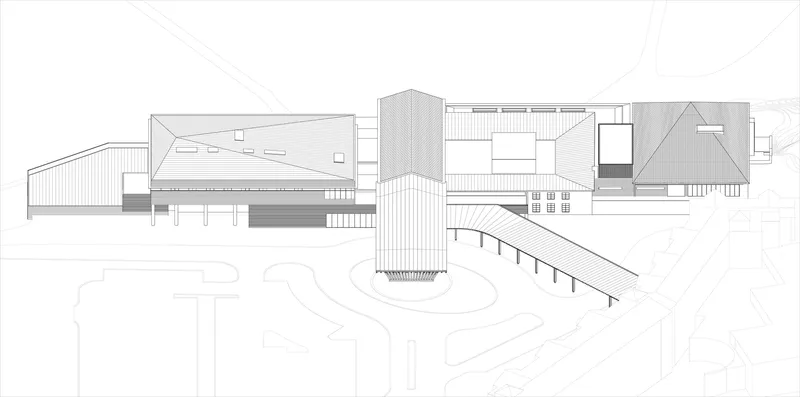
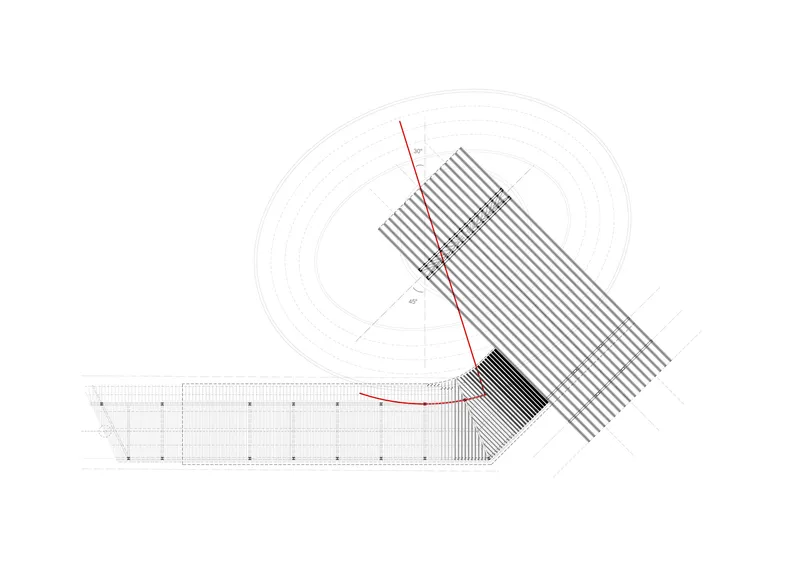
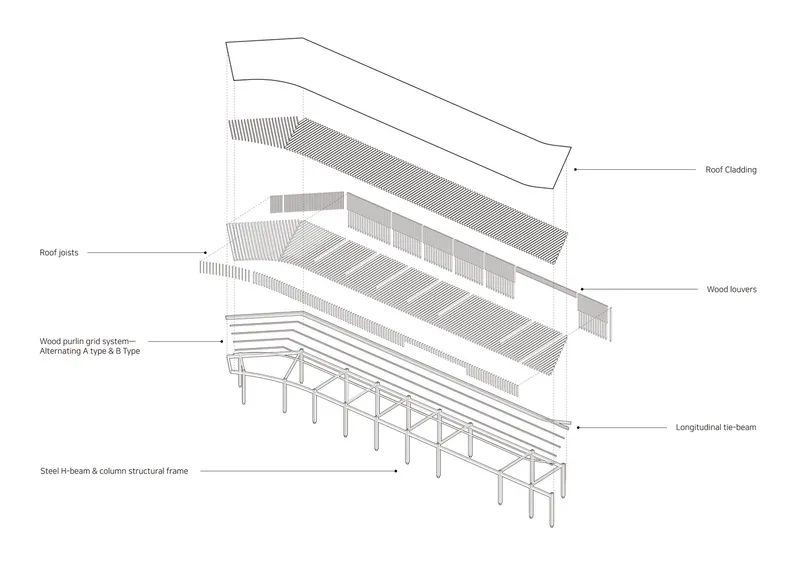
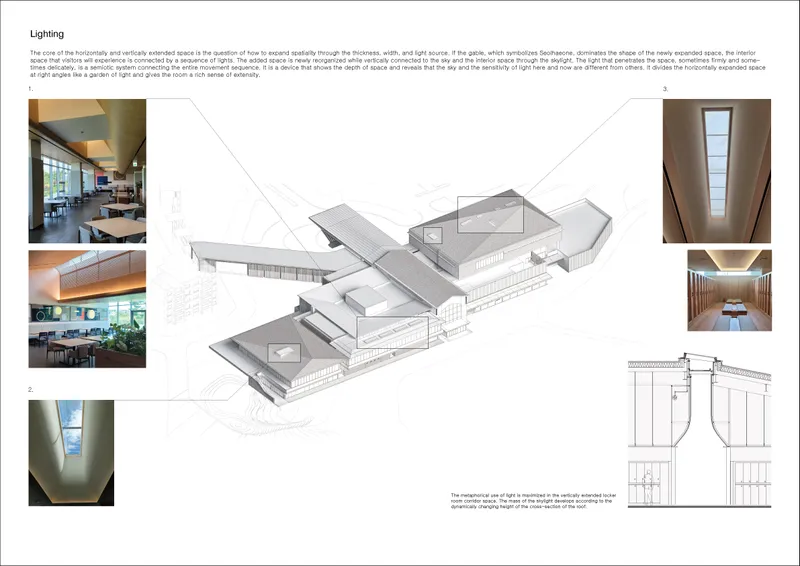
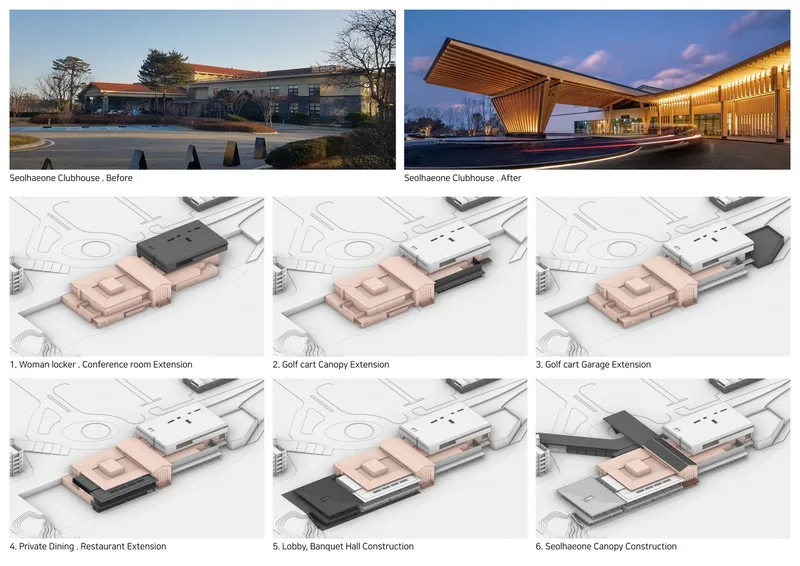
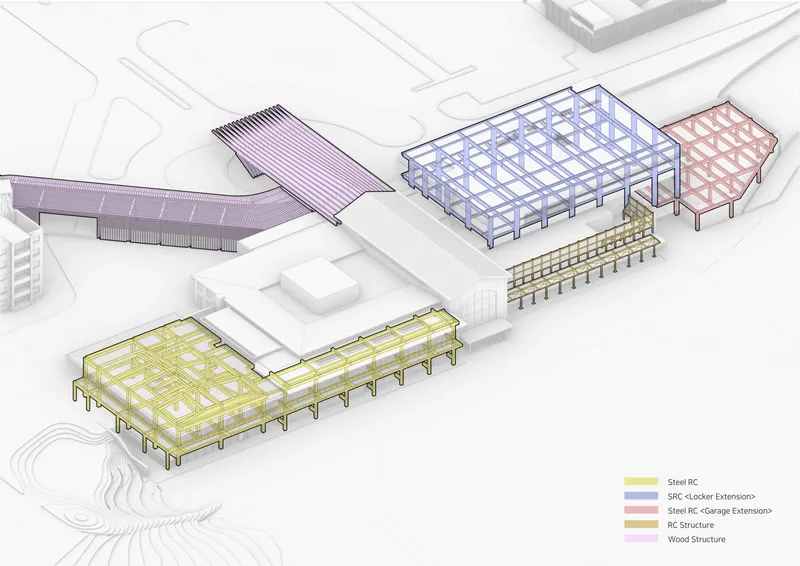
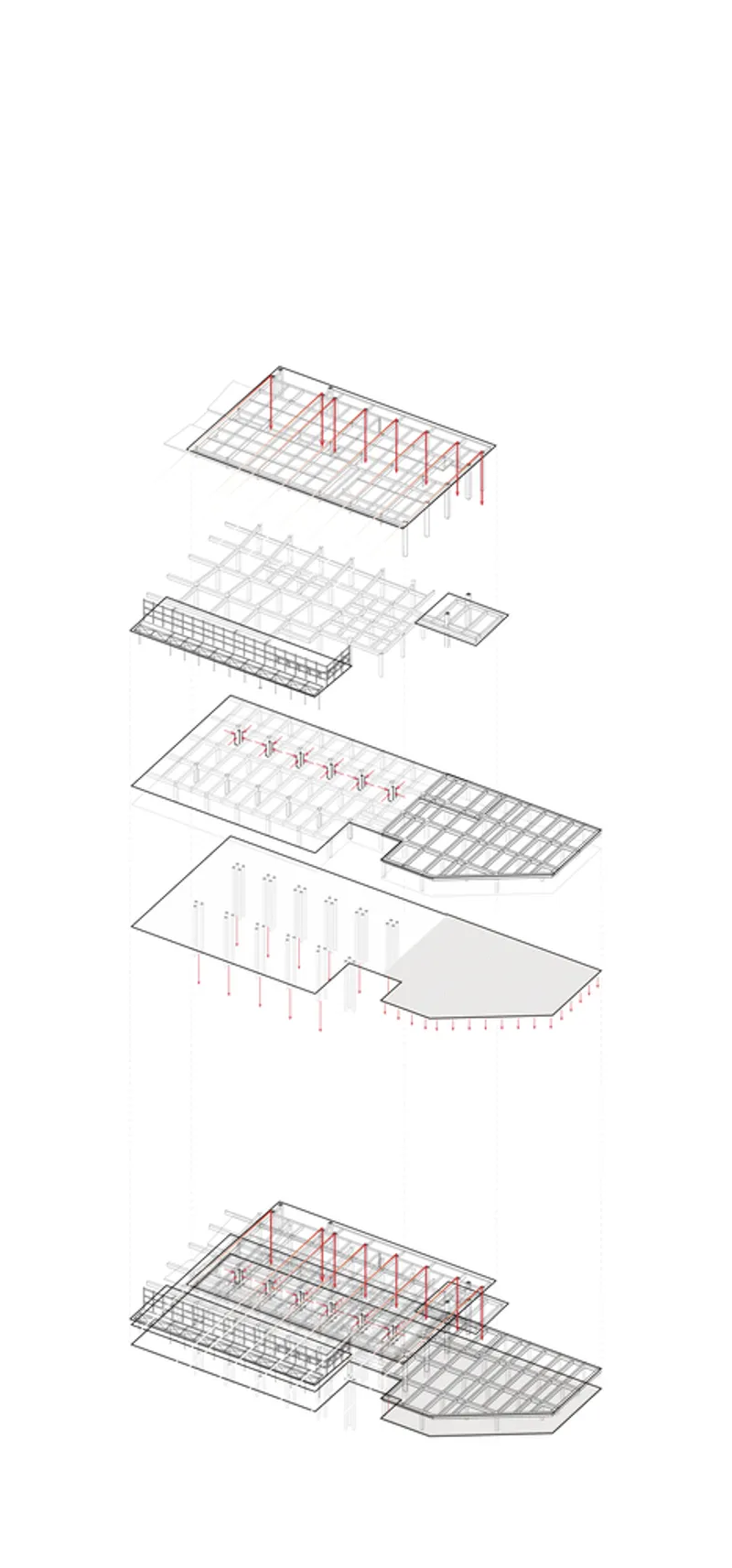
The site plan diagrams reveal the scope of JOHO's circulatory overhaul: red arrows trace the before-and-after movement patterns for customers, staff, and service vehicles. The floor plans show how vertical expansion allowed the second floor to absorb the women's locker program without sacrificing ground-level area. The section comparisons, with new volumes highlighted in pink and terracotta, are particularly revealing. They make visible how modest height additions, no more than 19 meters at the peak, transformed the building's profile without triggering the bulk that a purely horizontal expansion would have produced.
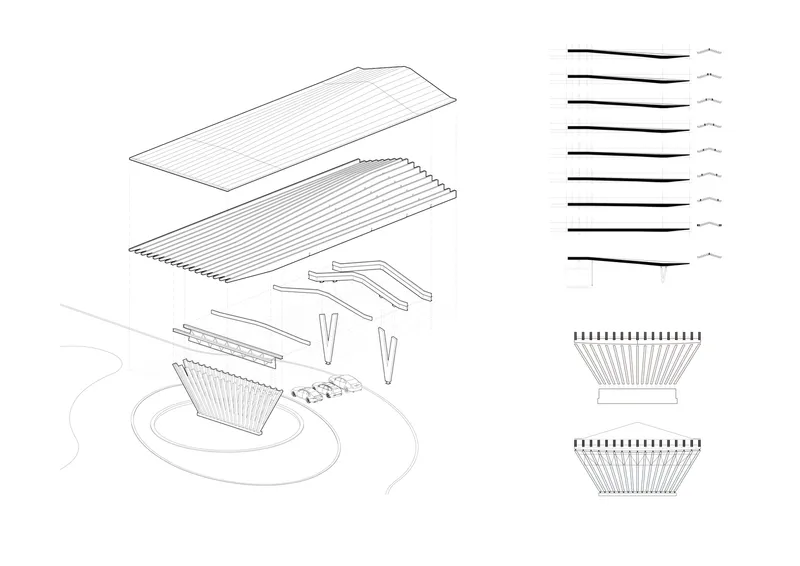
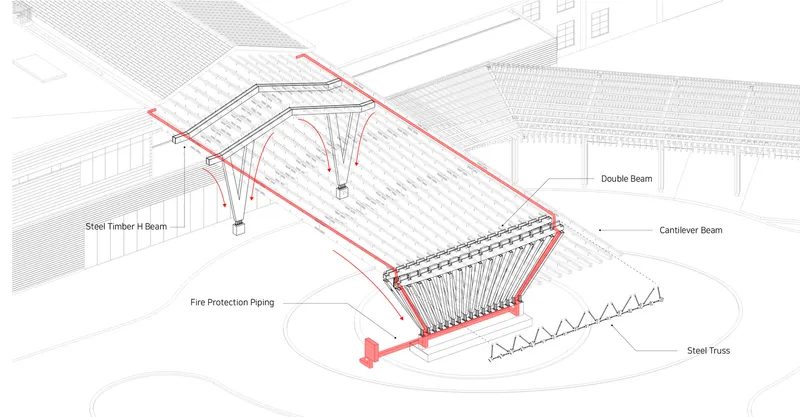
The exploded axonometric drawings of the roof assembly are worth studying closely. Multiple structural systems, reinforced concrete, steel-reinforced concrete, steel frame, and timber, are deployed in different zones depending on span and program. The color-coded structural diagram maps this hybrid logic across the plan, showing how the architects managed what is essentially a multi-system building under a single formal language. The phased construction sequence documents how the project was built in six stages, a pragmatic necessity given that portions of the existing clubhouse needed to remain operational throughout.
Why This Project Matters
The Seolhaeone Clubhouse expansion is a case study in how to fix a building that was never really designed. JOHO Architecture confronted a structure defined by material clashes and ad hoc additions and imposed a legible order on it, not through demolition but through strategic insertion. The timber colonnade, the hybrid roofline, the differentiated facades: each decision serves both a functional purpose and a compositional one. The project demonstrates that even building types considered architecturally unglamorous, like golf clubhouses, can reward serious design thinking.
More broadly, the project offers a model for campus-scale renovation in which a single material gesture, here the timber colonnade, can reorganize an entire site. The axis it creates is not a formal exercise; it physically connects programs that were previously isolated, improving the daily experience for hundreds of visitors. In a profession that often privileges the new over the remedial, this kind of intelligent repair work deserves attention.
Seolhaeone Clubhouse Architectural Expansion by JOHO Architecture. Gangwon-do, South Korea. Gross floor area: 13,564 m². Completed 2022. Photography by ARCHFRAME.
About the Studio
Share Your Own Work on uni.xyz
If projects like this are the kind of work you want to make, uni.xyz is a place to publish your own, find collaborators, and enter design competitions.



Popular Articles
Popular articles from the community


Play: Fragments of Their World
Familiar architecture becomes modular playground design, creating safe spaces where displaced children can learn, connect, imagine and play.

Co-Life: Senior Housing Design That Reconnects Older Adults With the City
Co-Life reimagines senior housing design through healing gardens, shared streets, workshops, and a sustainable community across generations.

Co-life: Sustainable Architecture for Age-Friendly Community Living
Co-life reimagines sustainable architecture for seniors through courtyards, rammed earth, shared gardens, and spaces designed for belonging.

Riyadh For All: Intergenerational Urban Design for Active Aging in Rabat
Riyadh For All reimagines urban design in Rabat with intergenerational co-living, adaptive courtyards, and Moroccan cultural exchange today.


Similar Reads
You might also enjoy these articles


Hodi-Mandai Geram
Project Function: Preservation and revitalization of the Intangible heritage and socio-spatial identity of the Hodi by Housing, Cultural Memory Center, Sacred Grove, landscape, local tourism economy


Olio Towers: A Mid-Rise for Performers That Fuses Housing, Rehearsal, and Stage
Located blocks from Houston's Theater District, this modular tower stacks living units around a central performance atrium.

Oasis: Modular Green Housing Carved into Dhaka's Urban Fabric
A shortlisted Plugin Housing entry reclaims unauthorized settlements in Dhaka with stepped concrete volumes, green roofs, and ventilation-driven design.

Black Hole: A Floating Megastructure for the Post-Physical Era
Emiliano Mazzarotto envisions a spherical, self-scaling arena where e-sports, digital hotels, and holographic stadiums replace traditional public space.


Explore Architecture Competitions
Discover active competitions in this discipline



Challenge to reimagine the Iron Throne


Photograph architecture without architects


Illustrate the lost glory of Angkor Wat - Render Challenge


Design challenge to reuse E-waste
Comments (0)
Please login or sign up to add comments
No comments yet. Be the first to comment!