
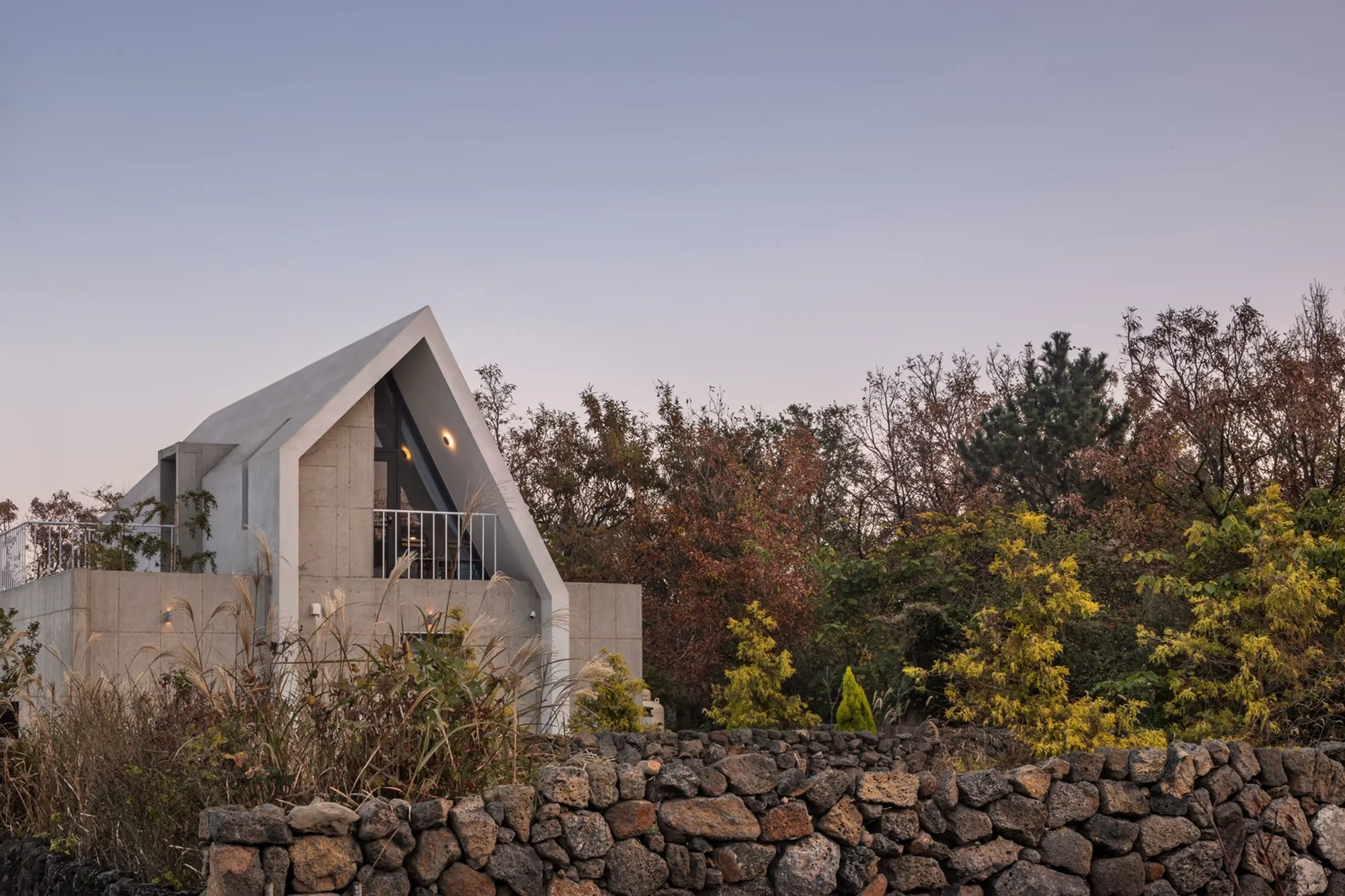
SOHUN Architects Nestle a Gabled Concrete Retreat into Jeju's Volcanic Forest Floor
Seon Heul Sup House carves a quiet domestic world between Gotjawal's ancient stone walls and autumn canopy on Jeju Island.


Jeju Island's Gotjawal forests are geologically young but ecologically dense, a terrain of rough basalt, tangled roots, and volcanic soil that resists the neat logic of suburban planning. Building here demands negotiation rather than imposition. SOHUN Architects & Planners understood that premise when they designed Seon Heul Sup House, a residence that splits its program into distinct concrete and metal-clad volumes, each one calibrated to the slope, the tree line, and the island's deep tradition of dry stone walls.
What makes the project genuinely compelling is how it refuses to sentimentalize its rural setting. There are no thatched references, no volcanic-rock pastiche. Instead the house operates with a clear structural vocabulary of board-formed concrete, white standing-seam metal, and sharply triangulated gable ends that frame the forest like apertures in a camera. The result is a building that belongs to its site not because it mimics it, but because it takes the same posture as the landscape: grounded, blunt, quietly dramatic.
Reading the Hillside
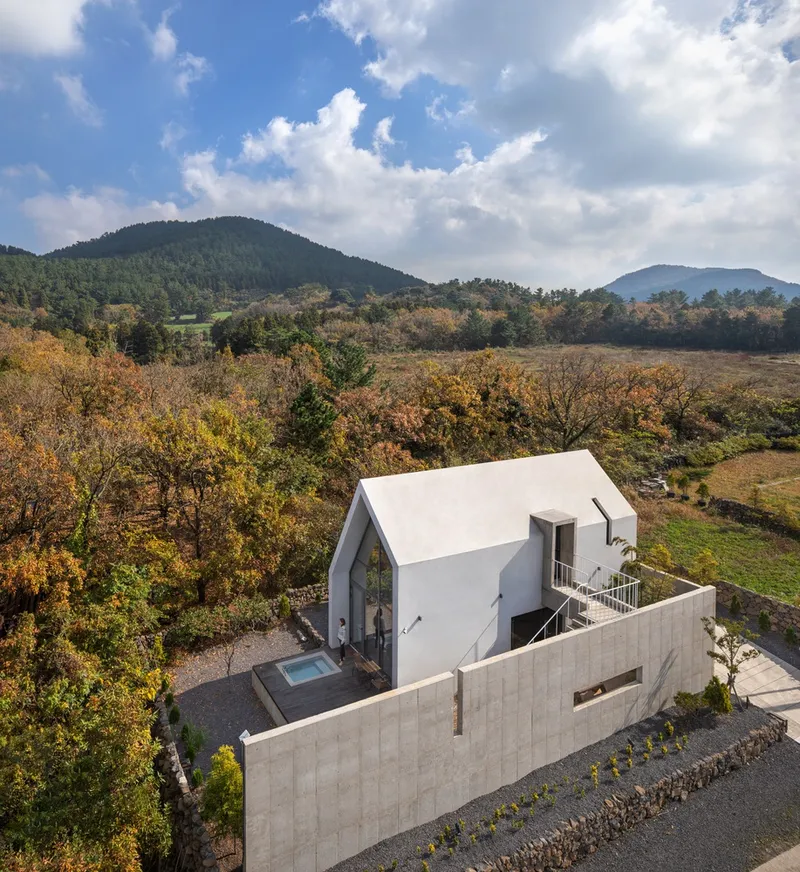
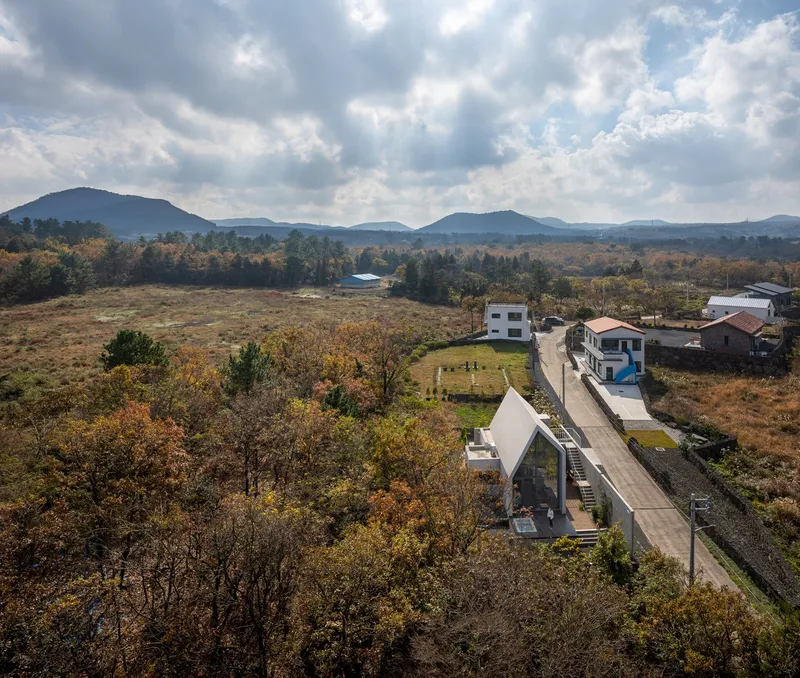
From the air the design logic becomes immediately legible. The house is not a single mass but a composition of volumes organized around a courtyard, enclosed by a long concrete boundary wall that traces the property edge much the way Jeju's traditional stone walls once partitioned farmland. The gabled white volume sits at a slight angle to the driveway, its ridge line parallel to the distant mountain peaks rather than to the road. It is a deliberate alignment, locking the building into the topographic grain.
Autumn foliage in the drone shots underscores how tightly the canopy presses against the perimeter. The architects left that proximity intact, allowing the trees to crowd the wall rather than clearing a buffer. The house doesn't command a panorama; it peers through gaps in the forest, which is a far more honest relationship with this particular terrain.
Concrete as Terrain
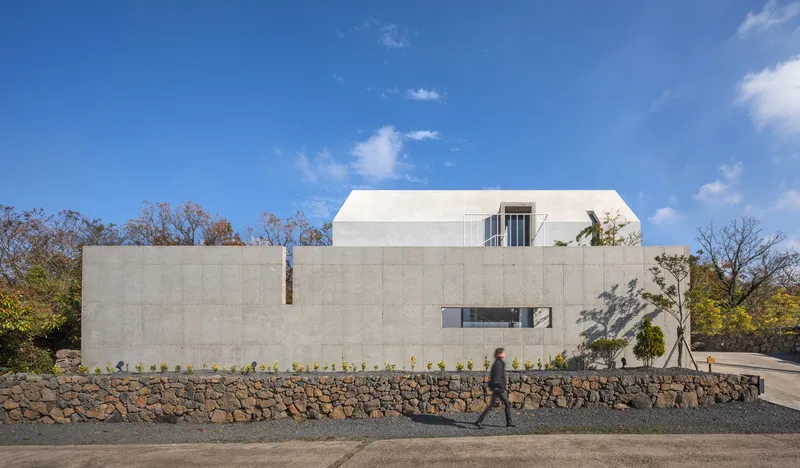
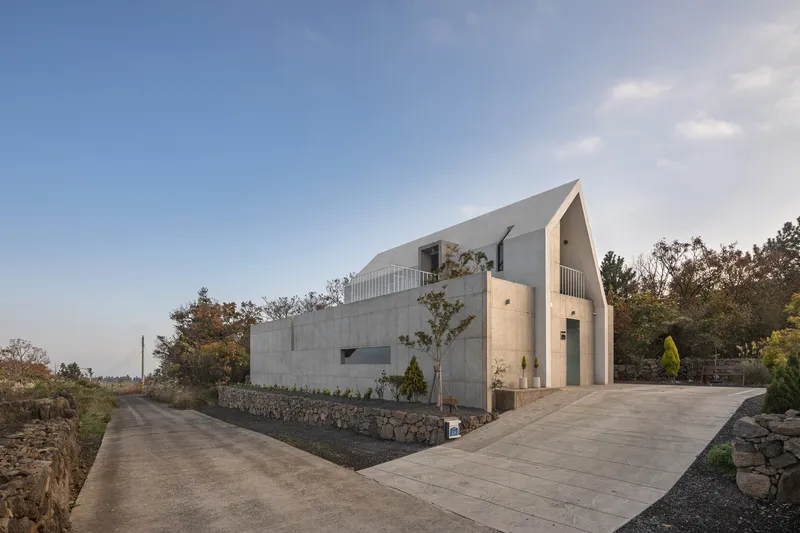
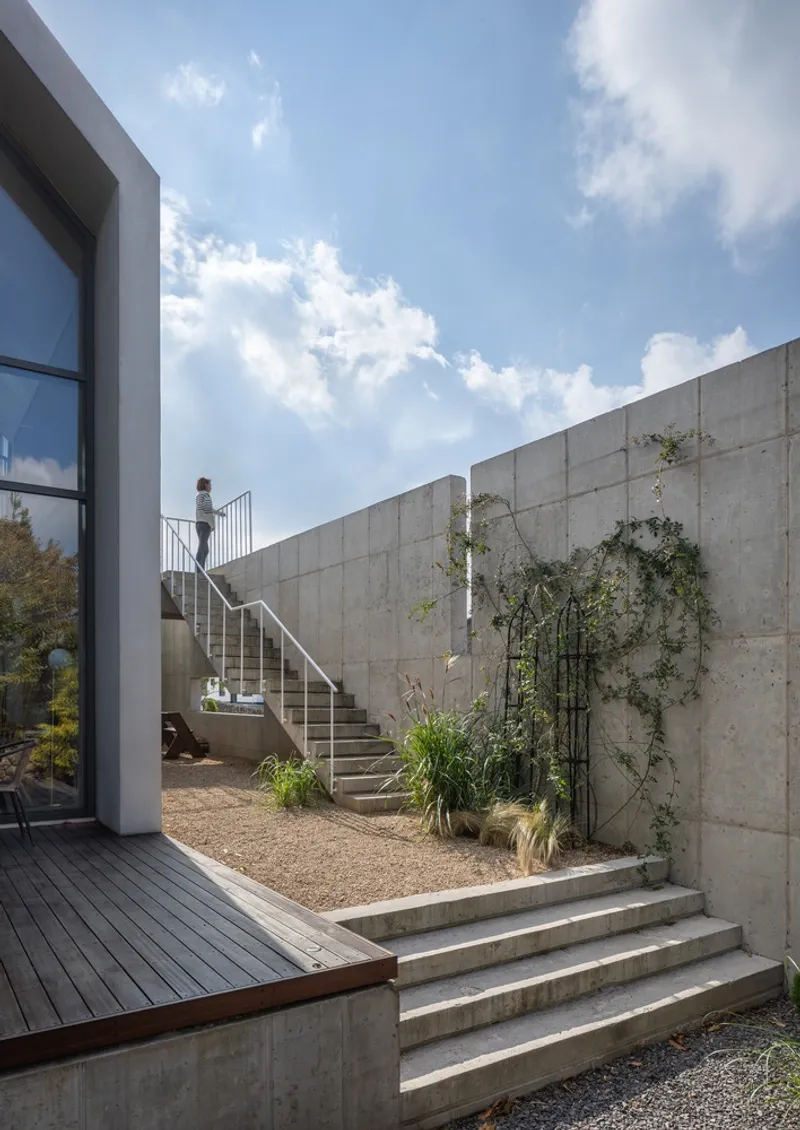
Board-formed concrete does a lot of work here, and SOHUN deploys it with unusual variety. The boundary wall and the curved roof over the entrance drive are poured with a rough horizontal grain that echoes stacked basalt. The exterior staircases rise between close concrete walls, channeling movement the way a lava tube channels air. Climbing vines have already started to colonize the handrail zone, a detail that suggests the architects expected biological softening from the beginning.
At the driveway, a curved roof element lifts above the retaining wall, creating a threshold that is neither gate nor canopy but something in between. It signals arrival without making a ceremony of it. The gesture is restrained: low, horizontal, set against the slope rather than rising above it.
The Gable as Frame
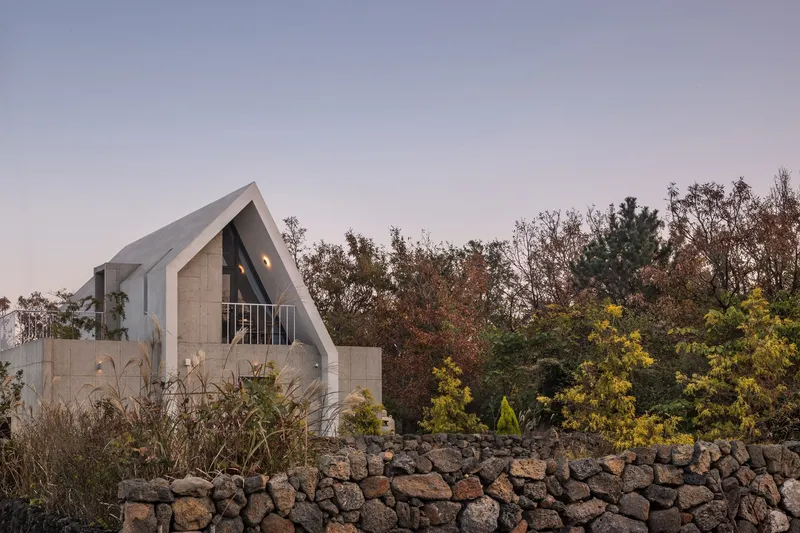
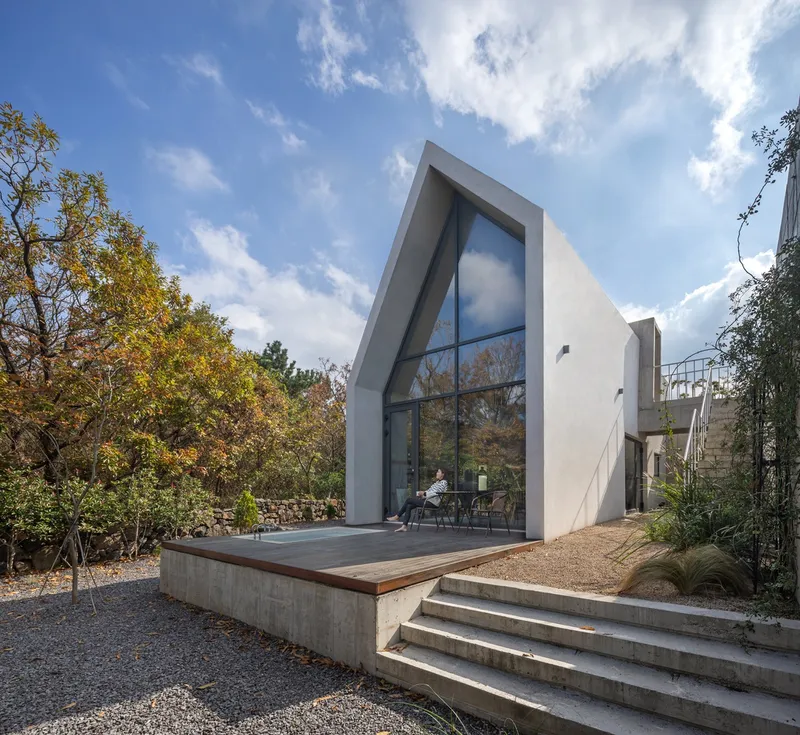
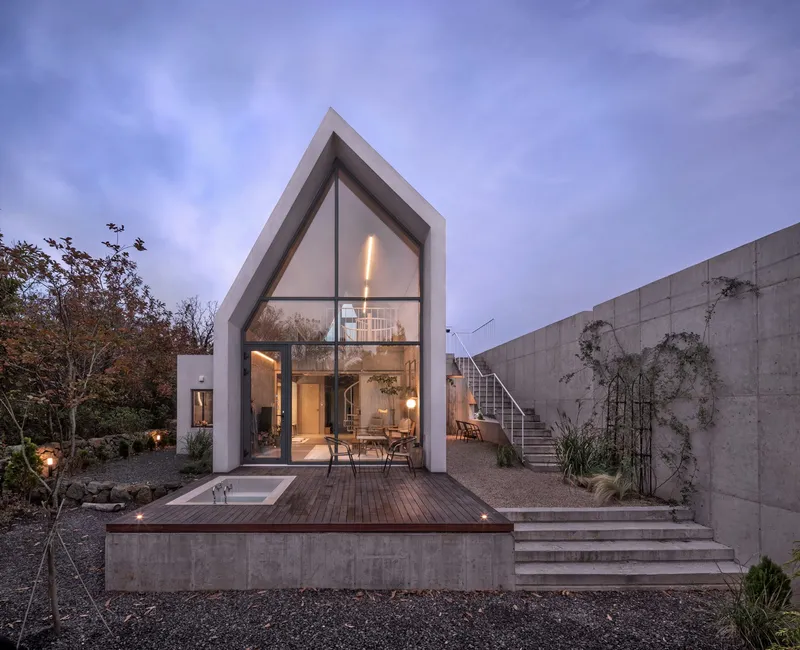
The most photogenic move in the project is the triangular glass gable that closes one end of the main volume. At dusk, lit from within, it becomes a luminous wedge floating above the dry stone retaining wall. The geometry is simple but the effect is layered: the triangle compresses the view of the forest into a single focused plane, while the timber deck at its base extends the interior outward over a gravel courtyard.
During the day, the same facade reads differently. The white metal cladding and the full-height glazing pull apart to reveal the structural depth of the gable, and the courtyard gravel scatters diffused light upward into the overhang. It is a facade that changes personality with the hour, which is rare for a house that keeps its material palette this tight.
Vertical Circulation as Spatial Event
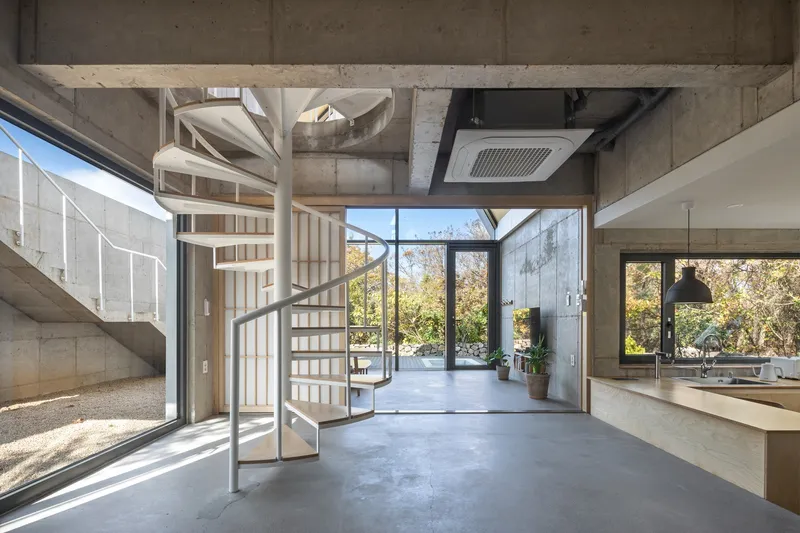
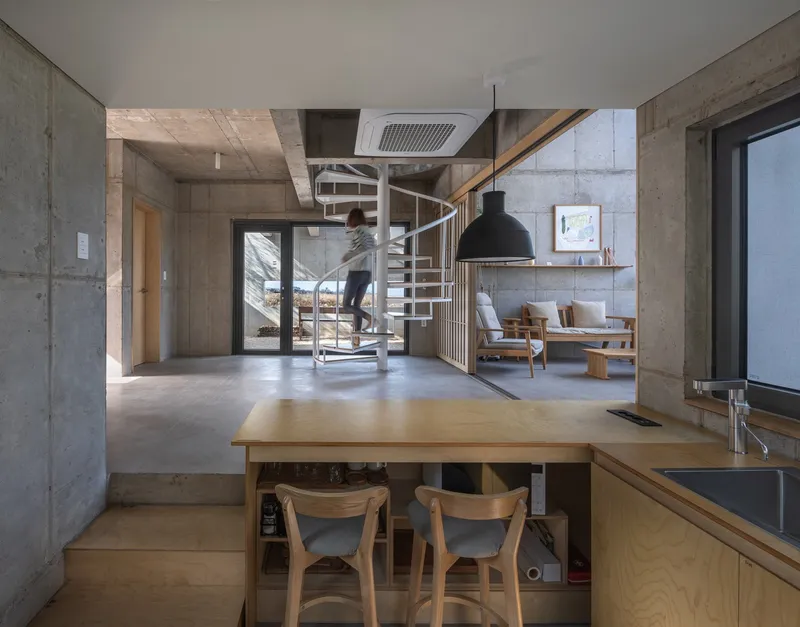
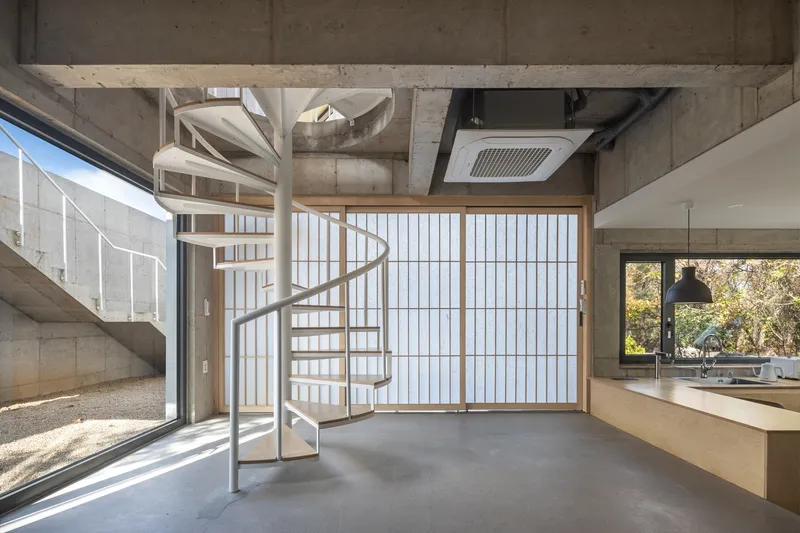
Inside, a white spiral staircase acts as the spatial engine of the double-height living area. It is sculptural, yes, but it also does practical work, connecting the open ground floor to private rooms above while pulling light down through the concrete ceiling opening. The stair is placed off-center, which keeps the living volume from feeling symmetrical or static.
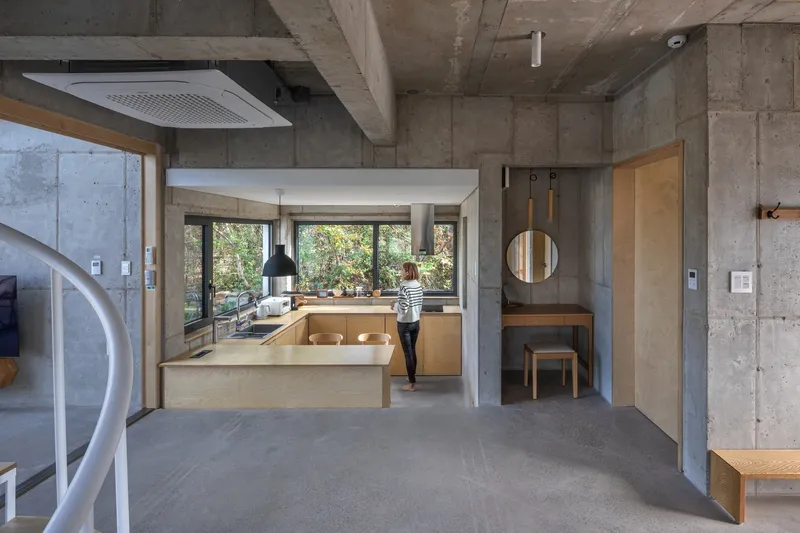
Translucent sliding screens beside the stair suggest a debt to Korean spatial tradition, where rooms are partitioned by degrees of opacity rather than solid walls. When closed, they filter light between the kitchen and the stair hall. When open, the ground floor becomes a single continuous space from the entrance to the glazed terrace. The exposed concrete ceiling, left rough overhead, provides a tonal counterweight to all that whiteness below.
Living with the Canopy
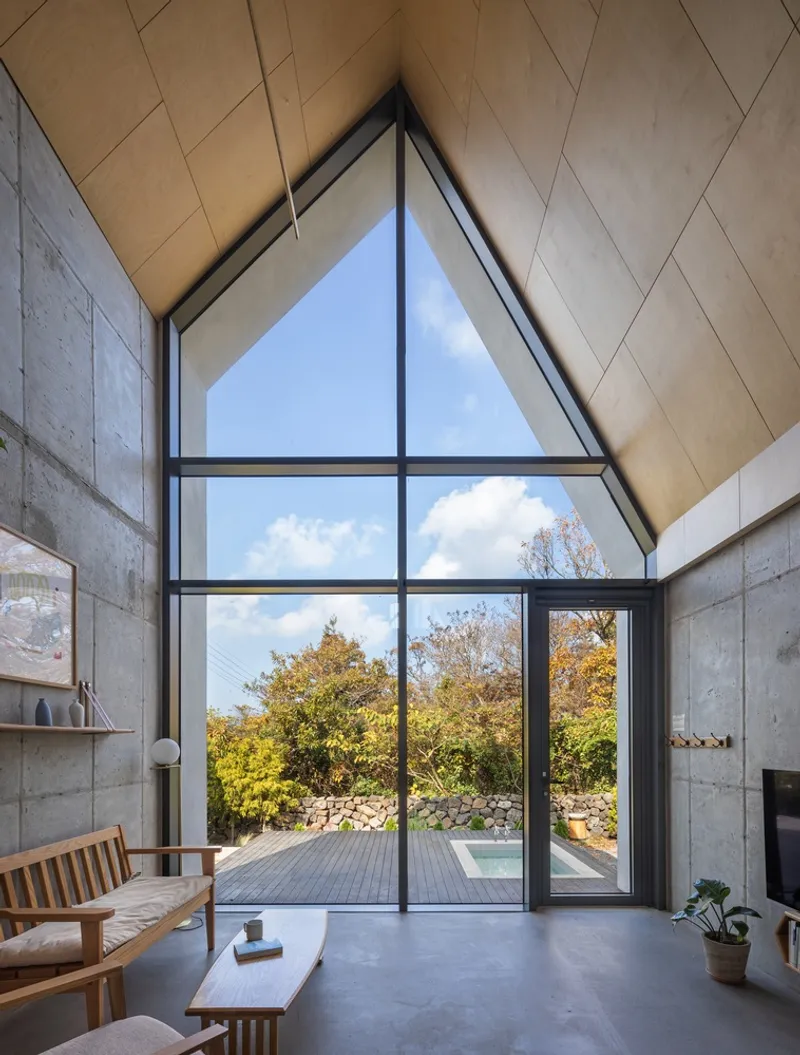
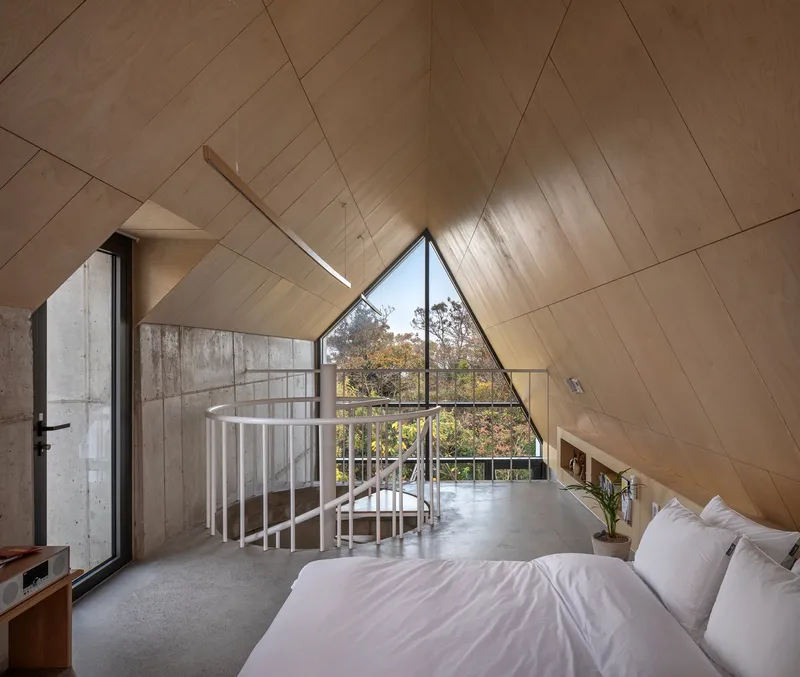
The triangular windows recur throughout the interior, and their purpose is consistent: they frame the forest canopy at treetop level rather than at ground level. In the bedroom, a diagonal wood-paneled ceiling meets a pointed window that offers nothing but autumn leaves and sky. The effect is intimate rather than expansive. You are not surveying the landscape; you are inhabiting it at close range.
The kitchen is more grounded, with timber cabinetry and a horizontal window that looks out at a human scale. A figure standing at the counter reinforces that this is a house designed for daily domestic life, not just atmospheric photographs. The material shift from concrete overhead to warm timber at hand height is a deliberate comfort gradient, hard and monumental above, soft and tactile where you actually touch things.
Thresholds and Exterior Stairs
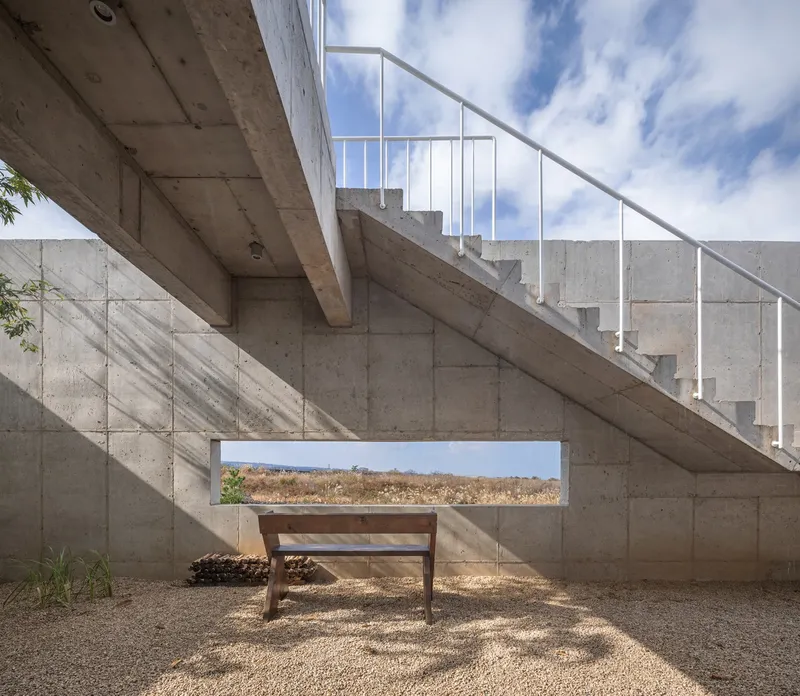
SOHUN treats the exterior staircases not as service routes but as experiences in their own right. The main stair ascends past a narrow horizontal slot window that crops the landscape into a cinematic band. Metal railings are industrial and thin, refusing to compete with the concrete walls flanking the path. These transitions between levels double as moments of compressed framing, each landing offering a slightly different angle on the courtyard, the trees, or the distant peaks.
Plans and Drawings
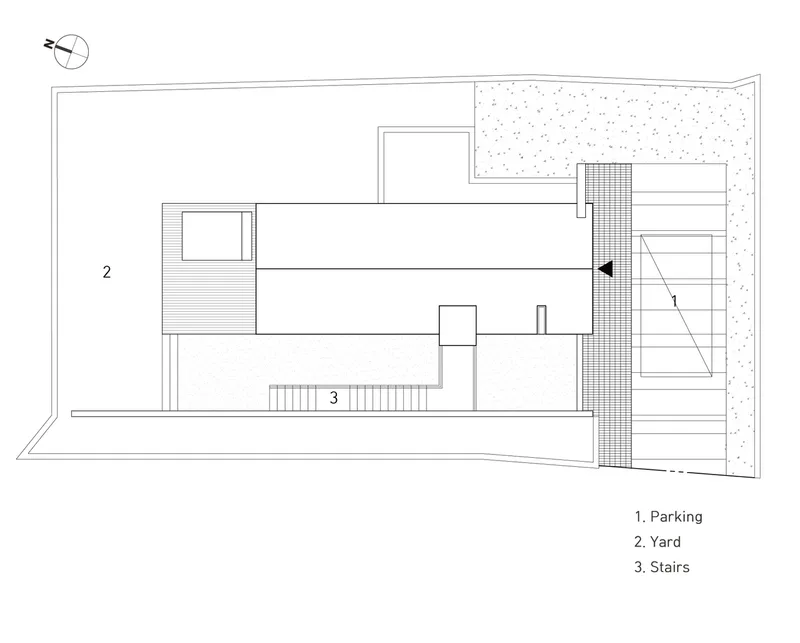
The site plan confirms what the aerial photographs suggest: the building footprint is compact, occupying a small fraction of the plot. Parking is pulled to the southeast corner, separated from the courtyard by the concrete boundary wall. Exterior stairs link the driveway level to the upper yard and the main entrance, creating a promenade that requires you to walk the full length of the wall before arriving at the front door. It is a sequence borrowed from traditional Korean garden design, where the approach is always longer than it needs to be.
Why This Project Matters
Jeju has become a magnet for second homes and boutique retreats, many of which default to either luxury minimalism or nostalgic vernacular quotation. Seon Heul Sup House charts a third path. It takes the island's raw materials, basalt, concrete, volcanic slope, and works with them directly, using geometry and framing instead of decoration to create a sense of place. The result is a house that respects its forest context without deferring to it.
For architects working in ecologically sensitive rural sites, the project offers a useful lesson: specificity beats sensitivity. The triangular gable, the curved entry roof, the slot windows along the stairs, these are not generic green-architecture gestures. They are precise responses to slope, canopy, light, and wind on one particular hillside. That precision is what makes the house feel inevitable rather than imposed.
Seon Heul Sup House by SOHUN Architects & Planners, Jeju Island, South Korea. Photography by Yoon Joonhwan.
About the Studio
Share Your Own Work on uni.xyz
If projects like this are the kind of work you want to make, uni.xyz is a place to publish your own, find collaborators, and enter design competitions.




Popular Articles
Popular articles from the community


Play: Fragments of Their World
Familiar architecture becomes modular playground design, creating safe spaces where displaced children can learn, connect, imagine and play.

The Musturak Paradise: Senior Living Architecture for a Connected Future in Temara, Morocco
The Musturak Paradise reimagines senior living architecture in Temara via private homes, social spaces, culture, community, and shared care.

The Earth Pod: 3D Printed Homes for Resilient Refugee Communities
The Earth Pod reimagines refugee housing through 3D printed homes made from clay, combining resilience, self-sufficiency, and rapid shelter.

Co-life: Sustainable Architecture for Age-Friendly Community Living
Co-life reimagines sustainable architecture for seniors through courtyards, rammed earth, shared gardens, and spaces designed for belonging.

Similar Reads
You might also enjoy these articles


Hodi-Mandai Geram
Project Function: Preservation and revitalization of the Intangible heritage and socio-spatial identity of the Hodi by Housing, Cultural Memory Center, Sacred Grove, landscape, local tourism economy


Olio Towers: A Mid-Rise for Performers That Fuses Housing, Rehearsal, and Stage
Located blocks from Houston's Theater District, this modular tower stacks living units around a central performance atrium.

Oasis: Modular Green Housing Carved into Dhaka's Urban Fabric
A shortlisted Plugin Housing entry reclaims unauthorized settlements in Dhaka with stepped concrete volumes, green roofs, and ventilation-driven design.

Black Hole: A Floating Megastructure for the Post-Physical Era
Emiliano Mazzarotto envisions a spherical, self-scaling arena where e-sports, digital hotels, and holographic stadiums replace traditional public space.


Explore Housing Competitions
Discover active competitions in this discipline



Challenge to reimagine the Iron Throne


Photograph architecture without architects


Illustrate the lost glory of Angkor Wat - Render Challenge


Design challenge to reuse E-waste
Comments (0)
Please login or sign up to add comments
No comments yet. Be the first to comment!