

Sepide Elmi Turns a Staircase into the Protagonist of an Apartment Building in Karaj
A 2000 m² residential block west of Tehran treats vertical circulation as spectacle, carving a central void that stages daily life against white screens.


In most apartment buildings, the staircase is the part nobody photographs. It is a fireproofed tube, a leftover between units, a space designed to be passed through and forgotten. Sepide Elmi's Frenzy Stair in Karaj, Iran, inverts that hierarchy entirely. Here the staircase is the building's central event: a zigzagging black steel armature that climbs through an open void, connecting offset terraces, bridging volumes, and turning what should be mundane transit into a choreography of movement visible from almost every vantage point.
The project is a 2000 m² residential building completed in 2025 in a dense urban neighborhood roughly 40 kilometers west of Tehran. Karaj is not a place celebrated for architectural experimentation; it is a sprawling commuter city where generic concrete slabs repeat block after block. Frenzy Stair treats that context as both a problem and a provocation. The building's white perforated screens, cantilevered balconies, and exposed circulation are legible from the street as something deliberately different, but the real argument is spatial rather than cosmetic. The stair does not simply connect floors. It organizes the entire section, governs the proportions of the void, and dictates how light, air, and sightlines enter each unit.
The Street Face: Screens, Layers, and Controlled Exposure


The facade operates as a layered wall system. White vertical louvers, chevron-patterned screens, and corrugated metal panels overlap to produce a surface that shifts between opaque and transparent depending on the angle and the time of day. From the street, the building reads as a stack of perforated volumes, each balcony slightly offset, each screen pattern subtly different. There is a productive tension between repetition and variation: the building is clearly systematic, but never monotonous.
Elmi's design concept foregrounds the wall as a mechanism of visibility and invisibility, a mediator between public and private life. That idea is most legible here, where the screens allow residents to occupy their balconies with some measure of seclusion while still permitting light and breeze. The planted entry court at ground level, partially hidden behind a concrete wall, reinforces the threshold quality. You are never fully inside or fully outside; you are always somewhere in between.
The Central Void: Staircase as Social Infrastructure


Look straight down through the central void and the building reveals its real ambition. The zigzagging black steel staircase, fabricated by DIME, connects multiple terrace levels with suspended bridges and landings. From above, the geometry reads almost like a folded ribbon dropped into the building's core. Turquoise pool edges at certain levels add a flash of color to an otherwise monochromatic palette of white stone paving, dark metal, and planted beds.
This void does double duty. It is the primary circulation route, yes, but it also functions as the building's communal living room: a shared space where residents encounter each other, tend plants, pause in sunlight. The overhead views reveal small trees planted at the base of the stairwell, their canopies visible from several floors up. By making the staircase open to the sky rather than enclosing it in a shaft, Elmi ensures that vertical movement is always a spatial experience, never a corridor one.
Bodies on the Stair: Movement as Spectacle

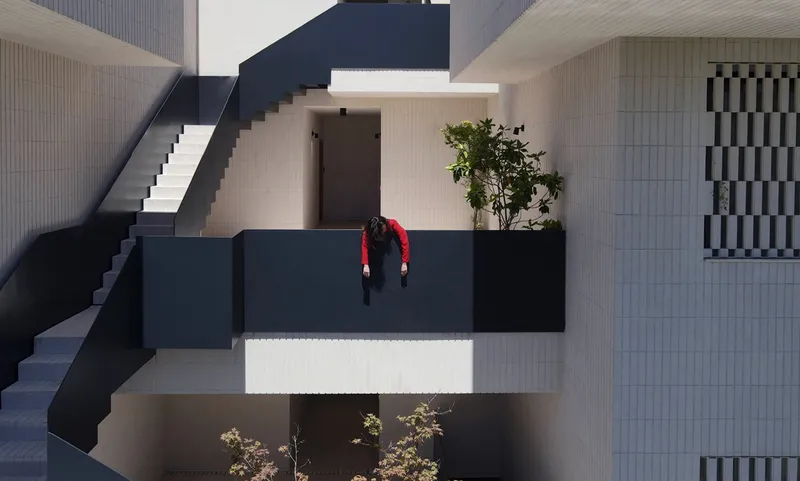
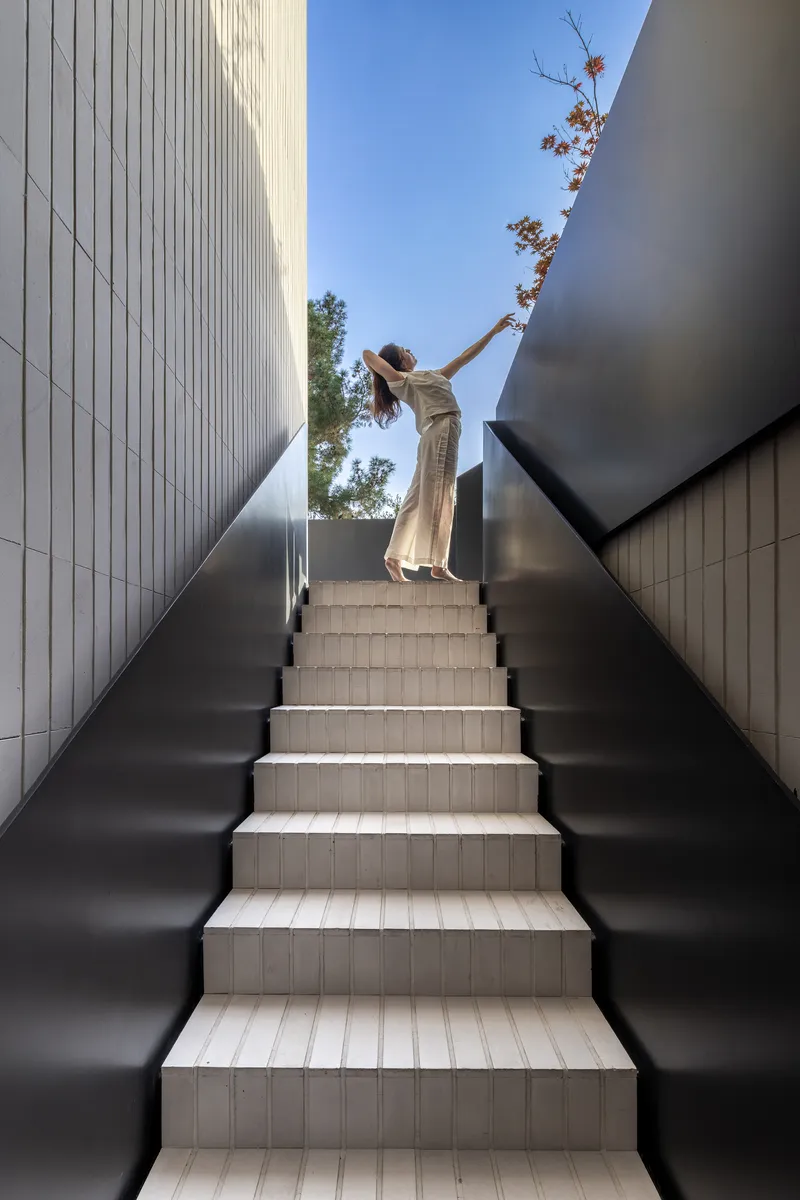
Several of the photographs by Parham Taghioff and Persia Photography Center stage human figures on the stairs: stretching, leaning over railings, reaching for branches. These are not incidental. They illustrate a deliberate design posture in which the stair is a place to be seen, a threshold between domestic privacy and shared exposure. A figure in red leans over a courtyard bridge; another in white reaches for a branch while ascending white-tiled risers flanked by dark metal walls. The stair is not neutral infrastructure. It is a stage.
The material palette reinforces this reading. White tiled treads contrast sharply with black metal railings and walls, making every person on the staircase a silhouette, a figure against a graphic ground. The scale is intimate enough that these encounters feel personal rather than performative, but the open void above and below ensures they are never private either.
Terraces, Trees, and the In-Between

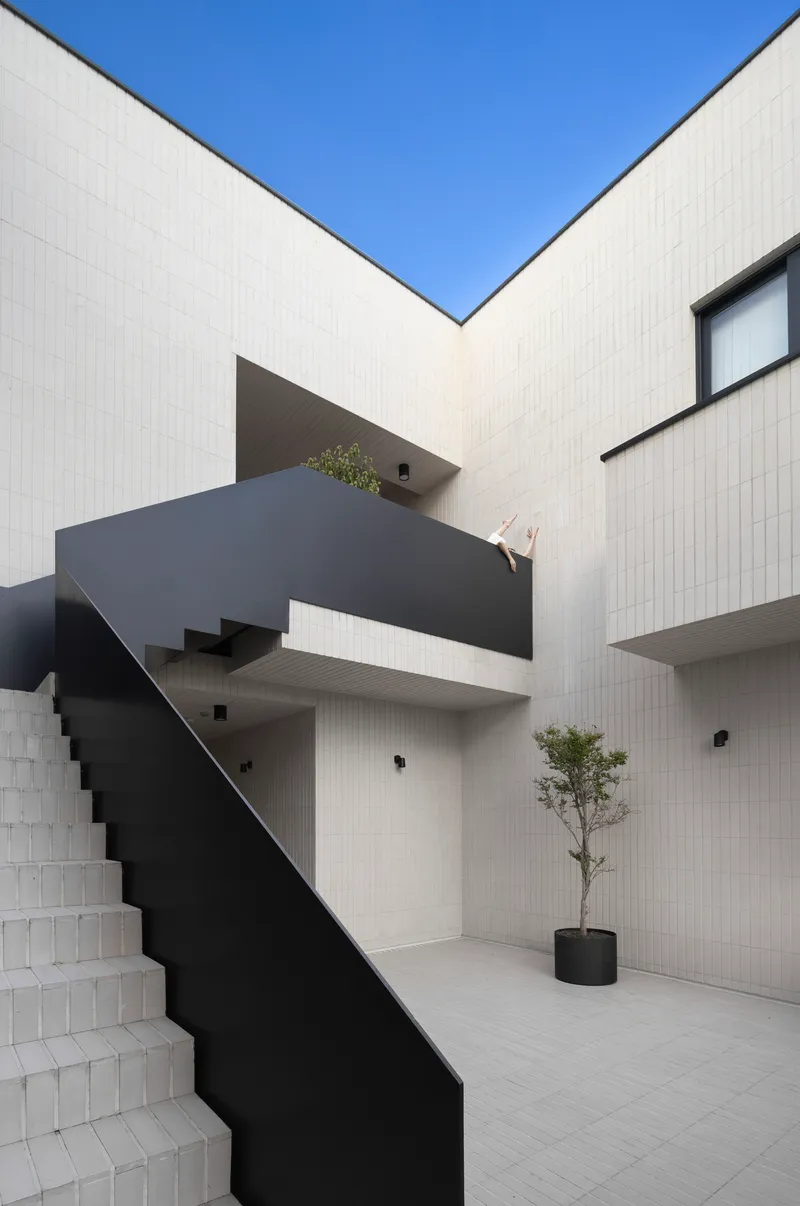
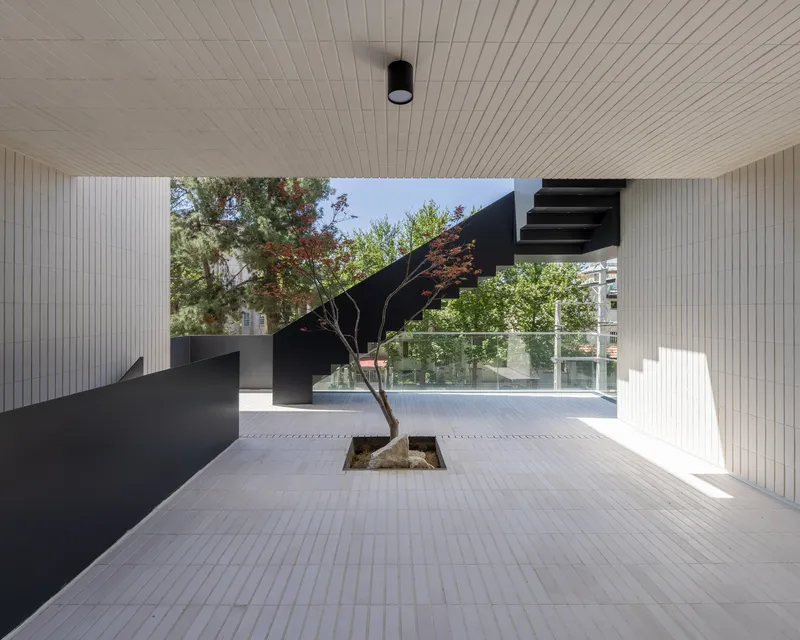
The terraces function as extensions of the staircase logic, outdoor rooms carved into the building's mass where planted beds, gravel surfaces, and timber ceilings create pockets of calm. One terrace features a tree growing through a cutout in the floor, its canopy brushing a ribbed timber ceiling. Another frames a folded black steel staircase against white tiled walls. These are generous spaces, not token balconies.
In Karaj's hot, dry climate, these semi-shaded outdoor rooms are practical as well as atmospheric. They provide ventilation pathways, buffer solar gain, and create microclimates where vegetation can survive the summer. The Japanese maple visible in several shots is a carefully chosen species, its delicate leaf structure filtering light rather than blocking it.
Inside the Units: Shadow, Stone, and Restraint


If the exterior is bold and graphic, the interiors are deliberately quiet. Polished concrete floors, light wood surfaces, and minimal furniture let the architecture speak through light rather than material excess. The vertical screens that define the facade produce striped shadow patterns across living room floors, turning sunlight into decoration. In one unit, a raw stone sculpture sits in a gallery-like space beside glass doors opening to a terrace. The effect is austere but warm.
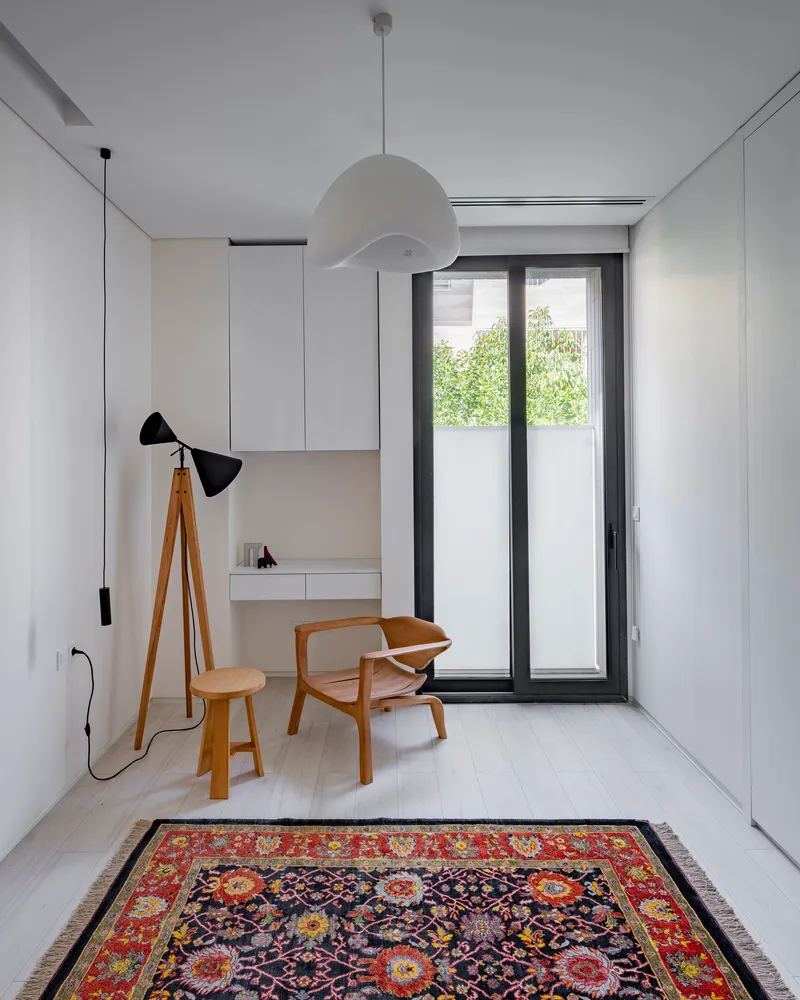

A study nook with a built-in desk and timber chair beneath a spherical pendant lamp suggests that the interiors were detailed with care, not just left as open shells. Through a glazed partition in another unit, the cantilevered black staircase is visible, and a figure tends bonsai plants on a ledge. The boundary between interior and exterior, unit and circulation, dissolves wherever glass meets void.
Rooftop and Evening: The Building as Urban Object
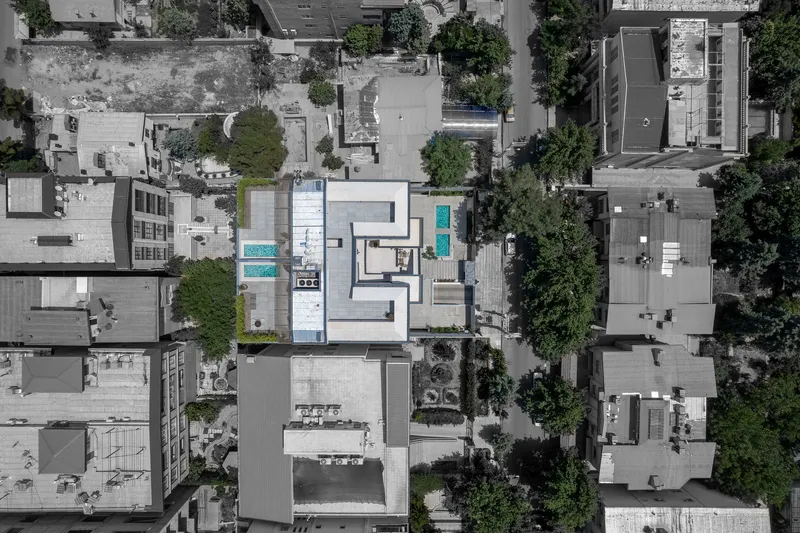


From the air, the building's stacked white volumes and rooftop pools are strikingly distinct from the surrounding urban fabric. Karaj's roofscape is a patchwork of unfinished concrete, steel rebar, and satellite dishes; Frenzy Stair's clean geometry registers as an act of care in a landscape that often lacks it. At dusk, the perforated screens glow from within, and the corrugated metal fence reads as a luminous band against the darkening street.
The rooftop itself, with cantilevered black steel walkways and views over tree-lined streets, extends the building's communal logic to its highest point. In a city where rooftops are typically afterthoughts, this one is designed to be inhabited.
The Stairwell as Vertical Landscape


The stairwell itself is a compelling piece of architecture independent of the building it serves. White ribbed walls rise toward a skylight opening above black steel landings, compressing and releasing space with each half-flight. The geometry is straightforward, nothing tricky, but the proportions and material contrasts give each landing a distinct character. Where the stair meets cantilevered volumes clad in white and dark metal beside a Japanese maple, the building comes closest to something genuinely lyrical.
Plans and Drawings

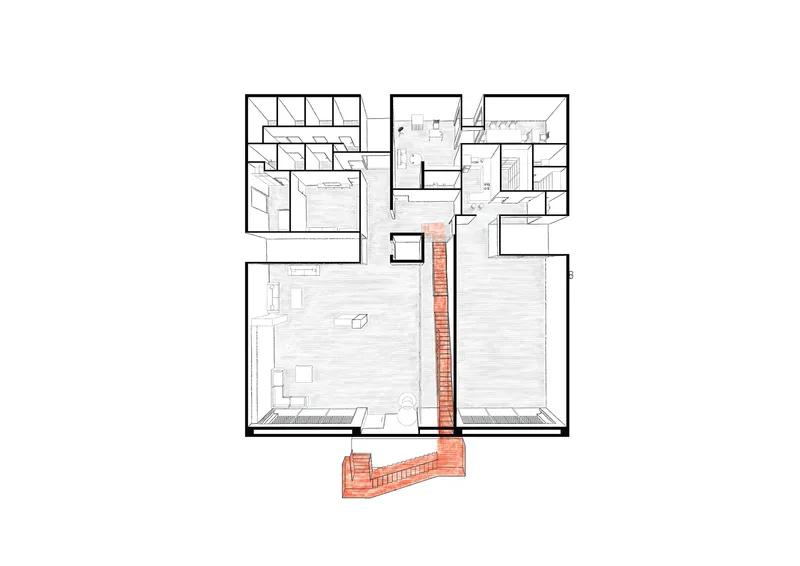


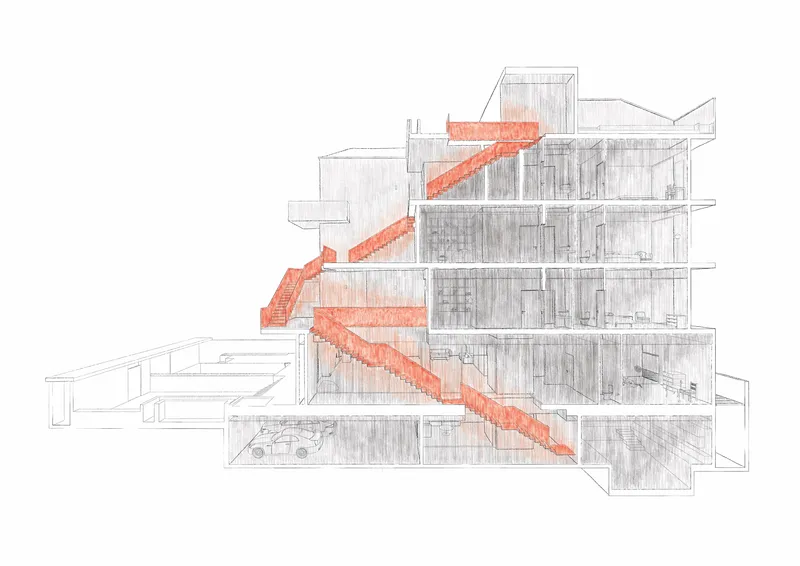


The drawings make the organizational logic explicit. Floor plans show symmetrical residential units surrounding a central circulation core, with the staircase highlighted in red at every level. The section drawings reveal the zigzag in its full vertical extent, traversing through multiple floors and connecting offset volumes. Axonometric studies, including one that overlays a construction grid and perspective wireframe, demonstrate the geometric rigor behind what appears, in photographs, to be a casual composition.
A physical section model with translucent white walls offers perhaps the clearest reading of the design intent: the red stairs and platforms glow inside the building's shell like a circulatory system, the thing that keeps the whole organism alive. Structural engineers Farshad Aghajani and Davood Hajibabayi resolved the cantilevered volumes and suspended bridges into a buildable frame. The drawings show this was not a sculptural gesture that happened to contain apartments; it was a residential plan that found its identity in the space left over for movement.
Why This Project Matters
Frenzy Stair matters because it refuses the premise that multi-unit housing in a peripheral city has to be generic. Karaj is not a place where clients typically invest in spatial ideas; the norm is maximum floor area, minimum design ambition. By convincing client Bistoon Tile to dedicate a significant portion of the building's volume to an open void and an exposed staircase, Sepide Elmi has produced something that challenges the economics of repetition. Every unit benefits from cross-ventilation, natural light, and a view into a communal garden that would not exist if the stair were buried in a shaft.
The project also contributes to a growing body of Iranian residential architecture that treats the threshold between public and private as a design problem worth solving with generosity rather than security. The stair is not gated. The terraces are not barricaded. The screens modulate privacy without eliminating it. In a context where apartment buildings often turn their backs to the street, Frenzy Stair faces it, climbs through it, and invites occupation at every level. That is a political statement as much as an architectural one.
Frenzy Stair by Sepide Elmi. Karaj, Iran. 2000 m². Completed 2025. Design team: Salar Keshavarz, Hamed Kamalzadeh, Omid Golshan, Kosar Ghafoorinezhad, Sahar Nouri, Parham Ghaderi. Structural engineers: Farshad Aghajani, Davood Hajibabayi. Construction and supervision: Aslan Fotouhi. Builder: Ali Khazaee. Stair construction: DIME. Client: Bistoon Tile. Photography by Parham Taghioff, Persia Photography Center.
About the Studio
Share Your Own Work on uni.xyz
If projects like this are the kind of work you want to make, uni.xyz is a place to publish your own, find collaborators, and enter design competitions.


Popular Articles
Popular articles from the community

Opera on the Sea: Driftwood Logic Shapes a Timber Opera House on Estonia's Coast
Trevor Orgill's opera house translates the entangled drift of floating timber into a civic building where wood, water, and music converge.
Opera by the Sea Estonia: Three Shells Dissolving Architecture into Tallinn's Coastline
A winning opera house proposal replaces monumental form with interconnected shells that blur the boundary between building, park and Baltic Sea.

Singing Woman: An Opera House That Performs Before the Curtain Rises
Ovidiu Cristian Pavel's conceptual opera house translates Estonia's choral identity into a sculpted waterfront landmark facing the Baltic Sea.

Extended Shell: Retrofitting Kolkata's Balconies as Living Urban Thresholds
A modular retrofit system recovers the social and environmental intelligence of Kolkata's historic verandas for contemporary Park Street residents.

Similar Reads
You might also enjoy these articles

Pixel Gardens: One Repeated Module Stacked Into a Terraced Social Housing Tower for Famagusta
Salem Bader's shortlisted housing tower builds a vertical neighbourhood from one repeated module, offsetting units to carve terraces, light and air.

Bao Huynh Watercolor Atelier: A Serene Art Retreat in Hội An
Bao Huynh Watercolor Atelier in Hội An blends multifunctional art spaces, sustainable design, local materials, and family-friendly living in a serene environment.

Atelier Macri Concept Store Interior Design by CASE-REAL
Atelier Macri store features a "ko" counter, walnut wood details, cork displays, blending retail, gallery, and seamless customer experiences.

Manuel Vargas Izquierdo Stadium and High-Performance Sports Center: Architectural Excellence in Jalpa de Méndez
The Manuel Vargas Izquierdo Stadium blends sustainable design, inclusive sports facilities, and cultural-inspired architecture, revitalizing Jalpa de Méndez’s public spaces.

Comments (0)
Please login or sign up to add comments
No comments yet. Be the first to comment!