

Serendipity: Modular Housing That Engineers Chance Encounters Between Neighbors
A plugin housing system reclaims the lost art of neighborly interaction through interlocking terraces and semi-public in-between spaces.


High-rise living solved density but killed the alley. The narrow streets and shared thresholds that once made neighbors out of strangers have been replaced by elevator rides and fire doors, compressing social life into a commute between lobby and apartment. Serendipity takes that problem seriously, proposing a modular housing system built around what the designers call "in-between spaces": semi-public zones threaded through a stepped residential structure that make unplanned encounters not just possible but likely.
Designed by Rana Zarei and Amirhosein Zarei, the project won the Plugin Housing Challenge 2020. The brief asked entrants to rethink how residential units connect, plug in, and adapt. This team responded with a scheme that treats the social gradient from private bedroom to public street as its primary design material, layering terraces, courtyards, and modular private yards into a coherent vertical neighborhood.
Stacked Units, Interlocking Terraces
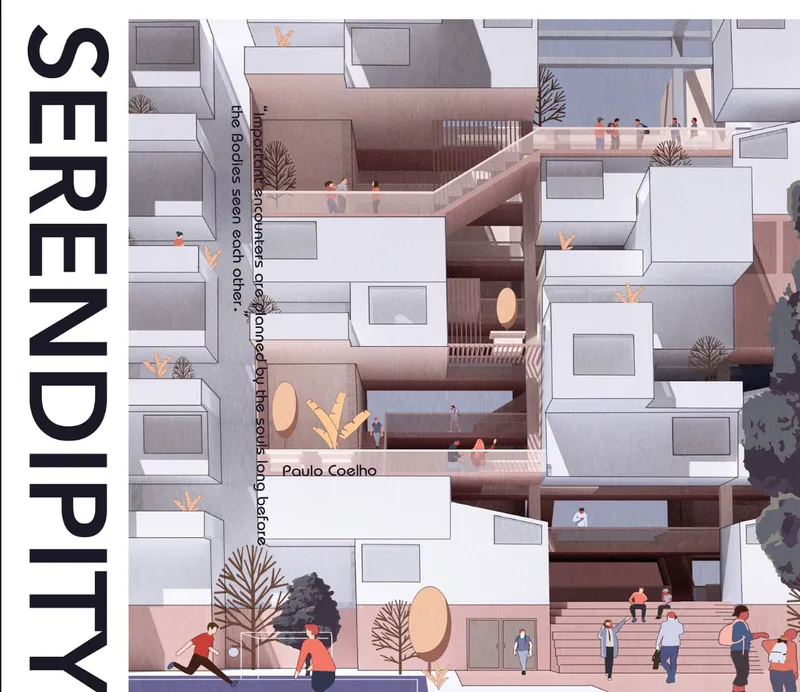
The sectional drawing reveals the project's core logic: residential units stack vertically but shift horizontally, creating interlocking terraces at every level. These offsets are not decorative. Each terrace becomes a threshold between the fully private interior and the shared life of the building. Figures populate the balconies, suggesting the kind of casual visibility that traditional low-rise neighborhoods once provided. You can see your neighbor tending plants two levels down. You can wave, or not.
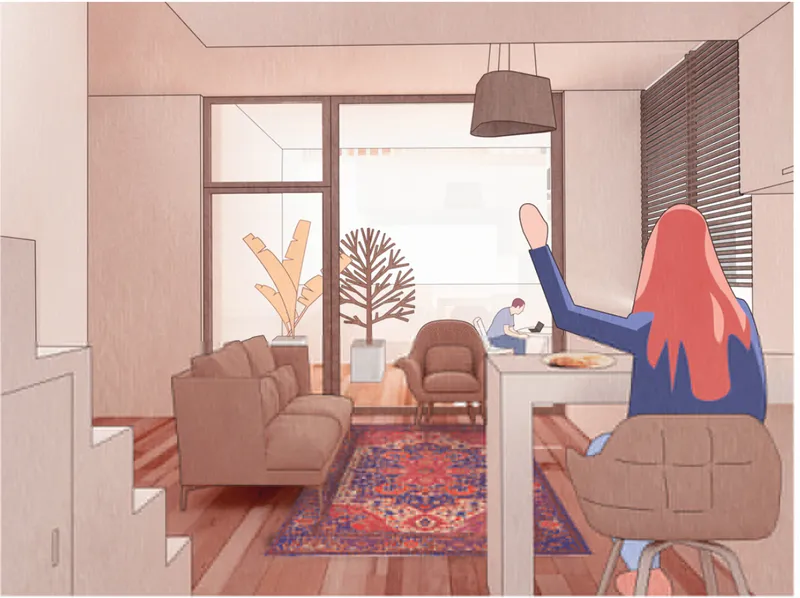
Inside, the living spaces open directly onto these terraces through large glazed doors. The interior perspective shows a compact, considered room where a resident works at a desk with the terrace just beyond the glass. The boundary between inside and outside is deliberately thin, encouraging residents to drift outward into shared space rather than retreating inward.
Private Rooms That Breathe Outward
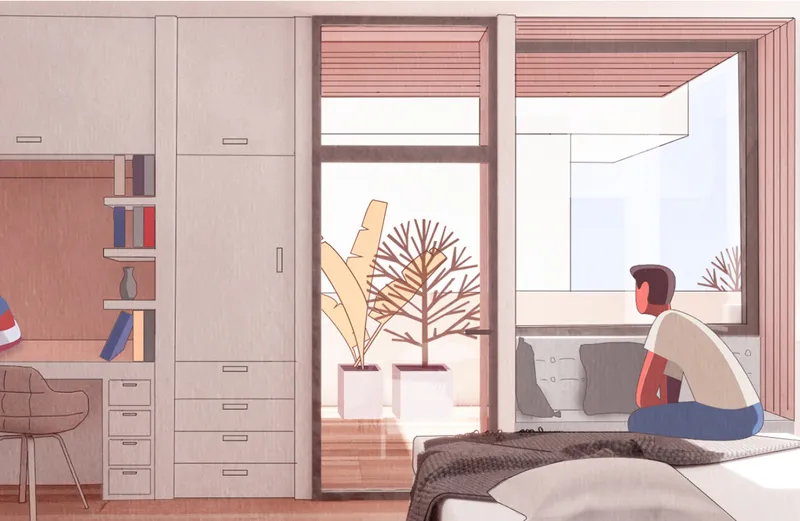
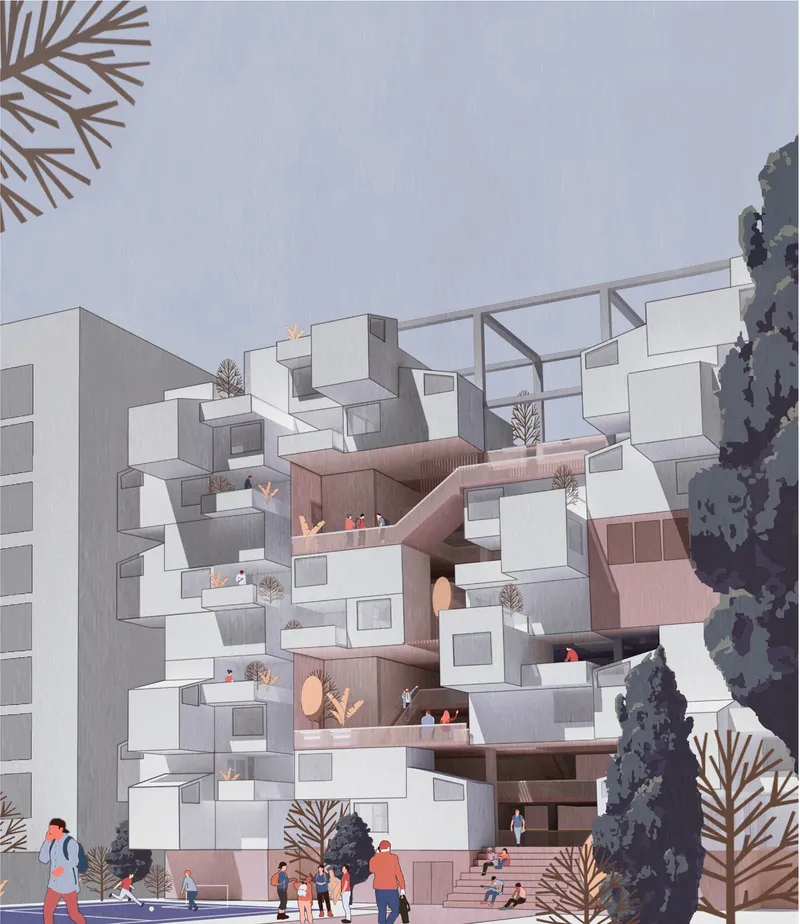
Even the most private rooms maintain a dialogue with the exterior. The bedroom illustration shows built-in storage along one wall and a figure seated by a window framed with planters outside. Green elements are not afterthoughts here; they are integral to the mental well-being strategy the designers emphasize. Every unit gets its own modular private yard, a patch of vegetation that belongs to the individual but contributes to the building's collective green identity.
At street level, the stepped facade reads as a terrain of projecting balconies and recessed volumes. Pedestrians move below a residential mass that feels more like a hillside village than a conventional apartment block. The stepping creates natural shade, frames views between units, and establishes a hierarchy of interaction zones: the ground plane is fully public, the terraces are semi-public, and the rooms behind are private. That gradient is the entire thesis of the project.
Communal Terraces as Social Infrastructure
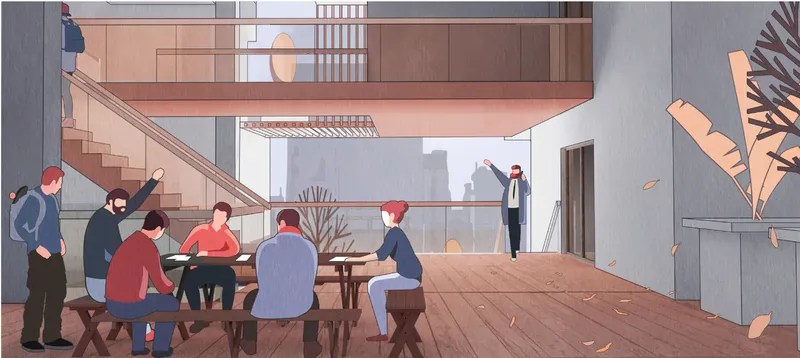
The sectional illustration of a communal terrace makes the social ambition concrete. Timber decking supports an outdoor gathering space where residents sit around a table together. These are the in-between spaces the project hinges on: not corridors, not lobbies, but genuine places where people might linger. The designers position these zones as the contemporary equivalent of the neighborhood alley, spaces without a rigid program that allow serendipitous interaction to occur.
Plug-In Logic: Modular Volumes on the Hook
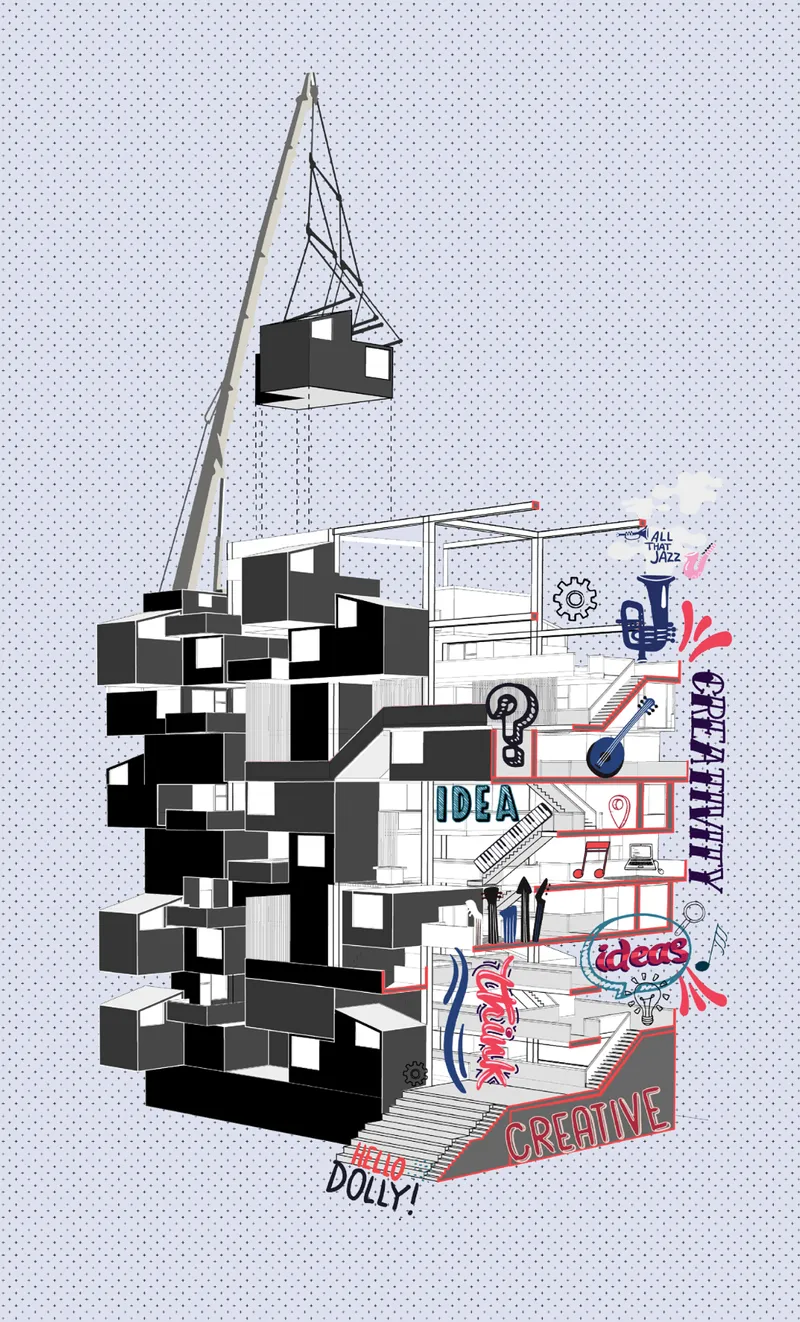
The axonometric drawing literalizes the plugin concept. Stacked cubic volumes hang from a crane hook, suggesting that units can be assembled, rearranged, or expanded over time. The graphic collage elements around the drawing reinforce the idea that this is a system, not a fixed building. Residents could, in theory, personalize their living modules based on household size, lifestyle, or evolving needs. Flexibility at the unit scale supports stability at the community scale: people stay because the building adapts to them.
Why This Project Matters
Serendipity does not try to solve urban housing with a single technical innovation. Instead, it reorganizes the spatial relationships that already exist in every residential building and asks whether they could be tuned to produce better social outcomes. The stepped section, the interlocking terraces, the communal timber decks: none of these elements are radical in isolation. What makes the proposal compelling is the clarity with which they are assembled into a coherent hierarchy from private room to public street.
As cities continue to densify, the question of how neighbors encounter each other will only grow more urgent. Zarei and Zarei argue, convincingly, that architecture can engineer the conditions for spontaneous interaction without forcing it. The in-between space is their instrument. It is a simple idea, but one that most contemporary housing has quietly abandoned. Serendipity makes a case for bringing it back.
View the Full Project
About the Designers
Designers: Rana Zarei, Amirhosein Zarei
Enter a Design Competition on uni.xyz
uni.xyz runs architecture and design competitions year-round that reward proposals with spatial conviction and real site intelligence.
Project credits: Serendipity by Rana Zarei, Amirhosein Zarei Plugin Housing Challenge 2020 (uni.xyz).


Popular Articles
Popular articles from the community


ETEH Reworks the Shared Spaces of São Domingos School in Brazil Around Timber, Color and Hanging Plants
At São Domingos School in Brazil, 436 m² of hall, refectory and library are recast with timber joinery, a yellow and blue code and trailing greenery.


The Amber Palace Opera: A Geological Fiction Surfaces on Tallinn's Baltic Waterfront
Pierre Brillard reimagines a Baltic legend as a public landscape, opera house, and waterfront promenade rooted in Tallinn's coastal identity.

David Ortega Stacks a Two-Story Mexico City Penthouse Around a Steel Stair and a Pergola-Shaded Roof Terrace
In Colonia Roma, a 300 m² penthouse uses oak joinery, a planted steel stair and a slatted roof pergola to make a new-build apartment feel like a house.

graciastudio Turns a Viewless Tijuana Lot Inward Around a Courtyard of Concrete, Timber and Trees
In Tijuana, Jorge Gracia's GA2 House stacks a timber-clad private floor over exposed concrete and replaces a missing view with a planted interior patio.

Similar Reads
You might also enjoy these articles

Cube Design Draws an Ecological Corridor Between Two Shenzhen Hills with the Nankai Building
Beside Shenzhen's container docks, the Nankai Building pairs stacked balconies with a climbing green screen to connect two hillsides across its height.

Praksis A and Studio Sted Bend a Red Timber Cabin Across the Granite of Norway's Southern Coast
On the southern Norwegian coast, a 105 m² cabin follows the rock on slender posts, pairing red cladding outside with pine, brick and plywood within.
David Ortega Stacks a Two-Story Mexico City Penthouse Around a Steel Stair and a Pergola-Shaded Roof Terrace
In Colonia Roma, a 300 m² penthouse uses oak joinery, a planted steel stair and a slatted roof pergola to make a new-build apartment feel like a house.

PARALELA and LB2 Thread a Public Walkway Through the Base of a Las Condes Residential Tower
In Las Condes, Santiago, the Hamlet Building gives its fenceless ground floor to a 70-metre wooded passage linking two streets and the metro.


Comments (0)
Please login or sign up to add comments
No comments yet. Be the first to comment!