
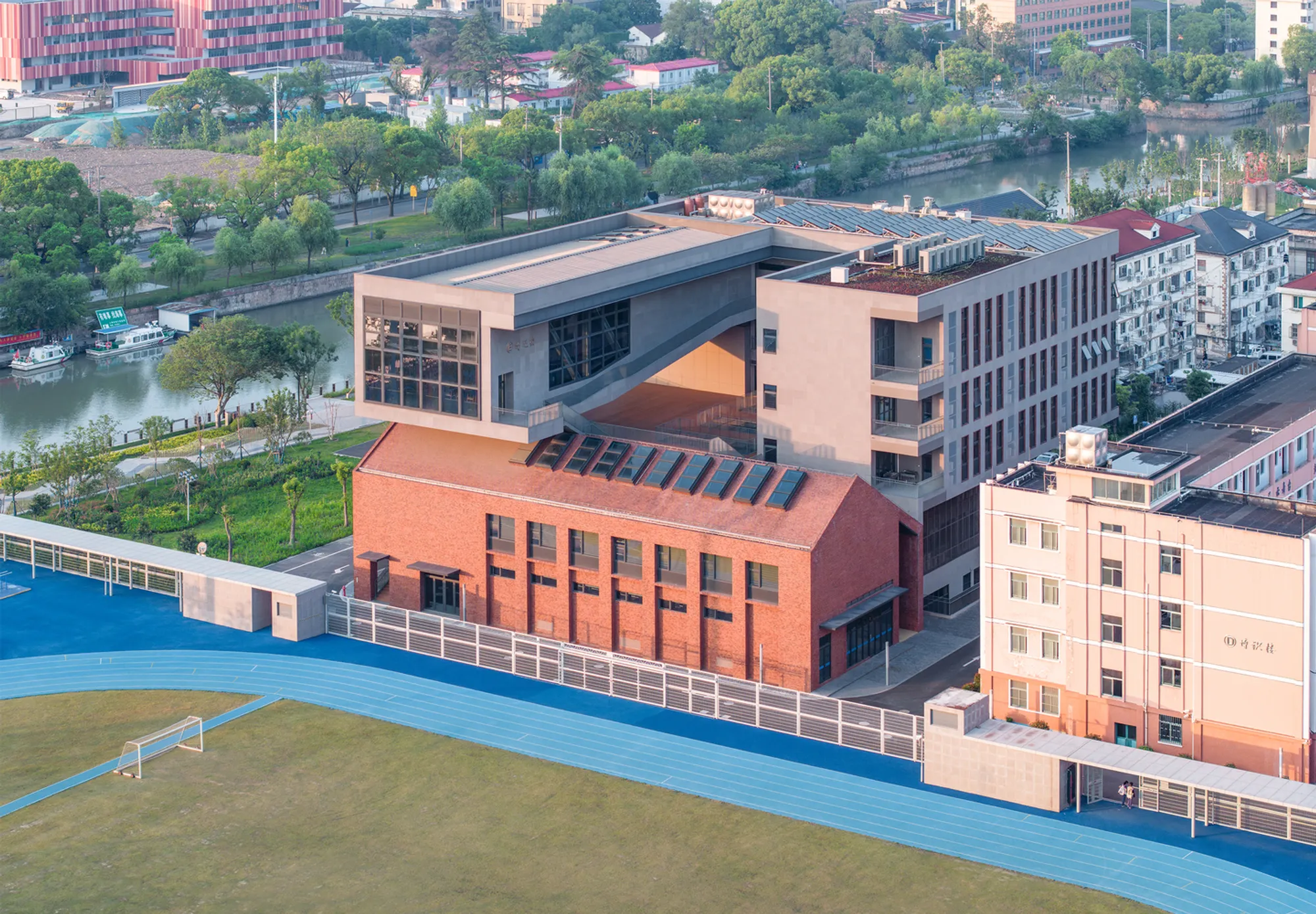
Shanghai Nanqiao Academy by NODE: A Landmark of Educational and Urban Renewal in Fengxian District
Shanghai Nanqiao Academy by NODE blends educational functions with historical context, creating a vibrant, community-integrated campus through adaptive design.


Designed by NODE Architecture & Urbanism, the revitalization of Shanghai Nanqiao Academy stands as a flagship project in urban regeneration and architectural innovation. Situated in Fengxian District, this transformative educational complex includes a comprehensive building, a revitalized riverside landscape, and a multifunctional sports ground. Completed in phases between 2021 and 2022, the project redefines the interaction between architecture, community, and history.
A Fusion of History and Modern Education Architecture
Nanqiao Town, the site of the academy, carries nearly a thousand years of architectural heritage, with its origins traced back to the Tang Dynasty and a canal system dating from the Southern Song Dynasty. NODE’s approach to the Nanqiao Academy Comprehensive Building strategically integrates this cultural lineage with modern educational needs. Ancient bridges, traditional breweries, and early 20th-century residences are harmonized through contemporary spatial and material strategies.
The result is a school renovation project that is not only functionally optimized but also rich in cultural memory. The design rekindles the historical context, transforming the once-fragmented site into a vibrant hub for both education and community interaction.
Spatial Strategy: A "Toy Block" of Educational Prototypes
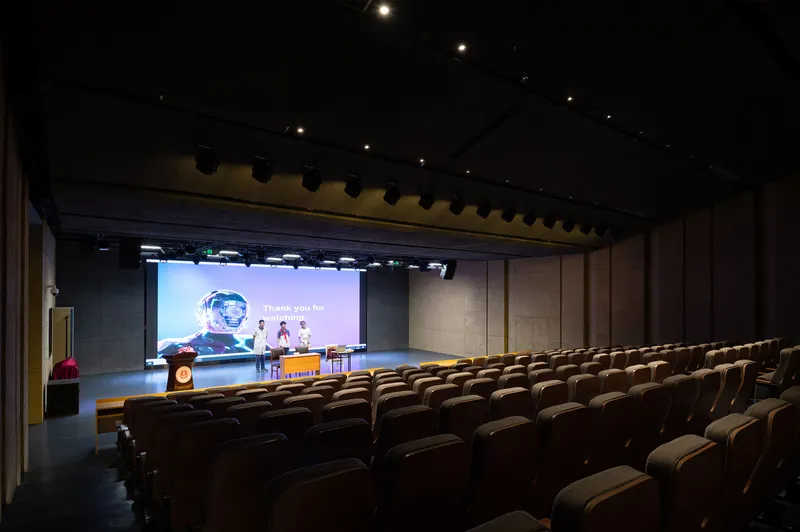
NODE architects employed a unique collage methodology, likened to assembling toy blocks, to design a spatially diverse and pedagogically engaging environment. The building consolidates previously scattered facilities—such as the library, lecture hall, theater, cafeteria, laboratories, art studios, and music rooms—into one unified volume. These programmatic modules form a “spatial puzzle cube”, generating a dynamic learning environment that fosters creativity, collaboration, and exploration.
The project not only meets the functional needs of a modern educational institution but also introduces flexible public spaces that reinforce community participation, echoing principles of shared educational architecture.
Form and Material: Dialogues with the Surroundings
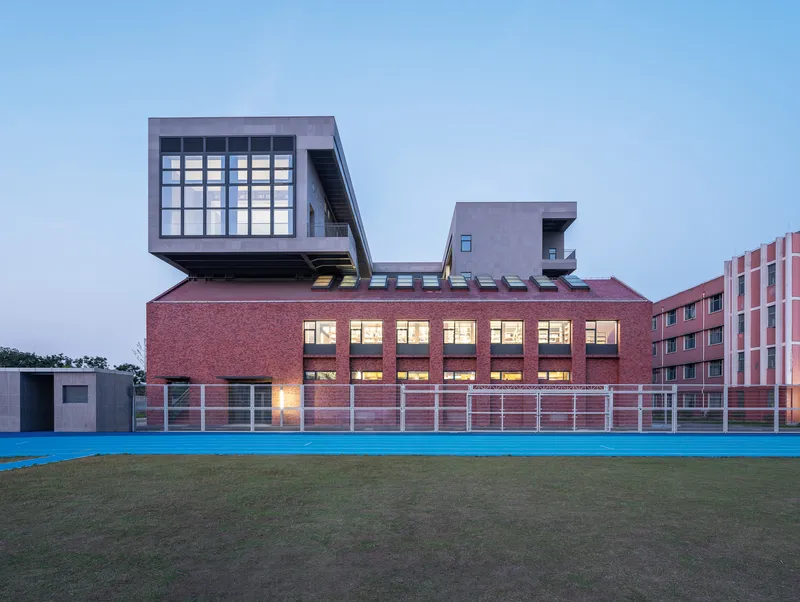
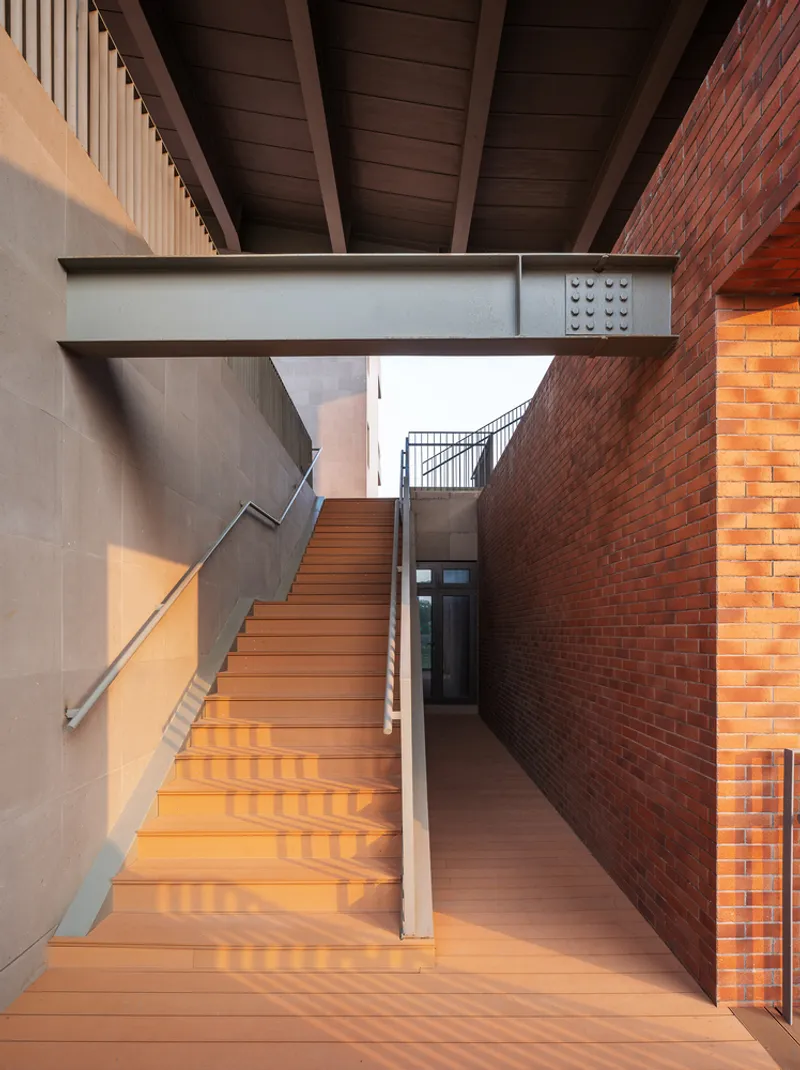
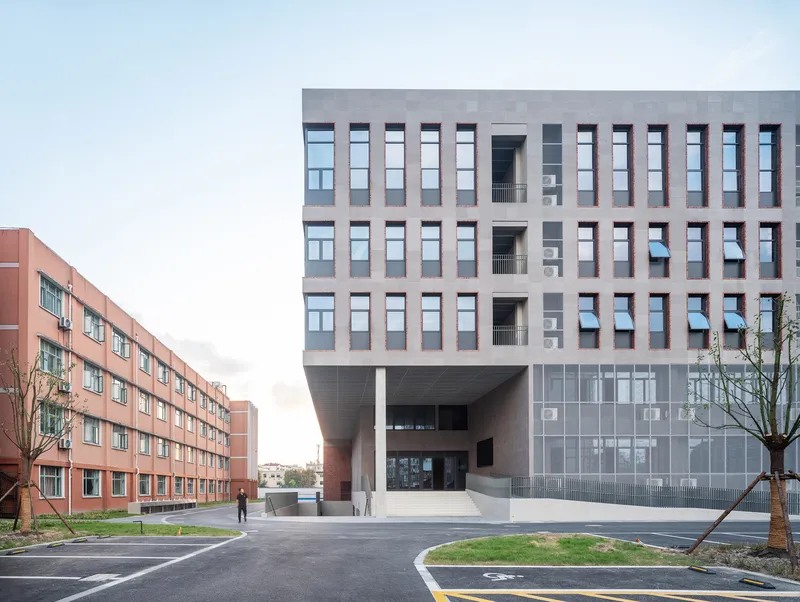
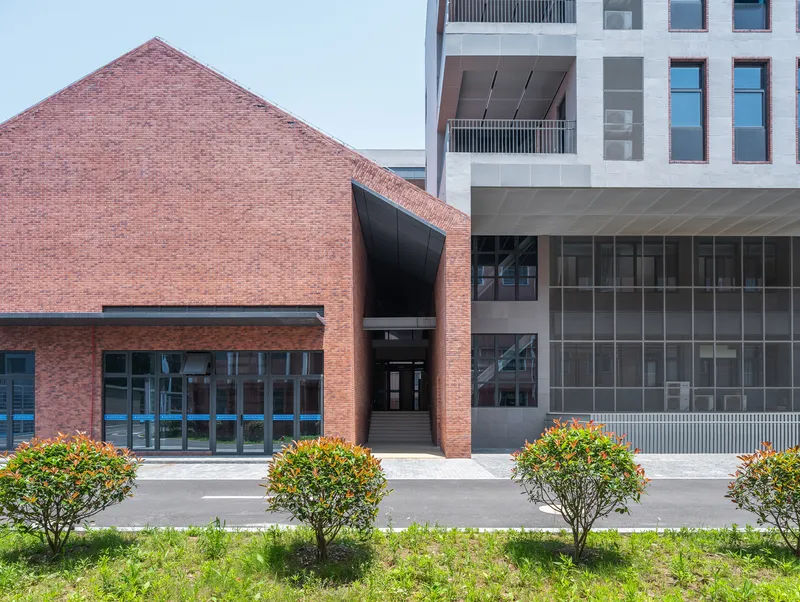
To create a meaningful dialogue with the surrounding urban and historical fabric, NODE chose a material palette inspired by nearby vernacular architecture. Red brick and ceramic tiles with concrete textures reference local traditions while maintaining a clean, modern aesthetic. The library, positioned at the heart of the composition, features a sloped red-brick roof that visually and symbolically anchors the complex.
On the west façade, vertical brick undulations and strategically placed windows create a rhythmic articulation that transitions seamlessly between interior and exterior. This thoughtful material approach fosters a sense of continuity between old and new, tradition and innovation.
Vertical Integration and Communal Activation
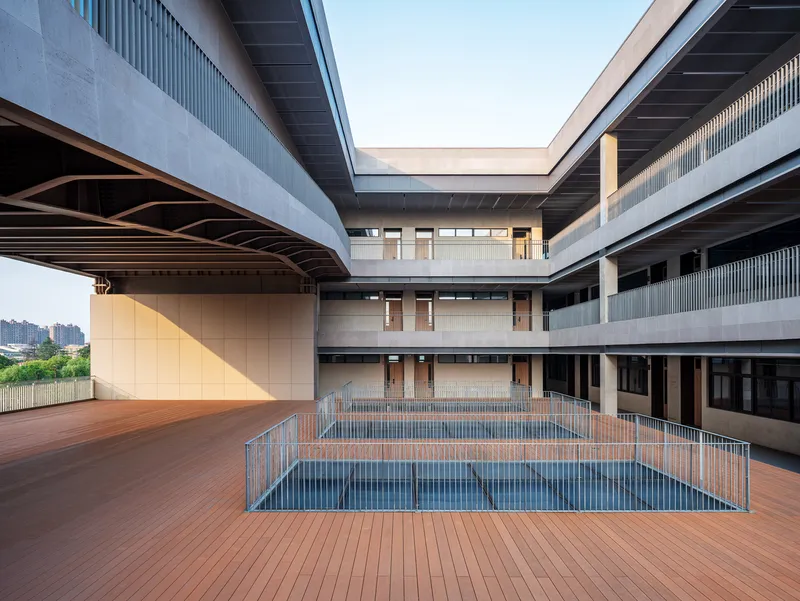
Instead of allocating outdoor communal areas on the ground level, NODE introduced a rooftop terrace on the third floor of the Arts Building. This elevated outdoor space offers students panoramic views and a multilevel campus experience. Below the lecture hall, a semi-open-air gym connects visually to the canal, blurring the boundaries between built and natural environments.
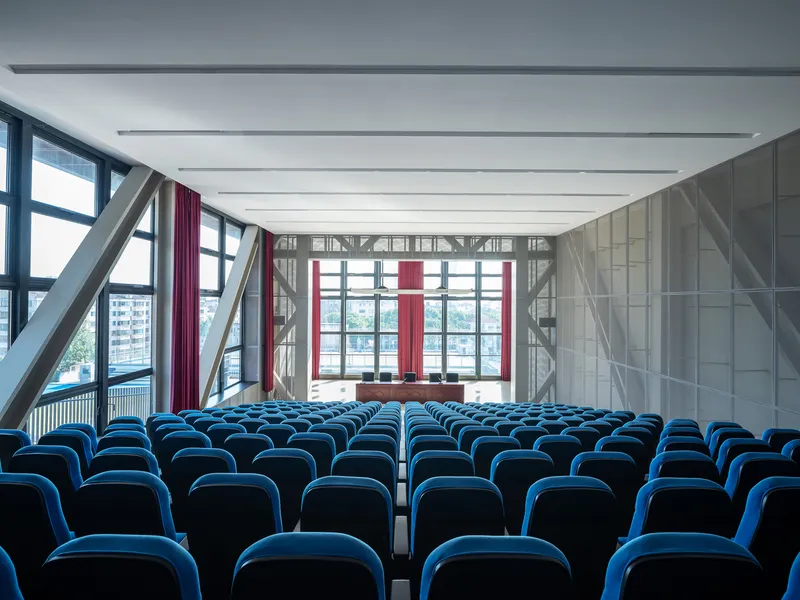
The lecture hall itself, perched atop the library using advanced bridge construction techniques, becomes a lightweight architectural landmark. This elevated volume—resembling a poised dancer—symbolizes the project’s structural ingenuity and poetic ambition.
Lighting, Interiors, and Sensory Engagement
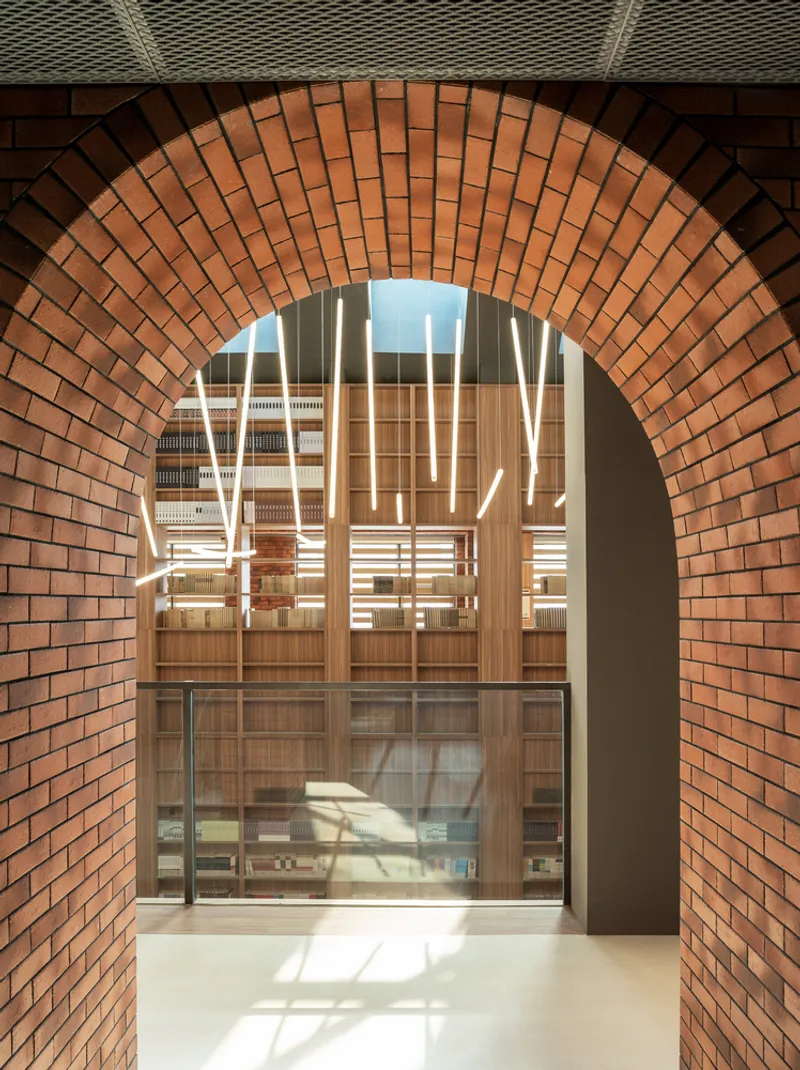
The interiors, also designed by NODE, reflect a nuanced material language that adapts to each space’s function. Materials such as wood veneers, patterned tiles, and exposed concrete evoke different atmospheres throughout the day, enhancing occupants’ emotional connection to the space.
In the library atrium, a sculptural light installation composed of triangular LED strips forms a three-dimensional geometry that transforms the space with a sense of verticality and energy. Meanwhile, the flooring tiles echo motifs from the Republican Era, further strengthening the historical narrative.
A Model of School-Community Integration
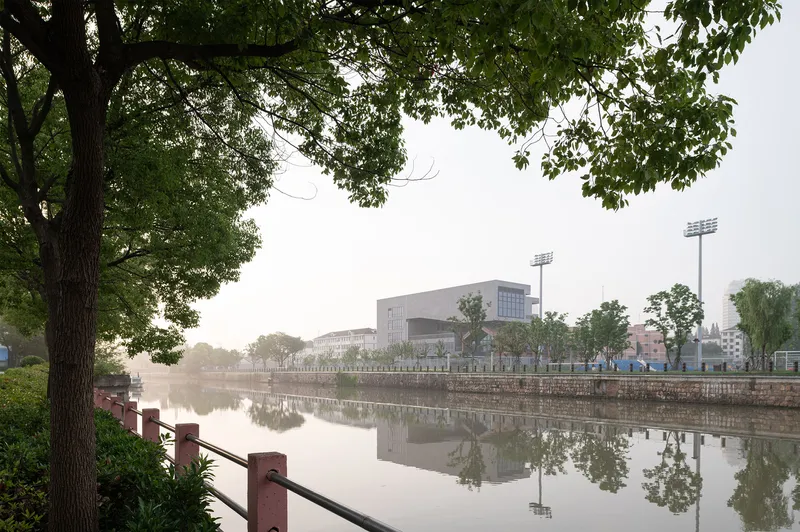
Located between a scenic canal and a school playground, the building maximizes openness with large casement windows facing both natural and built contexts. The design champions context-sensitive educational architecture, where light, view, and ventilation are optimized.
Importantly, the building is designed with the future in mind: the underground theater, cafeteria, and sports facilities are connected by bright, navigable corridors and will be made accessible to the public. This visionary concept supports the broader “Nanqiaoyuan” urban renewal initiative, which aims to merge education, culture, and community into a cohesive, multifunctional urban ecosystem.
A Blueprint for Culturally Rooted School Architecture
The Shanghai Nanqiao Academy Comprehensive Building is not just a school building—it is a civic landmark, an architectural response to historical continuity, and a prototype for 21st-century educational spaces. By prioritizing heritage, spatial innovation, and shared functionality, NODE has crafted a campus that resonates with both local identity and future-forward thinking.


Popular Articles
Popular articles from the community


Lunar Spiral: Space Architecture Shaped by the Mathematics of the Universe
Lunar Spiral reimagines space architecture through Fibonacci geometry, lunar regolith, levitating habitats, and self-sustaining Moon living.

Co-life: Sustainable Architecture for Age-Friendly Community Living
Co-life reimagines sustainable architecture for seniors through courtyards, rammed earth, shared gardens, and spaces designed for belonging.

The Musturak Paradise: Senior Living Architecture for a Connected Future in Temara, Morocco
The Musturak Paradise reimagines senior living architecture in Temara via private homes, social spaces, culture, community, and shared care.

Hill & Cross Opera: Sculptural Opera House Architecture Shaped by Tallinn’s Landscape and Identity
Hill & Cross Opera reimagines opera house architecture in Tallinn through its sculptural hill, civic plaza, glass wave and a luminous cross.
Similar Reads
You might also enjoy these articles


Hodi-Mandai Geram
Project Function: Preservation and revitalization of the Intangible heritage and socio-spatial identity of the Hodi by Housing, Cultural Memory Center, Sacred Grove, landscape, local tourism economy


Olio Towers: A Mid-Rise for Performers That Fuses Housing, Rehearsal, and Stage
Located blocks from Houston's Theater District, this modular tower stacks living units around a central performance atrium.

Oasis: Modular Green Housing Carved into Dhaka's Urban Fabric
A shortlisted Plugin Housing entry reclaims unauthorized settlements in Dhaka with stepped concrete volumes, green roofs, and ventilation-driven design.

Black Hole: A Floating Megastructure for the Post-Physical Era
Emiliano Mazzarotto envisions a spherical, self-scaling arena where e-sports, digital hotels, and holographic stadiums replace traditional public space.


Explore Landscape Design Competitions
Discover active competitions in this discipline



Challenge to reimagine the Iron Throne


Photograph architecture without architects


Illustrate the lost glory of Angkor Wat - Render Challenge


Design challenge to reuse E-waste
Comments (0)
Please login or sign up to add comments
No comments yet. Be the first to comment!