

SHELTERED: A Newark Help Center That Stitches a City's Fragmented Outreach Chain Into One Building
Samantha Pires reframes the homeless shelter as a Help Center, a timber-built node connecting emergency beds, services and housing in Newark.


Most homeless shelters are designed as endpoints: a bed for the night, a door that opens in the evening and closes in the morning. SHELTERED treats the shelter as a junction instead. Its argument is that cities already have a network of encampments, outreach vans, private shelters and supportive housing, and that this network fails at the gaps between its parts. The architecture is meant to close those gaps.
Developed as a thesis project by Samantha Pires, SHELTERED: Alternative Shelter and Urban Framework maps homelessness services across Newark, New Jersey, and proposes a new building type to sit at their centre: the Help Center. It is part emergency shelter and part community resource. It is positioned to bridge federal programs, municipal responsibilities and nonprofit initiatives, and the project treats architecture as an active participant in a social problem rather than a container for temporary relief.
A Street Front That Reads as a Neighbour, Not an Institution
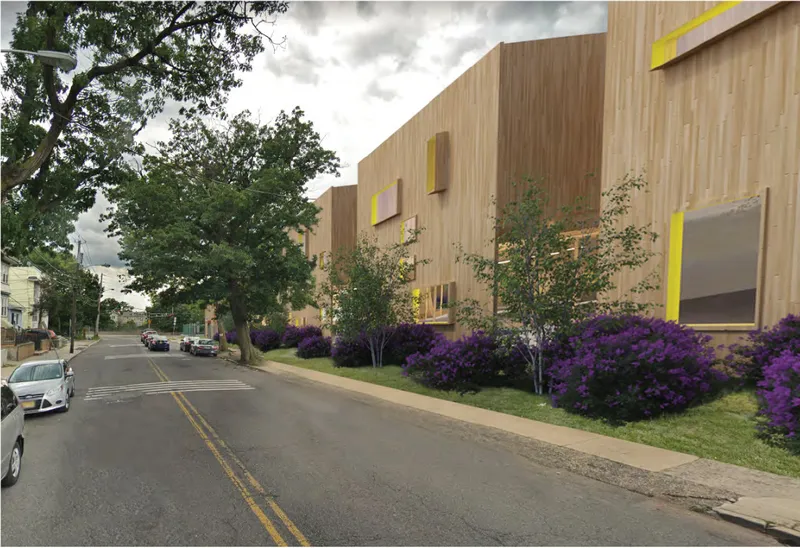
The first image makes the project's strategy clear before any diagram does. A timber-clad facade with yellow-framed windows sits behind a lawn of purple flowering shrubs, and nothing about it announces emergency housing. That is deliberate. Pires identifies community resistance as one of the biggest barriers to homeless infrastructure, since shelters are often read as isolated or disruptive. The Help Center answers with a prototype that blends into its surroundings and gives the neighbourhood a building it can accept.
Behind that domestic face is the project's larger analytical work. Pires describes the existing system as an outreach chain in which each link operates alone. Emergency shelters lack long-term services, private and religious shelters can attach conditions that limit access, and outreach programs find people in need but cannot hold onto them. The Help Center is proposed as the missing link, a single address where housing, healthcare, counselling and education meet.
An Entry Hall Where the Transition Begins
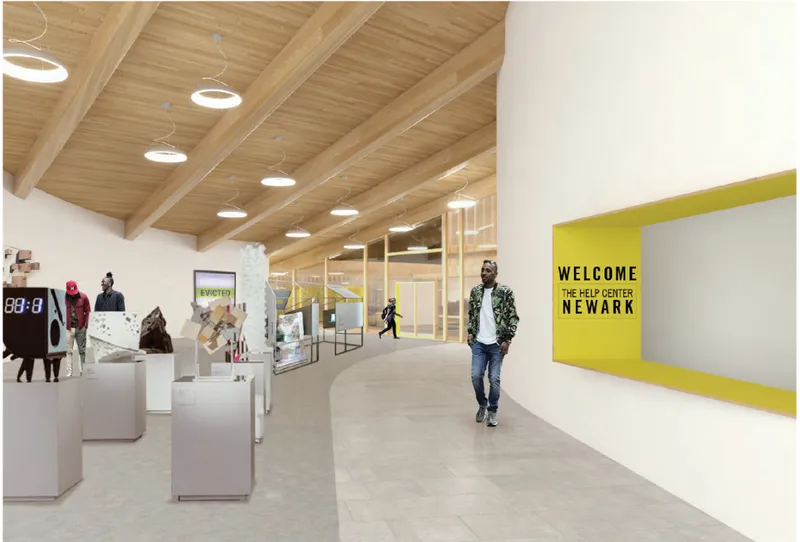
The entry hall carries the thesis into space. Exposed timber beams run overhead, display plinths line the room, and a yellow-framed welcome niche picks up the colour of the street windows, so the threshold continues the outside rather than breaking from it. A man walks a curved path through the hall. The curve matters: it suggests movement and choice rather than the queue-and-check-in sequence typical of conventional shelters.
This is where the project's idea of a transition process starts. Individuals enter through emergency accommodation, gain access to services and training, and gradually move toward stable housing. The building is described as a bridge between crisis and independence, and the entry hall is the first span of that bridge. It is generous and legible, and it does not make arrival feel like a penalty.
A Courtyard Programmed for Ordinary Life
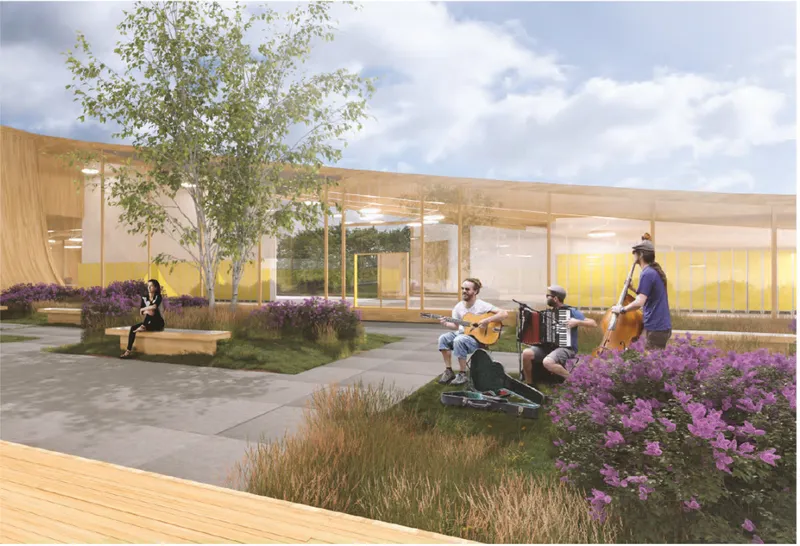
The courtyard is the image that best shows how the Help Center tries to be a community resource rather than a facility. A birch tree, benches and the same purple shrubs from the street front frame a space where three musicians play guitar, accordion and double bass. It is an everyday scene, and it shows a shelter that hosts life rather than just managing it.
The courtyard also works for the project's urban case. A shared open space gives residents and neighbours somewhere to meet without either group being cast as visitor or intruder. If community acceptance is the barrier, then spaces like this, which are pleasant, porous and unremarkable in the best sense, carry real weight in the scheme.
Reading Rooms and Dormitories Under One Timber Structure
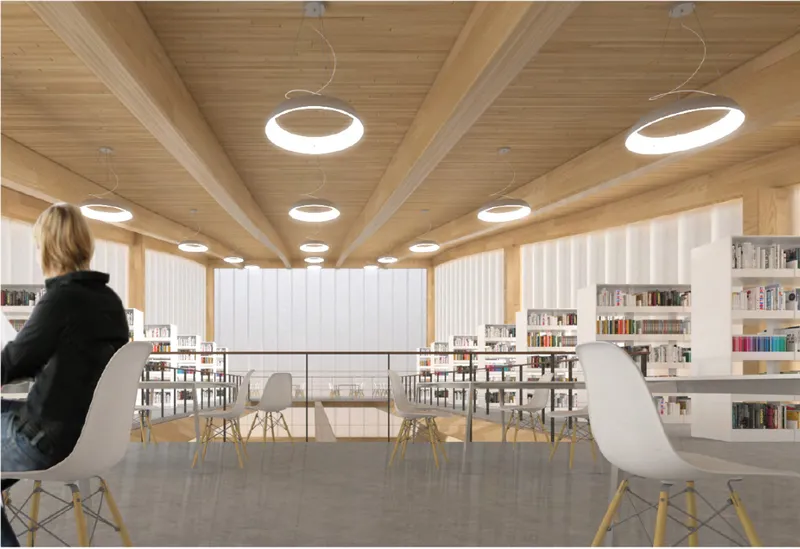
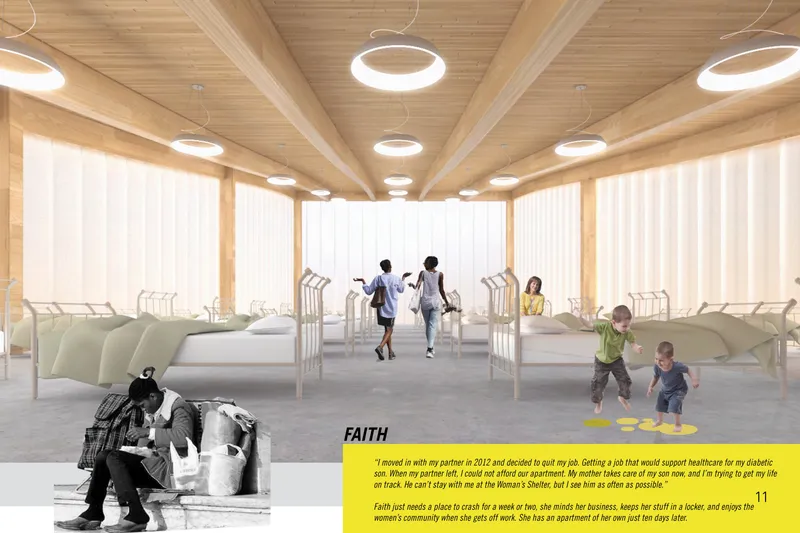
The last two views show the layered program at work. An upper-floor reading room, with glulam beams, ring pendant lights and white bookshelves, holds a woman working quietly at a table. The dormitory hall shares the same timber language: rows of metal-frame beds, translucent walls that soften the light and divide space without sealing it off, and children playing between the beds. Placing study and sleep within one structural system tells you the building's priorities. The bed is the entry point, and the library, the training and the counselling are the way out.
The children in the dormitory also point to one of the thesis's strongest methods. Pires built fictionalized but research-based personas to test how different people move through the system and where traditional shelter models fail them. The result is an argument that homelessness is a spectrum of circumstances, not a single condition, and that the architecture has to be flexible enough to serve a lone adult, a family and someone who needs support far beyond a night's stay. The project calls this a framework for empathy, and the dormitory, open but filtered and collective but not punitive, is where that claim is easiest to see.
Why This Project Matters
SHELTERED is valuable because it begins with a systems diagnosis rather than a form. By mapping Newark's outreach chain and finding where it breaks, Pires gives the Help Center a clear brief: be the connective node that encampments, vans, shelters and supportive housing currently lack. The architecture follows from that role, and the clarity shows in how consistently the timber, the yellow frames and the planted edges carry from street to courtyard to dormitory.
For a thesis, it also takes on the political side of shelter design with unusual directness. Community resistance is often treated as something to get around. Here it is treated as a design constraint, met with a building that looks like it belongs on the block. The open question, as with any prototype, is how the Help Center performs when it is repeated across a city. As a model for turning emergency shelter into social infrastructure, it is a persuasive place to start.
View the Full Project
About the Designers
Designer: Samantha Pires
Enter a Design Competition on uni.xyz
uni.xyz runs architecture and design competitions year-round that reward proposals with spatial conviction and real site intelligence.
Project credits: SHELTERED: Alternative Shelter and Urban Framework by Samantha Pires.


Popular Articles
Popular articles from the community


Opera by the Sea Estonia: Three Shells Dissolving Architecture into Tallinn's Coastline
A winning opera house proposal replaces monumental form with interconnected shells that blur the boundary between building, park and Baltic Sea.

The Amber Palace Opera: A Geological Fiction Surfaces on Tallinn's Baltic Waterfront
Pierre Brillard reimagines a Baltic legend as a public landscape, opera house, and waterfront promenade rooted in Tallinn's coastal identity.

Cloaked Colonization: A Mobile Underwater Habitat That Moves Like a Fish
Micah Abaya's shortlisted EHC Pacific entry reimagines ocean settlement as a dispersed network of self-sustaining architectural organisms.
Faces of the Soviet Avant-Garde: Turning Moscow's Street Names into an Open-Air Museum
A network of sculptural installations across a Moscow residential district transforms forgotten architect names into spatial encounters with cultural memor

Similar Reads
You might also enjoy these articles

Healing Façade: A Modular Chapel System That Restores Ethiopia's Sacred Forests
Winner of the Eco-Chapel competition, this circular timber façade collects water from air to rebuild soil and reforest degraded Ethiopian landscapes.
Kaffeebühnen: Where Coffee Shop Architecture Becomes a Civic Stage in Vienna
A linear sequence of timber boxes, transparent shells, and open yards turns the Viennese café tradition into a public performance space.
Eco Chapel: A Modular Forest Pavilion That Grows Like the Landscape It Protects
Hexagonal timber modules weave through existing trees, turning a chapel into a living system for prayer, education, and reforestation.


Urban Forest: A Vertical Ecosystem for 5,000 Workers in Singapore's Changi Business Park
Radially stacked pods and layered green decks turn a 7-acre plot into 47 acres of ecological workspace projected for 2040.

Explore Shelter Competitions
Discover active competitions in this discipline

Challenge to reimagine the Iron Throne

Photograph architecture without architects

Illustrate the lost glory of Angkor Wat - Render Challenge

Design challenge to reuse E-waste
Comments (0)
Please login or sign up to add comments
No comments yet. Be the first to comment!