

Shirakawa-Go Culture and Conservation Center: Tectonic Modules as Cultural Memory
A modular cultural center in Japan's UNESCO-listed village translates Gassho-zukuri geometry into two tectonic facade systems rooted in craft and community


What if the act of building could itself be an act of cultural preservation? In Shirakawa-Go, the mountainous Japanese village famous for its steep-roofed Gassho-zukuri houses, architecture has always been inseparable from communal labor, seasonal rhythms, and shared identity. The Culture and Conservation Center proposed here takes that premise literally, constructing a public building from a single tectonic module that distills the geometry of those iconic thatched roofs into a repeatable, adaptable system. The result is a cultural center that doesn't just house heritage: it performs it, structurally and spatially.
Designed by Nida Mohammed as an Editor's Choice entry to the Cultural Conserve competition, the project sits among the rice fields that define Shirakawa-Go's agricultural landscape. The center contains exhibition halls, craft workshops, community and administration spaces, and a central courtyard that serves as the social heart of the complex. Its programme is deliberate: learning, performing, gathering, and remembering, all organized around pedestrian paths and open courtyards that integrate with the existing rural fabric.
Two Systems, One Language: Pyramid Diamond and Weave Box
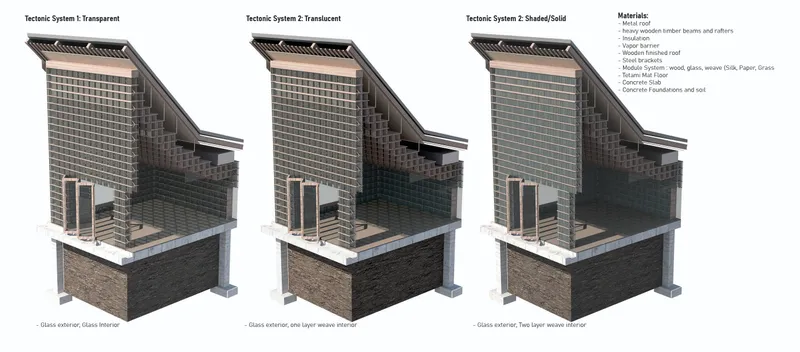
The axonometric drawing above reveals the DNA of the project: two tectonic facade systems that together form the building's architectural language. The Pyramid Diamond System reinterprets the intricate wooden joinery and layering found in Gassho roof construction, creating a module that filters light while expressing its own structural logic. The Weave Box System borrows the 60-degree roof angle characteristic of Gassho-zukuri dwellings and translates it into a modular facade element, sliced and layered to produce shadow play, breathability, and structural fluidity. Transparent and translucent material layers alternate across both systems, giving each facade a quality somewhere between screen and wall.
What makes these systems compelling is their emphasis on the act of making. Rather than applying ornamentation or stylistic references, the project locates cultural meaning in the tectonic joint itself. The modules can be assembled, reconfigured, and extended, mirroring the collaborative spirit of a village where rice farming, crafts, and shared labor have always defined daily life. Architecture here becomes a process, not just a product.
Gabled Volumes Stepping Across the Landscape
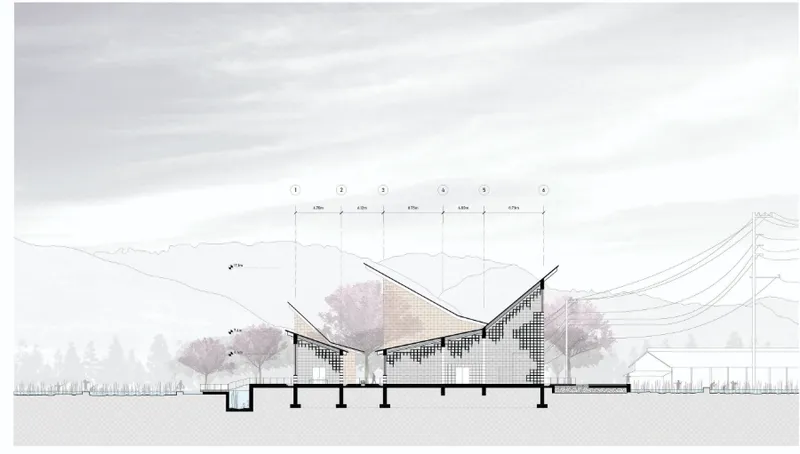
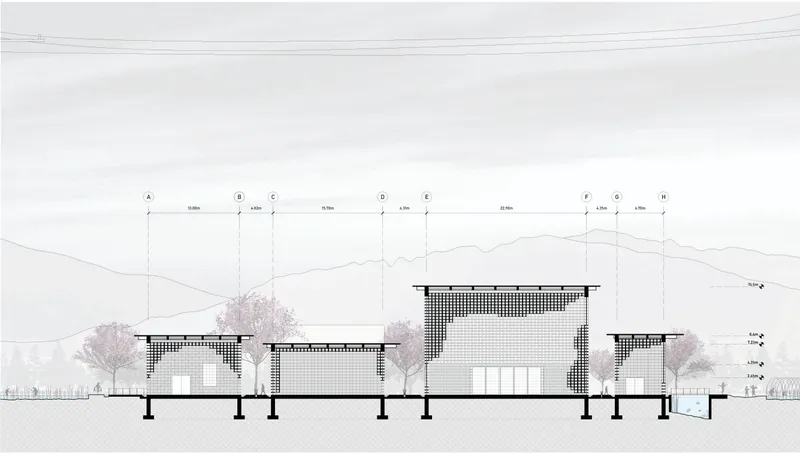
The section drawings show how the center breaks its programme into a series of distinct gabled volumes, each with its own roofline and character, connected by shaded circulation. In the first section, three volumes sit beneath gridded screens that recall the latticed facades of traditional village structures. The second section reveals four pavilion-like forms with varied roof pitches and checkered facade treatments set among trees, suggesting a looser, almost village-like composition. The buildings step with the land's slope rather than fighting it, maintaining visual and physical connection to the surrounding terrain.
This fragmented massing strategy is critical. By distributing the programme across multiple pavilions rather than consolidating it under a single roof, Mohammed avoids the institutional monolith that could overpower a delicate rural site. The gaps between volumes become courtyards and pathways, preserving sightlines toward the mountains and rice paddies while offering shaded, open-air movement between programme zones.
Elevations Against Mountain Ridges and Rice Paddies

The four elevation drawings present the building from every cardinal direction, and the consistency of the tectonic language holds up at each angle. Building volumes rendered in natural materials read as precise but lightweight against the mountain ridges behind them. The checkered and gridded screens vary in density and pattern depending on orientation, suggesting that the facade systems are calibrated for solar exposure, privacy, and framed views. The low profile of the complex keeps it subordinate to the landscape, a gesture of respect toward a site whose significance lies in the relationship between architecture and topography.
The Courtyard as Social Heart
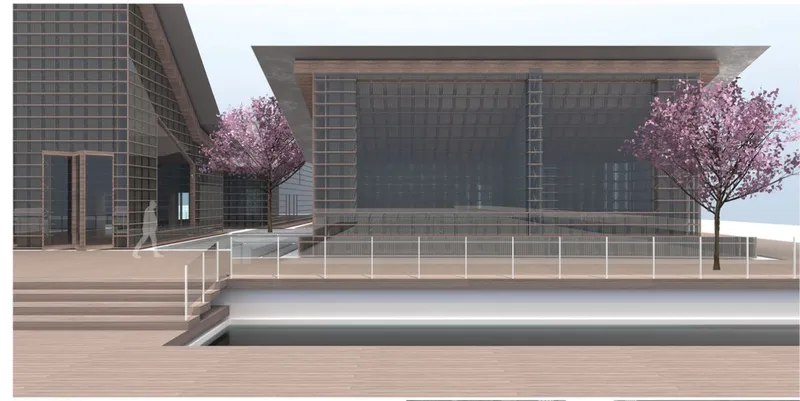
The rendered view of the central courtyard brings the project's spatial ambitions into focus. Stepped seating terraces descend toward an open gathering area flanked by two cherry blossom trees, their canopies softening the gridded facade behind them. The interplay between the rigid module geometry and the organic forms of planting and people is exactly what the project promises: a place where structure and culture meet, where the building's tectonic discipline creates a frame for informal social life. Filtered light falls through the screen facade, casting shadow patterns that shift with the time of day.
The courtyard is positioned as the heart of the complex, and its design echoes the multi-use village spaces traditional to Shirakawa-Go. It is performance space, meeting ground, and quiet garden simultaneously. The fluid public zones inside the building extend outward into this courtyard, blurring the threshold between interior and exterior in a way that respects the temperate climate and the village's deep relationship with its natural setting.
Why This Project Matters
Cultural centers in heritage contexts face a persistent tension: how to be contemporary without being alien, how to honor the past without becoming a museum of itself. Mohammed's approach sidesteps this trap by locating continuity not in form or style but in the logic of making. The Pyramid Diamond and Weave Box systems are not copies of Gassho-zukuri roofs; they are abstractions of the geometric principles and craft traditions that produced those roofs. The distinction matters, because it positions the building as a living extension of local knowledge rather than a frozen tribute to it.
The project also demonstrates how modular thinking can serve preservation goals. A tectonic system that can be assembled, adapted, and maintained by local hands keeps the community at the center of the architectural process, not as spectators but as participants. In a village where communal labor has always been the foundation of built culture, that continuity of agency may be the most meaningful form of conservation there is.
View the Full Project
About the Designers
Designer: Nida Mohammed
Enter a Design Competition on uni.xyz
uni.xyz runs architecture and design competitions year-round that reward proposals with spatial conviction and real site intelligence.
Project credits: Shirakawa-Go Cultural Conserve Center 2022 by Nida Mohammed Cultural Conserve (uni.xyz).


Popular Articles
Popular articles from the community


The Amber Palace Opera: A Geological Fiction Surfaces on Tallinn's Baltic Waterfront
Pierre Brillard reimagines a Baltic legend as a public landscape, opera house, and waterfront promenade rooted in Tallinn's coastal identity.

Opera by the Sea Estonia: Three Shells Dissolving Architecture into Tallinn's Coastline
A winning opera house proposal replaces monumental form with interconnected shells that blur the boundary between building, park and Baltic Sea.

Opera on the Sea: Driftwood Logic Shapes a Timber Opera House on Estonia's Coast
Trevor Orgill's opera house translates the entangled drift of floating timber into a civic building where wood, water, and music converge.

Singing Woman: An Opera House That Performs Before the Curtain Rises
Ovidiu Cristian Pavel's conceptual opera house translates Estonia's choral identity into a sculpted waterfront landmark facing the Baltic Sea.

Similar Reads
You might also enjoy these articles

Shakur's House: Exposed Brick as an Interior Organiser in a 168 m² Mashhad Residence
Brick moves indoors in this Mashhad residence, where masonry walls, glass partitions and teal planes sequence a compact home without closing it off.

Day and Night Park: A Time-Based Urban Newsstand in Beijing
A temporary urban newsstand in Beijing blending travel, light, and reading through poetic colors, compact form, and community-focused design.

Modernist Patio Renovation in El Masnou, Barcelona by Oliver Segura Arquitectura + Cebrià Arquitectura
Modernist patio renovation blending tradition and innovation with a movable pool, leveled floors, and Catalan materials in El Masnou.
Alto Residencial Coop: Cooperative Housing Development in Santiago de Compostela by Carbajo Barrios Arquitectos
A linear cooperative housing complex blending white volumes and perforated metal façades, enhancing community living, natural light, privacy, and urban integration.


Comments (0)
Please login or sign up to add comments
No comments yet. Be the first to comment!