

Sinfonia Verde Home by Studio Saxe: A Regenerative Off-Grid Retreat Immersed in the Costa Rican Rainforest
An off-grid circular home in Costa Rica’s rainforest, blending sustainable design, passive cooling, and immersive nature views with minimal environmental impact.


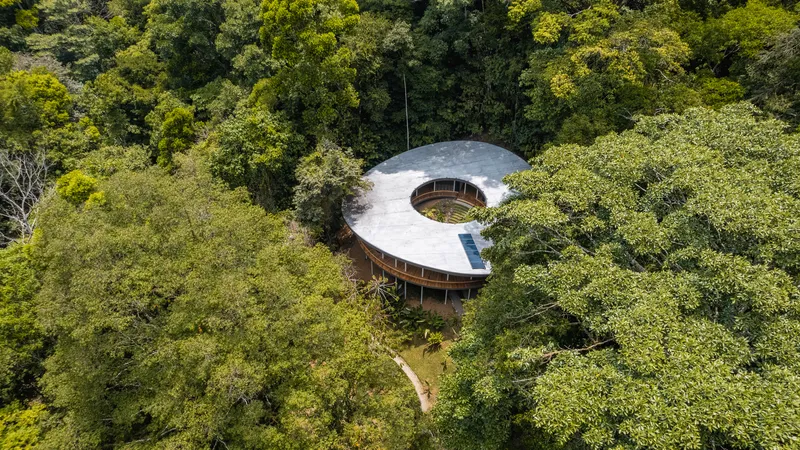
Nestled deep within the Osa Peninsula in Costa Rica, the Sinfonia Verde Home by Studio Saxe stands as a visionary model of off-grid living, biophilic design, and sustainable architecture. Designed for two researchers living in one of the world’s most biodiverse ecosystems, this 400 m² circular retreat redefines how architecture can coexist with the wild.
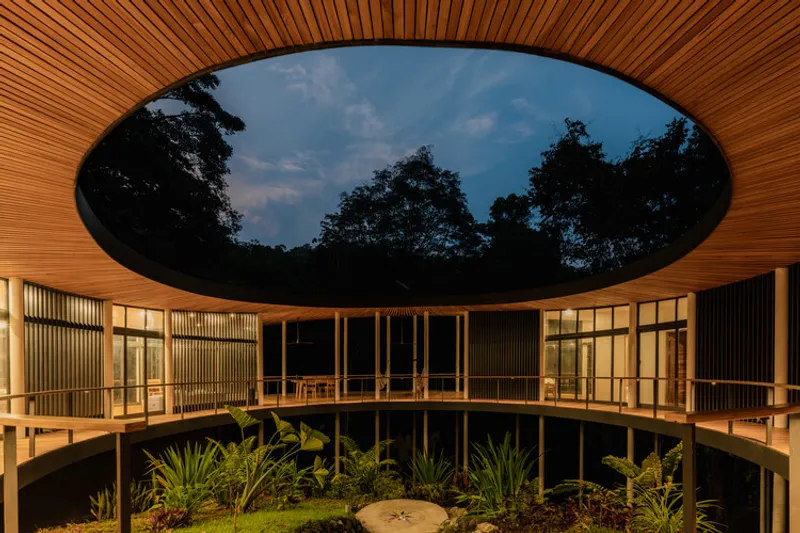
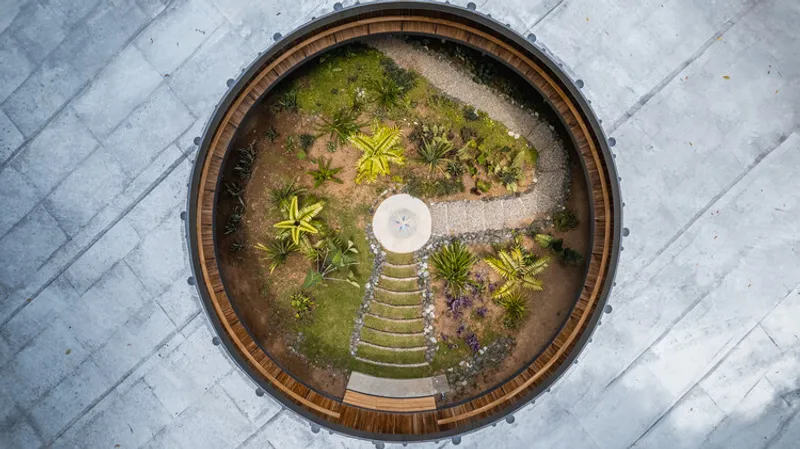
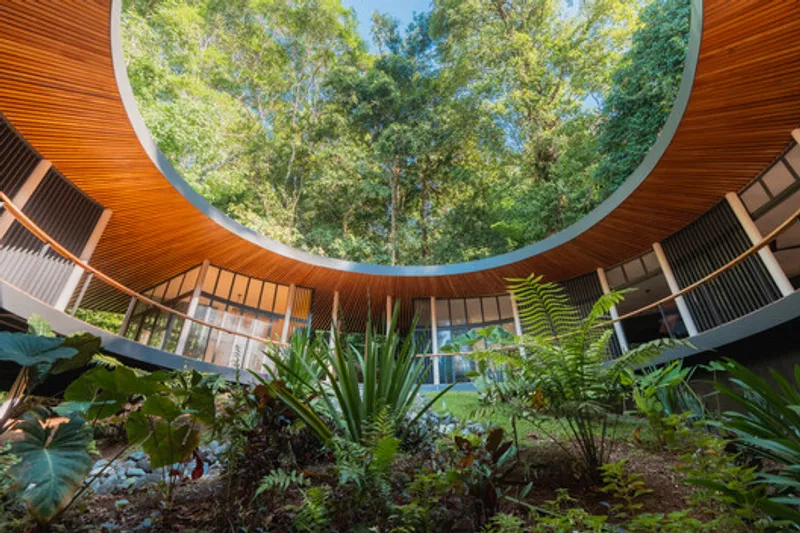
When a massive tree fell in the rainforest, an unexpected clearing appeared—an opening that revealed sunlight and a rare glimpse of the sky. This natural event sparked the idea for a home that embraces the forest canopy while providing sanctuary at its core.
Concept: A Harmonious Dialogue Between Architecture and the Rainforest
Inspired by the layered complexity of the rainforest, the architects conceptualized the home as a circular structure with a central oculus, mirroring the moment of clarity created by the fallen tree.
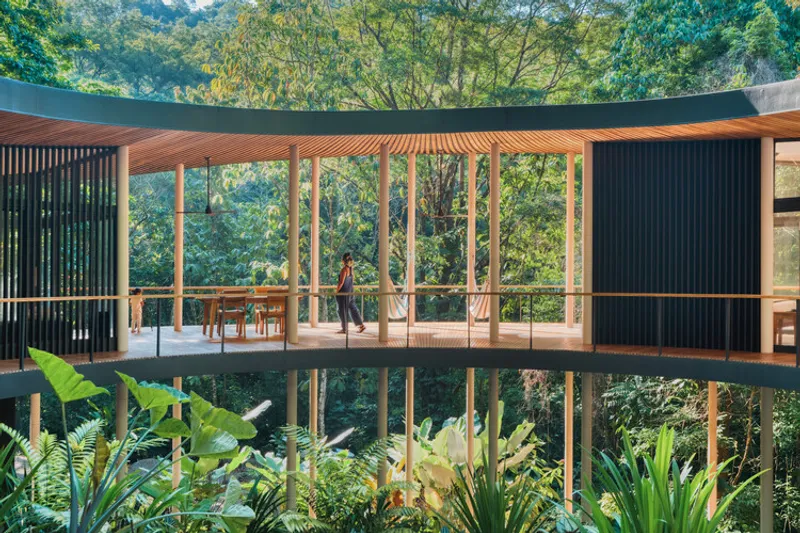
- The disk-shaped form allows panoramic engagement with the forest.
- The central courtyard acts as a calm retreat amid the wild, offering protection from wildlife such as jaguars and howler monkeys.
- The elevated design immerses residents in nature’s sensory rhythms—light, shadow, sound—much like a living symphony.
This thoughtful approach transforms the clearing into a meditative living observatory, celebrating the heights, depths, and energy of the surrounding ecosystem.
Design: Elevated Lightness, Immersive Views, and Sensitive Spatial Flow
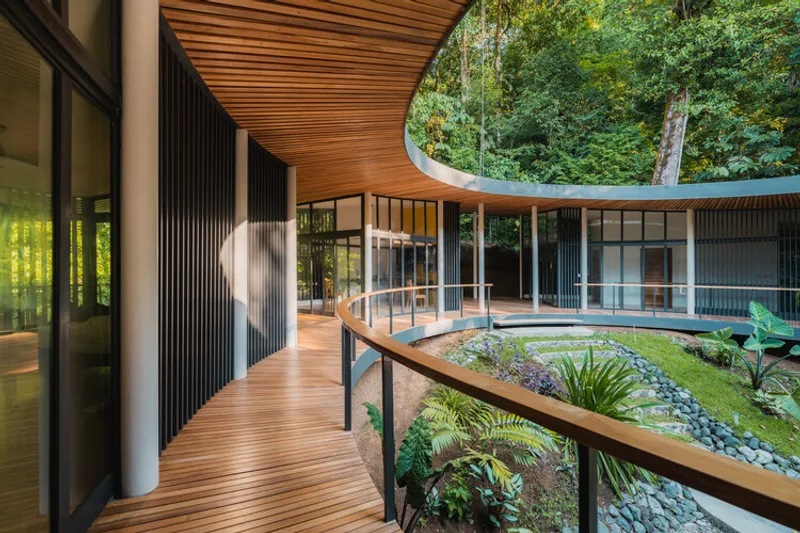
Studio Saxe sought to create a home that shifts perspectives as you move through it. Though the interior is arranged on a single level, the steeply descending terrain allows the architecture to float at varying heights.
Key Design Features
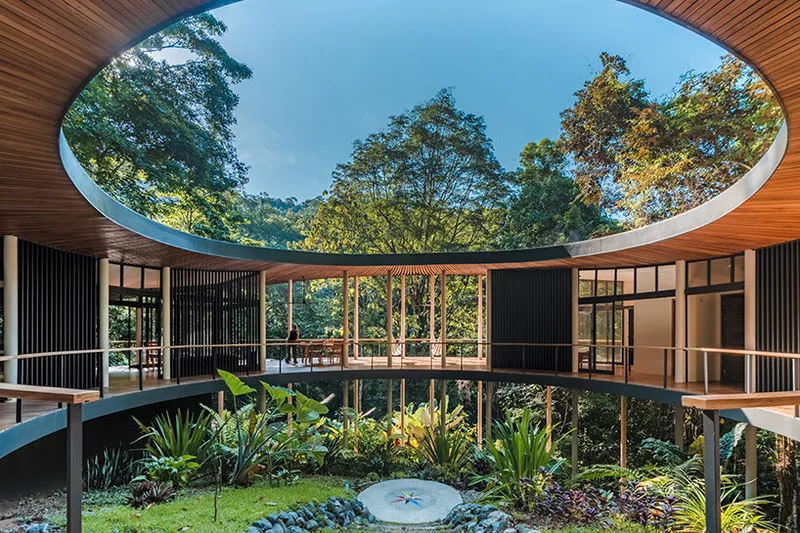
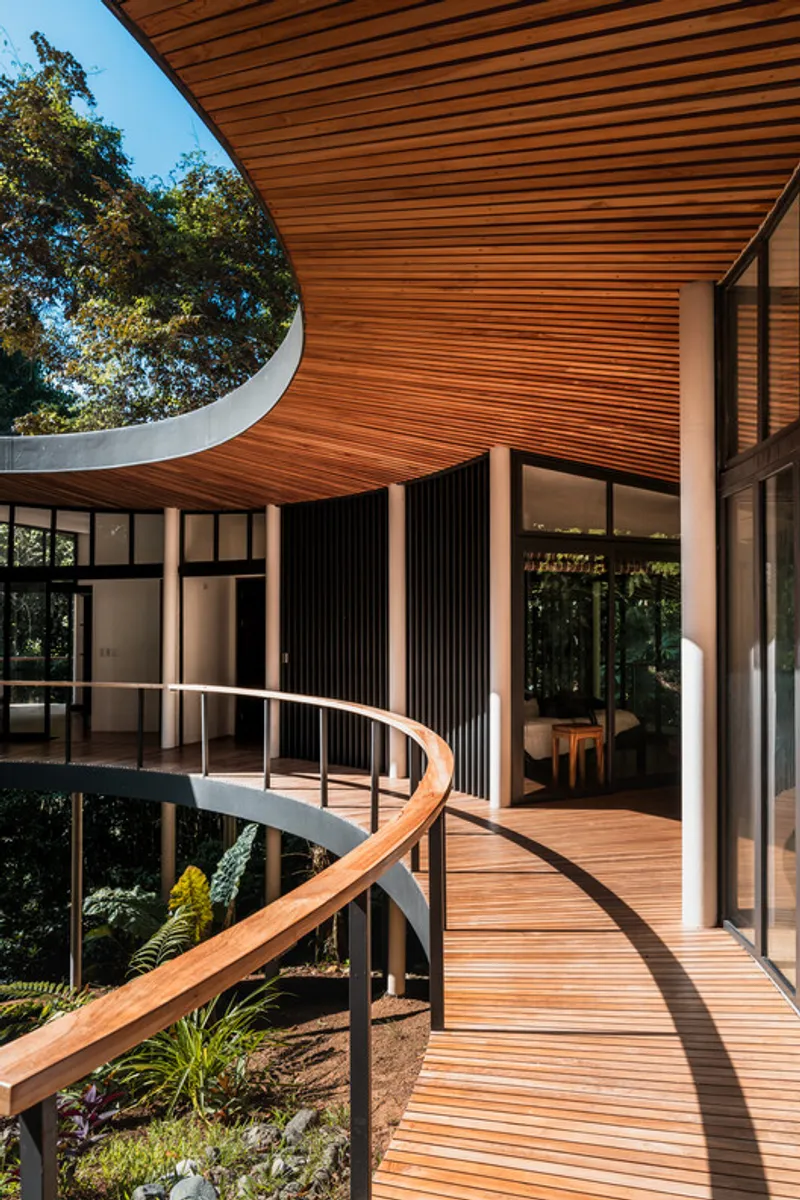
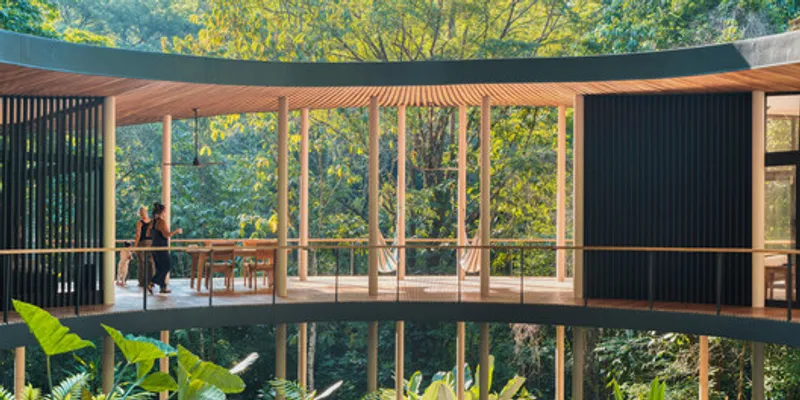
- Perimeter walkway: A continuous loop that transitions from mossy roots to treetop heights, enabling daily encounters with scarlet macaws and forest wildlife.
- Program layout: Two bedrooms, an open-plan kitchen and living area, and a combined laboratory-library to support the residents’ research activities.
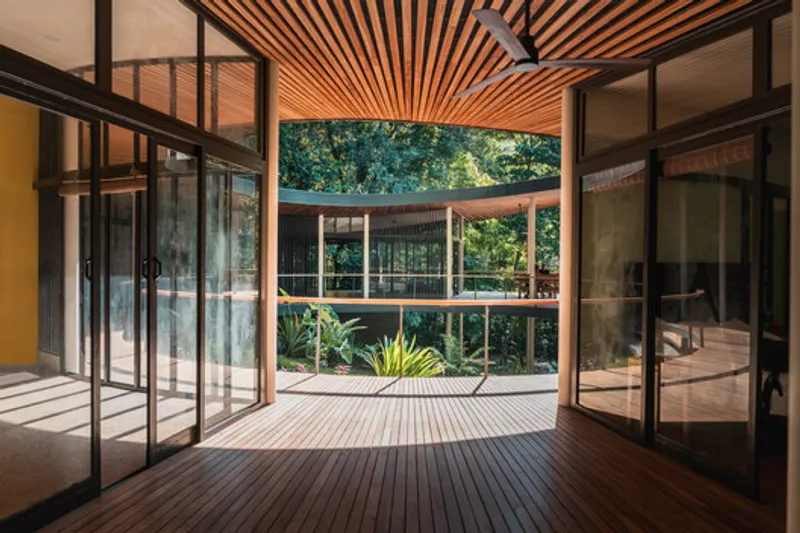
- Shaded terraces: Sheltered outdoor spaces for quiet observation, offering immersive views while staying protected from heat and rainfall.
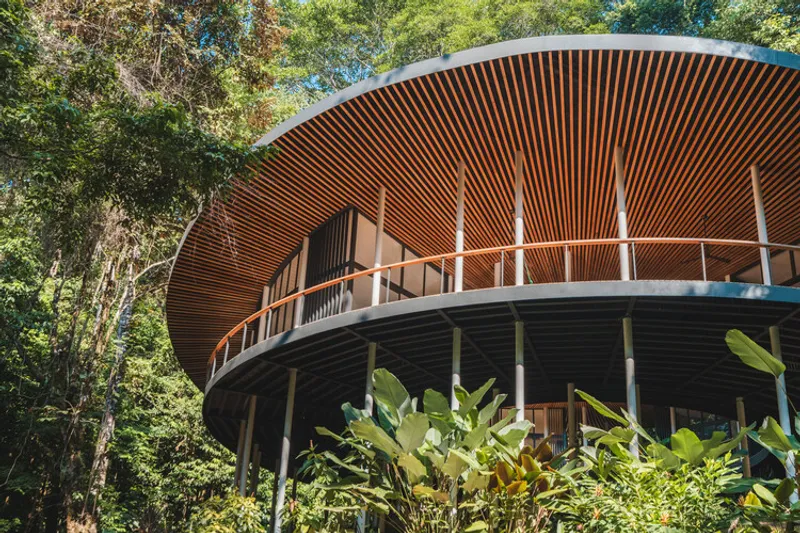
- Hyperbolic roof form: A dynamic structure that collects and channels rainwater away from the core, mirroring natural hydrological flows.
- Breathable façade: Slatted wood screens promote passive ventilation while filtering natural light and forest sounds.
- Radiating wooden ceiling: Structured around the oculus, it enhances the visual experience and deepens the sense of immersion in nature.
The architecture creates a sensory journey—from rooted earth to sky canopy—celebrating every layer of tropical life.
Sustainability: Building Lightly in One of the Most Biodiverse Places on Earth
Located near Corcovado National Park, home to an astonishing 3% of global biodiversity, the project demanded a highly sensitive and ecological approach.
Low-Impact Strategies
- Minimal footprint: The home sits lightly within the natural clearing, eliminating the need to remove surrounding vegetation.
- Elevated on stilts: Narrow, careful footings avoid disturbing groundwater, soil, and wildlife movement.
- Passive cooling: Elevated structure, louvered openings, and cross ventilation eliminate the need for mechanical cooling in a hot, humid climate.
- Reflective insulated roof: Reduces heat absorption to maintain indoor comfort.
- Off-grid systems: Photovoltaic solar power A hydro turbine drawing from a nearby stream Natural spring water for household use
- Photovoltaic solar power
- A hydro turbine drawing from a nearby stream
- Natural spring water for household use
- Responsible material sourcing: Locally sourced teak, cork, and energy-efficient fixtures reduce embodied energy.
Beyond architecture, the residents actively support the ecosystem by monitoring wildlife, propagating native species, and restoring coral reefs—turning the house into a living research hub.
Construction: Craftsmanship, Resilience, and Remote Ingenuity
Building in such a remote rainforest location presented significant challenges:
- No electricity or water at the site
- Limited access via narrow footpaths
- Transportation across rivers and mountains
- Earthquake risks, heavy rainfall, salt-laden air, and wildlife activity
To address these conditions, Studio Saxe collaborated closely with local builders who understood the terrain and climate.
Construction Highlights
- Prefabricated steel components were fabricated off-site and transported during the dry season.
- All materials were carried by hand to the site due to inaccessible terrain.
- The roof’s complex geometric form was crafted using a woven grid of uniquely pitched beams.
- A high-performance membrane and fiber cement boards ensure long-term durability in harsh weather.
- After completion, the site was replanted with native vegetation, allowing the forest to gradually reclaim and envelop the home.
The result is a resilient, regenerative, and deeply contextual piece of architecture—one that stands lightly yet confidently in one of the planet’s most delicate landscapes.
A Symphony of Nature and Design
The Sinfonia Verde Home is more than a place to live—it is a profound architectural expression of symbiosis, sustainability, and sensory connection. Through its circular geometry, elevated footprint, and off-grid systems, the home demonstrates how architecture can harmonize with even the most complex natural environments.
Studio Saxe’s design offers a powerful blueprint for the future of ecological living, where humans coexist peacefully with the rhythms of the earth.


Popular Articles
Popular articles from the community


Aquadapt: An Underwater Habitat That Rewrites Its Rooms by the Hour
Curved modules ring the seabed while one shell shifts from breakfast room to cinema, farm and football pitch as residents' needs change.

Singing Woman: An Opera House That Performs Before the Curtain Rises
Ovidiu Cristian Pavel's conceptual opera house translates Estonia's choral identity into a sculpted waterfront landmark facing the Baltic Sea.

The Amber Palace Opera: A Geological Fiction Surfaces on Tallinn's Baltic Waterfront
Pierre Brillard reimagines a Baltic legend as a public landscape, opera house, and waterfront promenade rooted in Tallinn's coastal identity.

Opera on the Sea: Driftwood Logic Shapes a Timber Opera House on Estonia's Coast
Trevor Orgill's opera house translates the entangled drift of floating timber into a civic building where wood, water, and music converge.

Similar Reads
You might also enjoy these articles


Hodi-Mandai Geram
Project Function: Preservation and revitalization of the Intangible heritage and socio-spatial identity of the Hodi by Housing, Cultural Memory Center, Sacred Grove, landscape, local tourism economy


Olio Towers: A Mid-Rise for Performers That Fuses Housing, Rehearsal, and Stage
Located blocks from Houston's Theater District, this modular tower stacks living units around a central performance atrium.

Oasis: Modular Green Housing Carved into Dhaka's Urban Fabric
A shortlisted Plugin Housing entry reclaims unauthorized settlements in Dhaka with stepped concrete volumes, green roofs, and ventilation-driven design.

Black Hole: A Floating Megastructure for the Post-Physical Era
Emiliano Mazzarotto envisions a spherical, self-scaling arena where e-sports, digital hotels, and holographic stadiums replace traditional public space.

Explore Architecture Competitions
Discover active competitions in this discipline

Challenge to reimagine the Iron Throne

Photograph architecture without architects

Illustrate the lost glory of Angkor Wat - Render Challenge

Design challenge to reuse E-waste
Comments (0)
Please login or sign up to add comments
No comments yet. Be the first to comment!