
Siqueira + Azul Arquitetura Frame the Atlantic Through Circular Portals at Janeiro Hotel
A Leblon beachfront hotel wraps guests in freijó wood, travertine, and pirarucu leather while pointing every sight line toward the sea.


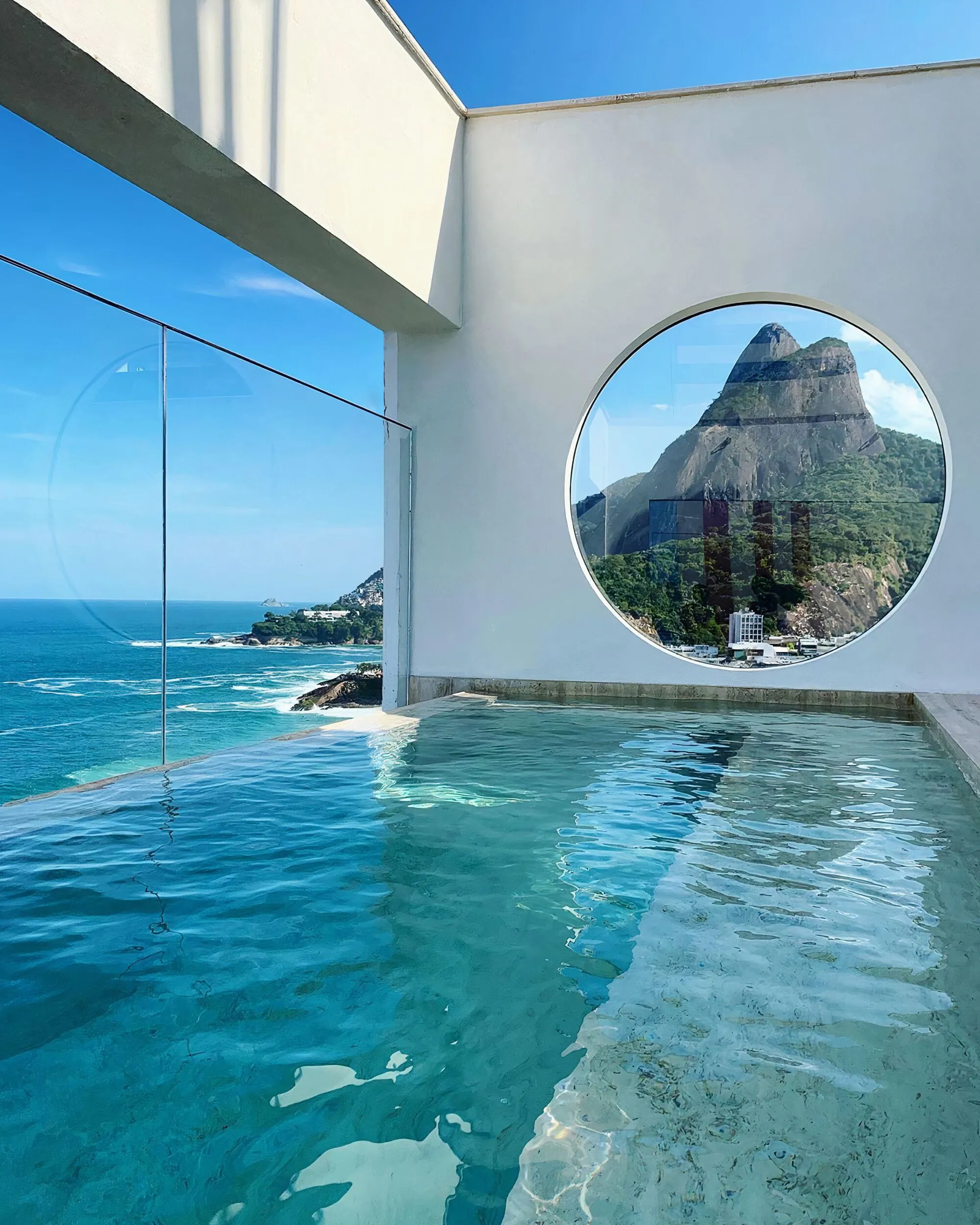
Hotels on Rio de Janeiro's beachfront are not in short supply, but most treat the ocean as wallpaper, a backdrop glimpsed through standardized curtain walls. Janeiro Hotel, a 3,800 m² renovation of the former Marina All Suítes building in Leblon, takes the opposite stance. Siqueira and Azul Arquitetura, led by Lia and Felipe Siqueira, restructured the entire building to dissolve barriers between guest and landscape, using circular apertures, full-height openings, and a rooftop infinity pool that bleeds into the horizon line of the Cagarras Islands archipelago.
The result is a 53-suite hotel that feels less like a conventional tower and more like a timber-lined periscope aimed at the Atlantic. Every material decision, from freijó wood ceilings to travertine floors to pirarucu fish-skin leather accents, reinforces a specifically Carioca identity: Brazilian production, natural textures, and a palette drawn from the sand and sea outside. Creative direction by Oskar Metsavaht (founder of Osklen) sharpened that identity into something legible without being heavy-handed.
The Circular Aperture as Architectural Device
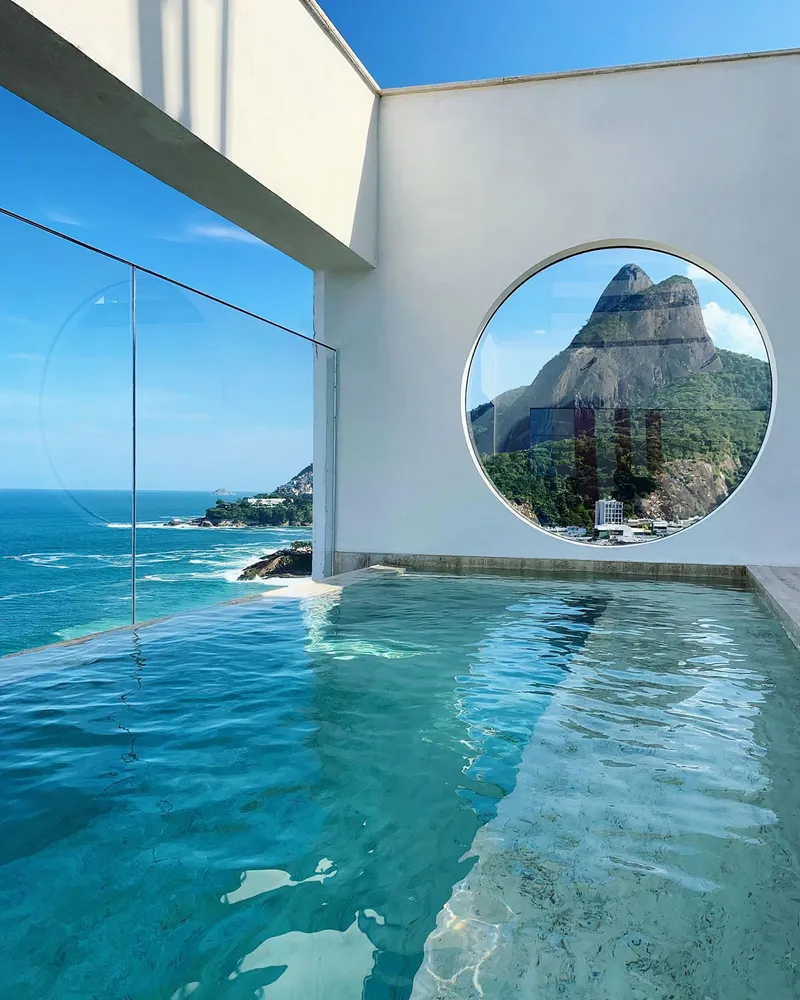
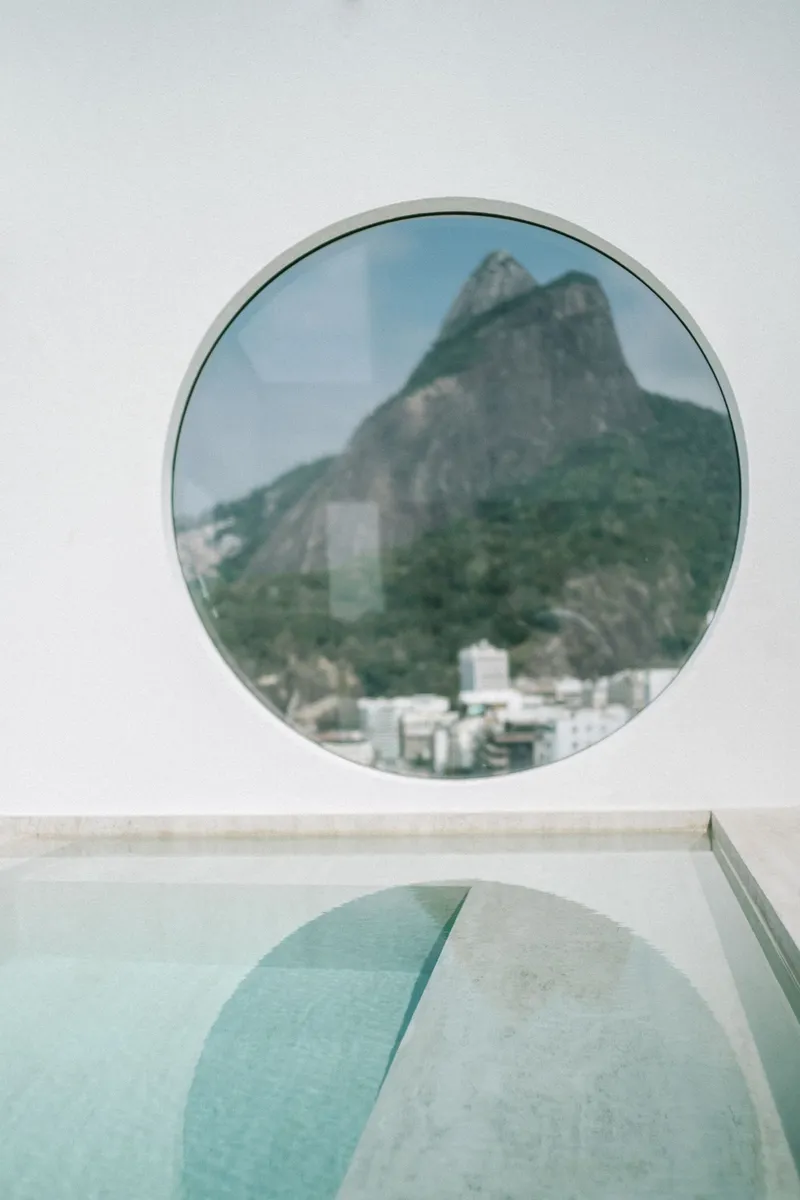
The most recognizable gesture at Janeiro is the circular porthole, and it earns its prominence. At the rooftop level, a large round opening beside the infinity pool frames the twin peaks of Morro Dois Irmãos with the precision of a telescope eyepiece. The geometry is deliberate: a circle crops the landscape into a focused composition, removing the visual noise of adjacent buildings and infrastructure. It converts a panoramic view into a portrait.
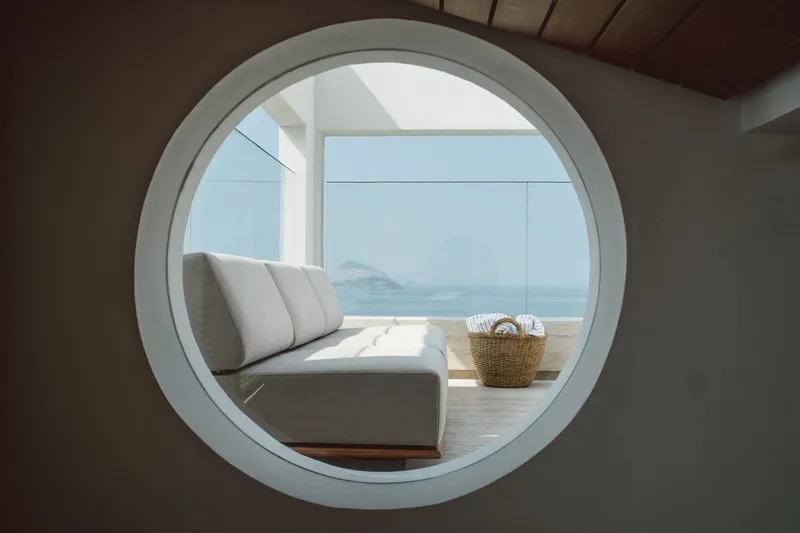
Smaller circular windows appear on lower floors and in corridors, each one calibrated to capture a particular fragment of the surroundings, whether forested mountain, open ocean, or terrace foliage. The device is simple, almost obvious, but it works because the architects commit to it structurally, punching through concrete planes rather than merely applying a decorative motif.
Timber, Travertine, and the Sand Palette
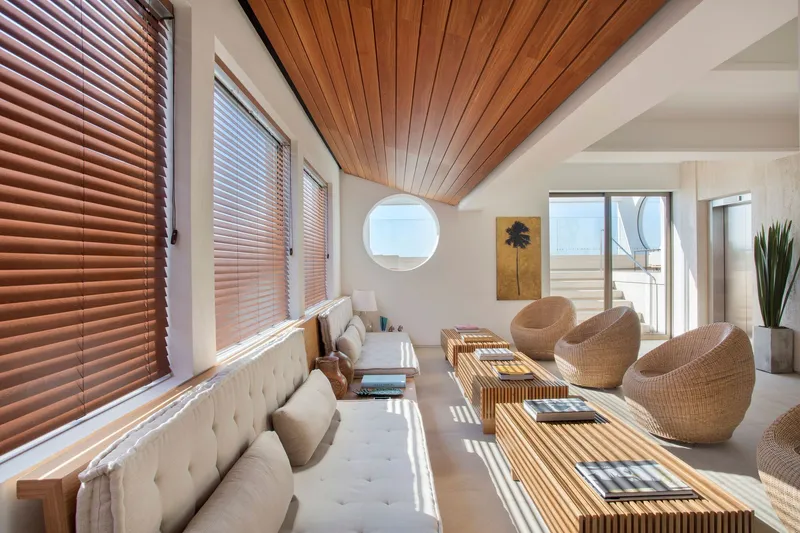
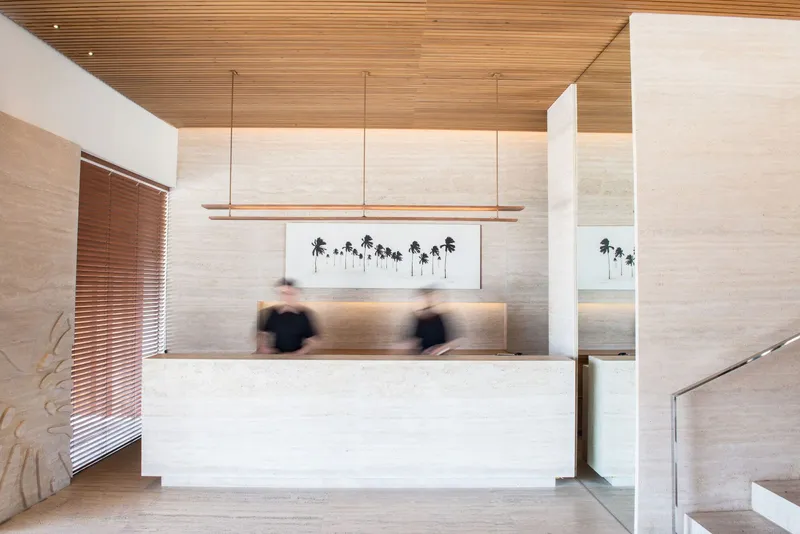
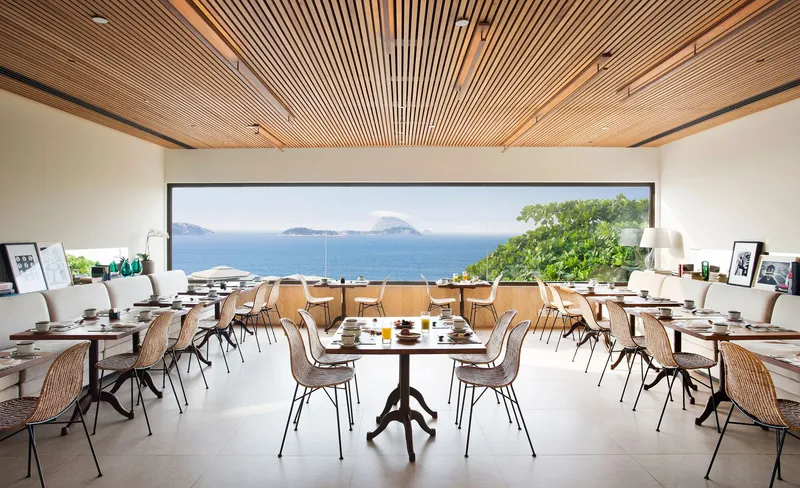
Freijó wood dominates the public areas. The reception desk sits beneath a continuous timber-slat ceiling that compresses vertical space and pulls the eye horizontally toward the beach. Custom woodwork, designed and fabricated exclusively for the project by Marcenaria Joia, gives the interior a warmth that prefabricated hotel finishes rarely achieve. The grain is consistent but not monotonous, broken up by the rhythm of slats and the shadow lines they produce under lighting designed by Maneco Quinderé.
In the restaurant, that same slatted ceiling frames a long horizontal window that turns the dining experience into a panoramic screening of the ocean. The travertine flooring, sand-toned and matte, anchors the palette and gives the timber something cooler and more mineral to play against. The material strategy is disciplined: wood, stone, natural fiber, linen, and not much else. It reads as restraint rather than austerity.
Suites Designed for Stillness
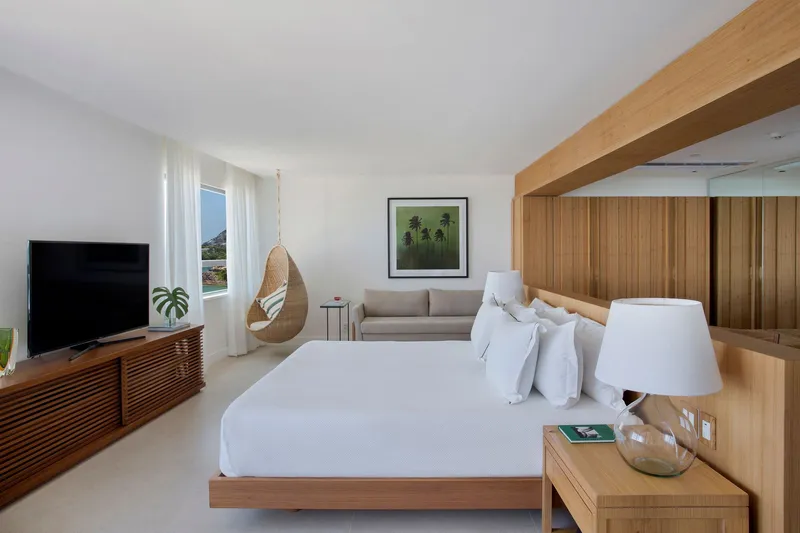
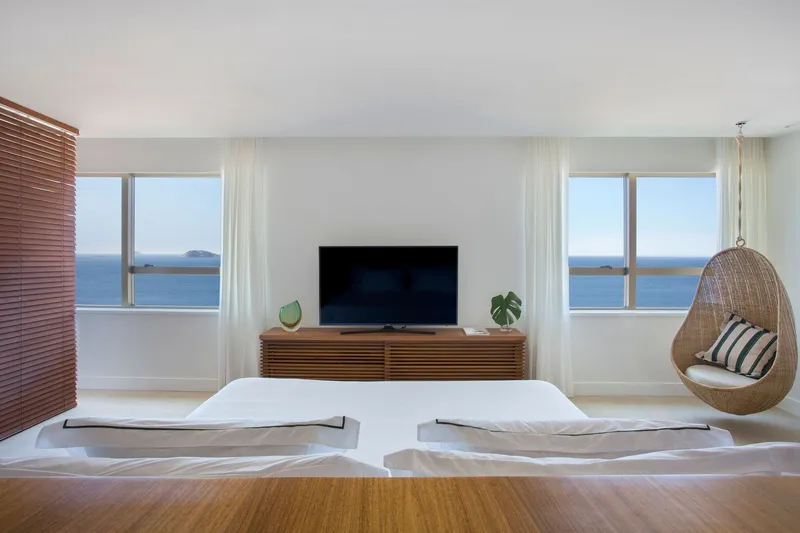
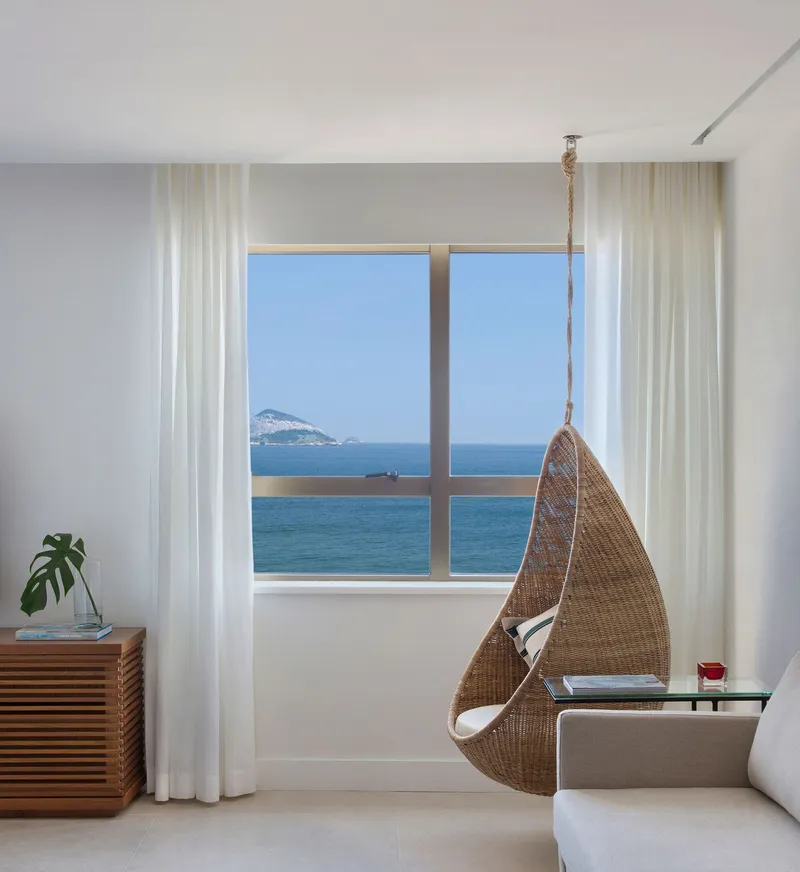
The suites follow a clear logic: a timber platform bed, a slatted screen separating wet and dry zones, and at least one suspended wicker rocking chair positioned beside the window. The hanging chairs, made from natural straw, are not a gimmick. They orient the guest's body toward the view and, because they swing, create a subtle sense of motion that connects you psychologically to the wind and waves outside.
Twin vertical windows in some suites pull full-height ocean views into the sleeping area without the glare and exposure of floor-to-ceiling glass walls. Sheer linen curtains diffuse the tropical light into something softer. The rooms are compact, but because the openings are generous and the furniture is minimal, they never feel tight. The platform bed functions as a plinth, lifting the occupant to sightline height with the horizon.
The Wet Zone and Threshold Details
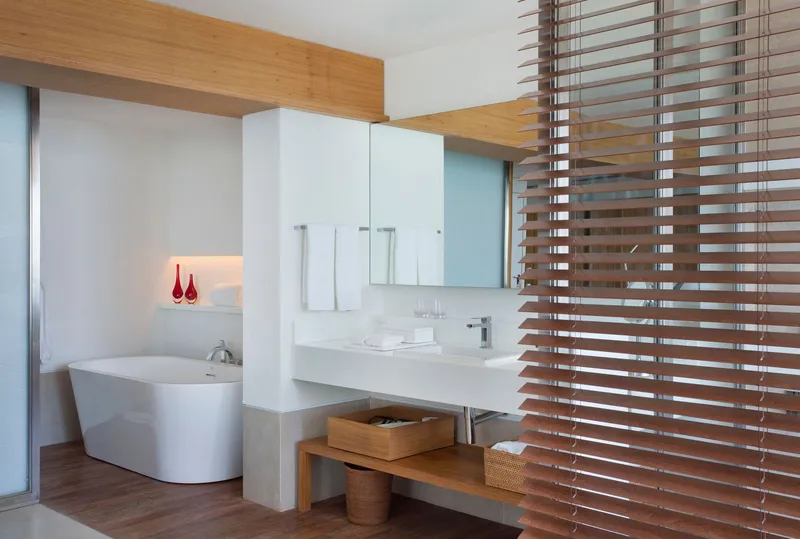
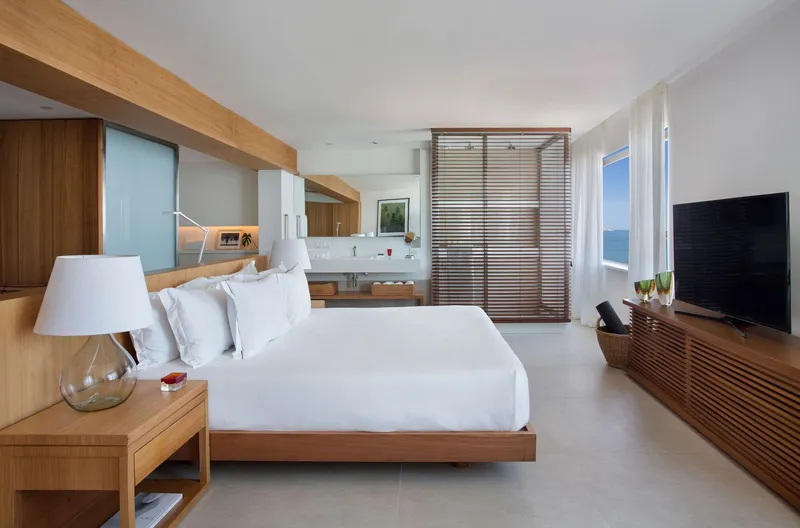
Janeiro's bathrooms are separated from the sleeping area by slatted timber screens rather than solid walls, maintaining visual continuity while creating acoustic and spatial distinction. A freestanding white tub, visible through the slats, becomes a sculptural object within the room rather than an afterthought hidden behind a door. The vanity, positioned on the other side of the screen, borrows natural light from the bedroom windows.
These thresholds matter because they reinforce the hotel's broader philosophy of permeability. Walls are replaced with screens, doors with openings, curtains with veils. The architects treat opacity as something to be earned, reserving solid partitions only where privacy genuinely demands it.
Rooftop Pool and the Horizon Edge
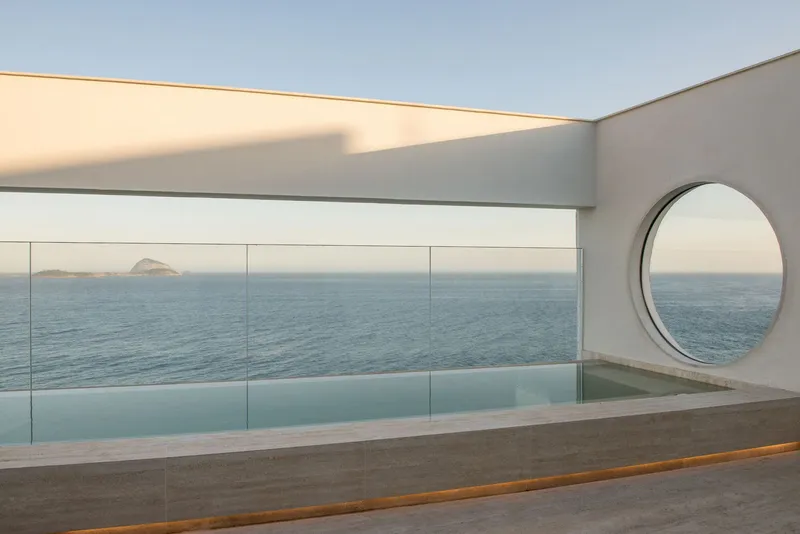
The rooftop terrace concentrates the hotel's most cinematic moments. The infinity pool's glass edge dissolves the boundary between water and sky, and at dusk the reflection doubles the circular portal behind it into a luminous ring. A daybed terrace extends beyond the pool, offering a second register of relaxation: dry, shaded, and lower to the ground.
What makes the rooftop successful is not its components, which are standard for boutique hotels, but the way the circular window, the edge pool, and the open horizon align into a single visual axis. The architects clearly studied the sightlines from this level and positioned every element to serve them. The pool does not merely exist on the roof; it is aimed.
Plans and Drawings
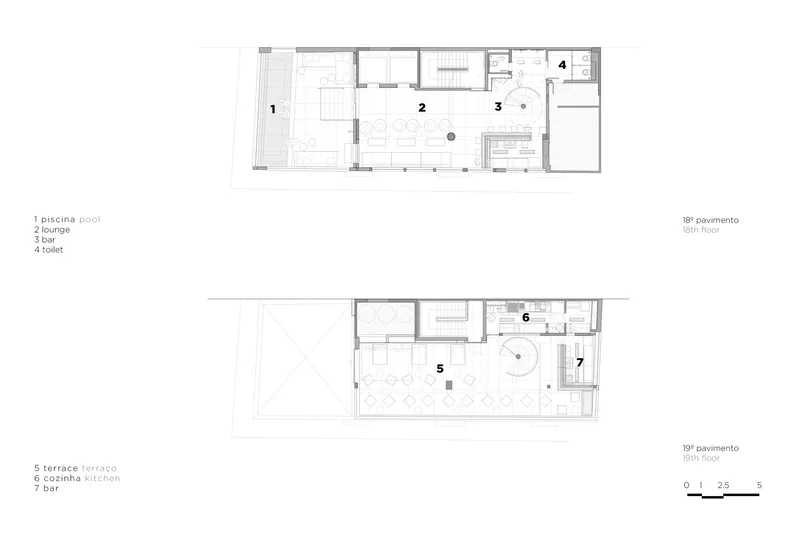
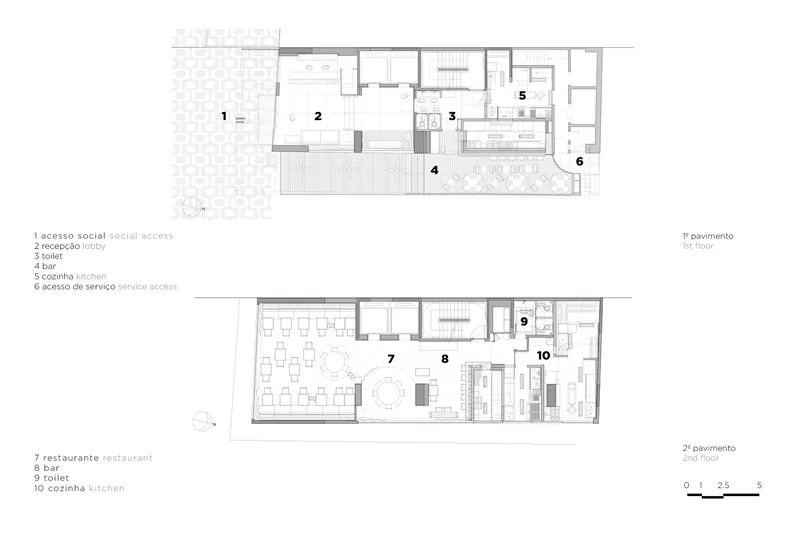
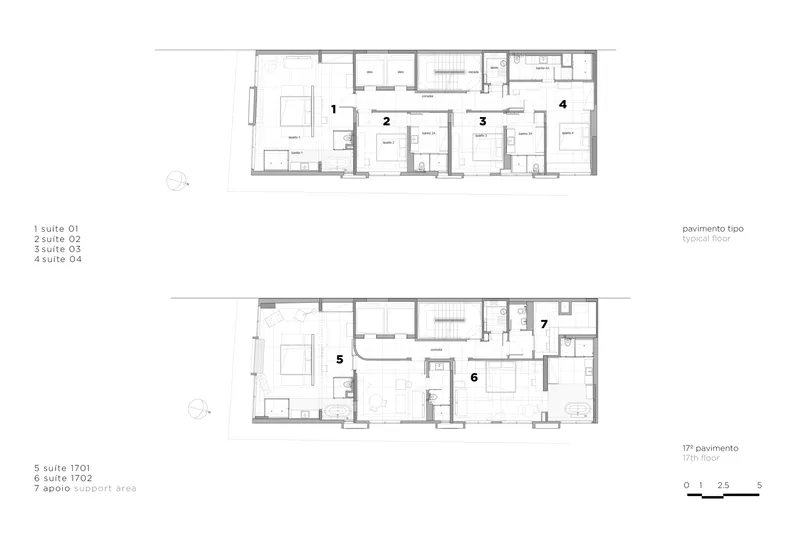
The floor plans reveal how the building's organization shifts as it rises. The ground floor concentrates public functions: lobby, bar, and reception, all oriented toward the beachfront. The second floor houses the restaurant and kitchen, positioned to exploit the horizontal window visible in the dining hall photographs. Upper typical floors subdivide into multiple suites per level, each angled to maximize ocean exposure. The seventeenth floor, with only two suites, offers the most generous floor plates and the widest views.
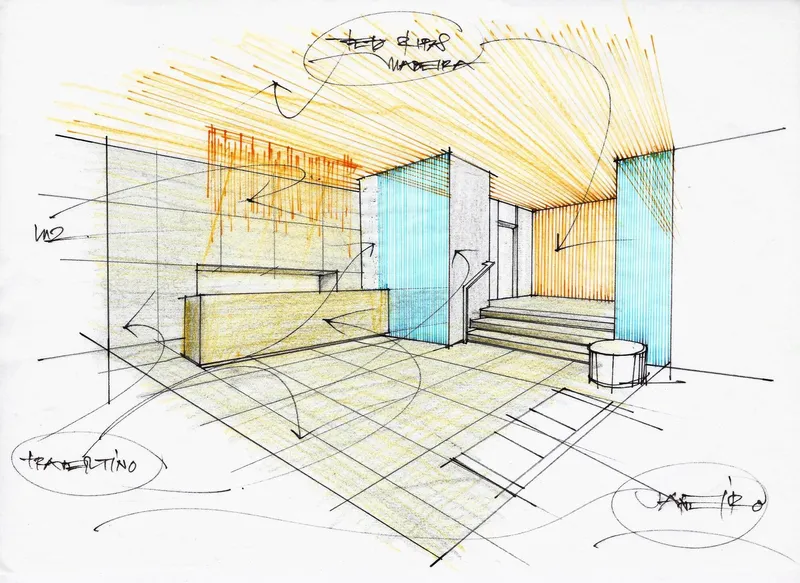
The perspective sketch of the reception area confirms the architects' investment in the timber ceiling as an organizing element: it runs continuously from the entrance through to the stairway, knitting the ground floor into a single spatial experience. A blue accent wall at the stair provides the only chromatic departure from the sand-and-wood palette, a deliberate reference to the ocean just outside.
Why This Project Matters
Janeiro Hotel matters because it demonstrates that a beachfront hotel renovation does not have to default to international minimalism or resort excess. Siqueira and Azul Arquitetura rooted every decision in place: Brazilian timber species, local craft traditions, and the specific topography of Leblon's coastline with its island archipelago and twin mountain peaks. The "ASAP" sustainability concept (as sustainable as possible) is pragmatic rather than dogmatic, reflected in material choices like organic cotton linens and pirarucu leather that reduce environmental impact without treating sustainability as a marketing badge.
More broadly, the project offers a lesson in the architectural power of framing. The circular portals, the horizontal restaurant window, the infinity pool edge: each is a device for editing the view, for telling the guest exactly where to look and how to feel about what they see. In a city where the landscape does most of the work, the architects' smartest decision was to let it, but on their terms.
Janeiro Hotel by Siqueira and Azul Arquitetura. Leblon, Brazil. 3,800 m². Completed 2019. Photography by MCA Estudio, Joao Freire, Divulgação Janeiro Hotel, André Nazareth, and Via Tolila.
About the Studio
Share Your Own Work on uni.xyz
If projects like this are the kind of work you want to make, uni.xyz is a place to publish your own, find collaborators, and enter design competitions.




Popular Articles
Popular articles from the community


Hill & Cross Opera: Sculptural Opera House Architecture Shaped by Tallinn’s Landscape and Identity
Hill & Cross Opera reimagines opera house architecture in Tallinn through its sculptural hill, civic plaza, glass wave and a luminous cross.

The Earth Pod: 3D Printed Homes for Resilient Refugee Communities
The Earth Pod reimagines refugee housing through 3D printed homes made from clay, combining resilience, self-sufficiency, and rapid shelter.

Play: Fragments of Their World
Familiar architecture becomes modular playground design, creating safe spaces where displaced children can learn, connect, imagine and play.

Riyadh For All: Intergenerational Urban Design for Active Aging in Rabat
Riyadh For All reimagines urban design in Rabat with intergenerational co-living, adaptive courtyards, and Moroccan cultural exchange today.


Similar Reads
You might also enjoy these articles

Bao Huynh Watercolor Atelier: A Serene Art Retreat in Hội An
Bao Huynh Watercolor Atelier in Hội An blends multifunctional art spaces, sustainable design, local materials, and family-friendly living in a serene environment.

Atelier Macri Concept Store Interior Design by CASE-REAL
Atelier Macri store features a "ko" counter, walnut wood details, cork displays, blending retail, gallery, and seamless customer experiences.

Manuel Vargas Izquierdo Stadium and High-Performance Sports Center: Architectural Excellence in Jalpa de Méndez
The Manuel Vargas Izquierdo Stadium blends sustainable design, inclusive sports facilities, and cultural-inspired architecture, revitalizing Jalpa de Méndez’s public spaces.

KAKR Buluh Awar Hall: Revitalizing Community and Ecology Through Bamboo Architecture
Community built bamboo hall revitalizes Buluh Awar village, empowering youth, restoring ecology, celebrating vernacular craftsmanship through sustainable architecture and culture.


Explore Hospitality Building Competitions
Discover active competitions in this discipline



Challenge to reimagine the Iron Throne


Photograph architecture without architects


Illustrate the lost glory of Angkor Wat - Render Challenge


Design challenge to reuse E-waste
Comments (0)
Please login or sign up to add comments
No comments yet. Be the first to comment!