
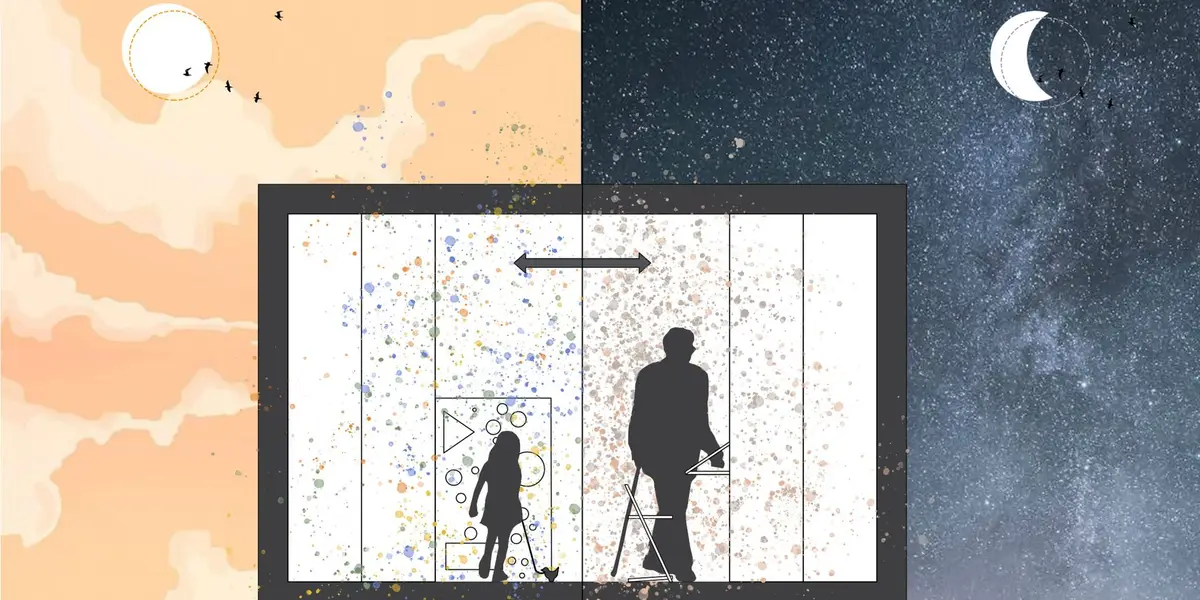
Sliding House: Modular Architecture That Transforms Daycare by Day into Housing by Night
A multigenerational building in Bremen where sliding modules convert private living quarters into kindergarten spaces each morning.


What if your apartment disappeared every morning, only to reappear each evening? The Sliding House takes that provocation seriously, proposing a building in Bremen, Germany, where physical modules slide open to convert private residences into a functioning daycare center during the day, then retract at night to restore domestic privacy. It is architecture treated not as a fixed container but as a mechanism, one that restructures itself around the daily rhythms of an entire community.
Designed by Thea Koop and published on uni.xyz, the project responds to a specific urban deficit: Bremen's shortage of kindergarten facilities. Rather than adding another standalone daycare building, Koop proposes a hybrid typology that houses seniors, students, and children under one roof, leveraging the fact that residential spaces sit empty during working hours. The result is a multigenerational living model where architecture itself becomes the social infrastructure.
A Narrow Volume Stacked Around a Central Core
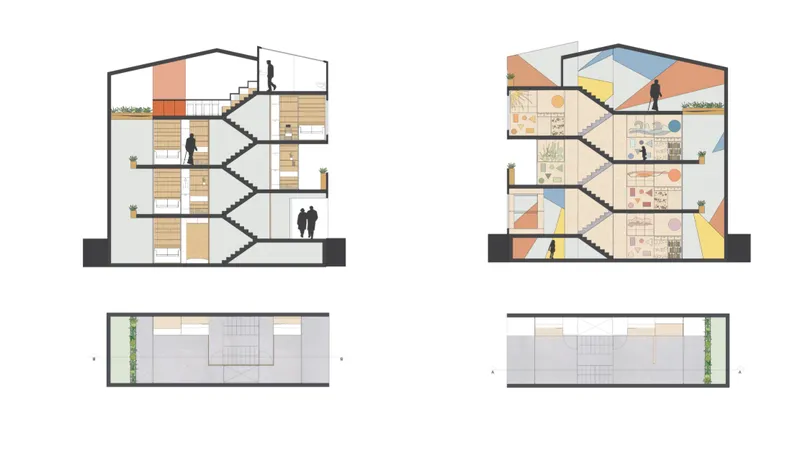
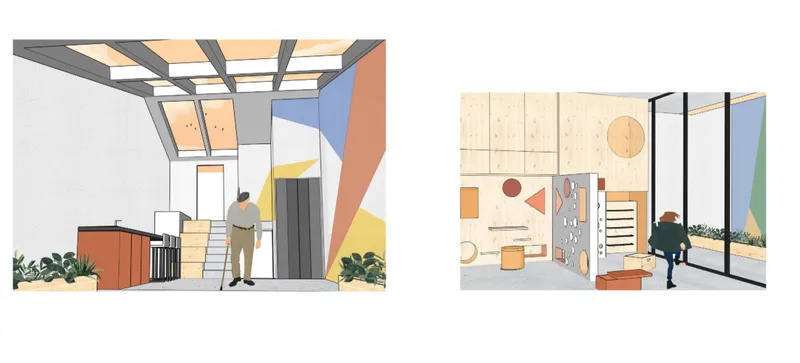
Section drawings reveal the building's compact vertical organization: a narrow multi-story volume anchored by a central stair that connects every level, from ground-floor entry up through terraces and roof access. The staircase is more than circulation; it is the spine around which the sliding modules pivot. Each floor reads as a distinct layer, with double-height voids punched through to draw light deep into the plan. The interior perspective renderings confirm this strategy, showing a skylit entry space that floods the ground level with natural illumination, while open workspaces lined with plywood wall panels create warm, tactile environments for residents.
Sliding Between Public and Private
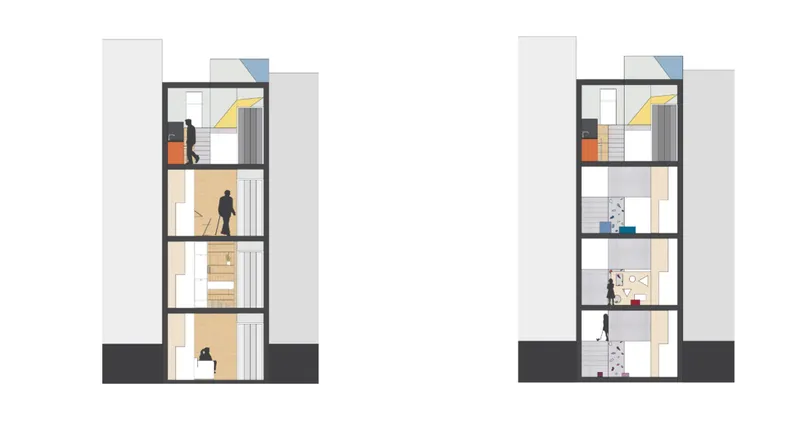
The elevation drawings expose the building's dual personality. By day, modules slide to open up bright, stimulating spaces for children, designed with natural light, playful geometry, and generous proportions. By evening, those same modules retract, restoring private living quarters for seniors and students. The concept is deceptively simple: rather than building two separate programs and leaving each underused for half the day, Koop collapses them into a single footprint. Double-height spaces visible in the elevations accommodate this transformation, providing the vertical clearance needed for modules to shift without compromising ceiling heights in either configuration.
This spatial flexibility is the project's central proposition. Students pursuing social degrees gain hands-on caregiving experience during daycare hours. Seniors remain active participants in community life rather than isolated occupants. Parents gain access to reliable childcare within the same building where their neighbors live. The architecture does not merely permit these relationships; its sliding mechanism demands them.
Plywood, Plants, and Daylight as Material Strategy
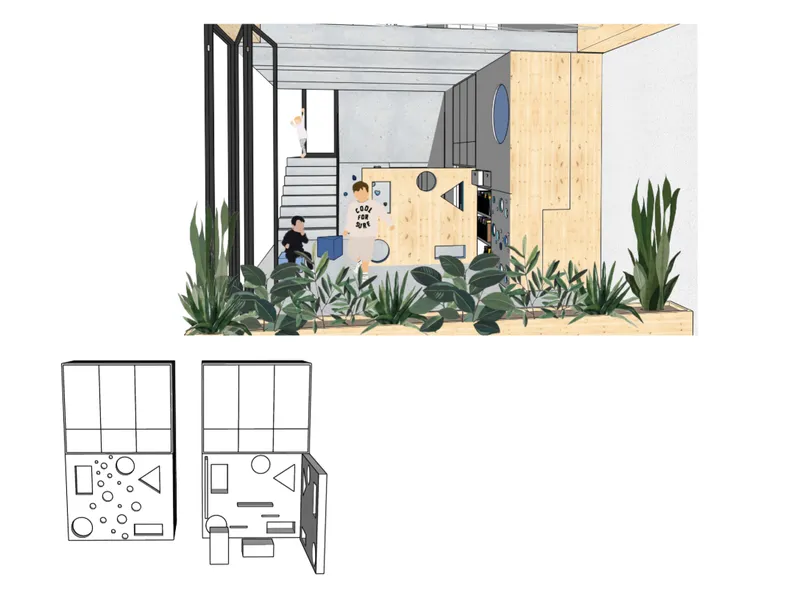
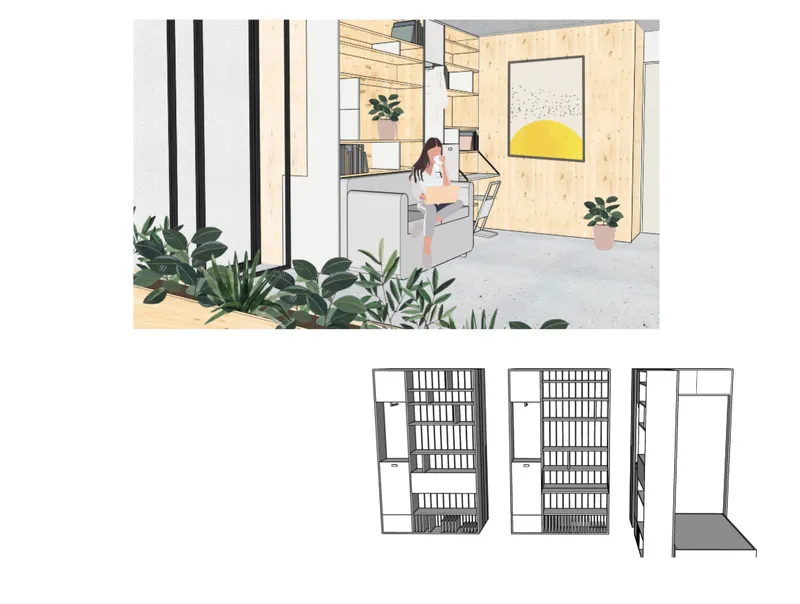
The axonometric section peels back the building's skin to show a consistent material palette: plywood interiors that line walls and ceilings, compact stair volumes clad in the same warm timber, and a planted garden at the building's base that grounds the project in its site. Large openings on the rear facade allow daylight to penetrate from top to bottom, while operable windows and rooftop openings enable cross-ventilation through the open-plan layout. The interior renderings reinforce this approach, depicting workstations set against plywood walls with potted plants softening the edges of the space.
The material choices serve the program's dual nature. Plywood is durable enough for a daycare setting where small hands will test every surface, yet warm enough to feel domestic when the modules close and the building becomes a home again. The floor plan drawings visible alongside the interior perspectives show how each unit is configured with minimal fixed partitions, allowing the sliding mechanism to work without obstruction. Natural light and ventilation are not decorative additions; they are fundamental to making a single building habitable across two radically different use patterns.
Designed for a Car-Free Bremen
The project aligns with Bremen's trajectory toward a car-free city center. By consolidating housing, childcare, and intergenerational community within a single compact building, the Sliding House reduces the need for the daily commutes that fragment urban life. The kindergarten is not across town; it is downstairs. The caregivers are not hired strangers; they are neighbors. This density of program within a narrow footprint reflects a broader commitment to urban sustainability that goes beyond energy performance into how people actually organize their days.
Why This Project Matters
Most flexible architecture proposals stop at the diagram: walls that could move, rooms that might change. The Sliding House goes further by tying spatial transformation to a specific daily schedule and a real urban need. Bremen lacks kindergarten facilities. Residential spaces sit empty during working hours. Koop's proposal treats these two facts as a single design problem, and the sliding module is the mechanism that solves it. The architecture is not flexible for flexibility's sake; it is flexible because the community requires it.
What makes the project compelling is its refusal to separate social ambition from architectural technique. The multigenerational program is not layered on top of a conventional building; it is built into the sliding mechanism itself. Seniors, students, and children share space because the architecture physically reconfigures to make that sharing possible. In a discipline that often treats adaptability as an abstract virtue, the Sliding House offers something rarer: a concrete proposal where transformation serves a visible, measurable human purpose.
View the Full Project
About the Designers
Designer: Thea Koop
Enter a Design Competition on uni.xyz
uni.xyz runs architecture and design competitions year-round that reward proposals with spatial conviction and real site intelligence.
Project credits: Sliding House by Thea Koop.


Popular Articles
Popular articles from the community


David Macias Steps a Doorless Stone and Plaster House Down a Tropical Colombian Hillside
In the humid hills of Colombia, Threshold House replaces the front door with an open void and terraces its 850 m² down the slope instead of fighting it.

LT2A and OPEN Architectes Thread a Brick and Glass High School Through a Wooded Belgian Campus
In Braine-l'Alleud, a 3,000 m² wing for Collège Cardinal Mercier pairs pale brick with a glazed colonnade, deferring to a small chapel and a dense wood.

GROUP A Strips a 1969 Rotterdam Harbor Headquarters to Its Frame and Wraps It in Timber Louvers
In Rotterdam's M4H harbor district, Ferro Offices reuses a 1969 frame, adds one timber storey and reaches BREEAM-NL Outstanding.

Juan García Correa, John González and Claudia Rueda Sink a Circular Amphitheater into a Manizales Engineering Building
On the La Nubia campus in Manizales, Colombia, the S1 Building folds labs and offices into a hillside of ramped lawns that double as a campus route.

Similar Reads
You might also enjoy these articles

Gil Mello Arquitetura Tilts a Single Roof Toward the Waterfalls on a Plateau Above Aiuruoca, Brazil
In Aiuruoca, Minas Gerais, a 200 m² house of local labor and reclaimed poles pairs a low valley veranda with a tall mountain one.

U.GA Architects Wraps an Oval Rooftop Pool in Curved Board-Formed Concrete on Busan's Jeollidan-gil
In Busan's Jeonpo-dong, a 454 m² mixed-use block stacks a neighborhood facility, guest rooms and an oval rooftop pool inside spiraling concrete walls.

Felipe Hess Arquitetos Turns a Blind Stone Wall to the Street and Opens a Brazilian House onto a Courtyard and Canal
A canal-front house in Brazil hides behind painted stone and planting, then opens to an olive-tree courtyard, a reed-ceilinged porch and a curving pool.
David Macias Steps a Doorless Stone and Plaster House Down a Tropical Colombian Hillside
In the humid hills of Colombia, Threshold House replaces the front door with an open void and terraces its 850 m² down the slope instead of fighting it.

Explore Shared Living Competitions
Discover active competitions in this discipline

Challenge to visualize slums of 2080

Challenge to reimagine the Iron Throne

Photograph architecture without architects

Illustrate the lost glory of Angkor Wat - Render Challenge
Comments (0)
Please login or sign up to add comments
No comments yet. Be the first to comment!