
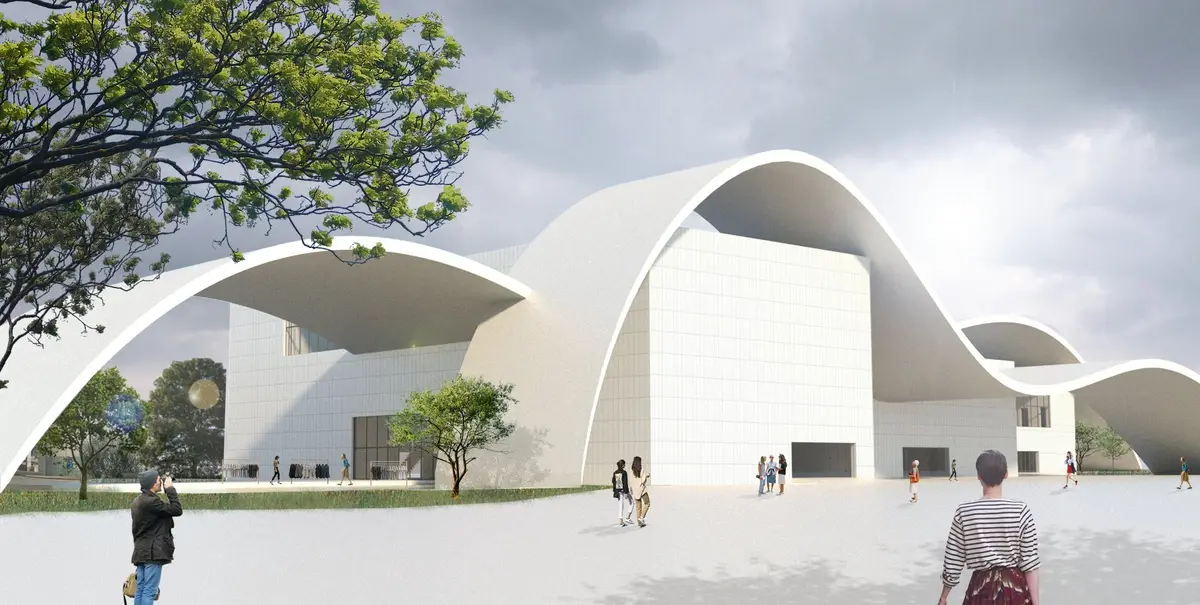
Slow and Save: A Woven Canopy Turns Milan's Fast Fashion Habit into a Circular Hub
Hayoung Gu borrows the drape of weekend market tents to stitch retail, exhibition and workshop into one continuous loop of reuse and making in Milan.


Fast fashion depends on speed: garments made quickly, bought quickly, discarded quickly. Slow and Save answers with a building that asks visitors to stay longer, look closer and leave with something remade by their own hands. Its central move is disarmingly simple. Take the loose, billowing fabric of a weekend market tent, the most temporary kind of shelter a city produces, and turn it into a permanent canopy that weaves an entire circular fashion system together beneath it.
Designed by Hayoung Gu and selected as an Editor's Choice entry in the Weave competition, the project lands in Milan, one of the world's fashion capitals. That choice of site matters. Rather than scolding fashion culture from outside, the proposal works within it, converting a triangular urban plot inside a dense infrastructural network into a recycling fashion hub where education, production and exchange share the same roof.
A Market Tent Stretched into a Continuous Roof
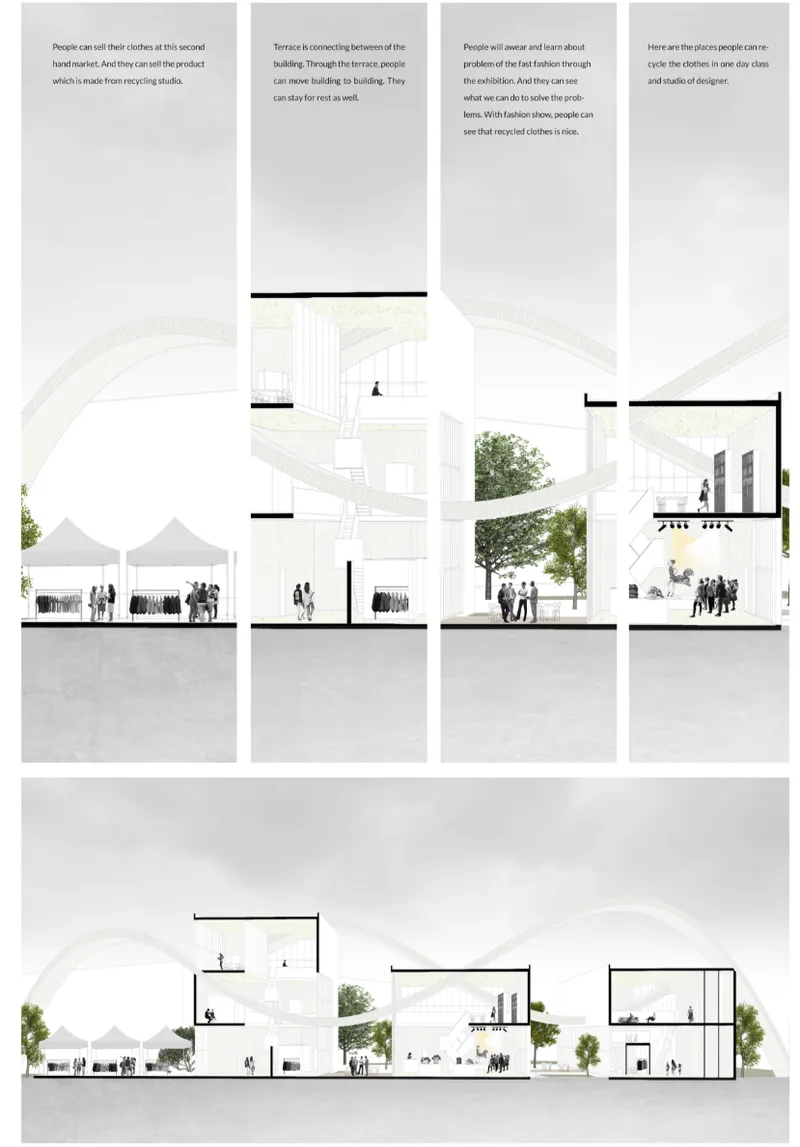
The section drawing reads almost like a strip of film. Market tents, terrace stairs, a courtyard tree and exhibition rooms sit in sequence under a single looping roof, and the effect is to show that the canopy is the project's organising device rather than a decorative cap. Gu takes the variety, informality and accessibility associated with weekend market stalls and translates them into a flowing form that links the separate programmatic units across the site.
That continuity does real work. The canopy blurs inside and outside, acting as a climatic mediator while also standing in for the interconnected cycles of production, consumption and reuse. On the triangular plot, distributed volumes let movement pass freely between them, and terraces and open plazas become the in-between rooms where people gather, rest and linger. The drawing makes clear that the public realm is threaded through the scheme, not left at its edges.
A Ramp That Carries Shoppers from Buying to Making
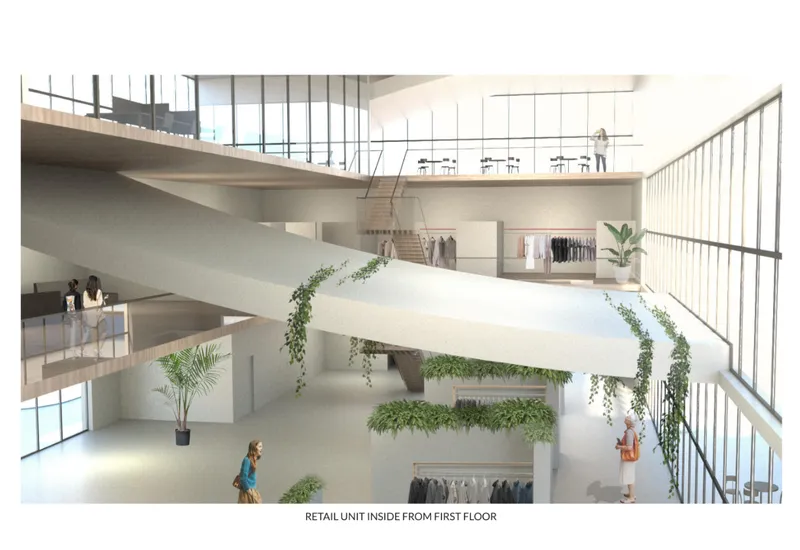
The retail hall, seen from the first floor, is dominated by a sloping white ramp draped in trailing vines, with shoppers moving below. This is where the project's tripartite programme becomes legible. The ground floor holds the public and commercial functions: secondhand markets, retail and exhibition zones. The retail unit itself supports a secondary economy where garments are sold, exchanged or bought after being recycled or repurposed. The ramp belongs to the continuous, curved pathway that runs through the building both vertically and horizontally, so the act of browsing gradually leads upward toward studios, offices and learning spaces.
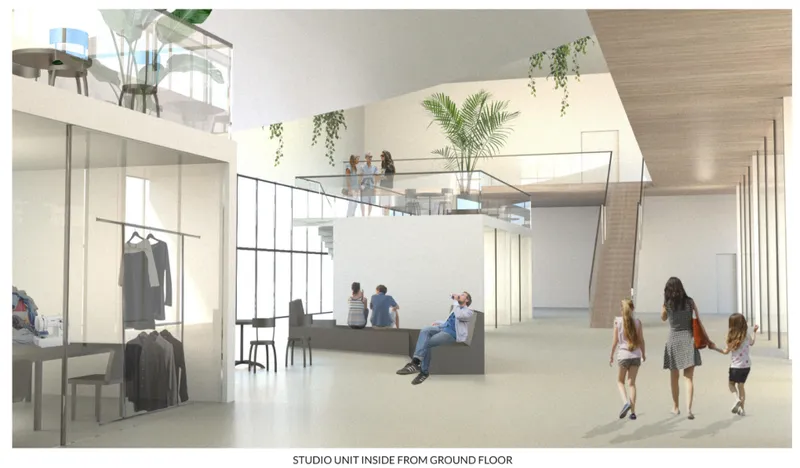
The ground floor studio pushes that idea toward participation. A timber stair, a mezzanine with glass balustrades and built-in bench seating create a warm, daylit room where a family walks through as easily as a designer might work. This is the workshop end of the cycle, where users learn to transform garments, experiment with materials and engage with designers directly. The shift from passive consumption to active making is the project's real ambition, and these interiors give it a domestic, approachable scale instead of the sealed-off feel of a professional atelier.
Tiled Walls and a Courtyard Tree That Slow the Pace
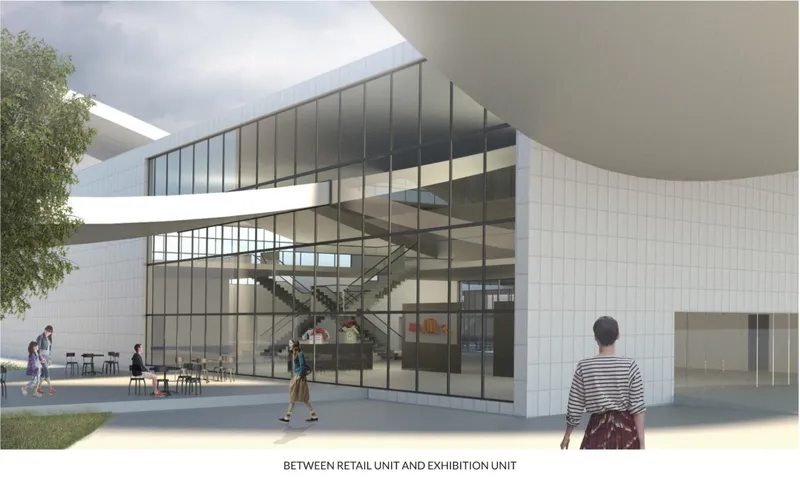
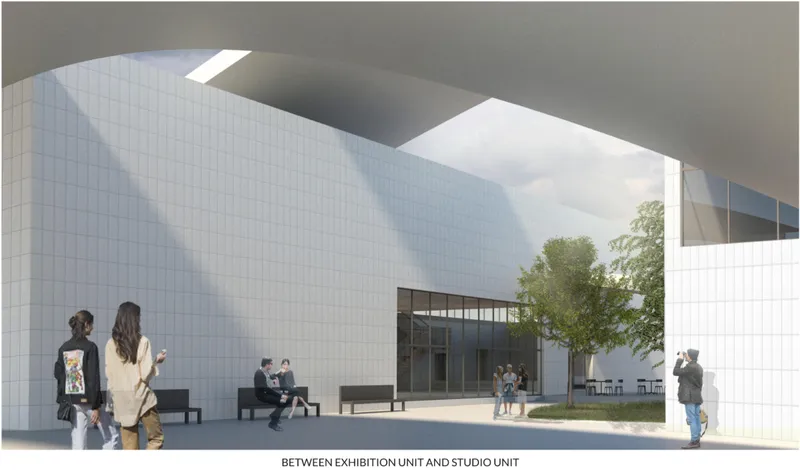
From outside, a glazed facade of white tile panels reveals the crossing stairs within, so circulation becomes part of the street-facing image. People sit at outdoor tables beneath the curved roof, and the building's inner movement plays out in view of anyone passing. It is a quiet form of advertising for the programme: before entering, visitors can already see that the building is about moving between floors, between activities, between roles as buyer and maker.
The courtyard view is where the title earns its first word. A white tiled wall stands beside a tree, the curved roof hovers overhead, and people sit on benches in shafts of sunlight. Nothing here is selling anything. These terraces and plazas are the project's pauses, extending its narrative into civic space and giving the exhibition's lessons on the environmental cost of fast fashion, delivered through displays, books, videos and fashion shows, somewhere to settle.
Why This Project Matters
Many sustainability proposals stop at messaging. Slow and Save is more convincing because it maps the circular fashion lifecycle onto architecture: the exhibition builds awareness, retail sustains a secondhand economy, and the workshop turns visitors into makers. The continuous pathway ties these stages into one route, so the building does more than describe a circular system. It asks people to walk through one.
The borrowed market tent is the smartest decision in the scheme. By drawing on one of the most informal and accessible structures in urban life, Gu keeps the project open and unintimidating in a city often associated with exclusivity in fashion. The lesson for other designers is that a sustainable programme lands better when its spatial language feels familiar, generous and public, and when the architecture rewards people for slowing down.
View the Full Project
About the Designers
Designer: Hayoung Gu
Enter a Design Competition on uni.xyz
uni.xyz runs architecture and design competitions year-round that reward proposals with spatial conviction and real site intelligence.
Project credits: Slow and Save by Hayoung Gu Weave (uni.xyz).


Popular Articles
Popular articles from the community


LT2A and OPEN Architectes Thread a Brick and Glass High School Through a Wooded Belgian Campus
In Braine-l'Alleud, a 3,000 m² wing for Collège Cardinal Mercier pairs pale brick with a glazed colonnade, deferring to a small chapel and a dense wood.

longwave studio Reorganizes a 112 m² Tainan Apartment Around the Daily Routines of a Family and Two Cats
In Tainan, Taiwan, birch plywood, rust-red furniture and a freestanding plaster wall link arrival, storage, work and family life in one apartment.

Juan García Correa, John González and Claudia Rueda Sink a Circular Amphitheater into a Manizales Engineering Building
On the La Nubia campus in Manizales, Colombia, the S1 Building folds labs and offices into a hillside of ramped lawns that double as a campus route.

U.GA Architects Wraps an Oval Rooftop Pool in Curved Board-Formed Concrete on Busan's Jeollidan-gil
In Busan's Jeonpo-dong, a 454 m² mixed-use block stacks a neighborhood facility, guest rooms and an oval rooftop pool inside spiraling concrete walls.

Similar Reads
You might also enjoy these articles
Healing Façade: A Modular Chapel System That Restores Ethiopia's Sacred Forests
Winner of the Eco-Chapel competition, this circular timber façade collects water from air to rebuild soil and reforest degraded Ethiopian landscapes.
Kaffeebühnen: Where Coffee Shop Architecture Becomes a Civic Stage in Vienna
A linear sequence of timber boxes, transparent shells, and open yards turns the Viennese café tradition into a public performance space.
Eco Chapel: A Modular Forest Pavilion That Grows Like the Landscape It Protects
Hexagonal timber modules weave through existing trees, turning a chapel into a living system for prayer, education, and reforestation.


Urban Forest: A Vertical Ecosystem for 5,000 Workers in Singapore's Changi Business Park
Radially stacked pods and layered green decks turn a 7-acre plot into 47 acres of ecological workspace projected for 2040.

Explore Architecture Competitions
Discover active competitions in this discipline

Challenge to reimagine the Iron Throne

Photograph architecture without architects

Illustrate the lost glory of Angkor Wat - Render Challenge

Design challenge to reuse E-waste
Comments (0)
Please login or sign up to add comments
No comments yet. Be the first to comment!