
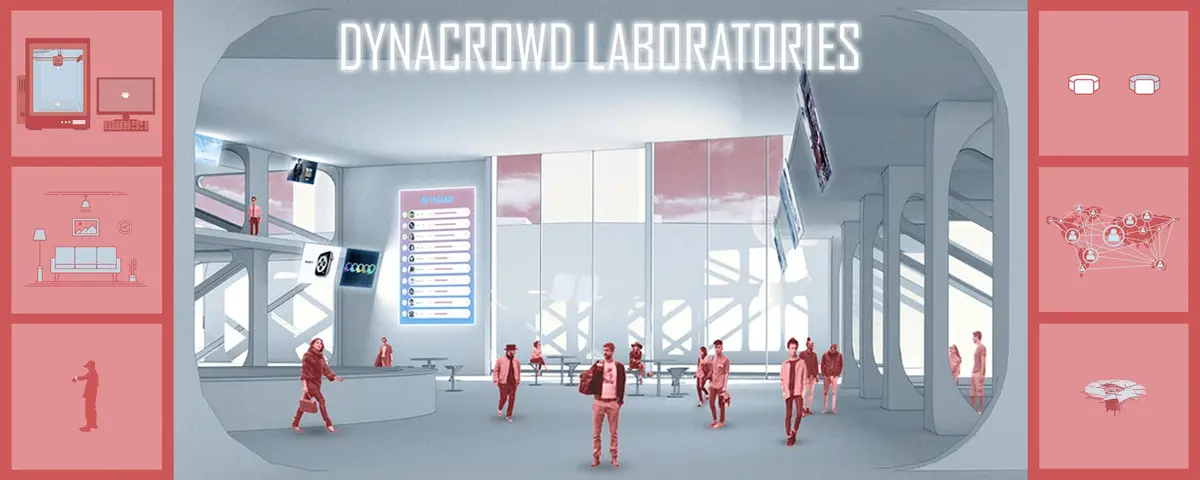
Dynacrowd Laboratories: Where AI Refines Products Through Crowd-Sourced Architecture
A hybrid shopping center and manufacturing plant uses artificial intelligence to test, refine, and distribute products through real-time user engagement.


What if a building could watch you shop, learn from your reactions, and redesign the product before you even left the store? Dynacrowd Laboratories proposes exactly that: a hybrid architecture that fuses a shopping center with an advanced manufacturing plant, using artificial intelligence to monitor how people interact with prototype products in real time. The AI then adjusts designs on the fly, manufactures refined iterations, and sends them out via drone delivery. It is less a building than a feedback loop made physical, a space where architecture serves as the interface between consumer behavior and industrial production.
Designed by Jordan Micham, the project earned an Organizer's Choice Award in the Breaking Work - Singularity competition. The brief asked entrants to speculate on future workspaces shaped by technological singularity, and Micham responded with a system-level vision: not just a workplace but an entire production and distribution ecosystem compressed into a single architectural proposition.
Curved Pavilions and Drone Swarms at Ground Level


The primary rendering reveals a cluster of curved tubular pavilions with generous glazed openings, set within a public gathering space where pedestrians move freely beneath a swarm of active drones. The forms have a deliberate softness to them, curving overhead to create sheltered zones that feel more like market canopies than conventional retail boxes. The axonometric view clarifies the massing: stepped red roof forms cascade over a triangular plaza dense with human figures, suggesting a space designed to attract foot traffic and concentrate social energy rather than disperse it.
This ground-level activation is central to the concept. Micham describes an "urban energy" created by the visible presence of intelligent drone delivery, arguing that the spectacle of automated logistics itself becomes an attractor for consumer traffic and local economic growth. The architecture is not passive shelter; it performs, drawing people in so the AI system can begin its work.
Modular Pavilions and the Mechanics of Distribution
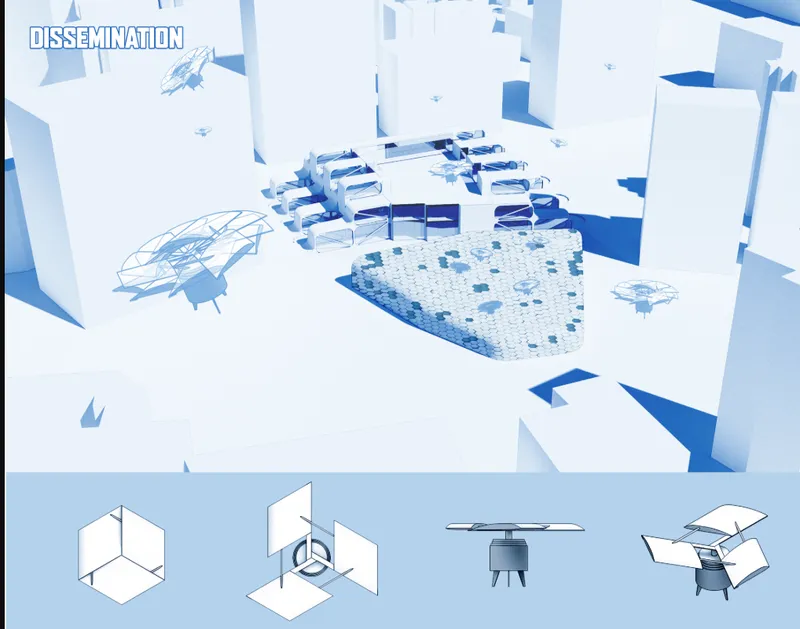

A cleaner axonometric rendering strips the project back to its modular logic. White and blue pavilion volumes are arranged in a loose cluster while drone units disperse overhead, making legible the relationship between built form and airborne logistics. The modularity here is not cosmetic; Micham describes an adaptive building structure that enables "efficient space utilization" and seamless product testing, with spaces reconfigurable as product lines change.
The accompanying network diagram maps how individual user nodes connect to an isometric drone delivery pavilion below. Each tester's interaction feeds data upward into the AI system, which processes stimuli and reactions to dynamically adjust product design. The diagram makes explicit what the renderings only imply: every person in the space is simultaneously a consumer, a tester, and a data point. A reward-based system and social media leaderboard incentivize participation, turning product testing into a gamified social experience where the most successful testers gain greater influence over design refinement.
Inside the Testing Floors: From Basement Lab to Edible Prototypes
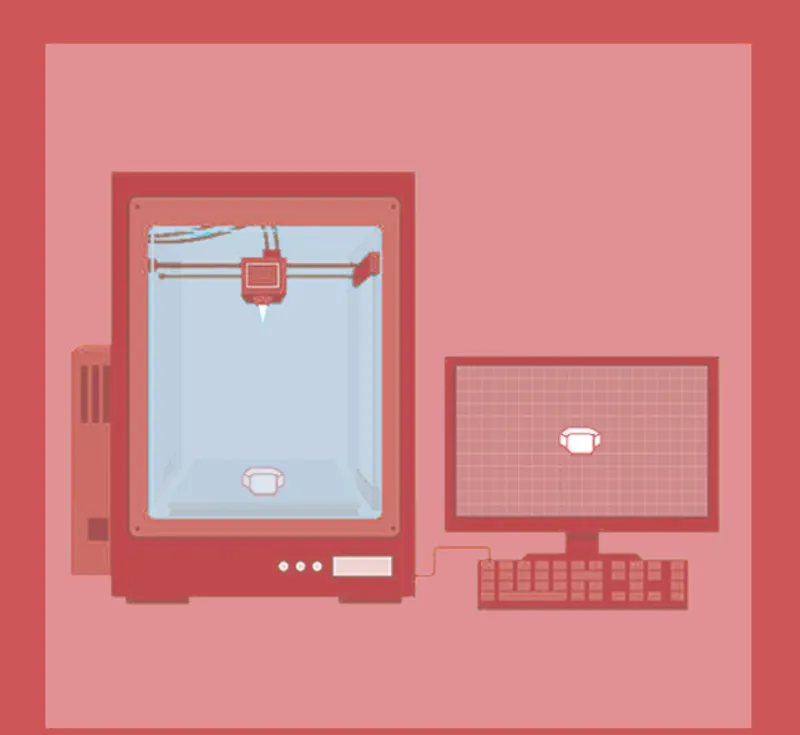

The program is organized vertically across four levels, each dedicated to a distinct phase of the testing pipeline. The basement houses an advanced RPC laboratory for research and development. Level 1 accommodates dual-product testing for mass production. Level 2 focuses on single-product line trials. Level 3 is dedicated to edible testing for large-scale food production. The illustrations of interior workspaces, showing 3D printers alongside monitors in tonal red environments and furnished domestic test rooms with sofas and pendant lights, suggest spaces calibrated to simulate real use conditions rather than sterile lab settings.
This is where the concept gains its most provocative edge. The domestic interior, complete with floor lamp and wall clock, is not a home. It is a test chamber. Micham's architecture deliberately blurs the line between living and being observed, proposing that the most effective way to refine a product is to watch someone use it in a space that feels natural. The AI monitors stimuli and reactions within these staged environments, then feeds adjustments back into the manufacturing process. Finalized products are placed in a virtual marketplace for consumer access.
A Globalized Network of Localized Production

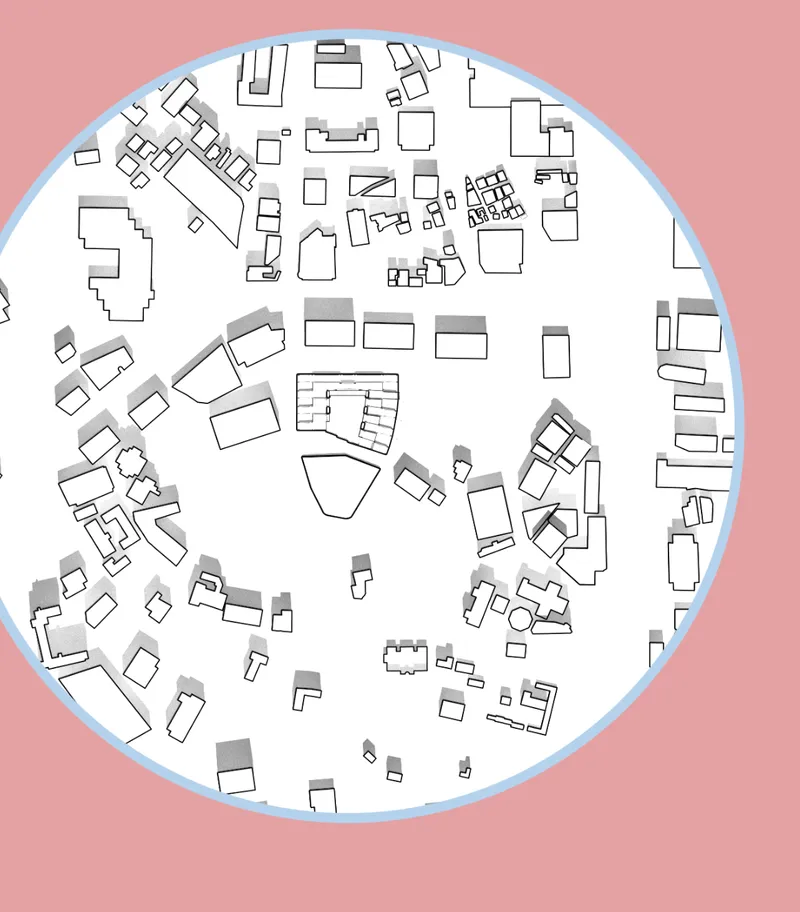
The project's ambitions extend well beyond a single site. A digital globe visualization displays illuminated network connections spanning continents, illustrating a regionalized AI distribution system where localized production facilities minimize logistics costs and accelerate delivery cycles. The aerial site plan, rendered within a circular frame, shows how scattered building footprints and street layouts might accommodate these smart manufacturing hubs within existing urban fabric.
Micham envisions a system where consumers track orders from manufacturing to doorstep, collapsing the gap between production and consumption into something nearly instantaneous. The architectural proposition scales from a single pavilion to a planetary logistics network, and the project is most compelling when it holds both scales in view simultaneously. Each local hub is both a neighborhood gathering place and a node in a global supply chain.
Why This Project Matters
Dynacrowd Laboratories is unapologetically speculative, and that is its strength. Rather than designing a better office or a more efficient factory, Micham collapses retail, manufacturing, logistics, and user research into one architectural system. The result raises genuinely uncomfortable questions about surveillance, consent, and the commodification of human behavior, but it does so through spatial design rather than abstract theory. The gamified leaderboard, the domestic test chambers, the visible drone swarms: each element is an architectural decision that makes a systemic argument tangible.
For a competition asking designers to imagine work after singularity, the project delivers a clear provocation. Work, in Micham's vision, is no longer something people go to a building to do. It is something a building extracts from people as they move through it, shop in it, and live within its staged interiors. Whether that future is liberating or dystopian depends on your perspective, but the architectural framework Micham proposes for exploring the question is sharp, systematic, and worth debating.
View the Full Project
About the Designers
Designer: Jordan Micham
Enter a Design Competition on uni.xyz
uni.xyz runs architecture and design competitions year-round that reward proposals with spatial conviction and real site intelligence.
Project credits: Dynacrowd Laboratories by Jordan Micham Breaking Work - Singularity (uni.xyz).


Popular Articles
Popular articles from the community


FCC Arquitectura Expands a Portuguese Granite House with a Board-Marked Concrete Wing
In Portugal, JV House pairs a cleaned-up whitewashed and granite dwelling with a timber-shuttered concrete extension, courtyards and a garden pool.


Manzana Morphosis: Stretching Barcelona's Grid into a Living Landscape for 2050
A radical reworking of the Eixample manzana turns density into a tool for generous public space, vertical ecology, and environmental performance.

Opera on the Sea: Driftwood Logic Shapes a Timber Opera House on Estonia's Coast
Trevor Orgill's opera house translates the entangled drift of floating timber into a civic building where wood, water, and music converge.

Aquadapt: An Underwater Habitat That Rewrites Its Rooms by the Hour
Curved modules ring the seabed while one shell shifts from breakfast room to cinema, farm and football pitch as residents' needs change.

Similar Reads
You might also enjoy these articles

Vereda Arquitetos Renovates a 40-Square-Meter Apartment Inside Niemeyer's Copan Building
A compact unit in São Paulo's most iconic residential tower gets a material overhaul that pairs exposed concrete with bold blue Formica.

Shakur's House: Exposed Brick as an Interior Organiser in a 168 m² Mashhad Residence
Brick moves indoors in this Mashhad residence, where masonry walls, glass partitions and teal planes sequence a compact home without closing it off.

Day and Night Park: A Time-Based Urban Newsstand in Beijing
A temporary urban newsstand in Beijing blending travel, light, and reading through poetic colors, compact form, and community-focused design.

Modernist Patio Renovation in El Masnou, Barcelona by Oliver Segura Arquitectura + Cebrià Arquitectura
Modernist patio renovation blending tradition and innovation with a movable pool, leveled floors, and Catalan materials in El Masnou.

Explore Interactive Architecture Competitions
Discover active competitions in this discipline

Design challenge to equip cities with modern furniture

Packaging challenge - Design meets sustainability
Comments (0)
Please login or sign up to add comments
No comments yet. Be the first to comment!