
Smart Favela 2040: A Bio-Plastic Office Ecosystem Built for Four Futures of Work
Modular, 3D-printed workspaces cluster like an informal settlement, adapting to four radically different worker archetypes through recyclable architecture.


What if the office of the future didn't look like an office at all, but like a favela? Not the informal settlement born of necessity and neglect, but a deliberately clustered, organically growing architectural ecosystem where every module is 3D-printed from recyclable bio-plastic, tailored to a specific company's workforce, and designed to be dismantled, recycled, and reprinted the moment that company moves on. Smart Favela 2040 takes the density and adaptability of informal urban fabric and filters it through advanced planning, data-driven design, and a zero-waste material cycle.
The project is the work of designers Ivan Pechenkin and Petr Khorkov, who propose a speculative office center for the year 2040 that rejects the one-size-fits-all workplace. Instead, it organizes space around four archetypal worker profiles derived from large-scale social network data analysis, each demanding a fundamentally different environment. The result is a living architectural system that grows, contracts, and reconfigures itself as the workforce evolves.
Four Color-Coded Worlds Stacked in Section
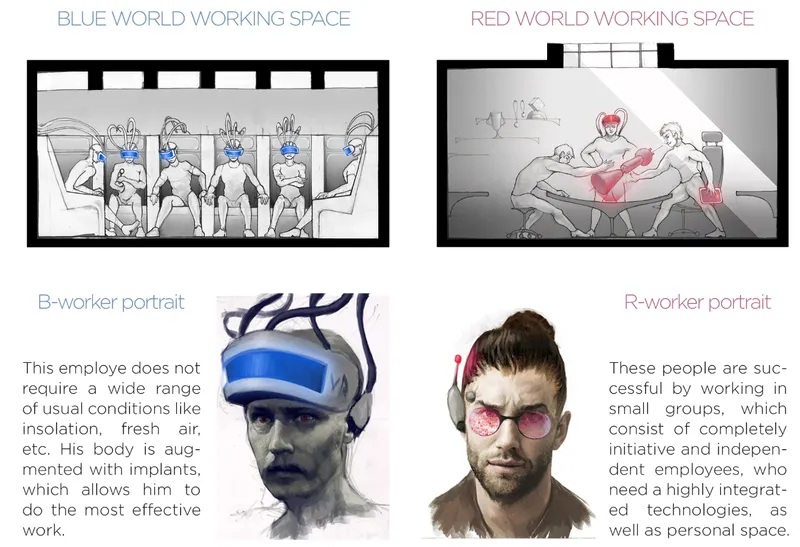
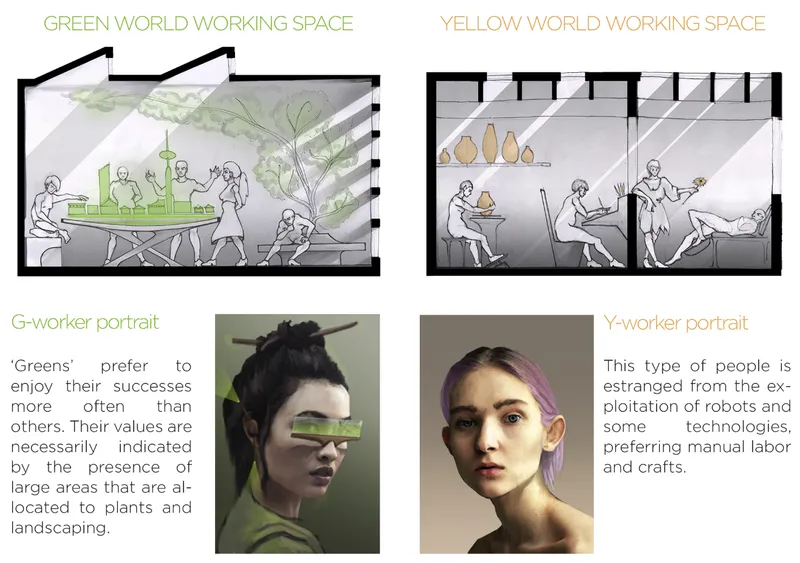
The project's conceptual backbone is its taxonomy of four worker archetypes, each assigned a color and a distinct spatial logic. Blue World workers, augmented with implants and technology, occupy controlled, efficiency-driven environments where physical comfort takes a back seat to productivity. Red World workers are collaborative independents who need technologically integrated but flexible spaces for small group interaction. Green World workers prioritize sustainability and well-being, surrounding themselves with plants, natural light, and landscaped zones that reinforce ecological values. Yellow World workers reject heavy technology in favor of craftsmanship-oriented, manual-labor environments.
The sectional illustrations make these distinctions tangible. Figures populate each zone differently: some huddle around screens in tight configurations, others gather at long tables beneath canopies of vegetation, and still others work at benches in open-air workshops. The color coding is more than a diagram convention; it becomes a spatial organizing principle, allowing the architecture to communicate its programmatic intent at a glance. The green and yellow zones, in particular, show how planted areas and table arrangements create genuinely different atmospheres within the same structural system.
A Pentagonal Site Covered in Clustered Volumes
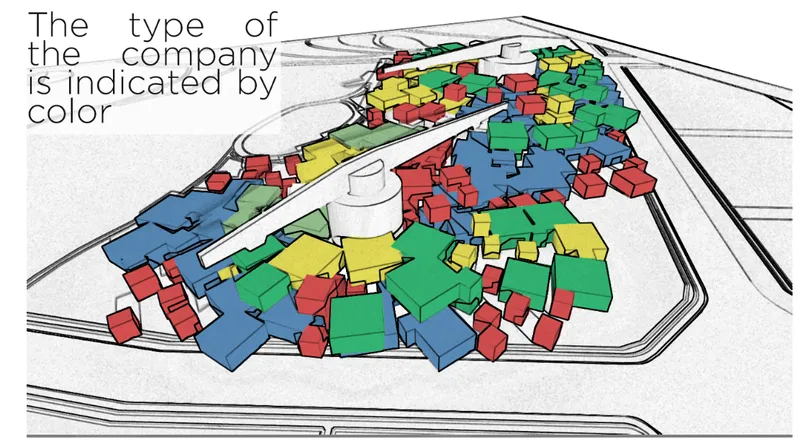
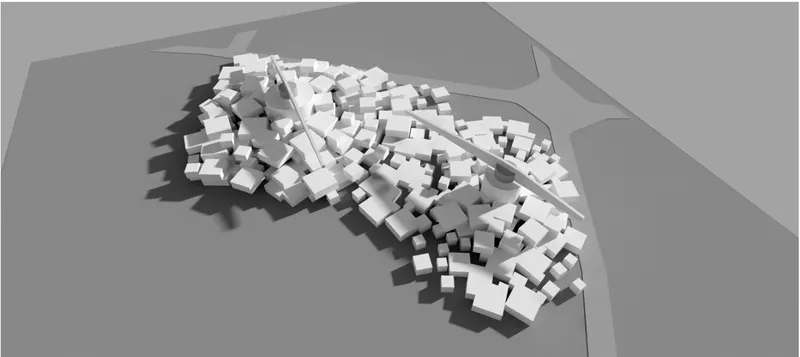
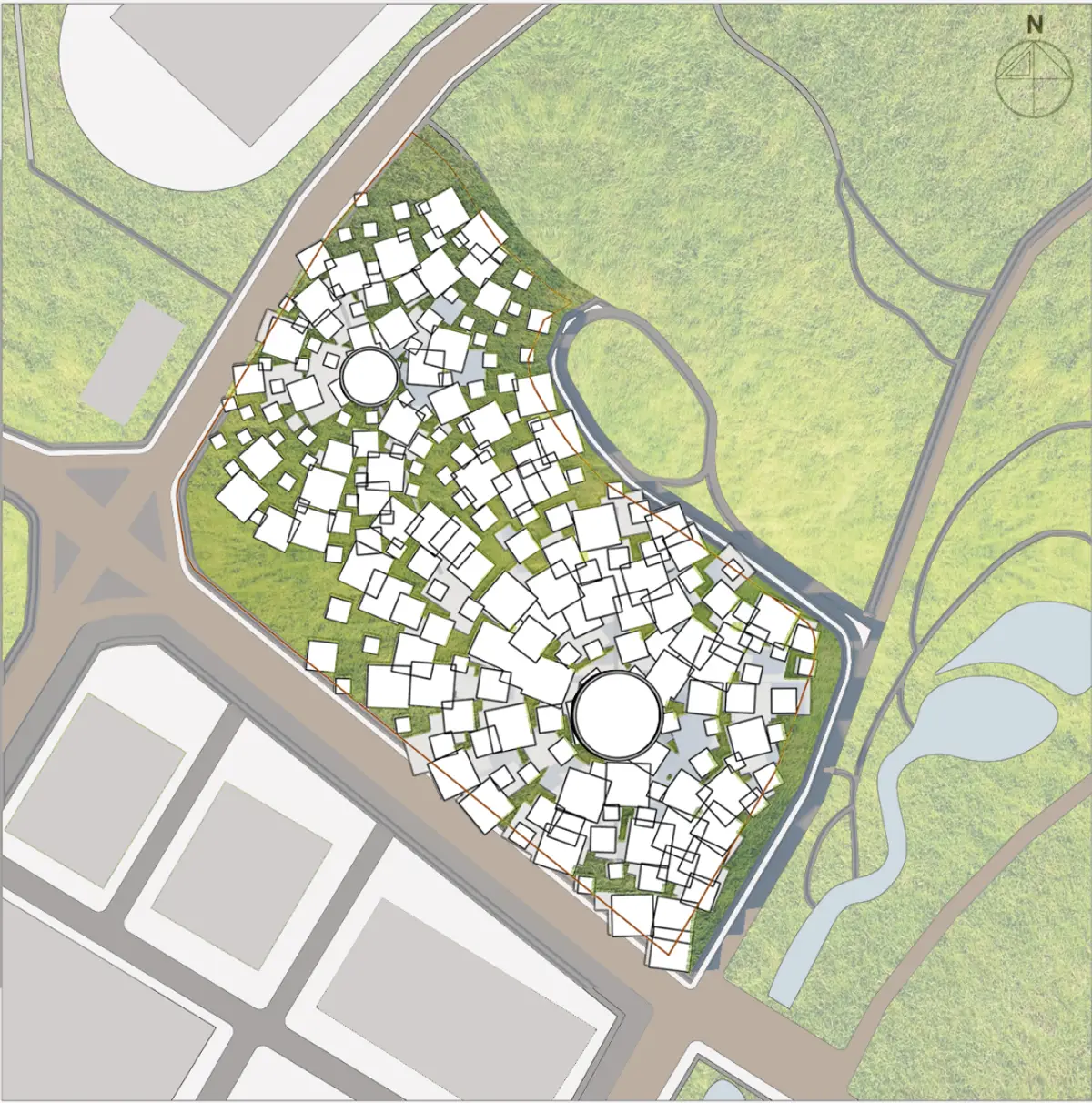
The masterplan distributes a network of interconnected modular units across a pentagonal site, and the axonometric drawing reveals the organizational logic at work. Color-coded volumes cluster together in a dense, irregular pattern that deliberately evokes a favela's organic growth while remaining governed by advanced planning principles. Each module responds to specific company requirements, with multiple layout variations available. The arrangement promotes fluidity and scalability: the architecture can absorb new tenants or release departing ones without disrupting the whole.
The white massing model strips away the color coding and program to expose the volumetric relationships in pure form. Under dramatic shadows, the cluster reads as a small city within a city, its rooflines stepping up and down at irregular intervals. There is nothing sleek or corporate about this silhouette. It has the grain and texture of a neighborhood, which is precisely the point. Smart Favela 2040 proposes that a future workplace should feel less like a headquarters and more like a community, with the density and chance encounters that come from tight, varied aggregation.
Bio-Plastic Walls, 3D-Printed and Fully Recyclable
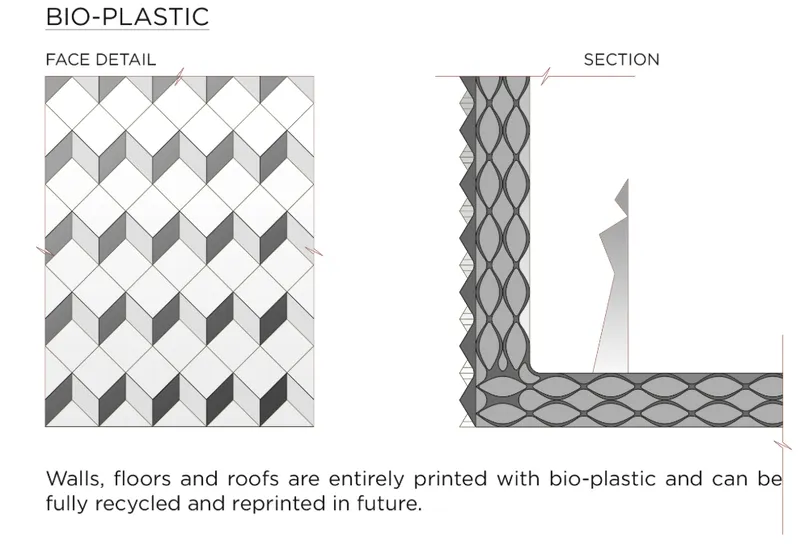
The material proposition is where Smart Favela 2040 moves from speculative urbanism into technical territory. Walls, floors, and roofs are 3D-printed entirely from recyclable bio-plastic. The technical drawing details a cube-pattern facade and a lattice wall section that together define the building envelope's dual role: structural integrity and environmental responsiveness. The surface geometry is not decorative; it is a direct output of the printing process, giving the facade a texture that registers the construction method at human scale.
The cyclical material process is central to the project's sustainability argument. When a company departs, its modules are disassembled, the bio-plastic is recycled, and new modules are reprinted to suit the next tenant. Construction waste is, in theory, eliminated entirely. The bio-plastic panels create a flexible yet robust envelope that adapts to both structural loads and environmental demands, and the lattice section suggests a system capable of incorporating insulation, ventilation, or shading within its depth. It is a construction system designed not for permanence, but for perpetual reinvention.
Data-Driven Design as Architectural Engine
Underlying the physical architecture is a data infrastructure. By analyzing large-scale information from social networks, the system generates company profiles based on employee comfort preferences, interests, and working styles. These profiles determine which of the four worlds a company inhabits and what specific module configurations best serve its people. Architecture becomes less about a designer's intuition and more about a feedback loop between human behavior and spatial production. It is a provocative proposition: the building as an output of collective preference data, continuously updated and physically reconfigured.
Why This Project Matters
Smart Favela 2040 operates simultaneously as a workplace proposal, a material systems experiment, and a polemic about architectural adaptability. Its strength lies in the refusal to treat the future office as a single typology. By identifying four distinct worker archetypes and giving each a physically different environment, Pechenkin and Khorkov argue that diversity in how people work must be matched by diversity in the spaces they inhabit. The favela metaphor is bold and carries risk, but it serves a clear purpose: to position density, informality, and organic growth as legitimate architectural strategies for professional environments.
The bio-plastic construction cycle elevates the project beyond formal speculation into genuine material innovation. A building that can be fully dismantled, recycled, and reprinted is not just sustainable; it is a fundamentally different conception of what a building is. Architecture here is not a fixed artifact but a temporary configuration of resources, always ready to become something else. Whether or not 2040 delivers the technology to realize this vision, the project succeeds in reframing the questions architects should be asking about permanence, waste, and the evolving relationship between work and space.
View the Full Project
About the Designers
Designers: Ivan Pechenkin, Petr Khorkov
Enter a Design Competition on uni.xyz
uni.xyz runs architecture and design competitions year-round that reward proposals with spatial conviction and real site intelligence.
Project credits: Smart Favela 2040 by Ivan Pechenkin, Petr Khorkov.


Popular Articles
Popular articles from the community


graciastudio Turns a Viewless Tijuana Lot Inward Around a Courtyard of Concrete, Timber and Trees
In Tijuana, Jorge Gracia's GA2 House stacks a timber-clad private floor over exposed concrete and replaces a missing view with a planted interior patio.

ETEH Reworks the Shared Spaces of São Domingos School in Brazil Around Timber, Color and Hanging Plants
At São Domingos School in Brazil, 436 m² of hall, refectory and library are recast with timber joinery, a yellow and blue code and trailing greenery.


The Amber Palace Opera: A Geological Fiction Surfaces on Tallinn's Baltic Waterfront
Pierre Brillard reimagines a Baltic legend as a public landscape, opera house, and waterfront promenade rooted in Tallinn's coastal identity.

Manzana Morphosis: Stretching Barcelona's Grid into a Living Landscape for 2050
A radical reworking of the Eixample manzana turns density into a tool for generous public space, vertical ecology, and environmental performance.

Similar Reads
You might also enjoy these articles

Aquadapt: An Underwater Habitat That Rewrites Its Rooms by the Hour
Curved modules ring the seabed while one shell shifts from breakfast room to cinema, farm and football pitch as residents' needs change.

Play: Fragments of Their World: Remembered Architecture Rebuilt as a Modular Playground for Refugee Camps
Tom Gardner abstracts domes, arches and towers from the homelands of displaced families into a kit of child-scaled play parts for camp settlements.
REBIRTH: A Circular Settlement Where Afghan Widows and Their Children Rebuild Life Together
A shortlisted Resile entry turns the circle into a protective ring of timber and brick, gathering homes, classrooms and gardens around a shared landscape.
The Main Dream: A Recycled Plastic Kit That Lets Refugee Children Build Their Own Playground
Thirty-centimetre interlocking cubes that connect on three axes turn play into construction, letting children author the spaces they occupy.

Comments (0)
Please login or sign up to add comments
No comments yet. Be the first to comment!