
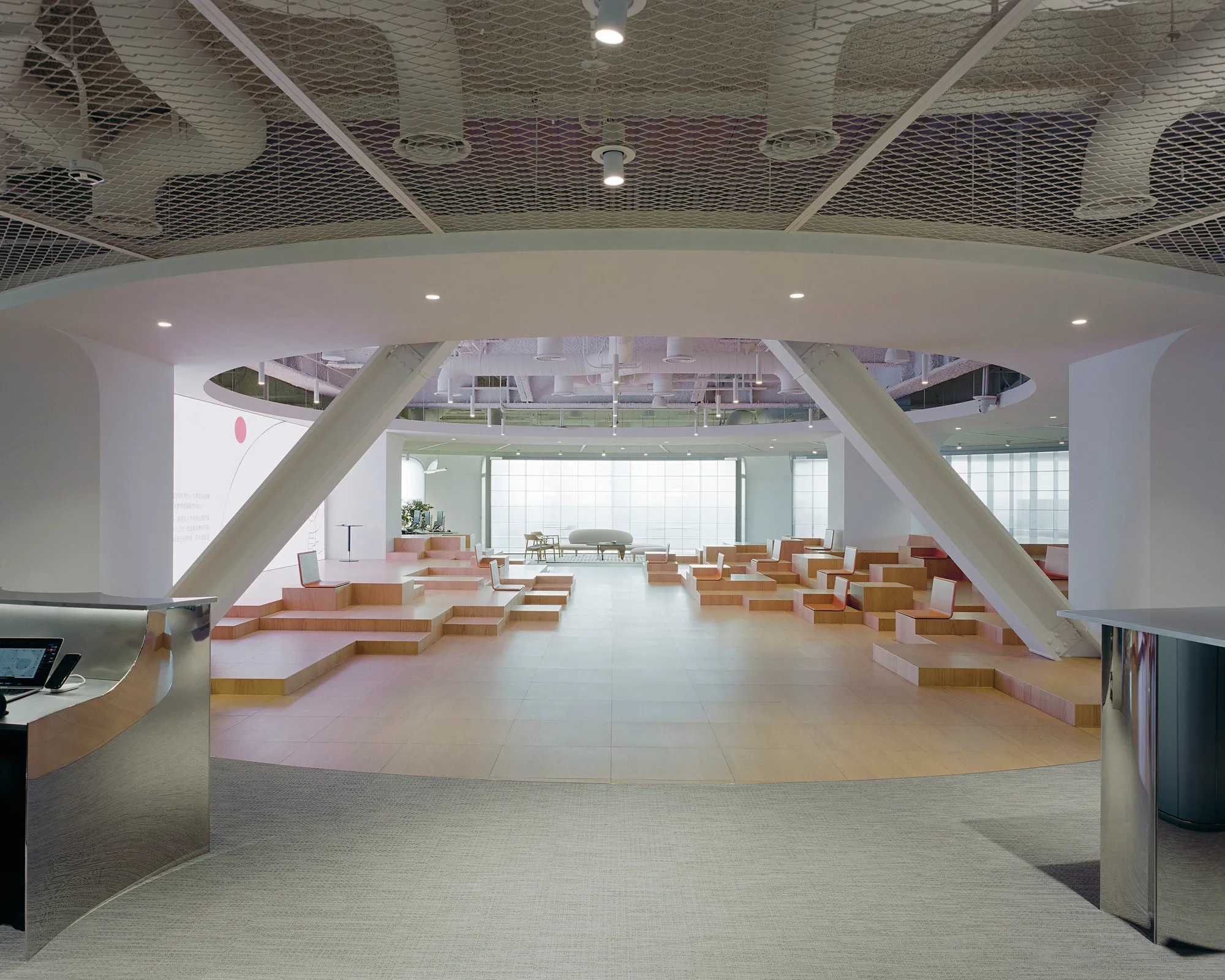
Snøhetta Turns a 32nd-Floor Office in Taichung into a Forum for Open Finance
A competition-winning 800-square-meter workspace on the 32nd floor of The Landmark skyscraper redefines what a finance office can feel like.


The finance industry rarely invites words like "forum" or "gathering" into its spatial vocabulary. Offices for financial consultants tend to default to enclosed meeting rooms, heavy desks, and a studied quietness that signals discretion above all else. Snøhetta's design for Good Finance's Taichung Downtown Branch, perched on the 32nd floor of The Landmark skyscraper, rejects that template with conviction. The result, completed in 2025 after winning an invited competition in 2022, is an 800-square-meter interior organized around a circular, tiered forum that treats dialogue and social exchange as the primary activities of the workplace.
What makes this project genuinely interesting is not just the aesthetic departure from typical corporate interiors but the structural argument it makes: that transparency and openness are competitive advantages for a finance brand, not liabilities. The central forum, built from warm timber seating elements and ringed by fluted glass partitions, acts as a gravitational center. Everything radiates outward from it. The plan is almost centrifugal, with meeting rooms, workstations, and planted zones pushed to the perimeter, giving the collective space the prime real estate at the core.
The Forum as Heart

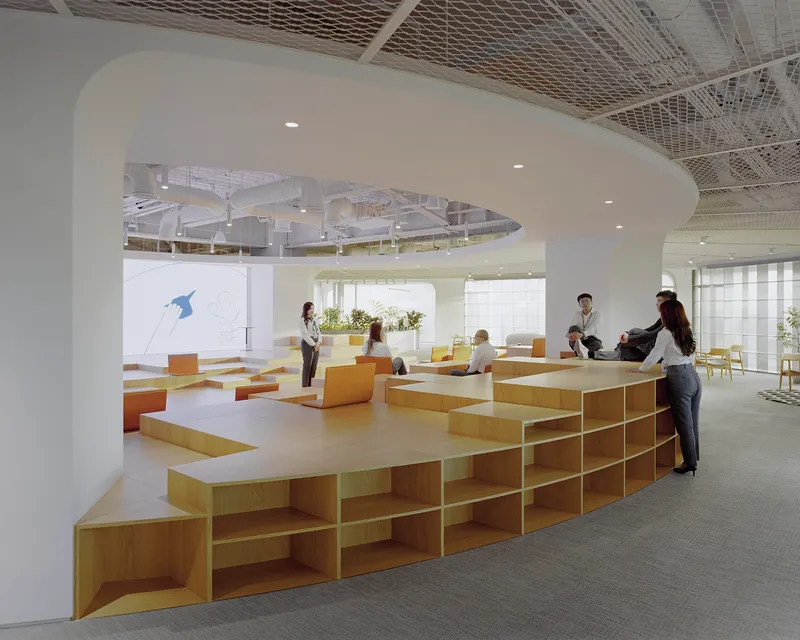

The multipurpose forum is the unequivocal centerpiece of the design. Tiered plywood seating platforms step upward in an arrangement that recalls a small amphitheater, inviting informal lectures, team meetings, or simply a place to sit and read. The timber is warm and tactile, softening a space that could easily have felt corporate. Curved ceiling soffits overhead reinforce the sense of enclosure without boxing the forum in, while integrated shelving along the edges suggests that this is a place for knowledge exchange, not just conversation.
Snøhetta's decision to make the forum circular, rather than rectangular, is deliberate. It eliminates the implied hierarchy of a head-of-table arrangement. Everyone seated on the stepped platforms faces roughly inward, creating a democratic geometry. For a financial services firm, this sends a pointed signal about corporate culture: the client and the advisor meet on equal footing.
Light, Glass, and the Perimeter
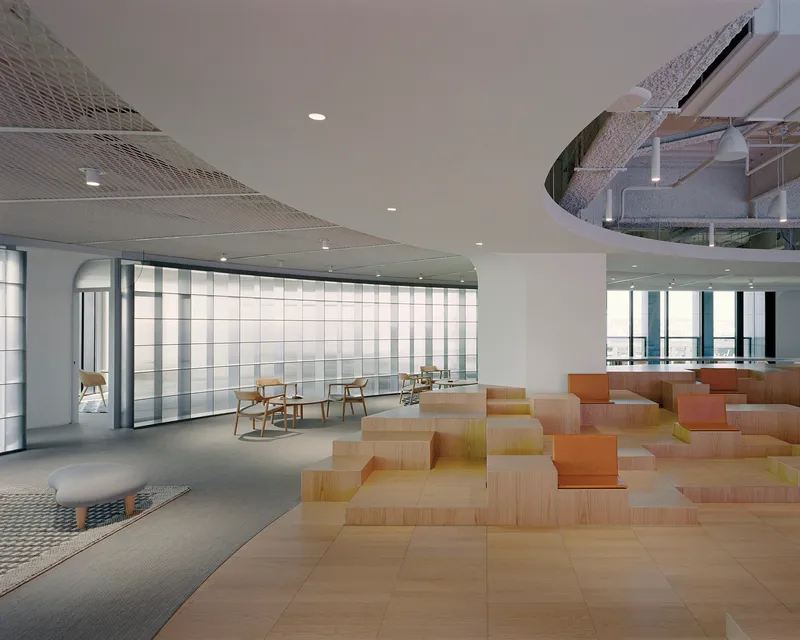

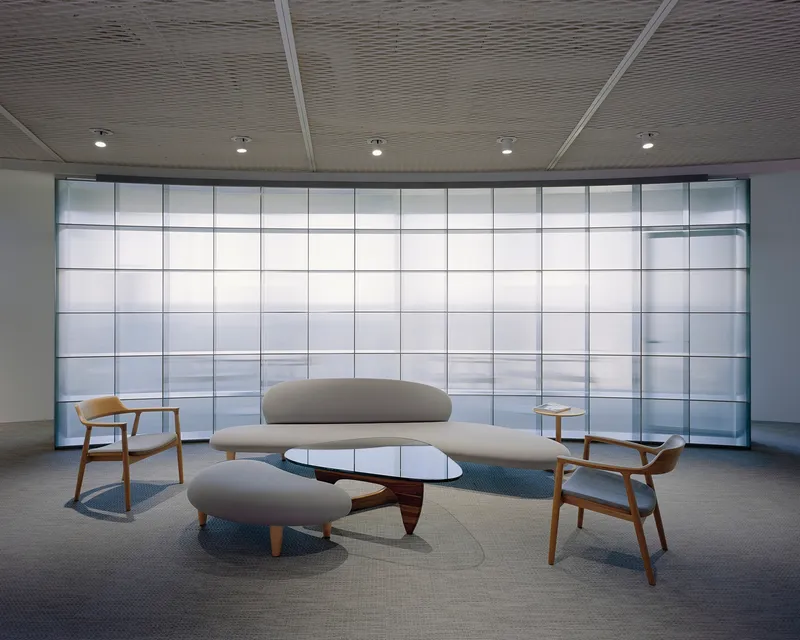
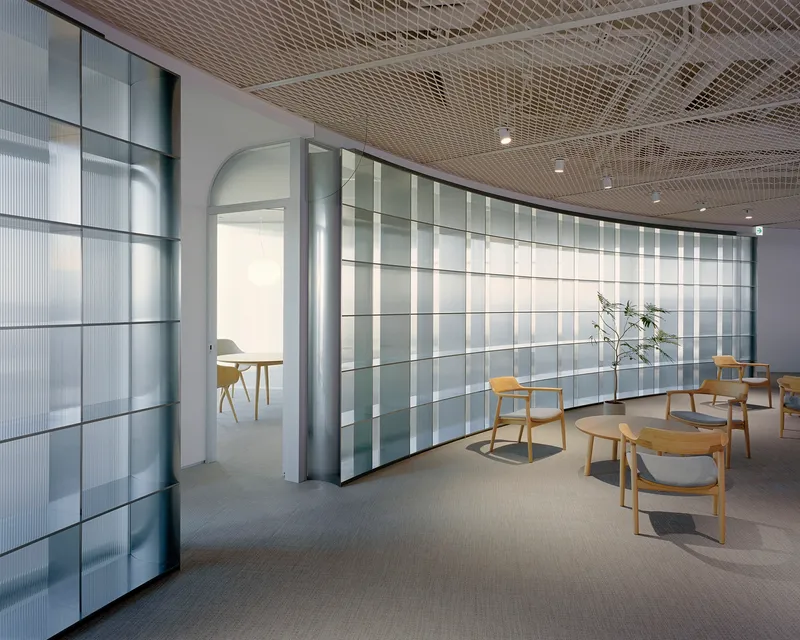
Fluted glass partitions line the meeting rooms along the perimeter and do double duty. They diffuse daylight and filtered city views inward toward the forum while providing a measure of acoustic and visual privacy for the rooms behind them. The effect is luminous without being stark: the translucent panels catch light in soft vertical rhythms, giving the interior a sense of depth that a fully open plan would lack.
The balance between transparency and discretion that Snøhetta describes is most legible here. Finance demands confidentiality, but the firm wanted none of the oppressive enclosure that typically accompanies it. The gridded glass facades manage to feel generous and protective at the same time, letting occupants sense the life of the forum from within the meeting rooms and vice versa.
Metal, Threshold, and Materiality
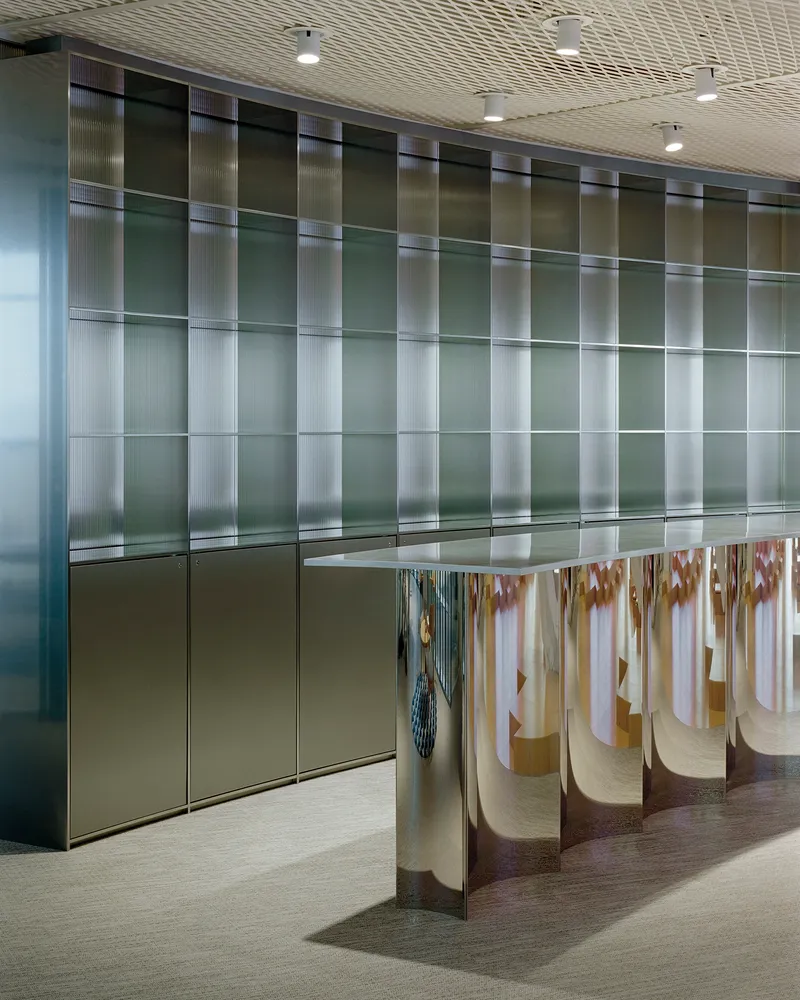
If the timber forum represents warmth and communal exchange, the custom metalwork acts as the connective tissue between zones. A polished stainless steel reception desk greets visitors against a backdrop of gridded translucent glass, immediately signaling that this is not a conventional office. The reflective surface is precise and cool, a counterpoint to the plywood platforms just beyond.
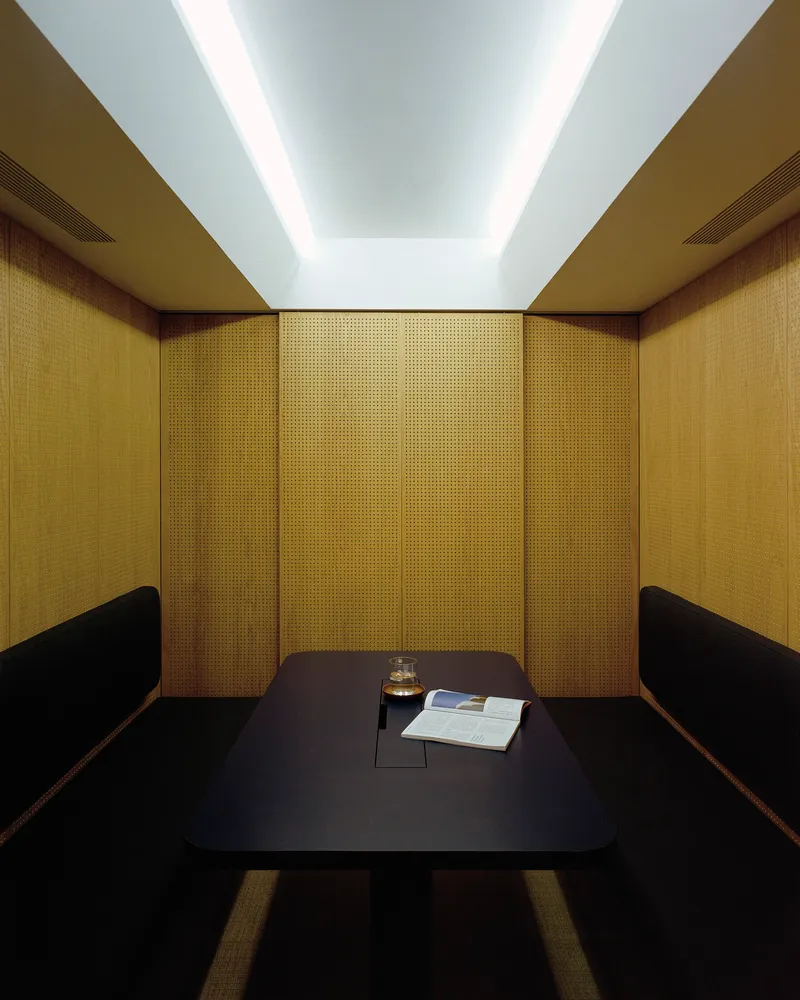
Enclosed booths wrapped in woven gold panels offer a more intimate register, their richness suggesting the seriousness of private counsel without resorting to dark wood panelling or leather. An expanded metal mesh ceiling undulates across the lounge areas, catching and scattering light in ways that add texture overhead without competing with the forum's warmth below. These metallic elements function as transitions, marking the shift from public forum to semi-private workspace to fully enclosed meeting room.
Arrival and the Linear Entry
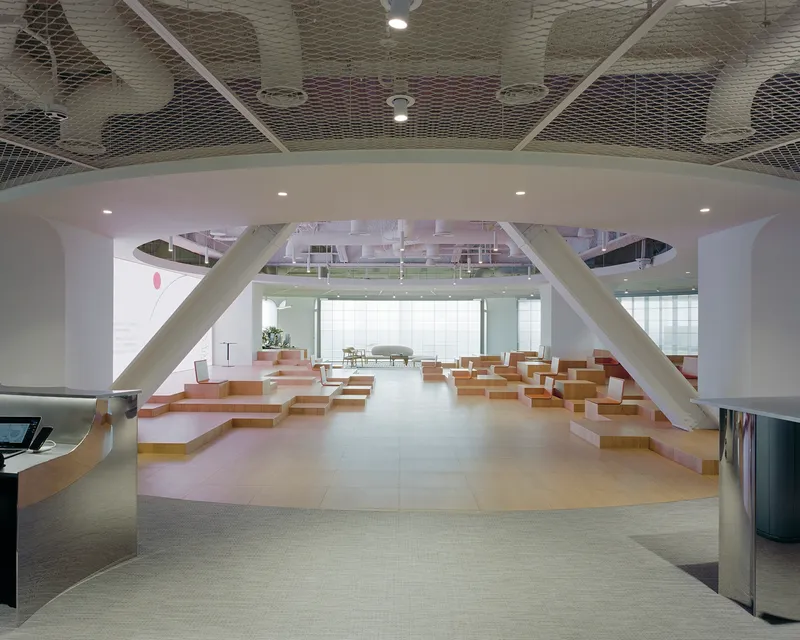


The journey into the office begins with a long, linear corridor that compresses the visitor's experience before releasing them into the central forum. An arched portal frames the tiered seating area beyond, with diagonal structural beams and a metal mesh ceiling creating a moment of visual tension at the threshold. The arch is a surprisingly classical gesture for Snøhetta, but it works: it elevates the act of entering, making the transition from elevator lobby to workspace feel ceremonial rather than incidental.
Stepped timber blocks near the entry serve as both seating and wayfinding, their geometric forms guiding visitors toward the center. The sequence is carefully calibrated: compression, threshold, release. It is a technique more commonly associated with museum design than office interiors, and it underscores Snøhetta's ambition to make the act of visiting a finance office feel like something worth remembering.
Working at the Edges
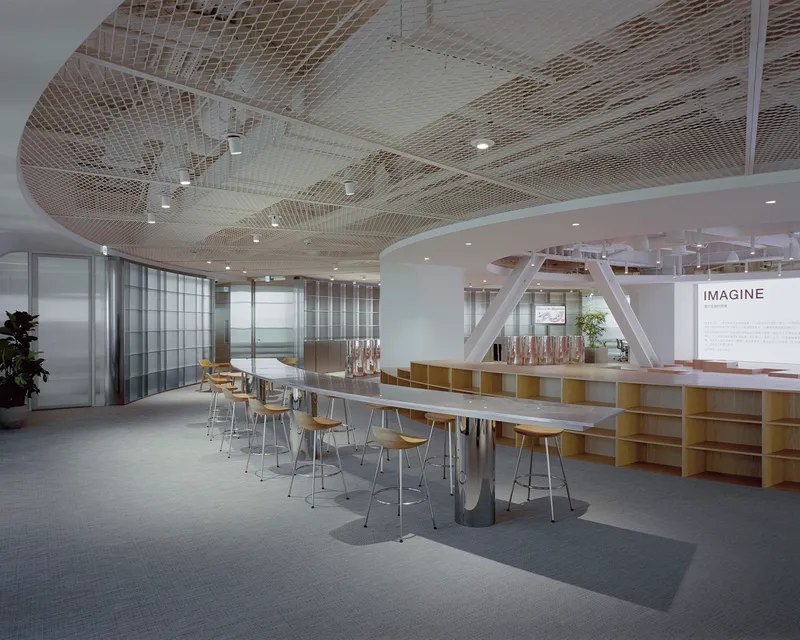


The perimeter of the plan houses the more conventional program: communal worktables beneath white structural steel trusses, meeting rooms with floor-to-ceiling windows overlooking the Taichung cityscape, and curved lounge areas with patterned rugs that soften the transition between focused work and collaborative zones. The decision to push these functions outward means they benefit from the best natural light and the most direct views, which is a smart inversion of the typical open-plan office where executives claim the window seats.
The woven ceiling panels above the communal workspace give these areas a distinct acoustic character, absorbing sound and reducing the reverberation that plagues many open offices. The effect is a series of micro-environments that ring the central forum, each with its own spatial quality but all connected by sightlines back to the heart of the plan.
Landscape as Interior Strategy

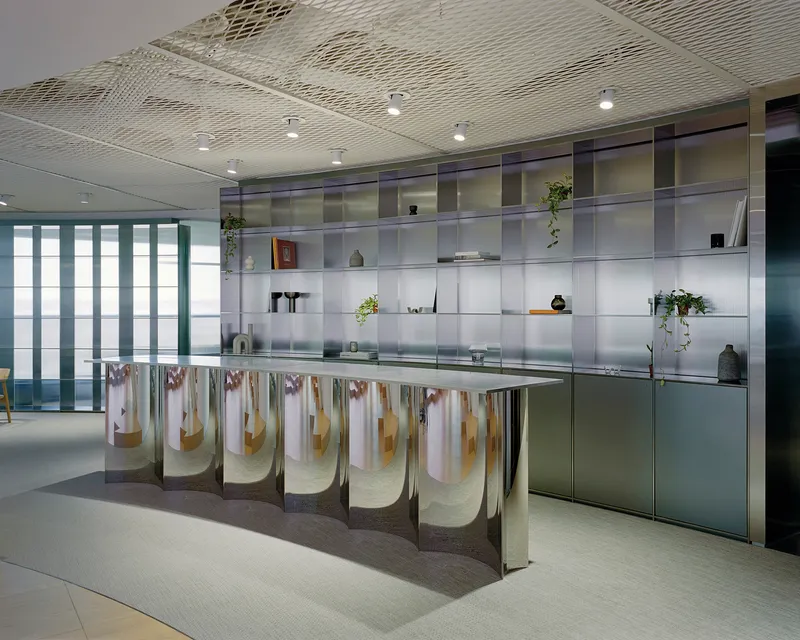
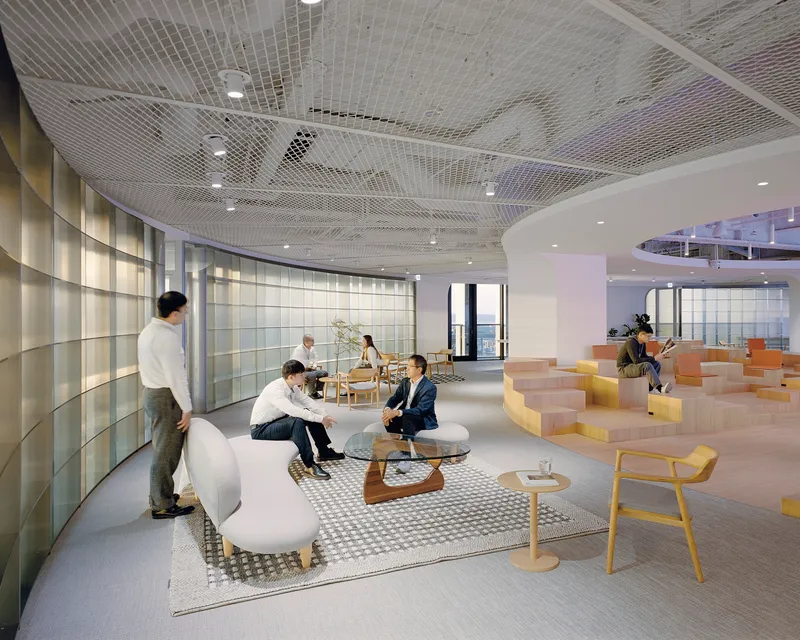
Integrated planting appears throughout the office, from potted bamboo alongside long timber dining tables to greenery displayed on translucent glass shelving walls. The landscape elements are not decorative afterthoughts. They are woven into the spatial logic, used to soften boundaries between zones and to introduce biological rhythms into a 32nd-floor interior that could easily feel hermetic. A kitchen island with a pleated fabric skirt sits beneath one of these planted shelving walls, blurring the line between pantry and garden.
The planting strategy also reinforces the project's commitment to Bolon sustainable flooring and a broader material palette that favors tactile, honest surfaces over corporate polish. Together, these choices build an environment that feels lived-in from the first day of occupancy.
Plans and Drawings
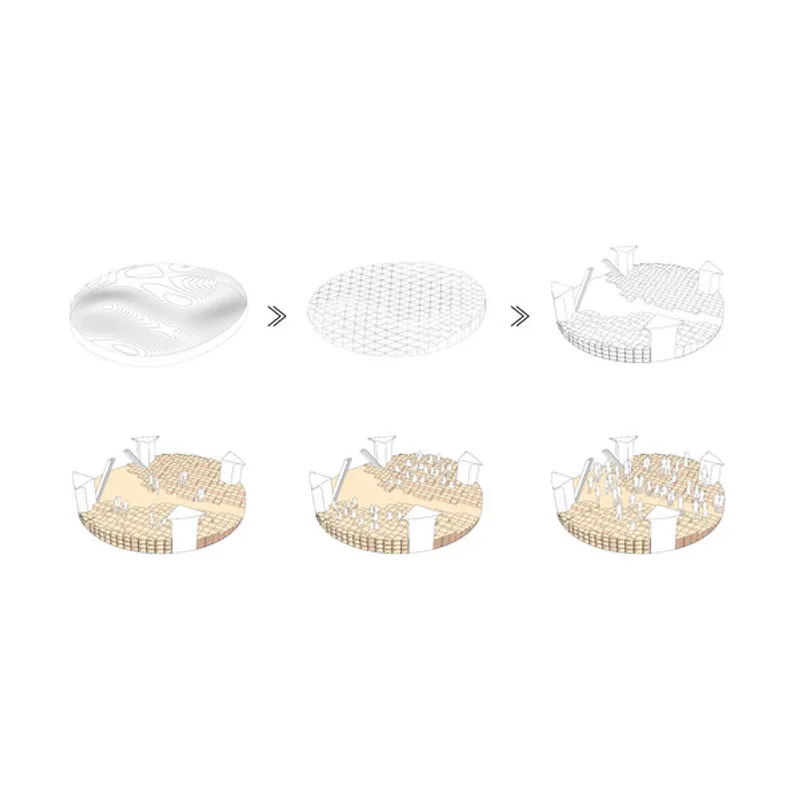


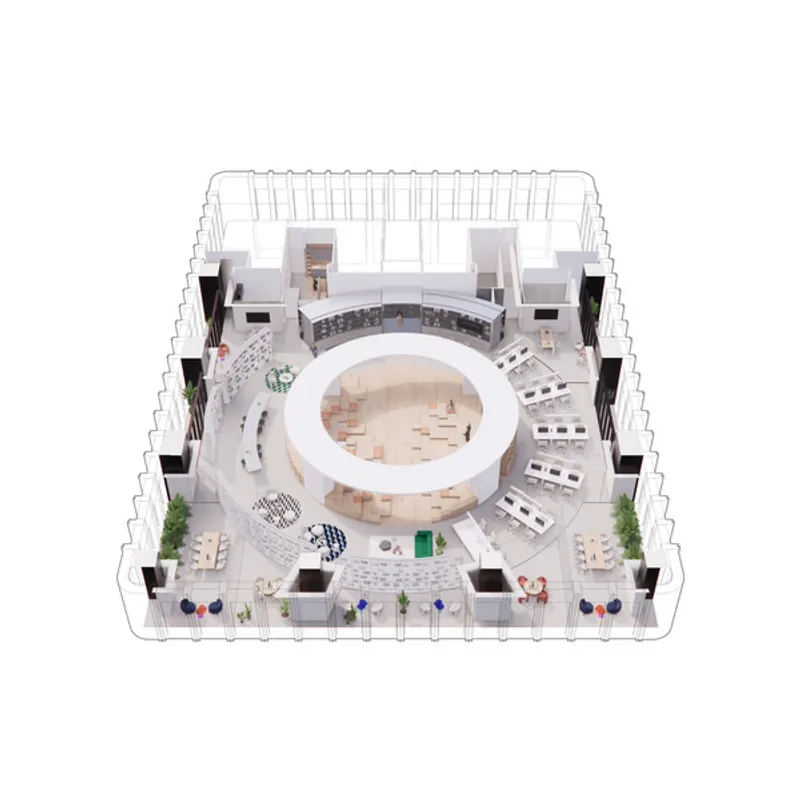
The axonometric diagrams trace the design's evolution from the existing structural grid of The Landmark tower to a circular interior volume defined by vertical timber elements. The sequence is instructive: Snøhetta treats the rectangular floor plate not as a constraint but as a container within which a fundamentally different geometry can emerge. The floor plan confirms the centrifugal organization, with the circular atrium at the center, workstations and meeting rooms at the perimeter, and planted zones mediating between the two. The isometric cutaway reveals how the mesh ceiling, timber forum, and glass partitions layer vertically to create spatial richness within what is, structurally, a single open floor plate.
Why This Project Matters
Most workplace interiors that claim to be "innovative" are simply open plans with a few breakout pods and a barista station. Snøhetta's Good Finance branch goes further by reorganizing the plan around a genuine public interior, a forum that privileges communal exchange over individual productivity metrics. The circular geometry, the material warmth of the timber, and the careful calibration of transparency through fluted glass all serve a single argument: that finance can be a social practice, not just a transactional one.
The project also demonstrates what a strong interior architecture practice can achieve within the constraints of a speculative high-rise floor plate. Snøhetta did not have the luxury of shaping the building envelope or the structural grid. Instead, they carved a compelling spatial narrative out of 800 square meters of generic commercial space. That is a harder problem than designing a building from scratch, and the result here is a persuasive case for interior architecture as a discipline with its own rigor and ambition.
Good Finance Taichung Downtown Branch by Snøhetta. Located in Taichung, Taiwan, on the 32nd floor of The Landmark skyscraper. 800 m². Completed in 2025. Photography by tudio Millspace.
About the Studio
Share Your Own Work on uni.xyz
If projects like this are the kind of work you want to make, uni.xyz is a place to publish your own, find collaborators, and enter design competitions.



Popular Articles
Popular articles from the community


The Musturak Paradise: Senior Living Architecture for a Connected Future in Temara, Morocco
The Musturak Paradise reimagines senior living architecture in Temara via private homes, social spaces, culture, community, and shared care.

Riyadh For All: Intergenerational Urban Design for Active Aging in Rabat
Riyadh For All reimagines urban design in Rabat with intergenerational co-living, adaptive courtyards, and Moroccan cultural exchange today.
AL-JANNAH: Sustainable Architecture and Permaculture for Afghan Widows
AL-JANNAH uses sustainable architecture and permaculture to create resilient oasis of housing, learning, work and renewal for Afghan widows.

The Ocean Hive: Sustainable Architecture for a Self-Sufficient Civilization at Sea
The Ocean Hive imagines sustainable architecture at sea, where modular habitats, algae, wave power and ocean waste sustain a growing colony.

Similar Reads
You might also enjoy these articles

Bao Huynh Watercolor Atelier: A Serene Art Retreat in Hội An
Bao Huynh Watercolor Atelier in Hội An blends multifunctional art spaces, sustainable design, local materials, and family-friendly living in a serene environment.

Atelier Macri Concept Store Interior Design by CASE-REAL
Atelier Macri store features a "ko" counter, walnut wood details, cork displays, blending retail, gallery, and seamless customer experiences.

Manuel Vargas Izquierdo Stadium and High-Performance Sports Center: Architectural Excellence in Jalpa de Méndez
The Manuel Vargas Izquierdo Stadium blends sustainable design, inclusive sports facilities, and cultural-inspired architecture, revitalizing Jalpa de Méndez’s public spaces.

KAKR Buluh Awar Hall: Revitalizing Community and Ecology Through Bamboo Architecture
Community built bamboo hall revitalizes Buluh Awar village, empowering youth, restoring ecology, celebrating vernacular craftsmanship through sustainable architecture and culture.

Explore Office Building Competitions
Discover active competitions in this discipline



Challenge to reimagine the Iron Throne


Photograph architecture without architects


Illustrate the lost glory of Angkor Wat - Render Challenge


Design challenge to reuse E-waste
Comments (0)
Please login or sign up to add comments
No comments yet. Be the first to comment!