
Social Housing Lyon, La Confluence by Tatiana Bilbao ESTUDIO
Tatiana Bilbao ESTUDIO’s Social Housing in Lyon redefines community living through inclusive design, flexible layouts, and sustainable urban integration.


Reimagining Collective Living in Lyon’s Revitalized District
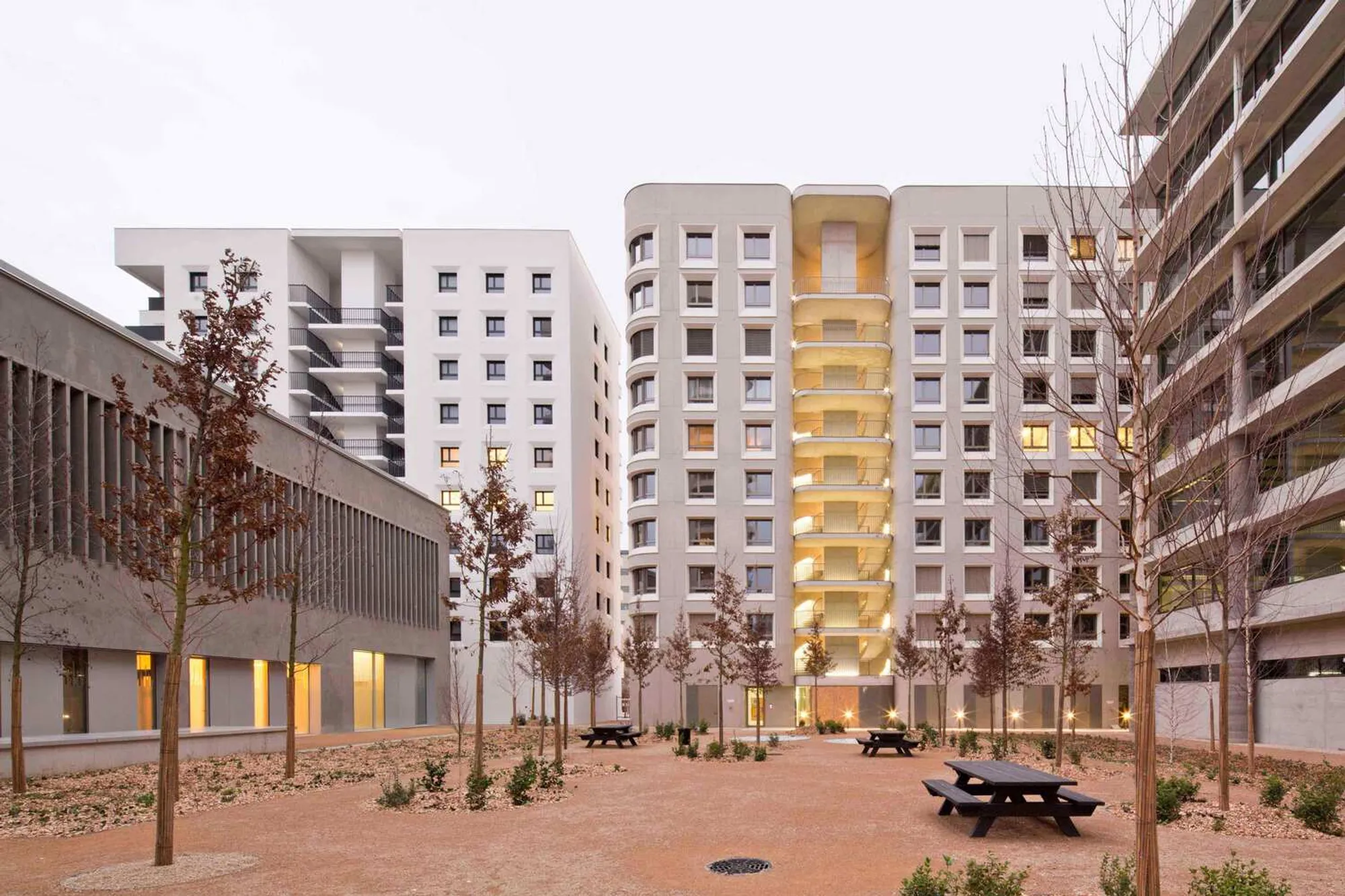
Located in Lyon, France, the Social Housing Lyon, La Confluence project by Tatiana Bilbao ESTUDIO represents a forward-thinking model of inclusive urban housing. Completed in 2017, this 8,856-square-meter development forms part of the large-scale La Confluence urban renewal initiative, a visionary effort to transform the city’s former industrial zone into a vibrant, mixed-use neighborhood centered on community, sustainability, and social integration.
Photographed by Jonathan Letoublon and Rodrigo Chapa Taller, the project consists of three distinct buildings designed around the guiding principle of “unity within diversity.”
Revitalizing La Confluence: Urban Renewal through Architecture
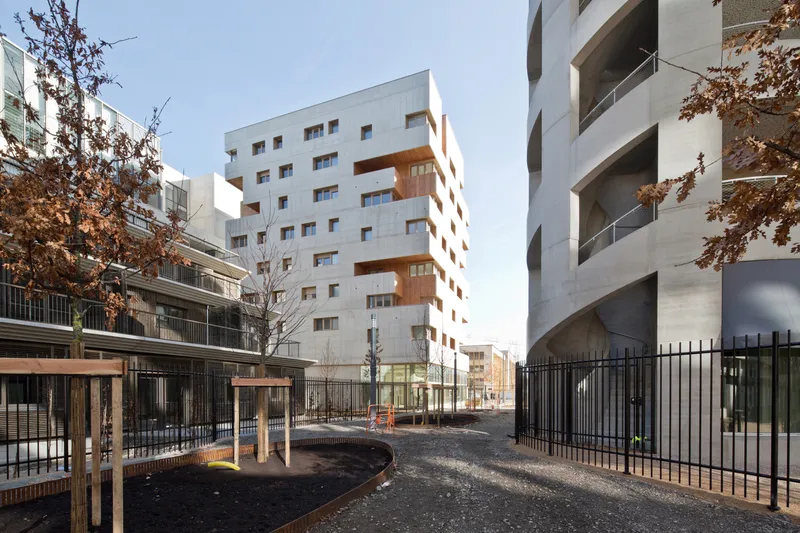
La Confluence, once a symbol of Lyon’s industrial past, began its revitalization in 2007 with a master plan developed by Herzog & de Meuron. Their vision for the second phase emphasized architectural diversity and social inclusivity, inviting a group of international architects to design a series of residential buildings that would embody this ethos.
Within this collaborative framework, Tatiana Bilbao ESTUDIO was commissioned to design three structures — two social housing buildings (Bâtiment 3 and Bâtiment 7) and one private housing building (Bâtiment 8). Together, they form a cohesive yet varied urban composition, unified around a shared semi-public courtyard that acts as the social and spatial heart of the block.
Architecture that Encourages Connection
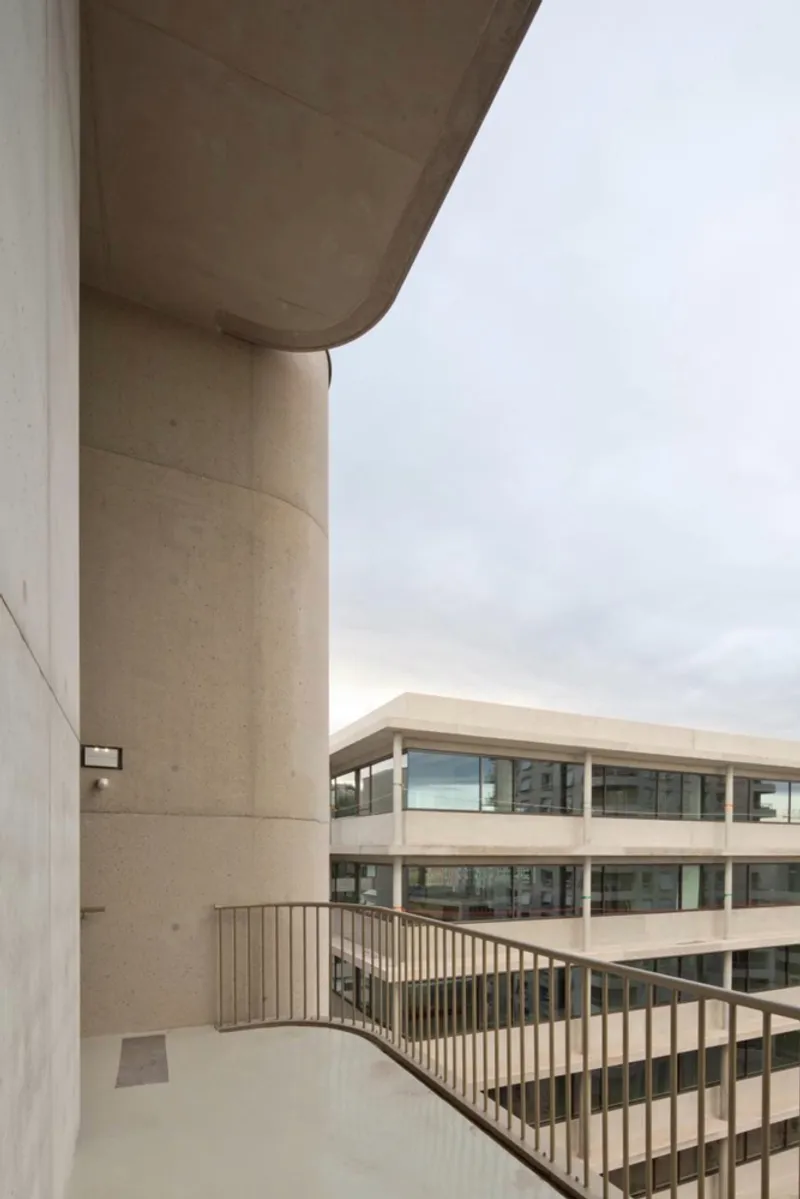
From the project’s inception, the architects sought to redefine the idea of community living. The design promotes interaction, coexistence, and a sense of belonging through stacked living units, terraces, and open vertical circulation spaces.
Each of the three buildings embraces the idea that the city extends into domestic life — where public, semi-public, and private realms fluidly intersect. The central courtyard, open to all, serves as a communal meeting point that fosters spontaneous encounters and strengthens the neighborhood’s social fabric.
Bâtiment 3: Flexible and Connected Social Housing
Bâtiment 3 exemplifies spatial flexibility through a series of 21 social housing units, each uniquely configured and connected to the outdoors. The building’s central concrete core anchors a composition of double-height terraces, corner balconies, and continuous windows, creating a rhythmic façade defined by light and openness.
The use of yellow pine wood adds warmth and material contrast to the raw concrete structure, reinforcing the dialogue between interior comfort and urban presence. Each apartment’s unique spatial relationship with the exterior reflects Bilbao’s commitment to human-centered design — emphasizing individuality within collective living.
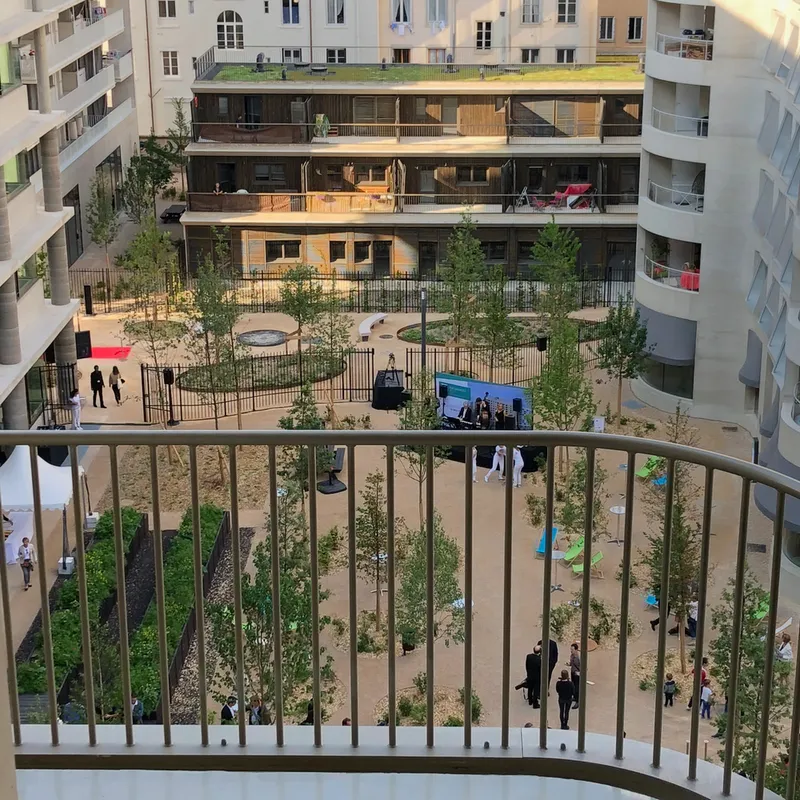
Bâtiment 7: Overlooking the Courtyard and Plaza
Positioned between the main public plaza and the internal courtyard, Bâtiment 7 continues the social housing narrative with 21 distinct units organized around an exposed central staircase. This vertical element not only facilitates circulation but also acts as a visual and social connector, encouraging residents to engage with one another across different levels.
The façades feature a dynamic composition of balconies and terraces that respond to orientation and views. Facing both the courtyard and the plaza, the building embodies the project’s dual focus — integrating public life and private dwelling within a cohesive architectural form.
By designing each apartment as a unique unit, Bilbao reinforces the message that diversity fosters unity, turning architectural variety into a metaphor for community identity.
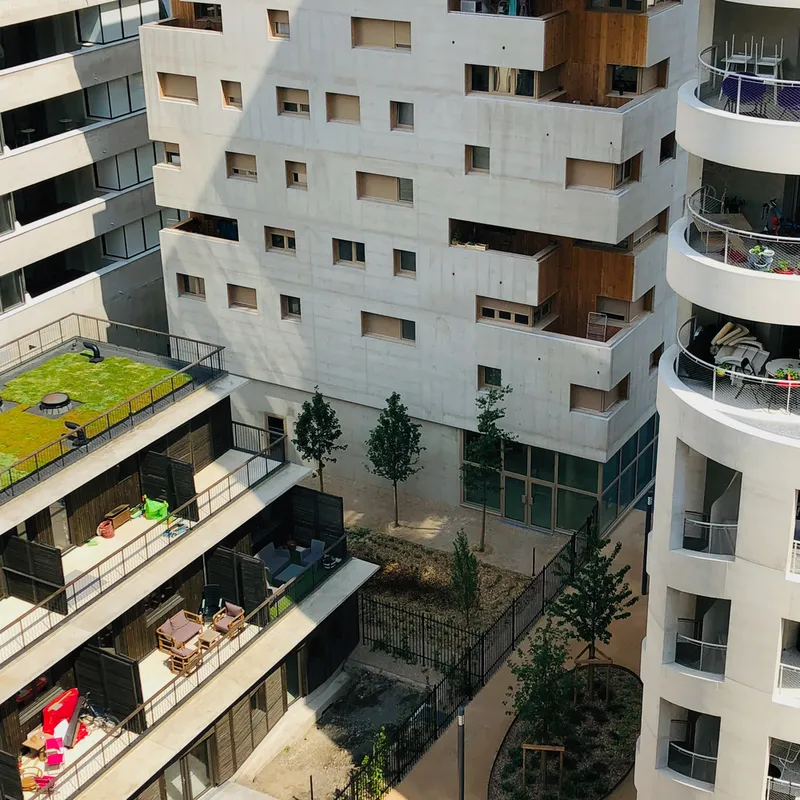
Bâtiment 8: Market-Rate Housing with a Collective Spirit
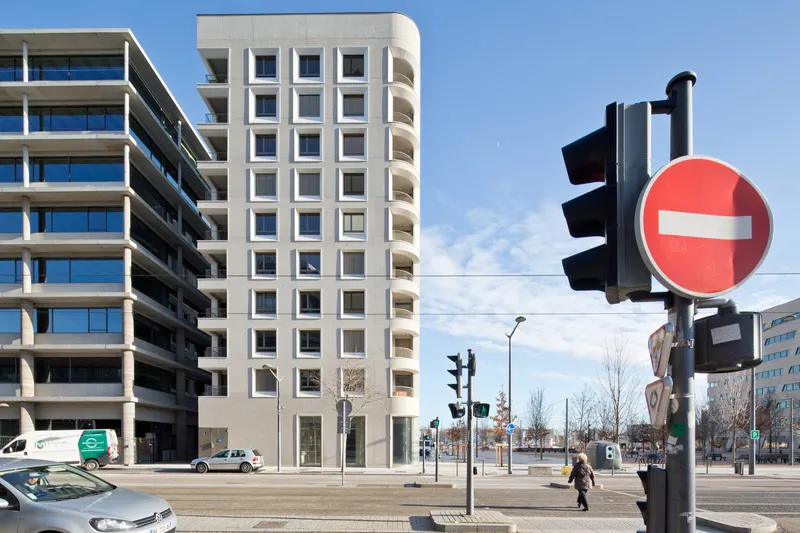
Located to the west of Bâtiment 7, Bâtiment 8 represents the private housing component of the ensemble. Comprising 23 market-rate apartments, this building explores the concept of unity through homogeneity.
Unlike the expressive façades of the social housing buildings, Bâtiment 8 presents a simple and monolithic volume facing the plaza. This restraint in form reflects an architectural balance within the block — complementing diversity with coherence and encouraging residents to identify as part of a larger collective whole.
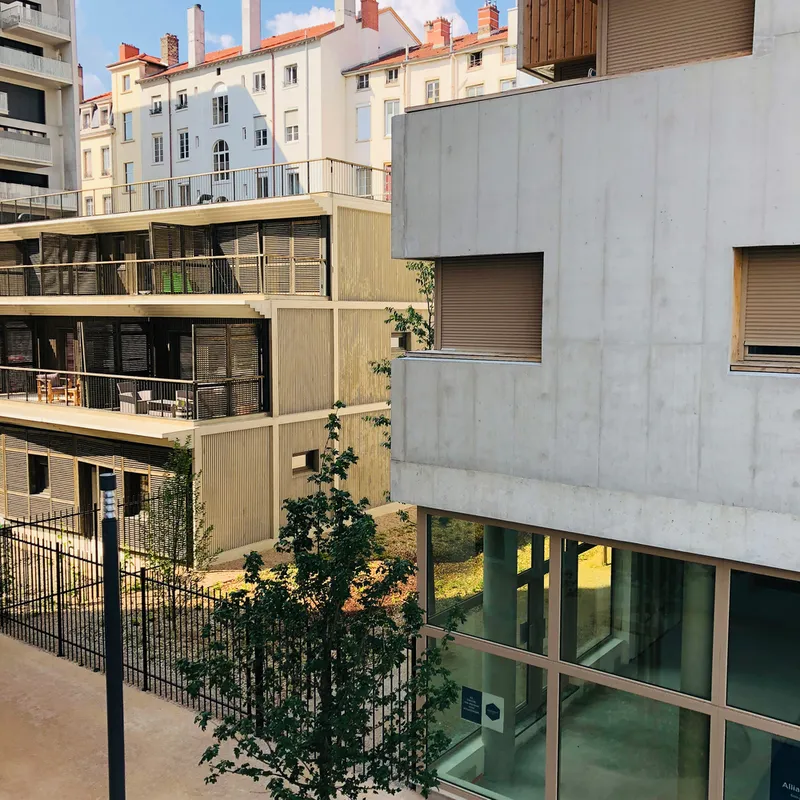
Material Honesty and Sustainable Design
Across all three buildings, material honesty defines the architectural language. Exposed concrete structures highlight durability and simplicity, while wood detailing introduces a tactile, human scale. The use of natural materials, generous openings, and cross-ventilation aligns with Bilbao’s broader ethos of sustainable, context-responsive architecture.
These design strategies reduce energy demands, enhance comfort, and promote well-being — essential aspects of sustainable urban living.
Redefining Social Housing in the European Context
Through its thoughtful combination of social engagement, architectural clarity, and material depth, the Social Housing Lyon, La Confluence project demonstrates how architecture can shape community life.
All Photographs are works of Jonathan Letoublon, Rodrigo Chapa Taller



Popular Articles
Popular articles from the community


Hill & Cross Opera: Sculptural Opera House Architecture Shaped by Tallinn’s Landscape and Identity
Hill & Cross Opera reimagines opera house architecture in Tallinn through its sculptural hill, civic plaza, glass wave and a luminous cross.

The Earth Pod: 3D Printed Homes for Resilient Refugee Communities
The Earth Pod reimagines refugee housing through 3D printed homes made from clay, combining resilience, self-sufficiency, and rapid shelter.

Riyadh For All: Intergenerational Urban Design for Active Aging in Rabat
Riyadh For All reimagines urban design in Rabat with intergenerational co-living, adaptive courtyards, and Moroccan cultural exchange today.

Co-life: Sustainable Architecture for Age-Friendly Community Living
Co-life reimagines sustainable architecture for seniors through courtyards, rammed earth, shared gardens, and spaces designed for belonging.

Similar Reads
You might also enjoy these articles


Hodi-Mandai Geram
Project Function: Preservation and revitalization of the Intangible heritage and socio-spatial identity of the Hodi by Housing, Cultural Memory Center, Sacred Grove, landscape, local tourism economy


Olio Towers: A Mid-Rise for Performers That Fuses Housing, Rehearsal, and Stage
Located blocks from Houston's Theater District, this modular tower stacks living units around a central performance atrium.

Oasis: Modular Green Housing Carved into Dhaka's Urban Fabric
A shortlisted Plugin Housing entry reclaims unauthorized settlements in Dhaka with stepped concrete volumes, green roofs, and ventilation-driven design.

Black Hole: A Floating Megastructure for the Post-Physical Era
Emiliano Mazzarotto envisions a spherical, self-scaling arena where e-sports, digital hotels, and holographic stadiums replace traditional public space.

Explore Residential Building Competitions
Discover active competitions in this discipline


Challenge to design mud housing for contemporary communities


Challenge to reimagine the Iron Throne


Photograph architecture without architects


Illustrate the lost glory of Angkor Wat - Render Challenge
Comments (0)
Please login or sign up to add comments
No comments yet. Be the first to comment!