
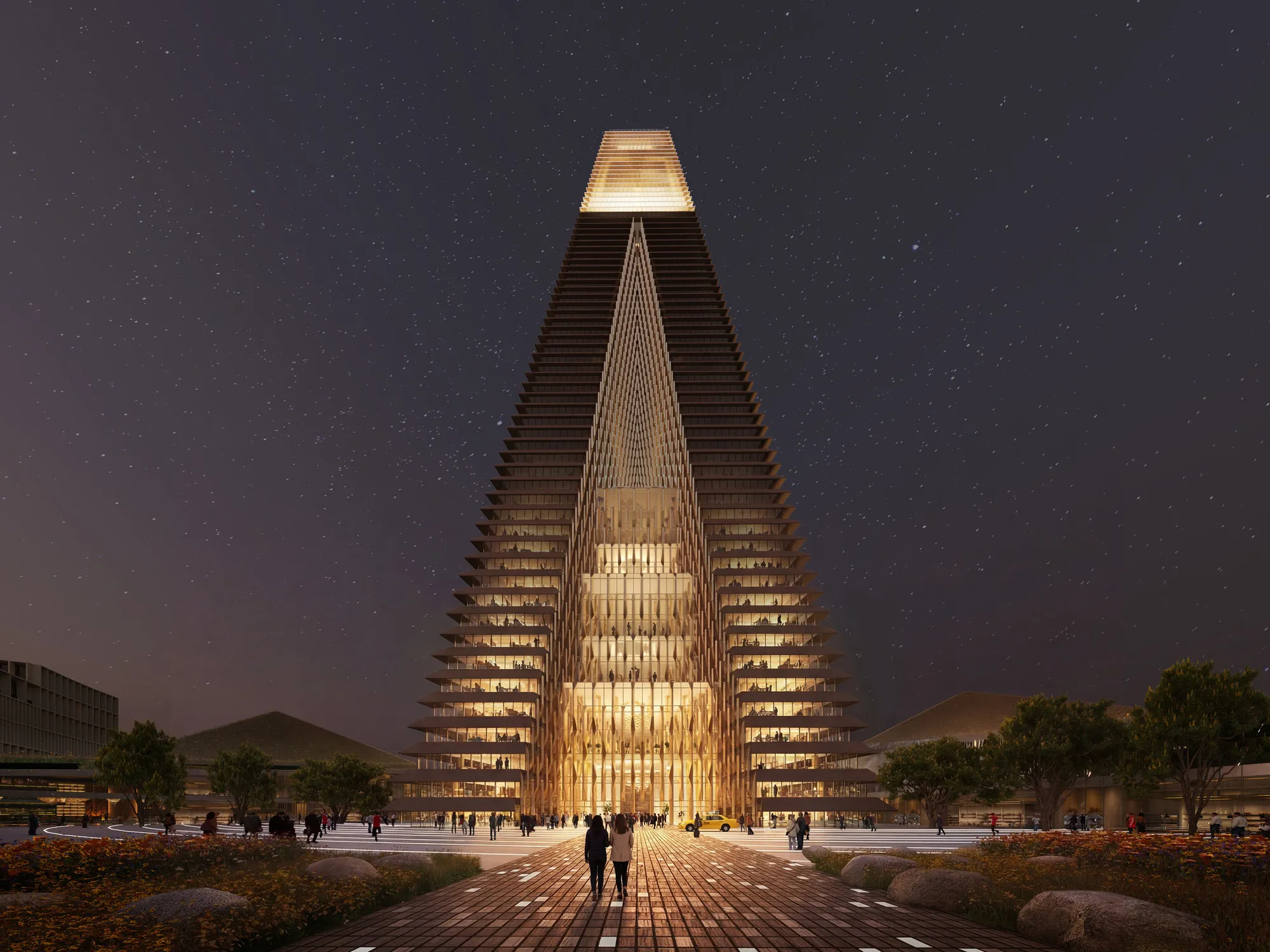
SOM Shapes a 272-Metre Tower Complex in Kazakhstan's New City of Alatau as a Built Mountain Range
A seismically resilient mixed-use landmark along the Almaty–Qonaev highway translates the Trans-Ili Alatau geology into faceted towers and terraced public


Alatau is not yet a city. It is a proposition: 88,000 hectares of steppe and highway corridor between Almaty and Qonaev, carved into four districts that exist mostly as zoning categories. Into this tabula rasa, SOM has dropped a 276,800-square-metre mixed-use complex anchored by a 56-storey, 272-metre spiraling tower, a companion 80-metre hotel tower, and a 58,000-square-metre podium stitching retail, cultural venues, and event spaces together at street level. The project, titled "Mountain Landscape," draws its formal logic from the Trans-Ili Alatau, a 350-kilometre range of valleys, glaciers, and stratified geology that looms to the south. SOM is translating that stratigraphy into architecture: stepped massing, faceted facades, wedge-shaped volumes, and external terraces that echo the layered terrain of foothills.
What makes the project more than a metaphor is the engineering problem underneath it. This region sits on active seismic faults, and the design team is finalizing a choice between two structural philosophies: a Japanese-style damping model that absorbs earthquake energy through controlled movement (think of a car's suspension at skyscraper scale) or an American reinforced framework of high-strength steel that resists force more rigidly. Either approach would make the tower among the most seismically sophisticated buildings in Central Asia. That structural ambition, combined with SOM's prior experience delivering the Talan Towers in Astana under similarly punishing conditions, gives the Alatau complex a credibility that renders of spiraling glass alone cannot provide.
A Geological Massing Strategy
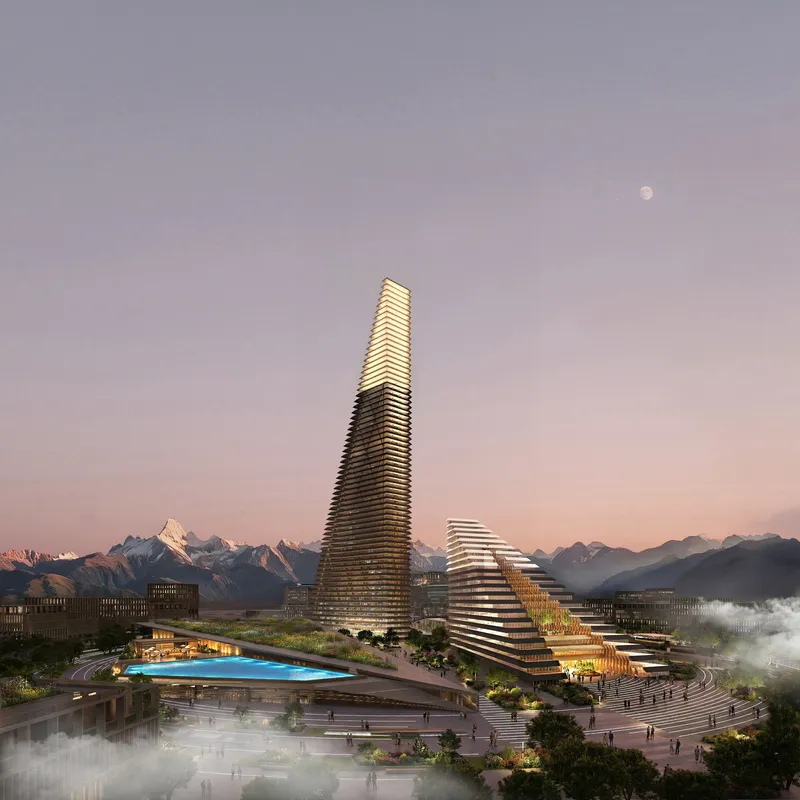
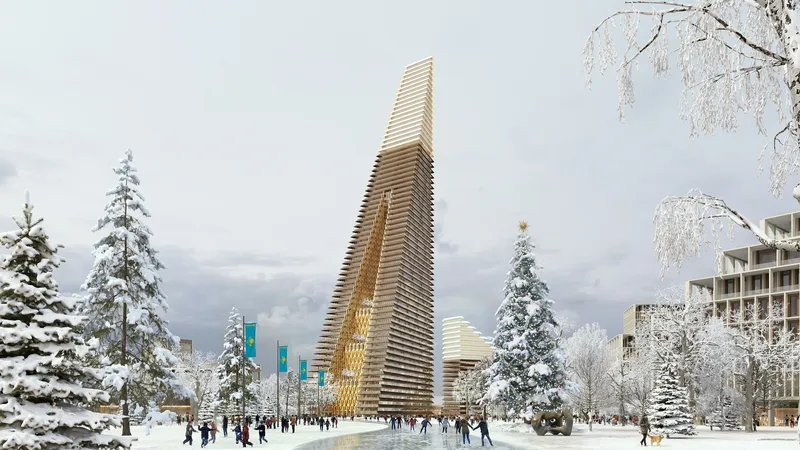
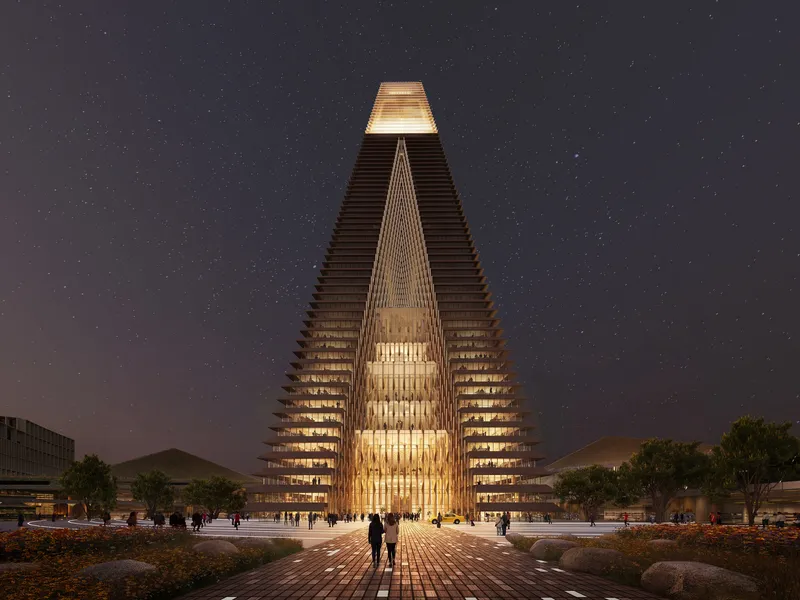
The primary tower reads differently depending on the angle and the season. From above at dusk, the spiraling form and its stepped podium recall the contour lines of a topographic survey, the massing rippling outward from the tower's peak toward a landscaped waterfront plaza. In the winter rendering, surrounded by snow-covered birches and pedestrians in heavy coats, the same building becomes a geological outcrop, its layered floor plates stacking like sedimentary rock against a cold sky. The pyramidal silhouette is deliberate: SOM intends it to function as a civic emblem for Alatau's nascent business district, legible at highway speed from the Western Europe–Western China transport corridor that passes nearby.
The stepped profile is not only symbolic. Each setback generates a terrace, and the wedge-shaped volumes between the two towers create courtyards that funnel daylight into the deep floor plates. In a continental climate with extreme temperature swings, those outdoor platforms become usable space for a meaningful portion of the year, while the inward-facing atria buffer the transition between exterior and interior conditions.
The Podium as Foothills
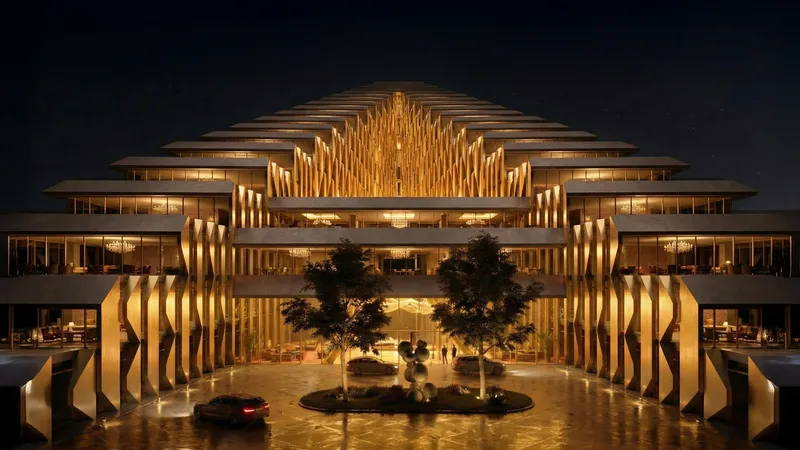
Three levels of podium, covering 58,000 square metres, terrace down toward the street in a form SOM describes as echoing the local foothills. At night, the symmetrical facade of vertical fins frames a central courtyard planted with trees and anchored by a fountain, creating a kind of urban canyon lit from within. It is a generous public gesture for a city that does not yet have a public to fill it, a calculated bet that the space will generate the activity it currently only renders.
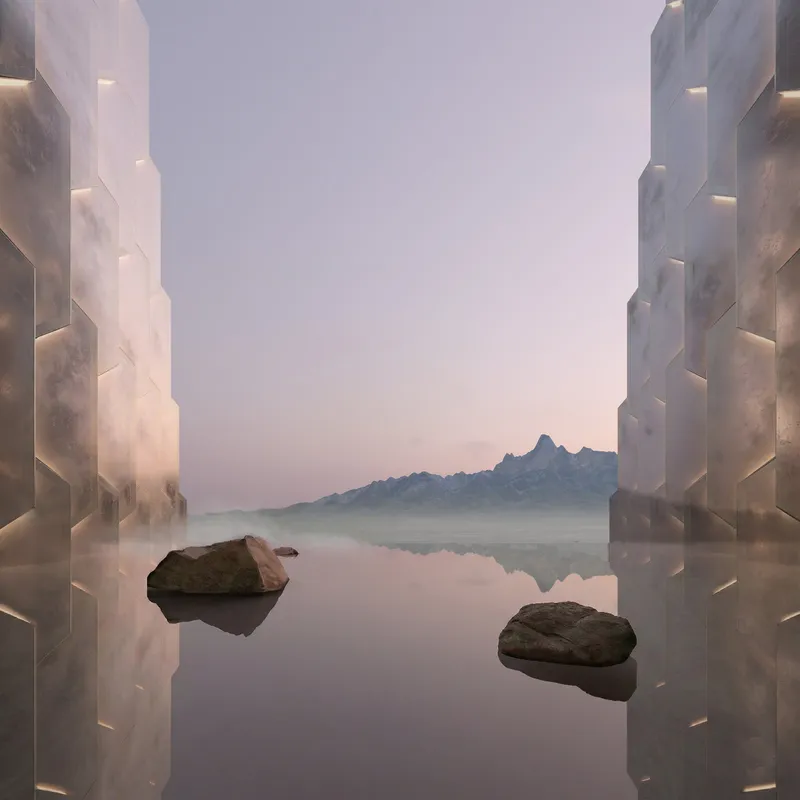
Elsewhere, stepped concrete walls frame a reflecting pool flanked by boulders, a deliberately minimal landscape composition that nods to the high-altitude stillness of the Tien Shan foothills. The restraint is welcome. Rather than packing every surface with program, SOM has left room for contemplation and negative space, qualities that will matter if Alatau's Gateway District achieves its stated goals of walkability, density, and multimodal transit.
Facade as Structure, Structure as Ornament
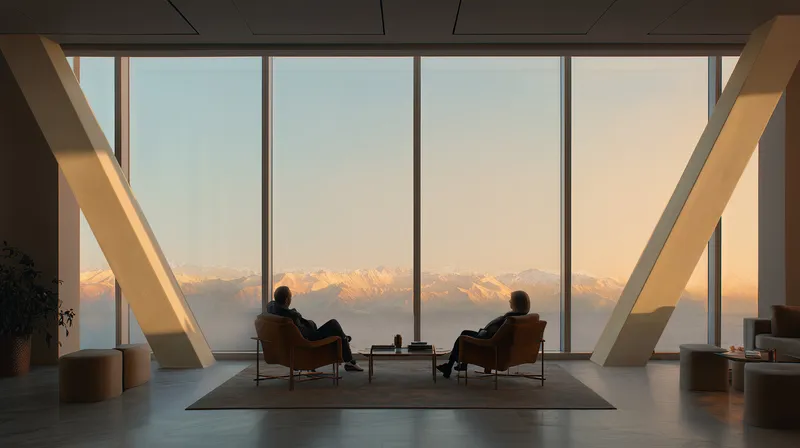
The most compelling detail in the imagery is the diagonal structural beams visible through floor-to-ceiling glazing in the interior views. SOM notes that the structural system doubles as a decorative element in the facade, and the rendered interiors deliver on that promise. From leather chairs facing the mountains, occupants look through an exoskeleton of angular members that slice the panorama into triangulated frames. It is a technique SOM has refined across decades of supertall design: make the engineering legible, and you eliminate the need for decorative cladding.
The triangular cutout at the tower's entrance, visible in the night rendering, performs a similar double duty. It marks arrival while revealing the stacked floor plates behind it, giving the lobby a sectional depth that most tower bases conceal behind curtain walls. High-performance facades and integrated shading strategies are promised to reduce solar gain across the complex, a critical requirement where summer temperatures can spike and winter lows plunge well below freezing.
Living at Altitude
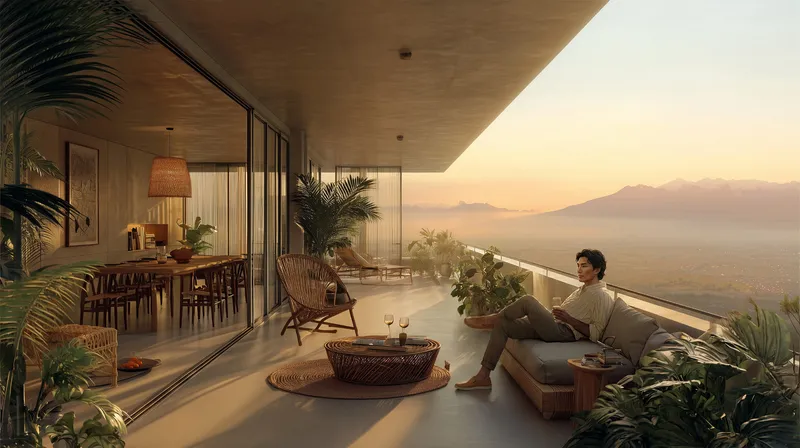
The upper floors of the primary tower house premium residences, and the adjacent 80-metre tower integrates a luxury hotel with branded residences. The terrace rendering, where a figure reclines under a timber ceiling with the mountains bleeding orange at sunset, sells a lifestyle predicated on altitude and proximity to landscape. The glass railing, the warm wood soffit, the absence of any neighboring building: it is aspirational, and it has to be. Alatau's success depends on attracting the kind of international investment that responds to exactly these images.
The interior shot, with its diagonal structural beams framing a mountain panorama, reveals a more grounded ambition. These are spaces designed around views that will actually exist. The Trans-Ili Alatau is not a marketing fiction; it is a geological fact visible from every south-facing window. If SOM's facade engineering performs as described, the interplay between structural rhythm and mountain silhouette could produce some of the most compelling residential views in Central Asia.
Why This Project Matters
New cities are inherently risky propositions. For every Songdo or Masdar that reaches a critical mass, there are planned capitals and economic zones that stall at the infrastructure phase. Alatau's advantage is geographic: it sits on the Western Europe–Western China transport corridor, within a Special Economic Zone of nearly 100,000 hectares, and between two existing cities with established economies. SOM's complex, with large-scale excavation scheduled for May 2026 and commissioning targeted for 2029, is designed to be the anchor that proves the district's viability to subsequent investors. The selection of China State Construction Engineering Corporation for execution adds construction credibility to the architectural ambition.
What elevates the project beyond developer-grade supertall design is the honest integration of constraints. The seismic engineering is not an afterthought bolted to a form; it shapes the form. The mountain metaphor is not arbitrary; the mountains are right there, close enough to frame through structural members. And the podium's public generosity, its terraces and courtyards and reflecting pools, suggests SOM understands that a landmark tower without a livable base is just a billboard. If Alatau becomes a city, this complex will be the reason people believed it could.
Alatau Iconic Complex, designed by SOM, Alatau City, Kazakhstan. Total area: 276,800 square metres. Primary tower: 272 metres, 56 floors. Expected completion: 2029.
About the Studio
Share Your Own Work on uni.xyz
If projects like this are the kind of work you want to make, uni.xyz is a place to publish your own, find collaborators, and enter design competitions.



Popular Articles
Popular articles from the community


The Musturak Paradise: Senior Living Architecture for a Connected Future in Temara, Morocco
The Musturak Paradise reimagines senior living architecture in Temara via private homes, social spaces, culture, community, and shared care.

Conexión: Biophilic Design Reimagines High-Rise Living in Hong Kong
Conexión reimagines high-rise living in Hong Kong through biophilic design, green facades, shared spaces, daylight, water and nature within.

Lunar Spiral: Space Architecture Shaped by the Mathematics of the Universe
Lunar Spiral reimagines space architecture through Fibonacci geometry, lunar regolith, levitating habitats, and self-sustaining Moon living.

Riyadh For All: Intergenerational Urban Design for Active Aging in Rabat
Riyadh For All reimagines urban design in Rabat with intergenerational co-living, adaptive courtyards, and Moroccan cultural exchange today.

Similar Reads
You might also enjoy these articles

Bao Huynh Watercolor Atelier: A Serene Art Retreat in Hội An
Bao Huynh Watercolor Atelier in Hội An blends multifunctional art spaces, sustainable design, local materials, and family-friendly living in a serene environment.

Atelier Macri Concept Store Interior Design by CASE-REAL
Atelier Macri store features a "ko" counter, walnut wood details, cork displays, blending retail, gallery, and seamless customer experiences.

Manuel Vargas Izquierdo Stadium and High-Performance Sports Center: Architectural Excellence in Jalpa de Méndez
The Manuel Vargas Izquierdo Stadium blends sustainable design, inclusive sports facilities, and cultural-inspired architecture, revitalizing Jalpa de Méndez’s public spaces.

KAKR Buluh Awar Hall: Revitalizing Community and Ecology Through Bamboo Architecture
Community built bamboo hall revitalizes Buluh Awar village, empowering youth, restoring ecology, celebrating vernacular craftsmanship through sustainable architecture and culture.


Comments (0)
Please login or sign up to add comments
No comments yet. Be the first to comment!