
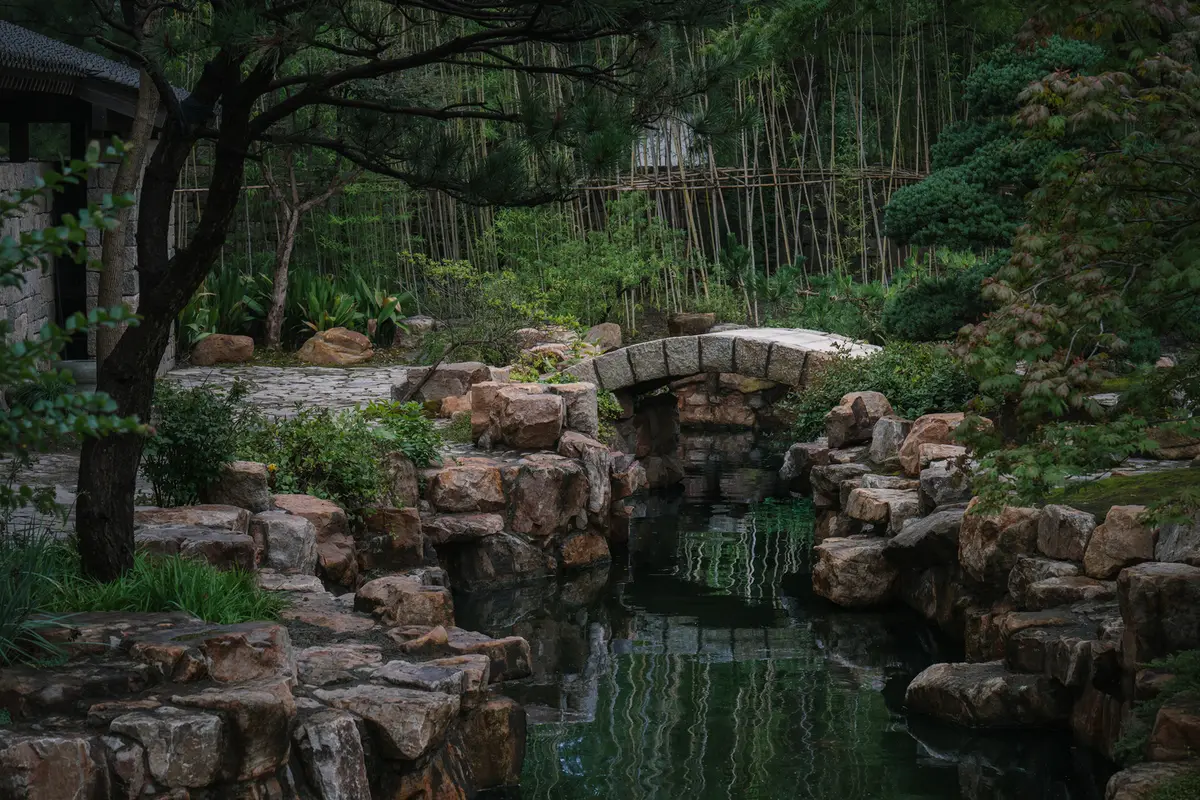
Atelier VISION Channels the Ancient Lanting Gathering into a Living Garden at Jiading
Songming Garden reinterprets Wang Xizhi's waterside literati gathering through stone, thatch, and a U-shaped canal near Jiading Ancient City.


Two kilometers north of Jiading Ancient City, a 150-square-meter landscape called Songming Garden compresses centuries of Chinese garden philosophy into a single, walkable sequence. Designed by Atelier VISION, the project takes its organizing concept from Wang Xizhi's fourth-century "Preface to the Lanting Pavilion," a text celebrating a springtime gathering of scholars beside a winding stream. Rather than reproducing a historic garden, the designers extracted the essential relationship the text describes: people gathered at the edge of moving water, absorbed in nature, momentarily freed from the ordinary world.
What makes the project worth studying is the rigor of that extraction. A U-shaped water system forms the structural spine, orienting every spatial decision. Tea rooms sit at the water's edge. Planted zones are zoned directionally: water and vegetation to the west, sculpted artificial mountains to the north, dense planting buffers to the south, and tall bamboo forests to the east. The result is a garden that feels discovered rather than designed, a quality the Yuan Ye (The Craft of Gardens) calls "expelling the mundane." Atelier VISION takes the instruction literally, constructing a threshold sequence that moves visitors from asphalt road to shadowed corridor to open garden in a few carefully choreographed steps.
Water as Organizational Spine
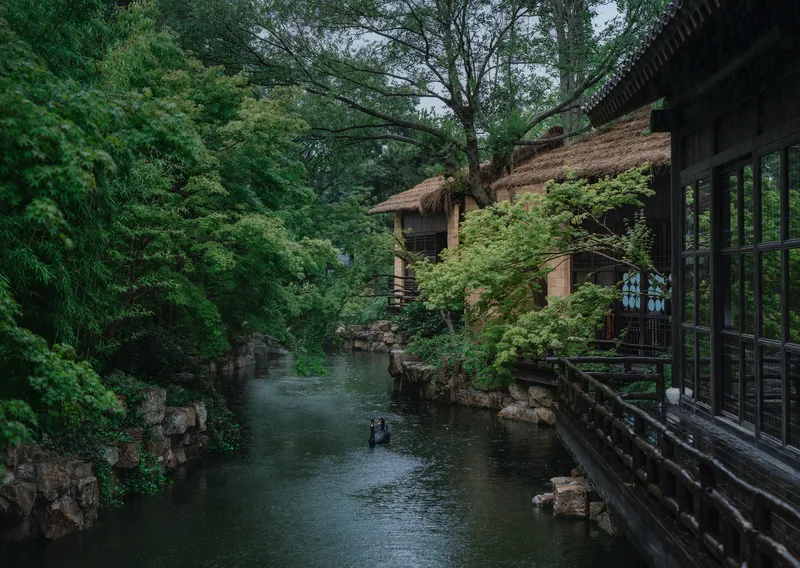
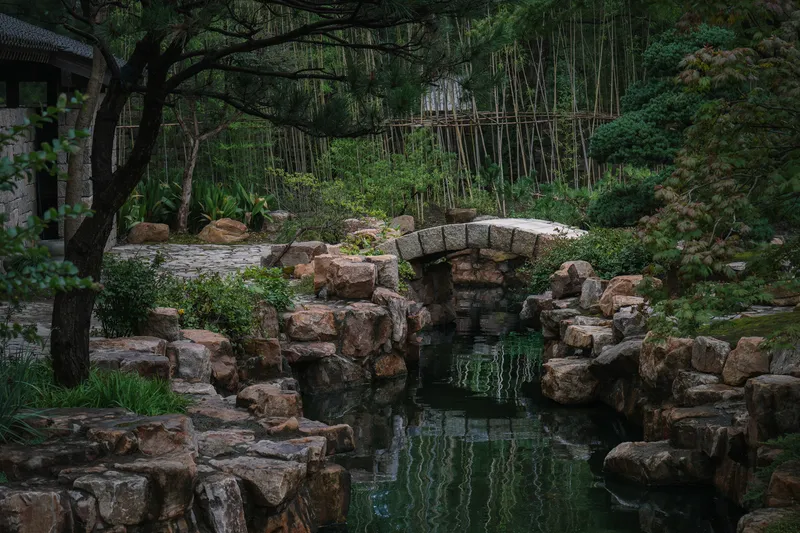
The U-shaped canal is not a decorative pond; it is the garden's primary circulation device. Visitors encounter the water almost immediately after entering from the north, and the channel pulls them through the site's successive scenes. Along its edges, stacked yellow stone retaining walls give the watercourse an architectural presence that reads as geology rather than masonry. The stone arch bridge and reflecting pool create a moment of compression and release: a narrow crossing followed by a long view through bamboo.
Traditional Chinese gardens often treat water as a mirror for sky and foliage, but Songming Garden also treats it as a boundary. The canal separates zones of program without walls, letting sound and reflected light do the work of enclosure. Tea rooms are positioned so that their occupants look across water, never directly at another building. The effect recalls the Lanting scene itself: scattered pavilions unified by a single stream.
Stone and Thatch: A Material Vocabulary of Wilderness
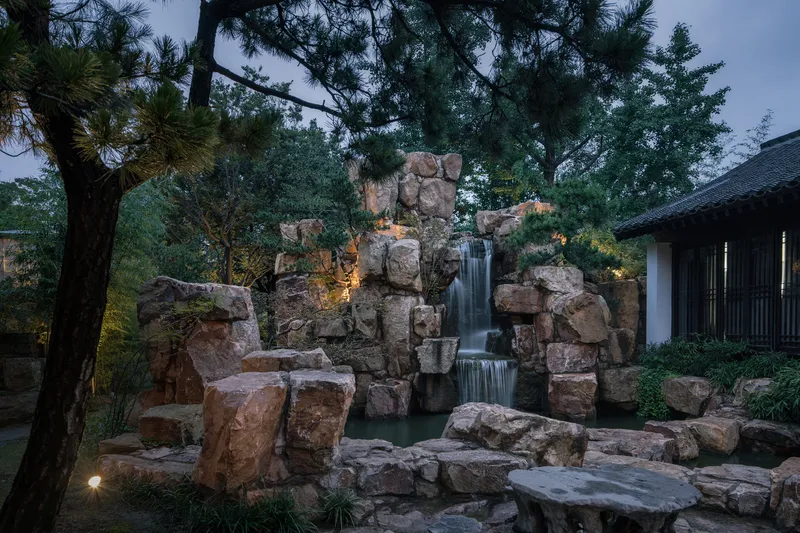
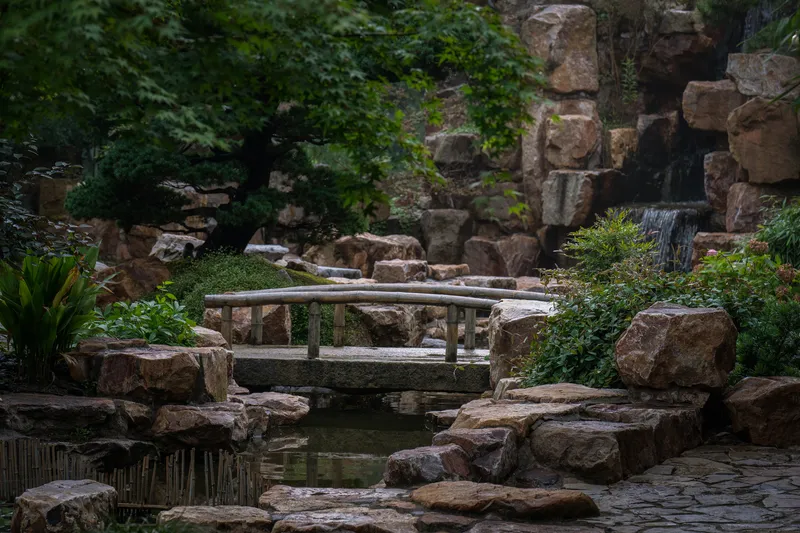
Atelier VISION limits the palette to three primary materials: yellow stone, raw stone, and thatch. Yellow stone appears in pathways, retaining walls, and waterfall features, its warm tone unifying the garden across seasons. Raw stone, left unfinished, surfaces in corridor walls and structural retaining elements, where its rough texture signals the transition from cultivated space to something wilder. Thatched roofs on the tea rooms dissolve the buildings into the canopy line, making architecture read as a subcategory of landscape.
The stacked stone waterfall near the pine grove demonstrates how the material strategy produces atmosphere. Integrated uplighting catches the crevices between stones at dusk, turning a retaining wall into a luminous geological section. The timber footbridge over the stream is similarly restrained: simple plank construction that defers to the boulders and shrubs surrounding it. Nothing here competes for attention. Every material exists in service of what the designers call "natural wilderness," a paradox that only works when the craft is invisible.
Threshold Sequences and the Moon Gate
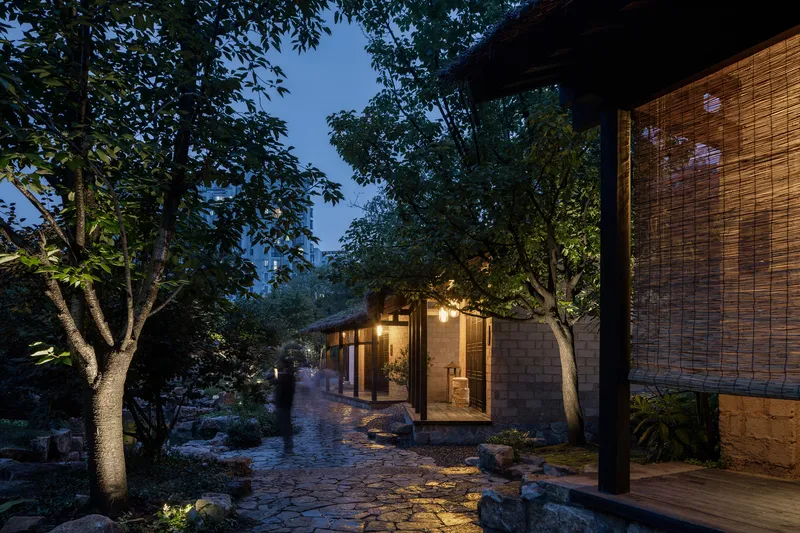
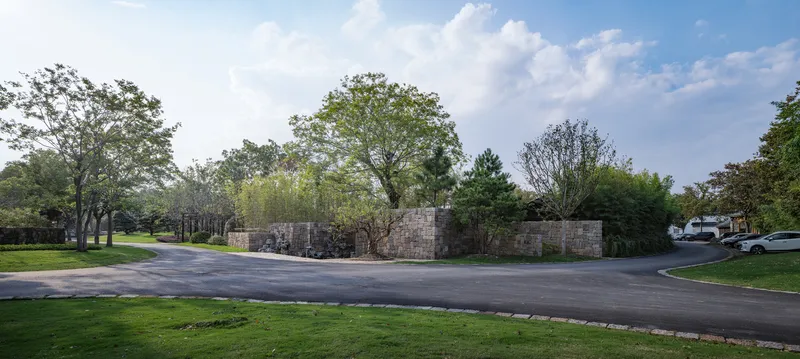
The garden has two entrances, each calibrated to a different psychological sequence. The northern main entrance is direct, suitable for regular visitors and service access. The southern entrance, connected to a parking lot across the road, is more theatrical. A low stone wall traces the curve of the asphalt road, offering a minimal preview of what lies beyond. The glazed entrance pavilion, wrapped in a bamboo screen and capped with thatch, functions as an airlock between the street and the garden interior.
From this pavilion, a shadowy, mountain-like corridor compresses the visitor's field of vision before the space opens out through a moon gate into the courtyard. The technique is classical: constrict, then release. But the execution feels contemporary. The bamboo screen at the entrance pavilion filters exterior light in a way that is closer to a perforated metal facade than a traditional lattice. It is a detail that signals Atelier VISION's intent: not to copy the literati garden, but to operate within its logic using present-day means.
Planting as Directional Enclosure
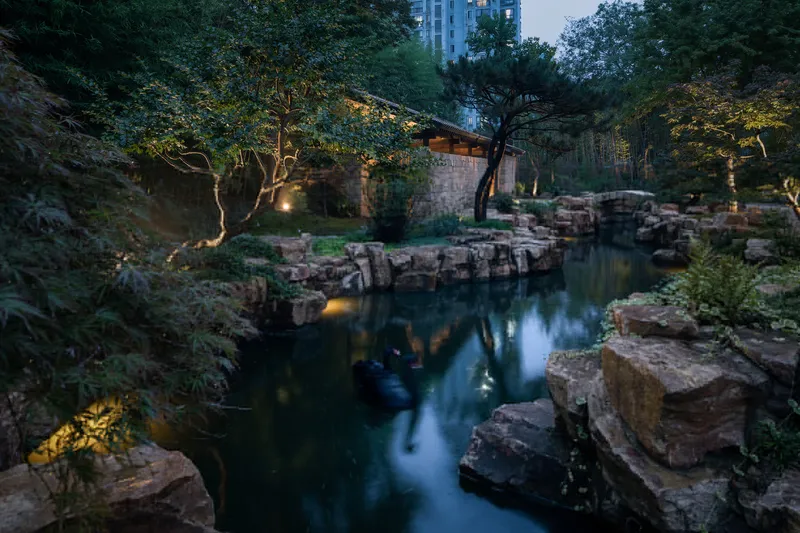
Each edge of the site has a distinct planting character, and this directional strategy is one of the project's strongest ideas. The east side deploys tall bamboo to create an acoustic and visual wall against the road. The south side uses dense mixed planting as a buffer. The north relies on sculpted artificial terrain and mountain-like rock formations. The west side pairs water with vegetation, blurring the boundary between garden and the adjacent waterway. The result is a garden that feels much larger than 150 square meters because the edges never repeat.
Within this framework, the client's specified Osaka pines act as structural accents, their horizontal branching habits contrasting with the vertical bamboo. Moss groundcover softens the base plane and introduces a temporal dimension: moss reads as age, as patience, as something that was not installed but allowed to arrive. This mix of deliberate placement and implied naturalness is the garden's central tension, and Atelier VISION navigates it with discipline.
Why This Project Matters
Songming Garden is a counterargument to the notion that traditional garden design is a finished conversation. By anchoring the project in a specific literary source, Wang Xizhi's Lanting preface, Atelier VISION avoids the vagueness that often plagues "nature-inspired" landscape projects. Every decision, from the U-shaped water system to the directional planting, can be traced back to a legible idea about how people and water should meet. That clarity of concept is what lifts the project above scenography.
More practically, the project shows how a small site can achieve spatial richness through sequencing rather than size. The threshold corridors, the zoned edges, the calibrated material palette: these are strategies available to any landscape project, regardless of budget. What they require is conviction, the willingness to let a single organizing idea discipline every subsequent choice. Songming Garden has that conviction, and the result is a contemporary garden that earns its claim to an ancient lineage.
Songming Garden by Atelier VISION. Located in the Chrysanthemum Garden area, Jiading Ancient City, China. Area: 150 square meters. Photography by Qingshan Wu.
About the Studio
Atelier VISION
Share Your Own Work on uni.xyz
If projects like this are the kind of work you want to make, uni.xyz is a place to publish your own, find collaborators, and enter design competitions.


Popular Articles
Popular articles from the community


David Ortega Stacks a Two-Story Mexico City Penthouse Around a Steel Stair and a Pergola-Shaded Roof Terrace
In Colonia Roma, a 300 m² penthouse uses oak joinery, a planted steel stair and a slatted roof pergola to make a new-build apartment feel like a house.


Singing Woman: An Opera House That Performs Before the Curtain Rises
Ovidiu Cristian Pavel's conceptual opera house translates Estonia's choral identity into a sculpted waterfront landmark facing the Baltic Sea.

FCC Arquitectura Expands a Portuguese Granite House with a Board-Marked Concrete Wing
In Portugal, JV House pairs a cleaned-up whitewashed and granite dwelling with a timber-shuttered concrete extension, courtyards and a garden pool.

Opera on the Sea: Driftwood Logic Shapes a Timber Opera House on Estonia's Coast
Trevor Orgill's opera house translates the entangled drift of floating timber into a civic building where wood, water, and music converge.

Similar Reads
You might also enjoy these articles


Hodi-Mandai Geram
Project Function: Preservation and revitalization of the Intangible heritage and socio-spatial identity of the Hodi by Housing, Cultural Memory Center, Sacred Grove, landscape, local tourism economy


Olio Towers: A Mid-Rise for Performers That Fuses Housing, Rehearsal, and Stage
Located blocks from Houston's Theater District, this modular tower stacks living units around a central performance atrium.

Oasis: Modular Green Housing Carved into Dhaka's Urban Fabric
A shortlisted Plugin Housing entry reclaims unauthorized settlements in Dhaka with stepped concrete volumes, green roofs, and ventilation-driven design.

Black Hole: A Floating Megastructure for the Post-Physical Era
Emiliano Mazzarotto envisions a spherical, self-scaling arena where e-sports, digital hotels, and holographic stadiums replace traditional public space.

Explore Landscape Gardening Competitions
Discover active competitions in this discipline

Challenge to reimagine the Iron Throne

Photograph architecture without architects

Illustrate the lost glory of Angkor Wat - Render Challenge

Design challenge to reuse E-waste
Comments (0)
Please login or sign up to add comments
No comments yet. Be the first to comment!