
SOSOKKI ANAC Builds a Post-Apocalyptic Monastery Disguised as a Café in Rural South Korea
On a narrow riverside plot in Gangwon-do, faceted red brick volumes channel fortified monasteries and speculative fiction into a coffee shop.

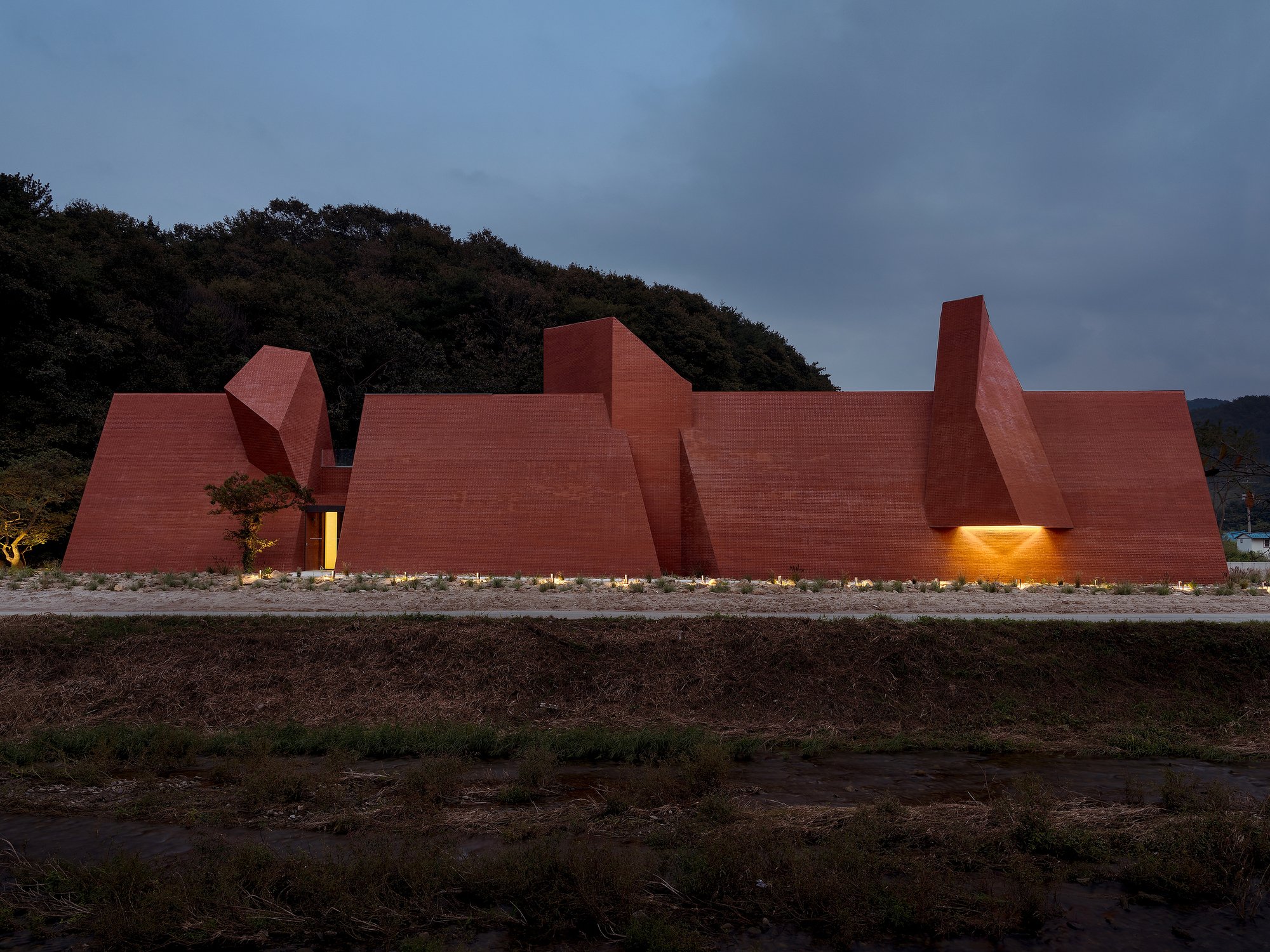
Most cafés in South Korea's rural tourism corridors compete on atmosphere: warm wood, floor-to-ceiling glass, an Instagram corner. Monologue Café, designed by SOSOKKI ANAC on a narrow riverside plot in Hongcheon, Gangwon-do, refuses every one of those moves. Instead, lead architect Gi-tae Chung has erected a sequence of faceted red brick volumes that read less like a hospitality venue and more like a fortified monastery from a world that no longer exists. The concept is explicitly speculative: the design imagines a structure built after an imagined reset of the Earth, a place where architecture is less about comfort and more about marking a boundary between what was and what remains.
What makes the project genuinely interesting is how seriously it commits to that narrative without becoming theatrical. Chung cites the Wall from Game of Thrones as an inspiration, and you can see it in the building's massing: thick walls, abrupt angles, and a silhouette that rises and falls in intermittent volumes above a low-lying base. But the building never tips into set design. It is constructed from reinforced concrete clad in red brick, finished with hairline stainless steel details, and grounded on a 3,463 m² site surrounded by forest and low vegetation. The architecture does not dissolve into the landscape. It stands apart, a deliberate object that treats its own weight as a formal virtue.
A Fortification on the River's Edge

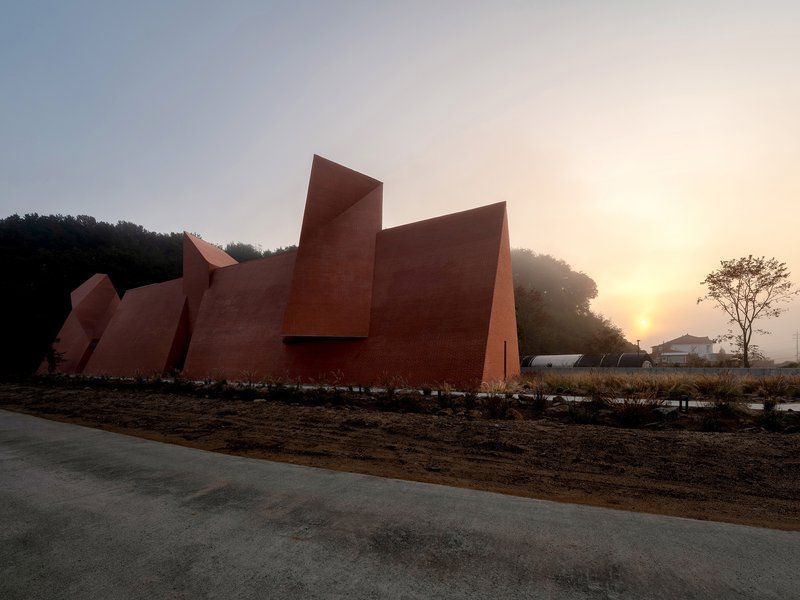
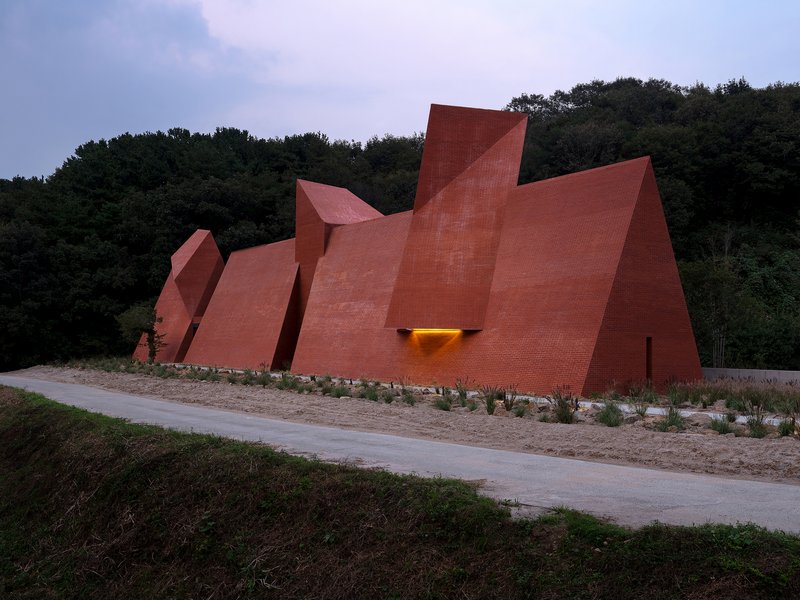
The building follows the linear form of the site, stretching along the quiet edge of water and low vegetation in Seo-myeon. From a distance, the composition reads as a solid, opaque mass punctuated by angular peaks. The volumes do not suggest a unified roof but rather an accumulation, as if the building accreted over time rather than being designed all at once. At dusk, a single illuminated opening pulls you toward the entrance, but the overall posture is one of resistance rather than invitation.
The decision to stand in contrast to the surrounding forested landscape is the most polemical choice here. Where a more conventional approach would use materials and proportions to blend into the hillside, SOSOKKI ANAC treats the building as a geological event, something dropped onto the site with its own logic and its own gravity.
Brick as Sculpture
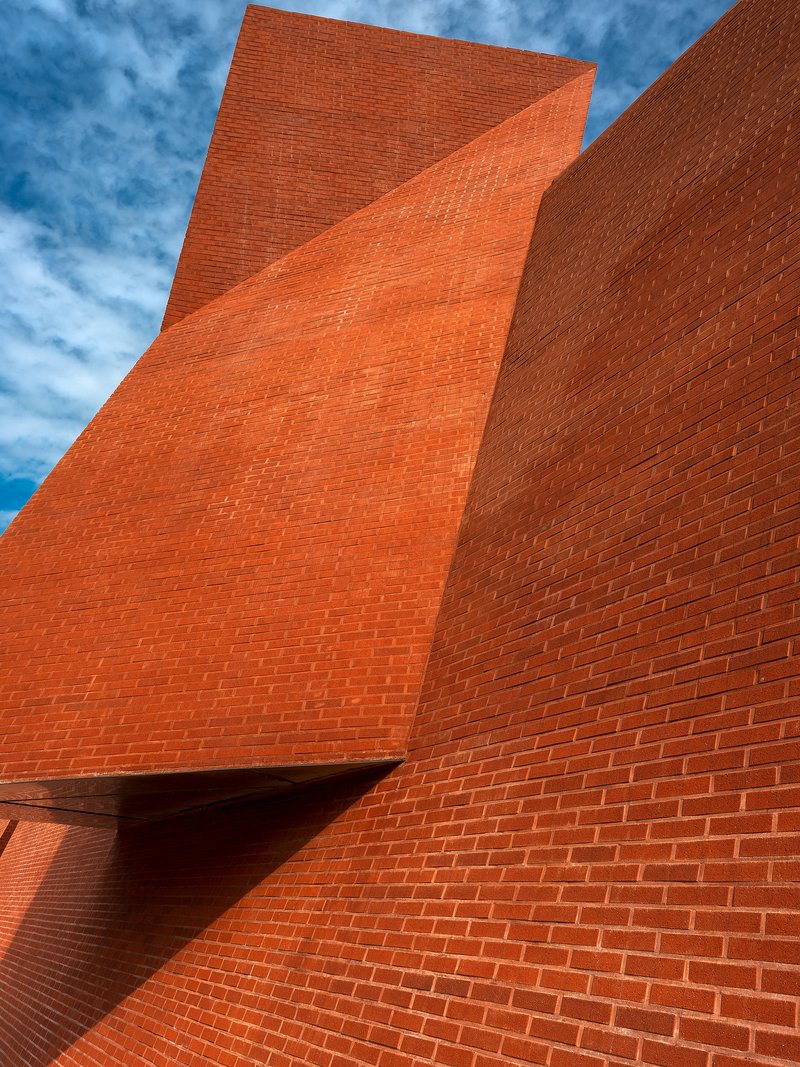
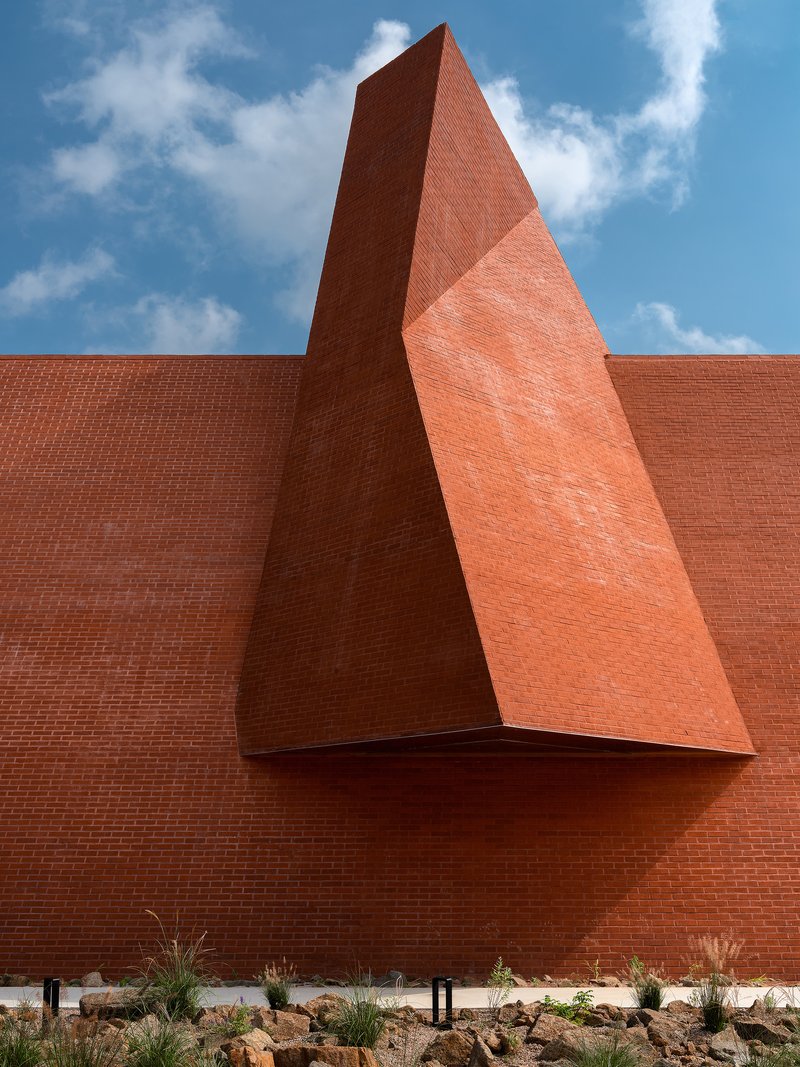
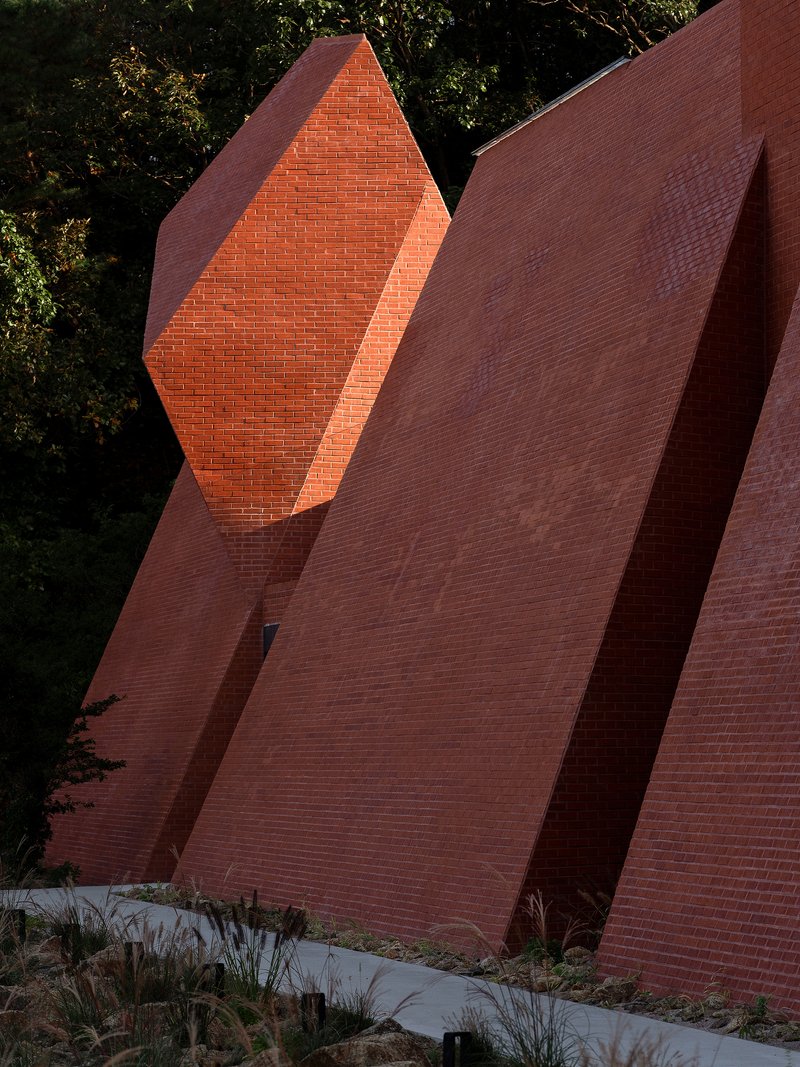
The red brick cladding does far more than wrap the reinforced concrete structure. The brick planes tilt, fold, and intersect in ways that make the building read simultaneously as solid and cut. Triangular projections emerge from flat walls above native grasses and rock gardens. Diamond-shaped voids catch afternoon sunlight. The material palette is deliberately restrained: red brick, stainless steel at the seams, and nothing else on the exterior. The consistency forces you to read the geometry rather than the finish.
One of the strongest details is how the building handles corners. Rather than softening transitions between volumes, the brick meets at sharp angles that cast hard shadow lines. These junctions give the facade a faceted quality, closer to a cut gemstone than a wall assembly. The craftsmanship required to lay brick along these non-orthogonal planes is substantial, and the result justifies the effort.
Thresholds and Openings
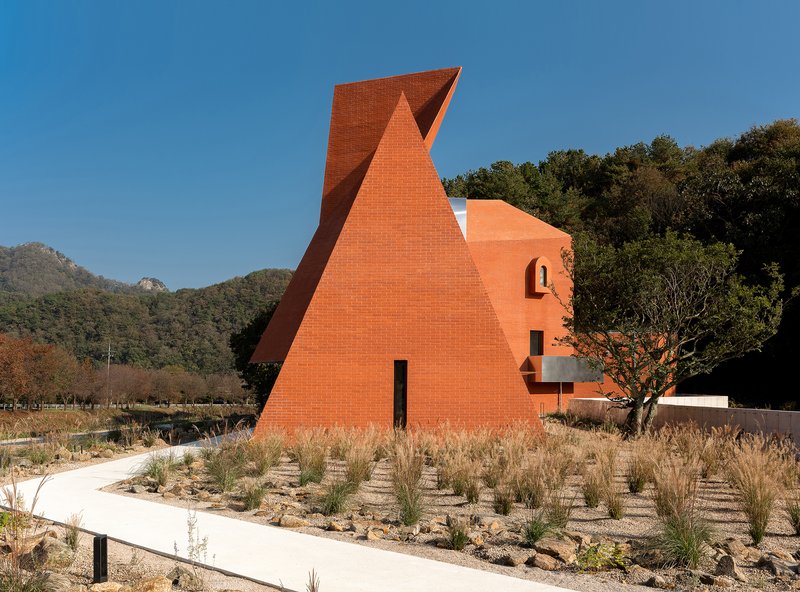

Entry into the building is a deliberate act. The main approach presents a narrow slot cut into a triangular brick volume, set in a planted gravel field. There is no canopy, no signage hierarchy, no glass storefront. You walk toward a gap in the wall. The entrance sequence reinforces the monastery analogy: you cross a threshold, not a welcome mat.
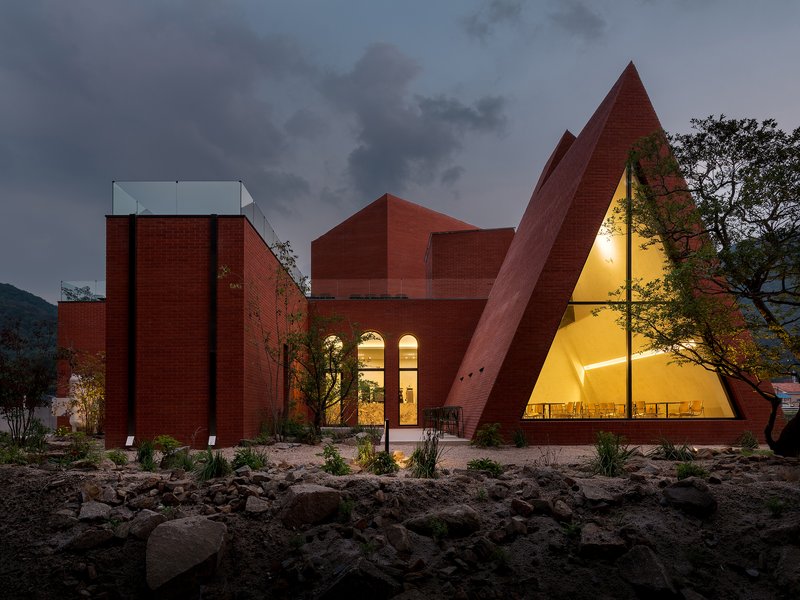
Elsewhere, vertical slot windows and triangular glass openings are placed with precision rather than pattern. These are not fenestration strategies in the conventional sense. They are controlled ruptures in an otherwise defensive envelope, each one framing a specific view of autumn grasses, a young tree, or the wooded hillside beyond. The illuminated triangular facade at the entrance glows at twilight, revealing the steel framing within and pulling the visitor inward.
The Interior as Procession
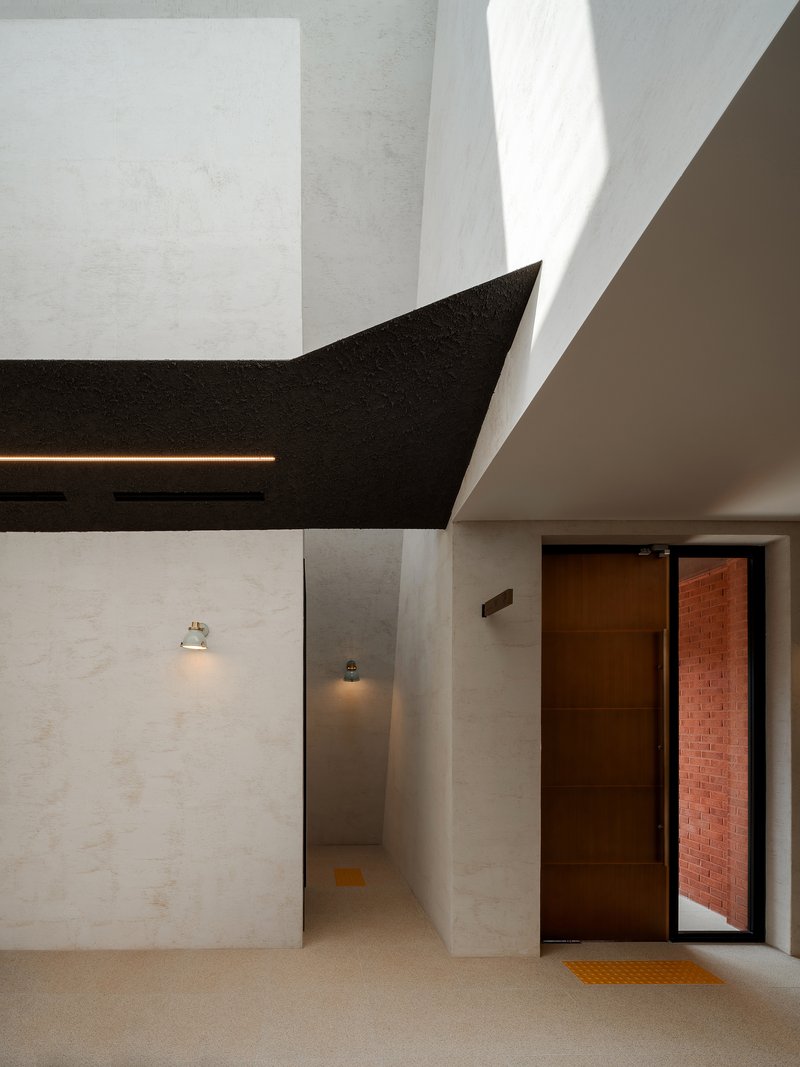
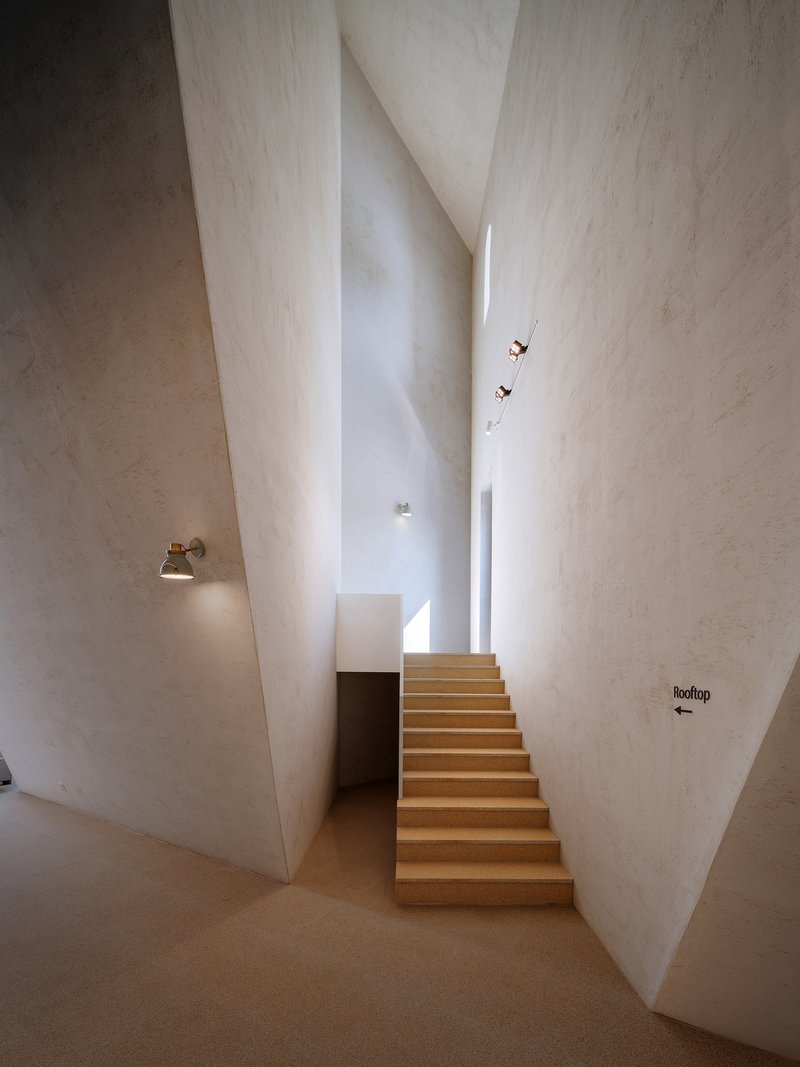
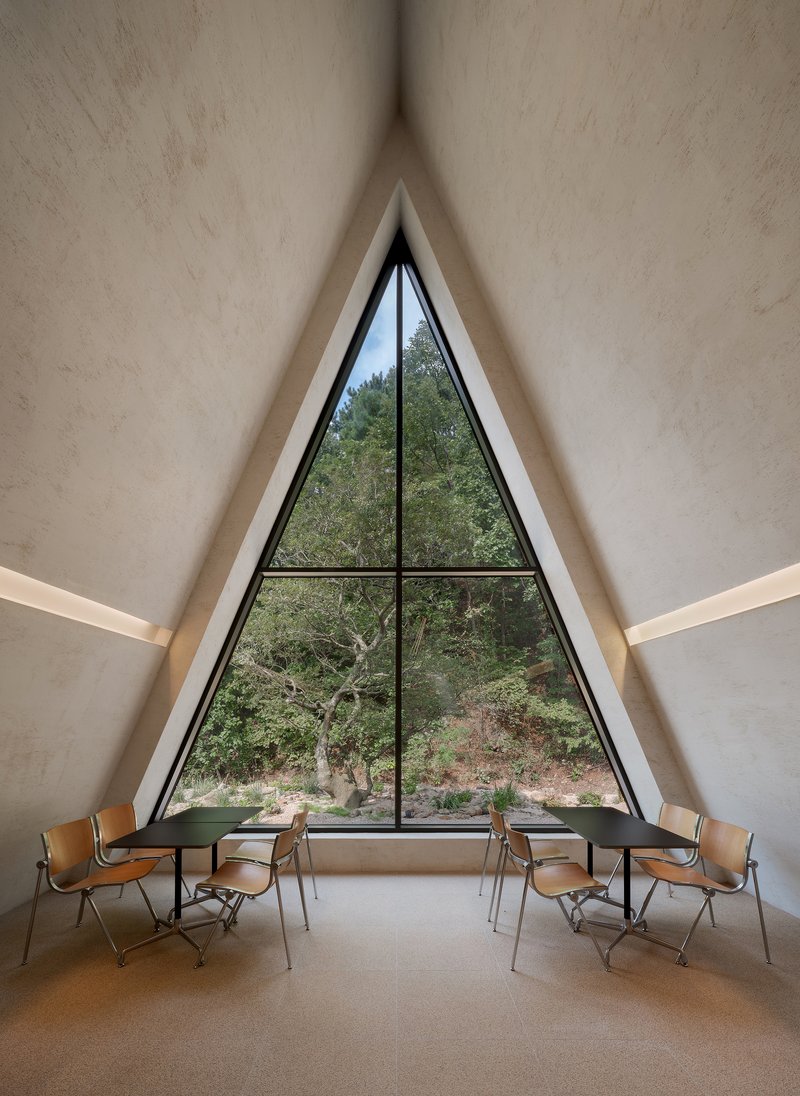
Inside, the building trades red brick for tierra plaster, crunch stucco, and sabi stone tile. The shift in material creates a clear distinction between exterior armor and interior warmth without abandoning the angular geometry. Hallways are narrow, with white plaster walls meeting black ceiling planes at unexpected junctions. Sloped walls and compressed sections guide movement through the space, releasing you into taller volumes before compressing again.
A timber staircase rises between angled plaster walls toward a skylight, one of the few moments where the building openly acknowledges the sky. The tall triangular windows that punctuate the exterior become framing devices from within, turning views of woodland and chairs into composed still-lifes. There is a cinematic quality to the sequence, each room setting up the next without revealing it.
The Chapel Volume
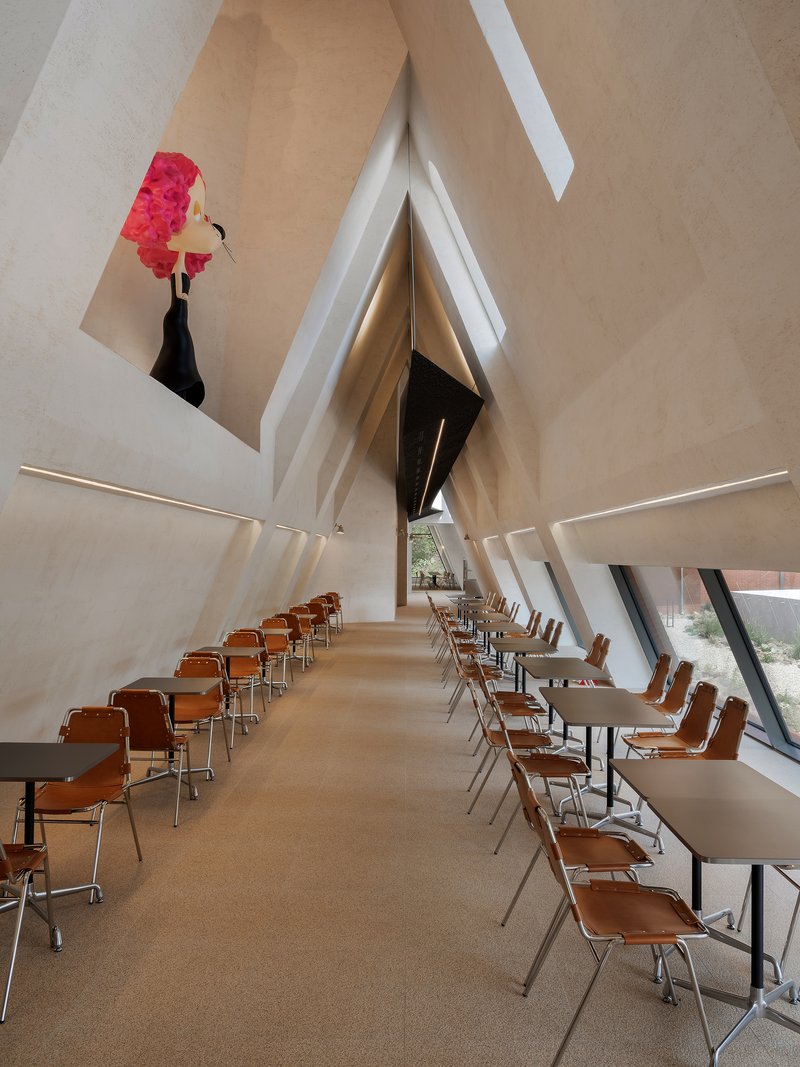
The most striking interior moment is the tall angular hall that reads unmistakably as a chapel. Rows of orange chairs face a suspended red artwork, and the proportions of the space, narrow in plan but soaring in section, amplify a sense of collective gathering even in a commercial program. This is where the monastic narrative becomes spatial rather than rhetorical. The ceiling folds upward to a peak, and light enters from a controlled opening above, washing the plaster walls with shifting patterns throughout the day.
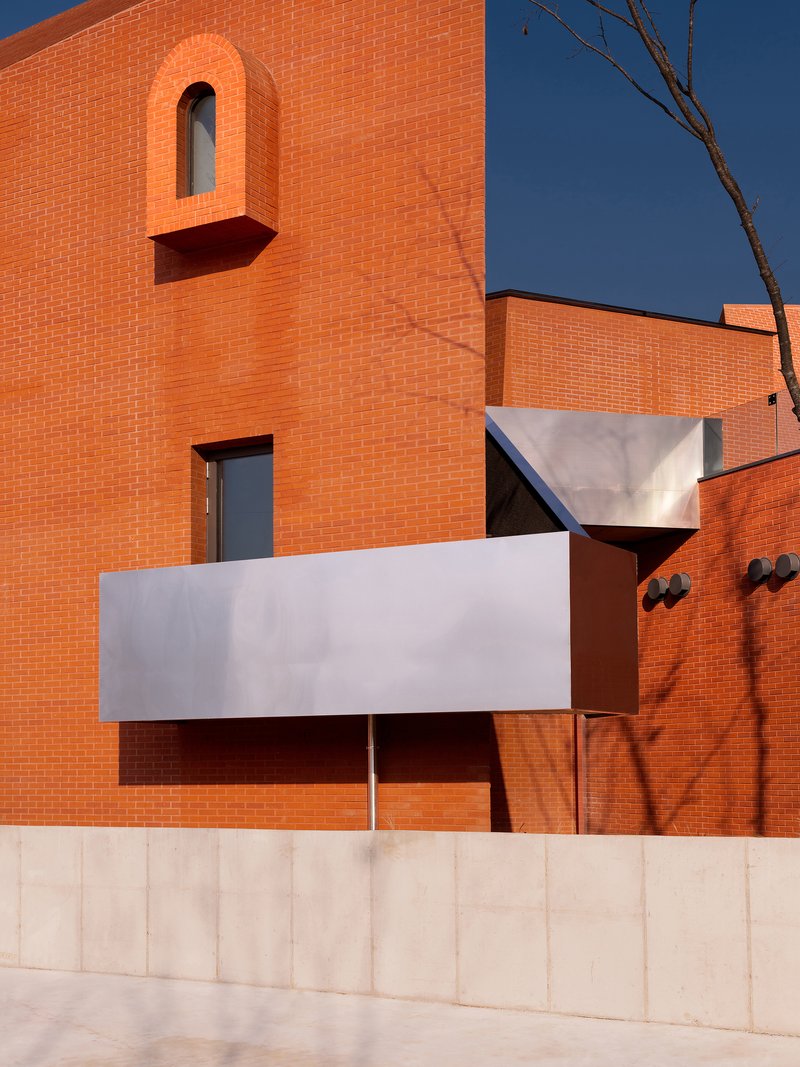
It takes a certain confidence to build a chapel inside a café and not have it feel ironic. The seriousness of the proportions, the restraint of the material palette, and the precise calibration of the light all work to make the space feel earned rather than affected. The arched window opening on the exterior, visible from the road with its white metal canopy, hints at this interior condition without giving it away.
After Dark
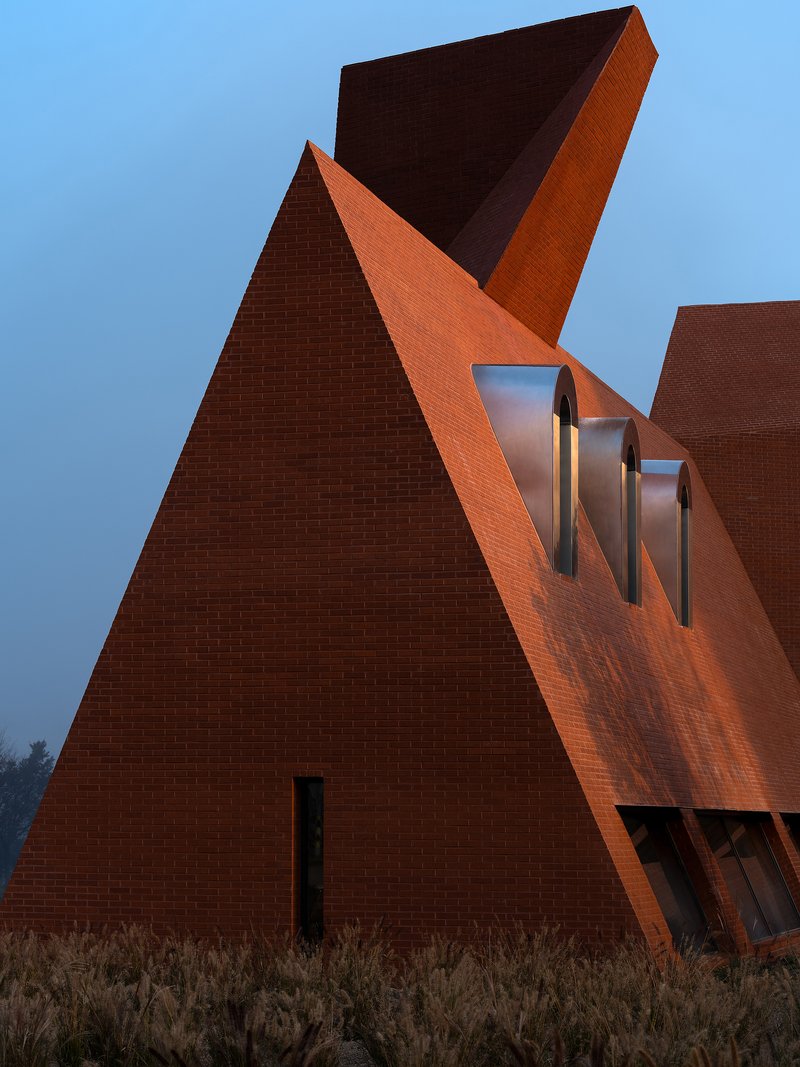
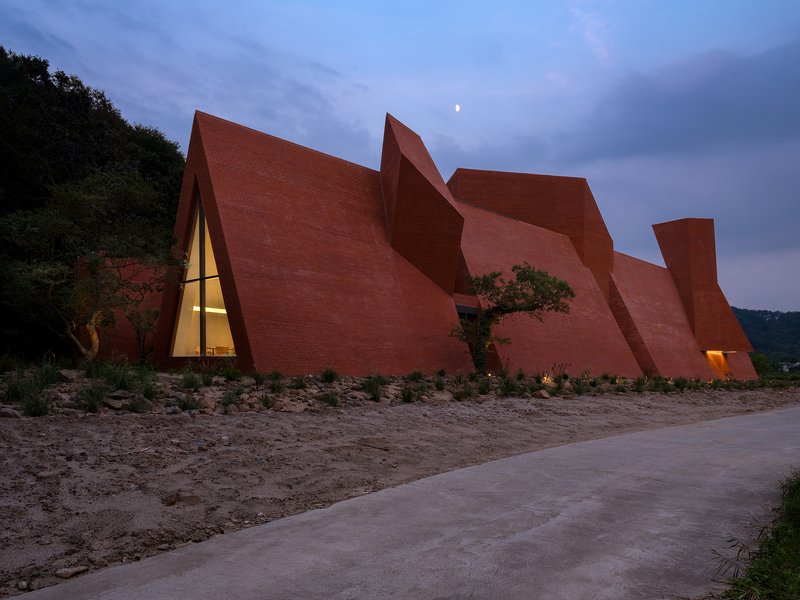
The building transforms significantly at dusk. The triangular glass openings glow from within, turning the opaque brick mass into something that emits light at precise, irregular intervals. The curved dormer windows and faceted volumes take on a silhouette quality against the darkening hillside, and the building's relationship to its site inverts: during the day it is a heavy object on the ground; at night it becomes a lantern in the forest.
The lighting strategy reinforces the architectural logic rather than contradicting it. There are no exterior wash lights, no uplighting on the brick. The only illumination comes from within, through the openings that were already doing compositional work during the day. It is a disciplined approach that rewards the building's geometry.
Plans and Drawings
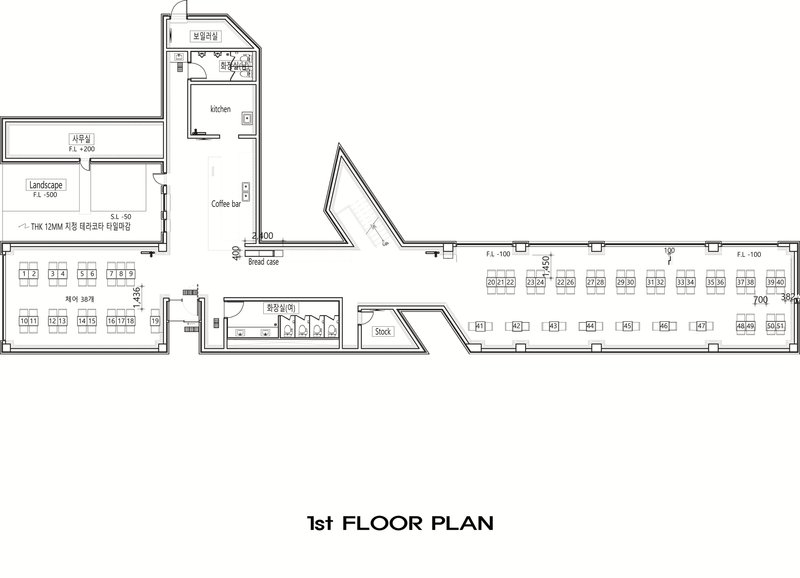
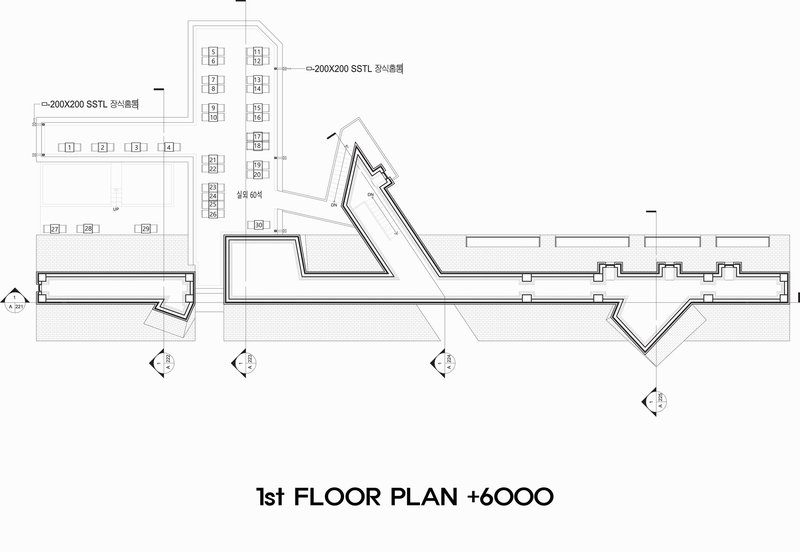
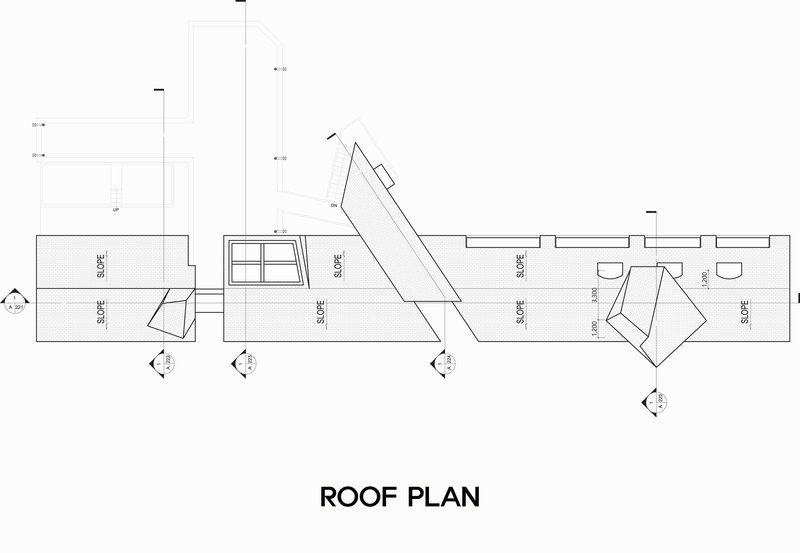

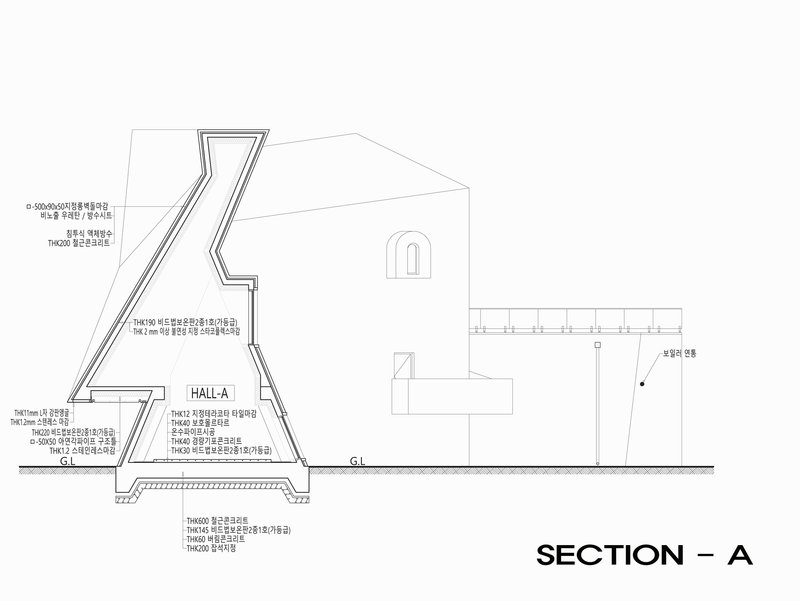
The floor plans reveal the organizational clarity beneath the sculptural exterior. The program is essentially linear: a triangular chapel volume connects to rectangular café and kitchen spaces, with angled volumes extending from a central bar. The roof plan makes the angular projecting forms legible, showing how four distinct peaked volumes rise from a horizontal base. Section drawings expose the sloped interior hall beneath its angular skylight, confirming that the dramatic interior proportions are a direct consequence of the roof geometry rather than an applied effect.
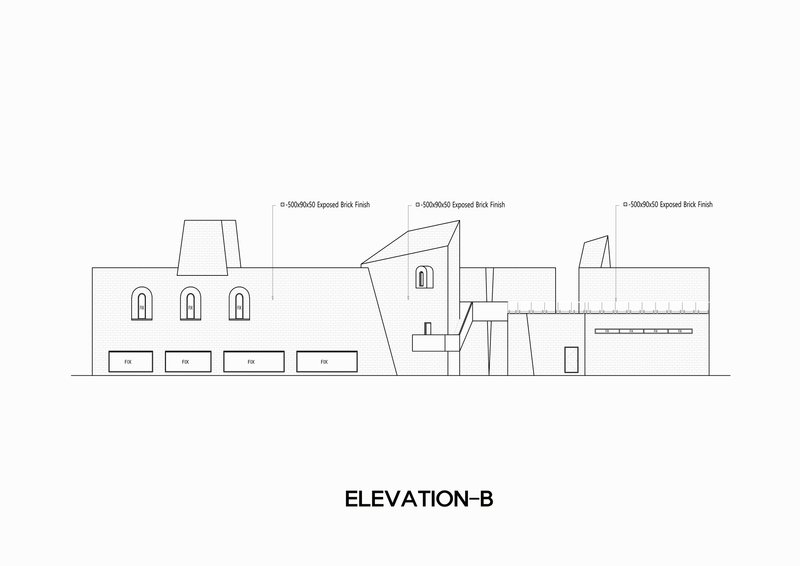
The elevations are particularly instructive. They show the building as a series of arched openings in a textured base topped by slanted rooftop forms, making clear how the massing strategy works as a unified composition rather than a collection of separate gestures. At 455 m² of building area on a 3,463 m² site, the building occupies a modest footprint relative to the land, reinforcing its reading as a singular object set within a larger landscape.
Why This Project Matters
Monologue Café is valuable because it demonstrates that commercial architecture in a rural setting does not have to defer to its surroundings or flatten itself into an approachable brand experience. Gi-tae Chung and SOSOKKI ANAC have built a genuinely strange building, one that borrows from fortification, monastic typology, and speculative fiction, and they have done it with material discipline and spatial conviction. The café program almost disappears inside the architecture, which is either a problem or a provocation depending on your position.
What the project ultimately argues is that narrative can be a legitimate generator of form if it is taken seriously enough to produce real spatial consequences. The compressed corridors, the chapel proportions, the defensive envelope, these are not decorative references to a fictional world. They are architectural decisions that shape how you move through the building and what you feel when you stop. In a landscape saturated with scenic cafés, Monologue insists on being something else entirely: a building with its own mythology.
Monologue Café by SOSOKKI ANAC, led by Gi-tae Chung. Located in Hongcheon, Gangwon-do, South Korea. 455 m². Completed 2025. Photography by Hong Seokgyu.
About the Studio
Share Your Own Work on uni.xyz
If projects like this are the kind of work you want to make, uni.xyz is a place to publish your own, find collaborators, and enter design competitions.



Popular Articles
Popular articles from the community

A.N. Tombazis and K-Studio Bury a Luxury Resort into a Peloponnese Hillside
Mandarin Oriental Costa Navarino scatters 99 earth-sheltered rooms across 140 hectares above the Bay of Navarino in Pilos, Greece.

Shinkō Komyuniti: Public Space Architecture Reimagining Sport, Culture and Community in Tokyo
Shinkō Komyuniti transforms sports spectatorship into public space architecture that reconnects play, culture, community and Tokyo life now.
Kawasaki Olympic Sports Center: Sports Complex Architecture Rooted in Community, Tradition, and Movement
Kawasaki Olympic Sports Center reimagines sports complex architecture as a civic park where tradition, training, and community meet locally.
UNA Barbara e Valentim Plants Four CLT Bungalows in a Fragile Ceará Landscape
Prefabricated eucalyptus timber cabins touch down lightly on the sandy, biodiverse coast of Barroquinha, Brazil.

Similar Reads
You might also enjoy these articles
Private Villa in Ubud by BAMM ARCHITECTS: Contemporary Design Amidst Bali’s Jungle
Private Villa in Ubud blends contemporary design with tropical landscape, featuring open-air pavilion, stone and wood materials, suspended master bedroom, and jungle pool views.
School Group Samuel Paty in Béziers: A Contemporary Educational Campus by Ateliers O-S Architectes and NAS Architecture
Samuel Paty School in Béziers features concrete massing, porous courtyards, metal structures, and landscaped playgrounds, creating a child-scaled, light-filled learning environment.
Four Public Pavilions in Beijing by Aurélien Chen and CSCEC
Four park pavilions in Beijing combine public services with floating roofs, acting as subtle urban signals integrated into landscape contextually.
LÁ-SÁCH House by Atelier tho.A
Compact tropical tube house-library with polycarbonate louvers, flexible interiors, concrete core, crafted materials, and community-focused alley setback.


Explore Religious Building Competitions
Discover active competitions in this discipline




The Global Benchmark for Architecture Dissertation Awards

Design Challenge - Contemporary interpretation of a religious complex
Comments (0)
Please login or sign up to add comments
No comments yet. Be the first to comment!