

NEOSSPACE Weaves Rice Paper and Reclaimed Stone into a Mountain Inn near Yuyao's Ancient Villages
Sounder Inn draws on Northern Song Dynasty heritage and bamboo forests to create an 849 m² retreat in a Siming Lake valley.


The valley around Siming Lake in Yuyao, China, is the kind of landscape that makes architects either very brave or very cautious. Bamboo forests crowd the slopes, a stream cuts through the valley floor, and the ancient village of Guanpei, which traces its origins to the Xining period of the Northern Song Dynasty, sits nearby as a reminder that people have been building here for nearly a thousand years. NEOSSPACE, led by architect Xi Shi, chose neither timidity nor spectacle. Sounder Inn, completed in 2023, is an 849 m² boutique hotel that slots into this terrain with a linear plan that follows the mountain contour, treating the site as a collaborator rather than a canvas.
What makes this project worth studying is the discipline of its material palette and the specificity of its cultural references. Rice paper, bamboo, local stone, and reclaimed antique elements from the surrounding region are not deployed as decoration but as a structural vocabulary that ties the building to its context. The undulating rice paper ceilings mimic the layered mountain silhouettes visible from every window. Recycled entrance doors, stone steps, pillar bases, and decorative bamboo fans carry the village's memory into a contemporary hospitality program. It is a building that earns its relationship to place rather than simply claiming one.
Reading the Site Through the Facade
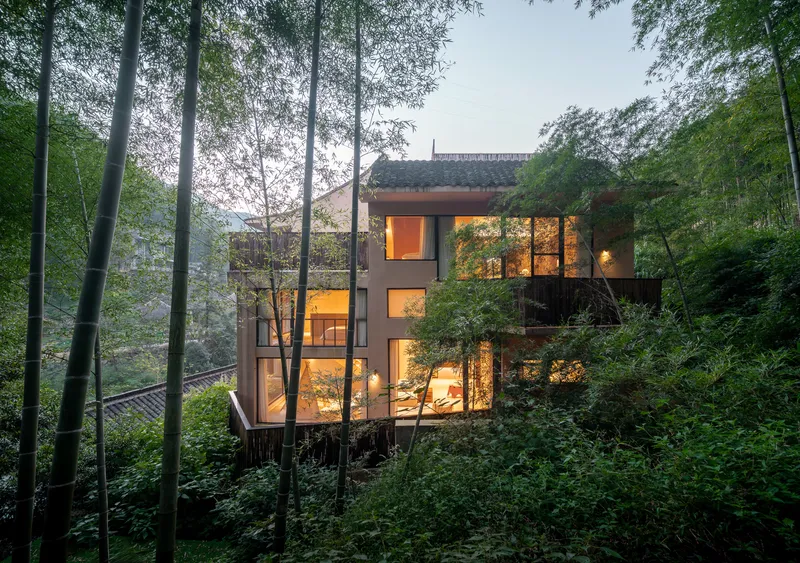
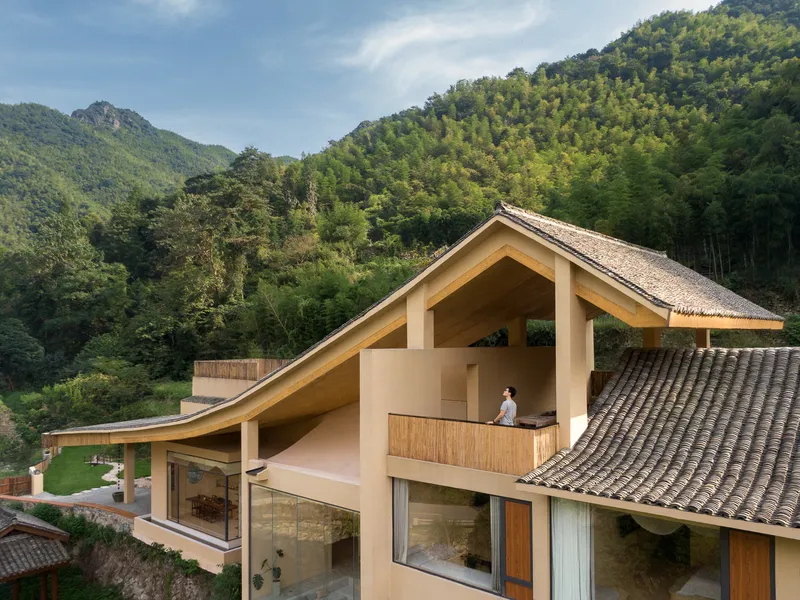
Seen at dusk through the surrounding bamboo grove, Sounder Inn glows like a lantern set into the hillside. The glass facade is generous but not ostentatious: it reads as a membrane between interior warmth and the dense green darkness outside. The gabled timber frames that define the terraces borrow their pitch and rhythm from vernacular mountain structures, anchoring the silhouette in regional tradition without resorting to mimicry.
From the terrace vantage point, the relationship between building and forest becomes reciprocal. The structure frames views of the wooded hillside in deliberate compositions, while the surrounding vegetation screens the architecture from long-distance views. It is a building designed to disappear as much as it is designed to welcome.
The Arc-Roofed Hall as Social Core
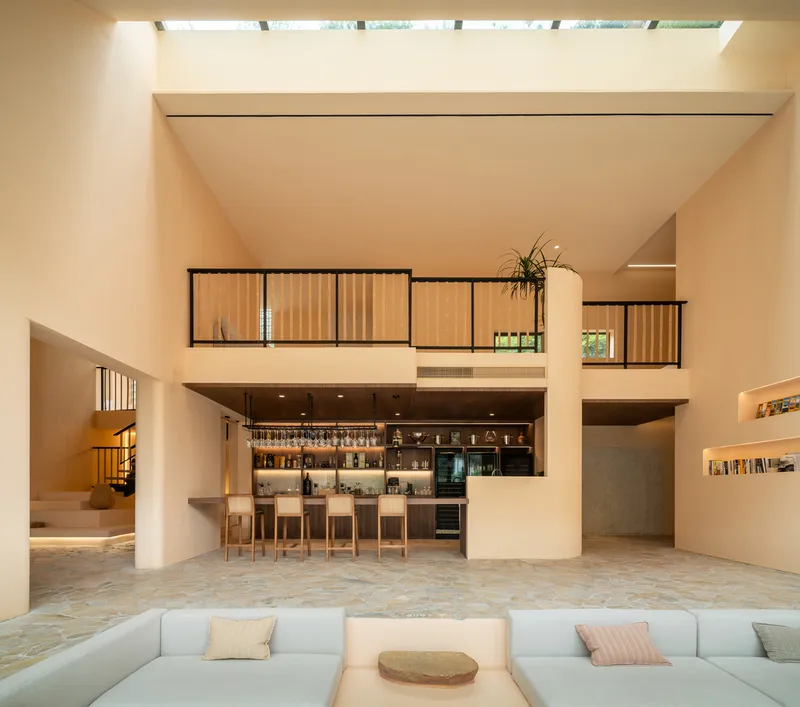
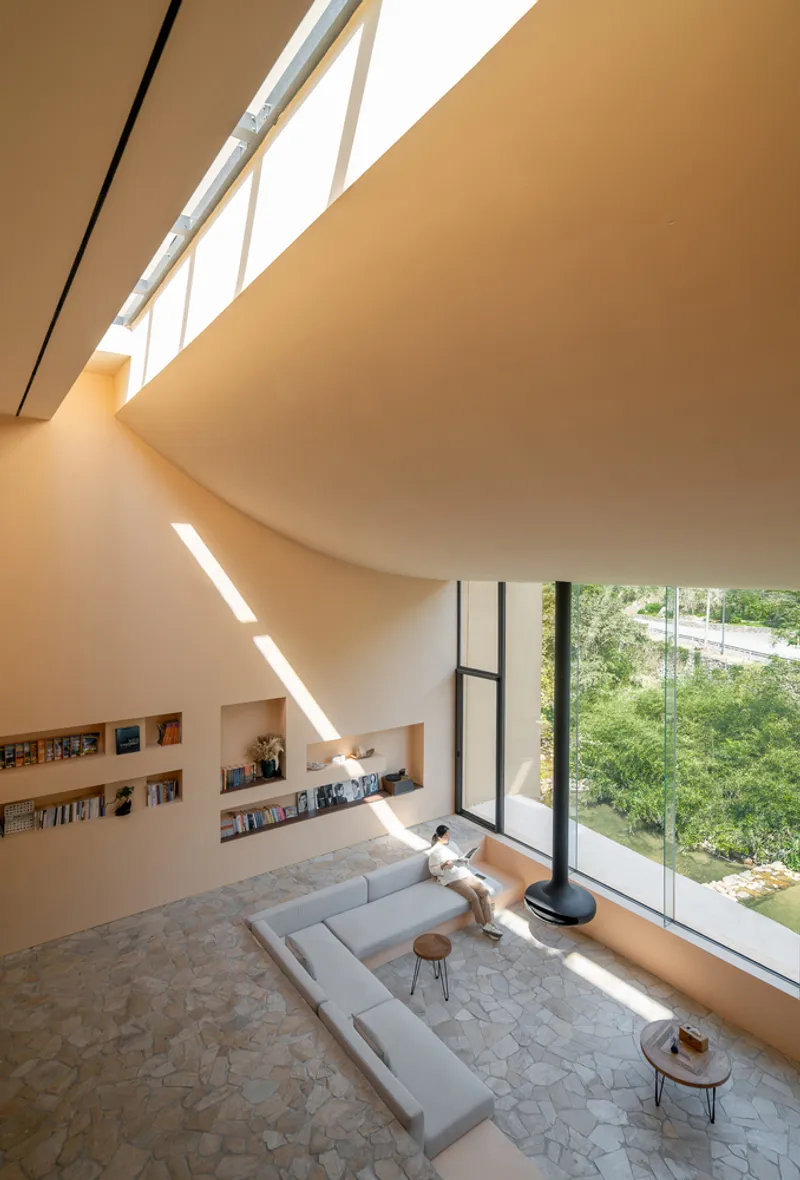
The double-height lobby is the gravitational center of the public program, housing a bar counter beneath suspended timber screens and skylights that pull daylight deep into the plan. The overhead screens filter and fragment the light, producing a shifting pattern that changes through the day as the sun moves over the bamboo canopy above the skylights. It is a space engineered for atmosphere without relying on artificial mood lighting.
Adjacent to this, the living room functions as a leisure book bar with built-in shelving, a sectional sofa, and clerestory windows that cast afternoon light across the spines. NEOSSPACE integrates spaces of varying intimacy within a single interconnected volume: the bar invites social exchange, the book nook encourages solitude, and the transitional zones between them allow guests to calibrate their own level of engagement. The arc-roofed hall holds these different moods together without partitioning them into separate rooms.
Outdoor Rooms and the Bamboo Ceiling
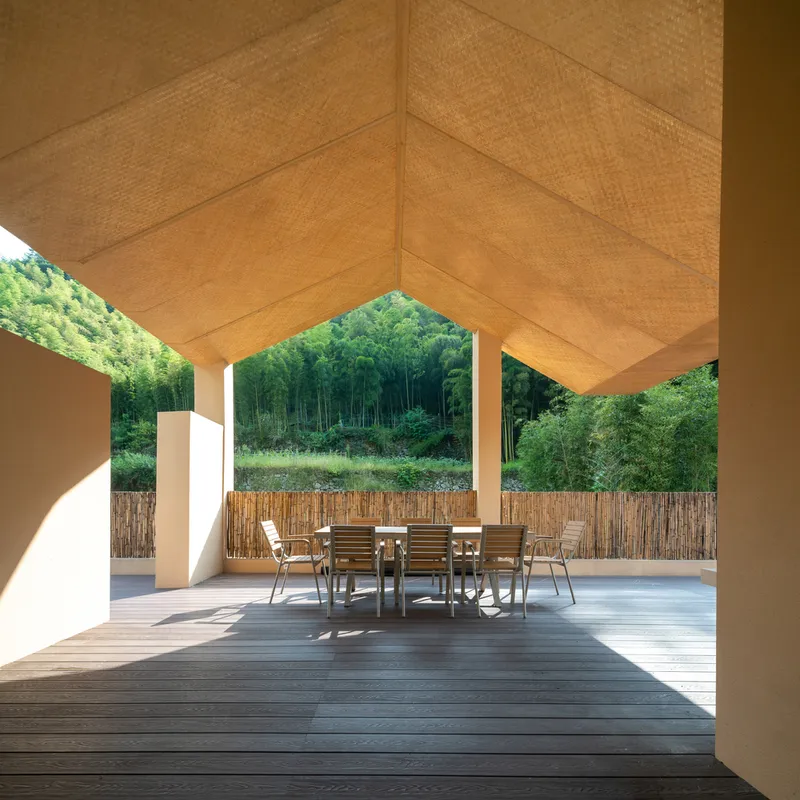
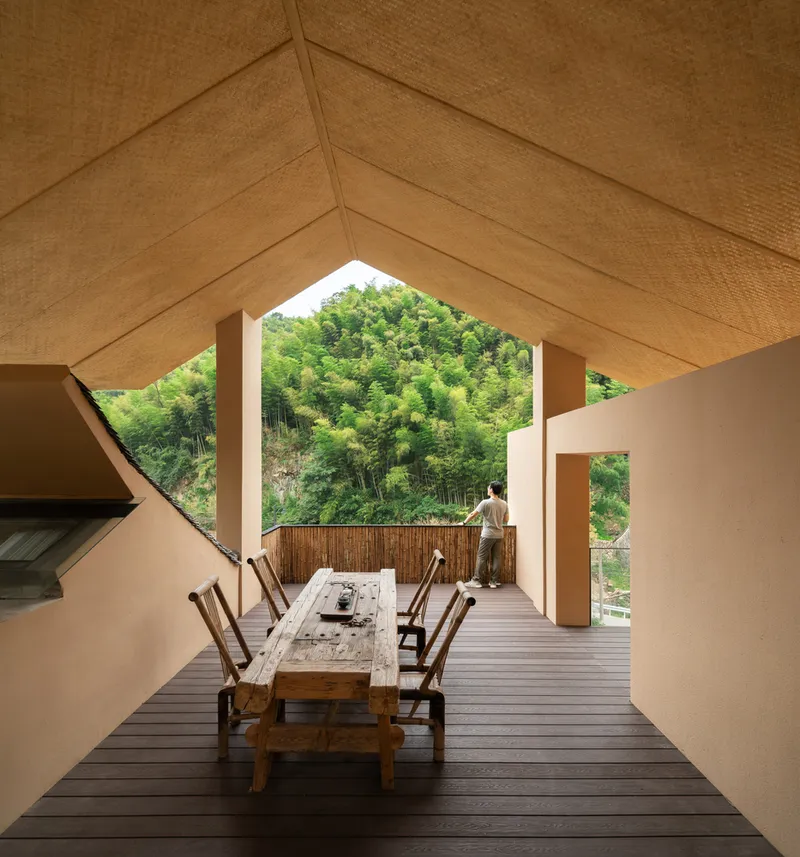
Two terraces extend the interior program outdoors, each with a distinct character. The covered timber deck features a woven bamboo ceiling that transforms the space beneath into something closer to a pavilion than a porch. Dried bamboo poles are assembled into an intricate canopy that softens overhead views while permitting air movement, a passive strategy that keeps the space comfortable in the humid valley climate without mechanical intervention.
The second terrace, defined by its gabled frame and bamboo fence railing, operates as a lookout. Standing at the rail, a guest faces nothing but wooded hillside. The detailing here is restrained: the bamboo fencing recalls traditional village construction, and the timber structure is honest about its joinery. These outdoor rooms are not afterthoughts appended to the plan. They are essential to the spatial sequence, transitional zones that slow down the passage between conditioned interior and wild landscape.
Guest Rooms: Stone, Light, and the Semi-Enclosed Garden
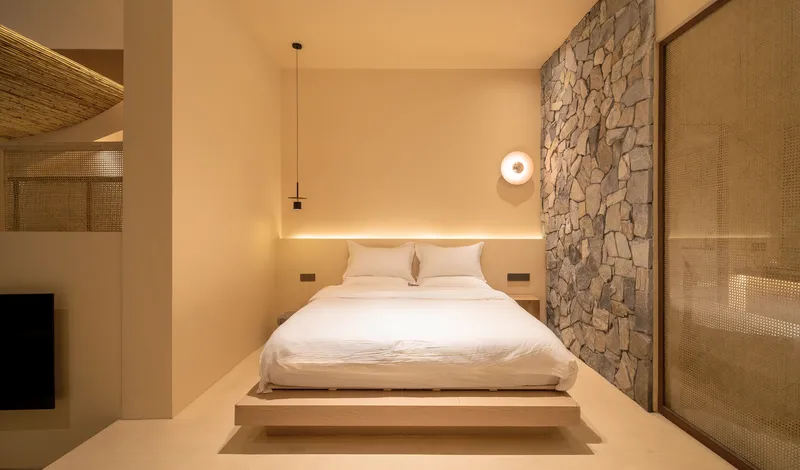
The guest rooms are arranged linearly along the mountain forest beside the stream, and each one is oriented to frame views of both water and mountains. The bedroom shown here pairs a platform bed with an irregular stone wall that reads as a geological fragment brought indoors. The recessed ceiling lighting washes the stone surface without competing with it, letting the material's texture do the work. It is the kind of restraint that requires confidence: the stone is enough.
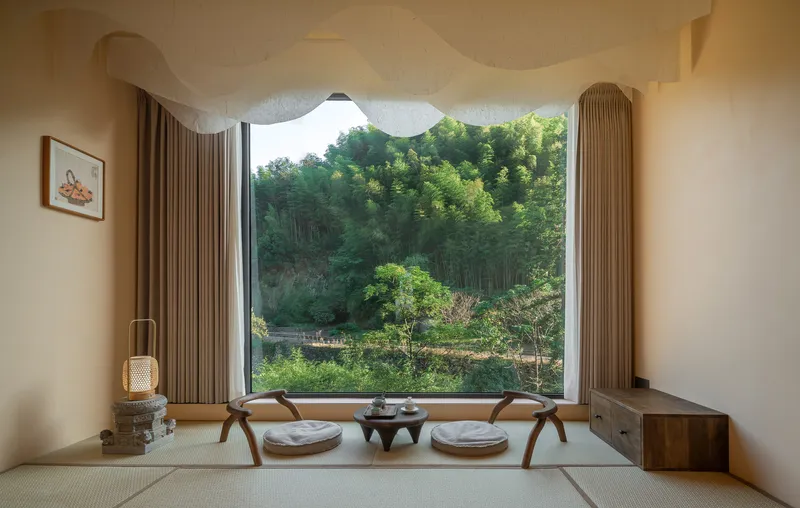
The tatami seating nook introduces a different register of intimacy. A low table and floor cushions face a picture window overlooking terraced gardens and the forest beyond. The semi-enclosed garden concept that NEOSSPACE applies to the guest room zone, with open wardrobes, washbasins, and bathrooms arranged to blur the threshold between indoor and outdoor, reaches its clearest expression in moments like this. The room does not contain a view; it opens onto one.
Reclaimed antique elements, including bedside pillar bases and long tables, are threaded through the guest rooms as functional objects rather than museum pieces. These artifacts connect each room to the material history of Guanpei village, giving guests something more than aesthetic novelty: a tactile link to the Confucian cultural heritage of the Yuyao region.
Why This Project Matters
Rural hospitality architecture in China has too often fallen into one of two traps: either a nostalgic reconstruction of a vernacular that no longer serves contemporary needs, or a sleek urban transplant that ignores the specificity of its site. Sounder Inn avoids both by treating local materials and cultural artifacts as active design elements rather than ornamental references. The rice paper ceilings that evoke layered mountain silhouettes, the handmade lanterns in the stairwell, the recycled entrance doors, these are not gestures toward locality. They are the building's actual substance.
NEOSSPACE demonstrates here that sustainability and cultural continuity are not separate agendas. By sourcing stone locally, repurposing antique elements, and using bamboo and woven materials drawn from the immediate landscape, the project achieves a low material footprint while simultaneously preserving craft traditions that might otherwise erode. At 849 m², Sounder Inn is a small project. Its argument, that the most compelling hospitality architecture is the kind that belongs where it stands, is not.
Sounder Inn by NEOSSPACE, Yuyao, China. 849 m². Completed 2023. Lead architect: Xi Shi. Design team: Xi Shi, Vince Yu, Xiaoya Wang, Hao Cheng, Jiaqi Huang. Photography by Bian Lin.
About the Studio
Share Your Own Work on uni.xyz
If projects like this are the kind of work you want to make, uni.xyz is a place to publish your own, find collaborators, and enter design competitions.


Popular Articles
Popular articles from the community


Juan García Correa, John González and Claudia Rueda Sink a Circular Amphitheater into a Manizales Engineering Building
On the La Nubia campus in Manizales, Colombia, the S1 Building folds labs and offices into a hillside of ramped lawns that double as a campus route.

Jaramillo Van Sluys Arquitectura and Urbanismo Turn a Demolished Registry Lot in Quito into an Orchard Plaza
In Quito's Centro Histórico, a 2,800 m² plaza exposes the San Agustín convent wall and redraws its lost Augustinian orchard in volcanic stone.

David Ortega Stacks a Two-Story Mexico City Penthouse Around a Steel Stair and a Pergola-Shaded Roof Terrace
In Colonia Roma, a 300 m² penthouse uses oak joinery, a planted steel stair and a slatted roof pergola to make a new-build apartment feel like a house.

longwave studio Reorganizes a 112 m² Tainan Apartment Around the Daily Routines of a Family and Two Cats
In Tainan, Taiwan, birch plywood, rust-red furniture and a freestanding plaster wall link arrival, storage, work and family life in one apartment.

Similar Reads
You might also enjoy these articles


Hodi-Mandai Geram
Project Function: Preservation and revitalization of the Intangible heritage and socio-spatial identity of the Hodi by Housing, Cultural Memory Center, Sacred Grove, landscape, local tourism economy


Olio Towers: A Mid-Rise for Performers That Fuses Housing, Rehearsal, and Stage
Located blocks from Houston's Theater District, this modular tower stacks living units around a central performance atrium.

Oasis: Modular Green Housing Carved into Dhaka's Urban Fabric
A shortlisted Plugin Housing entry reclaims unauthorized settlements in Dhaka with stepped concrete volumes, green roofs, and ventilation-driven design.

Black Hole: A Floating Megastructure for the Post-Physical Era
Emiliano Mazzarotto envisions a spherical, self-scaling arena where e-sports, digital hotels, and holographic stadiums replace traditional public space.

Explore Hospitality Building Competitions
Discover active competitions in this discipline

Challenge to reimagine the Iron Throne

Photograph architecture without architects

Illustrate the lost glory of Angkor Wat - Render Challenge

Design challenge to reuse E-waste
Comments (0)
Please login or sign up to add comments
No comments yet. Be the first to comment!