

R+D Studio Builds a Fort-Inspired School Campus on the Edge of Dubai's Desert
South View School in Remraam wraps a precast concrete frame in ancestral stone and mashrabiya screens to shield students from dust and heat.


Schools in the Gulf tend to fall into two camps: air-conditioned boxes that could sit anywhere from Houston to Hyderabad, or decorative exercises in "heritage" that never quite escape the cosmetic. South View School, designed by R+D Studio for a four-acre campus in Dubai's Remraam community, is interesting precisely because it refuses both templates. The 135,000-square-foot building borrows the spatial logic of a fort city, with fortified stone walls, compressed entry alleys, and a generous courtyard at the center, then executes the whole thing with a precast concrete frame that went up in six months. The result is a school that feels rooted in the region without pretending to be a ruin.
What makes the project worth studying is the discipline of its climate strategy. Every formal gesture, from the mashrabiya screens to the yellow tensile canopies to the courtyard itself, does measurable environmental work. Pergolas filter the harshest sunlight. Courts and canopies form a first line of defense against the dusty winds that sweep through Remraam. And the vertical organization separates kindergarteners from older students while funneling all ages through a shared landscape that functions, spatially, like a small city square. The architecture treats children as inhabitants of a place, not users of a facility.
A Fortress That Opens Inward
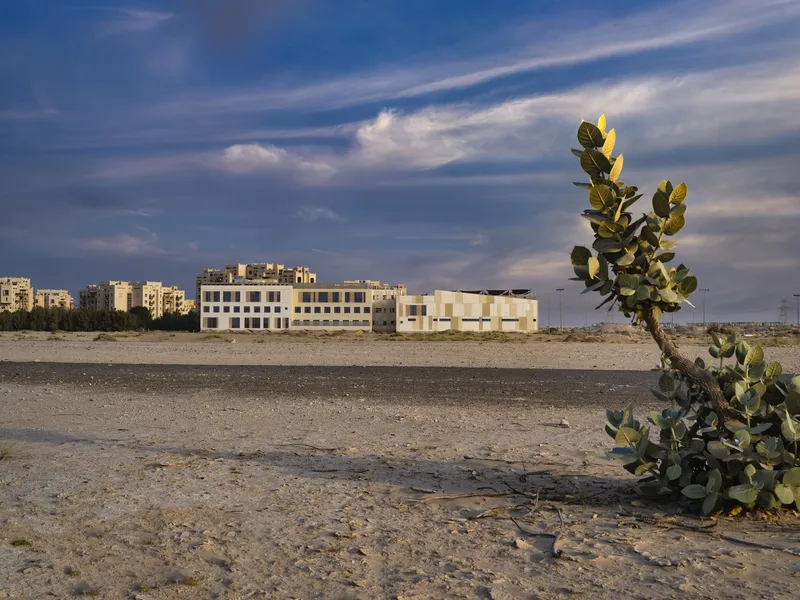
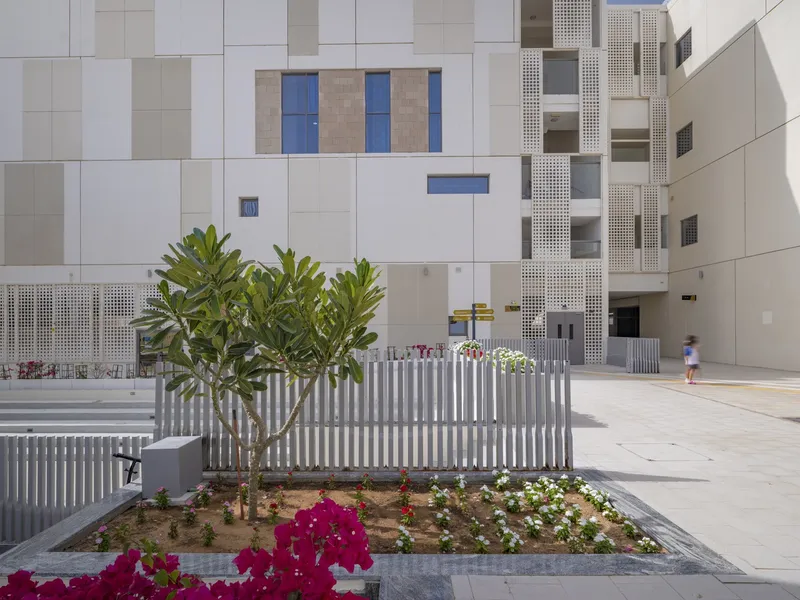
Seen from across the desert, South View School reads as a long, low-slung horizontal mass, almost defensive in posture. The white paneled facades, punctured by perforated screens and narrow openings, recall the emblematic walls of UAE forts. Planting beds with bougainvillea and young trees soften the perimeter at ground level, but the overall impression is of a building that presents a deliberate boundary to its surroundings. That restraint is the point: the architecture compresses the arrival experience, channeling visitors through tight passages that echo the narrow alleys of a fort city streetscape before releasing them into the courtyard beyond.
Ancestral Saudi stone wraps the precast concrete structure, giving the walls a tactile warmth that raw concrete alone cannot achieve. The material choice also bridges scales. Up close, the stone has grain and color variation. From a distance, it unifies the complex into a single civic mass, something that reads as institution rather than retail park.
The Courtyard as Microclimate Machine
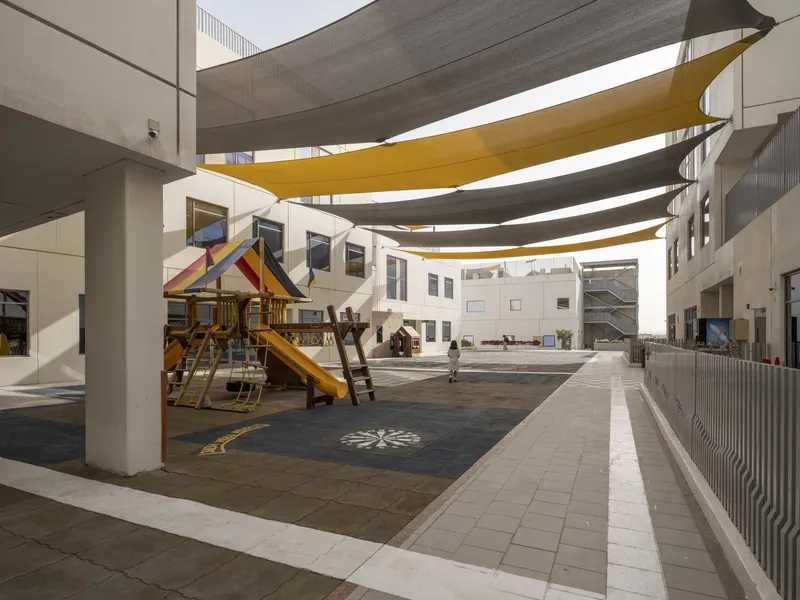
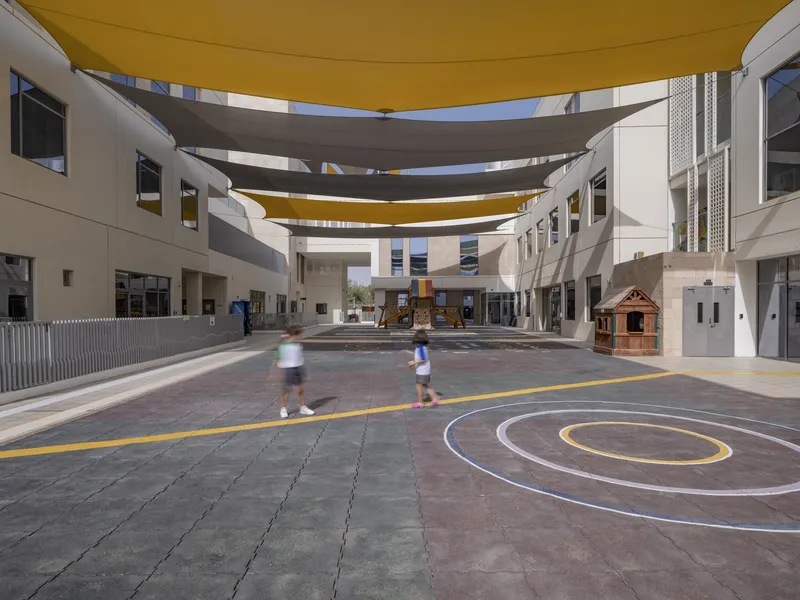
The central courtyard is the school's most legible idea. It functions simultaneously as playground, gathering space, and environmental buffer. Concentric circle markings in the paving organize movement and play. Above, yellow and grey fabric tensile canopies stretch across the void, filtering sunlight into shifting patterns on the ground below. The yellow canopies are not merely decorative; they allow controlled natural light to pass through while blocking direct solar gain, a technique that creates comfort without enclosure.
R+D Studio conceived the courtyard as analogous to a city square, a civic space where different ages and programs converge. Kindergarteners occupy the base level adjacent to a recreation zone with an amphitheater and play area. Older students inhabit the upper floors, which split into two wings connected at the top by a centrally placed library. The courtyard holds these distinct worlds together. It also generates a favorable microclimate: shaded and partially enclosed, the space channels airflow while deflecting the dusty winds that define Remraam's open terrain.
Filtered Light, Filtered Air
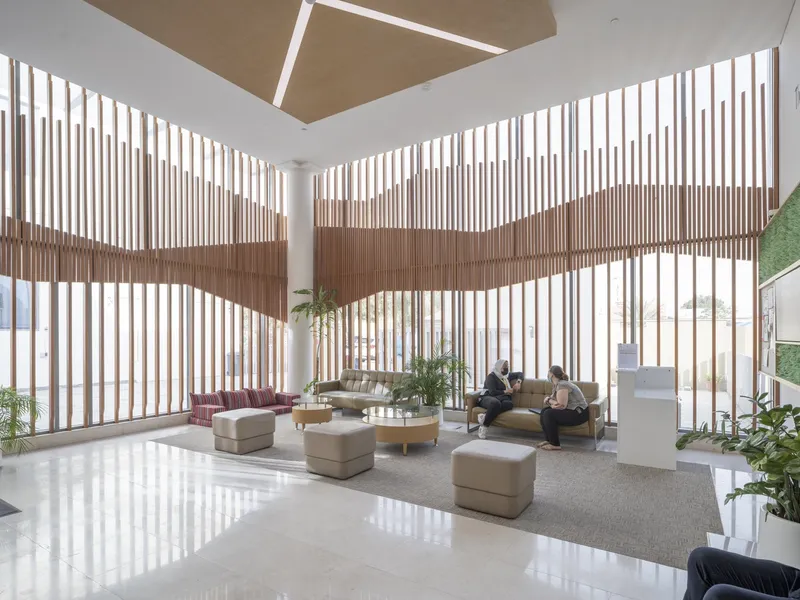

Inside, the environmental strategy translates into carefully modulated daylight. The double-height lobby deploys vertical timber brise-soleil that casts rhythmic shadows across polished white floors. The effect is serene and directional, pulling visitors deeper into the building. Rather than the standard curtain-wall-plus-blinds approach that plagues Gulf schools, R+D Studio uses the screens as architectural elements that simultaneously ventilate, shade, and give the interior its visual identity.
A lounge space elsewhere in the school pairs the same vertical timber screen with a green moss wall panel, introducing biophilic texture into what could easily be a sterile corridor. The mashrabiya tradition is clearly the reference here, reinterpreted in timber rather than carved plaster, but doing the same job: bringing filtered air and diffused daylight into inhabited spaces. Each scholarly function gets its own fenestration design on the facade, so the building's skin is not uniform but legible, expressing the program behind it.
Why This Project Matters
South View School demonstrates that contextual design in the Gulf does not have to mean pastiche. R+D Studio drew from fort architecture, mashrabiya tradition, and courtyard urbanism, but the building never becomes a theme park of heritage motifs. Every traditional element, the stone cladding, the latticework screens, the introverted plan, is put to measurable climatic and spatial work. The precast frame, erected in half a year, shows that speed and specificity are not mutually exclusive. You can build fast and still build for a place.
For anyone designing schools in arid climates, the lesson here is organizational. By treating the courtyard as the generative center, the architects gave the building a climate strategy, a social program, and a civic identity all at once. The two wings, the age-separated floors, the connecting library at the top: all of it radiates from that one open-air room. It is a compact idea executed with enough material conviction to hold up against the heat, the dust, and the relentless pace of Dubai's construction cycle.
South View School by R+D Studio, Remraam, Dubai, United Arab Emirates. 135,000 sq ft. Completed 2021. Photography by Beno Saradzic.
About the Studio
Share Your Own Work on uni.xyz
If projects like this are the kind of work you want to make, uni.xyz is a place to publish your own, find collaborators, and enter design competitions.




Popular Articles
Popular articles from the community


Conexión: Biophilic Design Reimagines High-Rise Living in Hong Kong
Conexión reimagines high-rise living in Hong Kong through biophilic design, green facades, shared spaces, daylight, water and nature within.

Riyadh For All: Intergenerational Urban Design for Active Aging in Rabat
Riyadh For All reimagines urban design in Rabat with intergenerational co-living, adaptive courtyards, and Moroccan cultural exchange today.

The Musturak Paradise: Senior Living Architecture for a Connected Future in Temara, Morocco
The Musturak Paradise reimagines senior living architecture in Temara via private homes, social spaces, culture, community, and shared care.

Co-Life: Senior Housing Design That Reconnects Older Adults With the City
Co-Life reimagines senior housing design through healing gardens, shared streets, workshops, and a sustainable community across generations.


Similar Reads
You might also enjoy these articles


Hodi-Mandai Geram
Project Function: Preservation and revitalization of the Intangible heritage and socio-spatial identity of the Hodi by Housing, Cultural Memory Center, Sacred Grove, landscape, local tourism economy


Olio Towers: A Mid-Rise for Performers That Fuses Housing, Rehearsal, and Stage
Located blocks from Houston's Theater District, this modular tower stacks living units around a central performance atrium.

Oasis: Modular Green Housing Carved into Dhaka's Urban Fabric
A shortlisted Plugin Housing entry reclaims unauthorized settlements in Dhaka with stepped concrete volumes, green roofs, and ventilation-driven design.

Black Hole: A Floating Megastructure for the Post-Physical Era
Emiliano Mazzarotto envisions a spherical, self-scaling arena where e-sports, digital hotels, and holographic stadiums replace traditional public space.


Explore Mes School Of Architecture Competitions
Discover active competitions in this discipline



Challenge to design public laboratory


Challenge to reimagine the Iron Throne


Photograph architecture without architects


Illustrate the lost glory of Angkor Wat - Render Challenge
Comments (0)
Please login or sign up to add comments
No comments yet. Be the first to comment!