

SPEC: A Spacecraft-Shaped Learning Centre That Teaches Space Science Through Spatial Narrative
Jacqueline Kissler's shortlisted Moontrip 2019 entry stacks scientific disciplines into a building that moves like a launch sequence.


What if a building could replicate the emotional arc of a space mission? Not through screens or simulations alone, but through the architecture itself: the compression of a tunnel, the release of an elevated walkway, the disorientation of a spiral ramp ascending through robotics labs and astronomy decks toward a rooftop dedicated to selenology. SPEC, the Space Exploration Centre, treats its section as a script, stacking scientific disciplines vertically so that moving through the building feels like staging a launch.
Designed by Jacqueline Kissler and shortlisted in the Moontrip 2019 competition, SPEC proposes an interactive learning complex whose aerodynamic, teardrop form nestles into its landscape like a spacecraft on a launchpad. The name carries a deliberate double reading: an acronym for the programme, but also a reference to how the building would appear from orbit, a mere spec on the Earth's surface. That tension between human ambition and cosmic scale runs through every decision in the project.
A Teardrop Grounded in Terraced Contours
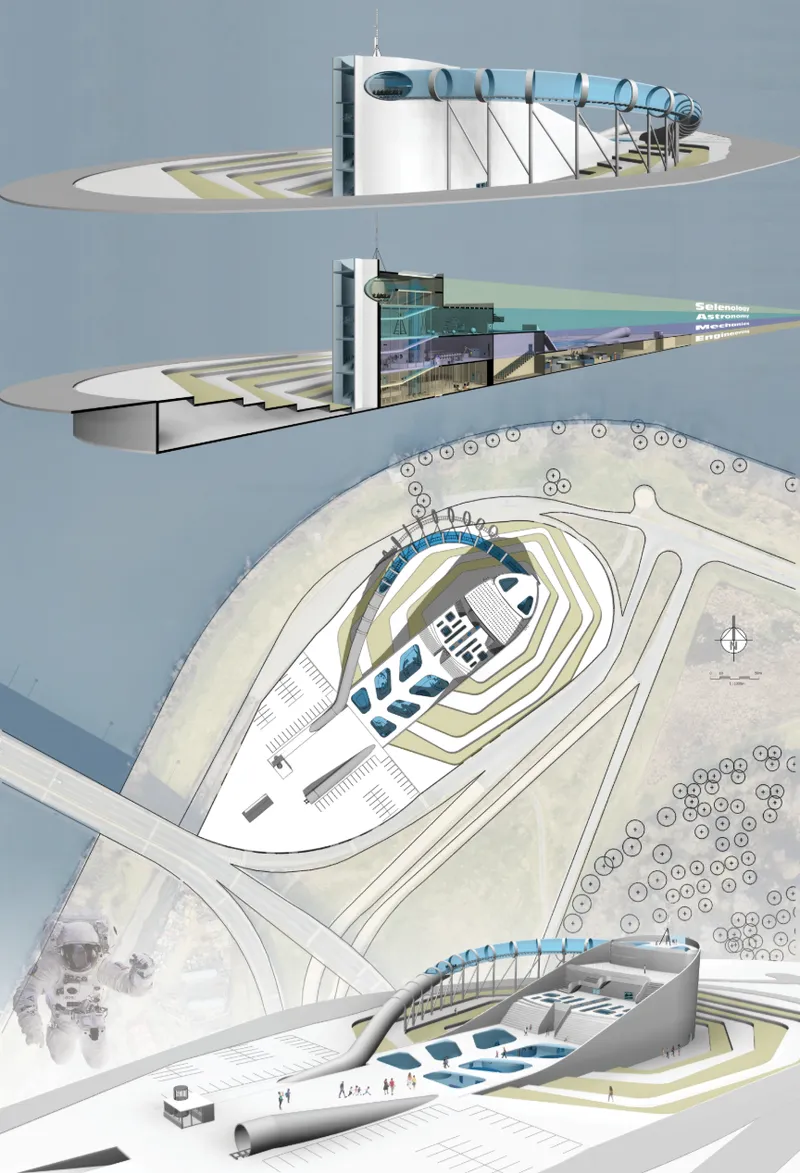
The axonometric drawing reveals the project's primary formal move: a bulbous, teardrop-shaped volume crowned by cylindrical roof elements and wrapped in layered contour terracing that merges the building with its topography. The form is aerodynamic and oriented toward movement, reading less as a static institution and more as something poised for departure. Kissler treats the landscape not as a neutral ground plane but as an active participant, pulling earth up around the structure to blur the boundary between site and vessel.
Curving Ramps and a Bulbous Plan
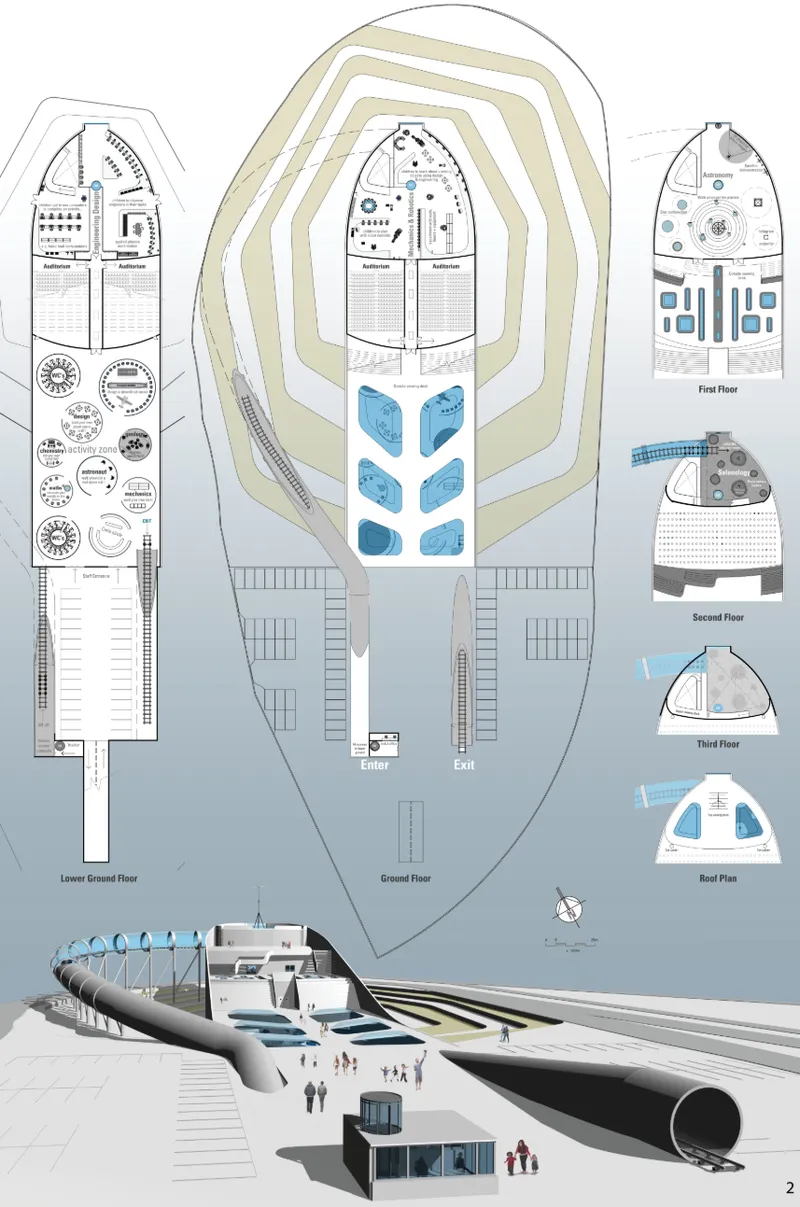
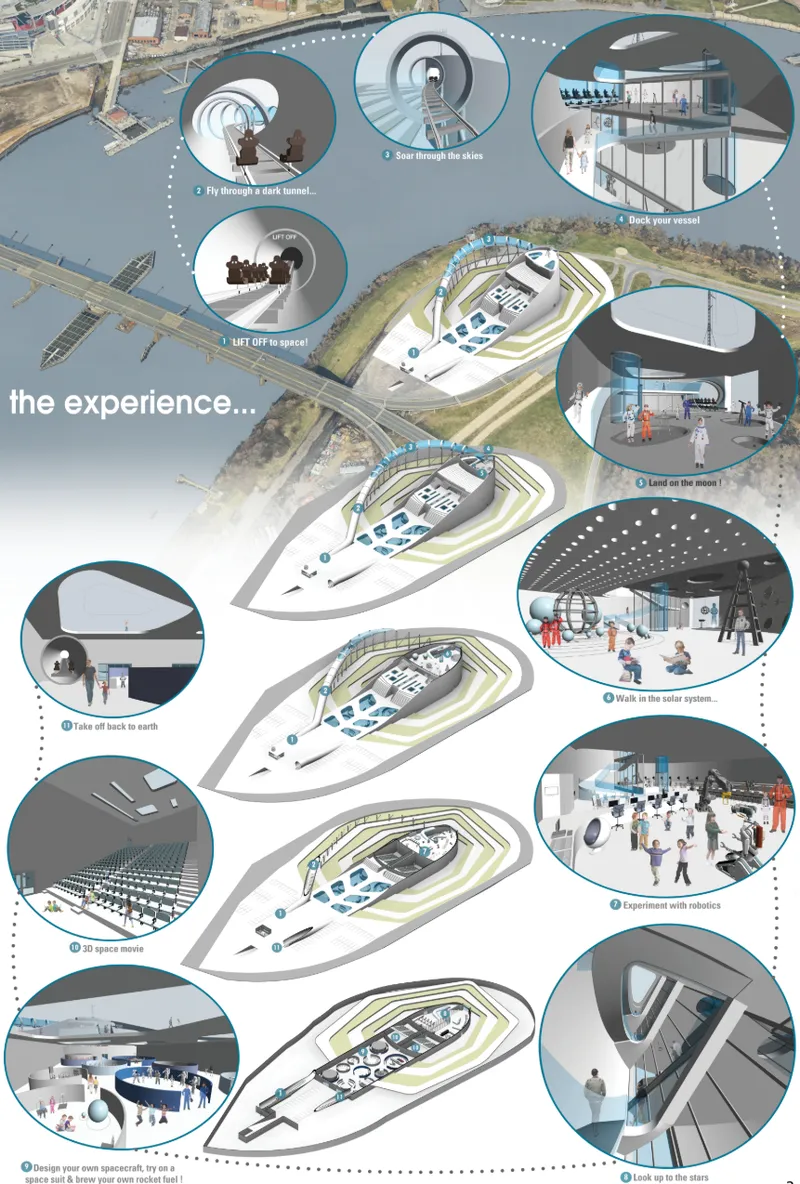
In plan, the curving access ramps that feed into SPEC's bulbous interior reveal a circulation strategy built around continuous discovery. Visitors enter through a futuristic tunnel that mimics a spacecraft launch, then progress through a choreographed sequence: liftoff simulation via dark tunnel rides, sky flight tubes offering elevated views, docking bays for core exhibits, moon landing pavilions with interactive surface modules, and finally solar walks, 3D space films, and design labs where visitors can build their own spacecraft models.
The exploded axonometric unpacks this sequence through circular vignettes that illustrate each interior condition. Lower levels house auditoriums and activity zones. Upper floors ascend through mechanics and robotics, astronomy, and finally selenology at the roof level. The spiral circulation aligns spatial narrative with thematic arc, so that moving upward literally parallels the journey from Earth's surface toward the Moon. Juror Kim Kyunghwan compared this expressive circulation language to the Pompidou Centre in Paris, suggesting that embracing a more deconstructivist vocabulary could further fuse user movement with the building's aesthetic identity.
Four Elevations of a Tubular Canopy
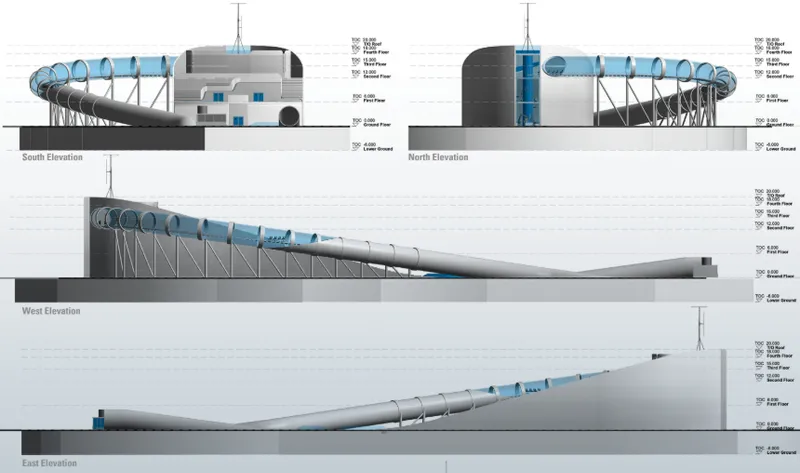
Seen from all four directions, SPEC reads consistently as an object building, its tubular glazed roof catching light while the sloping grade absorbs the lower levels into the earth. The elevation drawings expose the relationship between the transparent canopy and the solid base: program that requires immersion and darkness (simulation tunnels, film rooms) sits below grade, while disciplines that benefit from daylight and views (astronomy, the rooftop selenology pavilion) rise into the glazed envelope. This is not just formal expression; it is environmental logic tied directly to the pedagogical programme.
Sectional Logic as Pedagogical Sequence
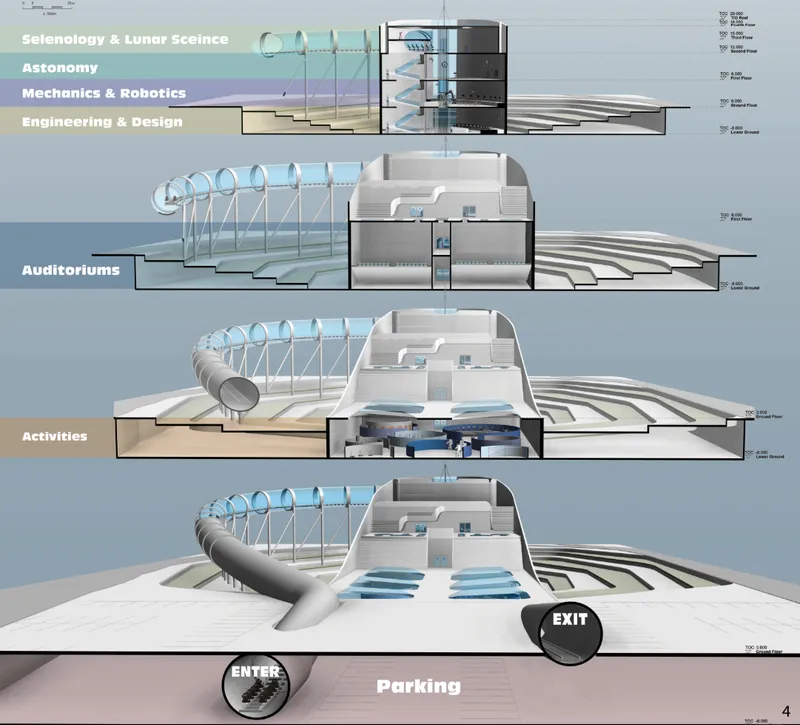
The section drawings are where SPEC's ambitions become most legible. Programmatic labels map each interior volume beneath the curved translucent canopy, revealing a building organized less by floor plates than by experiential zones. The color-coded disciplines and diagrammatic storytelling elevate technical information into narrative, making the section itself a teaching tool. Juror Mark Kerr praised this clarity directly, noting he could "enjoy almost every aspect of this concept thanks to the effective use of the presentation format." Kyunghwan added that the project "understood very well about the necessity of the interactive experiences for the space trip," singling out the robotics pavilion as a space where children could "play with full of curiosity without barrier."
Why This Project Matters
SPEC takes a programme that could easily default to exhibition hall conventions and instead argues that architecture itself is the primary teaching medium. The spiral section, the launch tunnel, the ascent from engineering to astronomy to selenology: these are not decorative gestures but structural commitments to the idea that spatial sequence can carry pedagogical content. In a cultural moment saturated with interest in space colonization and STEM education, the project offers a concrete proposal for how buildings can foster curiosity rather than simply house it.
Kissler's strength here is legibility. The drawings communicate not just what the building looks like but what it feels like to move through it, and the jurors' feedback confirms that this clarity landed. The suggestion to push the deconstructivist vocabulary further points toward a productive next step: making the structural expression as radical as the experiential ambition. As it stands, SPEC is a compelling argument that architecture for education should be as spatially adventurous as the subjects it teaches.
View the Full Project
About the Designers
Designer: Jacqueline Kissler
Enter a Design Competition on uni.xyz
uni.xyz runs architecture and design competitions year-round that reward proposals with spatial conviction and real site intelligence.
Project credits: SPEC by Jacqueline Kissler Moontrip 2019 (uni.xyz).


Popular Articles
Popular articles from the community


David Ortega Stacks a Two-Story Mexico City Penthouse Around a Steel Stair and a Pergola-Shaded Roof Terrace
In Colonia Roma, a 300 m² penthouse uses oak joinery, a planted steel stair and a slatted roof pergola to make a new-build apartment feel like a house.

Juan García Correa, John González and Claudia Rueda Sink a Circular Amphitheater into a Manizales Engineering Building
On the La Nubia campus in Manizales, Colombia, the S1 Building folds labs and offices into a hillside of ramped lawns that double as a campus route.

Architekt Andreas Gruber Scatters 23 Dark Timber Chalets Across a South Tyrolean Forest Edge
In Molini di Tures, Amonti Chalets breaks a resort into a hamlet of gabled timber houses, with parking, storage and services pushed into the slope.

David Macias Steps a Doorless Stone and Plaster House Down a Tropical Colombian Hillside
In the humid hills of Colombia, Threshold House replaces the front door with an open void and terraces its 850 m² down the slope instead of fighting it.

Similar Reads
You might also enjoy these articles


Vereda Arquitetos Renovates a 40-Square-Meter Apartment Inside Niemeyer's Copan Building
A compact unit in São Paulo's most iconic residential tower gets a material overhaul that pairs exposed concrete with bold blue Formica.

Shakur's House: Exposed Brick as an Interior Organiser in a 168 m² Mashhad Residence
Brick moves indoors in this Mashhad residence, where masonry walls, glass partitions and teal planes sequence a compact home without closing it off.

Day and Night Park: A Time-Based Urban Newsstand in Beijing
A temporary urban newsstand in Beijing blending travel, light, and reading through poetic colors, compact form, and community-focused design.

Modernist Patio Renovation in El Masnou, Barcelona by Oliver Segura Arquitectura + Cebrià Arquitectura
Modernist patio renovation blending tradition and innovation with a movable pool, leveled floors, and Catalan materials in El Masnou.

Explore Interactive Spaces Competitions
Discover active competitions in this discipline

Challenge to design locus for the upliftment of human rights

VR headsets Storefront design competition

Design challenge to reuse E-waste
Comments (0)
Please login or sign up to add comments
No comments yet. Be the first to comment!