
Daedalus Station: A Self-Building Orbital Habitat That Engineers Its Own Gravity
A toroidal space station in Low Earth Orbit that mines asteroids, simulates Earth gravity through rotation, and scales from 32 to 448 meters.


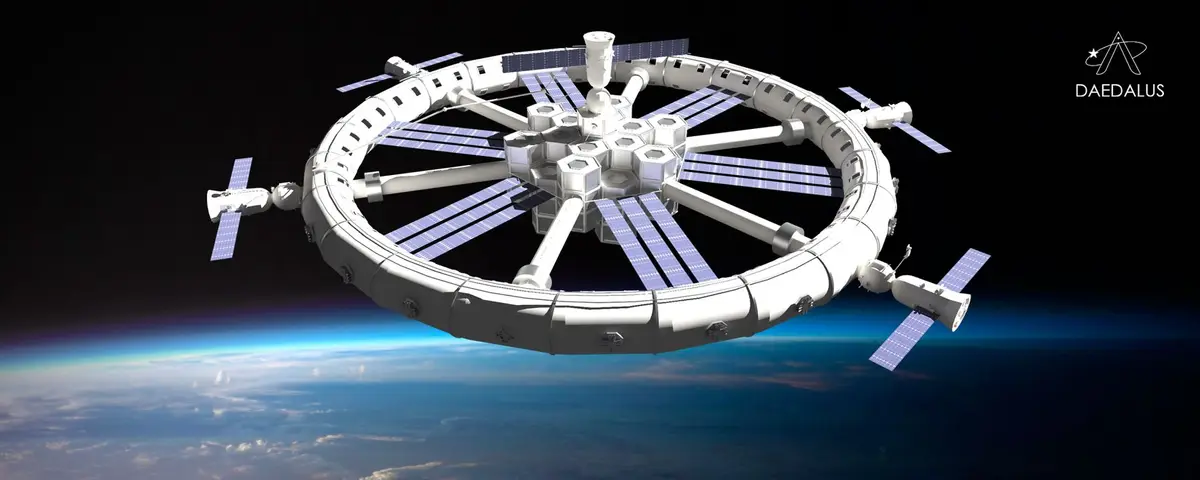
What if the next great work of architecture never touches the ground? Daedalus Station proposes a toroidal habitat orbiting 1500 km above Earth that doesn't just house people in space but builds itself there, harvesting raw materials from asteroids and lunar regolith to grow from a compact ring into a 448-meter-radius cylinder capable of simulating full Earth gravity. It is space architecture treated not as a sealed capsule to survive in, but as an expanding city to live in.
Designed by Basilio Paredes and awarded an Honorable Mention in the Origyn competition, the project confronts the central logistical bottleneck of orbital construction: launching everything from Earth. Daedalus replaces that dependency with a closed-loop model where local resource utilization drives each phase of expansion. The result is a compelling blueprint for autonomous space colonization, grounded in modular engineering and phased growth rather than speculative fantasy.
A Wheel That Grows: Modular Assembly in Orbit


The exploded assembly diagram reveals the station's fundamental logic: standardized habitable and industrial modules, delivered by reusable rockets, lock together with magnetic connectors to form a rotating wheel. Each module is purpose-differentiated, separating living quarters, research labs, manufacturing bays, and agricultural zones through a clear architectural hierarchy. The elevation drawing makes visible the docking points and thrusters that give the station both structural order and the propulsive capacity to maintain its orbit. Nothing here is monolithic. Every component is designed to be replaced, expanded, or reconfigured as the station's population and mission evolve.
Hexagonal Geometry Inside a Sphere

The cutaway through the transparent spherical module exposes the internal logic that makes microgravity habitation workable. Hexagonal chambers tile the interior, maximizing volumetric efficiency while creating connecting nodes that allow fluid movement in weightless conditions. It is a geometry chosen for structural performance and human navigation alike: hexagons distribute stress evenly across surfaces and offer multiple pathways between adjacent cells, eliminating the dead-end corridors that would make zero-gravity circulation frustrating.
This interior strategy reflects a broader commitment to treating space architecture as real architecture, not just engineering. The module isn't simply a pressure vessel. It is a spatial environment shaped to support psychological well-being, with open recreation zones and flexible layouts that acknowledge the mental toll of long-duration orbital living.
Seven Phases of Gravity: From 0.143g to Earth-Normal

The phased assembly diagram is where the project's ambition becomes visceral. Daedalus doesn't arrive fully formed; it grows through at least seven distinct phases, each marked by an increase in radius and a corresponding rise in simulated gravity. Phase 1 operates at a 32-meter radius producing just 0.143g, suitable for manufacturing and storage. By Phase 4 the radius reaches 128 meters and 0.572g, enough for comfortable habitation. Phase 7 achieves the full 448-meter radius and 1g, replicating Earth's gravitational pull through centrifugal force.
This gradient is not incidental; it is the organizing principle of the station's spatial program. Outer layers with higher gravity host residential quarters and recreation. Inner layers at lower gravity accommodate industry, agriculture experiments, and bulk storage where reduced weight is an advantage. The architecture and the physics are inseparable: the plan is the gravity map.
The Spine: Fuel, Manufacturing, and the Station's Structural Core

The section drawing through the station's central axis reveals the infrastructural backbone that makes autonomy possible. Fuel tanks line the spine alongside manufacturing zones, placing the heaviest and most industrially active programs at the station's rotational center where gravity is lowest. This is where asteroid-mined materials are processed and where fuel derived from ice mining is stored, feeding the solar satellite energy systems and thrusters that sustain the station's orbit and rotation. It is a deliberate inversion of terrestrial logic: the factory floor floats at the top, and the living room sits at the weighted edge.
Living Inside the Curve
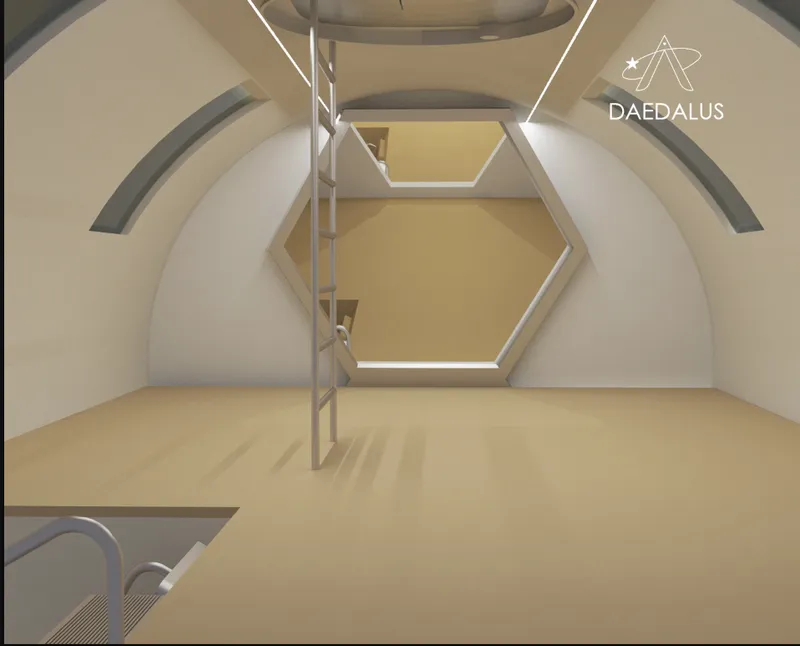
The interior rendering grounds the project in sensory reality. Beige walls curve gently overhead, a hexagonal ceiling hatch opens above a metal ladder, and the scale feels domestic rather than industrial. This is important. The success or failure of long-duration space habitation depends less on propulsion technology than on whether people can tolerate living inside the structure for months or years. The warm material palette and the legible spatial hierarchy, where hatches and ladders orient the body even in the absence of gravitational cues, suggest that Paredes has thought carefully about the phenomenology of orbital life, not just its mechanics.
Why This Project Matters
Daedalus Station matters because it refuses the two most common traps in space architecture: the purely speculative image and the purely technical diagram. Paredes operates in the territory between them, producing a design that is both visually compelling and logistically rigorous. The closed-loop construction model, phased gravity scaling, and modular assembly strategy are not decorative concepts. They are direct responses to the real constraints of building beyond Earth's atmosphere and supply chain.
More broadly, the project argues that architecture's disciplinary toolkit, its attention to spatial hierarchy, material warmth, and human comfort, is essential to the future of space colonization. Engineers can solve pressure differentials and orbital mechanics. What they need architects for is making a spinning cylinder in the void feel like a place worth inhabiting. Daedalus Station makes that case convincingly, from the 448-meter macro structure down to the hexagonal ceiling hatch.
View the Full Project
About the Designers
Designer: Basilio Paredes
Enter a Design Competition on uni.xyz
uni.xyz runs architecture and design competitions year-round that reward proposals with spatial conviction and real site intelligence.
Project credits: Daedalus Station by Basilio Paredes Origyn (uni.xyz).


Popular Articles
Popular articles from the community

Extended Shell: Retrofitting Kolkata's Balconies as Living Urban Thresholds
A modular retrofit system recovers the social and environmental intelligence of Kolkata's historic verandas for contemporary Park Street residents.

Manzana Morphosis: Stretching Barcelona's Grid into a Living Landscape for 2050
A radical reworking of the Eixample manzana turns density into a tool for generous public space, vertical ecology, and environmental performance.
Temporary Home for Dogs: A Reversed Zoo Rethinks Animal Shelter Architecture
In Bucharest, a sinuous corridor and freed landscape flip the logic of containment, designing a shelter that works to make itself unnecessary.

Opera on the Sea: Driftwood Logic Shapes a Timber Opera House on Estonia's Coast
Trevor Orgill's opera house translates the entangled drift of floating timber into a civic building where wood, water, and music converge.

Similar Reads
You might also enjoy these articles

Day and Night Park: A Time-Based Urban Newsstand in Beijing
A temporary urban newsstand in Beijing blending travel, light, and reading through poetic colors, compact form, and community-focused design.

Modernist Patio Renovation in El Masnou, Barcelona by Oliver Segura Arquitectura + Cebrià Arquitectura
Modernist patio renovation blending tradition and innovation with a movable pool, leveled floors, and Catalan materials in El Masnou.

Alto Residencial Coop: Cooperative Housing Development in Santiago de Compostela by Carbajo Barrios Arquitectos
A linear cooperative housing complex blending white volumes and perforated metal façades, enhancing community living, natural light, privacy, and urban integration.
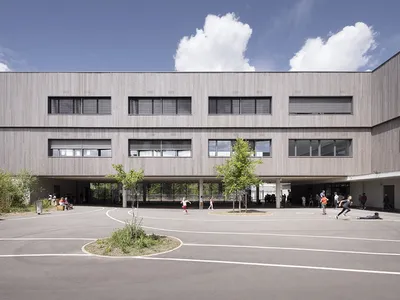
Vil Genis School by BPA ARCHITECTURE – Massy, France
Vil Genis School in Massy, France, features sustainable design, south-facing classrooms, community integration, accessible spaces, and modern educational architecture.

Comments (0)
Please login or sign up to add comments
No comments yet. Be the first to comment!