

Space Odyssey: Simulating a Mission to Space on Washington's Anacostia Riverfront
A three-phase architectural sequence of preparation, journey, and discovery transforms NASA's backyard into an immersive space experience.


Washington, D.C. is home to NASA Headquarters, yet the city lacks a dedicated NASA visitor center. Space Odyssey confronts that gap with a proposal that does more than fill a missing program slot: it stages the entire arc of a space mission as a sequence of architectural environments. Visitors don't just look at exhibits about space travel. They walk through preparation labs, cross a symbolic portal from Earth to cosmos, and arrive inside a geodesic dome where anti-gravity simulations and digital projections replicate the sensation of being off-planet.
Designed by Vikram Ghattora and Ankur Gupta, the project received an Honorable Mention in the Moontrip 2019 competition. Sited on the Anacostia riverfront near Anacostia Park, the complex organizes itself into three integrated phases: Preparation, Journey, and Result. Each mirrors a real stage of a space mission, translating abstract scientific processes into physical, walkable spatial sequences that target children, students, and space enthusiasts.
A Courtyard That Bridges Earth and Space
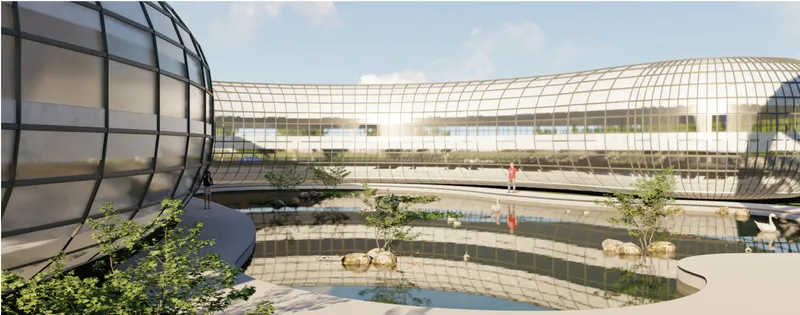
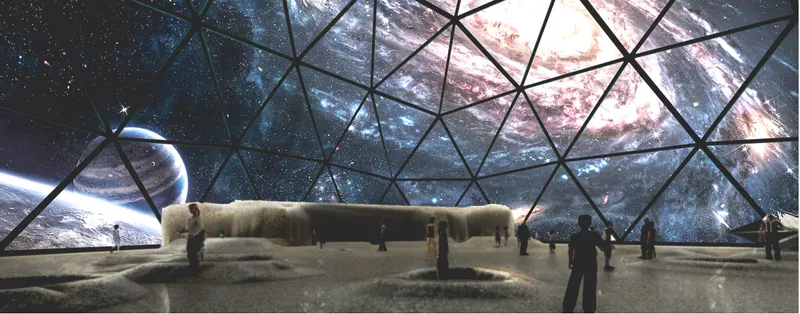
The ground-level courtyard operates as the hinge between the project's earthbound and cosmic halves. Circular paving and water features draw visitors from the barrel-vaulted glass structure, which houses the Preparation phase, toward the geodesic dome that contains the simulated space environment. The materiality is deliberate: transparent glass volumes for the science and engineering labs signal openness and visibility, while the triangulated dome skin shifts perception overhead, framing projections of celestial bodies and planetary surfaces. Inside the dome, the structure itself becomes scenography, its tessellated glazing dissolving the boundary between architecture and projected cosmos.
The Preparation zone separates mechanical design workshops from theoretical science labs, acknowledging the distinct but interdependent work of engineers and scientists. Museum galleries and interactive zones depicting project development sit alongside these working spaces, so visitors witness the unseen labor that enables a mission before they ever encounter the spectacle of simulated spaceflight. A fluid architectural form unifies these separate programs, representing the flow of knowledge and cross-disciplinary collaboration.
Site Strategy Along the Anacostia
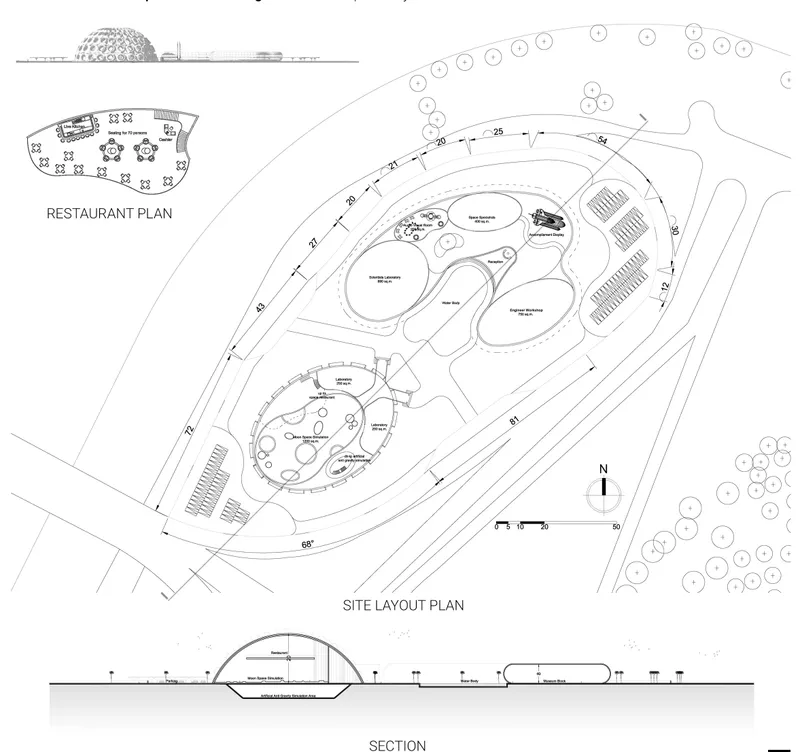
The site plan reveals how multiple dome structures, parking areas, and roadway circulation are organized to maximize public access from the riverfront. Positioned near Anacostia Park and within reach of NASA's own campus, the complex takes advantage of an underutilized stretch of waterfront to create a destination that is both symbolically resonant and practically accessible. The domes are distributed across the site rather than clustered, creating intervals of landscape between architectural events. This spacing reinforces the narrative of a journey: each structure marks a phase, and the act of walking between them becomes part of the experience.
Immersive Interiors from Labs to Lunar Terrain
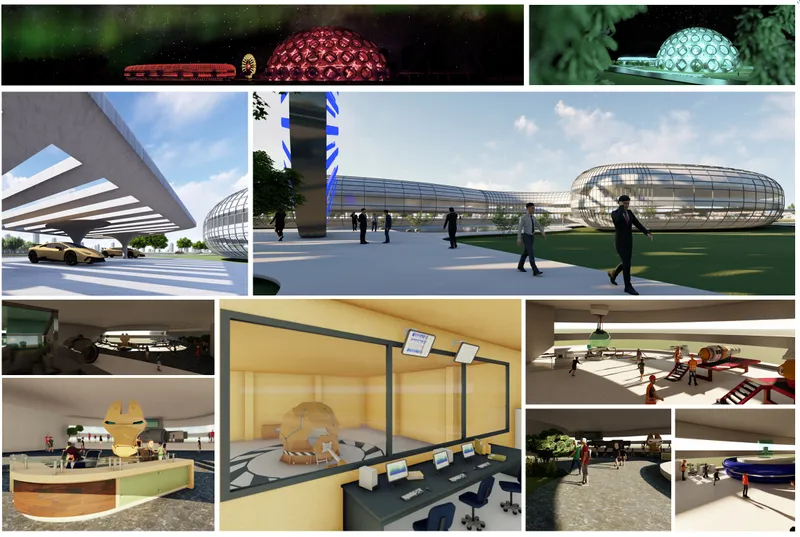
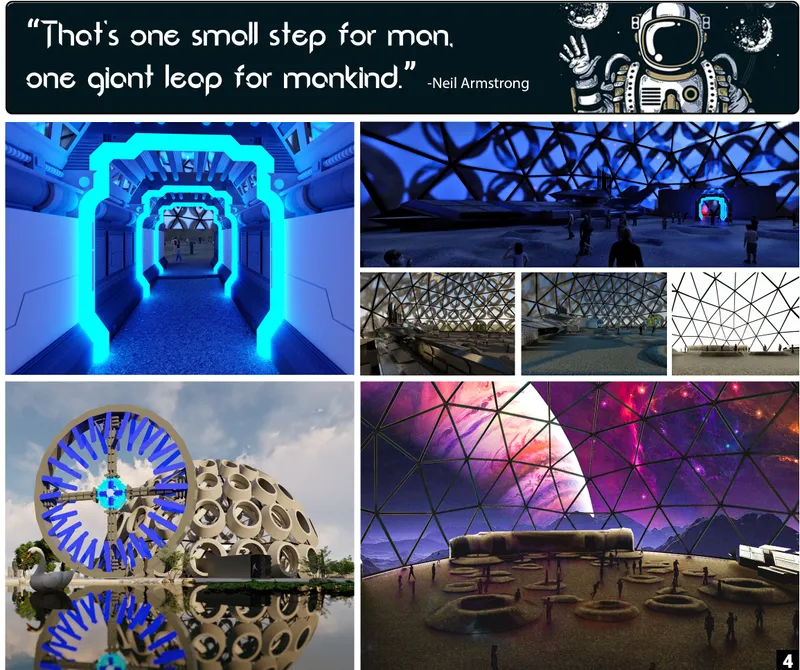
The composite renderings expose the range of interior conditions the designers envision. Vaulted corridors lit with ambient gradients connect to geodesic interiors fitted with tiered seating and projection surfaces. The Result phase, housed within the primary dome, integrates a digital projection studio, anti-gravity simulation modules, and virtual planetary exploration environments. Children can walk through spaces that replicate astronaut training conditions, while the dome's interior topography draws from space terrain to reinforce the feeling of being on another world. A restaurant shaped like a spacecraft and a mini-civilization prototype that imagines closed-loop living on another planet extend the program beyond education into speculative future habitation.
At dusk, the domes reflected in the Anacostia's water take on a different character entirely. The illuminated corridors glow outward, and the geodesic geometry reads less as architecture and more as a series of landed vessels. This nighttime condition is not incidental; it collapses the distance between the project's speculative premise and a visitor's visceral experience of encountering something that looks genuinely otherworldly against the D.C. skyline.
Why This Project Matters
Space Odyssey works because it refuses to treat space exploration as content to be displayed in a building. Instead, it treats the building itself as a vehicle. The three-phase narrative structure, Preparation to Journey to Result, gives visitors a spatial script that mirrors the emotional arc of a real mission: anticipation, transition, arrival. That sequencing is what separates this proposal from a conventional science museum with a dome tacked on.
Ghattora and Gupta also make a shrewd urbanistic argument. By identifying the absence of a NASA visitor center in the very city where NASA operates, they anchor a speculative project in a concrete need. The Anacostia riverfront site gives the complex visibility, public access, and a reflective surface that doubles the architecture's presence at night. For a competition entry, it demonstrates an unusual maturity: the willingness to let narrative, site, and program reinforce each other rather than relying on formal novelty alone.
View the Full Project
About the Designers
Designers: Vikram Ghattora, Ankur Gupta
Enter a Design Competition on uni.xyz
uni.xyz runs architecture and design competitions year-round that reward proposals with spatial conviction and real site intelligence.
Project credits: Space Odyssey" by Vikram Ghattora, Ankur Gupta Moontrip 2019 (uni.xyz).


Popular Articles
Popular articles from the community


Tsunami Convergenics: Turning Catastrophic Ocean Forces into Underwater Housing Infrastructure
A speculative underwater settlement off the coast of Onagawa, Japan, treats tsunamis and typhoons as energy sources rather than threats.

Opera on the Sea: Driftwood Logic Shapes a Timber Opera House on Estonia's Coast
Trevor Orgill's opera house translates the entangled drift of floating timber into a civic building where wood, water, and music converge.

The Amber Palace Opera: A Geological Fiction Surfaces on Tallinn's Baltic Waterfront
Pierre Brillard reimagines a Baltic legend as a public landscape, opera house, and waterfront promenade rooted in Tallinn's coastal identity.

Cloaked Colonization: A Mobile Underwater Habitat That Moves Like a Fish
Micah Abaya's shortlisted EHC Pacific entry reimagines ocean settlement as a dispersed network of self-sustaining architectural organisms.

Similar Reads
You might also enjoy these articles

Shakur's House: Exposed Brick as an Interior Organiser in a 168 m² Mashhad Residence
Brick moves indoors in this Mashhad residence, where masonry walls, glass partitions and teal planes sequence a compact home without closing it off.

Day and Night Park: A Time-Based Urban Newsstand in Beijing
A temporary urban newsstand in Beijing blending travel, light, and reading through poetic colors, compact form, and community-focused design.

Modernist Patio Renovation in El Masnou, Barcelona by Oliver Segura Arquitectura + Cebrià Arquitectura
Modernist patio renovation blending tradition and innovation with a movable pool, leveled floors, and Catalan materials in El Masnou.

Alto Residencial Coop: Cooperative Housing Development in Santiago de Compostela by Carbajo Barrios Arquitectos
A linear cooperative housing complex blending white volumes and perforated metal façades, enhancing community living, natural light, privacy, and urban integration.

Comments (0)
Please login or sign up to add comments
No comments yet. Be the first to comment!