
23o5Studio Converts a Ho Chi Minh City Paper Factory into a Youth-Focused Creative Hub
Space4Youth reimagines a disused industrial building in Vietnam as a flexible venue for work, culture, and community gathering.

Vietnam's cities are full of industrial buildings that no longer fit the neighborhoods around them. As policy shifts restrict warehouses and factories in residential areas, these structures face a familiar binary: demolition or expensive redevelopment. 23o5Studio found a third option in Ho Chi Minh City, taking a defunct paper factory and reworking it into Space4Youth, a 1,500 square meter venue designed for co-working, exhibitions, workshops, performances, and cultural exchange. Rather than leveling the old building and starting fresh, the architects kept the original frame and invested in surgical upgrades, cutting costs and construction time while preserving the industrial character that gives the place its identity.
What makes this project worth studying is the clarity of its logic. Every decision, from the structural reinforcement of existing columns to the removal of a portion of the original roof to create courtyard gardens, serves both a pragmatic and atmospheric purpose. The result is a building that feels generous and open without pretending it was never a factory. It wears its past lightly, and it gives a dense urban neighborhood something it didn't have before: a flexible public destination calibrated to younger generations.
Opening the Roof, Returning the Garden
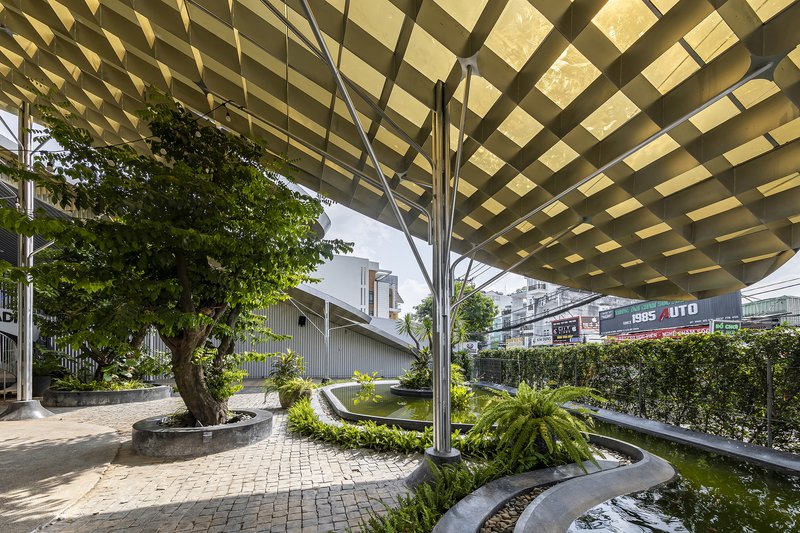
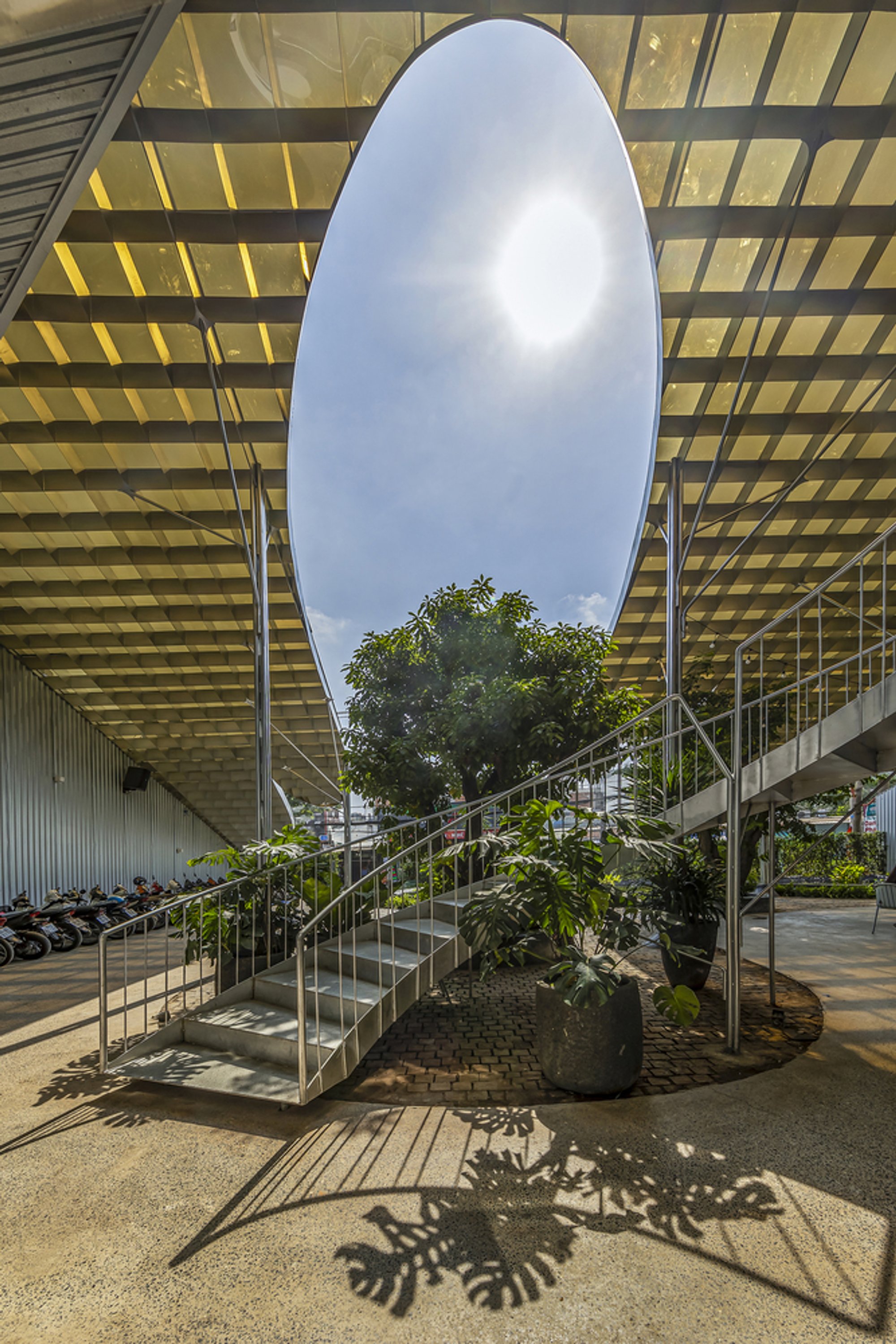
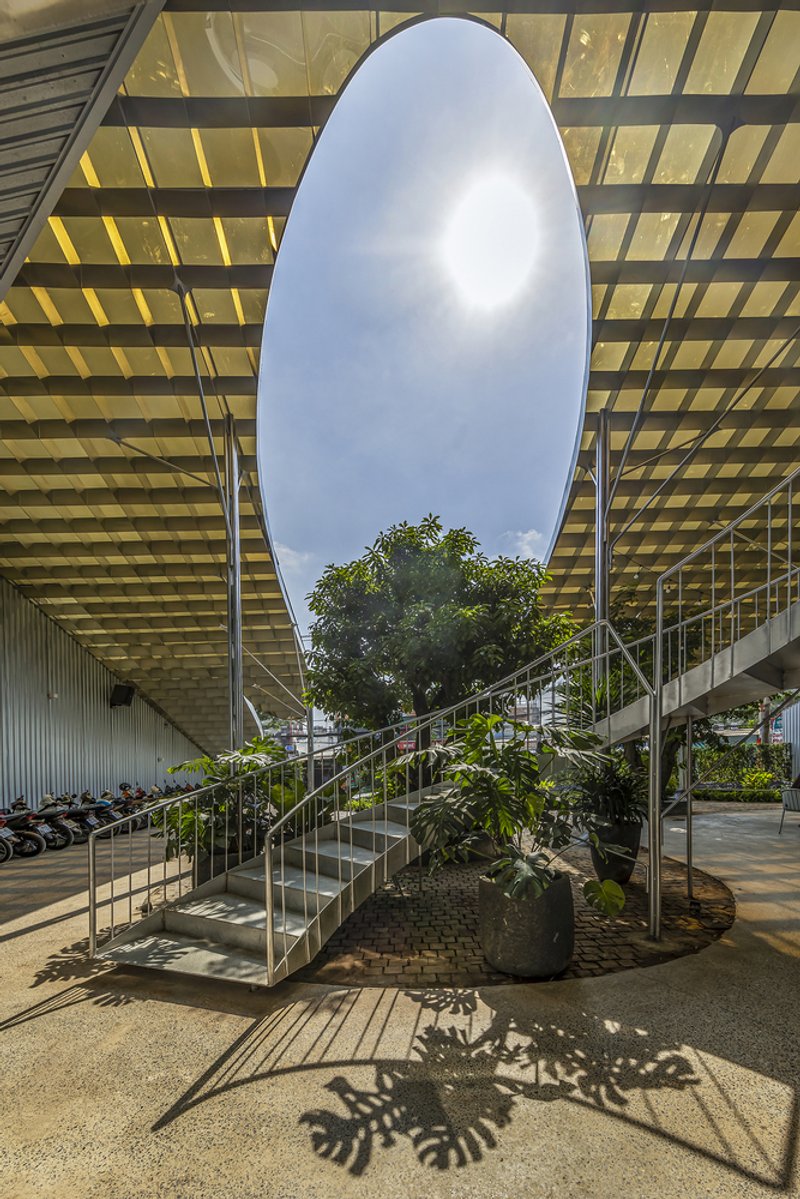
The single most defining move here is the surgical removal of sections of the original roof to carve out planted courtyards within the building's footprint. Where the factory once sealed itself off from the sky with a continuous industrial canopy, oval openings now puncture the waffle slab overhead, allowing trees to grow through the structure and daylight to flood the ground level. The effect is striking: what reads from the outside as a solid industrial volume reveals itself internally as a series of interconnected garden rooms.
Curved planted beds and paver paths at ground level soften the hard geometry of the existing concrete and steel. The retained coffered ceiling, now visible as a textured canopy rather than a utilitarian lid, frames these green pockets with a kind of sculptural weight. It is a strategy that transforms the environmental performance of the building as much as its appearance, pulling ventilation and natural light deep into spaces that were once sealed and dark.
Circulation as Experience
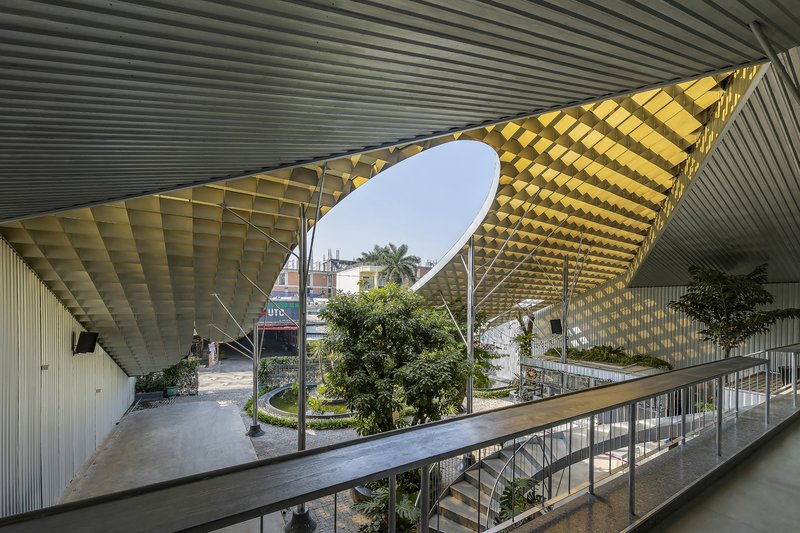
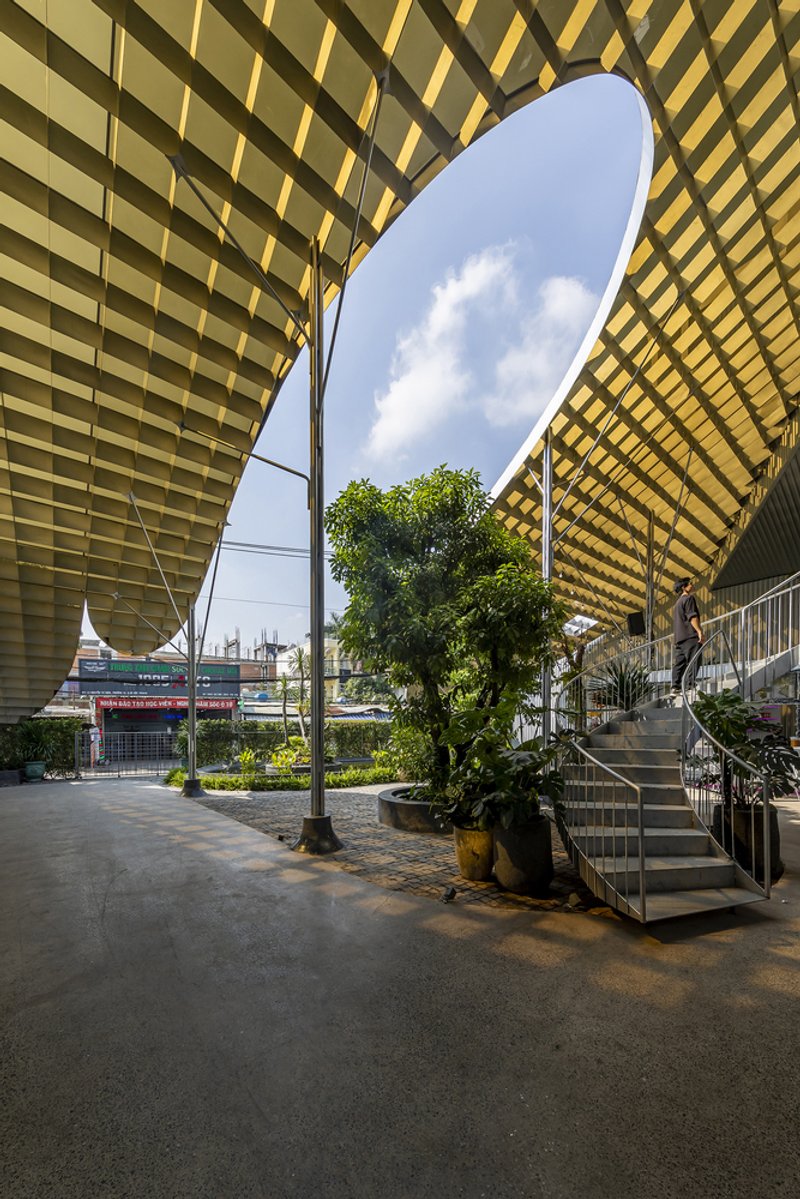
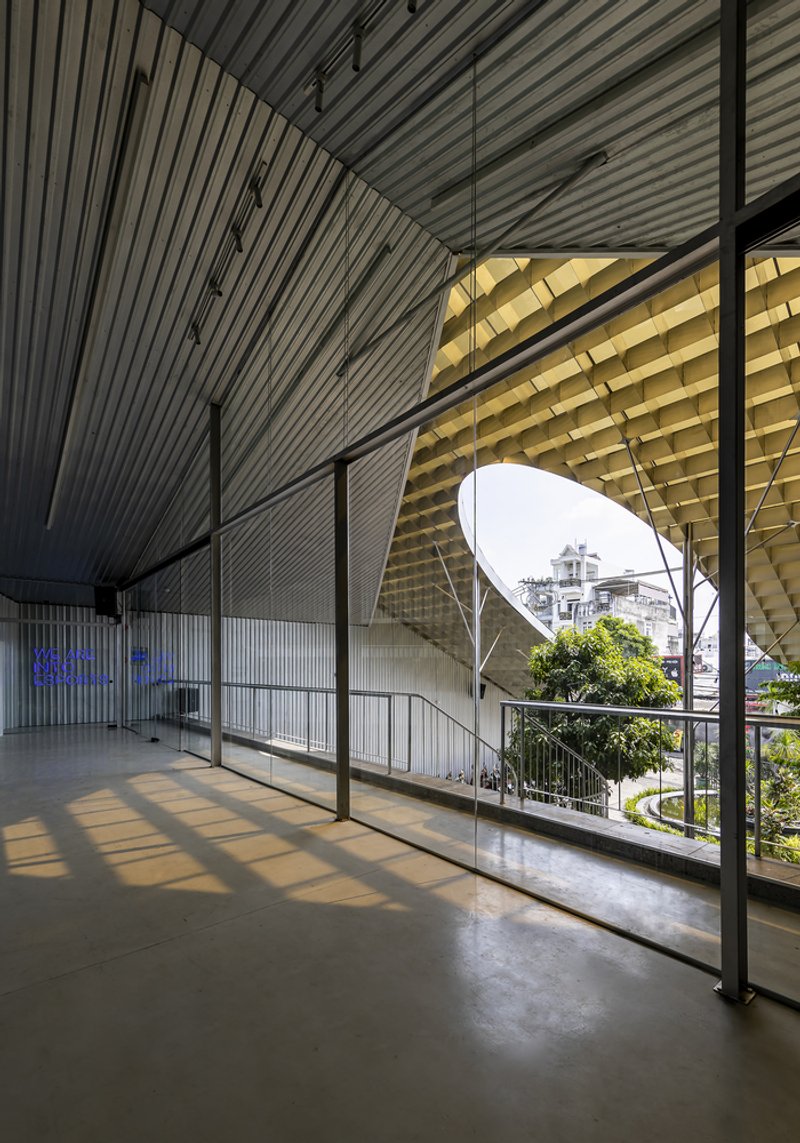
The courtyards are not merely decorative insertions. They organize the plan, separating primary program areas from auxiliary functions like storage and bathrooms, and they anchor the building's vertical circulation. A steel staircase spirals around a tree beneath one of the oval roof openings, turning a purely functional element into a moment of spatial drama. From the upper walkways, glass railings offer views down into the planted courts, keeping occupants connected to greenery and natural light regardless of where they are in the building.
Corridors lined with vertical metal slats and floor-to-ceiling glass frame long views of the landscaped interior. The slatted timber ceilings overhead filter light into warm bands. Movement through the building becomes a sequence of reveals: from compressed corridors into open halls, from industrial texture into garden softness. It is a deliberate choreography that keeps the spatial experience shifting without relying on expensive finishes or gratuitous formal gestures.
Industrial Texture, Honest Materials
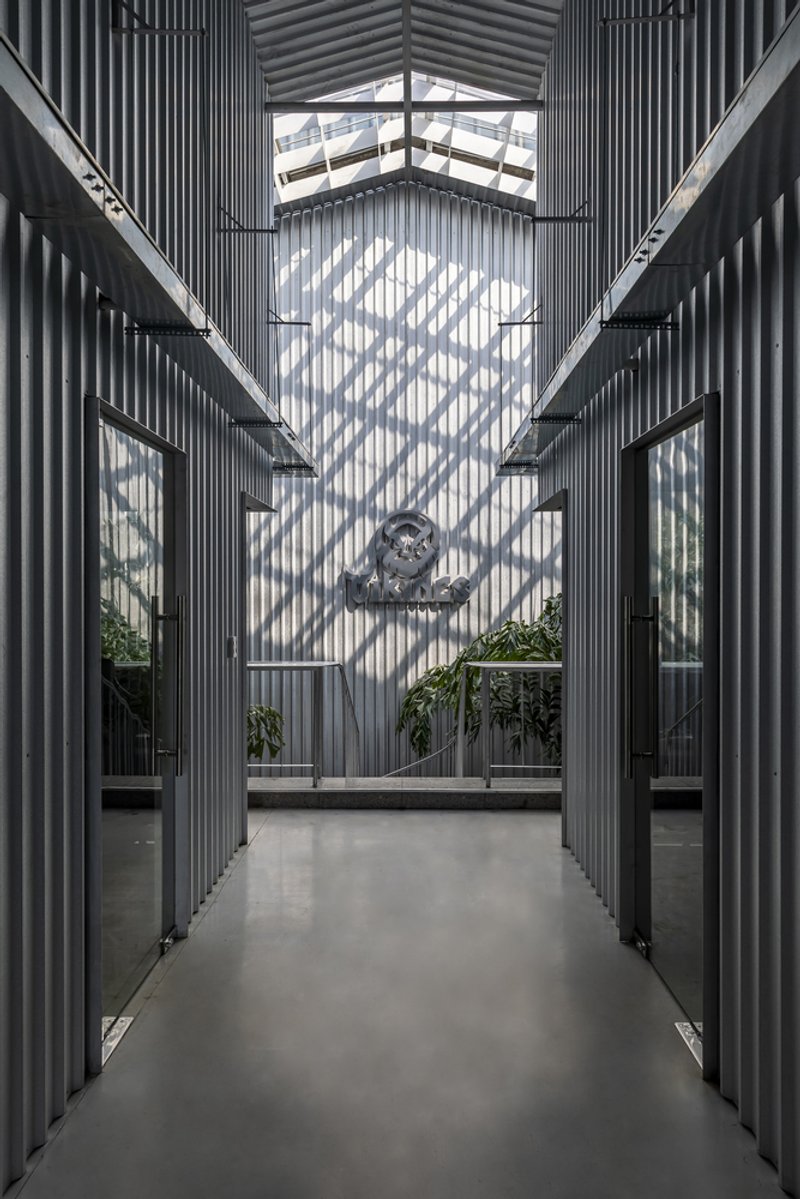
23o5Studio does not try to erase the factory. Corrugated metal surfaces are left exposed along corridors, creating dark, textured passages that contrast sharply with the bright courtyards. A narrow corridor with dark corrugated walls leads to a gabled clerestory window that casts sharp geometric shadows onto the floor, a detail that reads as both functional (bringing daylight into deep plan zones) and deliberately atmospheric. The honesty of the material palette, steel, concrete, corrugated metal, glass, keeps the project grounded in its industrial origins.
At the facade, a diamond-patterned translucent panel system wraps over the corrugated metal roof structure, catching light at dusk and giving the building a layered, almost crystalline street presence. It is a smart move: distinctive enough to signal that something new is happening inside without overwhelming the residential context around it.
Twilight Identity and the Connecting Bridge
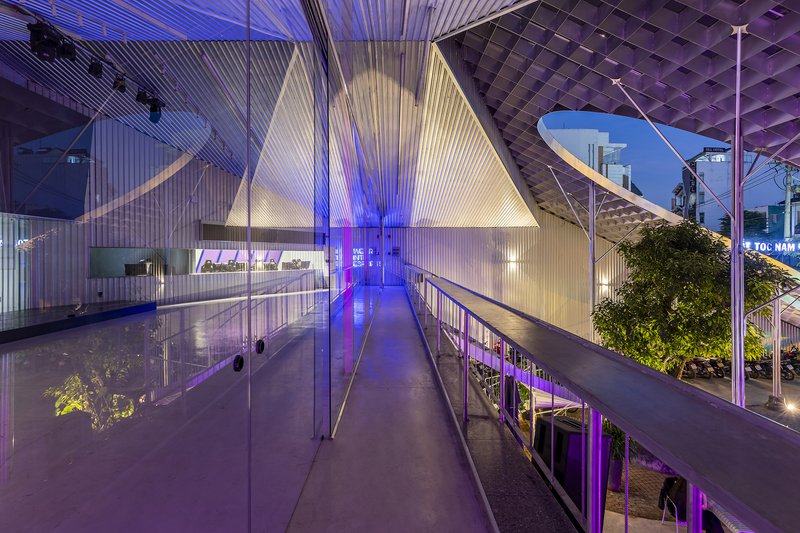
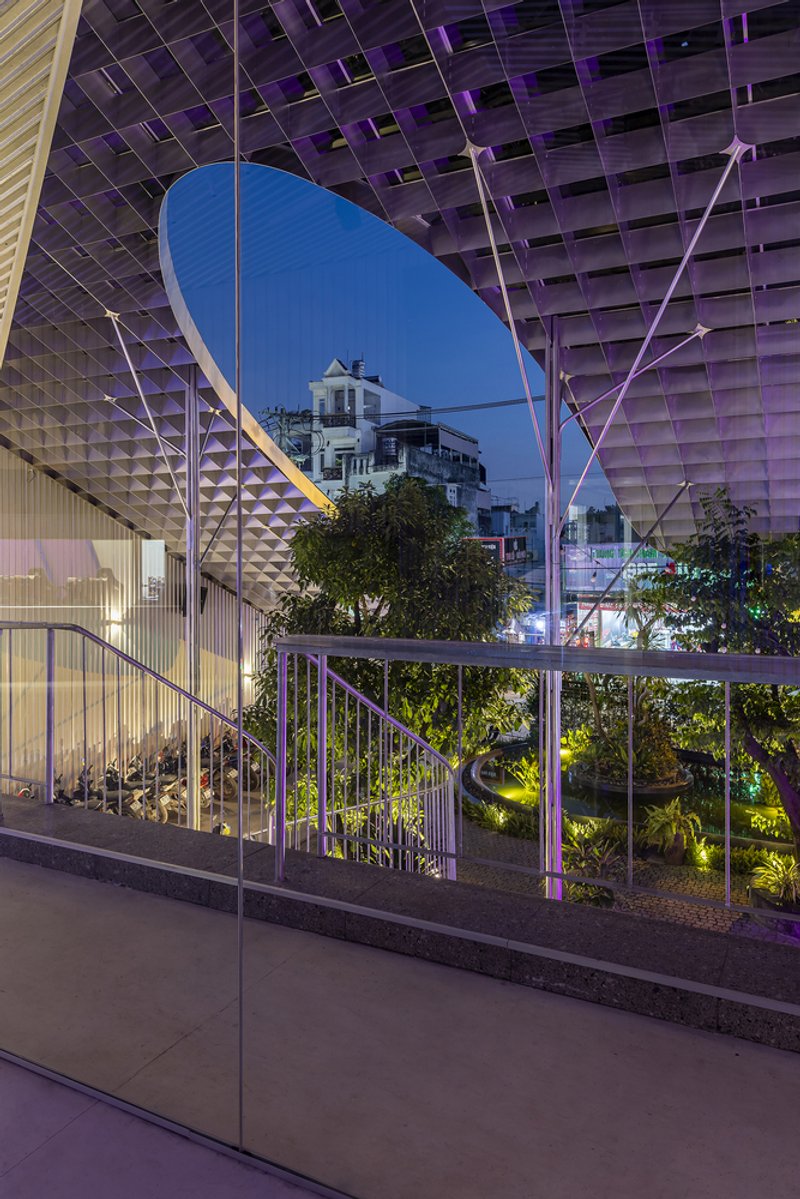
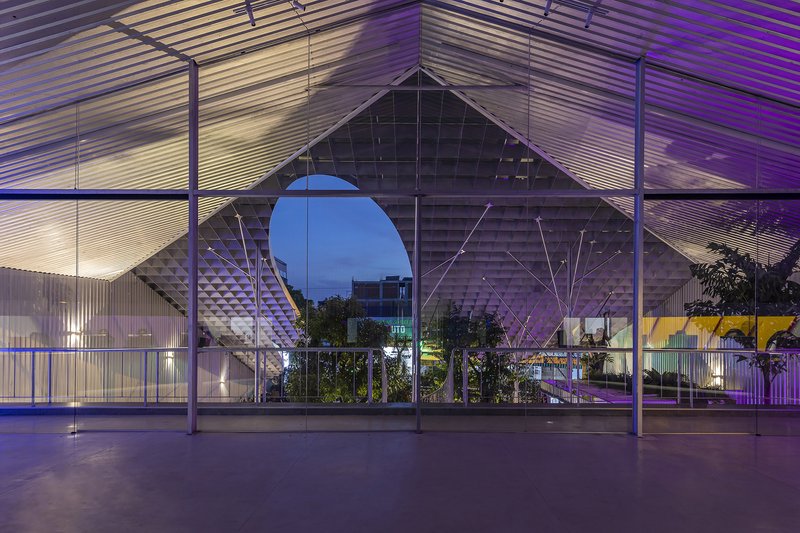
At dusk, the building transforms. Purple lighting washes through the coffered ceilings and along a bridge connecting two volumes, turning the utilitarian structure into something closer to a lantern. The triangular translucent panels on the bridge glow against the twilight sky, signaling activity and youth energy to the street. On the upper terrace, the same purple palette illuminates a planted area beneath the oval skylight, creating an outdoor room that functions equally well for evening events and daytime breaks.
The lighting strategy is not superficial. It reinforces the building's identity as a youth-oriented venue, distinguishing it from the more subdued residential fabric and inviting passersby to engage. In a city where street life is intense and visual competition is fierce, this kind of legible night presence matters.
Flexible Programming Under the Folded Roof
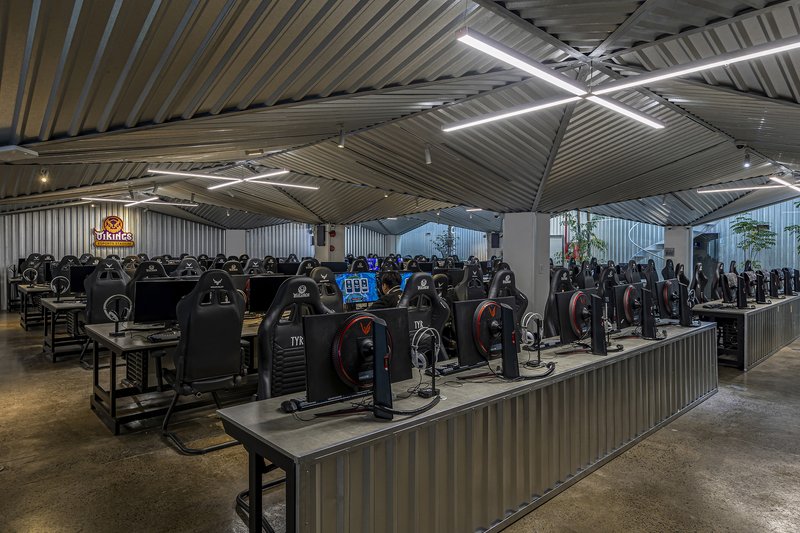
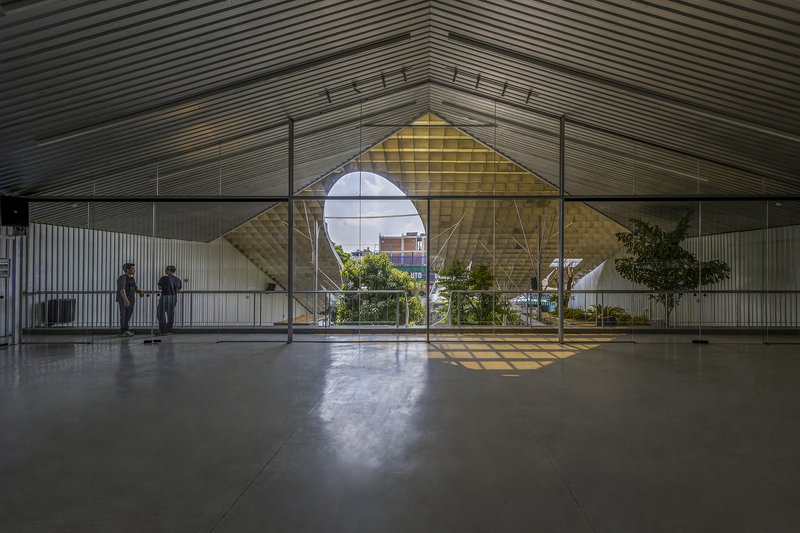
The building's largest interior hall, fitted with rows of computer stations under a folded metal roof with linear lighting, demonstrates the kind of flexible, high-capacity programming that drove the structural upgrades. The original columns and beams were not designed to support gatherings of 200 people, so 23o5Studio enlarged column cross-sections, strengthened beam connections, and replaced the old floor system with high-strength concrete. These are invisible interventions that make everything else possible.
The interior layout is designed to shift. Movable furnishings and adaptable infrastructure allow the same space to host a gaming event one week and an art exhibition the next. The courtyard, with its metal staircase circling a tree and dappled shadows from the oval opening above, provides a calming counterpoint to the intensity of the programmed halls. The building breathes because of these alternations between active and passive zones.
Why This Project Matters
Space4Youth is not a showcase of formal invention. Its value lies in the intelligence of its process: identifying what to keep, what to remove, and what to add. By retaining the factory's structural frame and investing in targeted performance upgrades rather than wholesale reconstruction, 23o5Studio delivered a project that was faster, cheaper, and more sustainable than a new build. In a Vietnamese real estate context where investors demand rapid returns, that argument is as important as the architecture itself.
More broadly, the project offers a replicable model for cities across Southeast Asia that are grappling with the same question: what do you do with industrial buildings stranded by changing zoning? The answer here is not preservation for its own sake, nor is it demolition for maximum yield. It is a pragmatic middle path that delivers community value, environmental performance, and a distinct sense of place, all without pretending the building's history doesn't exist. That restraint, paired with genuine spatial ambition in the courtyard insertions and the material honesty of the interiors, makes Space4Youth a project worth paying attention to.
Space4Youth by 23o5Studio, Ho Chi Minh City, Vietnam. 1,500 m². Completed 2023. Photography by Paul Phan.
About the Studio
Share Your Own Work on uni.xyz
If projects like this are the kind of work you want to make, uni.xyz is a place to publish your own, find collaborators, and enter design competitions.




Popular Articles
Popular articles from the community

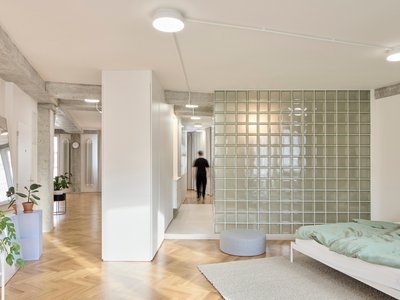
RDTH architekti Rips Out Nearly Every Wall in a Prague Apartment and Replaces Them with Furniture
A 101-square-meter post-war flat in Prague trades rigid partitions for a single rotated furniture block, curtains, and glass concrete.
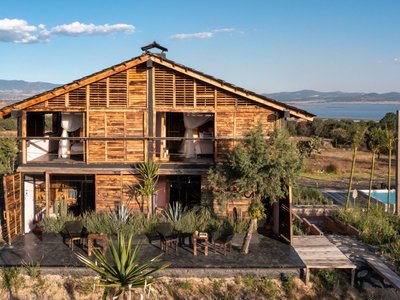
Fausto Terán and Toro Fuse Japanese Craft with Mexican Tradition in a Lakeside Retreat
Nakamura House pairs Shou-Sugi-Ban charred pine with handmade clay tile at the foot of Atlangatepec Lagoon in Mexico.

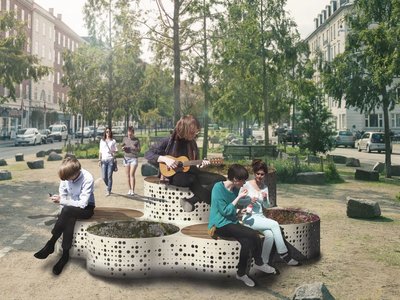
20 Most Popular Furniture Design Projects of 2025
Modular street systems, parametric benches, and insect hotels: the furniture design projects that captivated architects on uni.xyz in 2025.
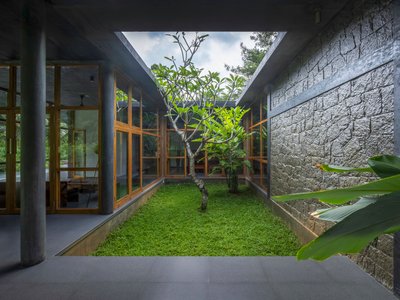
3dor Concepts Wraps a Kerala Home in Mirrored Concrete Arcs Around a Courtyard Tree
In the Western Ghats foothills of Thamarassery, a 270 m² single-story house uses two curved volumes to frame nature as its center.


Similar Reads
You might also enjoy these articles
Olio Towers: A Mid-Rise for Performers That Fuses Housing, Rehearsal, and Stage
Located blocks from Houston's Theater District, this modular tower stacks living units around a central performance atrium.
Oasis: Modular Green Housing Carved into Dhaka's Urban Fabric
A shortlisted Plugin Housing entry reclaims unauthorized settlements in Dhaka with stepped concrete volumes, green roofs, and ventilation-driven design.

Black Hole: A Floating Megastructure for the Post-Physical Era
Emiliano Mazzarotto envisions a spherical, self-scaling arena where e-sports, digital hotels, and holographic stadiums replace traditional public space.
Compact & Sustainable Living in Piraeus: A Four-Level Family Home Built Around Light and Air
A narrow townhouse in one of Greece's densest port cities uses a central atrium and passive strategies to house three generations under one roof.


Explore Architecture Competitions
Discover active competitions in this discipline




The International Standard for Design Portfolios


The Global Benchmark for Architecture Dissertation Awards


The Global Benchmark for Graduation Excellence


Challenge to reimagine the Iron Throne
Comments (0)
Please login or sign up to add comments
No comments yet. Be the first to comment!