
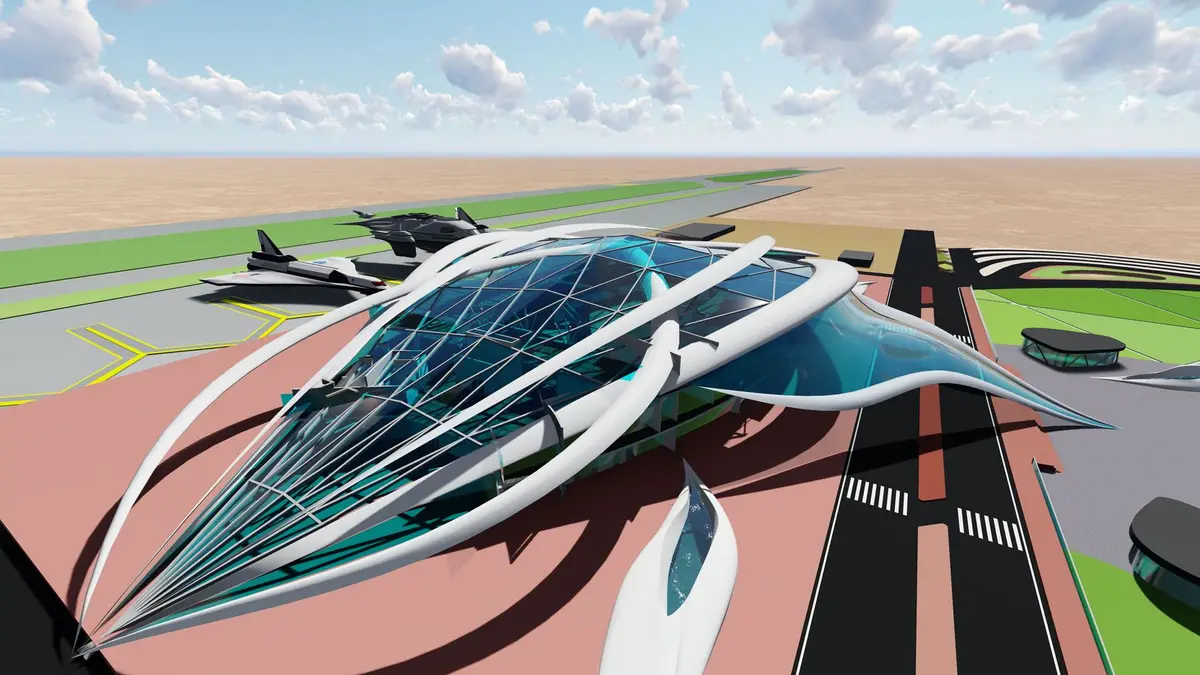
SPACEPORT: A New Gateway to Space
A visionary commercial spaceport architecture redefining space travel through immersive design, advanced infrastructure, and public engagement.


Commercial spaceport architecture represents an emerging frontier in contemporary architectural discourse, redefining how infrastructure, technology, and public experience converge. As space travel transitions from a government-controlled endeavor to a commercial and civilian-oriented enterprise, the spaceport becomes more than a launch facility, it evolves into a symbolic gateway between Earth and space.
This thesis project "SPACEPORT" proposes a visionary commercial spaceport located at Kulasekharapatnam, Thoothukudi District, Tamil Nadu, along the Bay of Bengal. Strategically positioned on India’s southeastern coastline, the site leverages geographical advantages such as eastward launch trajectories, proximity to the equator, and controlled coastal buffers. The project explores how architecture can respond to the technical rigor of spaceflight while simultaneously creating an immersive, educational, and emotionally engaging public environment.
Site Strategy and Regional Context
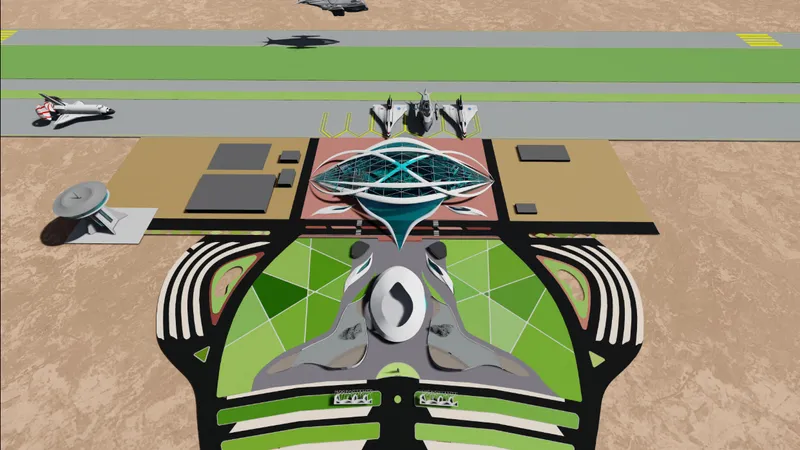
Kulasekharapatnam is identified as a critical node in India’s future space infrastructure due to its coastal orientation and reduced risk profile for rocket debris over populated areas. The site planning integrates multiple safety radii, controlled access zones, and flight approach corridors, ensuring operational efficiency without compromising environmental or human safety.
The master plan carefully organizes high-security technical zones: such as vertical launch pads, propellant stations, assembly complexes, and radio control facilities, away from public domains. These are balanced with civic-facing programs including exhibition spaces, training facilities, and arrival terminals, forming a layered spatial hierarchy across the site.
Landscape buffers, wind-responsive orientation, and circulation spines are designed to align with climatic conditions including high humidity, coastal winds, and saline soil. The overall planning strategy positions the spaceport as both a national infrastructure asset and a regional catalyst for development.
Programmatic Zoning and Functional Layout
The commercial spaceport operates as a hybrid between an airport, research campus, and public institution. The program is distributed across multiple zones:
- Launch and Assembly Zone: Vertical launch pads, propellant stations, and spacecraft assembly facilities form the core technical backbone of the project.
- Runway and Emergency Systems: A dedicated runway supports horizontal landing spacecraft, complemented by offshore emergency landing sites.
- Public Arrival and Experience Zone: Passenger terminals, viewing galleries, interactive museums, and training modules introduce civilians to space travel.
- Operational and Administrative Zone: Control rooms, facility offices, and logistics support ensure continuous monitoring and coordination.
This zoning strategy ensures secure segregation between sensitive launch operations and public access while maintaining visual and experiential connections through controlled vistas and circulation paths.
Architectural Form and Design Language
The architectural form is inspired by the abstraction of a bird’s nest: symbolizing shelter, transition, and departure. Just as a nest serves as both a point of rest and a launch into the world, the spaceport functions as an intermediary space between Earth and the cosmos.
Layered structural ribs and fluid envelopes define the terminal architecture, creating a dynamic silhouette that responds to movement, wind, and light. The woven spatial concept translates into a continuous interior landscape, where circulation, waiting areas, and exhibition zones merge seamlessly.
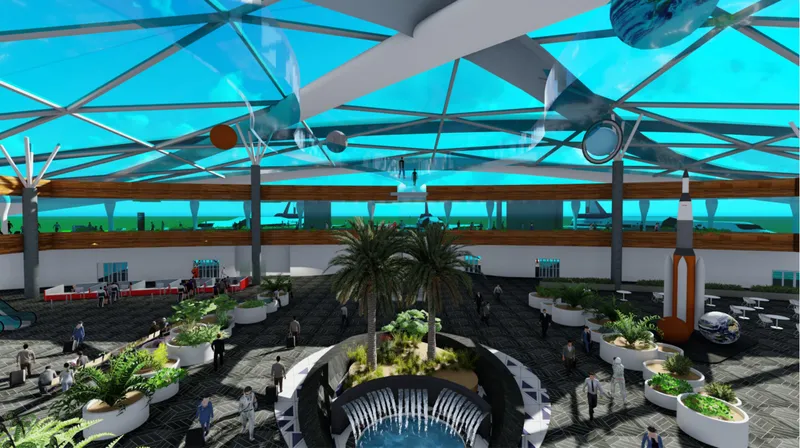
Large-span structures and transparent skins allow natural light to penetrate deep into the building, reducing reliance on artificial lighting while reinforcing a sense of openness and anticipation. The form avoids rigid symmetry, instead embracing organic curvature that reflects motion and flight.
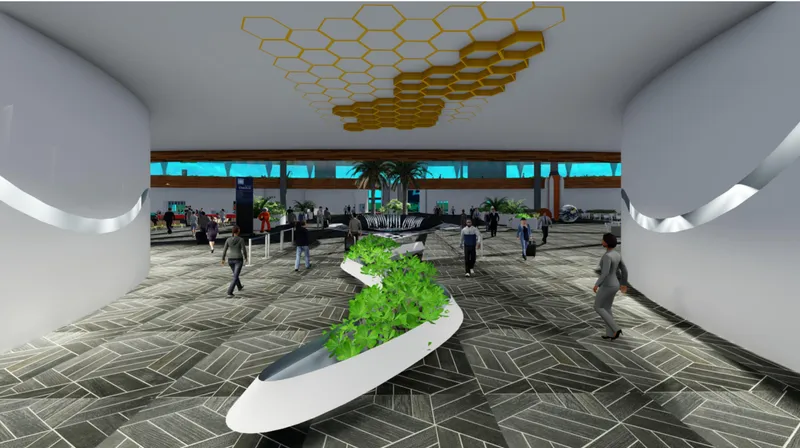
Interior Experience and Public Engagement
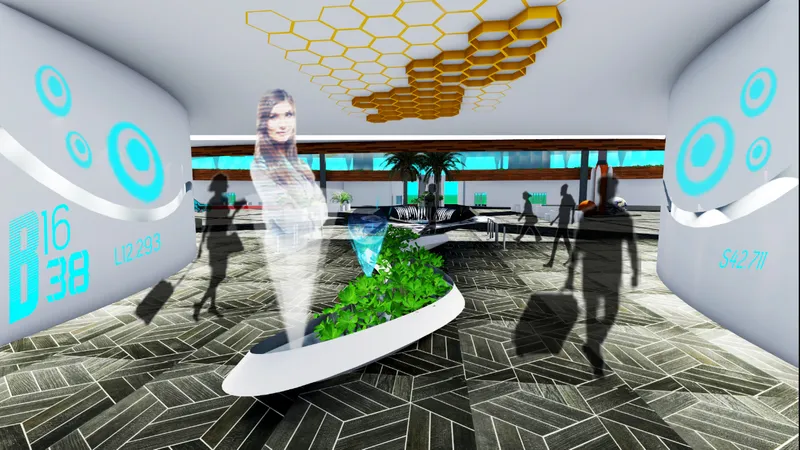
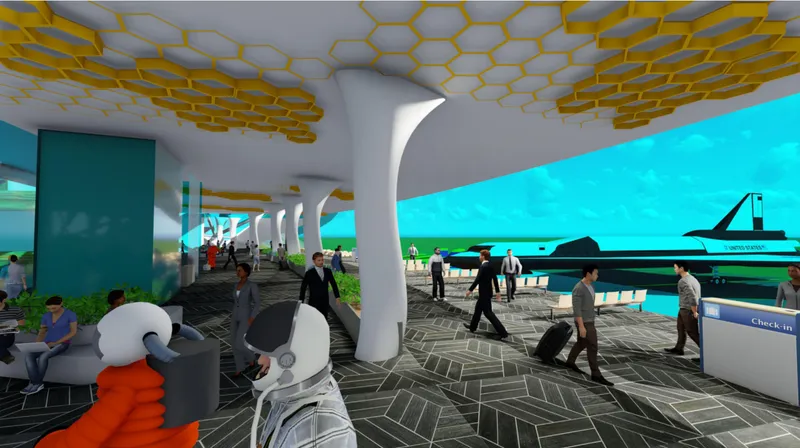
The interior spaces are designed to evoke awe, curiosity, and preparedness. Arrival halls function as immersive environments, integrating digital interfaces, real-time flight data, and visual connections to runways and spacecraft bays.
Training and rehabilitation zones prepare passengers physically and psychologically for space travel, while exhibition galleries educate visitors about orbital mechanics, spacecraft technology, and India’s role in global space exploration.
Public lounges, observation decks, and waiting areas are designed with flexibility, accommodating astronauts, tourists, researchers, and families alike. The architectural narrative ensures that even non-travelers experience the emotional gravity of spaceflight.
Sustainability and Environmental Response
Given its coastal context, the spaceport architecture integrates climate-responsive strategies such as shaded circulation, wind-channeling forms, and reflective surfaces to mitigate heat gain. Green buffers and permeable landscapes reduce surface runoff and improve microclimatic comfort.
Material selection prioritizes durability against saline air and humidity, while modular construction methods allow for future expansion as space travel technologies evolve. The project positions sustainability not as an add-on, but as an operational necessity within high-performance infrastructure.
Rethinking Infrastructure for the Space Age
This project challenges conventional notions of transport architecture by positioning the spaceport as a cultural, educational, and symbolic landmark. Beyond its technical function, the spaceport represents humanity’s collective aspiration to explore beyond planetary boundaries.
By merging commercial spaceport architecture with public experience, the design reframes space travel as an accessible and shared endeavor. The architecture becomes an instrument of storytelling: communicating ambition, innovation, and the future of mobility.
Project Credits
Project Title: Spaceport, Commercial Spaceport Architecture
Project By: Arun
Location: Kulasekharapatnam, Thoothukudi
District, Tamil Nadu, India



Popular Articles
Popular articles from the community


Manzana Morphosis: Stretching Barcelona's Grid into a Living Landscape for 2050
A radical reworking of the Eixample manzana turns density into a tool for generous public space, vertical ecology, and environmental performance.
Extended Shell: Retrofitting Kolkata's Balconies as Living Urban Thresholds
A modular retrofit system recovers the social and environmental intelligence of Kolkata's historic verandas for contemporary Park Street residents.
Tsunami Convergenics: Turning Catastrophic Ocean Forces into Underwater Housing Infrastructure
A speculative underwater settlement off the coast of Onagawa, Japan, treats tsunamis and typhoons as energy sources rather than threats.

The Amber Palace Opera: A Geological Fiction Surfaces on Tallinn's Baltic Waterfront
Pierre Brillard reimagines a Baltic legend as a public landscape, opera house, and waterfront promenade rooted in Tallinn's coastal identity.

Similar Reads
You might also enjoy these articles

Maya Harvest: A Cacao Resort Village Rooted in Mayan Tradition and Local Craft
Situated within a Tabasco cacao plantation, this shortlisted resort proposal merges vernacular materials with hands-on cultural immersion.
Harmonia: A River-Shaped Community That Grows Over Decades in Boa Vista
Curved pathways and modular grid structures along the Branco River create a phased settlement designed to evolve from 2030 to 2050.

The Architecture of Bathing: A Mughal Hammam Reimagined Across the Yamuna
Charlotte May's honorable mention entry for The Black Taj reinterprets Agra's bathing rituals through red sandstone, water, and framed views of the Taj Mah
Om-1: A Wall-Hung System That Moves Your Workspace Off the Desk
Modular plywood boards, magnetic pegs, and utility elements migrate clutter from the horizontal surface to the vertical plane.

Explore Space Tourism Competitions
Discover active competitions in this discipline

Challenge to reimagine the Iron Throne

Photograph architecture without architects

Illustrate the lost glory of Angkor Wat - Render Challenge

Design challenge to reuse E-waste
Comments (0)
Please login or sign up to add comments
No comments yet. Be the first to comment!