

SPASM Design Architects Weave a Steel-and-Earth Lakehouse into 50 Acres of Hyderabad Forest
On the shores of Lake Osman Sagar, a metal frame and rammed earth infill house vanishes behind the first line of trees.


Most lakefront houses announce themselves. They perch on bluffs, cantilever over water, or flatten the vegetation for an unobstructed panorama. Lake Shore House, designed by SPASM Design Architects on the banks of Lake Osman Sagar outside Hyderabad, does the opposite. From the water, the building is nearly invisible, tucked behind a screen of mature trees that the architects left entirely intact. The house does not dominate its 50-acre site; it occupies a quiet seam between cleared lawn and dense forest, registering as a sequence of thin roof planes and vertical steel columns that echo the trunks around them.
What makes the project genuinely interesting is its construction thesis. SPASM treats the house as an investigation into frame and infill: a slender metal skeleton provides structure and rhythm, while rammed earth walls provide mass, thermal inertia, and a tonal link to the laterite soil of the Deccan Plateau. The two systems remain legible from every angle, never fused into a single composite but instead held in a clear structural dialogue. The result is a building that breathes, filters breezes, frames birdsong, and lets light pass through in calibrated ways rather than sealing itself behind a glass curtain.
Disappearing into the Canopy
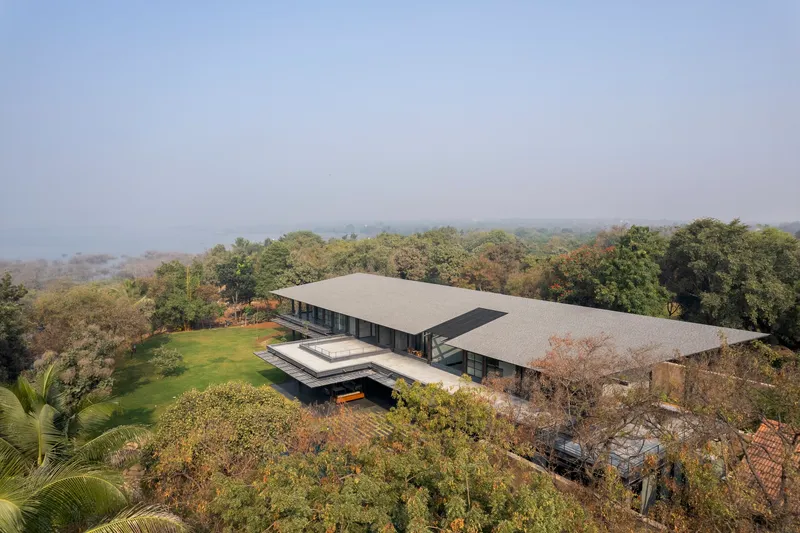
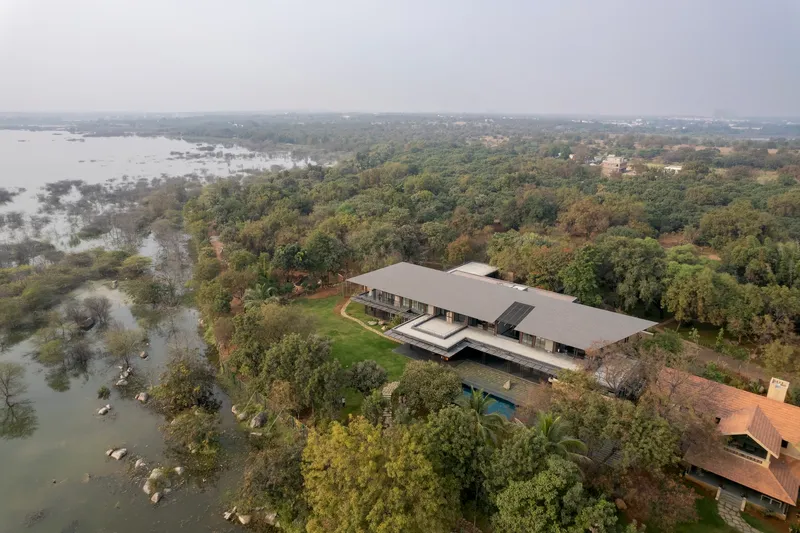
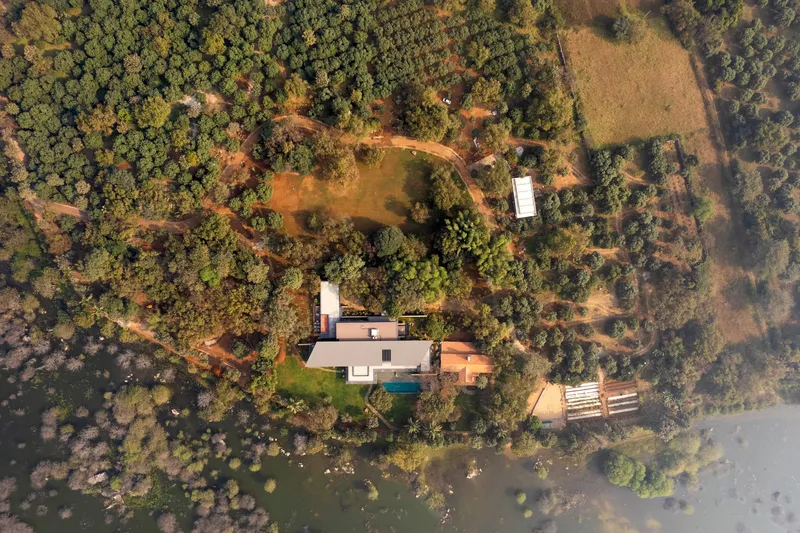
Seen from the air, the house reads as a pair of flat, grey-toned roof planes slipped beneath the tree canopy like cards into a deck. Hazy mornings around the lake amplify the effect: the residence dissolves into mist and foliage, with only the pool terrace and cleared lawn marking its footprint. The siting is strategic. Rather than clearing forest for a view corridor, SPASM positioned the house so the existing tree line serves as a natural veil. Approaching from the lake, you would have to know where to look.
The adjacent wetlands and dense forest that wrap the property are not just scenery; they are an integral part of the environmental strategy. Breezes crossing the lake pass through this green buffer before reaching the house, arriving cooler and filtered. In a city where summer temperatures regularly clear 40 degrees, that passive cooling layer is not ornamental.
Steel Frame, Earth Infill
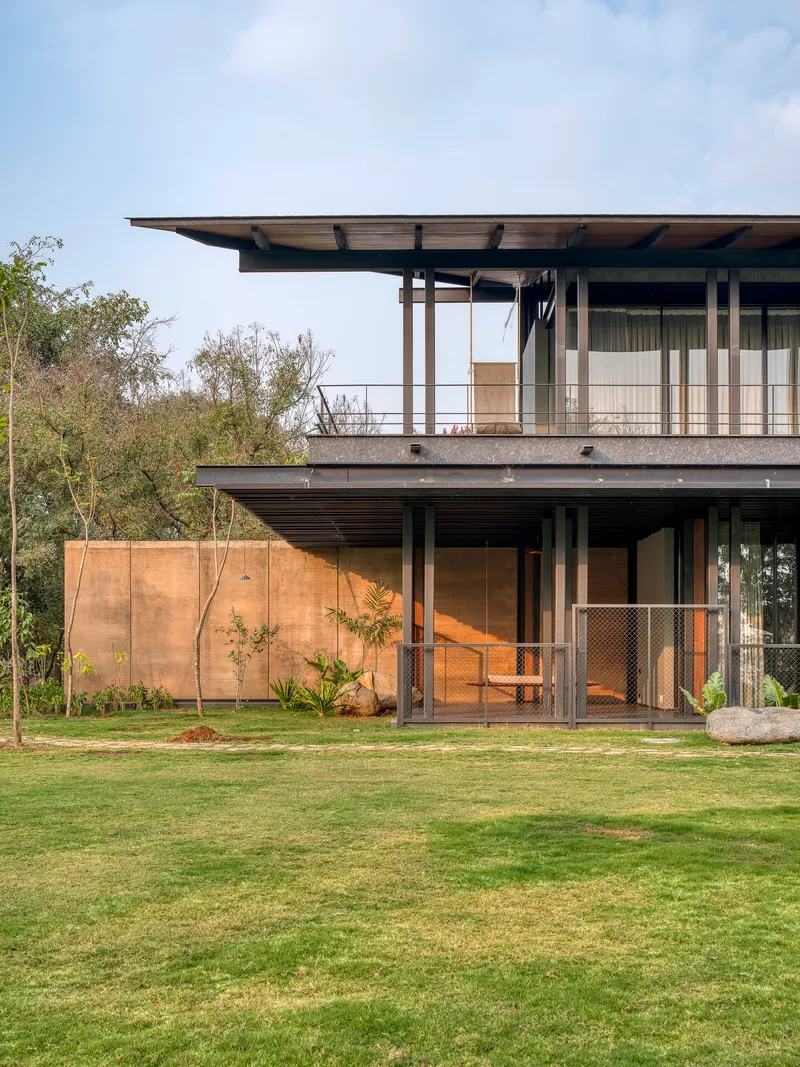


The structural logic is immediately readable at the garden facades. Vertical steel columns march at a consistent rhythm, forming a two-story frame that extends beyond the building envelope to support deep overhangs. Between these columns, the walls alternate between full-height glazing and thick panels of rammed earth whose warm, striated surfaces catch afternoon light and cast long shadows across the lawn.
The rammed earth is not decorative cladding. It carries real thermal weight, absorbing heat during the day and radiating it slowly at night, stabilizing interior temperatures without mechanical intervention. Paired with the steel skeleton, which is industrial, precise, and frankly structural, the earth walls register as geological, slow, and handmade. That tension between the two material systems gives the house its character. It would be a different building entirely if the infill were concrete block or brick.
The Ground Plane: Pool, Terrace, and Threshold


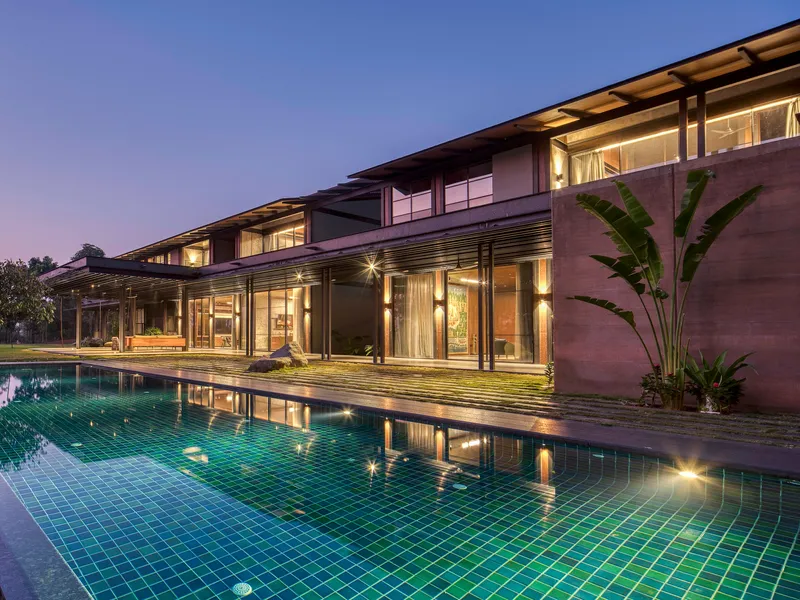
The pool terrace functions as the social center of the house, stretching along the garden side and connecting interior living spaces to the landscape through full-width sliding glass panels. Paving shifts between striped yellow stone and mosaic tile, subtly defining zones for lounging, dining, and circulation without walls or level changes. At dusk, the pool's green tile lining reflects the illuminated timber ceiling structure overhead, collapsing the distinction between inside and out.
Steel columns continue uninterrupted from interior to exterior, reinforcing the frame-and-infill logic even where walls vanish entirely. The covered outdoor terrace is essentially an open room, its slatted metal ceiling casting rhythmic shadow patterns across the stone floor. It is a space designed for the Hyderabad climate: sheltered from direct sun and monsoon rain, open to every breeze that crosses the lake.
Roof Planes and Dusk Geometry


At twilight the house reveals its geometry most clearly. The extended metal roof planes float above the glazed facades, their horizontal reach exaggerated by deep overhangs that shade the upper and lower stories simultaneously. A cantilevered upper balcony projects outward at the corner, supported by steel columns and screened by horizontal sun louvers that filter the low western light.
The composition is deliberately layered: roof, louver, glass, earth wall, landscape. Each layer operates at a different scale and performs a different environmental task. Taken together, they create a building that does not need a sealed, air-conditioned envelope to be comfortable. It is architecture as filter, not barrier.
Interior Craft and Material Continuity


Inside, the material palette stays consistent. Timber-clad walls and treads line the staircase, where a brass handrail catches light from a narrow slot window. The covered porch's slatted metal ceiling reappears as a motif throughout the house, its shadow play becoming a kind of ornament that changes with the sun's angle. Even the rammed earth walls continue into the interior, their exposed layers visible beside planted banana palms at the pool level.
What holds these moments together is discipline. The architects resist the temptation to introduce new materials for effect. Stone, steel, timber, earth, glass: the list is short, and every element earns its place structurally or environmentally. That restraint gives the house a coherence that many large residences on generous sites fail to achieve.
Landscape as Architecture

Granite boulders punctuate the lawns, left in place or repositioned to anchor the garden compositions. Bare trees and palm clusters frame views of the upper terrace, their organic silhouettes set against the planar geometry of plastered walls. The landscape design does not feel manicured so much as curated: existing site features are preserved and woven into a new ground plane that blurs the boundary between designed garden and natural forest.
SPASM's choice to build on only a fraction of the 50-acre plot is itself an architectural decision. The house is small relative to the land, and the proportion matters. It means that the primary experience of arriving, dwelling, and departing is one of landscape rather than building. The architecture is confident enough to play a supporting role.
Plans and Drawings

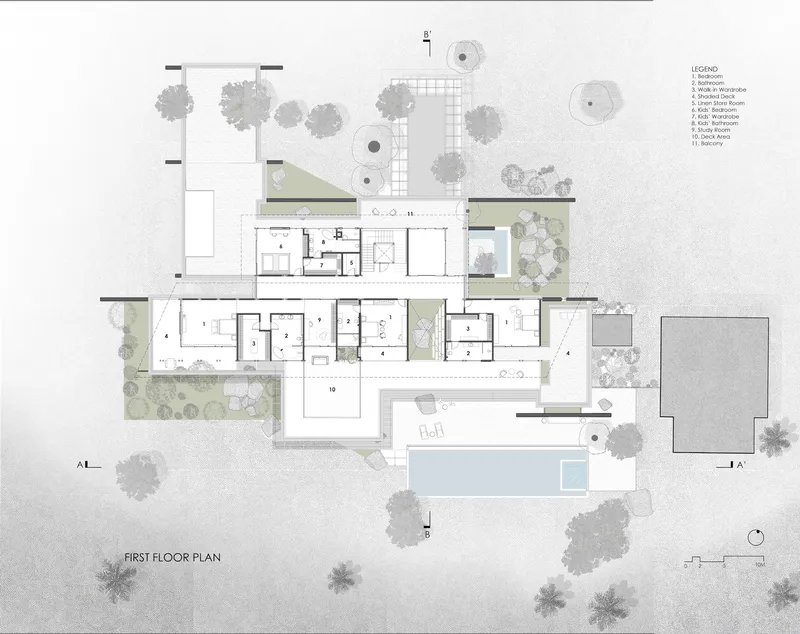


The ground floor plan reveals two wings arranged around courtyards and garden spaces, with living areas opening directly onto the pool terrace. Bedrooms and private suites are gathered on the first floor, pushed to the edges of the plan to maximize balcony access and cross-ventilation. The section drawings make the vertical strategy explicit: two-story volumes with tall window elements sit among the surrounding trees, their roof lines pitched just low enough to stay beneath the canopy. An early sketch captures the design's core idea, showing angled facade planes with a central opening flanked by vertical louvers, a diagram of the house as permeable screen.
Why This Project Matters
Lake Shore House matters because it demonstrates that a large residence in a tropical climate does not need to be a hermetically sealed glass pavilion or a fortress of reinforced concrete. SPASM's frame-and-infill approach is both structurally legible and environmentally purposeful, producing a house that responds to heat, monsoon, and breeze without relying entirely on mechanical systems. In a country where residential architecture is increasingly driven by developer aesthetics and imported typologies, this house argues for a construction logic rooted in site, climate, and material honesty.
It also offers a lesson in restraint on a generous site. With 50 acres at their disposal, the architects could have produced a sprawling estate. Instead, they built compactly and let the forest do the work. The house disappears when it should, reveals itself when the light is right, and remains, above all, a frame through which to experience the lake, the trees, and the particular quality of Deccan light. That is a harder thing to design than a monument.
Lake Shore House by SPASM Design Architects, Hyderabad, India. Completed 2022. Photography by Umang Shah.
About the Studio
Share Your Own Work on uni.xyz
If projects like this are the kind of work you want to make, uni.xyz is a place to publish your own, find collaborators, and enter design competitions.


Popular Articles
Popular articles from the community

Tsunami Convergenics: Turning Catastrophic Ocean Forces into Underwater Housing Infrastructure
A speculative underwater settlement off the coast of Onagawa, Japan, treats tsunamis and typhoons as energy sources rather than threats.

The Amber Palace Opera: A Geological Fiction Surfaces on Tallinn's Baltic Waterfront
Pierre Brillard reimagines a Baltic legend as a public landscape, opera house, and waterfront promenade rooted in Tallinn's coastal identity.

Opera on the Sea: Driftwood Logic Shapes a Timber Opera House on Estonia's Coast
Trevor Orgill's opera house translates the entangled drift of floating timber into a civic building where wood, water, and music converge.

Temporary Home for Dogs: A Reversed Zoo Rethinks Animal Shelter Architecture
In Bucharest, a sinuous corridor and freed landscape flip the logic of containment, designing a shelter that works to make itself unnecessary.

Similar Reads
You might also enjoy these articles

Pixel Gardens: One Repeated Module Stacked Into a Terraced Social Housing Tower for Famagusta
Salem Bader's shortlisted housing tower builds a vertical neighbourhood from one repeated module, offsetting units to carve terraces, light and air.

Bao Huynh Watercolor Atelier: A Serene Art Retreat in Hội An
Bao Huynh Watercolor Atelier in Hội An blends multifunctional art spaces, sustainable design, local materials, and family-friendly living in a serene environment.

Atelier Macri Concept Store Interior Design by CASE-REAL
Atelier Macri store features a "ko" counter, walnut wood details, cork displays, blending retail, gallery, and seamless customer experiences.

Manuel Vargas Izquierdo Stadium and High-Performance Sports Center: Architectural Excellence in Jalpa de Méndez
The Manuel Vargas Izquierdo Stadium blends sustainable design, inclusive sports facilities, and cultural-inspired architecture, revitalizing Jalpa de Méndez’s public spaces.


Comments (0)
Please login or sign up to add comments
No comments yet. Be the first to comment!