
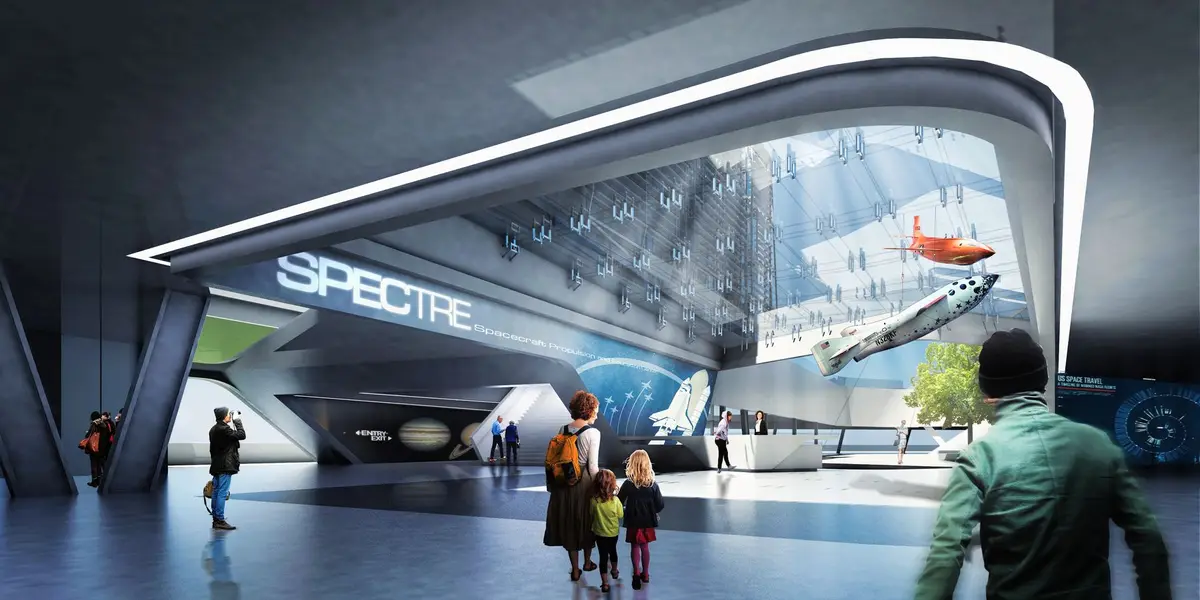
SPECtre: A Civic Architecture That Puts Space Research on Public Display
A runner-up entry for Moontrip 2019 reimagines the museum as a living laboratory where visitors witness spacecraft science in real time.


What happens when you stop treating a museum as a container of finished knowledge and start treating it as a live feed of discovery? SPECtre, the Spacecraft Propulsion and Education Center, proposes exactly that: a hybrid civic institution in Washington, D.C. that merges exhibition galleries, active research laboratories, and educational spaces into one continuously operating system. Visitors don't come to look at artifacts behind glass. They come to watch scientists test, iterate, and learn, becoming participants in the scientific narrative rather than passive spectators.
Designed by Ilko Iliev and Christopher Donatello, SPECtre was a runner-up entry in Moontrip 2019. Sited on a triangular plot near the Anacostia River with visual lines to the Washington Monument, the project draws its formal language from the physics of space travel: mass, vector, and gravity. The result is a building that looks like it was shaped by the same invisible forces it studies.
A Triangular Site Pulled Between River and Monument

The aerial view reveals SPECtre's relationship to its site with striking clarity. The building occupies a triangular lawn bordered by rivers, its angular massing appearing to have been sculpted by the geometry of the plot itself. Cantilevered volumes and suspended bridges reach outward, creating outdoor terraces that extend the program into the landscape. The Anacostia River and Washington Monument serve as both visual and symbolic anchors, rooting a building about the cosmos firmly in the geography and civic identity of the capital.
A Sloped Plaza That Choreographs Arrival

The entrance sequence is anything but neutral. A sloped concrete plaza guides visitors toward the building beneath a canopy of horizontal sunscreens, compressing the experience before the interior opens up. The ground plane tilts, the overhead louvers filter light, and the sense of moving through a controlled atmospheric threshold is immediate. It is a compressed prelude to a building that constantly oscillates between tight enclosure and panoramic openness.
This kind of spatial choreography reflects Iliev and Donatello's commitment to experiential design logic. Every transition is deliberate. The entrance doesn't just provide shelter; it primes the visitor's perception, setting up the layered encounters that follow inside.
Facade as Environmental Machine
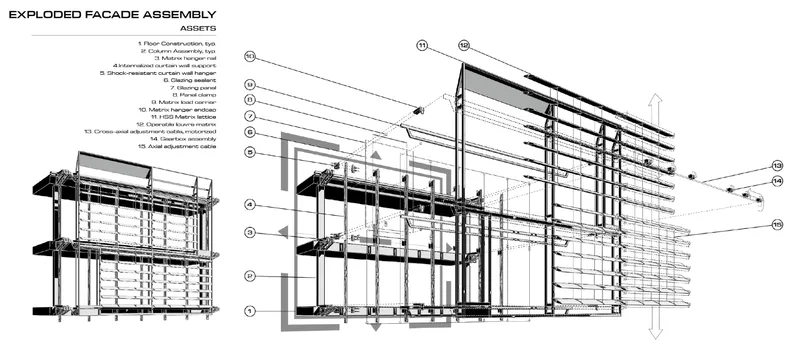
The exploded axonometric drawing reveals the facade as a carefully assembled system of louvers, structural frames, and cladding components. This is not decoration. The lattice facade performs double duty: establishing the building's angular visual identity while managing solar gain and passive environmental performance. The dichotomy of angular and rectilinear geometries, visible in the louver orientations and panel divisions, gives the envelope a tectonic depth that reads differently from each approach.
An Atrium That Connects Three Worlds
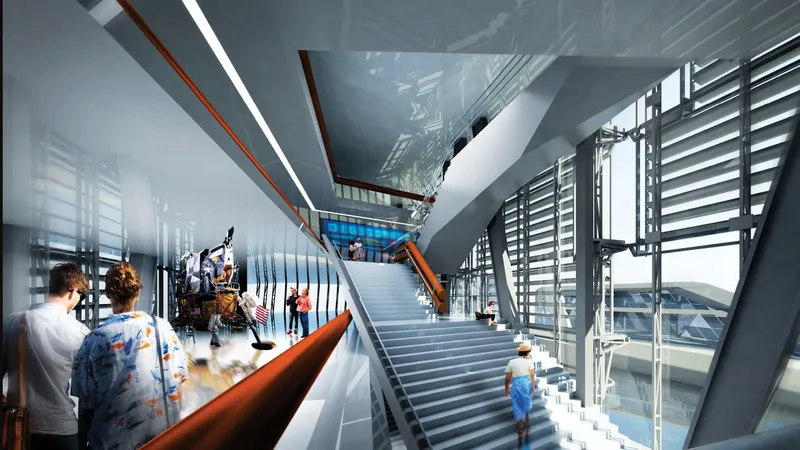
SPECtre's program revolves around three cores: a northern exhibition gallery for spacecraft and artifacts, southern active laboratories and mechanical testing environments, and a central belt of classrooms, seminar halls, and public gathering areas. The interior atrium is where these three worlds collide. Wide stairs with orange handrails invite movement between levels, while a generous skylight pours daylight into the section. Visitors on multiple floors can see across and into different programmatic zones simultaneously.
The looping elevated walkway that stitches these zones together encourages fluid circulation between exhibition, research, and education. Precise zoning and sightline control allow public accessibility and private innovation to coexist: you can watch researchers work without crossing into their space. The concept of the "living exhibition" depends on this architectural transparency, and the atrium section delivers it convincingly.
Cantilevered Volumes Read Like Celestial Bodies in Orbit
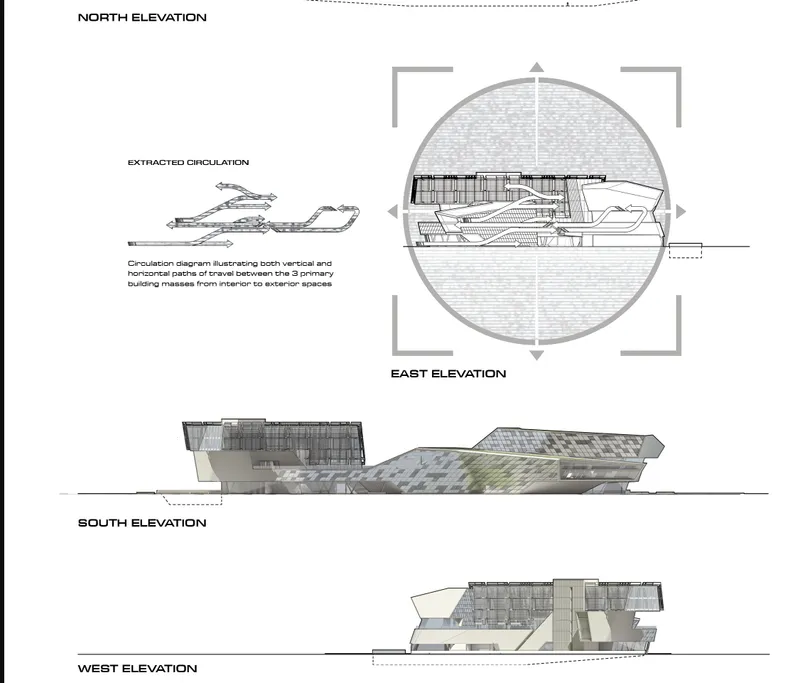
The four-cardinal elevation drawings make explicit what the renderings imply: SPECtre's massing is derived from abstract interpretations of mass, vector, and gravity. Volumetric aggregation produces the building's weight, trajectory defines its horizontal reach, and gravitational force sculpts its cantilevers. Seen from the side, the building reads as a series of bodies being pulled, pushed, and held in tension. The horizontal louvers wrap consistently across all elevations, unifying the formal variety under a single material discipline.
Why This Project Matters
SPECtre takes on a problem that most museum designs sidestep: how to make the process of discovery as compelling as its results. By dissolving the boundary between exhibition and laboratory, Iliev and Donatello propose an institution that remains perpetually current, its content refreshed not by curators swapping out displays but by researchers advancing their work in full view of the public. That programmatic ambition alone elevates the project beyond a typical competition entry.
Equally impressive is the formal conviction. The translation of mass, vector, and gravity into built geometry could easily have remained a diagrammatic exercise, but the designers push it through to facade detail, section, and site strategy. The building feels internally consistent: the same forces that justify its cantilevered massing also explain its circulation logic and its relationship to the Anacostia River. For a runner-up entry in Moontrip 2019, SPECtre sets a high bar for how architectural form and public programming can reinforce each other.
View the Full Project
About the Designers
Designers: Ilko Iliev, Christopher Donatello
Enter a Design Competition on uni.xyz
uni.xyz runs architecture and design competitions year-round that reward proposals with spatial conviction and real site intelligence.
Project credits: SPECtre by Ilko Iliev, Christopher Donatello Moontrip 2019 (uni.xyz).


Popular Articles
Popular articles from the community


Manzana Morphosis: Stretching Barcelona's Grid into a Living Landscape for 2050
A radical reworking of the Eixample manzana turns density into a tool for generous public space, vertical ecology, and environmental performance.


FCC Arquitectura Expands a Portuguese Granite House with a Board-Marked Concrete Wing
In Portugal, JV House pairs a cleaned-up whitewashed and granite dwelling with a timber-shuttered concrete extension, courtyards and a garden pool.

David Ortega Stacks a Two-Story Mexico City Penthouse Around a Steel Stair and a Pergola-Shaded Roof Terrace
In Colonia Roma, a 300 m² penthouse uses oak joinery, a planted steel stair and a slatted roof pergola to make a new-build apartment feel like a house.

Singing Woman: An Opera House That Performs Before the Curtain Rises
Ovidiu Cristian Pavel's conceptual opera house translates Estonia's choral identity into a sculpted waterfront landmark facing the Baltic Sea.

Similar Reads
You might also enjoy these articles

Vereda Arquitetos Renovates a 40-Square-Meter Apartment Inside Niemeyer's Copan Building
A compact unit in São Paulo's most iconic residential tower gets a material overhaul that pairs exposed concrete with bold blue Formica.

Shakur's House: Exposed Brick as an Interior Organiser in a 168 m² Mashhad Residence
Brick moves indoors in this Mashhad residence, where masonry walls, glass partitions and teal planes sequence a compact home without closing it off.

Day and Night Park: A Time-Based Urban Newsstand in Beijing
A temporary urban newsstand in Beijing blending travel, light, and reading through poetic colors, compact form, and community-focused design.

Modernist Patio Renovation in El Masnou, Barcelona by Oliver Segura Arquitectura + Cebrià Arquitectura
Modernist patio renovation blending tradition and innovation with a movable pool, leveled floors, and Catalan materials in El Masnou.

Explore Flexible Spaces Competitions
Discover active competitions in this discipline

Design a brochure to showcase the effects of the technosphere

Challenge to illustrate ‘A tale of Two Cities’

Deconstructivism - Illustration Design Challenge

Challenge to reimagine the Iron Throne
Comments (0)
Please login or sign up to add comments
No comments yet. Be the first to comment!