
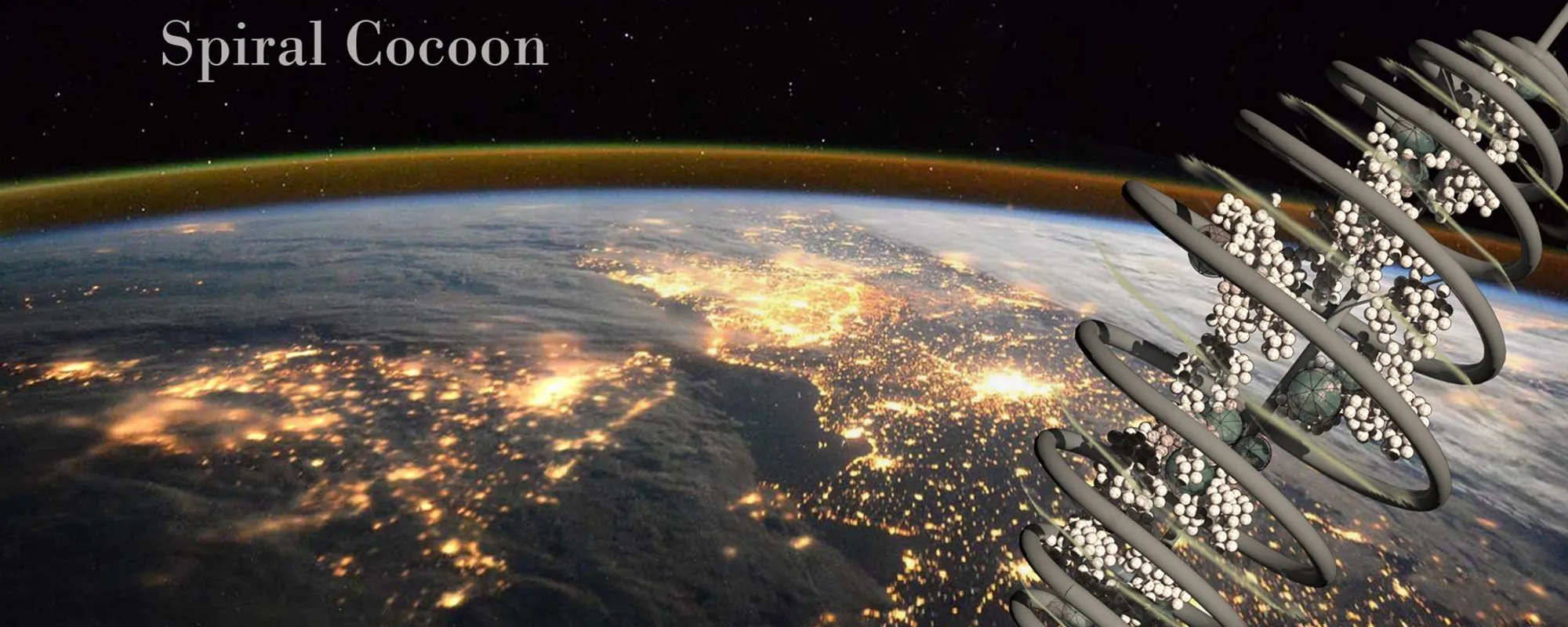
Spiral Cocoon: A Gravity-Sculpted Habitat for 2,000 Orbiting Residents
Zeynep Yerlikaya proposes a centrifugal spiral that carves artificial gravity along its walls and zero-gravity life at its core.


Most orbital habitat concepts treat gravity as a binary problem: spin the whole station or accept weightlessness. The Spiral Cocoon does neither. Instead, it distributes centrifugal force unevenly across a spiraling form, producing graduated gravitational zones along its outer walls while preserving a zero-gravity core for residential and social life. The result is a settlement where agriculture, laboratories, and sports facilities cling to the structure's weighted periphery, and modular living pods float freely at its center. It is, in spatial terms, a city organized by the physics of rotation rather than by a conventional ground plane.
Designed by Zeynep Yerlikaya, this shortlisted entry for the Origyn competition imagines a habitat base capacity of 2,000 people per spiral, with a modular logic that allows multiple cocoons to link into an archipelago of interconnected communities orbiting Earth. The project confronts the psychological toll of extraterrestrial living head on, proposing an artificial atmosphere sustained by magnetic field manipulation and electromagnetic charges that eliminates the need for space suits entirely.
Curved Discs and Floating Spheres: Anatomy of the Spiral
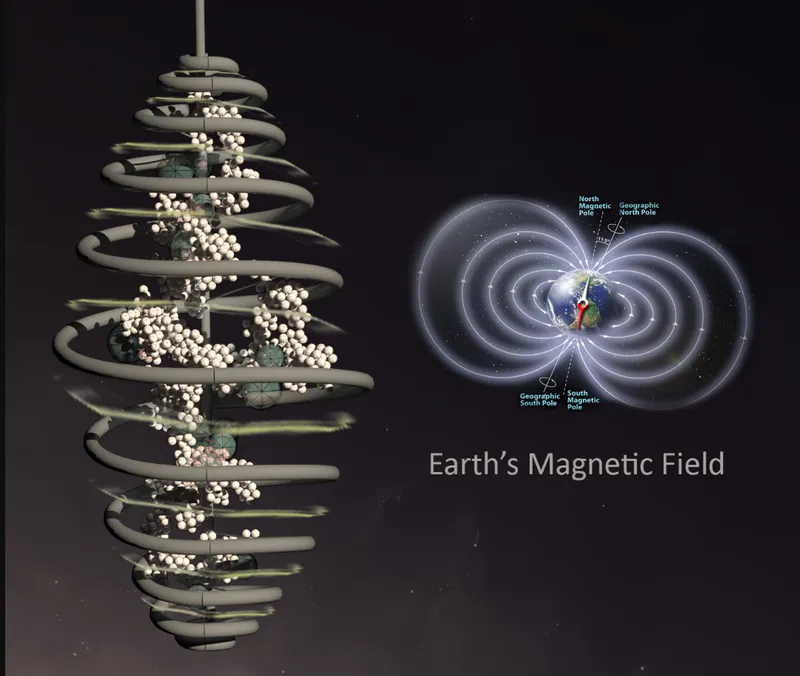
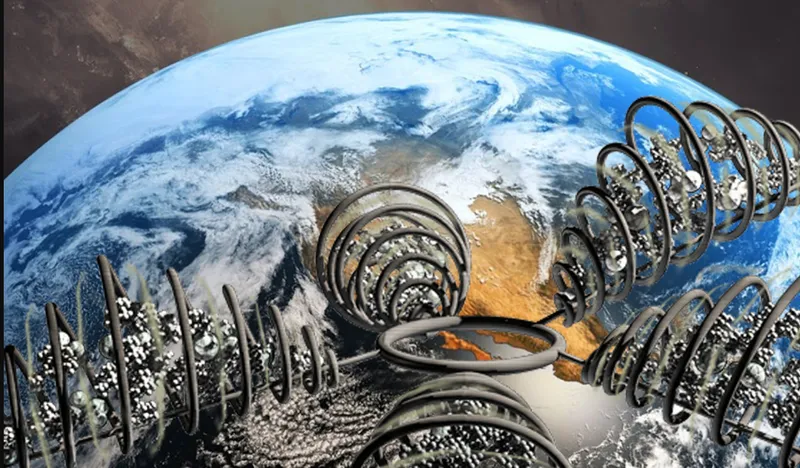
The structural diagram reveals the cocoon's core logic: a series of curved grey discs spiraling outward from a central spine, with white spherical modules distributed along and between them. These spheres are the habitat's living units, social spaces, educational centers, and observational platforms, all situated in the zero-gravity interior. The discs themselves form the gravitational landscape. As the spiral rotates, centrifugal force pushes against their surfaces, creating conditions heavy enough to sustain agriculture, water recycling, and oxygen production along the walls.
In the rendering, the habitat appears to emerge from Earth's cloud cover, its stacked spirals reading almost like geological strata pulled upward into orbit. The visual framing is deliberate. Yerlikaya positions the cocoon not as a departure from Earth but as an extension of it, a structure that carries terrestrial memory into the void. The quote from Sou Fujimoto that opens the project, about the richness of in-between spaces, finds literal expression here: the entire habitat occupies the territory between gravity and weightlessness, between planet and cosmos.
A Floating City Seen from the Night Side of Earth
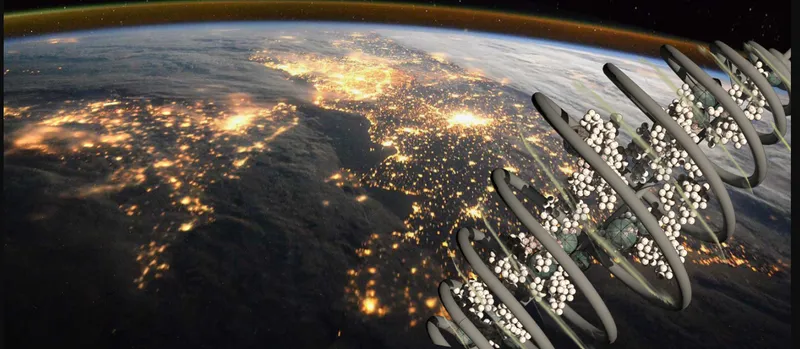
Viewed against the illuminated nighttime surface of Earth, with city lights tracing coastlines and river basins below, the spiral modules take on a different character. They look less like engineered infrastructure and more like an organism drifting above the planet it was born from. The scale becomes legible in this frame: each spiral arm is a self-contained settlement, but grouped together they suggest the density and interconnection of an urban network. The voids between modules are not wasted space. They are designed as communal zones, open plazas in zero gravity where residents gather, interact, and experience the freedom of weightless movement.
Vegetated Walls: Where Centrifugal Force Meets Agriculture
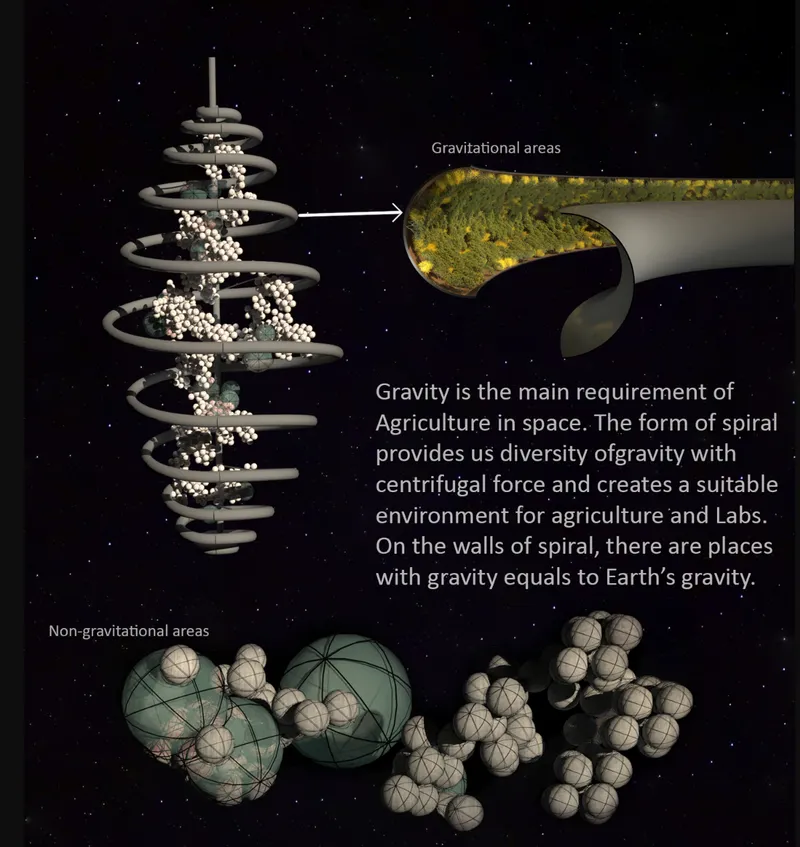
The sectional diagram cuts through the spiral to expose its interior ecology. Along the curved outer walls, where artificial gravity is strongest, layered vegetated zones support food production, O2 generation, and water recycling. These are the habitat's working landscapes, engineered to exploit the same rotational physics that keep residents' feet on the ground. The section also reveals the spatial contrast at the heart of the design: move inward from the planted walls and gravity dissipates, opening into the weightless core where clusters of living modules hang in suspension.
This arrangement has programmatic clarity. Gravitational zones host labor-intensive activities: farming, laboratory research, physical exercise. The zero-gravity interior is reserved for rest, education, observation, and social life. Yerlikaya frames this duality as essential to long-term psychological health in orbit, arguing that residents need both the grounding familiarity of weighted space and the liberating strangeness of weightlessness to sustain well-being far from Earth.
Three Construction Stages: From Ring to Networked City
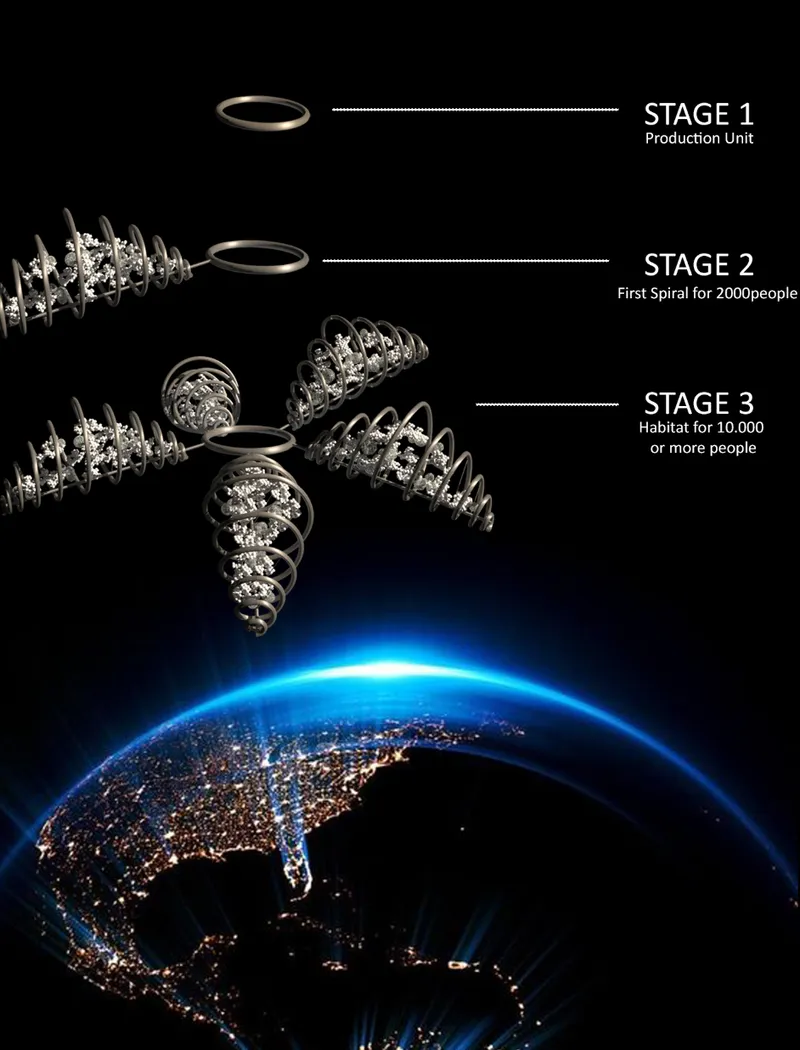
The phasing diagram maps a clear, scalable construction sequence. Stage one deploys a circular production unit into orbit, a manufacturing hub and central integrator that assembles the primary spiral structures. Stage two produces the first complete cocoon, a functioning habitat for up to 2,000 residents that doubles as a prototype. Stage three connects additional cocoons into a branching network, eventually forming a city capable of housing 10,000 or more people. Each phase integrates new functionalities and supports progressive habitation, so the settlement grows in capability as it grows in population.
The branching geometry visible in the final stage is significant. Rather than a single monolithic station, the system produces a distributed network of habitats linked at their bases but spiraling outward independently. This modularity means the city can adapt: adding capacity where demand grows, isolating sections for maintenance or emergency, and evolving its program over decades without requiring wholesale reconstruction.
Why This Project Matters
The Spiral Cocoon takes a position that most speculative space habitats avoid: it treats the emotional and spatial experience of living in orbit as a design problem of equal weight to the engineering. The artificial atmosphere sustained by electromagnetic manipulation, the graduated gravity zones, the zero-gravity communal plazas are all technical propositions, but they serve a fundamentally human agenda. Yerlikaya is not simply solving for air supply and radiation shielding. She is asking what kind of place people would actually want to inhabit for a lifetime, and she answers with a structure that oscillates between the familiar weight of Earth and the radical freedom of its absence.
As a conceptual framework, the project also challenges the default imagery of orbital architecture: the rigid torus, the cylindrical drum, the hermetically sealed capsule. The spiral is a more generous form. It creates variation in gravity, in program, and in spatial experience along its length. It allows expansion without symmetry. And it situates the act of living in space not as survival under extreme conditions, but as an encounter with an in-between world that is, to borrow Fujimoto's word, genuinely rich.
View the Full Project
About the Designers
Designer: Zeynep Yerlikaya
Enter a Design Competition on uni.xyz
uni.xyz runs architecture and design competitions year-round that reward proposals with spatial conviction and real site intelligence.
Project credits: Spiral Cocoon by Zeynep Yerlikaya Origyn (uni.xyz).



Popular Articles
Popular articles from the community


Riyadh For All: Intergenerational Urban Design for Active Aging in Rabat
Riyadh For All reimagines urban design in Rabat with intergenerational co-living, adaptive courtyards, and Moroccan cultural exchange today.

The Musturak Paradise: Senior Living Architecture for a Connected Future in Temara, Morocco
The Musturak Paradise reimagines senior living architecture in Temara via private homes, social spaces, culture, community, and shared care.

Co-life: Sustainable Architecture for Age-Friendly Community Living
Co-life reimagines sustainable architecture for seniors through courtyards, rammed earth, shared gardens, and spaces designed for belonging.

Co-Life: Senior Housing Design That Reconnects Older Adults With the City
Co-Life reimagines senior housing design through healing gardens, shared streets, workshops, and a sustainable community across generations.


Similar Reads
You might also enjoy these articles

Day and Night Park: A Time-Based Urban Newsstand in Beijing
A temporary urban newsstand in Beijing blending travel, light, and reading through poetic colors, compact form, and community-focused design.

Modernist Patio Renovation in El Masnou, Barcelona by Oliver Segura Arquitectura + Cebrià Arquitectura
Modernist patio renovation blending tradition and innovation with a movable pool, leveled floors, and Catalan materials in El Masnou.

Alto Residencial Coop: Cooperative Housing Development in Santiago de Compostela by Carbajo Barrios Arquitectos
A linear cooperative housing complex blending white volumes and perforated metal façades, enhancing community living, natural light, privacy, and urban integration.
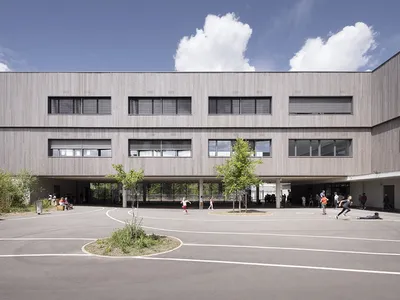
Vil Genis School by BPA ARCHITECTURE – Massy, France
Vil Genis School in Massy, France, features sustainable design, south-facing classrooms, community integration, accessible spaces, and modern educational architecture.
Comments (0)
Please login or sign up to add comments
No comments yet. Be the first to comment!