

Spiral Forest: A Library That Grows Like a Living Organism
Minh Chi's triangular, spiral-organized library dissolves boundaries between park, plaza, and reading room to anticipate urban change.


What if a library could grow? Not just accumulate more books or add a wing, but structurally evolve in response to cultural shifts, new technologies, and community needs that don't yet exist. Spiral Forest takes that question seriously. Built around a triangular layout and a spiral organizational logic, the project treats the public library not as a fixed container but as a flexible framework: one that can absorb future expansions, start-up hubs, exhibitions, and even healthcare support without breaking its formal coherence.
Designed by Minh Chi and recognized as an Editor's Choice entry in the Libgen 2019 competition, Spiral Forest reframes the library as an urban landscape rather than an institutional building. The design dissolves the hard line between interior and exterior, extending a central square both inward and outward so that visitors approach the building from multiple directions, encountering a park-like terrain before ever reaching a bookshelf.
A Glass Volume Hovering Above the City
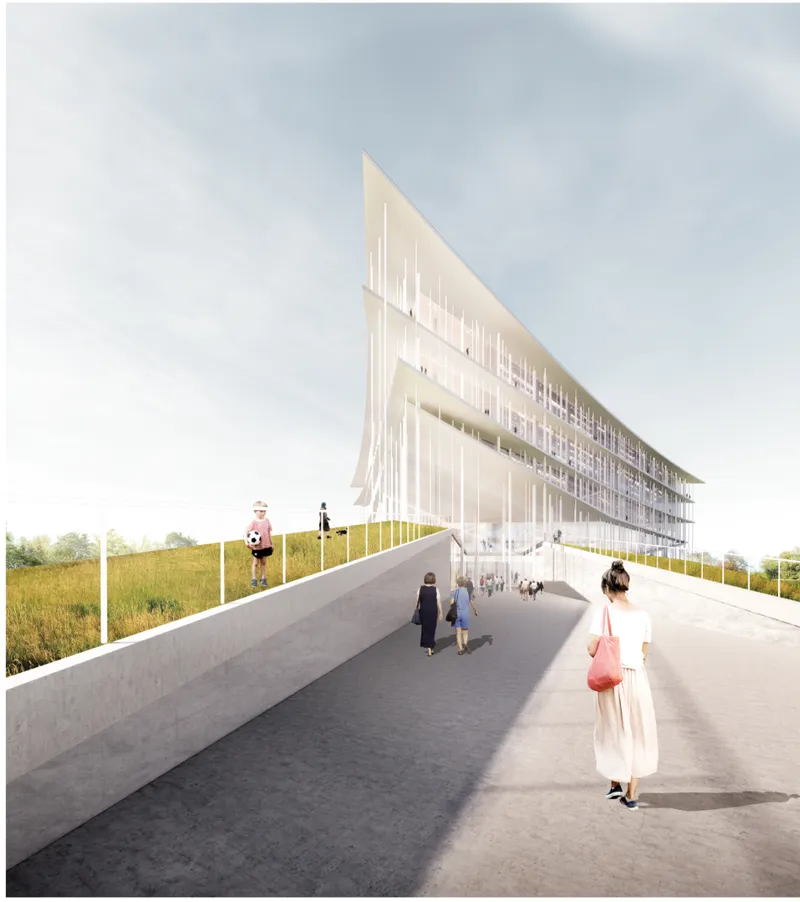
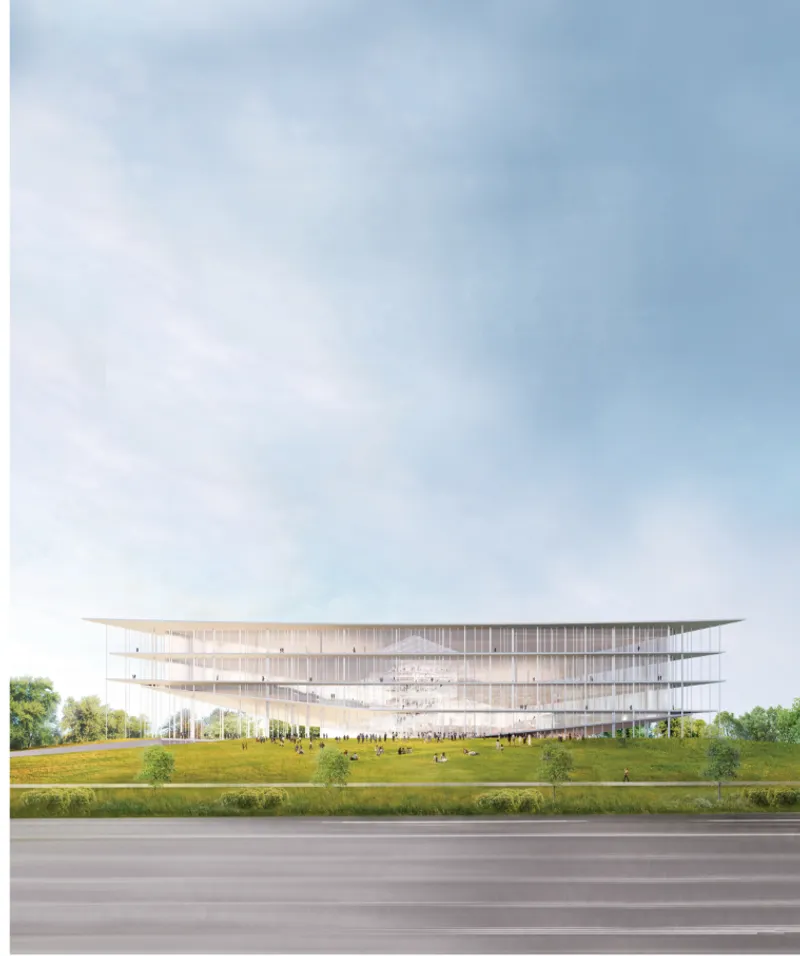
The exterior renderings reveal a cantilevered glass volume lifted above a ramped concrete plaza on one side and a sloping lawn on the other. Pedestrians move freely beneath and around the elevated structure, reinforcing the idea that this library belongs to the ground plane as much as it does to the reading rooms above. Columns hold the transparent volume aloft, allowing sightlines to pass through the building and into the landscape beyond. The effect is an architecture that refuses to wall itself off from its context, instead pulling the surrounding urban fabric into its orbit.
By lifting the primary program off the ground, Minh Chi reclaims the site's surface as genuinely public territory. The ramped plaza is not a threshold to be crossed but a destination in itself, continuous with the roadway and parkland. Afternoon light washes across the glass facade, signaling openness and activity to passersby who might not have planned a visit but find themselves drawn in regardless.
Tiered Reading Rooms Under a Coffered Ceiling
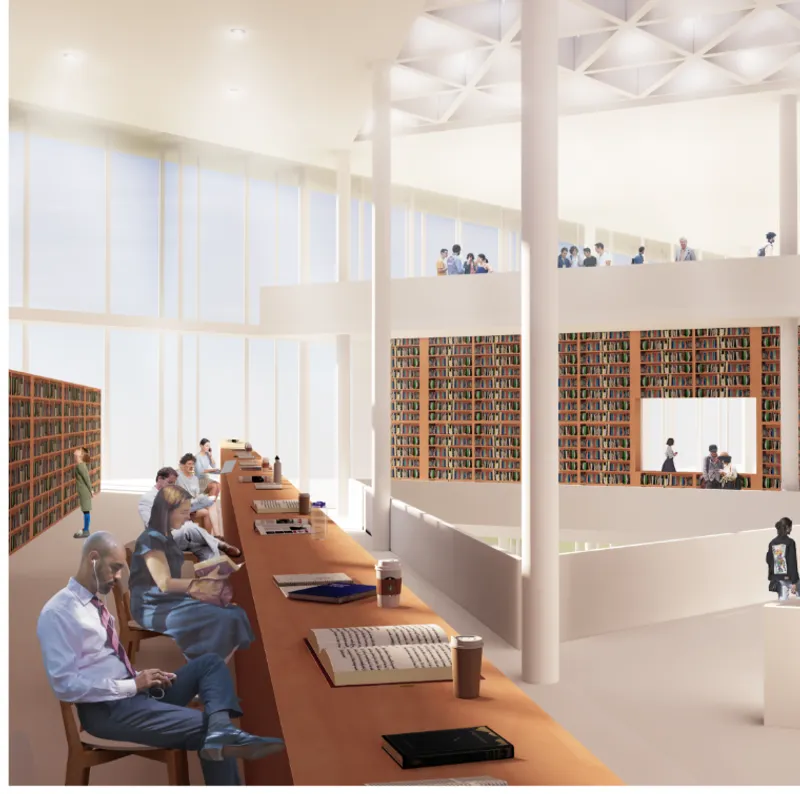
Step inside and the spatial logic shifts from horizontal openness to vertical layering. The reading room uses tiered seating that cascades down through the section, flanked by bookshelves that double as spatial dividers. Overhead, a faceted coffered ceiling filters soft daylight into the room, creating an atmosphere that is calm without being dim. The geometry of those coffers is deliberate: they break up the ceiling plane into smaller-scaled zones of light, so the room feels intimate even at a generous volume.
The tiered arrangement categorizes space by reading behavior rather than by subject matter. Quiet individual study, group discussion, and casual browsing each find their natural elevation and enclosure within the same room. It is a subtle but important move: rather than dictating how people use the library, the architecture offers a gradient of conditions and lets occupants self-sort.
A Multi-Level Atrium as the Spiral's Core
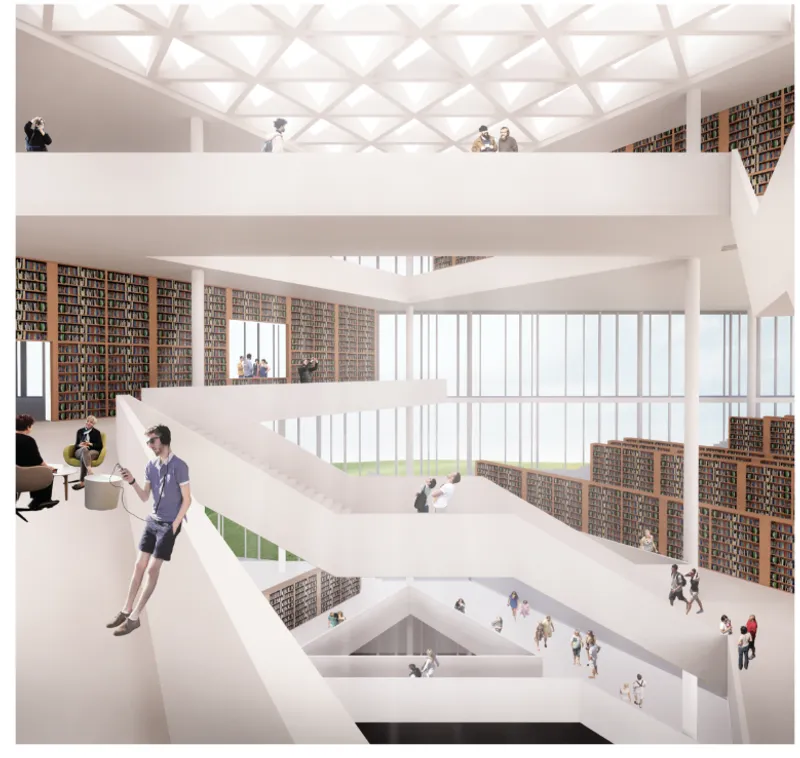
The project's most spatially ambitious moment is the multi-level atrium at the heart of the spiral. Cantilevered floor plates project into a central void, stacked and offset to create visual connections across several stories. Vertical bookshelves rise along the atrium walls, turning the act of browsing into something almost geological: you see strata of knowledge exposed in section. Above, the geometric coffered ceiling reappears at a larger scale, unifying the atrium and the reading rooms under a single structural language.
This is where the triangular framework proves its worth. The offset floor plates can extend or contract over time, accommodating new programs without requiring demolition. A start-up incubator could occupy one cantilever; an exhibition space another; a community health resource a third. The spiral organization means each addition slots into a sequence rather than competing for space, allowing the building to densify gracefully as demands evolve.
Adaptive Architecture as Programmatic Strategy
Spiral Forest's ambition goes beyond formal novelty. The triangular plan and spiral circulation are not stylistic choices but programmatic strategies for managing uncertainty. Libraries today serve as social, cultural, and intellectual hubs; tomorrow they may need to function as maker spaces, remote work centers, or civic gathering halls. By designing a framework rather than a finished object, Minh Chi builds resilience directly into the architecture. The building anticipates change rather than merely tolerating it.
The dissolution of boundaries between the central square, the park, and the interior reinforces this adaptability at the urban scale. When the library is not a destination with a single front door but a landscape you drift through, its capacity to serve unexpected populations and purposes multiplies. From young entrepreneurs to lifelong learners, the architecture serves as a platform rather than a prescription.
Why This Project Matters
Most library competitions produce beautiful objects that freeze a program in time. Spiral Forest does something rarer: it proposes a system. The triangular layout, the spiral circulation, the cantilevered floor plates, and the park-integrated ground plane all work together as a kit of strategies that could absorb decades of programmatic evolution without losing spatial clarity. That is a significant contribution to the conversation about what public architecture should do in an era of rapid social change.
Minh Chi's project also demonstrates a mature understanding of how form and flexibility relate. Adaptive architecture risks becoming shapeless if it prioritizes accommodation over identity. Here, the strong triangular geometry and the rhythmic coffered ceilings give the building a legible character even as its contents shift. It is both a place you would recognize and a place that could surprise you a decade from now, and that tension is exactly where the most interesting architecture lives.
View the Full Project
About the Designers
Designer: Minh Chi
Enter a Design Competition on uni.xyz
uni.xyz runs architecture and design competitions year-round that reward proposals with spatial conviction and real site intelligence.
Project credits: Spiral Forest by Minh Chi Libgen 2019 (uni.xyz).


Popular Articles
Popular articles from the community


Tsunami Convergenics: Turning Catastrophic Ocean Forces into Underwater Housing Infrastructure
A speculative underwater settlement off the coast of Onagawa, Japan, treats tsunamis and typhoons as energy sources rather than threats.
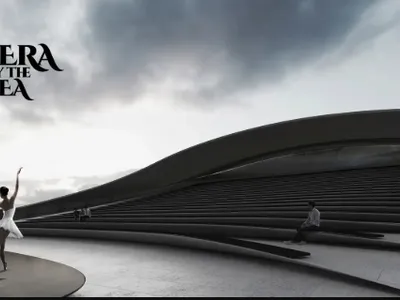
Opera by the Sea Estonia: Three Shells Dissolving Architecture into Tallinn's Coastline
A winning opera house proposal replaces monumental form with interconnected shells that blur the boundary between building, park and Baltic Sea.

Faces of the Soviet Avant-Garde: Turning Moscow's Street Names into an Open-Air Museum
A network of sculptural installations across a Moscow residential district transforms forgotten architect names into spatial encounters with cultural memor

Singing Woman: Contemporary Architecture Inspired by Estonia’s Voice and the Sea
Singing Woman turns Estonia’s song culture into flowing opera house architecture, blending public life, landscape, sea, and national memory.

Similar Reads
You might also enjoy these articles

Day and Night Park: A Time-Based Urban Newsstand in Beijing
A temporary urban newsstand in Beijing blending travel, light, and reading through poetic colors, compact form, and community-focused design.

Modernist Patio Renovation in El Masnou, Barcelona by Oliver Segura Arquitectura + Cebrià Arquitectura
Modernist patio renovation blending tradition and innovation with a movable pool, leveled floors, and Catalan materials in El Masnou.

Alto Residencial Coop: Cooperative Housing Development in Santiago de Compostela by Carbajo Barrios Arquitectos
A linear cooperative housing complex blending white volumes and perforated metal façades, enhancing community living, natural light, privacy, and urban integration.
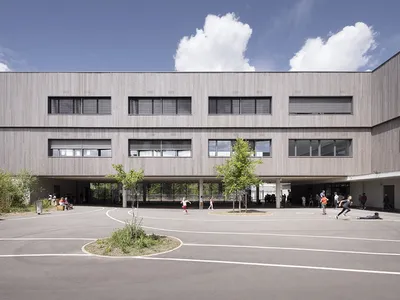
Vil Genis School by BPA ARCHITECTURE – Massy, France
Vil Genis School in Massy, France, features sustainable design, south-facing classrooms, community integration, accessible spaces, and modern educational architecture.

Explore Vertical Forest Competitions
Discover active competitions in this discipline

Challenge to reimagine the Iron Throne

Photograph architecture without architects

Illustrate the lost glory of Angkor Wat - Render Challenge

Design challenge to reuse E-waste
Comments (0)
Please login or sign up to add comments
No comments yet. Be the first to comment!