
St. James Town Hub: Steel Parasites That Stitch Toronto's Slab Towers Into a Shared Public Realm
Modular pods anchored to concrete stair cores and linked by sky bridges give St. James Town the shared rooms its 1970s towers never offered.


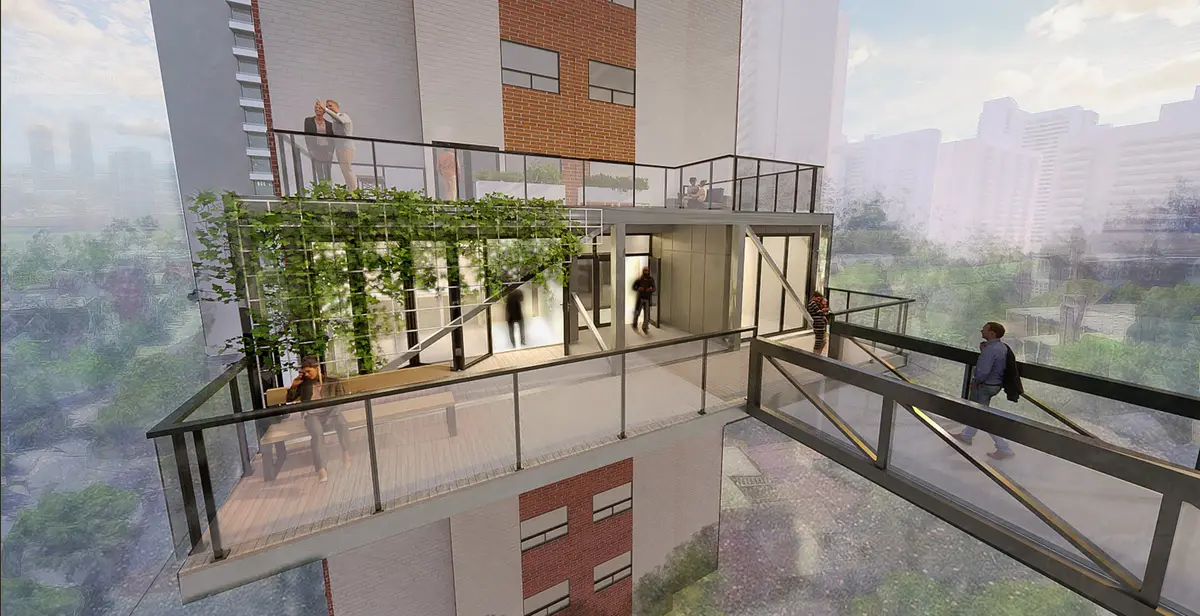
Density is not the same thing as community, and few places in Canada prove it as plainly as St. James Town. Thousands of residents live stacked in Toronto's 1970s slab towers, yet the neighbourhood has almost nowhere for them to meet. St. James Town Hub does not respond with demolition or a masterplan. It grafts small steel-framed rooms onto the towers' existing stair cores and strings them together with elevated bridges. The towers stay as they are, and the hub gives them the shared spaces they never had.
Designed by Teodor Mlynczyk, Alison Mair and Bill Tang, the project was named an Editor's Choice entry in Parasitic Architecture 2020. Its premise is grounded in the site's history. St. James Town was built for young urban professionals, but over the decades its population shifted toward low-income families with limited access to services and community space. As the building stock aged and public infrastructure failed to appear, the neighbourhood became fragmented. The designers read that gap as a brief: work with the fabric already there, and add what is missing.
Bridges That Turn Isolated Slabs Into a Network
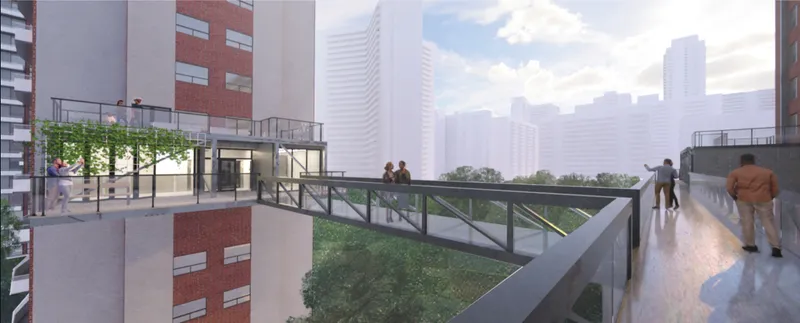
The opening render puts the project's main move up front: a glass-sided steel bridge spanning the leafy gap between two brick towers, with residents crossing it in daylight. Slab-tower estates usually leave each block to fend for itself, with lobbies at grade and no relationship between neighbours above the first floor. Here the walkway becomes a street lifted off the ground, and the space between buildings becomes a connection rather than leftover open space.
The anchoring strategy deserves attention. Each module is fixed to the existing concrete stair cores, the most robust and vertically continuous elements in a slab block. Choosing the cores lets the designers claim structural stability while barely disturbing the apartments. The parasite feeds on the host's strongest organ and leaves the rest alone, a precise reading of the competition theme.
A Work Pod With the Doors Thrown Open
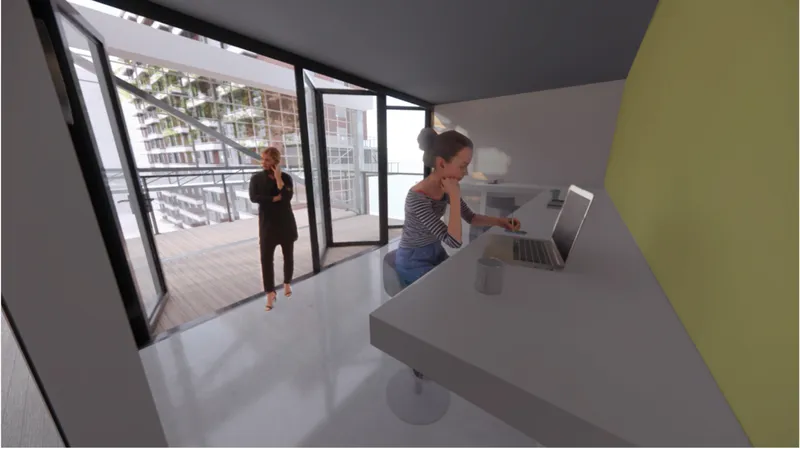
Inside, the scale shrinks to something domestic. A woman works at a laptop desk while glass doors open fully onto a deck beyond. This is the programme that a tower apartment cannot supply: a quiet place to work or study outside a crowded home that is still a lift ride away. The designers describe the interior zones as able to shift between professional, educational and recreational uses, and the render shows how modest that infrastructure can be. A desk, daylight and a threshold to the outdoors are enough.
Timber Decks as an Elevated Commons
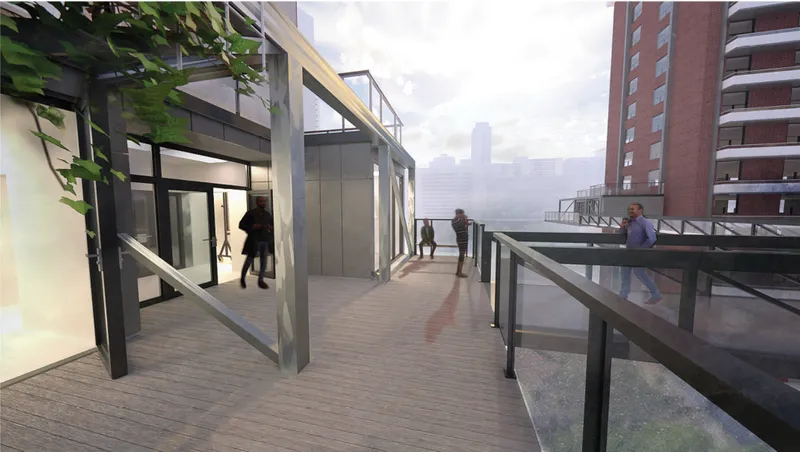
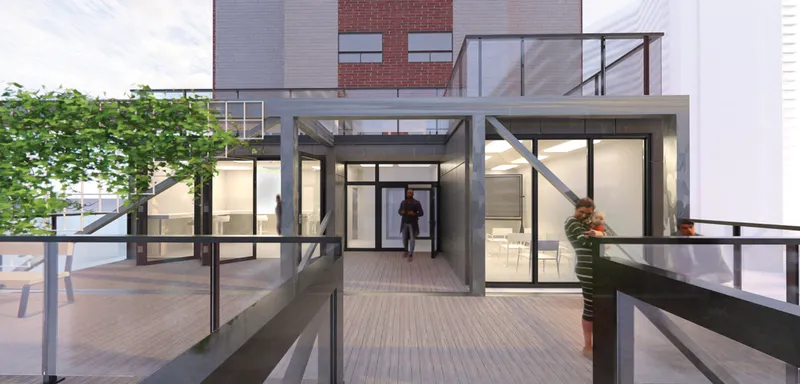
The terrace views explain why the project feels convincing rather than merely clever. Wooden decking, steel columns, glass railings and trailing vines produce a public realm in the air with a tactile quality the surrounding concrete lacks. Lifting communal space above the ground frees these terraces from the leftover lawns and parking that usually define tower-in-the-park estates, and the greenery softens a context the designers rightly describe as rigid. The front view, with a woman holding a child beside the glazed pavilion, locates the intended users clearly: families, not just commuting professionals.
Material choices support the integration. A lightweight steel framework carries the cantilevered modules, and perpendicular galvanized steel trusses extend from the core to distribute load and stabilise the structure. The enclosure is clad in grey fibre cement panels selected to sit comfortably against the towers' concrete and brick. The pods read as contemporary without claiming more attention than the buildings they serve.
One Plan, Split Between Eating and Working
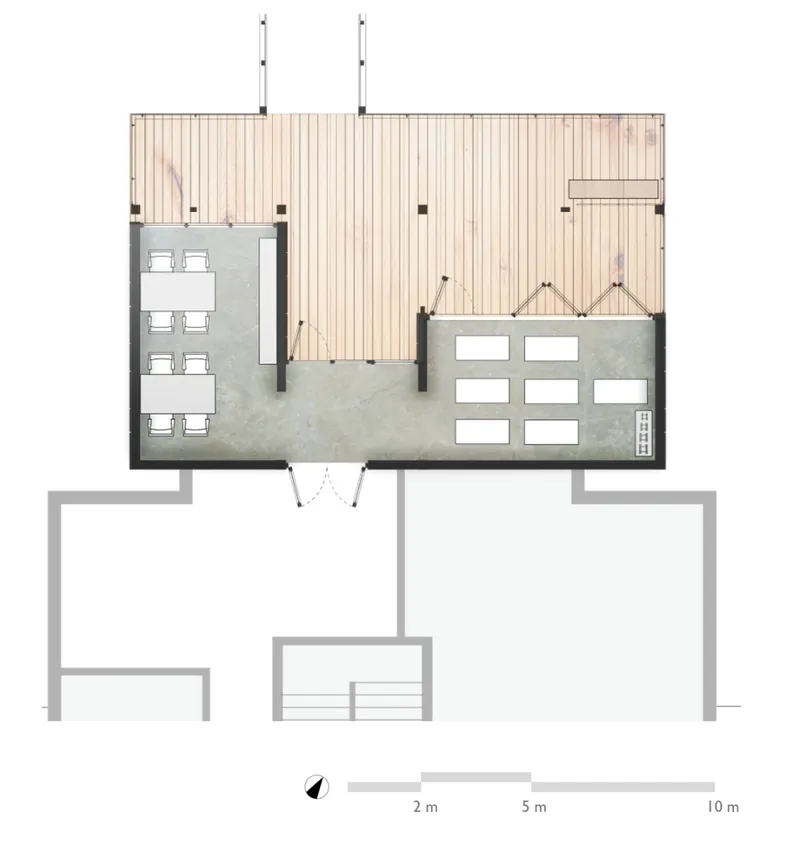
The floor plan shows the flexibility claim in concrete terms. A rectangular pavilion sits on its timber deck, with two dining tables on one side and a row of workstations on the other. The organisation is simple: one side for gathering, the other for focused work, with an open floor between that can be rearranged as needs change. Because the module is designed to repeat across multiple towers, each copy can tilt toward a different mix of uses, so the system can cover community kitchens, study rooms and shared offices without a new design for every site.
Why This Project Matters
Most proposals for ageing tower estates begin by asking what should be removed. St. James Town Hub asks what can be added, and answers with a kit of parts that respects both the structure and the people living in it. Anchoring to stair cores, linking towers with bridges and using restrained cladding together show that adaptive reuse can operate at the scale of a neighbourhood and not only a single building. The towers become the foundation for the public life that their original planning left out.
The project's wider value is in its modesty. It does not promise to fix St. James Town in one gesture; it offers a repeatable unit that can grow tower by tower as funding and need allow. For a community whose density has never translated into connection, that incremental, people-scaled approach may be more achievable than any redevelopment plan. The parasite here works more like an ally to its host.
View the Full Project
About the Designers
Designers: Teodor Mlynczyk, Alison Mair, Bill Tang
Enter a Design Competition on uni.xyz
uni.xyz runs architecture and design competitions year-round that reward proposals with spatial conviction and real site intelligence.
Project credits: St. James Town Hub by Teodor Mlynczyk, Alison Mair, Bill Tang Parasitic Architecture 2020 (uni.xyz).


Popular Articles
Popular articles from the community


Manzana Morphosis: Stretching Barcelona's Grid into a Living Landscape for 2050
A radical reworking of the Eixample manzana turns density into a tool for generous public space, vertical ecology, and environmental performance.


Cube Design Draws an Ecological Corridor Between Two Shenzhen Hills with the Nankai Building
Beside Shenzhen's container docks, the Nankai Building pairs stacked balconies with a climbing green screen to connect two hillsides across its height.

The Amber Palace Opera: A Geological Fiction Surfaces on Tallinn's Baltic Waterfront
Pierre Brillard reimagines a Baltic legend as a public landscape, opera house, and waterfront promenade rooted in Tallinn's coastal identity.

Singing Woman: An Opera House That Performs Before the Curtain Rises
Ovidiu Cristian Pavel's conceptual opera house translates Estonia's choral identity into a sculpted waterfront landmark facing the Baltic Sea.

Similar Reads
You might also enjoy these articles
Healing Façade: A Modular Chapel System That Restores Ethiopia's Sacred Forests
Winner of the Eco-Chapel competition, this circular timber façade collects water from air to rebuild soil and reforest degraded Ethiopian landscapes.
Kaffeebühnen: Where Coffee Shop Architecture Becomes a Civic Stage in Vienna
A linear sequence of timber boxes, transparent shells, and open yards turns the Viennese café tradition into a public performance space.
Eco Chapel: A Modular Forest Pavilion That Grows Like the Landscape It Protects
Hexagonal timber modules weave through existing trees, turning a chapel into a living system for prayer, education, and reforestation.


Urban Forest: A Vertical Ecosystem for 5,000 Workers in Singapore's Changi Business Park
Radially stacked pods and layered green decks turn a 7-acre plot into 47 acres of ecological workspace projected for 2040.

Explore Public Hub Competitions
Discover active competitions in this discipline

Challenge to reimagine the Iron Throne

Photograph architecture without architects

Illustrate the lost glory of Angkor Wat - Render Challenge

Design challenge to reuse E-waste
Comments (0)
Please login or sign up to add comments
No comments yet. Be the first to comment!