
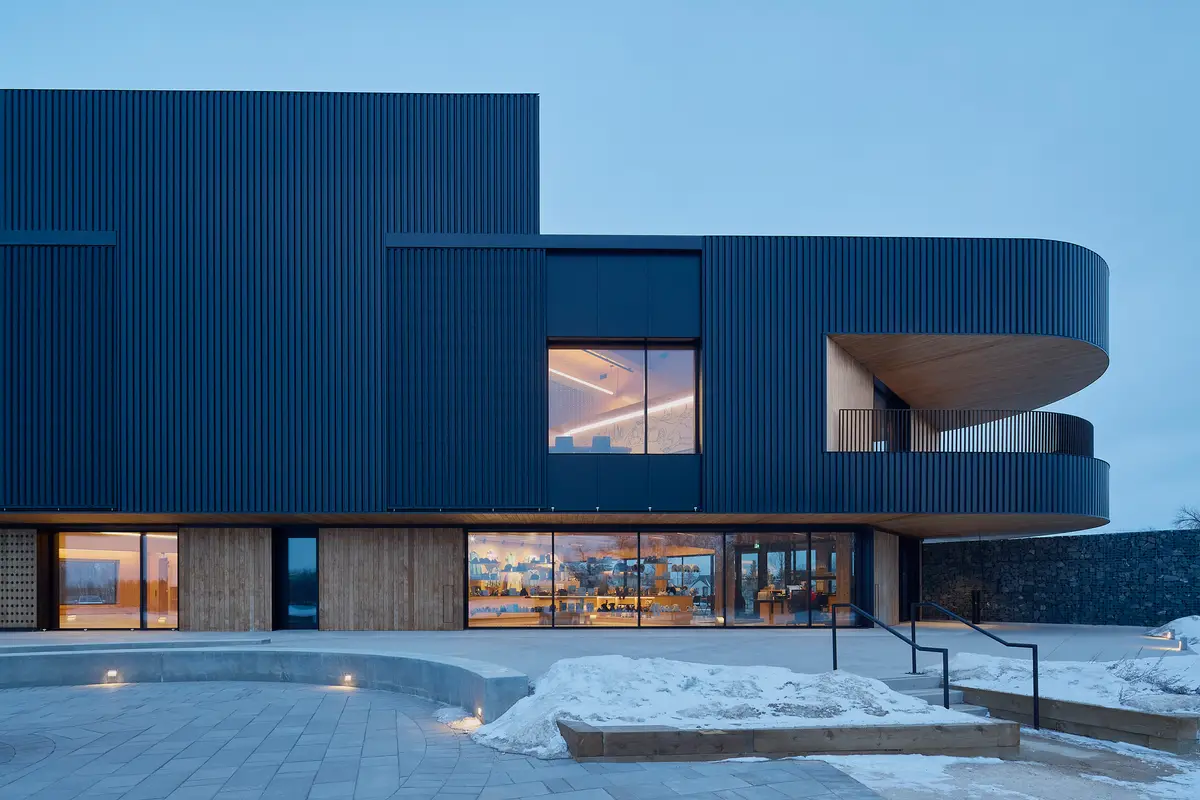
Stantec Plants a Mass Timber Visitor Centre on the Shore of a Reclaimed Pit Lake in Winnipeg
The Paul Albrechtsen Visitor Centre at FortWhyte Alive uses a triangular plan and Passive House strategies to welcome 660 acres of prairie wilderness.


Winnipeg is a city that knows cold. Winters plunge to minus forty, summers roast past plus forty, and the wind never really stops. Building anything here demands respect for thermodynamics. Building a public gathering place on the shore of a lake that was, until the 1950s, an open gravel pit demands something else entirely: a narrative about what land can become after industry leaves. The Paul Albrechtsen Visitor Centre, designed by Stantec Architecture under lead architect Michael Banman, takes on both challenges at once, giving FortWhyte Alive, a 660-acre nature preserve on Winnipeg's southern edge, a front door that is as much an argument about climate performance as it is about cultural reconciliation.
What makes the building genuinely interesting is its refusal to separate those ambitions. The triangular plan is not a formal gesture: it orients maximum glazing toward the south for passive solar gain, pinches the north facade to limit heat loss, and opens the northwest wall to frame views across Muir Lake. The all-mass-timber structure, built from FSC-certified CLT and GLT by Kalesnikoff, stores carbon and exposes its own material logic in every room. Geothermal heat pumps, radiant floors, and an extremely airtight envelope deliver 90 percent less operating energy than conventional construction, targeting both Passive House certification and CaGBC Zero Carbon Building Design Standard. And threaded through all of it is a design process shaped by collaboration with Indigenous elders and advisors, acknowledging that this land sits on the traditional territory of Anishinaabe, Ininew, Oji-Cree, Dene, Dakota, and Red River Métis peoples.
A Triangular Envelope on a Reclaimed Shore
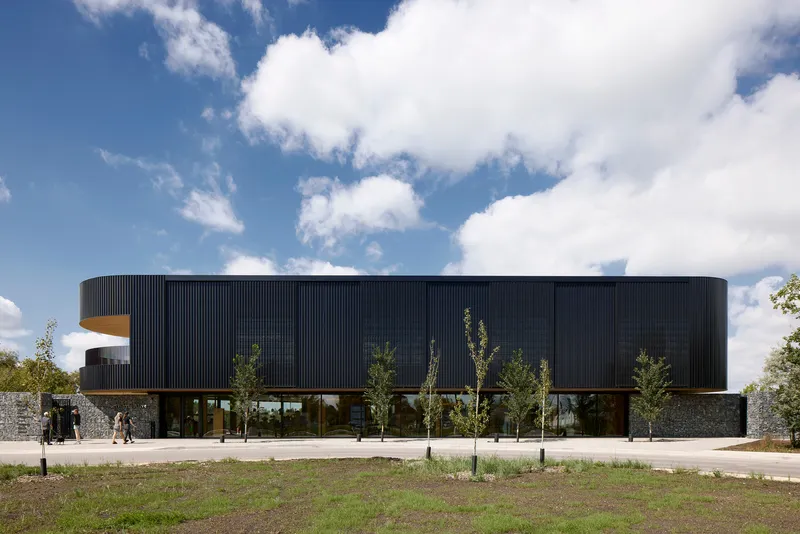
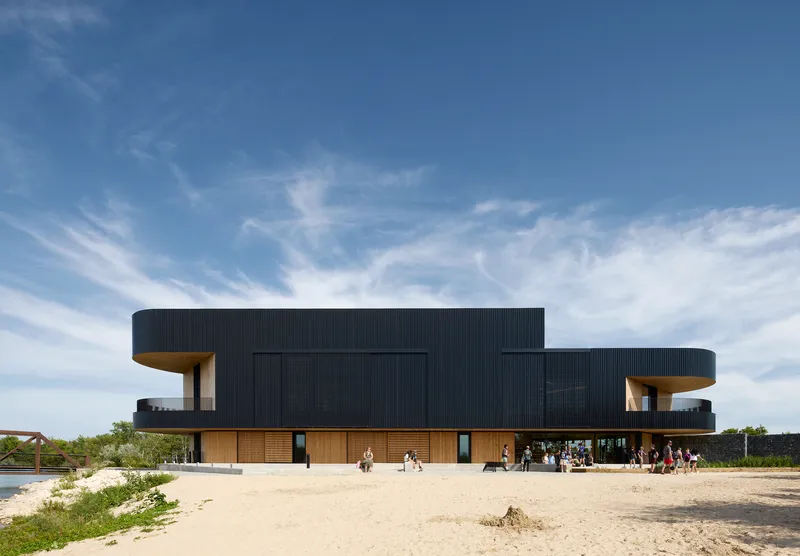
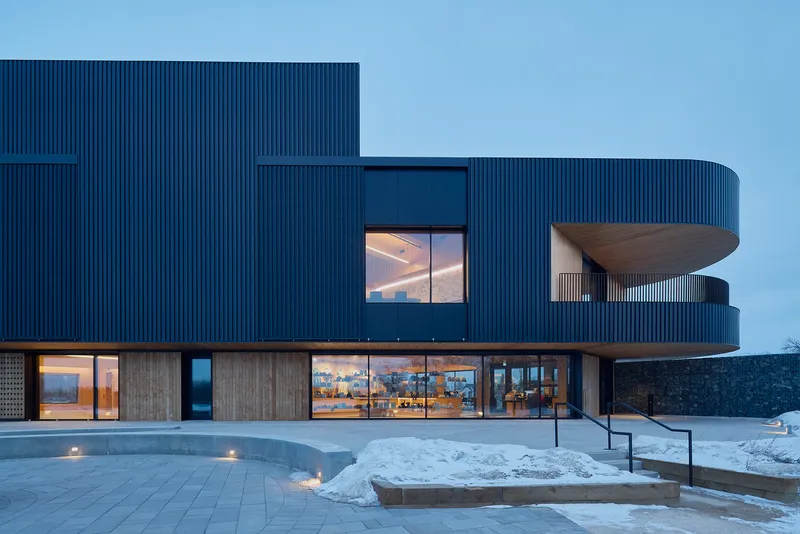
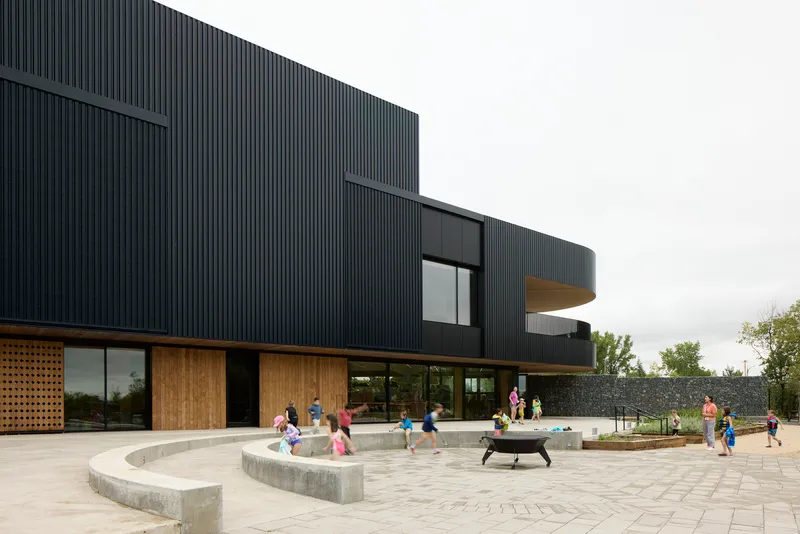
The building sits back from the lakefront among aspens, perched between and over granite gabion walls that recall the geological substrate of the former mine. Its dark corrugated metal cladding reads as a single, quiet mass from a distance, but up close the composition breaks apart: the upper volume cantilevers over a lighter timber-clad ground floor, rounding its corners to soften its presence in the savanna landscape. That cantilever is functional, providing shade for the south-facing glass below while defining covered exterior zones at the perimeter.
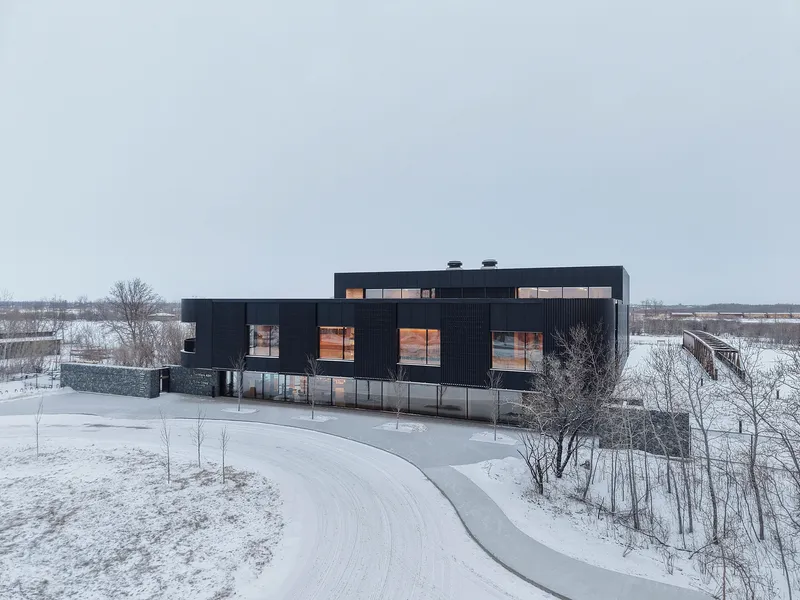
From the aerial view, the triangular footprint is legible not as a wedge but as a form that negotiates three different conditions: the motorway approach to the south, the lake and bridge to the northwest, and the aspen forest wrapping the east. Each edge of the triangle responds to a distinct set of pressures, solar, visual, ecological, rather than defaulting to a generic orientation.
Corrugated Metal, Timber Screens, and the Logic of Layers
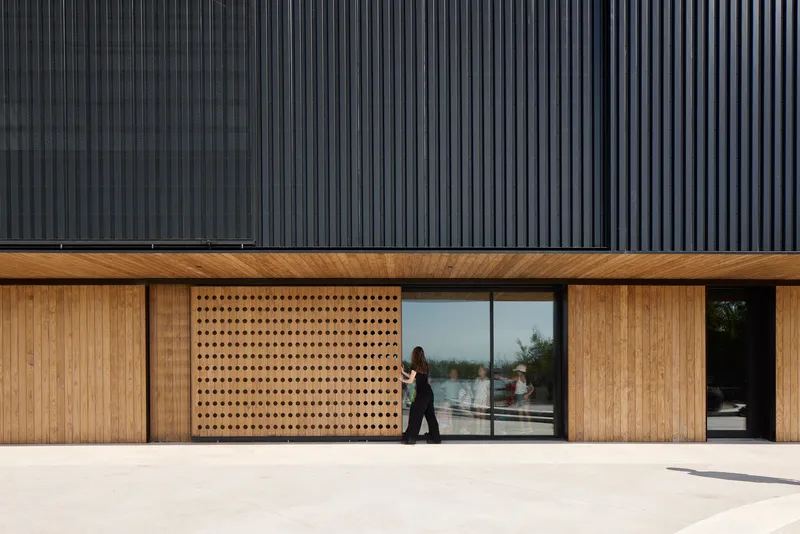
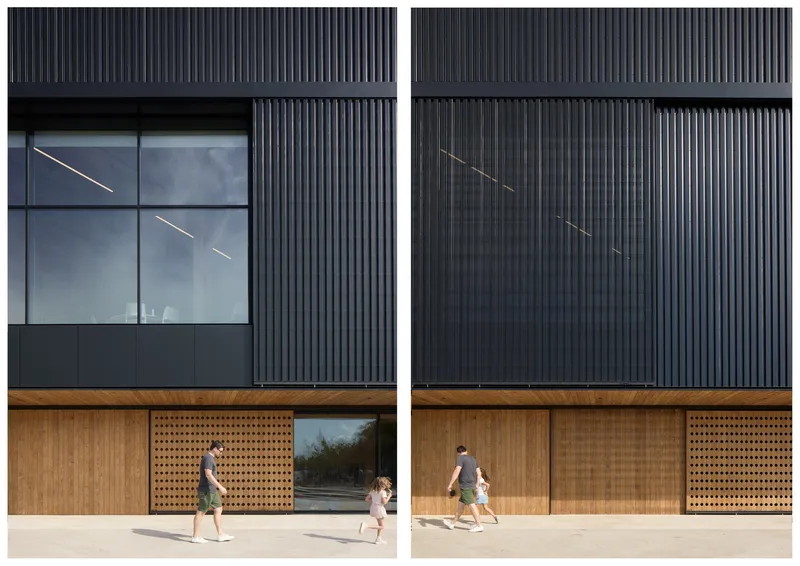

The facade is a layered system, not a surface. Dark corrugated metal wraps the upper volume. Below, perforated timber screens slide in front of large insulated glass units, acting as operable shading devices that open and close in response to sun angle and season. The screens double as bird-friendly measures, breaking up the reflectivity of the glass while maintaining views outward. Between these two registers, the building communicates its environmental strategy without relying on signage or didactic explanation.
Thermory cladding, Reynaers aluminum framing, and ROCKWOOL insulation sit behind those visible layers, contributing to an envelope that achieves the airtightness numbers required for Passive House. The punched windows on the upper volume, visible at dusk as warm rectangles against the ribbed blue-black skin, are deliberately few and carefully placed, reinforcing the idea that every opening was earned through energy modeling rather than aesthetic reflex.
Mass Timber as Structure, Surface, and Statement
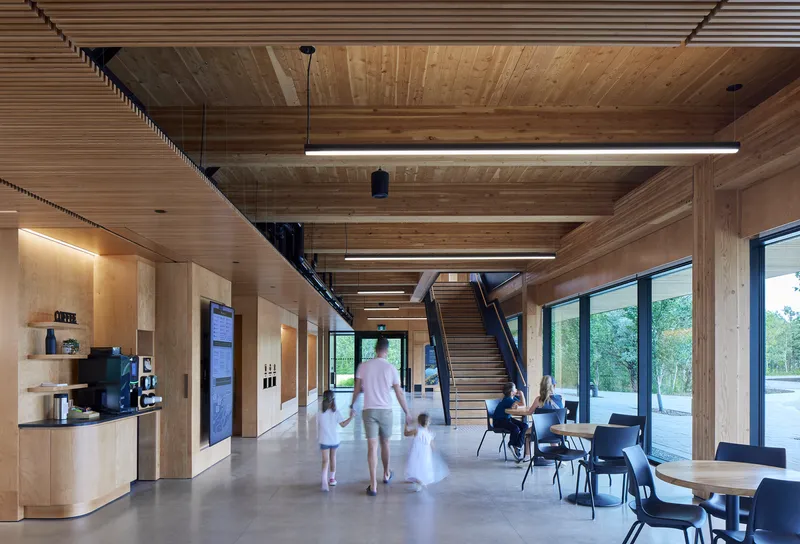


Inside, the mass timber is everywhere and it is not hidden. GLT columns and beams frame the double-height atrium, CLT panels form walls, floors, and roof, and short duct runs are tucked into a central service spine so that the timber remains fully exposed in every public space. The result is an interior that smells like a forest, which is appropriate given its location. A blackened steel staircase threads through the center, providing vertical circulation between the ground-floor lobby and the upper event spaces, its dark metal reading as a deliberate counterpoint to the pale wood surrounding it.
The building module was determined early in design to minimize waste and embodied carbon. That module governs the structural grid, timber panel sizes, openings, veneer plywood dimensions, saw cuts, and even the placement of electrical and mechanical devices. It is the kind of discipline that is invisible to the casual visitor but produces the sense of calm and coherence that people register without quite knowing why.
Gathering Spaces and Indigenous Presence

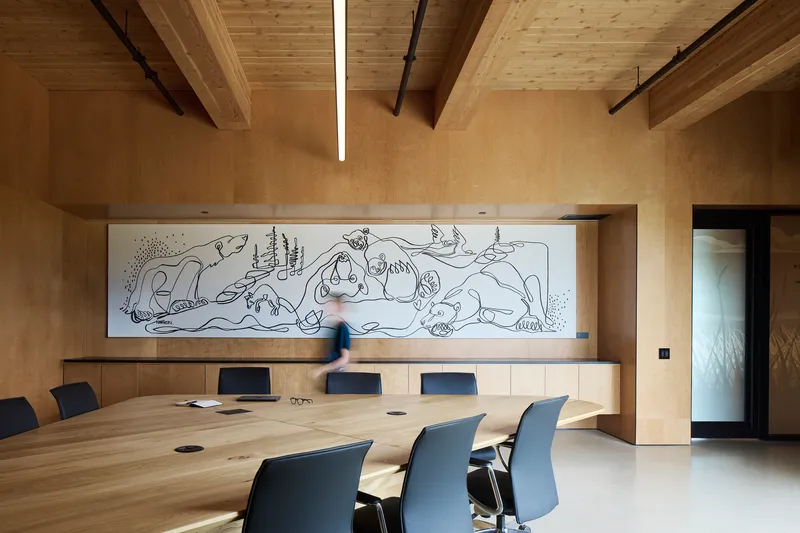

A star blanket floor pattern anchors the ceremony and sharing space, defining an area for smudging, storytelling, and communal gathering. Visitors are greeted with art evoking buffalo and welcomed in the traditional languages of the local First Nations and Métis peoples. These are not afterthoughts or decorative overlays: the Indigenous space, the learning rooms, and the ceremony zones were developed through sustained collaboration with elders and advisors, shaping the plan from the earliest stages.
The building's program, which includes admissions, a gift shop, café, prep kitchen, gender-neutral washrooms, pre-function and event spaces, is bisected by the service spine. South-facing pre-function areas line one side; event spaces occupy the other. Two carved-out balconies at the ends of the upper volume provide covered outdoor rooms, blurring the edge between interior gathering and the surrounding prairie landscape.
The Lake, the Porch, and the Bridge
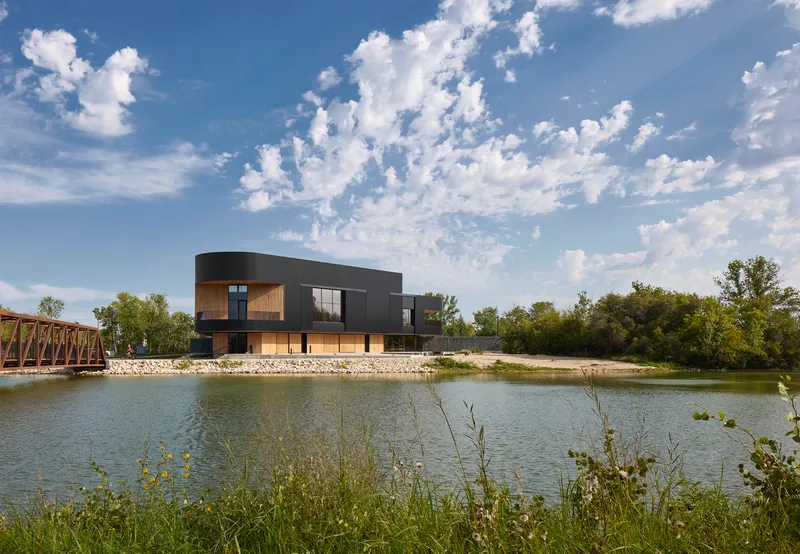

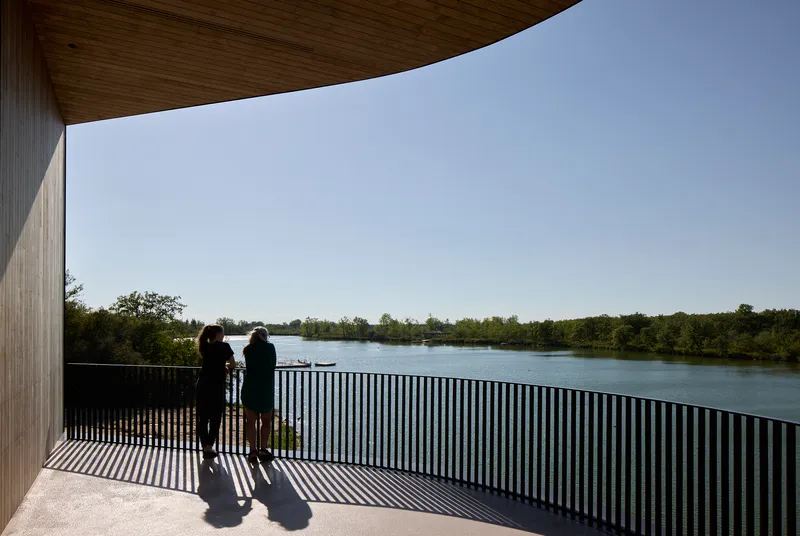
FortWhyte Alive's identity is inseparable from water. The seven pit lakes formed in abandoned quarries were reclaimed beginning in 1955 when employees of the Canada Cement Company established the waterfowl sanctuary that eventually grew into today's nature preserve. The visitor centre engages this history directly: a covered porch with timber soffit and perforated wood screens opens to views across Muir Lake and a steel truss bridge beyond, framing the passage between land and water.
The wildflower-edged shore and the bioswales, planted with 42 species of grasses, perennials, shrubs, and trees, are doing actual work. They capture stormwater from paved areas, mitigate heat island effects, and reintroduce native plant communities across a site that was, within living memory, bare industrial ground. The building does not sit apart from this restoration; it participates in it.
Thresholds and Interior Light
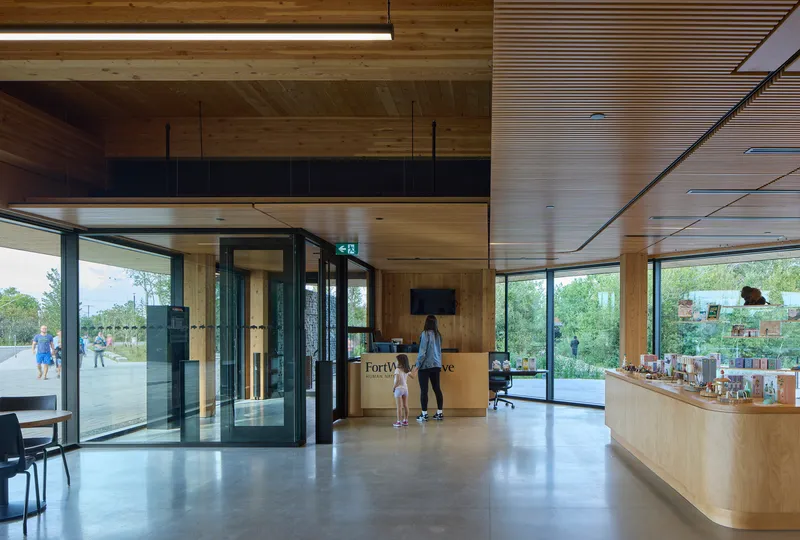


The entrance lobby is a controlled reveal. Timber-clad ceilings compress the space before floor-to-ceiling glazing opens to the parkland beyond. Upstairs, a mezzanine landing overlooks the south-facing facade, with exposed timber beams marching overhead and linear skylights pulling daylight deep into the plan. Rooms along the northwest edge offer uninterrupted lake views through floor-to-ceiling glass, the interior warmed by the honey tone of CLT panels on every surface.
Detail and Craft
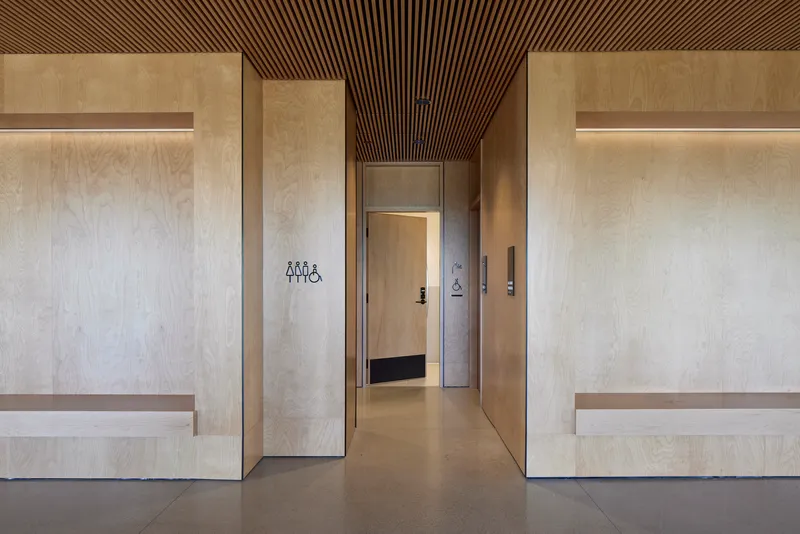


Corridors are lined with light plywood panels and integrated benches beneath slatted wood ceilings. A built-in cubby wall near the entrance stores visitors' bags in individual compartments, a small functional detail that signals the building's commitment to public hospitality. Stairwells are clad in timber with black metal railings and linear wall-mounted fixtures, maintaining the material palette without lapsing into monotony. The interplay between the warm plywood and the dark steel fasteners and railings gives the interior enough tension to stay visually engaged.
Seasonal Performance and Climate Response

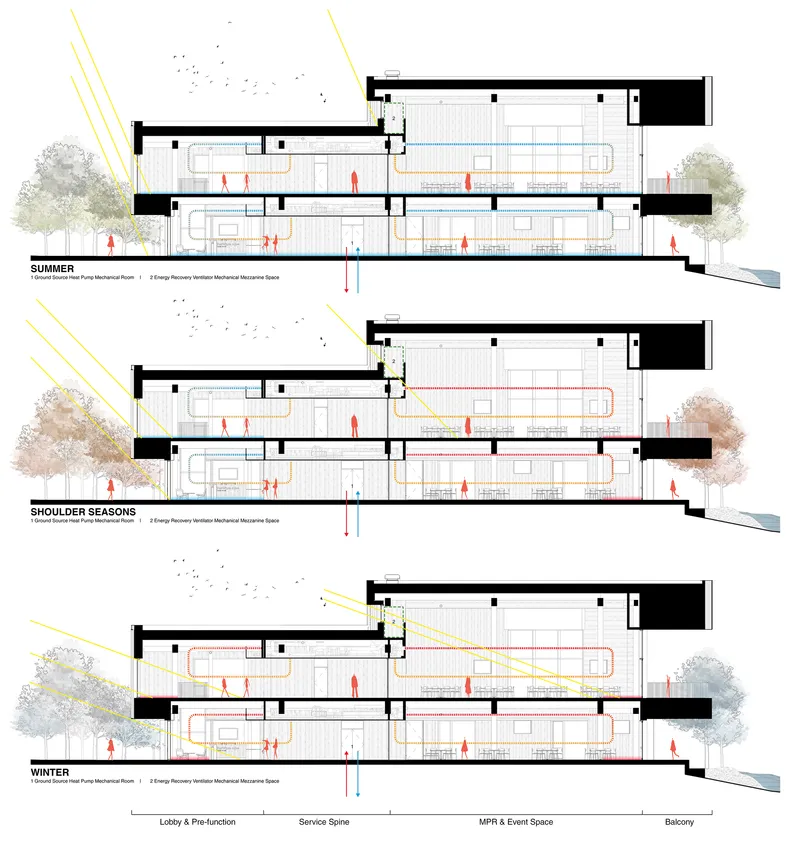
Winnipeg's 80-degree temperature swing across the year is the building's primary design constraint. In winter, the large south-facing glass units act as passive solar collectors, harvesting heat during the short days while geothermal heat pumps and radiant floor systems handle the balance. In summer, the cantilevered upper volume and operable perforated screens shade the lower glass, reducing cooling loads. An energy recovery ventilator ensures fresh air without thermal penalty. The ground source heat pump ties the building's energy cycle to the same earth that was once mined for cement.
The 90 percent energy reduction over conventional construction is a remarkable number, but the more interesting claim is the one that cannot be quantified as easily: a building that performs this well in one of North America's most extreme climates, while storing carbon in its structure and sitting on remediated industrial land, shifts the conversation about what visitor centres can be. This is not a pavilion. It is infrastructure for a changed landscape.
Plans and Drawings


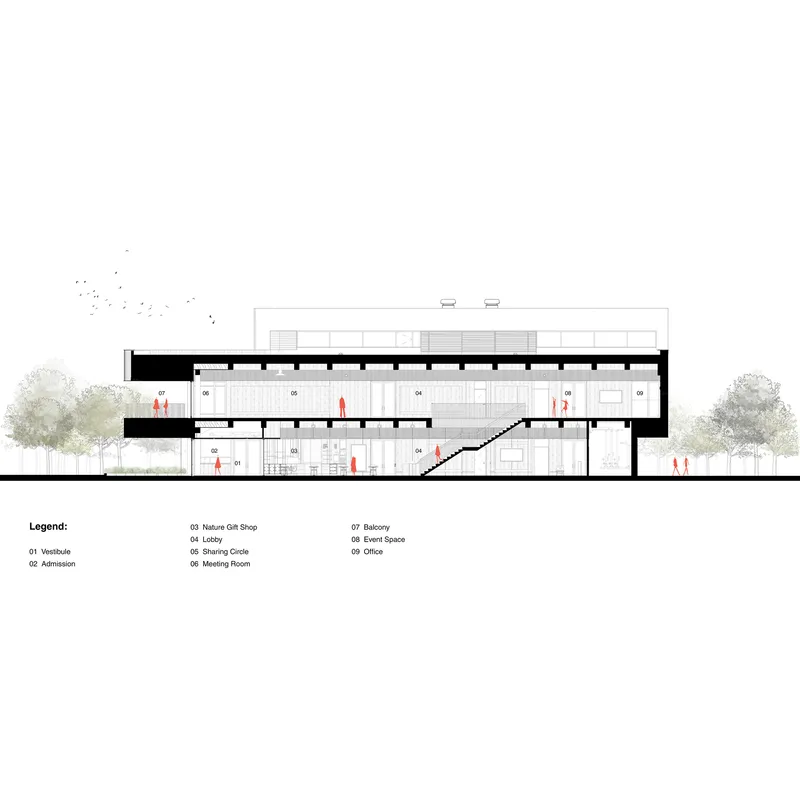

The axonometric site plan reveals the building's relationship to Muir Lake and the access drive that curves through the landscape. Floor plans and conceptual diagrams illustrate how the triangular geometry resolves program adjacencies, with the service spine cleanly dividing south-facing pre-function areas from event spaces oriented toward the lake. Building sections show the split-level organization, the central staircase, and the way the upper volume projects outward to create covered zones below.
The seasonal section diagrams are perhaps the most revealing drawings in the set. They map sun angles across summer, shoulder seasons, and winter, demonstrating how the cantilever, screens, and glass work together as a tuned environmental instrument. Wall assembly details layer the curtain wall, screen, and typical wall constructions, making legible the thermal envelope strategy that delivers Passive House-level performance. Every line in these drawings carries thermodynamic consequence.
Why This Project Matters
The Paul Albrechtsen Visitor Centre does several things that are easy to list but hard to execute simultaneously. It treats a site scarred by extraction as a place of cultural and ecological renewal. It embeds Indigenous knowledge and ceremony into its spatial program without tokenism. It achieves near-zero-carbon operation in one of the harshest climates on the continent. And it does all of this in mass timber, a structural system that stores carbon rather than emitting it. The triangular plan, which could have been a gimmick, turns out to be a precise response to solar geometry, site context, and programmatic need.
What Stantec and Michael Banman have produced here is a building that refuses the usual trade-offs. It does not sacrifice environmental performance for beauty, or cultural depth for technical rigor. It treats the land's industrial past, its Indigenous present, and its ecological future as a single, continuous story, and it gives that story a form that people will want to visit, occupy, and return to. In a field where visitor centres too often default to transparent boxes or overwrought sculptural gestures, this one earns its complexity.
Paul Albrechtsen Visitor Centre (Buffalo Crossing) by Stantec Architecture, lead architect Michael Banman. Located at FortWhyte Alive, Winnipeg, Canada. 1,670 m². Completed 2025. Photography by James Brittain Photography and Stationpoint Photographic.
About the Studio
Share Your Own Work on uni.xyz
If projects like this are the kind of work you want to make, uni.xyz is a place to publish your own, find collaborators, and enter design competitions.


Popular Articles
Popular articles from the community


U.GA Architects Wraps an Oval Rooftop Pool in Curved Board-Formed Concrete on Busan's Jeollidan-gil
In Busan's Jeonpo-dong, a 454 m² mixed-use block stacks a neighborhood facility, guest rooms and an oval rooftop pool inside spiraling concrete walls.

GROUP A Strips a 1969 Rotterdam Harbor Headquarters to Its Frame and Wraps It in Timber Louvers
In Rotterdam's M4H harbor district, Ferro Offices reuses a 1969 frame, adds one timber storey and reaches BREEAM-NL Outstanding.

Jaramillo Van Sluys Arquitectura and Urbanismo Turn a Demolished Registry Lot in Quito into an Orchard Plaza
In Quito's Centro Histórico, a 2,800 m² plaza exposes the San Agustín convent wall and redraws its lost Augustinian orchard in volcanic stone.

Juan García Correa, John González and Claudia Rueda Sink a Circular Amphitheater into a Manizales Engineering Building
On the La Nubia campus in Manizales, Colombia, the S1 Building folds labs and offices into a hillside of ramped lawns that double as a campus route.

Similar Reads
You might also enjoy these articles


LAVA Architecten Gives Vocational Education a Sawtooth-Roofed Face on a Mechelen School Campus
In Mechelen, Belgium, a 2,053 m² STEM school on a 6×6 m grid turns workshops and classrooms into rooms that can be rearranged as teaching changes.

KEMA Studio Turns a Derelict Marvila Attic into a 60 m² Lighthouse Apartment Above Lisbon
In Lisbon's Marvila district, a rebuilt roof, four skylights and two plywood volumes turn an unlivable attic into a bright home facing the Tagus.

Pixel Gardens: One Repeated Module Stacked Into a Terraced Social Housing Tower for Famagusta
Salem Bader's shortlisted housing tower builds a vertical neighbourhood from one repeated module, offsetting units to carve terraces, light and air.

Bao Huynh Watercolor Atelier: A Serene Art Retreat in Hội An
Bao Huynh Watercolor Atelier in Hội An blends multifunctional art spaces, sustainable design, local materials, and family-friendly living in a serene environment.

Explore Convention Centre Competitions
Discover active competitions in this discipline

Challenge to design a portable theatre

Challenge to design a portable music platform

Challenge to design an open learning module for the elderly

Bring back Drive In's
Comments (0)
Please login or sign up to add comments
No comments yet. Be the first to comment!