
Stark Lifts a Passive House Retreat Into the Canopy of British Columbia's Coast Mountains
A cantilevered timber and metal volume in Pemberton, Canada, meets Passive House Plus standards while framing Mount Currie through the trees.


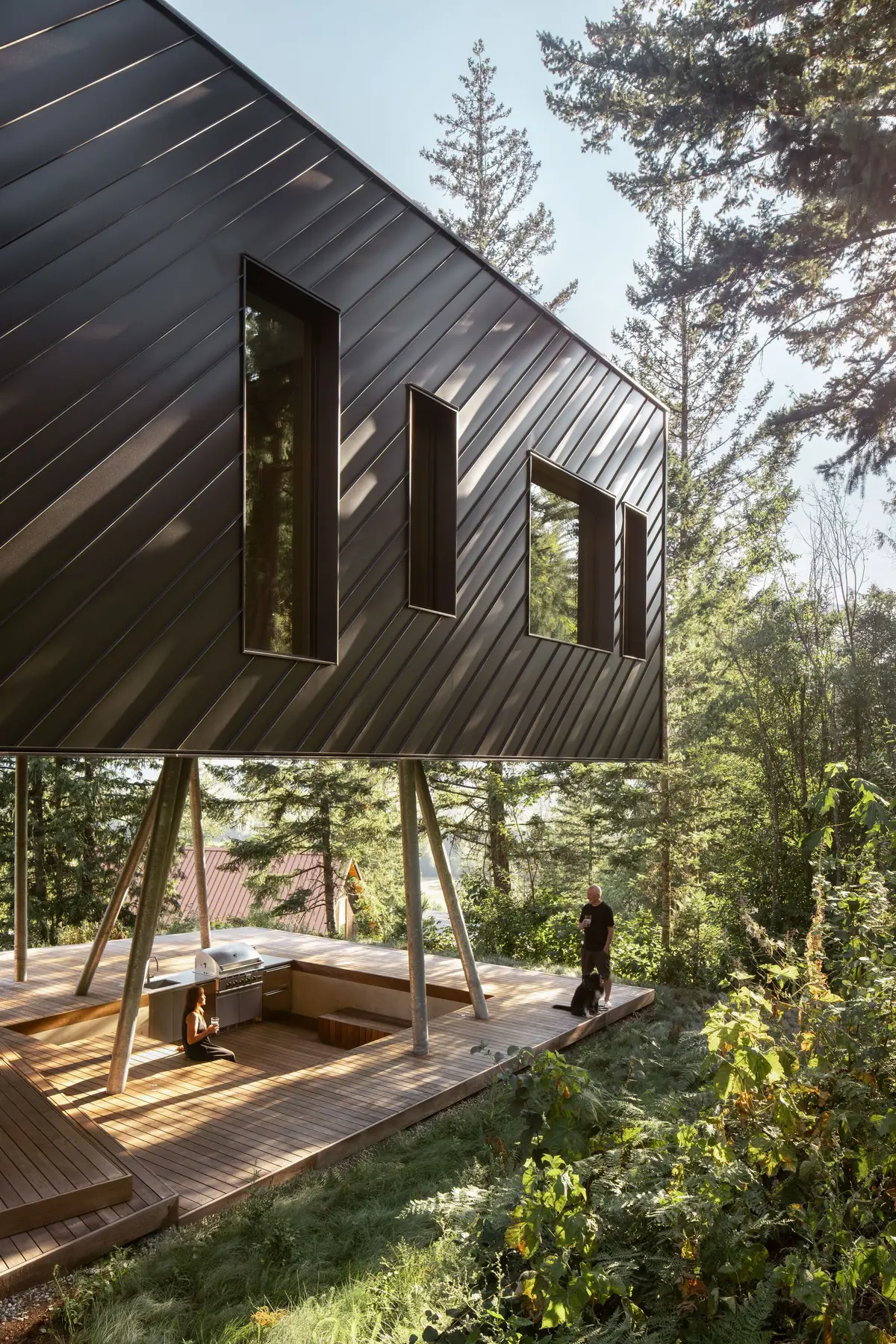
The argument that high-performance building envelopes lead to boxy, compromise-laden architecture has been losing ground for years. Stark's Passive House Forest Retreat in Pemberton, British Columbia, puts the last nail in that coffin. Perched on a forested slope in Canada's Coast Mountains, the house cantilevers its upper volume over the terrain on slender angled steel columns, creating a treehouse-like silhouette that is as spatially generous below as it is thermally rigorous above. The project meets Passive House Plus certification standards, yet nothing about its sculptural metal cladding, its lap pool framing Mount Currie, or its interiors lined floor to ceiling in warm timber reads as a concession to performance metrics.
The Swedish concept of lagom, roughly translated as "just enough but not too much," guided the design. That ethos is legible everywhere: in the restrained material palette of dark metal cladding and natural timber, in the careful way the cantilever shelters outdoor living without overwhelming the slope, and in the fire-resistant detailing that acknowledges a landscape increasingly shaped by wildfire risk. Built by Postle Construction Ltd. with structural engineering by Ikon Engineering, this is a house that takes its environment seriously on every front, from carbon performance to the choreography of natural light through its rooms.
A Cantilever That Earns Its Keep

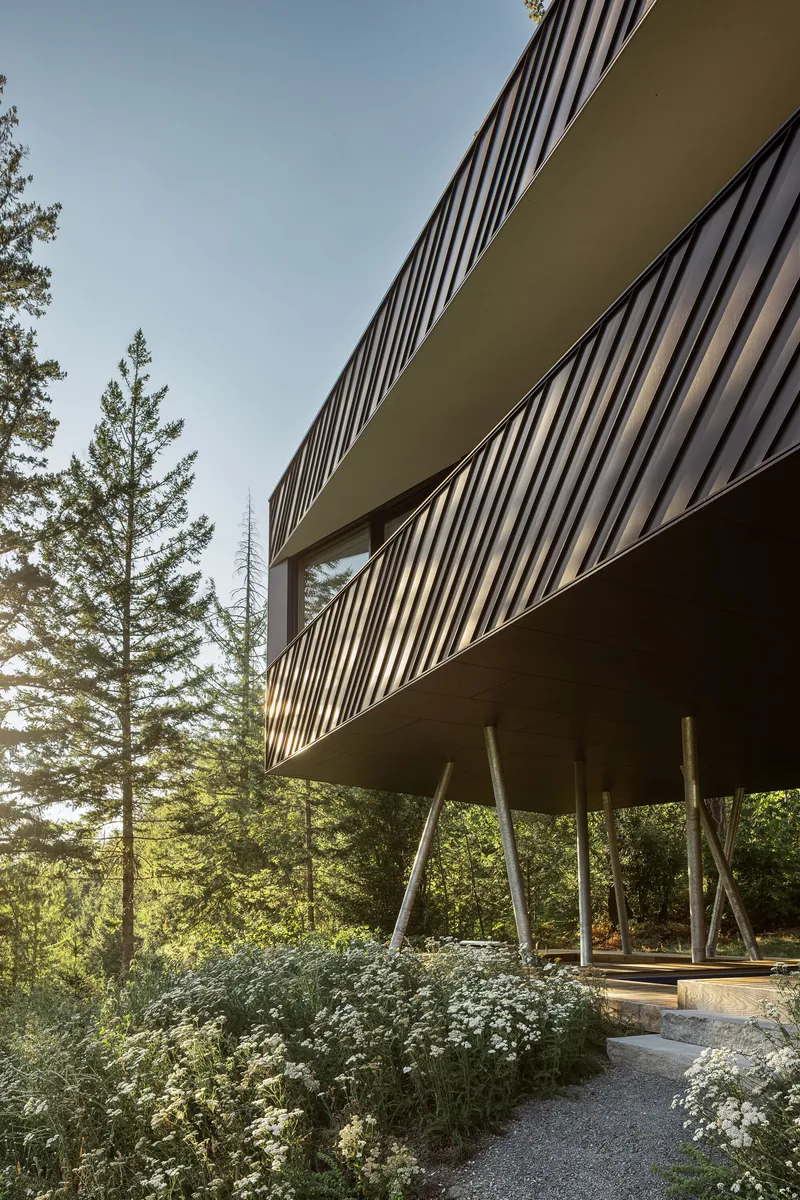
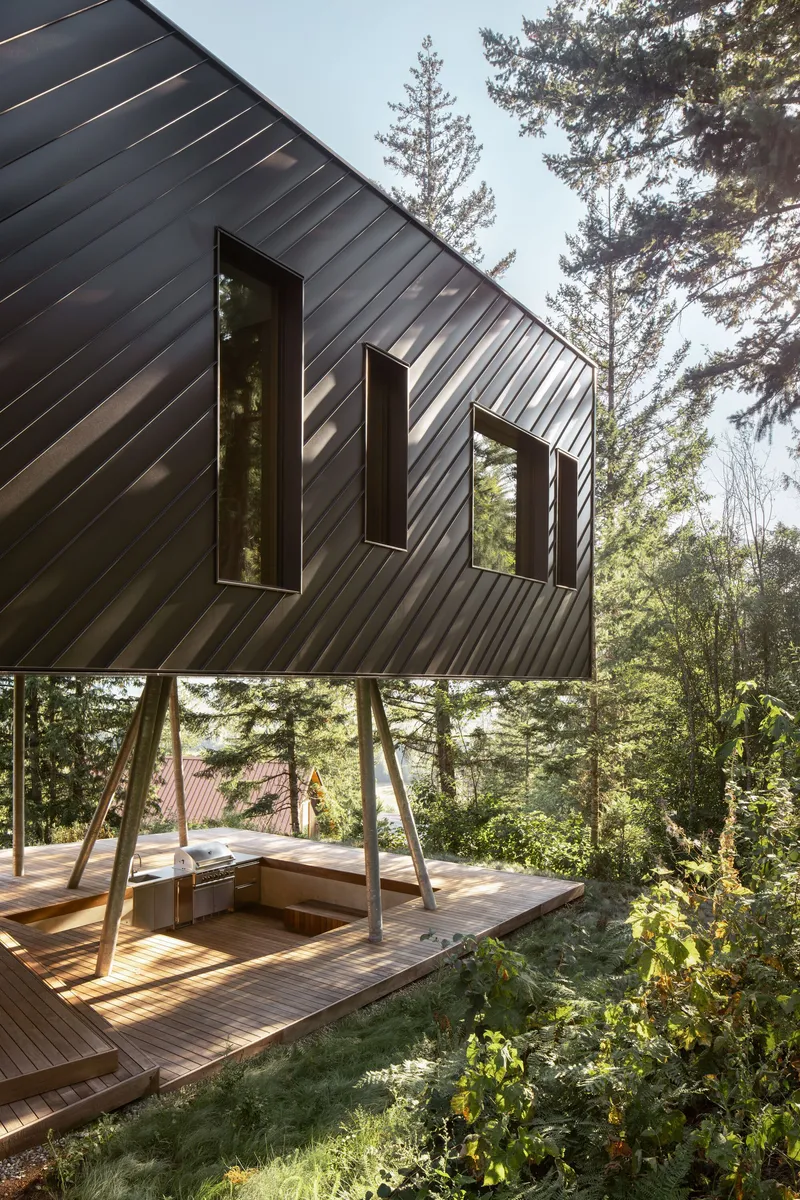
Cantilevers in residential architecture are often gratuitous, a structural flex that adds cost without adding life. Stark's version does real work. The projecting upper volume, wrapped in custom-bent diagonal metal cladding, creates a generous shaded zone beneath it: a covered timber deck, a sunken outdoor kitchen, and a lap pool that slides open on a custom deck cover. The angled steel columns that support the overhang are deliberately proportioned to echo the trunks of the surrounding evergreens, so the house reads less as an imposition on its slope and more as a tectonic species of the forest.
At dusk, when interior lights turn the ribbon windows into glowing lines against the dark cladding, the cantilever's geometry becomes cinematic. But during the day, its primary gift is practical: it allows the house to touch the ground lightly, preserving root systems and drainage patterns on a sloped site while delivering covered outdoor space that extends the livable footprint without adding conditioned area.
Ground Plane and Arrival
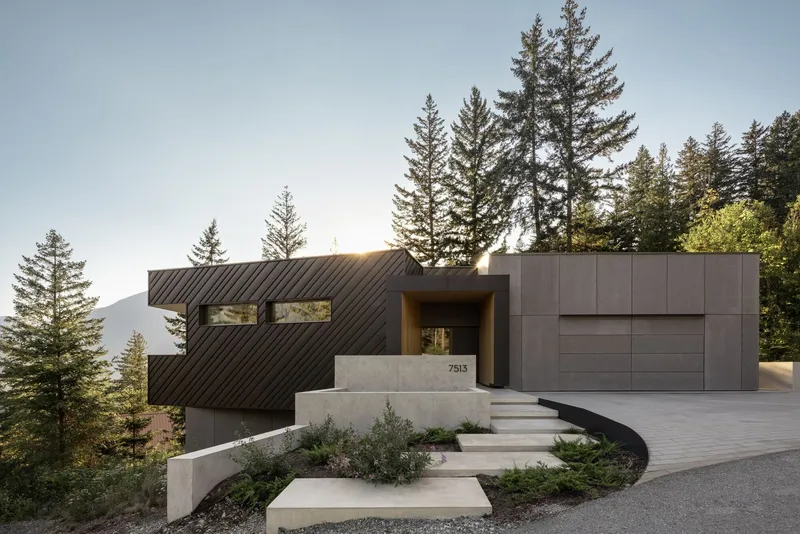

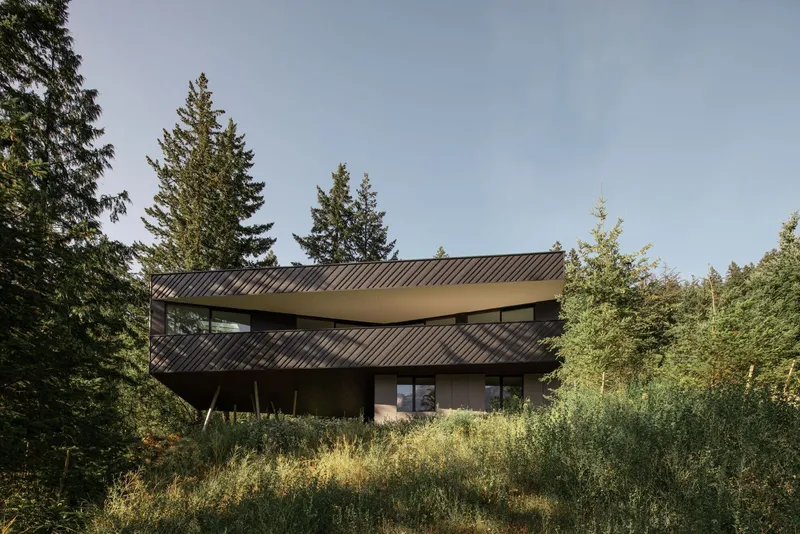
The entry sequence is low-key and controlled. A concrete retaining wall and wide steps lead to a garage clad in charcoal metal panels, setting the tone with material honesty rather than grandeur. The dark metal facade meets poured concrete at sharp angles, and the surrounding wildflower meadow planting softens the junction between architecture and terrain. There is no ceremonial front door moment here; instead, the house absorbs you laterally, through layered planes of material and landscape.
The two-story volume seen from the approach, with its diagonal cladding and horizontal ribbon windows, sits among wild grasses and evergreens as though it had been threaded between trees rather than dropped onto a cleared pad. That restraint is part of the lagom philosophy: the house is assertive in form but deferential in placement.
Living Under the Canopy


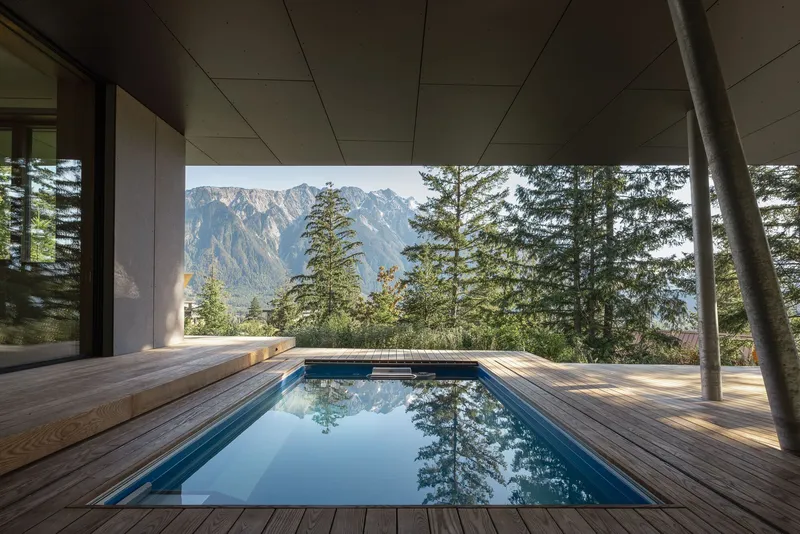
The sheltered zone beneath the cantilever is where the house's social life happens. A covered timber deck stretches between the angled columns, casting dappled shadows that shift throughout the day. The lap pool, oriented toward the mountain view, is flanked by a sunken outdoor kitchen, turning the understory of the house into a complete outdoor room. Steel columns frame the landscape like a series of vertical apertures, filtering views of forested mountains and channeling breezes across the deck.
What elevates this space beyond a typical covered patio is its ambiguity. You are simultaneously inside and outside, beneath the house and beside it. The timber decking and the planted slope flow into each other without hard edges, and the fire-resistant materials used for the decking and supports acknowledge that this outdoor room exists in a landscape where resilience is not optional.
Timber Interiors and Sculptural Light


Inside, the material palette consolidates around timber: vertical slat walls, horizontal paneling, and warm wood surfaces that wrap every major room. The living room deploys floor-to-ceiling timber paneling alongside an arcing floor lamp that introduces a single sculptural gesture into an otherwise planar composition. A corner reading nook with a freestanding black stove and leather lounge chair offers the kind of intimate, fire-lit moment that large houses rarely manage without feeling contrived.
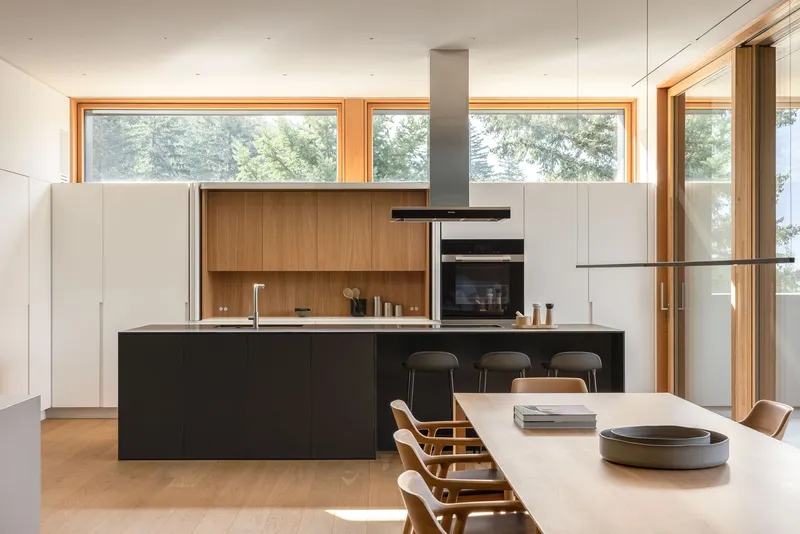
The kitchen balances darkness and warmth. A black island anchors the room while timber backsplash panels and horizontal strip windows keep the eye moving outward to the trees. The lighting design throughout the house draws on the subtle rhythms of natural light, with fixtures that wash walls rather than spotlight surfaces. It is a house that trusts its materials to carry the atmosphere.
Private Rooms Framed by Forest


The bedrooms continue the timber language with integrated headboards and wood-framed windows that place each sleeping space in direct conversation with the canopy outside. One bedroom features a timber slat wall rising to a skylight above the bed, while a sliding door opens to a terrace with Mount Currie filling the frame. These are not neutral sleeping boxes; they are calibrated views, each window positioned to capture a specific relationship between interior and landscape.
The freestanding black bathtub beneath a slatted timber ceiling, with nothing but forest visible through its window, is the kind of detail that earns a house its reputation. It signals confidence: the architects knew exactly where to place a moment of luxury and trusted the landscape to complete the composition.
Detail and Craft

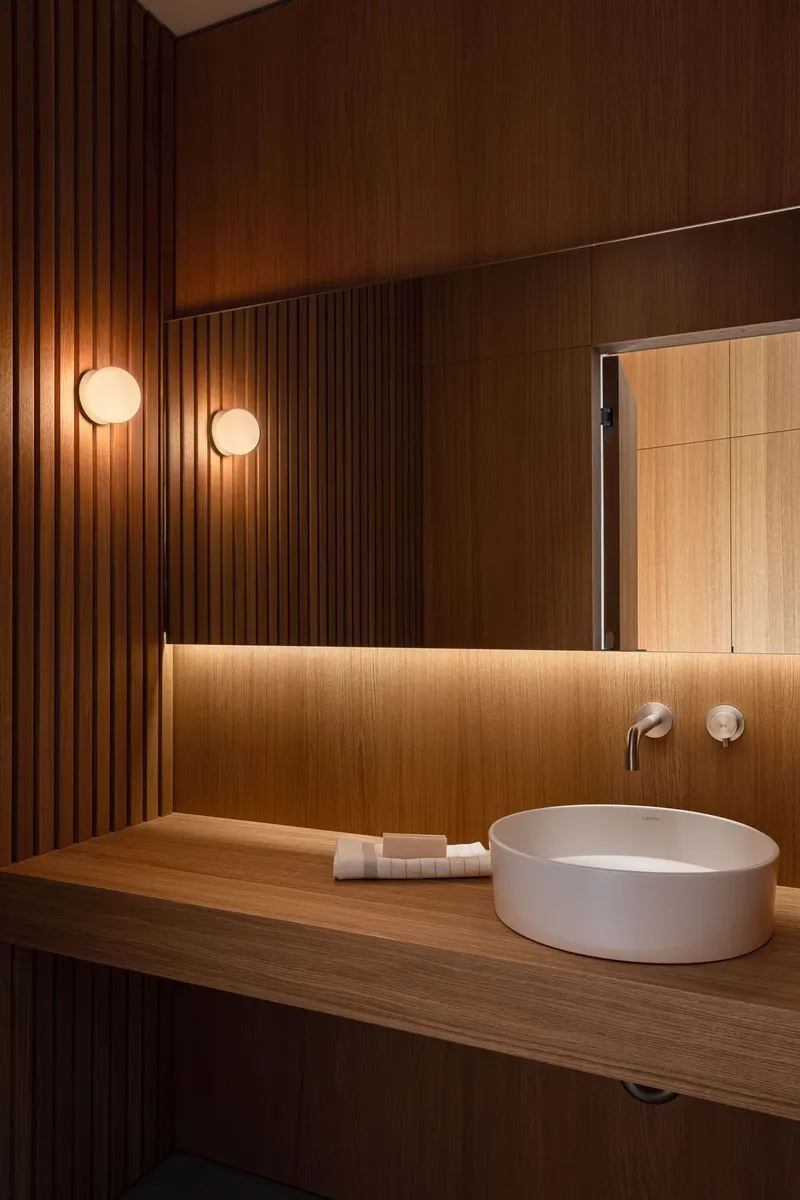

The entryway nook, with its vertical timber slats and built-in bench, sets the tone for the house's approach to millwork: every transition is resolved, every edge considered. The bathroom vanities feature backlit mirrors flanked by spherical wall sconces against timber slat walls, a combination that could easily tip into boutique-hotel territory but stays grounded through material consistency.
A glass door opens into a sauna with horizontal wood slats, positioned alongside an exercise area. These wellness amenities are integrated into the floor plan rather than appended to it, reflecting the house's interest in daily ritual over spectacle. The fire-resistant exterior shutters, designed to protect the house during environmental extremes, represent the same logic applied to the building envelope: resilience as a design parameter, not an afterthought.
Thresholds and Working Spaces
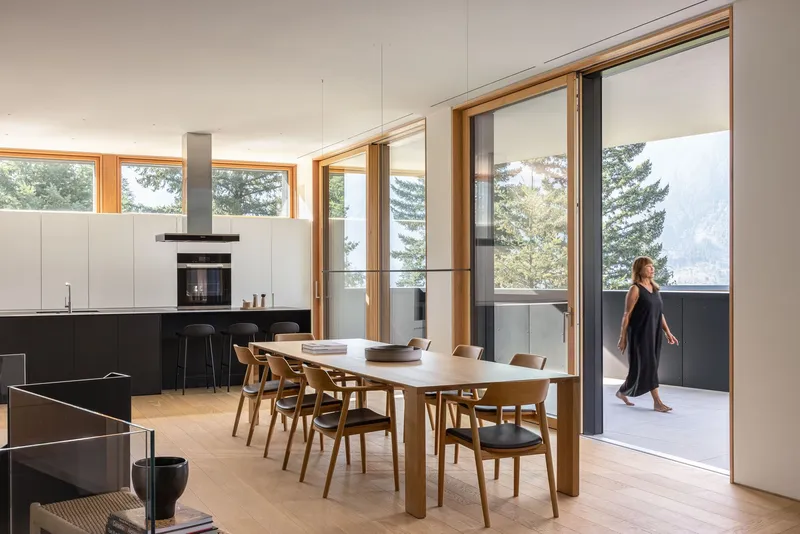


The open dining area, with its timber table and full-height sliding glass doors, dissolves the boundary between indoor and outdoor living in a single gesture. Adjacent, a workspace with vertical timber slat walls and white storage cabinets above a pale desk provides a quiet counterpoint to the communal spaces. The staircase, with light wood treads ascending alongside a black painted wall under a white vaulted ceiling, is one of the most spatially generous moments in the house, using contrast and height to create drama within a compact circulation zone.
Plans and Drawings

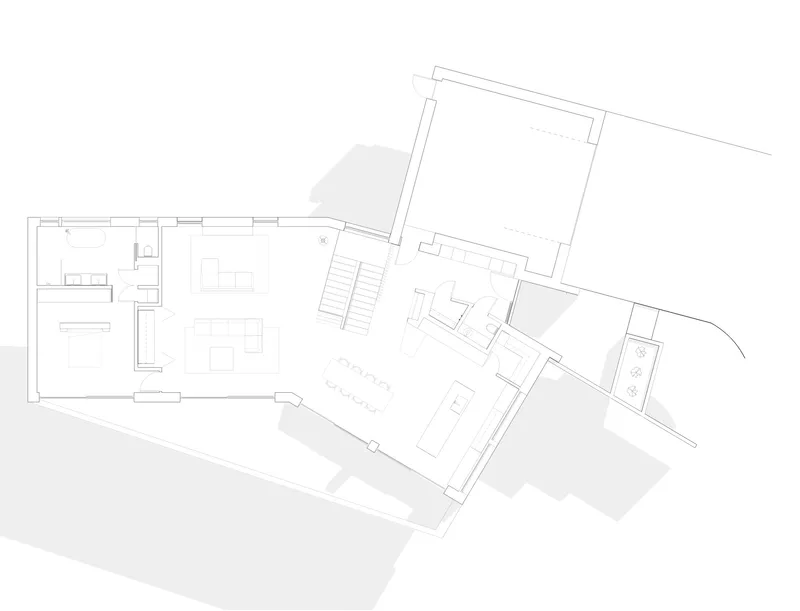
The floor plans reveal the organizational logic behind the house's sculptural exterior. An angled deck with pool connects to interior rooms across two levels, with a central staircase linking the public ground floor to the private upper volume. The angular geometry of the plan is not arbitrary; it responds to the slope's contour and the orientation toward Mount Currie, rotating rooms to capture specific views while maintaining the compact thermal envelope required by Passive House certification.
Why This Project Matters
The Passive House Forest Retreat matters because it refuses the false choice between environmental ambition and architectural expression. Meeting Passive House Plus standards in a mountain climate with significant temperature swings is technically demanding. Doing so while cantilevering a metal-clad volume over a forested slope, integrating a lap pool and sunken kitchen into the understory, and wrapping every room in locally crafted timber millwork is something else entirely. Stark has demonstrated that the Passive House framework, far from constraining design, can discipline it in productive ways, forcing decisions about orientation, envelope, and opening that ultimately make the architecture sharper.
In a moment when wildfire risk, energy costs, and climate volatility are reshaping what responsible building looks like in North American mountain communities, this project offers a credible model. It is fire-resistant, thermally sealed, and light on its site. It is also beautiful to inhabit, which is the part that too many performance-driven projects forget. Lagom turns out to be a useful word for architecture: just enough ambition, precisely deployed.
Passive House Forest Retreat by Stark (STARK Architecture & Interiors), Pemberton, Canada. Completed 2025. Photography by Ema Peter Photography.
About the Studio
Share Your Own Work on uni.xyz
If projects like this are the kind of work you want to make, uni.xyz is a place to publish your own, find collaborators, and enter design competitions.


Popular Articles
Popular articles from the community


The Amber Palace Opera: A Geological Fiction Surfaces on Tallinn's Baltic Waterfront
Pierre Brillard reimagines a Baltic legend as a public landscape, opera house, and waterfront promenade rooted in Tallinn's coastal identity.

Opera on the Sea: Driftwood Logic Shapes a Timber Opera House on Estonia's Coast
Trevor Orgill's opera house translates the entangled drift of floating timber into a civic building where wood, water, and music converge.
Opera by the Sea Estonia: Three Shells Dissolving Architecture into Tallinn's Coastline
A winning opera house proposal replaces monumental form with interconnected shells that blur the boundary between building, park and Baltic Sea.

Extended Shell: Retrofitting Kolkata's Balconies as Living Urban Thresholds
A modular retrofit system recovers the social and environmental intelligence of Kolkata's historic verandas for contemporary Park Street residents.

Similar Reads
You might also enjoy these articles

Bao Huynh Watercolor Atelier: A Serene Art Retreat in Hội An
Bao Huynh Watercolor Atelier in Hội An blends multifunctional art spaces, sustainable design, local materials, and family-friendly living in a serene environment.

Atelier Macri Concept Store Interior Design by CASE-REAL
Atelier Macri store features a "ko" counter, walnut wood details, cork displays, blending retail, gallery, and seamless customer experiences.

Manuel Vargas Izquierdo Stadium and High-Performance Sports Center: Architectural Excellence in Jalpa de Méndez
The Manuel Vargas Izquierdo Stadium blends sustainable design, inclusive sports facilities, and cultural-inspired architecture, revitalizing Jalpa de Méndez’s public spaces.

KAKR Buluh Awar Hall: Revitalizing Community and Ecology Through Bamboo Architecture
Community built bamboo hall revitalizes Buluh Awar village, empowering youth, restoring ecology, celebrating vernacular craftsmanship through sustainable architecture and culture.

Explore Passive Architecture Competitions
Discover active competitions in this discipline

Challenge to design mud housing for contemporary communities

Design challenge to reuse E-waste
Comments (0)
Please login or sign up to add comments
No comments yet. Be the first to comment!