
STuCOMM
Jennifer Lee and Eeshana Hamed

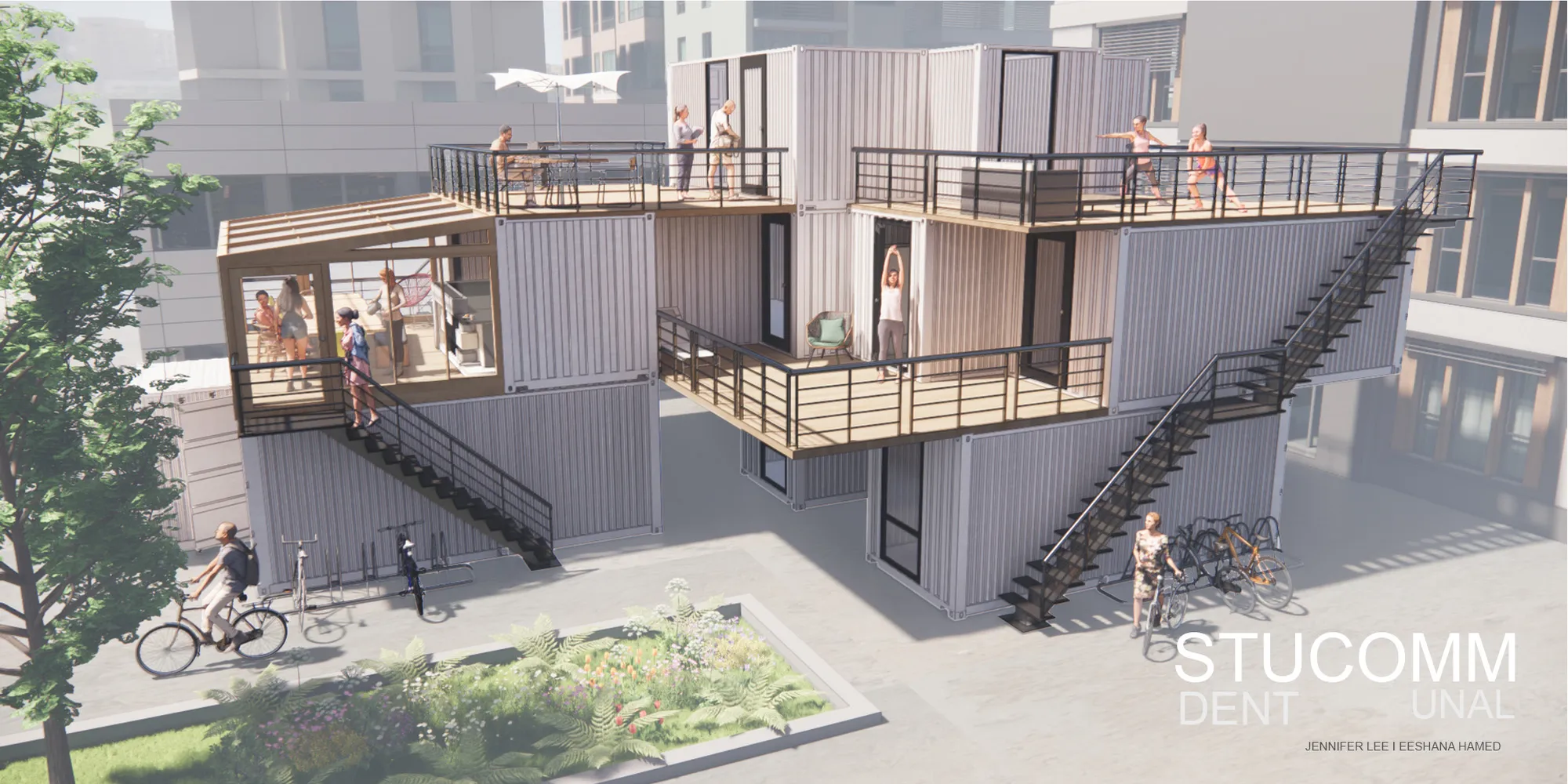
In the process of tackling the constraints for this project, my partner and I began by addressing the greatest strength of the shipping container: its modularity. Initially, we approached the project by looking at the shipping container as one unit itself that could be aggregated according to a systematic rule that would consequently form the overall structure. However, as we explored this approach, we found the developed massings to be lacking a sense of connection to the student occupants and the relationships they could be developing in these spaces. Being constrained to one container unit per person failed to create the strong sense of community my partner and I were searching for. Thereafter, we began looking at employing a different unit to aggregate that would be more conducive to the relationships we were attempting to develop. Through this exploration we decided on the welded connection of three containers in a W shape that not only creates a greater sense of fraternity amongst the residents but also allowed us to experiment with the degree of community in each unit. Connecting these containers allowed us to break the monotony of the long hall-like rooms of single containers and create more varieties of spaces. Three unit types were developed (communal, semi-private, and private) and separated by floors to provide residents with an option on their preferred lifestyle. Within these units, bedrooms employed foldable furniture to maximize space and increase storage capacity.
As we moved along with the concept of modularity, we addressed another problem we found impertinent as well: replicability. As this was a temporary structure meant to fit in a variety of different sites and urban areas, we were looking to make a structure that would easily adapt to its surroundings and find a place in the different kind of sites that would be available in an urban lot. Finding inspiration in the thermal qualities of ancient cliff dwellings, we aggregated a massing that would replicate the shape and thus the properties of those historic structures. The massing of the cliff dwellings took advantage of the high summer sun and low winter sun to block the heat during the summer while maximizing absorption in winter. This allowed the dwellings to adapt to whichever climate they were put in. Applying these principles to our structure created an angled front that made the orientation and placement of the structure flexible in different types of sites and took advantage of the climatic properties of the area. To emphasize this relationship, a solarium addition was added to extend the second-floor southwest container unit used for communal utilities such as cooking, dining, or laundry. The 3-container units were stacked at corners to reinforce the support and always created the cliff shape no matter what orientation the units were stacked in due to the strict rule of two units at the ground floor, two in the second level, and one on the last. This 15-container unit could then be aggregated, connecting and stacking at corners, to create larger housing communities. This makes the 3-container unit as well as the 15-container massing possible modular units that could quickly and cheaply construct homes. For both the massing and the units of our model, only the 20’x8’x8.5’ containers were used to minimize carbon footprint. However, this whole process could be just as easily done with the 40’ ones.
For circulation, we intentionally kept them external to connect with the naturally created terraces from the “cliff” massing and create an organic network of stairs and balconies that lead to individual units. These transitioning spaces further pursue our communal agenda in making circulation another place where individuals have the chance to interact as opposed to private stairs in personal units. This mix of horizontal and vertical circulation encourages interaction as residents go along their daily lives and create spaces for gatherings, study sessions, or even individual work. Finally, in applying materials, my partner and I were conscious of both cost and the impermanence of the structure. For this reason, we kept the container material as it existed in most places. Furthermore, we used wood for the solarium and the balcony as it is an easier material to dismantle than concrete and is more sustainable.
In conclusion, in our exploration we aimed to create a structure that was both modular, cost effective, and replicable without taking away from the quality of life of a space. In fact, a lot of the methods applied to address some of the main concerns significantly enhanced the quality of life within those spaces. This was a structure made with the intention of creating a community of students, not just residents.



Popular Articles
Popular articles from the community


Hill & Cross Opera: Sculptural Opera House Architecture Shaped by Tallinn’s Landscape and Identity
Hill & Cross Opera reimagines opera house architecture in Tallinn through its sculptural hill, civic plaza, glass wave and a luminous cross.

Conexión: Biophilic Design Reimagines High-Rise Living in Hong Kong
Conexión reimagines high-rise living in Hong Kong through biophilic design, green facades, shared spaces, daylight, water and nature within.

The Ocean Hive: Sustainable Architecture for a Self-Sufficient Civilization at Sea
The Ocean Hive imagines sustainable architecture at sea, where modular habitats, algae, wave power and ocean waste sustain a growing colony.

The Musturak Paradise: Senior Living Architecture for a Connected Future in Temara, Morocco
The Musturak Paradise reimagines senior living architecture in Temara via private homes, social spaces, culture, community, and shared care.


Similar Reads
You might also enjoy these articles

Day and Night Park: A Time-Based Urban Newsstand in Beijing
A temporary urban newsstand in Beijing blending travel, light, and reading through poetic colors, compact form, and community-focused design.

Modernist Patio Renovation in El Masnou, Barcelona by Oliver Segura Arquitectura + Cebrià Arquitectura
Modernist patio renovation blending tradition and innovation with a movable pool, leveled floors, and Catalan materials in El Masnou.
Alto Residencial Coop: Cooperative Housing Development in Santiago de Compostela by Carbajo Barrios Arquitectos
A linear cooperative housing complex blending white volumes and perforated metal façades, enhancing community living, natural light, privacy, and urban integration.
Vil Genis School by BPA ARCHITECTURE – Massy, France
Vil Genis School in Massy, France, features sustainable design, south-facing classrooms, community integration, accessible spaces, and modern educational architecture.



Comments (0)
Please login or sign up to add comments
No comments yet. Be the first to comment!