
Student’s Hostel by Studioboxx – Sustainable and Functional Educational Housing in Nagpur, India
Studioboxx’s Student’s Hostel in Nagpur blends sustainable materials, modular dormitories, courtyards, and passive cooling for safe, functional educational living.


Studioboxx’s Student’s Hostel in Butibori, an industrial suburb near Nagpur, reimagines educational housing with a sensitive approach to sustainability, safety, and community living. Situated within a school campus that already includes girls’ and boys’ hostels alongside indoor and outdoor sports facilities, this project involved the adaptive reuse of a 1970s-era hostel initially built for industrial staff and later modified for schoolboys. The original two-floor L-shaped structure featured three independent wings with disconnected staircases, resulting in tenements and rooms without continuous corridors.
Project Vision and Design Brief
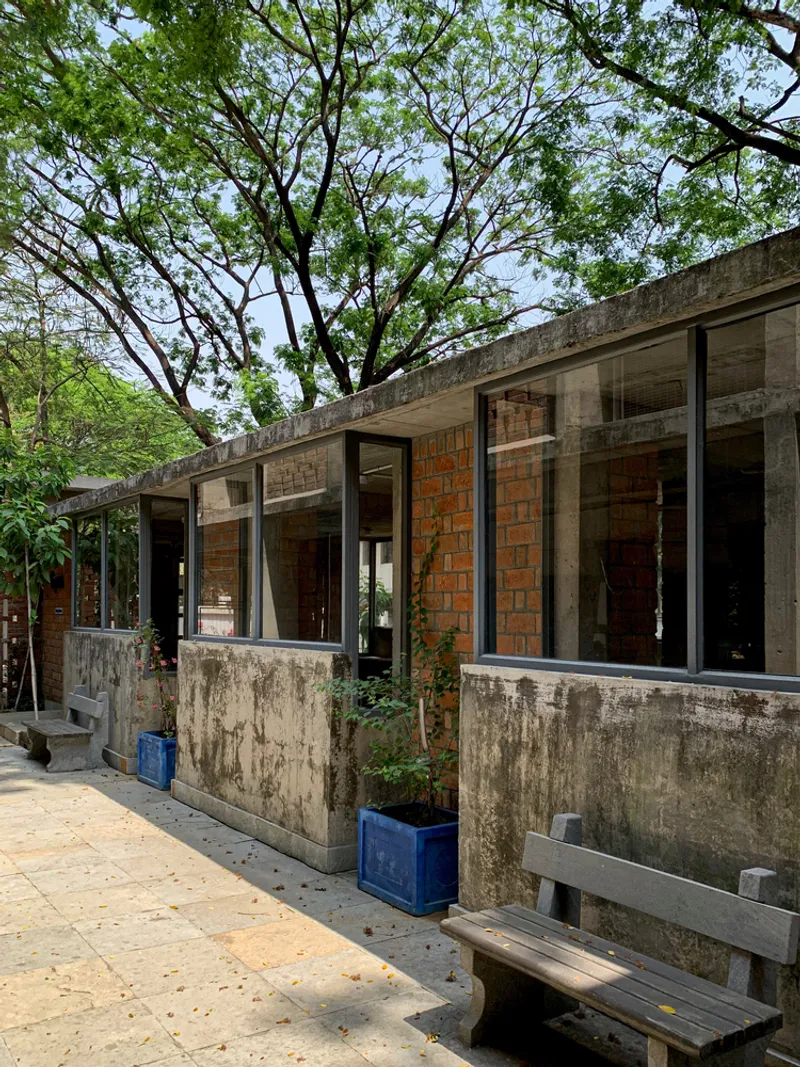
The primary brief for the hostel extension was to create additional dormitory rooms and a cafeteria to meet the growing demands of the school. Serving students from surrounding rural areas, the hostel accommodates learners as young as six, making safety and security central to the design strategy. The site also featured numerous mature trees, which shaped the building footprint and inspired a design that harmonizes with the natural landscape.

Architectural Approach and Spatial Planning
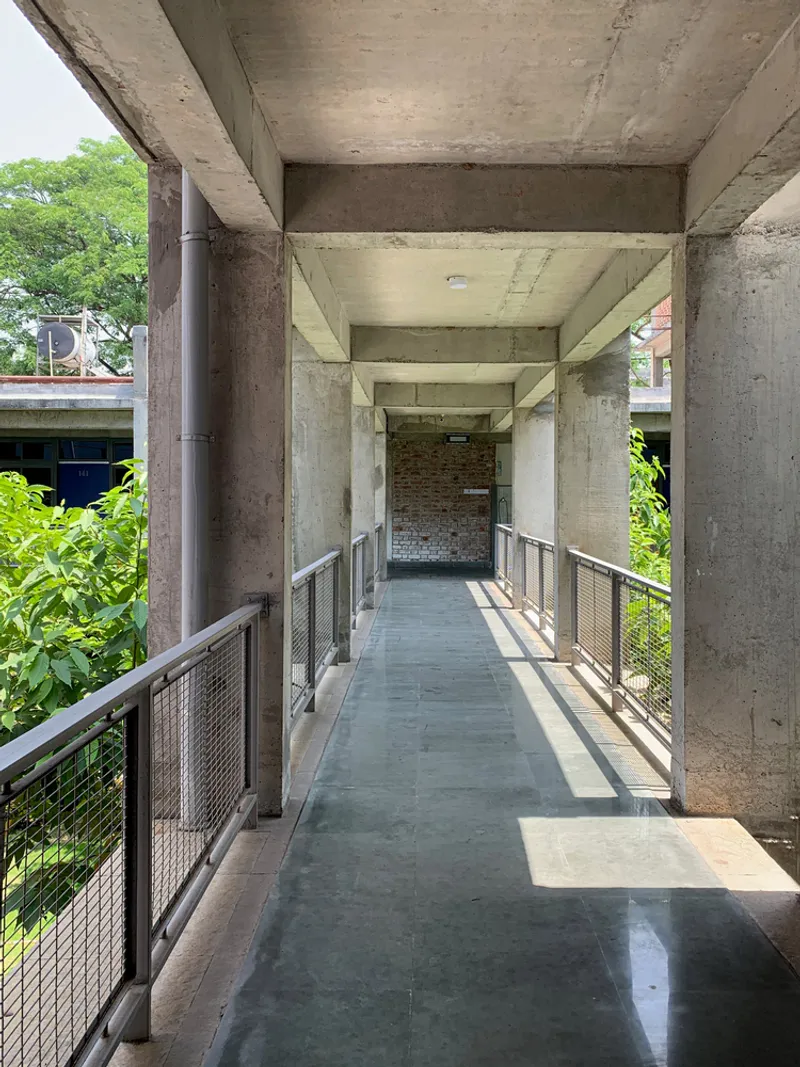
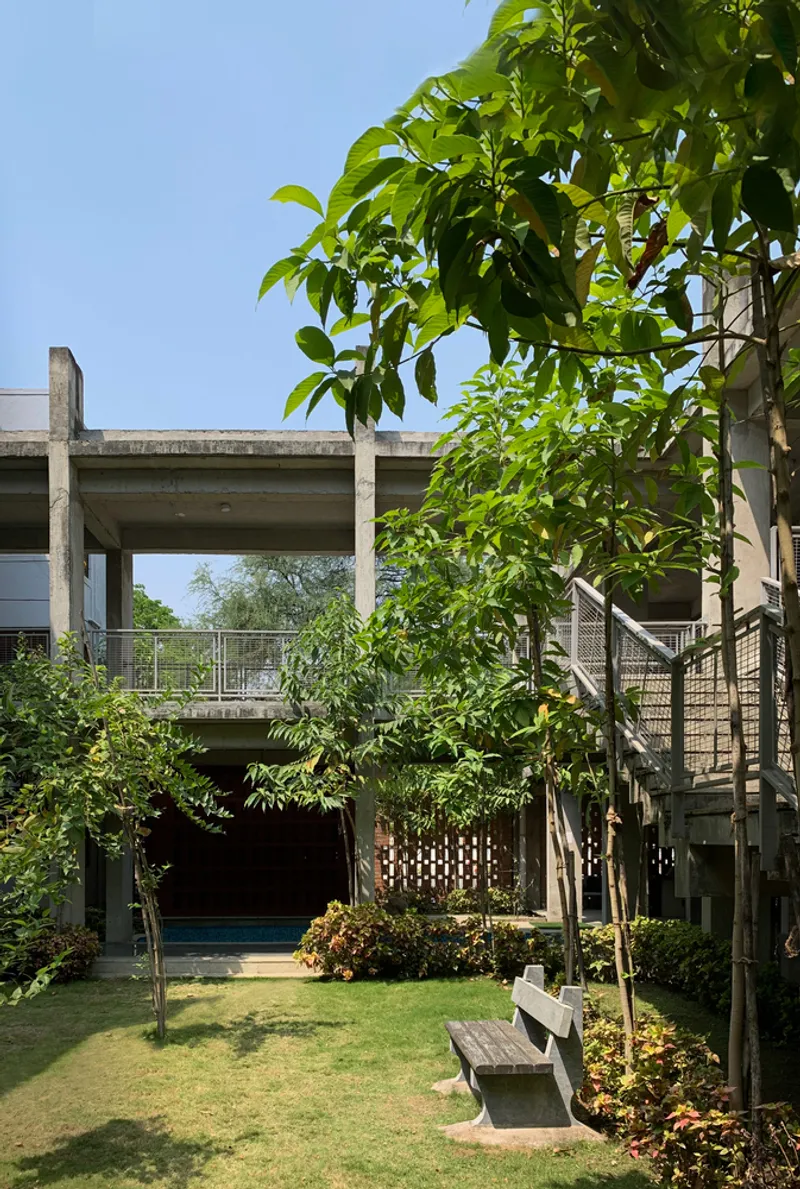
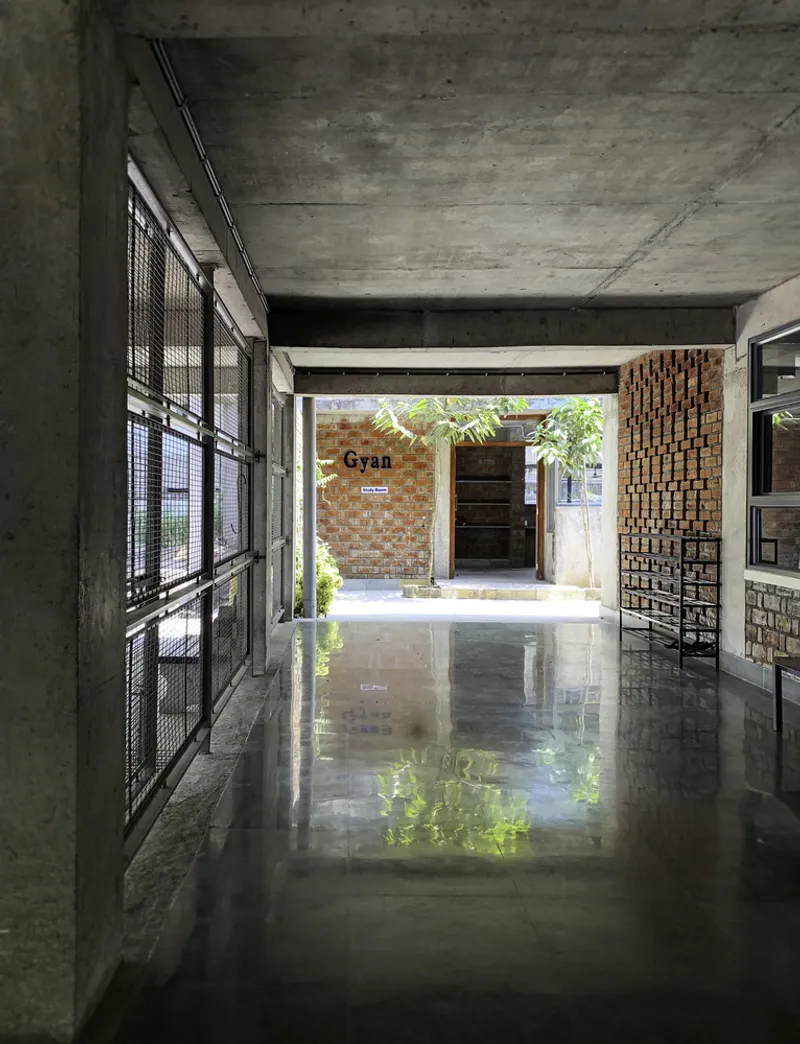
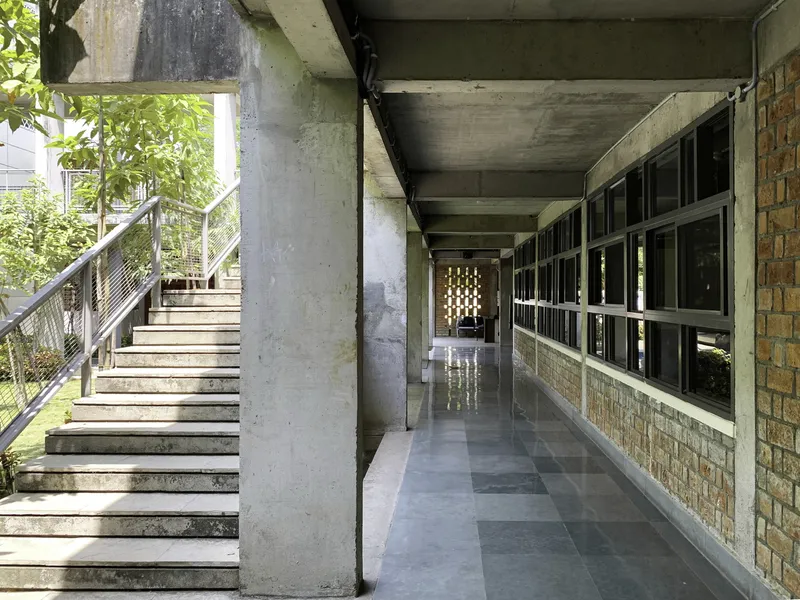
The new building is deliberately positioned away from the existing hostel, with connecting bridges linking the staircases. This arrangement creates a series of interconnected courtyards, enhancing ventilation, natural light, and visual connectivity. The upper-floor dormitories feature wide balconies overlooking the tree-lined side, serving multiple functions including study areas, recreational spaces, and a dignified area for drying clothes. The corridors act as buffers against extreme summer heat while integrating evaporative cooling ducts for passive climate control.
A carefully placed open staircase in one of the courtyards enhances accessibility and fosters social interaction, while a modest study center is isolated among the trees to provide a tranquil environment for focused learning. Between the old and new buildings, a meditation temple and water body are positioned to create spaces for reflection and spiritual well-being.
Materials and Sustainable Features
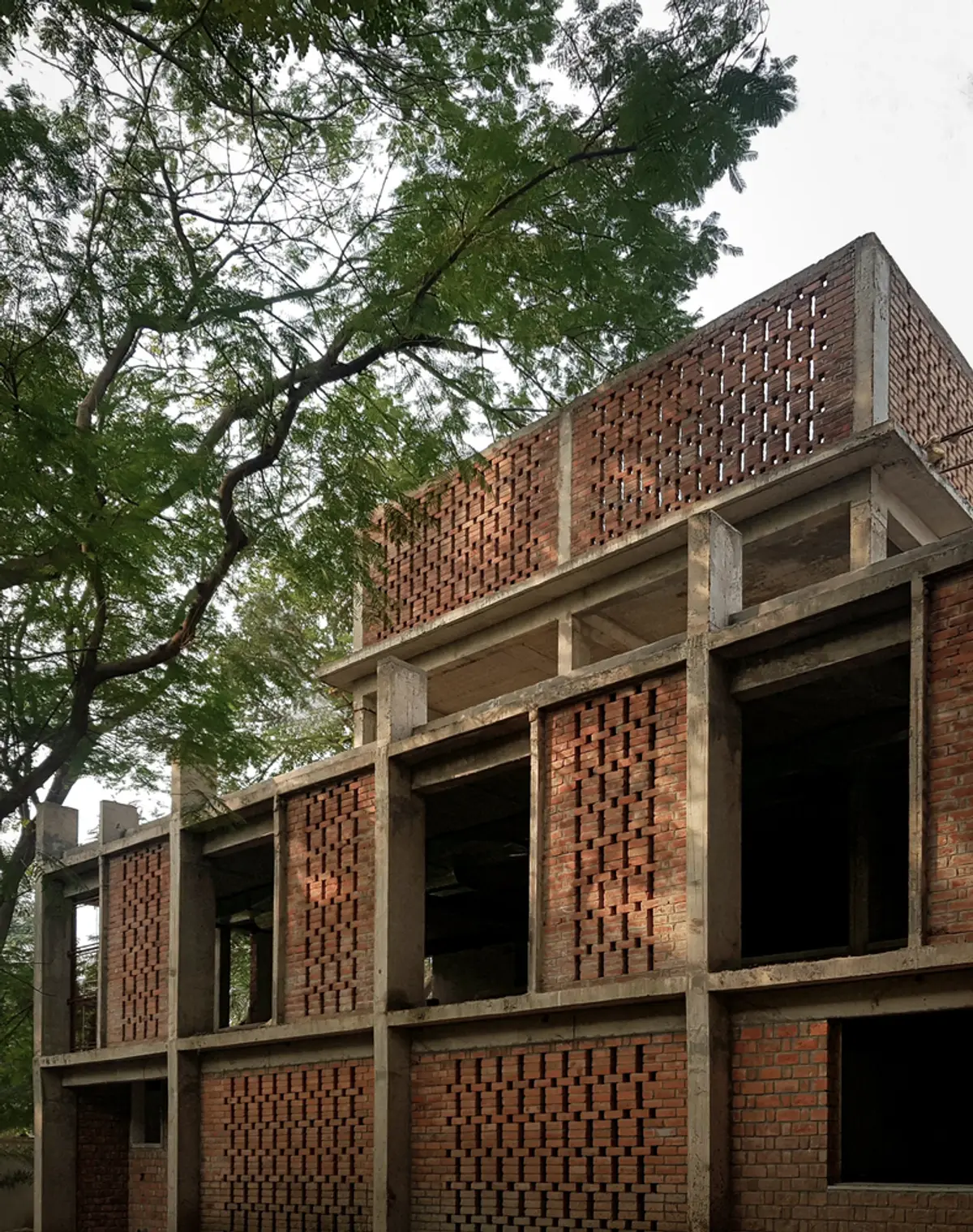
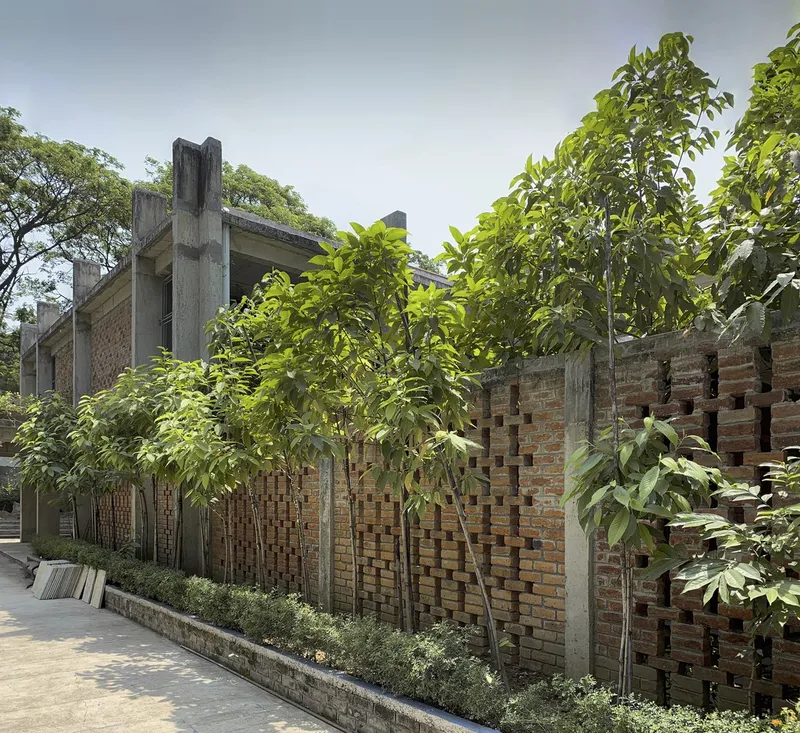
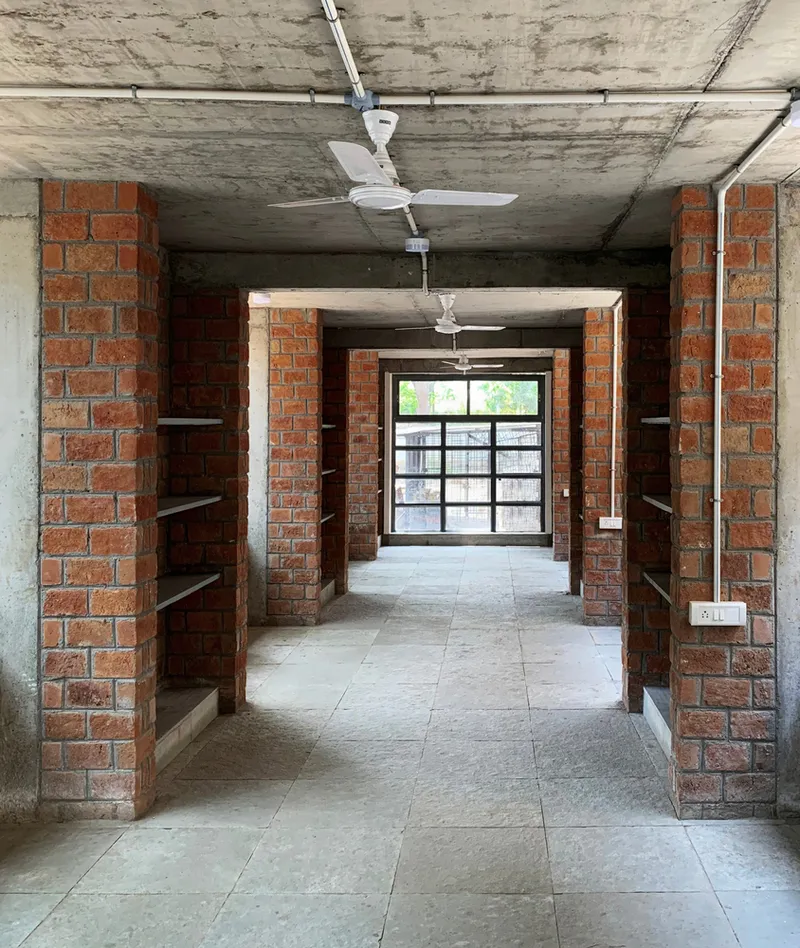
Sustainability is embedded in both material choice and structural logic. The hostel employs form-finished concrete and exposed local brickwork, creating an earthy, grounded aesthetic. Rat-trap bond brick masonry not only provides thermal insulation but also reduces material usage and future maintenance costs. Washrooms are oriented toward green courtyards, enclosed by brick jaali walls, enhancing privacy while maintaining ventilation.
Natural stones such as Kota, Shahbaz, and Kadapa are used for flooring, desks, and ledges, while custom dormitory furniture combines sleeping, storage, and study functions into single modular units. This efficient design conserves valuable space and encourages interaction among students. The building’s modular structural system allows for seamless vertical expansion in the future, making it a flexible solution for long-term educational needs.

Impact and Significance
Studioboxx’s Student’s Hostel stands as an exemplar of sustainable educational architecture, blending functional design, contextual sensitivity, and social responsibility. It demonstrates how thoughtful planning, material innovation, and passive design strategies can transform a modest, dated structure into a safe, inspiring, and future-ready living environment for students.


Popular Articles
Popular articles from the community


David Ortega Stacks a Two-Story Mexico City Penthouse Around a Steel Stair and a Pergola-Shaded Roof Terrace
In Colonia Roma, a 300 m² penthouse uses oak joinery, a planted steel stair and a slatted roof pergola to make a new-build apartment feel like a house.

GROUP A Strips a 1969 Rotterdam Harbor Headquarters to Its Frame and Wraps It in Timber Louvers
In Rotterdam's M4H harbor district, Ferro Offices reuses a 1969 frame, adds one timber storey and reaches BREEAM-NL Outstanding.

Cube Design Draws an Ecological Corridor Between Two Shenzhen Hills with the Nankai Building
Beside Shenzhen's container docks, the Nankai Building pairs stacked balconies with a climbing green screen to connect two hillsides across its height.

LT2A and OPEN Architectes Thread a Brick and Glass High School Through a Wooded Belgian Campus
In Braine-l'Alleud, a 3,000 m² wing for Collège Cardinal Mercier pairs pale brick with a glazed colonnade, deferring to a small chapel and a dense wood.

Similar Reads
You might also enjoy these articles


Hodi-Mandai Geram
Project Function: Preservation and revitalization of the Intangible heritage and socio-spatial identity of the Hodi by Housing, Cultural Memory Center, Sacred Grove, landscape, local tourism economy


Olio Towers: A Mid-Rise for Performers That Fuses Housing, Rehearsal, and Stage
Located blocks from Houston's Theater District, this modular tower stacks living units around a central performance atrium.

Oasis: Modular Green Housing Carved into Dhaka's Urban Fabric
A shortlisted Plugin Housing entry reclaims unauthorized settlements in Dhaka with stepped concrete volumes, green roofs, and ventilation-driven design.

Black Hole: A Floating Megastructure for the Post-Physical Era
Emiliano Mazzarotto envisions a spherical, self-scaling arena where e-sports, digital hotels, and holographic stadiums replace traditional public space.

Explore Educational Building Competitions
Discover active competitions in this discipline

Challenge to design public laboratory

Challenge to reimagine the Iron Throne

Photograph architecture without architects

Illustrate the lost glory of Angkor Wat - Render Challenge
Comments (0)
Please login or sign up to add comments
No comments yet. Be the first to comment!