
Studio mk27 Suspends a Timber and Concrete House Ten Meters Above the Minas Gerais Mountains
Three wooden boxes float between two concrete slabs on a steep hillside outside Belo Horizonte, framing valley views and reconstituted rainforest.

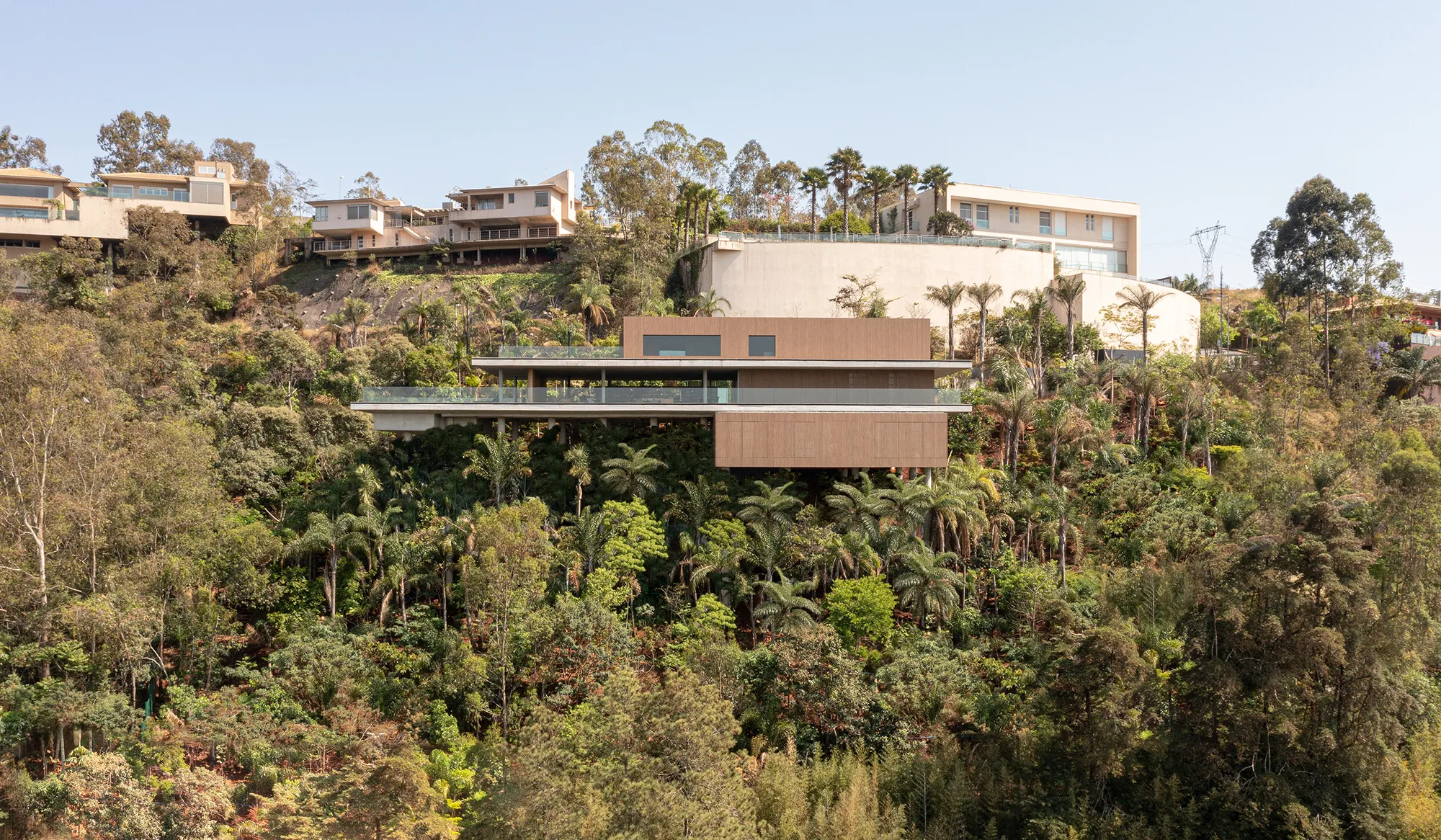
The name Belo Horizonte means "beautiful horizon," and studio mk27 has taken that promise literally. Minas House, the firm's first project in Minas Gerais, is a 1,100 m² residence in Nova Lima that levitates its entire program on stilts ten meters above a steeply sloped site. The house reads as a stack of horizontal planes and timber volumes threaded through the canopy of a garden designed to reconstitute the original Atlantic rainforest. It is a building that refuses to sit on its land, choosing instead to hover within it.
What makes the project worth studying is not just the dramatic cantilever or the infinity pool perched above the treetops, though both are arresting. It is the way the house organizes domestic life into a volumetric puzzle of three timber-clad boxes sandwiched between two concrete slabs, connected by a bridge and exposed to air on all sides. The stilts disappear among tree trunks. The house breathes, drains, and opens in every direction. There is no front door in the conventional sense, only a passage from earth to sky.
A House That Floats Among Trunks
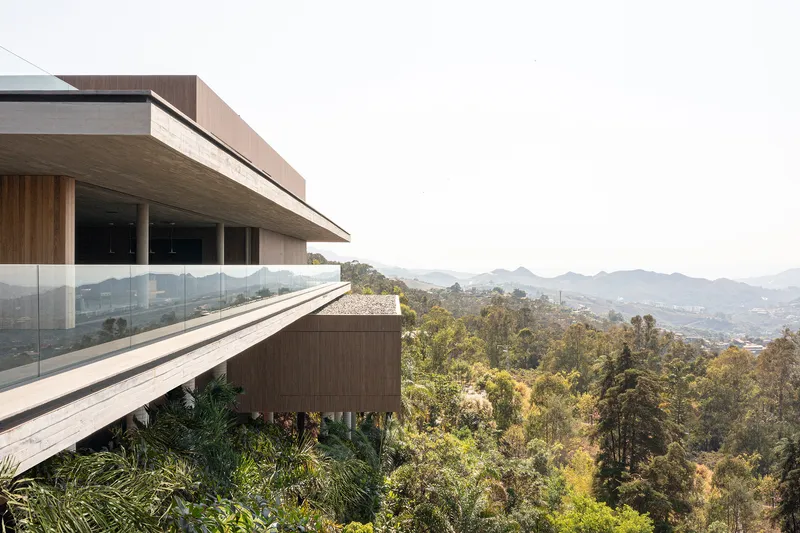
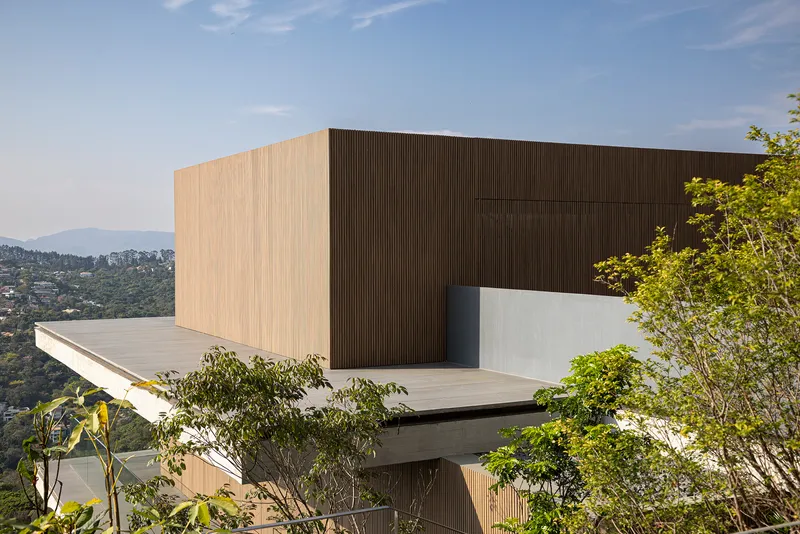
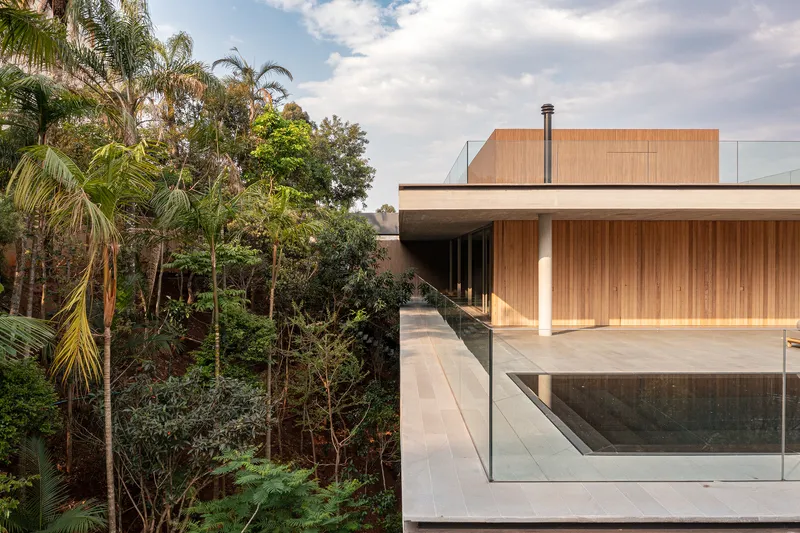
Seen from the hillside below, Minas House registers as a series of horizontal lines, concrete and timber, layered against the green slope. The stilts that hold the whole assembly aloft are deliberately slender and unpainted, mimicking the vertical rhythm of the surrounding tree trunks. Pedro Nehring's landscape design reinforces this camouflage by planting native species that, over time, will further absorb the structure into the canopy. One of the three wooden boxes is already immersed within the treetops, essentially a room in the forest.
Raising the house ten meters off the ground is not purely theatrical. On a site this steep, the elevation solves drainage, prevents erosion, and allows wind to pass freely beneath the living spaces. It is passive design disguised as spectacle.
Concrete Slabs as Horizon Lines
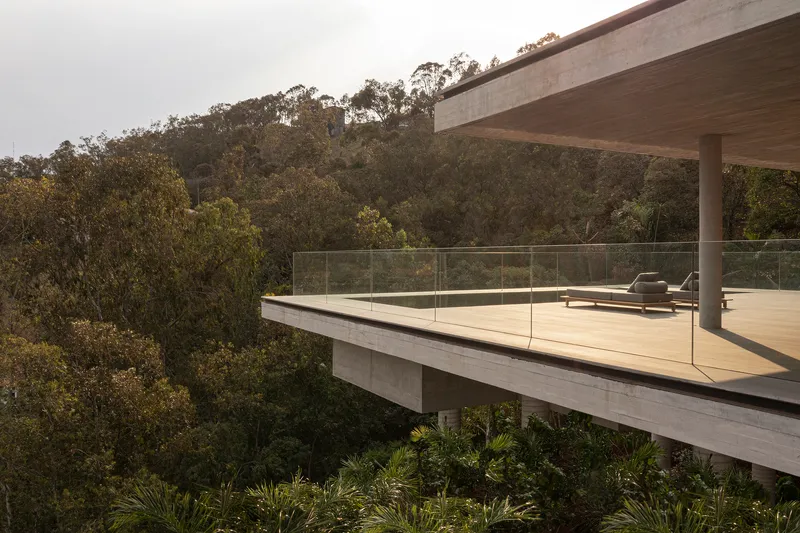
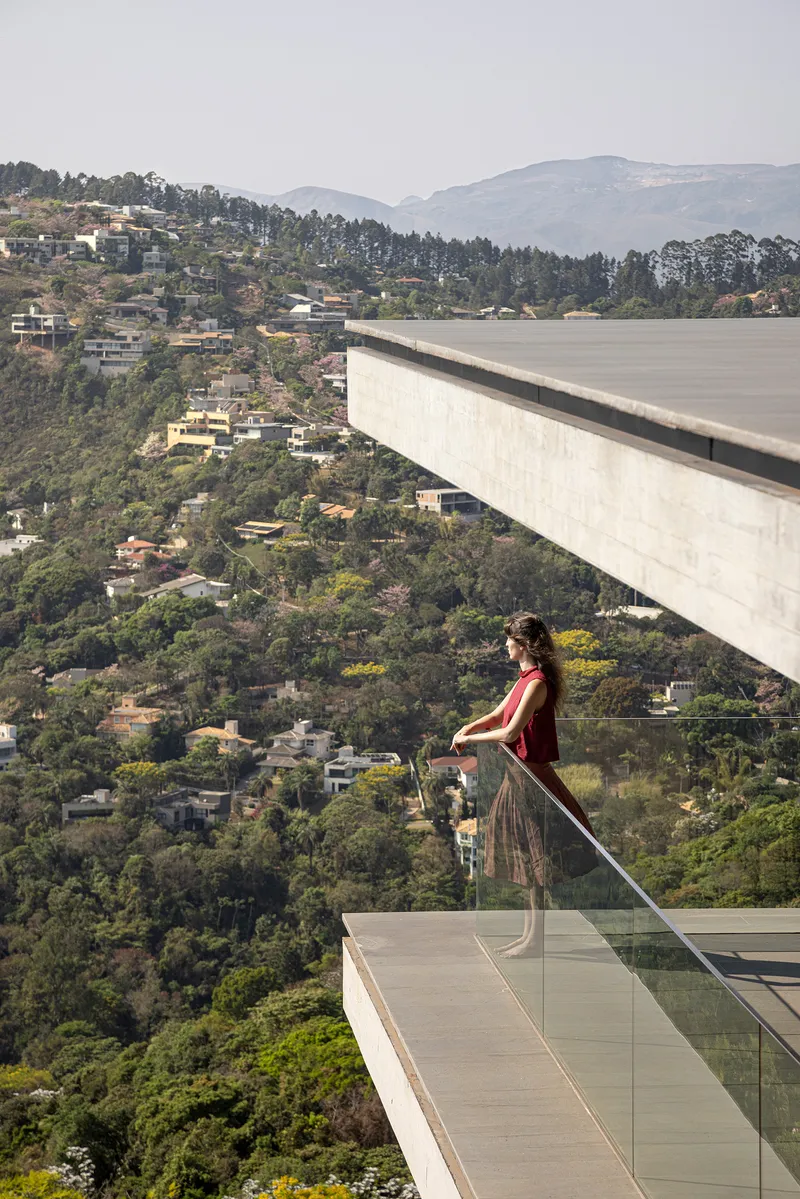
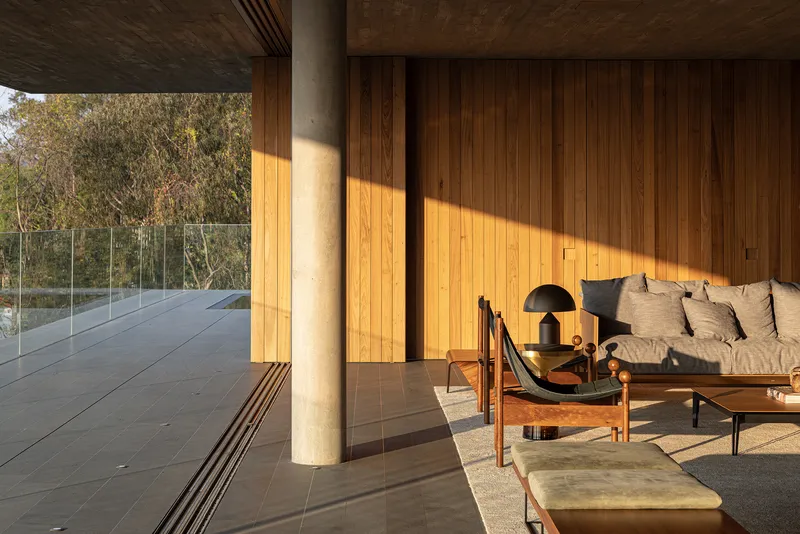
The two concrete slabs that define the floor and ceiling of the main living level are the structural backbone of the composition. They stretch outward in generous cantilevers, creating covered terraces and framing the distant cityscape of Belo Horizonte. The bare concrete is left exposed on the ceilings, its formwork texture visible, a detail that was refined with the help of concrete consultant Gabriel Regino Consultoria. The effect is monolithic without being heavy: the slabs read as thin ruled lines drawn across the horizon.
Cylindrical columns punctuate the terraces, their smooth white surfaces contrasting with the raw concrete overhead. These columns do real structural work, but they also organize movement, marking thresholds between interior rooms and the open-air decks.
Living in the Canopy
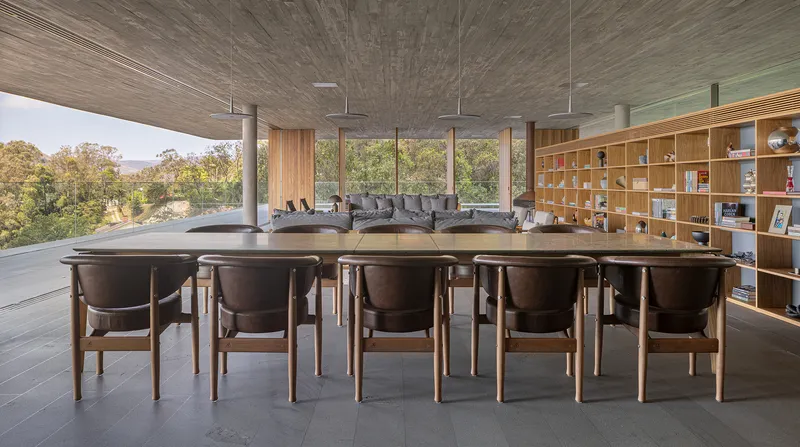
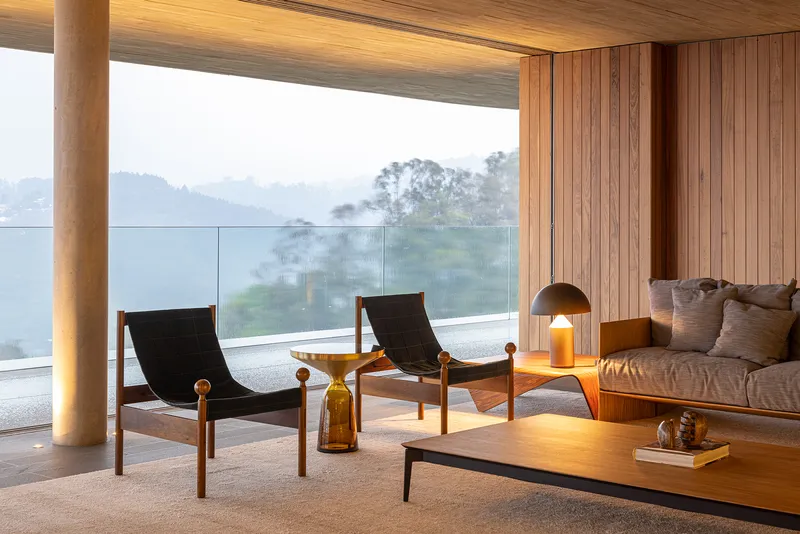
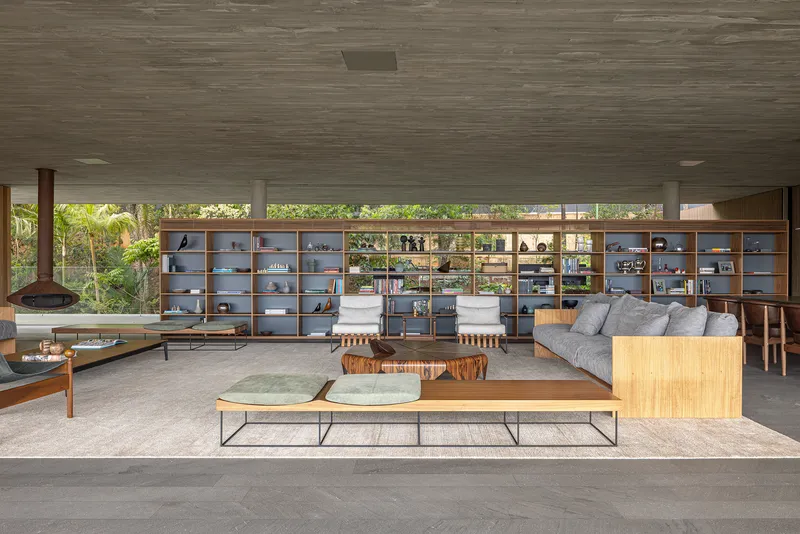
The primary living spaces occupy the upper platform, where floor-to-ceiling glass walls dissolve the boundary between the dining room and the valley below. A long timber dining table is positioned to take maximum advantage of the panoramic view, set beneath a warm wood-panelled ceiling that contrasts with the cooler concrete elsewhere. The living area, lined with built-in bookshelves, opens directly onto the garden, establishing a quieter, more introverted atmosphere even within the same open plan.
Mid-century Brazilian furniture pieces are placed throughout these rooms, grounding the interiors in a regional design lineage that complements the basalt stone flooring underfoot. The material palette, timber, stone, concrete, glass, is tight and consistent, which lets the views and the changing light do the decorative work.
Timber Boxes and Their Operable Skins
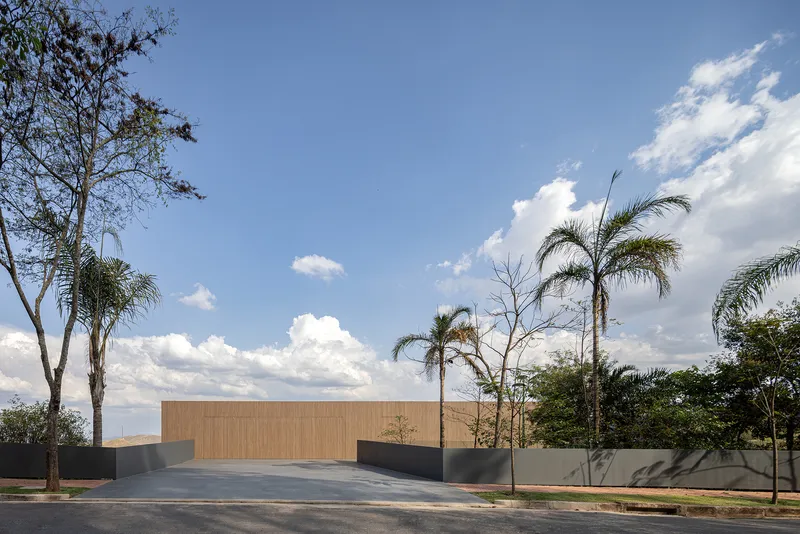
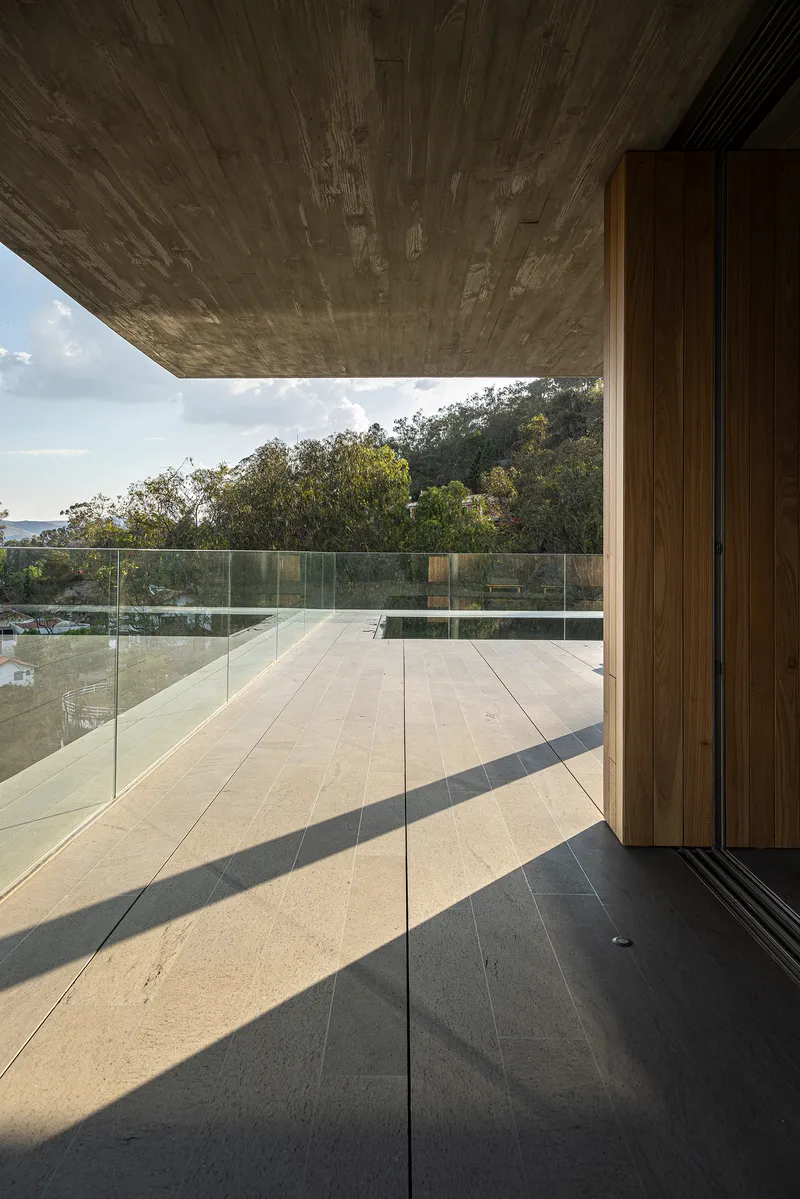
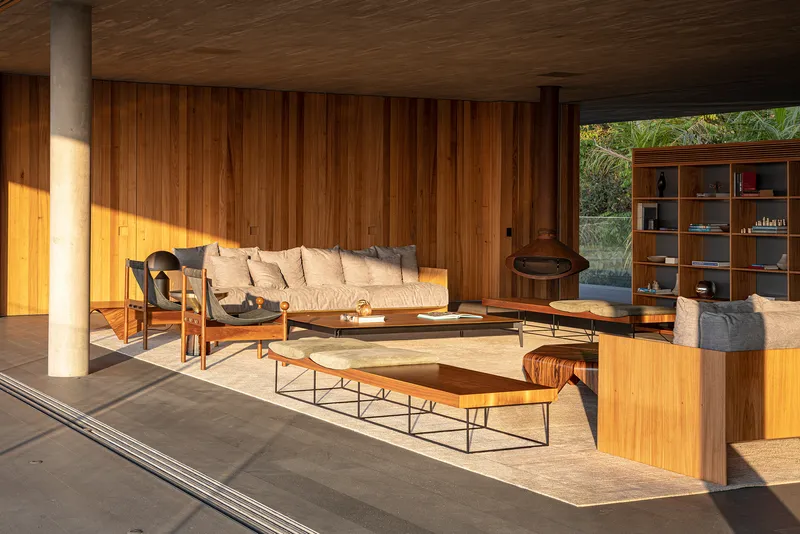
Each of the three wooden boxes serves a distinct programmatic purpose. One contains the kitchen, a powder room, and the master bedroom. Another holds additional bedrooms and a TV room. The third is a more secluded volume nestled into the treetops. What unites them is the slatted timber cladding that wraps their exteriors, punctuated by folding and sliding panels that allow residents to modulate light, ventilation, and privacy throughout the day.
The east-facing bedrooms use these operable panels to filter the morning sun, while pivoting wooden screens on the west side open the terraces wide to afternoon light and views. When everything is closed, the boxes appear solid and monolithic. When open, they are porous, their interiors merging with the surrounding air. The mechanism is simple, almost vernacular, but the precision of the joinery elevates it.
Pool, Terrace, and the Western Observation Deck
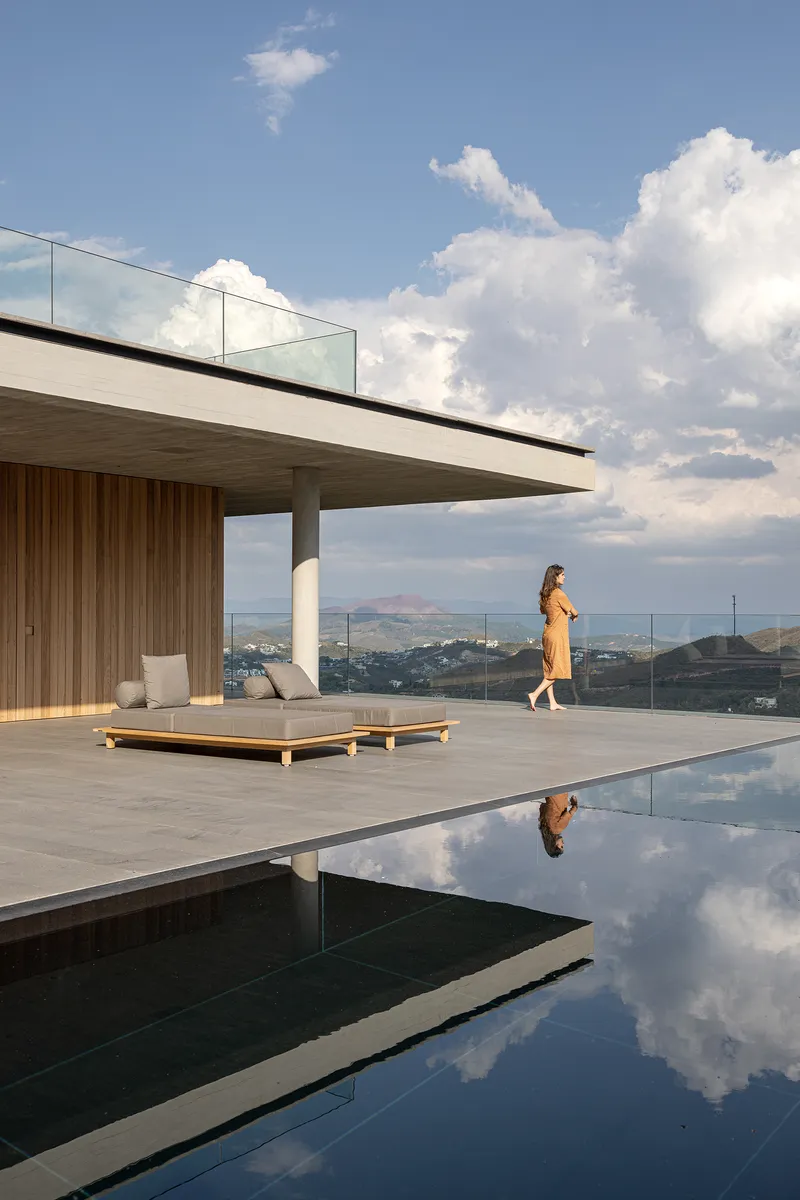
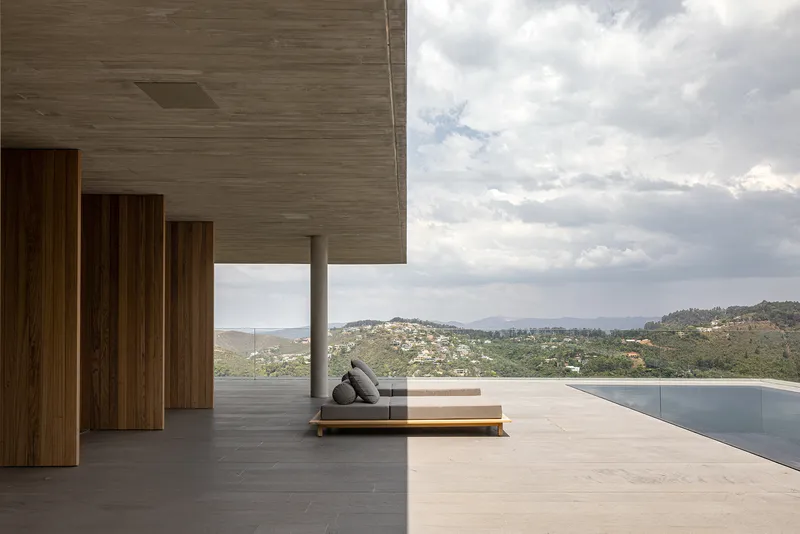
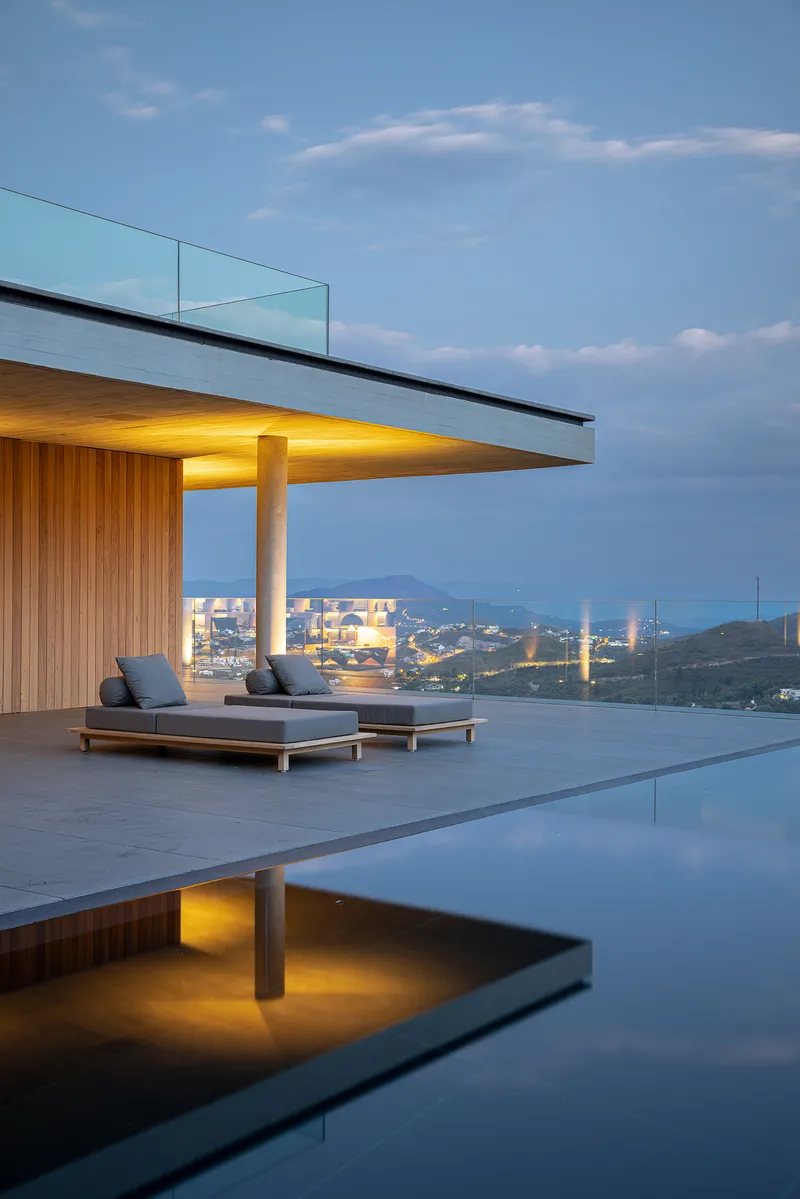
The western terrace is the house's social heart: an observation deck with an infinity pool, two tanning beds, and a low daybed that faces the hillside settlement and the horizon beyond. At dusk, the pool's glass edge catches the last light, and the timber pavilion above glows warmly. It is a consciously cinematic moment, designed to reward the act of sitting and watching time pass, which studio mk27 describes as the essence of the project's design philosophy.

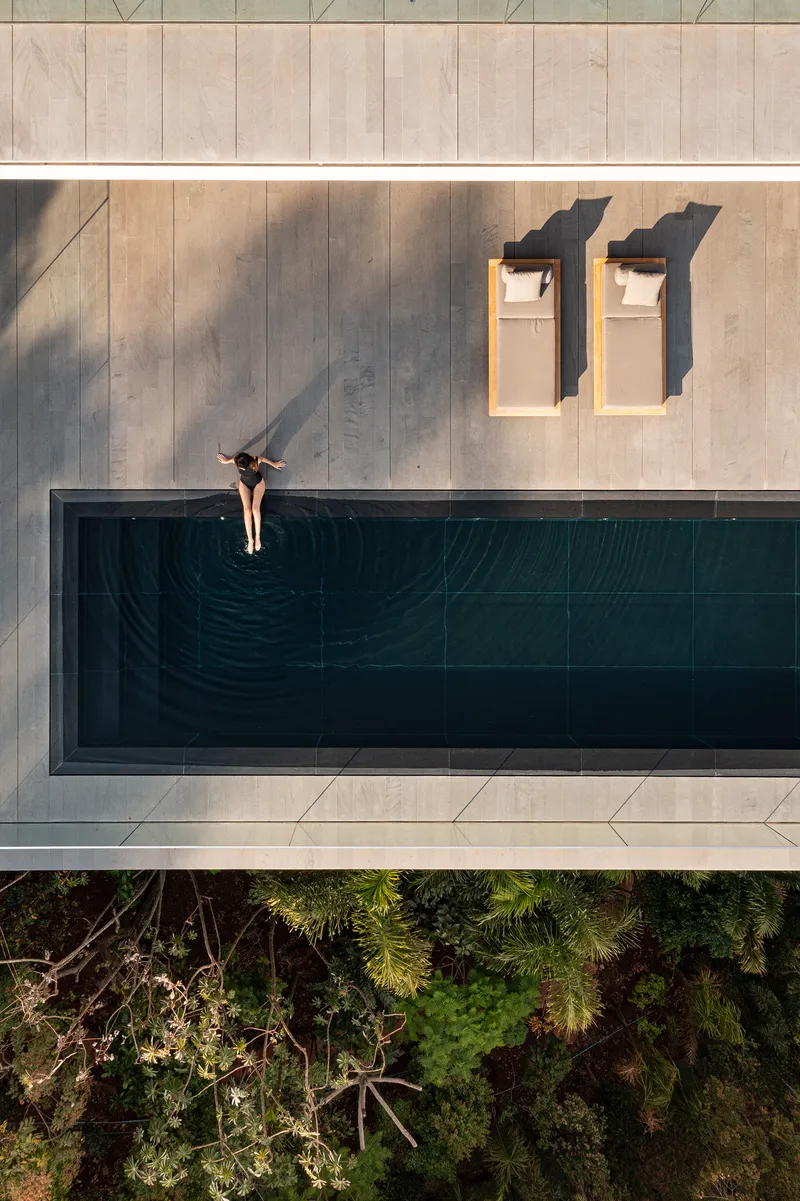
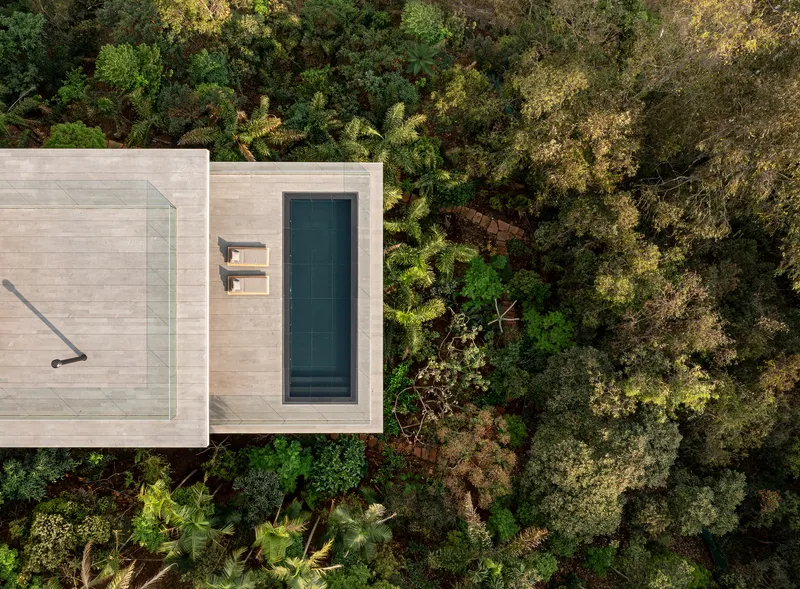
From above, the pool reads as a clean rectangle of blue punched into the pale concrete roof terrace, surrounded on all sides by dense canopy. A swimmer at its edge appears to float above the forest. The aerial views reveal how compact the building's footprint actually is relative to the 3,000 m² site, most of which is left to the restored landscape.
Private Rooms and Hidden Pleasures
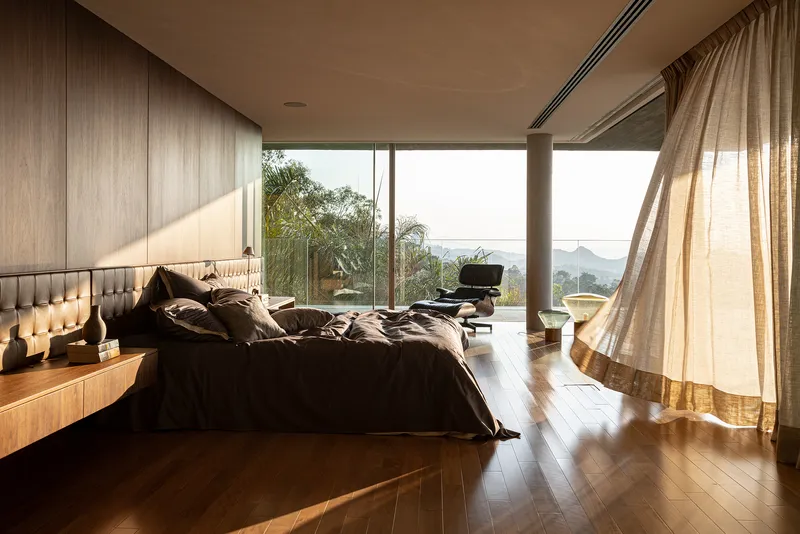
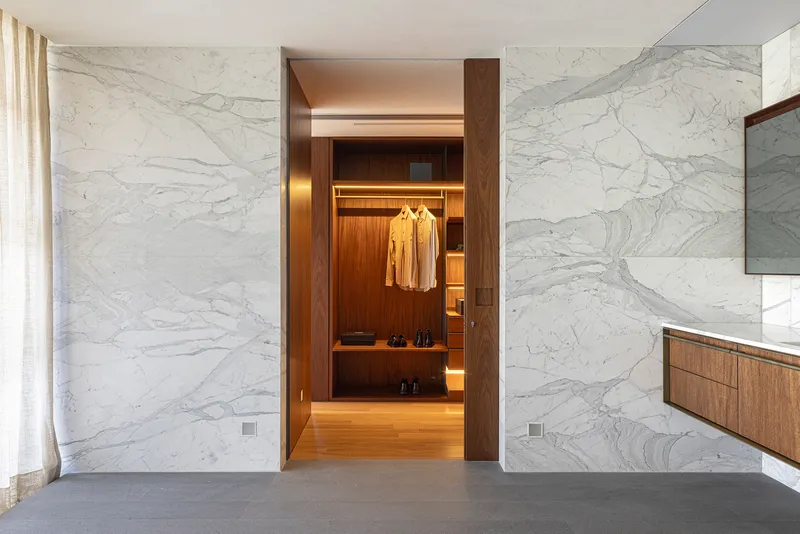
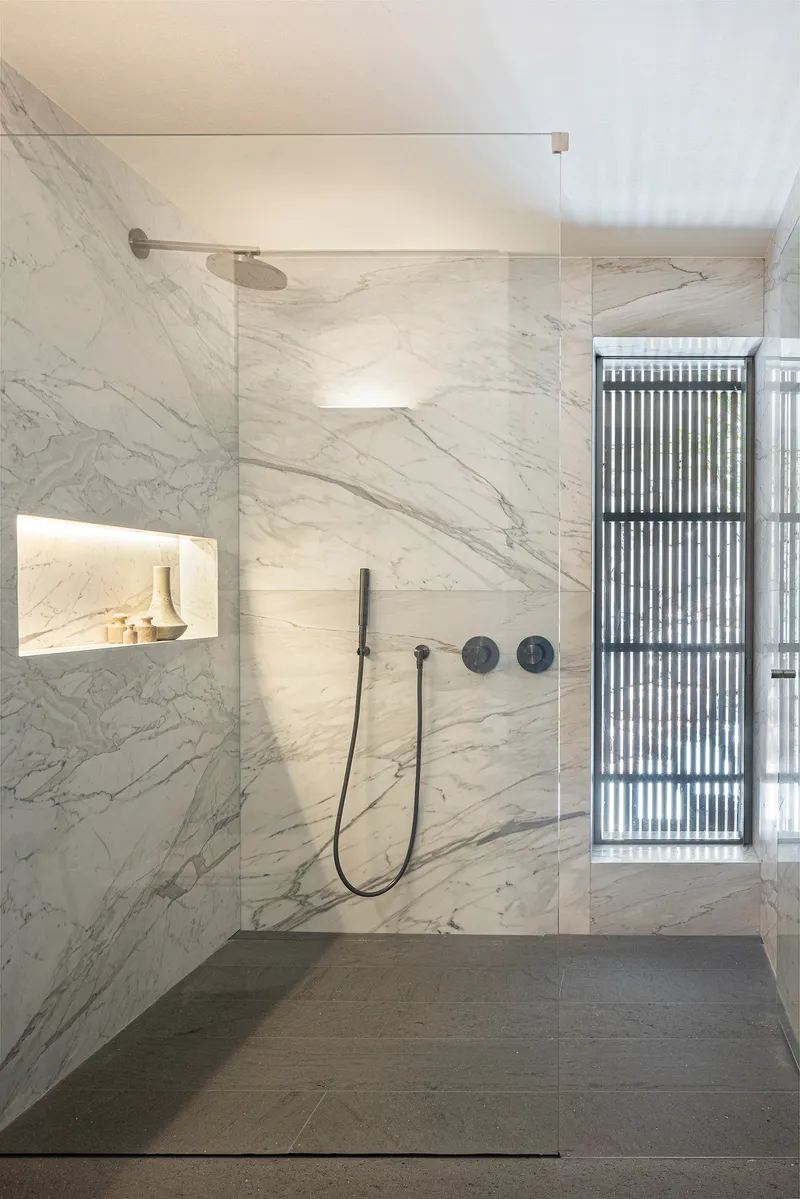
The bedrooms and bathrooms occupy a more restrained register. The master bedroom features an angled window wall with sheer curtains that soften the mountain view into an almost painterly composition. White marble lines the bathroom walls, with recessed niches and vertical louvered windows admitting narrow strips of daylight. These are private rooms in the true sense: enclosed, quiet, textured in pale stone and timber, deliberately set apart from the expansive openness elsewhere.
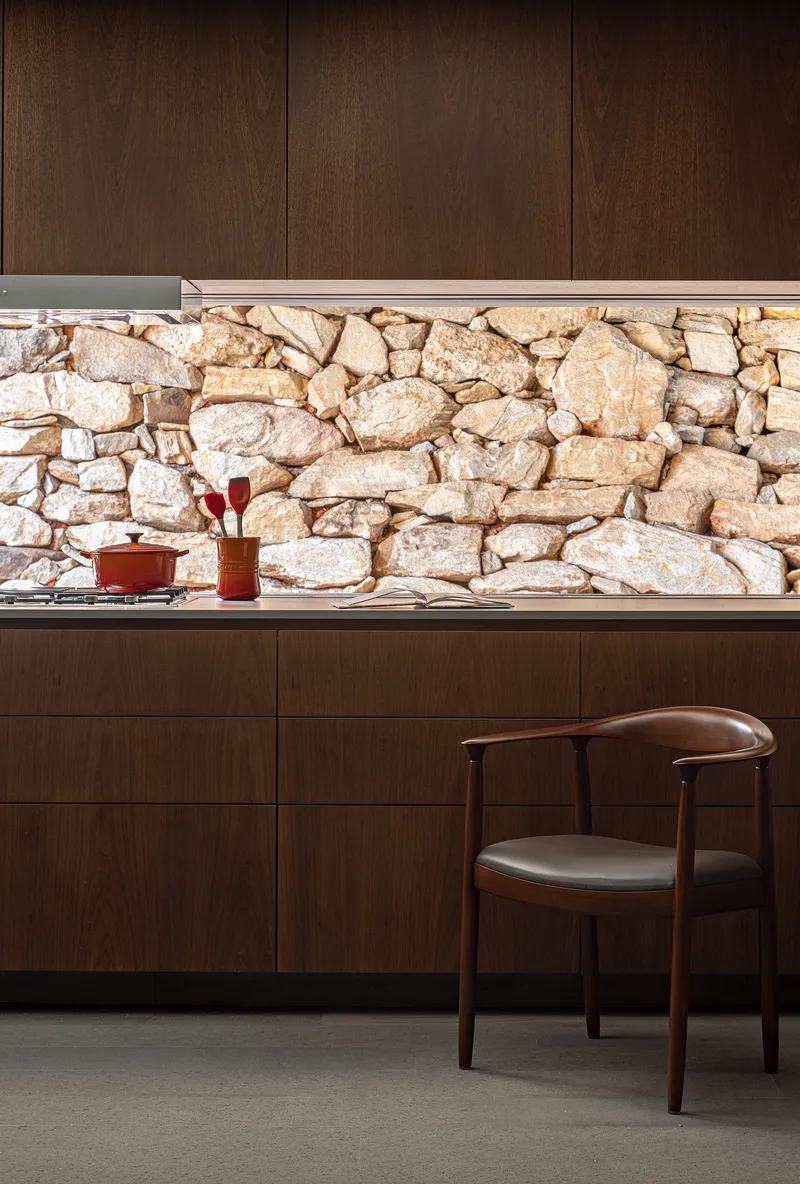
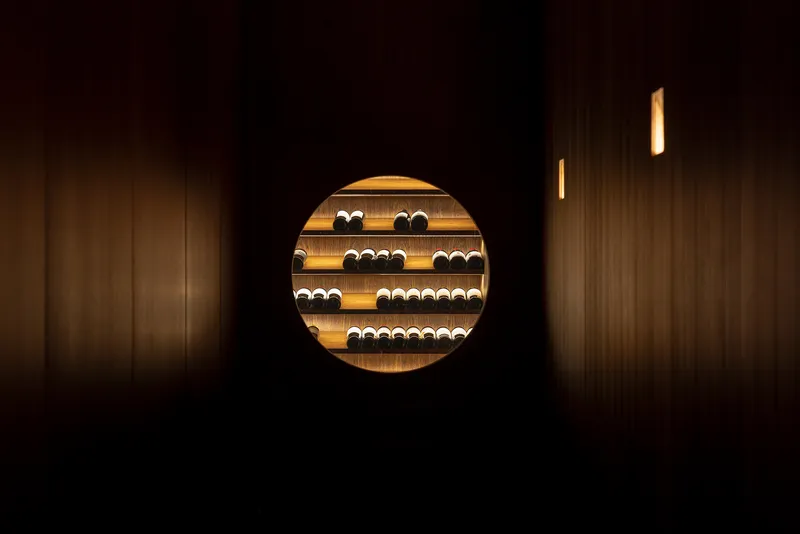
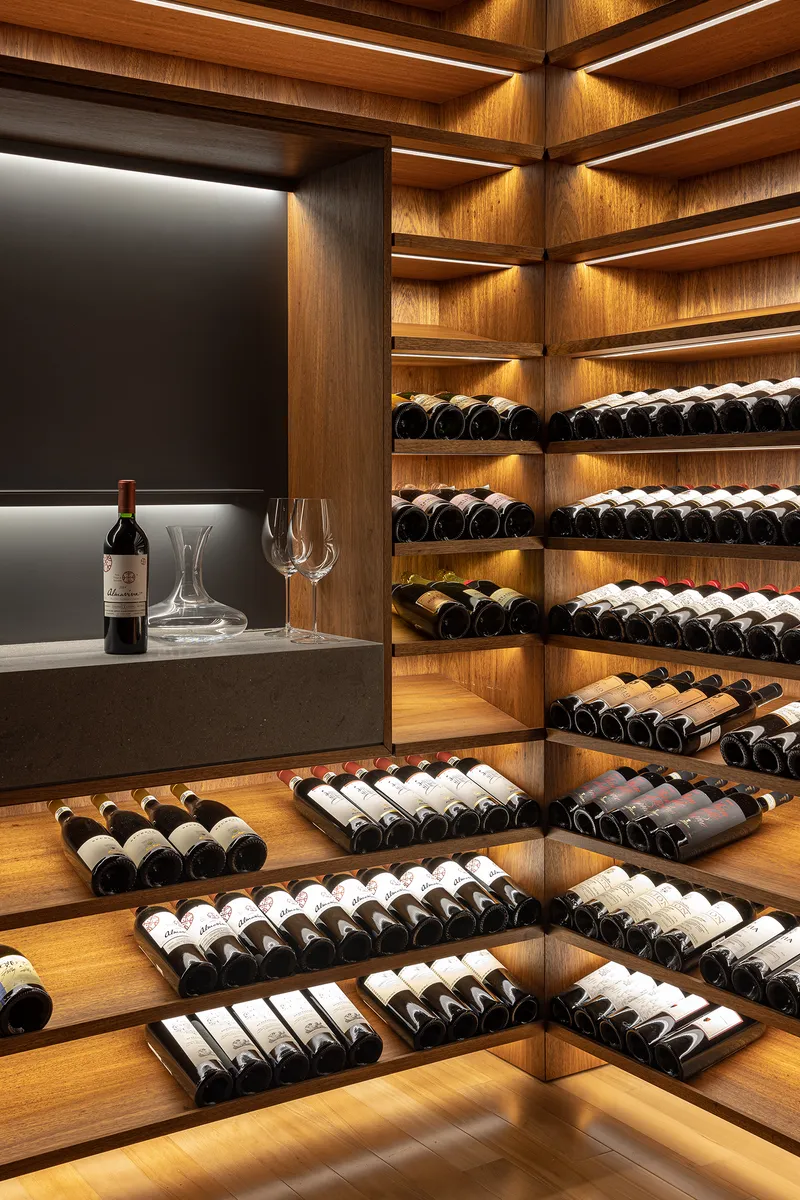
The lower level conceals some of the house's most characterful spaces. A wine cellar, accessed through a circular aperture in a dark timber wall, is lined with backlit shelving and a grey stone display counter. The kitchen features an exposed stone backsplash beneath dark timber cabinetry, its task lighting casting warm pools on the basalt surface. These details reveal a project where the brief was generous and the execution meticulous.
Bridge, Threshold, and Circulation
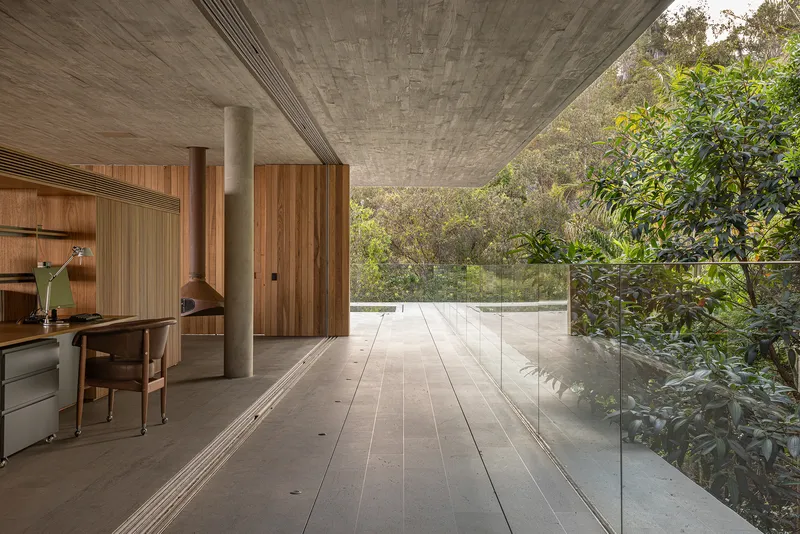
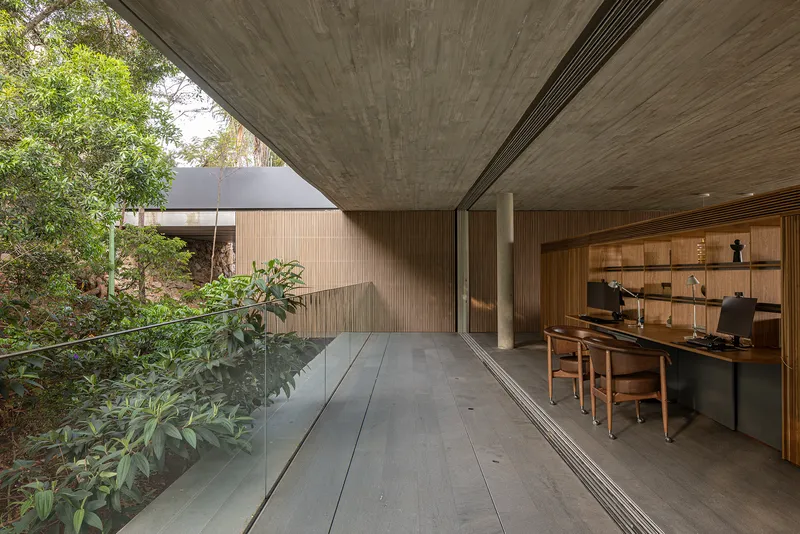
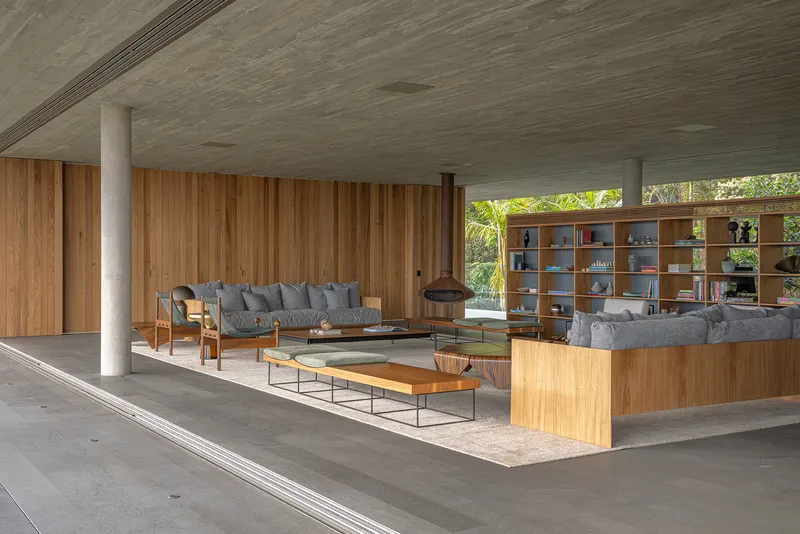
A bridge connects the public and private wings of the house, serving as both a circulation spine and a moment of pause. Glass-walled corridors with stone flooring lead from one volume to another, casting long afternoon shadows across the terrace. The transition from the covered living area, with its white columns and open shelving, to the planted courtyard beyond is handled with the kind of spatial generosity that makes a large house feel like a sequence of distinct places rather than a single relentless interior.
Plans and Drawings
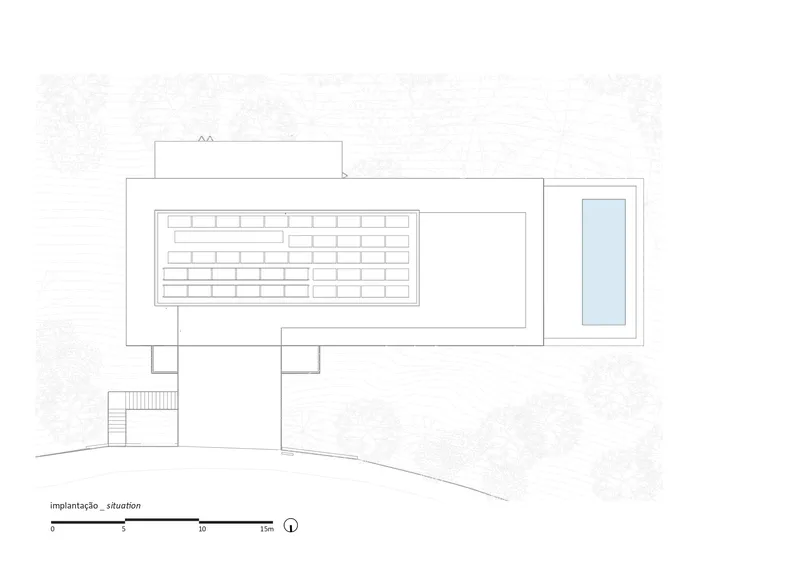
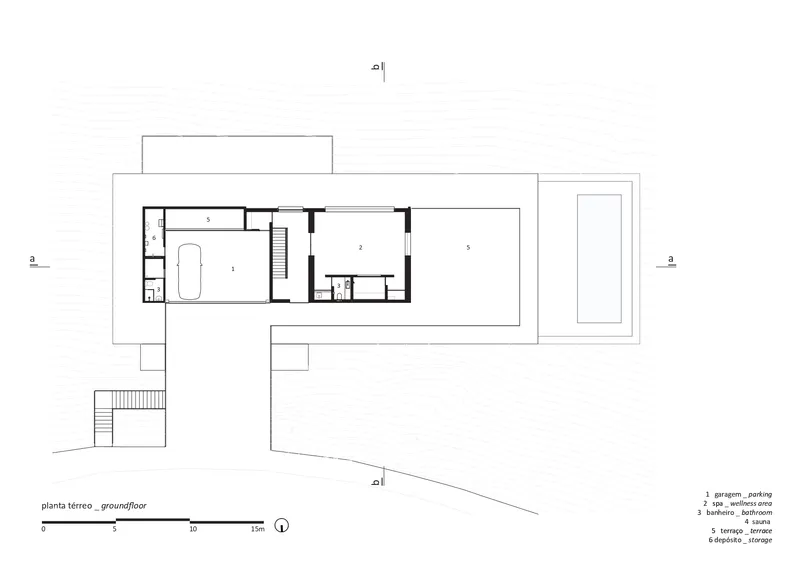
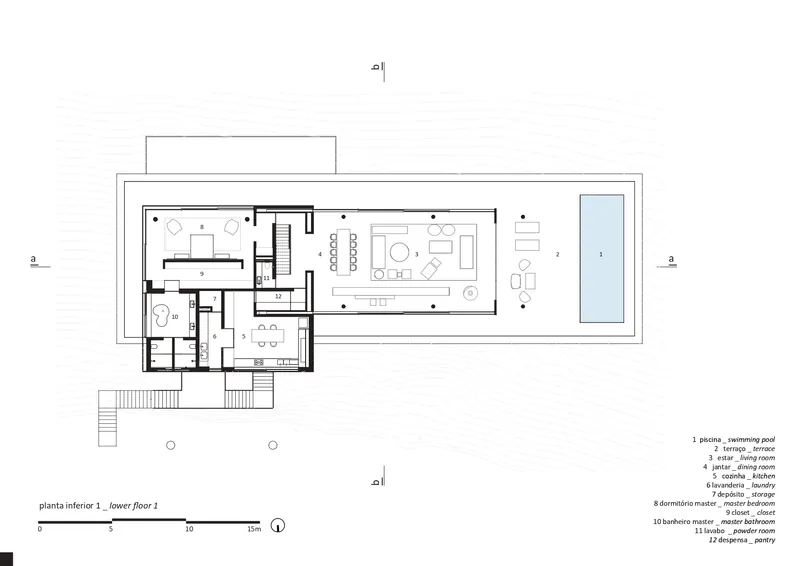
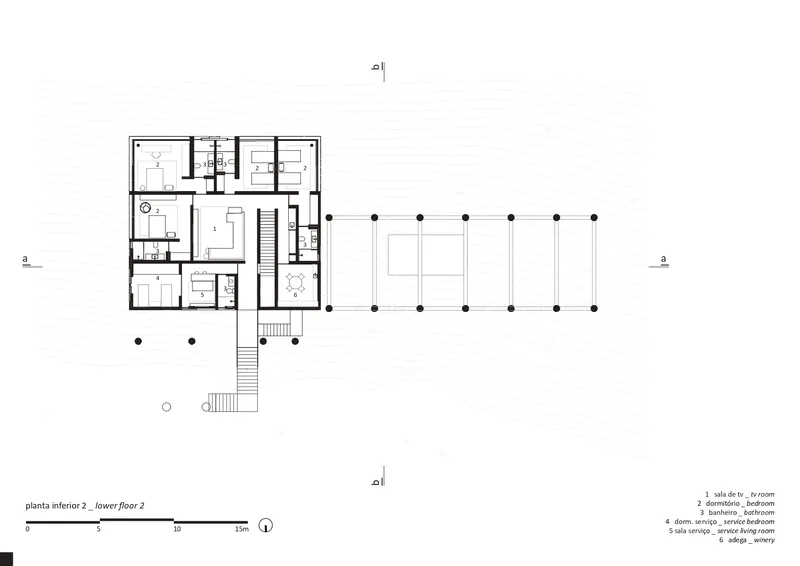
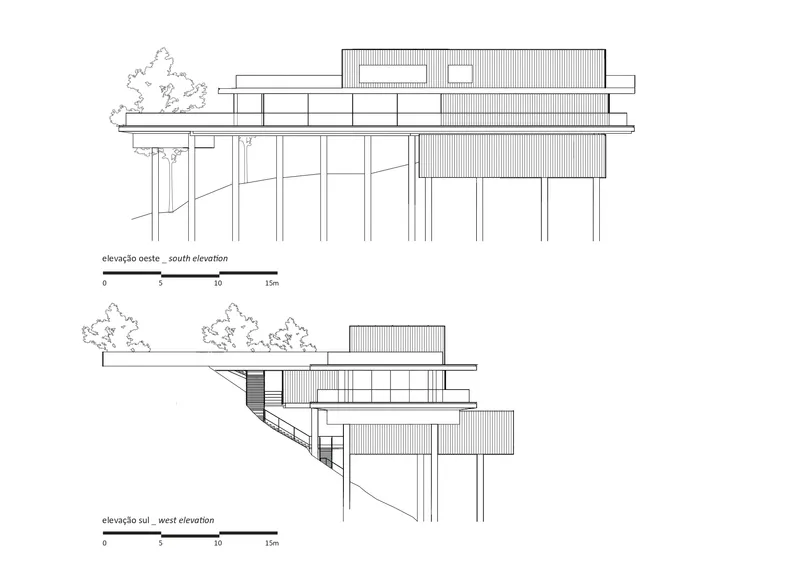
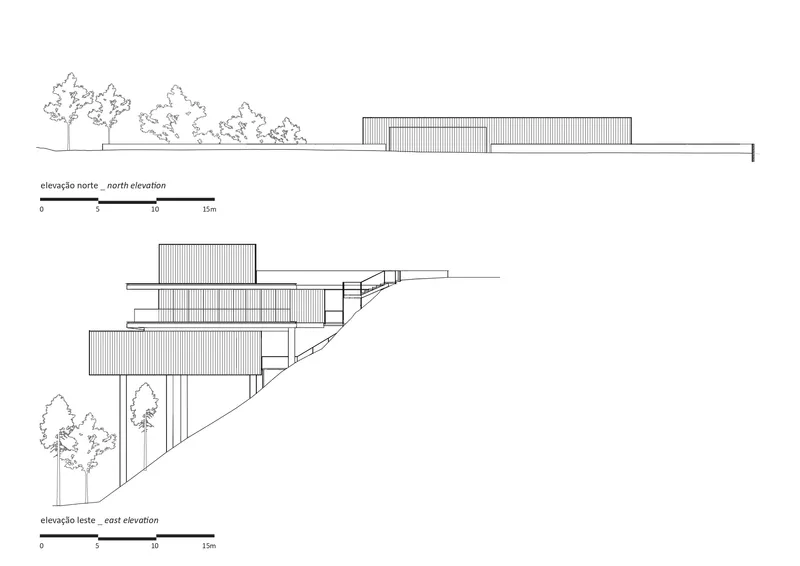
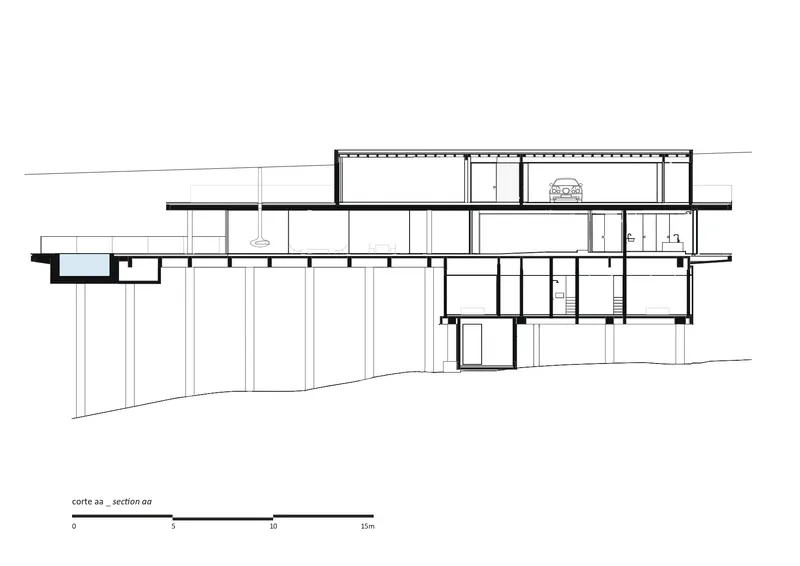
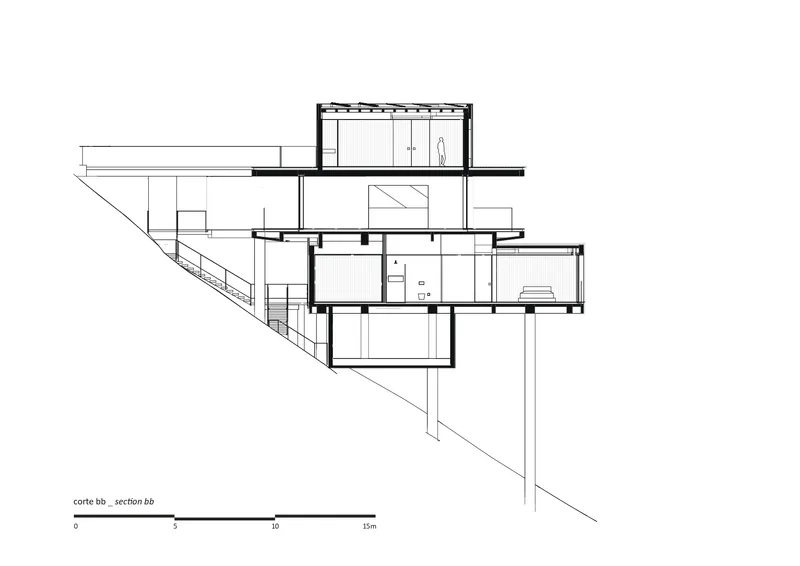
The drawings make the structural logic legible. The site plan shows how the rectangular volume is oriented along the slope, with the pool cantilevering toward the valley. The floor plans reveal the tripartite organization: three timber boxes distributed across two levels, with the colonnade terrace extending the upper platform outward. The sections are the most revealing documents. They expose the full ten-meter elevation, the vertical circulation threading through the slope, and the way the lowest box nestles into the hillside while the upper volumes reach for air and light.
The elevations, drawn with the surrounding vegetation, confirm how deliberately the house was designed to be read through trees. From the south and west, the stacked volumes step down the terrain like a geological formation. From the north and east, the cantilevers dominate, projecting the house outward into space.
Why This Project Matters
Minas House belongs to a lineage of Brazilian houses that use dramatic structure as a means of engaging with landscape rather than dominating it. The raised platform, the canopy garden, the operable timber screens: none of these moves are new in isolation. What studio mk27 achieves here is a synthesis where each element reinforces the others. The stilts make the garden possible. The garden makes the stilts invisible. The timber boxes modulate the concrete horizontals. The result is a house that is simultaneously massive and light, exposed and protected, rooted and airborne.
The project also demonstrates that contemplation, the stated design philosophy, is not just a programmatic idea but a structural one. Every space in the house is oriented toward watching: the horizon, the forest, the changing weather, the passage of time. The architecture does not compete with those phenomena. It frames them, holds still, and gets out of the way. That restraint, in a house this ambitious, is the real achievement.
Minas House by studio mk27, located in Nova Lima, Minas Gerais, Brazil. 1,100 m². Completed in 2020. Landscape design by Pedro Nehring. Photography by Joana França.
About the Studio
Share Your Own Work on uni.xyz
If projects like this are the kind of work you want to make, uni.xyz is a place to publish your own, find collaborators, and enter design competitions.



Popular Articles
Popular articles from the community

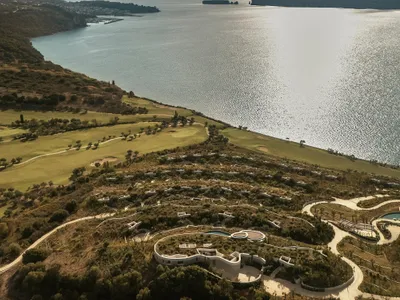
A.N. Tombazis and K-Studio Bury a Luxury Resort into a Peloponnese Hillside
Mandarin Oriental Costa Navarino scatters 99 earth-sheltered rooms across 140 hectares above the Bay of Navarino in Pilos, Greece.
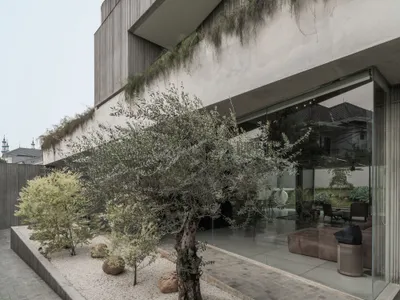
Wiyoga Nurdiansyah Composes Three Volumes into a Quiet Family Compound in South Jakarta
RJH House splits domestic life across a cube, a cylinder, and a service block, laced together by courtyards and raw concrete.


The Memory of World: Skyscraper Architecture as a Vertical Exhibition of Human Civilization
A vertical museum in Hong Kong transforms skyscraper architecture into a journey through six eras of humanity, nature, memory, and progress.
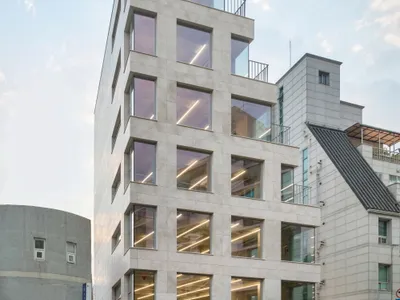
Simplex Architecture Steps a Seoul Mid-Rise Tower to Negotiate Between Low-Rise Commerce and High-Rise Housing
In Seocho-dong, a gridded stone tower of terraces and sunken courtyards mediates between two radically different urban scales.

Similar Reads
You might also enjoy these articles
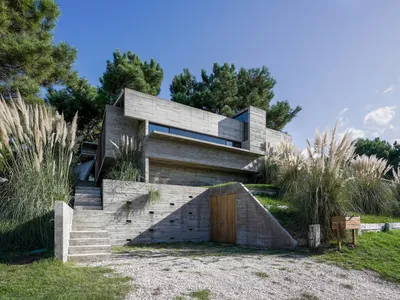
Loma House by Besonias Almeida Arquitectos: Modern Coastal Living in Costa Esmeralda
Loma House by Besonias Almeida Arquitectos is a modern coastal home in Costa Esmeralda, blending exposed concrete, wood, and natural dunes.
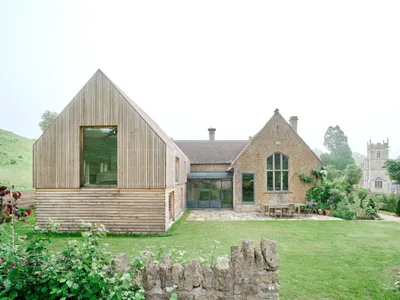
“Pitcombe’s Old School House Renovation by Bindloss Dawes: Blending Heritage and Contemporary Design”
Bindloss Dawes transformed Pitcombe’s 19th-century Somerset schoolhouse with a sustainable timber extension, blending historic charm, contemporary design, and panoramic countryside views.
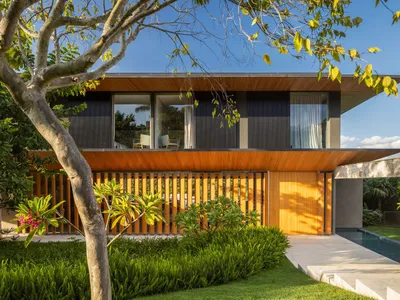
F3 Residence by Belluzzo Martinhão Arquitetos: Contemporary Luxury in São Paulo’s Countryside
F3 Residence in São Paulo blends contemporary design, natural materials, multigenerational living, hillside integration, expansive glass, infinity pool, and seamless indoor-outdoor flow.
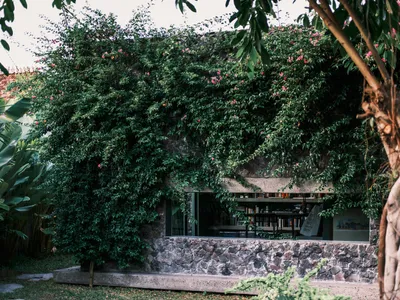
Private Villa in Ubud by BAMM ARCHITECTS: Contemporary Design Amidst Bali’s Jungle
Private Villa in Ubud blends contemporary design with tropical landscape, featuring open-air pavilion, stone and wood materials, suspended master bedroom, and jungle pool views.

Explore Transportation Competitions
Discover active competitions in this discipline




The Global Benchmark for Architecture Dissertation Awards


Challenge to design mud housing for contemporary communities
Comments (0)
Please login or sign up to add comments
No comments yet. Be the first to comment!