
Studio PROMADA Builds a Steel-Skeleton House That Grows Into Its Own Forest in Kerala
A prefabricated steel and concrete residence in Thiruvankulam wraps itself in vertical greenery overlooking rice paddies outside Kochi.


Most houses in Kerala's suburban belt lean on load-bearing masonry or reinforced concrete frames. Studio PROMADA's Amalgam Residence in Thiruvankulam does neither. Instead, it stakes its entire structure on a pre-engineered steel skeleton, a choice that liberates the plan from thick columns and deep beams and lets the facade dissolve into glass wherever the architects want a view. In a 20-cent plot facing rice paddies on the outskirts of Kochi, that turns out to be almost everywhere.
What makes this 4,500 square foot house genuinely interesting is the way it splits its personality. The front half is almost entirely transparent, a sequence of living and dining volumes that open without interruption toward the paddy field. The rear half is opaque, conventional, and private, holding bedrooms behind solid walls and planted courtyards. Between these two hemispheres, a double-height void acts as the hinge, pulling light down through clerestory windows and connecting every floor via a wood-and-steel staircase. The building is not trying to be a glass box or a concrete bunker. It is both, and the seam between them is where the architecture actually lives.
Steel Bones, Open Plans

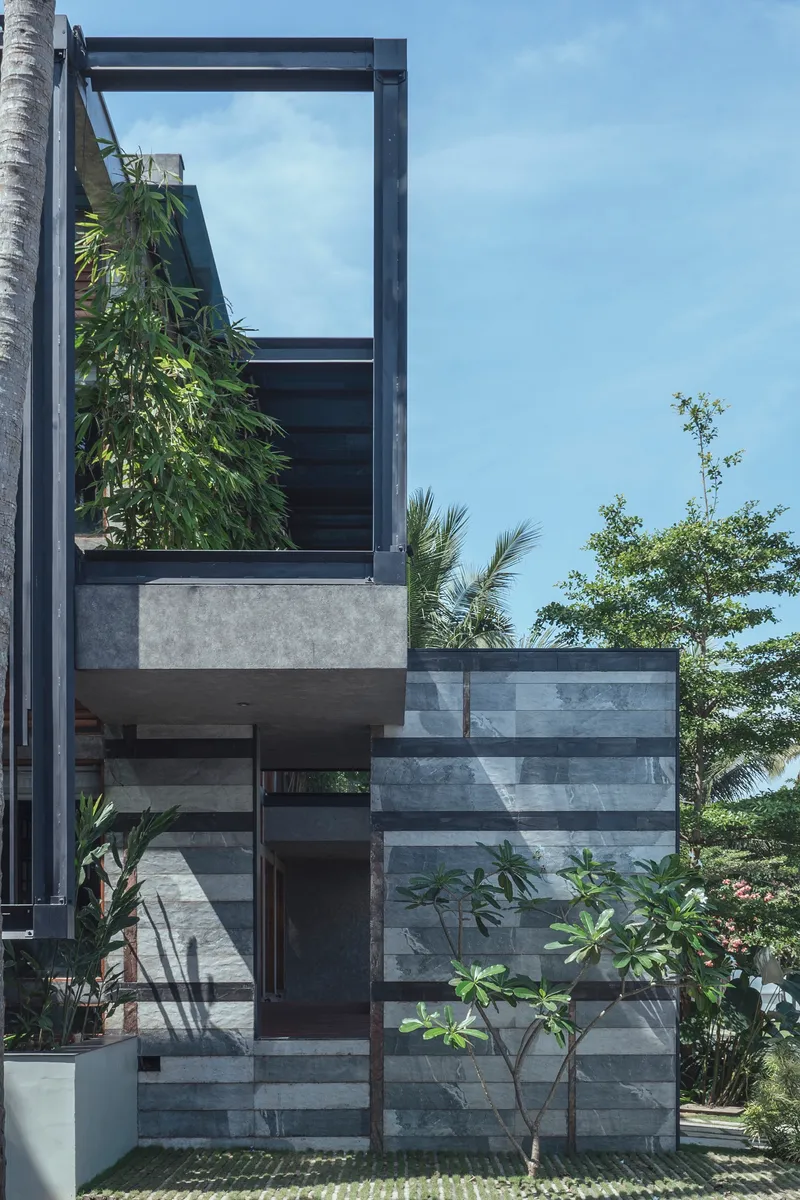

The steel frame is not hidden. Members wrap around segments of the building, occasionally exposed as canopy structures over terraces and walkways, giving the house an industrial legibility that concrete alone would never produce. Because the steel was prefabricated off-site, service utility lines, electrical conduits, and even sprinkler lines were embedded before the superstructure went up. The result is a building that looks mass-manufactured and slotted into place, each element registering on a visible grid.
That grid does real work. It organizes the alternation between large public voids and smaller enclosed zones, giving the plan a rhythm rather than a hierarchy. The living and dining spaces flow into each other without partition walls, while bedrooms are boxed off by concrete and brick. The structural logic and the spatial logic are the same logic, which is rarer than it should be.
The Double-Height Core

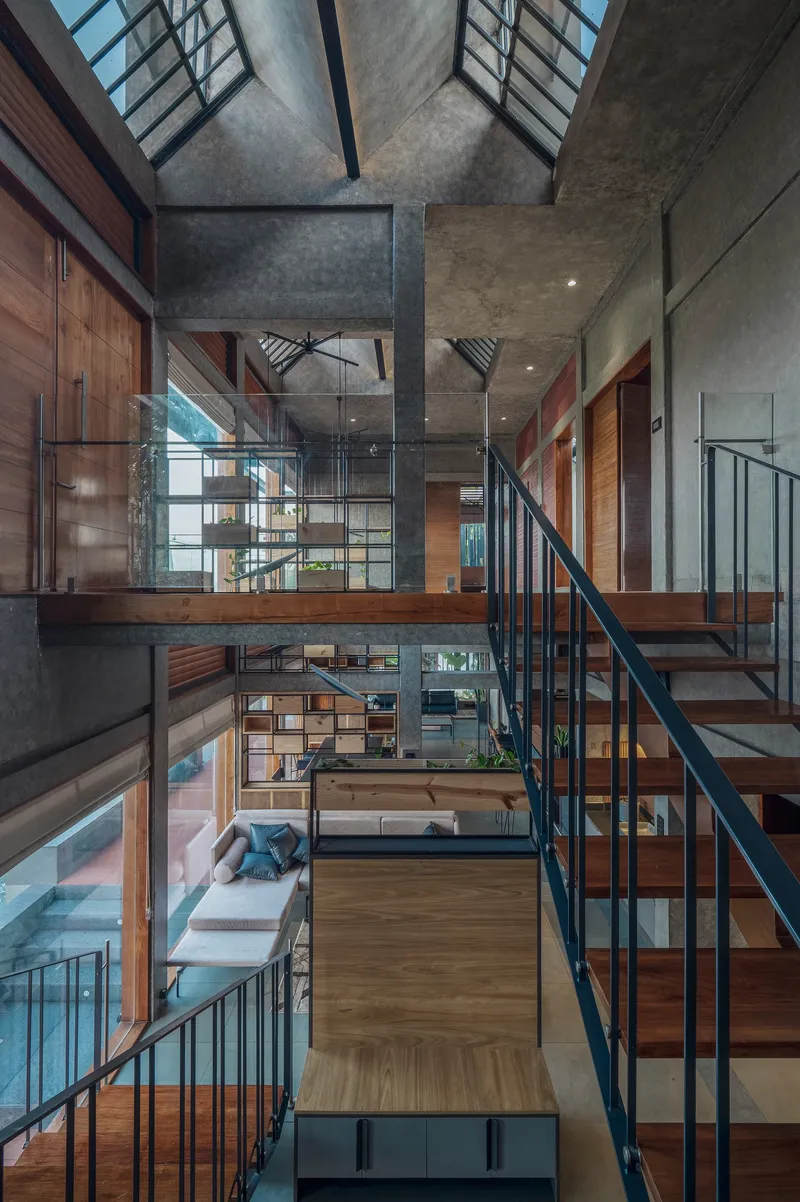

The central double-height void is capped by pitched ceilings fitted with north-light windows, a detail borrowed from industrial architecture that floods the interior with even, indirect illumination. The staircase threading through this space is part sculpture, part connector: timber treads on a steel frame, with landings that double as viewing platforms overlooking the living room below.
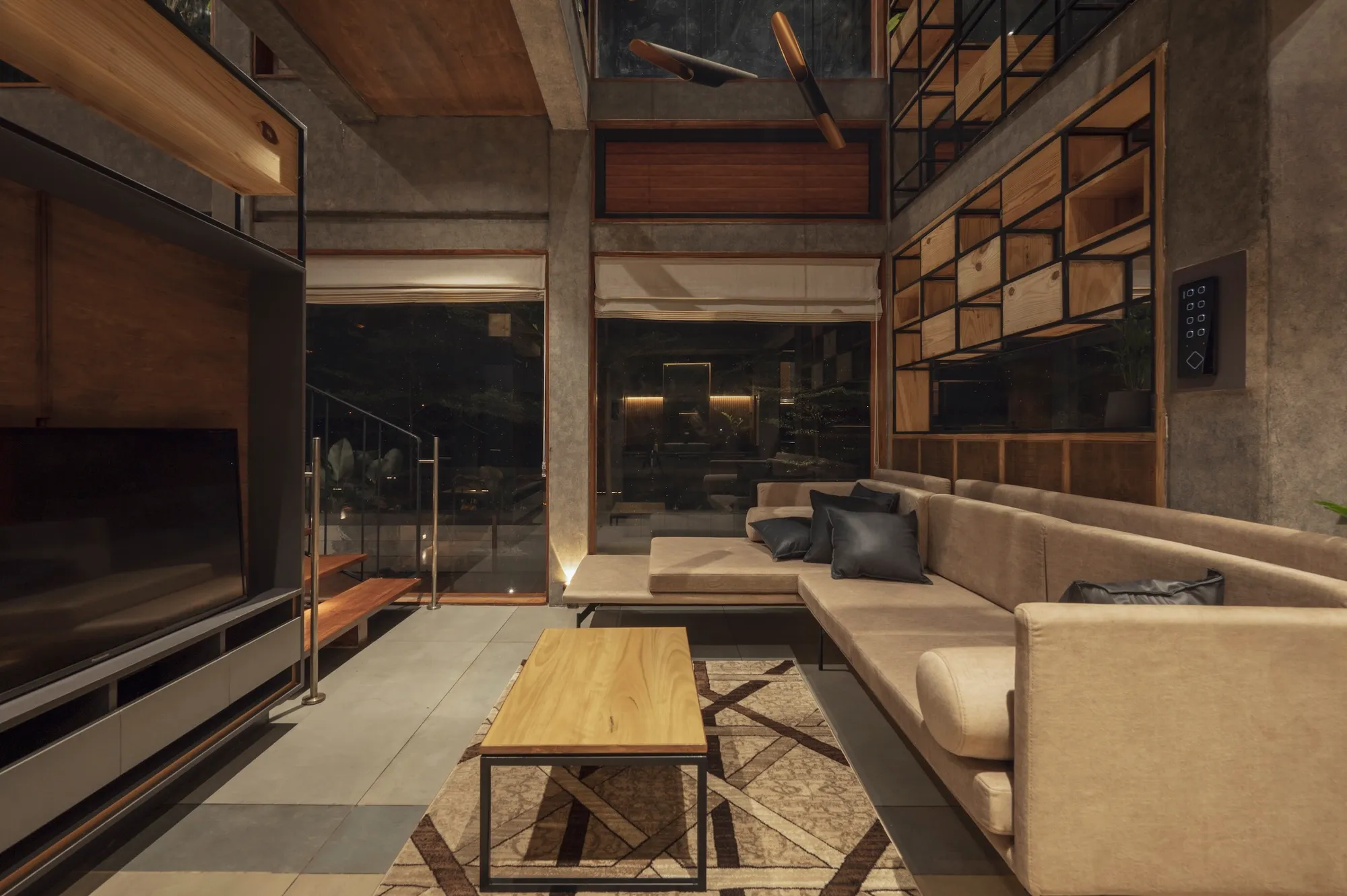
At dusk, the geometric timber storage wall at the base of this void glows against the exposed concrete beams above, turning a utilitarian surface into the room's focal point. The house uses its section as aggressively as its plan, stacking split-level platforms that create visual connections between floors without forcing every room to share the same ceiling height.
Tropical Climate Without Compromise

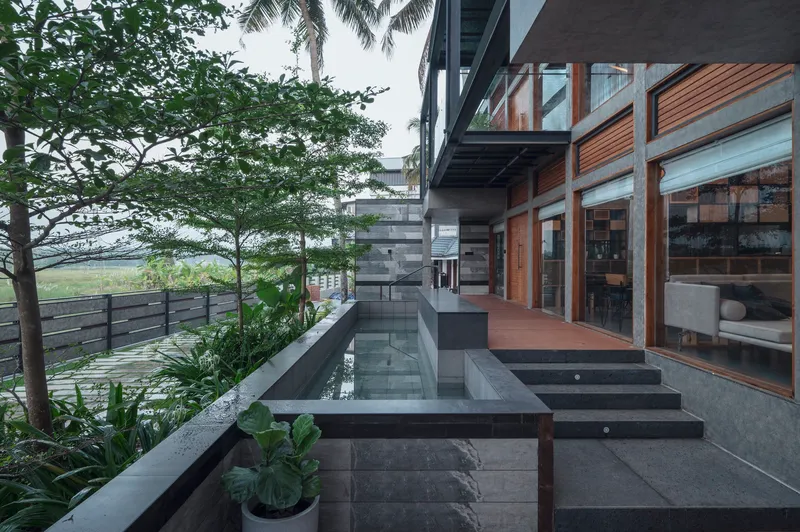
Orienting the building due north blocks direct sunlight from the primary glass surfaces, but orientation alone does not solve Kerala's heat and humidity. Studio PROMADA introduced air scoops to drive cross-ventilation without punching holes in the building envelope, a subtle move that keeps the facades clean while ensuring steady air exchange. The large glass panes have no mullions and, notably, no grills, a small act of faith in a climate where insects and security concerns typically mandate them.
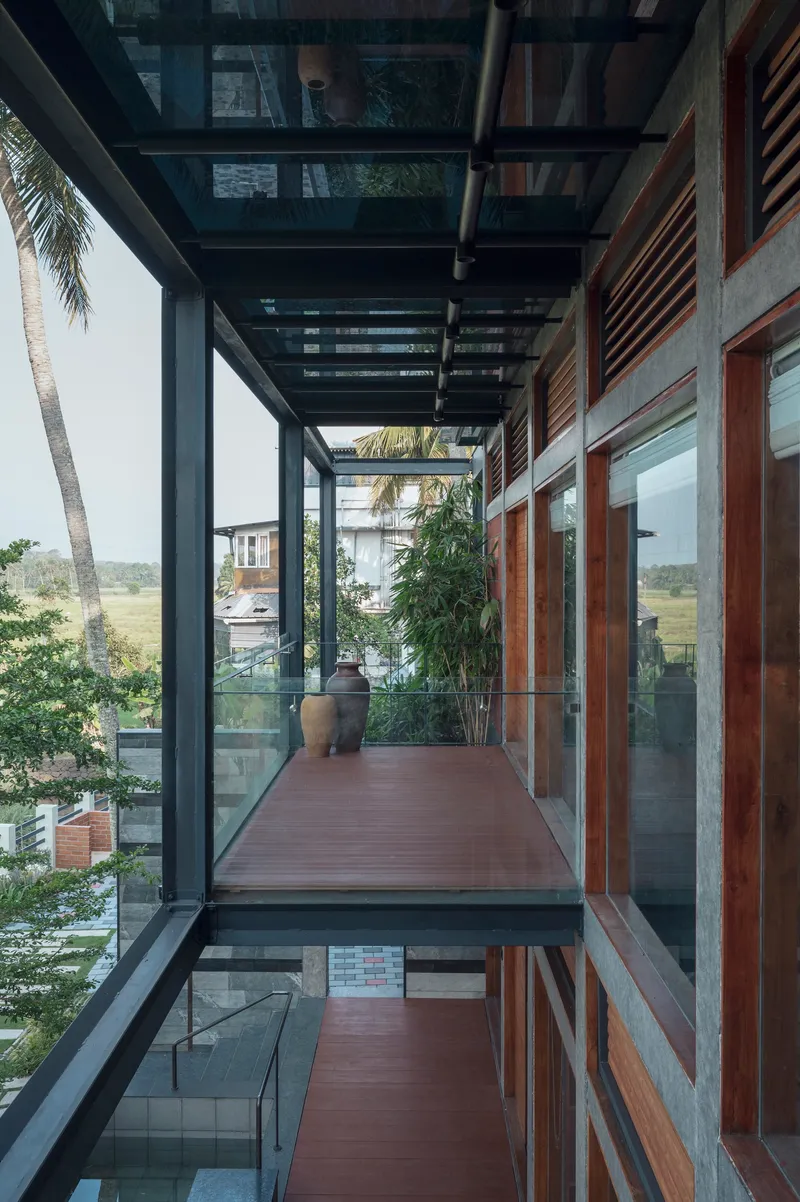
Covered timber-deck walkways with steel pergolas overhead serve as transition zones between indoors and outdoors. These are not decorative verandahs. They buffer the interior from rain splash and glare while creating shaded outdoor rooms that are usable year-round. A stepped terrace with a shallow water channel along the timber-and-glass facade adds evaporative cooling to the microclimate near the ground floor.
A Facade That Evolves


Planter boxes line the building on all sides, and vertical green spaces climb the facades. The architects describe this as a translucent effect: the greenery filters views in and out, providing privacy without solid walls. Over time, as the plants mature, the building's elevation will change. It is designed to look different in five years than it does today, which is a deliberate rejection of the idea that a building should be photographed once and frozen.
The night view makes this strategy legible. Floor-to-ceiling glass reveals the illuminated interior, but mature trees and planted courtyards soften the exposure, creating layers of depth between the street and the living space. Coconut palms and a mature tree canopy frame the building above, while the planting at ground level wraps it below. The house does not sit on its site so much as it nests inside it.
Private Rooms, Planted Buffers


The bedrooms occupy the opaque hemisphere and use a different material palette to signal the shift: exposed brick, polished concrete floors, and timber ceilings replace the raw concrete and steel of the public zones. Each bedroom opens to a planted courtyard through floor-to-ceiling glazing, trading the panoramic paddy field view for an intimate, dappled-light garden.
Bamboo screens and vertical timber slat partitions manage the boundary between corridor and room, allowing light to bleed through without sacrificing acoustic separation. It is a straightforward tactic, but it works because the architects committed to it consistently. Every private room gets its own green buffer, its own filtered light, its own sense of enclosure. The house never feels like it is forcing its public extroversion onto spaces that should be quiet.
Interior Craft and Material Assembly


Inside, the modular logic of the steel frame extends to the finishes. The kitchen's recessed concrete ceiling and central island with wire-frame stools feel assembled rather than built, each element registering its own identity within the grid. Vertical timber slat partitions beside concrete walls create visual texture without ornament, their rhythm picking up the cadence of the structural bays beyond.
Even the water filter was custom-designed in-house to avoid disrupting the facade, a detail that reveals how seriously the studio took the idea that every component should slot into the larger system. With 10kW of solar panels on the roof, the house operates as a largely self-sufficient structure, closing the loop between its prefabricated construction and its ongoing energy performance.
Plans and Drawings

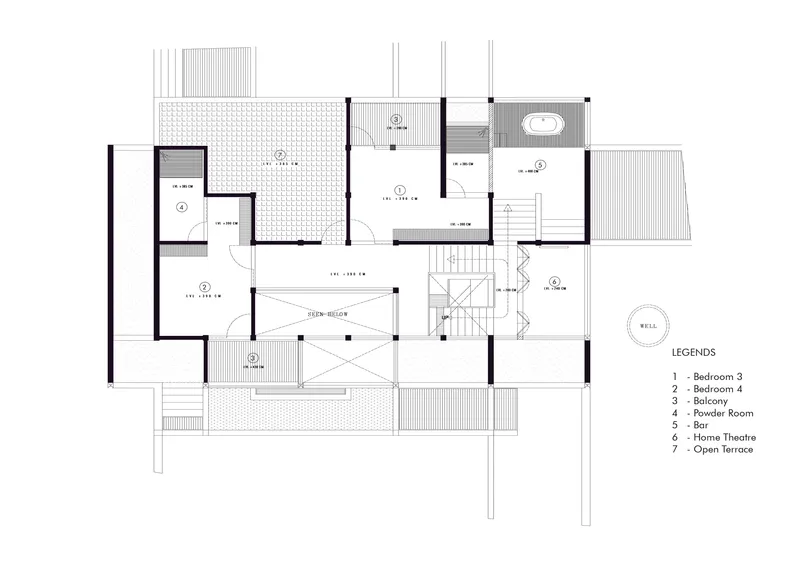


The ground floor plan confirms the two-hemisphere strategy: the living and dining areas open directly toward the reflecting pool and the paddy field beyond, while the bedroom wing wraps around a planted courtyard at the rear. The upper floor stacks bedrooms above the private zone and opens a terrace above the public one, maintaining the transparent-opaque split in section as well as plan.
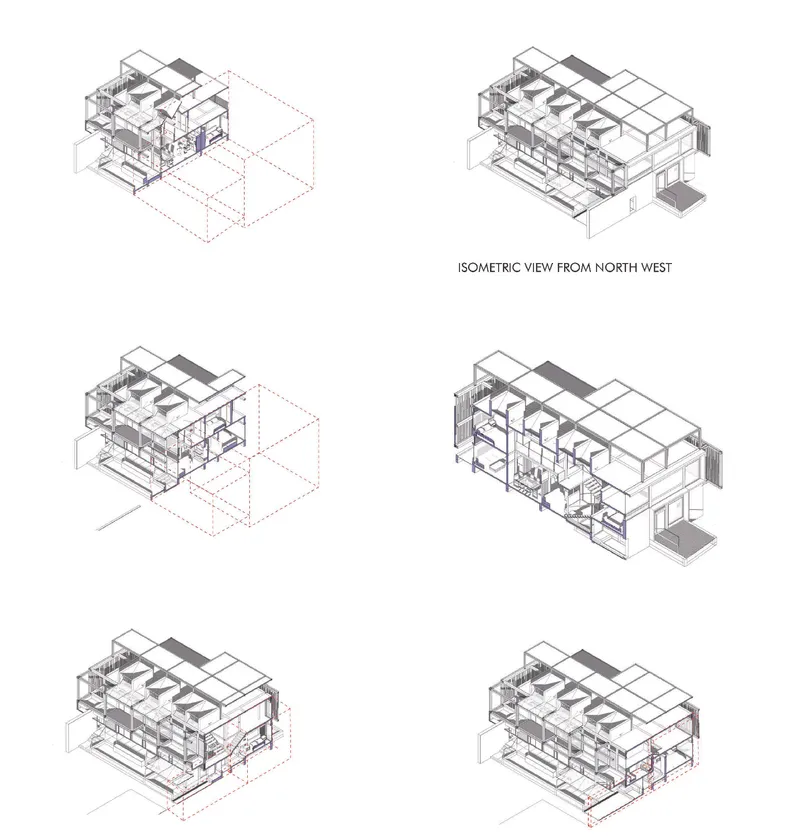
The sections are where the house reveals its true complexity. Split-level platforms connected by the central staircase create a series of interlocking volumes, each at a slightly different height, so that the double-height living space borrows ceiling from the floor above while the bedrooms tuck under lower, more intimate roof planes. The isometric drawings make the circulation legible: you move through the house on a continuous ramp of half-levels, never quite arriving at a single floor datum.
Why This Project Matters
Amalgam Residence matters because it proves that a pre-engineered steel frame is not just an industrial shortcut. In the right hands, it becomes a design instrument that opens plans, thins facades, and allows a house to breathe in a tropical climate without resorting to the heavy concrete boxes that dominate Kerala's suburban landscape. Studio PROMADA treated prefabrication not as a constraint but as a discipline, and the result is a building whose every joint, scoop, and planter box follows from a single structural idea.
The decision to design a facade that grows over time is equally significant. In a profession obsessed with the opening-day photograph, a house that expects to look better in a decade is a quiet rebuke. The vertical greenery is not decoration; it is the completion of an envelope strategy that depends on living material to provide shade, privacy, and evaporative cooling. When the bamboo fills in and the creepers climb the steel pergolas, the Amalgam Residence will no longer look like a house sitting next to a paddy field. It will look like something that grew out of it.
Amalgam Residence by Studio PROMADA, Thiruvankulam, Ernakulam, India. 4,500 sq ft. Completed 2022. Structural engineers: WVA Consulting Engineers Pvt Ltd. Photography by Studio IKSHA.
About the Studio
Share Your Own Work on uni.xyz
If projects like this are the kind of work you want to make, uni.xyz is a place to publish your own, find collaborators, and enter design competitions.




Popular Articles
Popular articles from the community


Riyadh For All: Intergenerational Urban Design for Active Aging in Rabat
Riyadh For All reimagines urban design in Rabat with intergenerational co-living, adaptive courtyards, and Moroccan cultural exchange today.

EW PARK: Sustainable Architecture Reimagines the Future of Urban Parking
EW PARK reimagines city parking as a modular wooden tower combining automation, solar energy, electric mobility, and adaptable urban design.

Co-Life: Senior Housing Design That Reconnects Older Adults With the City
Co-Life reimagines senior housing design through healing gardens, shared streets, workshops, and a sustainable community across generations.

Conexión: Biophilic Design Reimagines High-Rise Living in Hong Kong
Conexión reimagines high-rise living in Hong Kong through biophilic design, green facades, shared spaces, daylight, water and nature within.


Similar Reads
You might also enjoy these articles

Bao Huynh Watercolor Atelier: A Serene Art Retreat in Hội An
Bao Huynh Watercolor Atelier in Hội An blends multifunctional art spaces, sustainable design, local materials, and family-friendly living in a serene environment.

Atelier Macri Concept Store Interior Design by CASE-REAL
Atelier Macri store features a "ko" counter, walnut wood details, cork displays, blending retail, gallery, and seamless customer experiences.

Manuel Vargas Izquierdo Stadium and High-Performance Sports Center: Architectural Excellence in Jalpa de Méndez
The Manuel Vargas Izquierdo Stadium blends sustainable design, inclusive sports facilities, and cultural-inspired architecture, revitalizing Jalpa de Méndez’s public spaces.

KAKR Buluh Awar Hall: Revitalizing Community and Ecology Through Bamboo Architecture
Community built bamboo hall revitalizes Buluh Awar village, empowering youth, restoring ecology, celebrating vernacular craftsmanship through sustainable architecture and culture.




Comments (0)
Please login or sign up to add comments
No comments yet. Be the first to comment!