
Studio SKAI Wraps a Chennai Corner House in Layers of Tactile Materiality
Ilainayam House stacks quarry slate, terracotta, and timber into a courtyard dwelling that breathes in a dense urban neighborhood.


The name says it all. Ilainayam, Tamil for 'texture,' is a house that treats surface as substance. Designed by Studio SKAI under principal architect Senthil Kumar, this 650 m² residence occupies a corner plot in one of Chennai's packed residential neighborhoods. Rather than retreating behind a smooth plaster wall, the house turns its two street faces into a catalogue of material expression: quarry slate, wooden-textured concrete, terracotta tile, glass block, and planted balconies, all stacked and cantilevered into a composition that manages to feel both monumental and approachable.
What keeps Ilainayam from becoming a mere material sampler is the organizing logic behind it. A central courtyard, sliced open to the sky and anchored by a narrow water body, drives every spatial and environmental decision across three storeys plus a rooftop office. The courtyard pulls daylight deep into the plan, sets up cross-ventilation against Chennai's brutal humidity, and gives every major room a view that is private yet open. The house is, in other words, a traditional Tamil courtyard dwelling compressed vertically and dressed in contemporary craft.
Street Presence and the Layered Facade
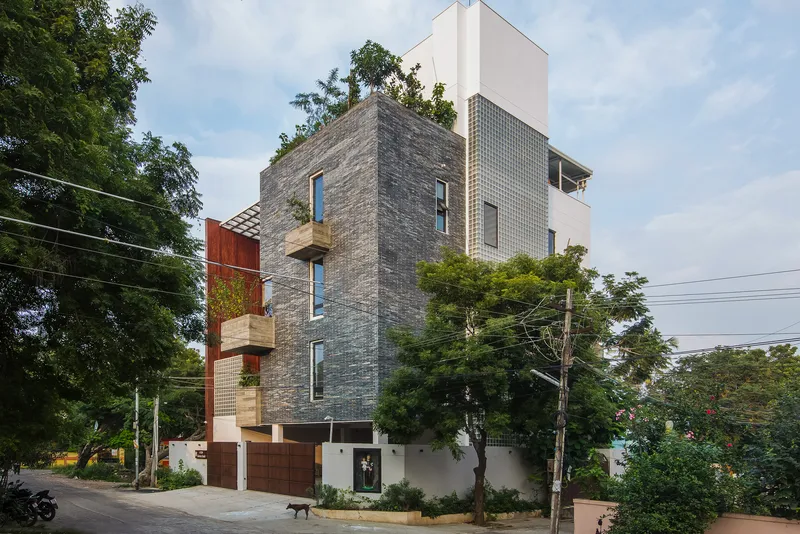
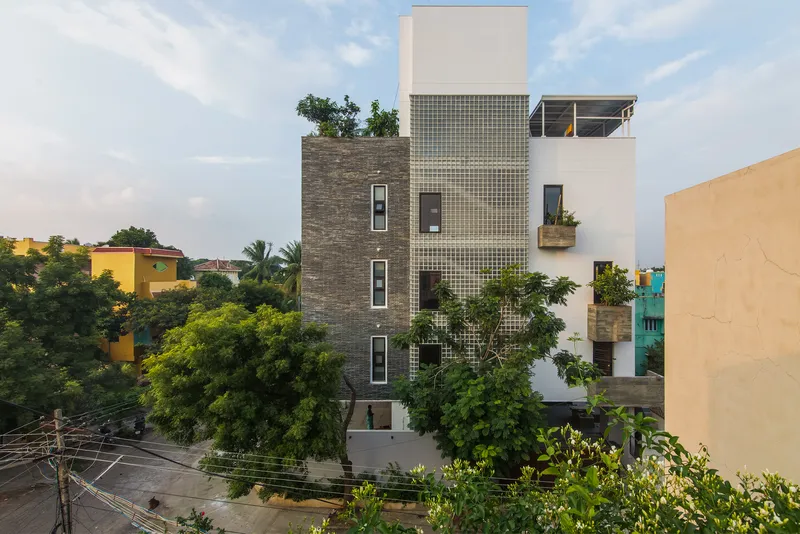
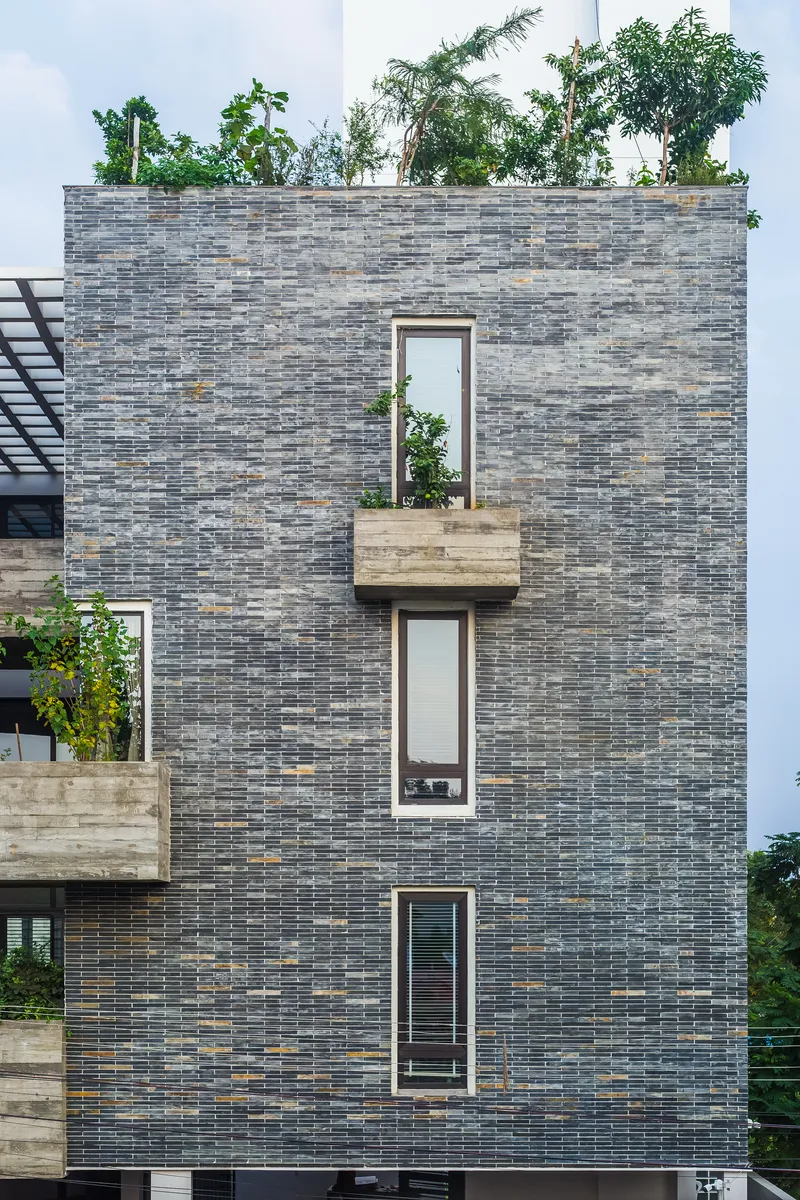
Corner plots in dense Indian neighborhoods are typically awkward: two exposed faces invite noise, heat, and the gaze of passersby. Studio SKAI turns the liability into an asset by treating each facade as a deep, layered screen rather than a flat wall. Variegated grey quarry slate forms the base register, its rough surface absorbing and diffusing harsh sunlight. Above it, white stucco volumes and glass-block panels punch through, while cantilevered concrete planters project outward with trailing vegetation. The result reads differently at every scale: solid and protective from across the street, richly textured up close.
The three planted balconies on the narrower elevation are especially effective. Each one is a thick concrete tray, its raw soffit visible from below, softened by vines that will thicken over time. They break the massing into horizontal bands and signal that this is not a commercial block but a house with gardens in the sky.
The Corner Tower
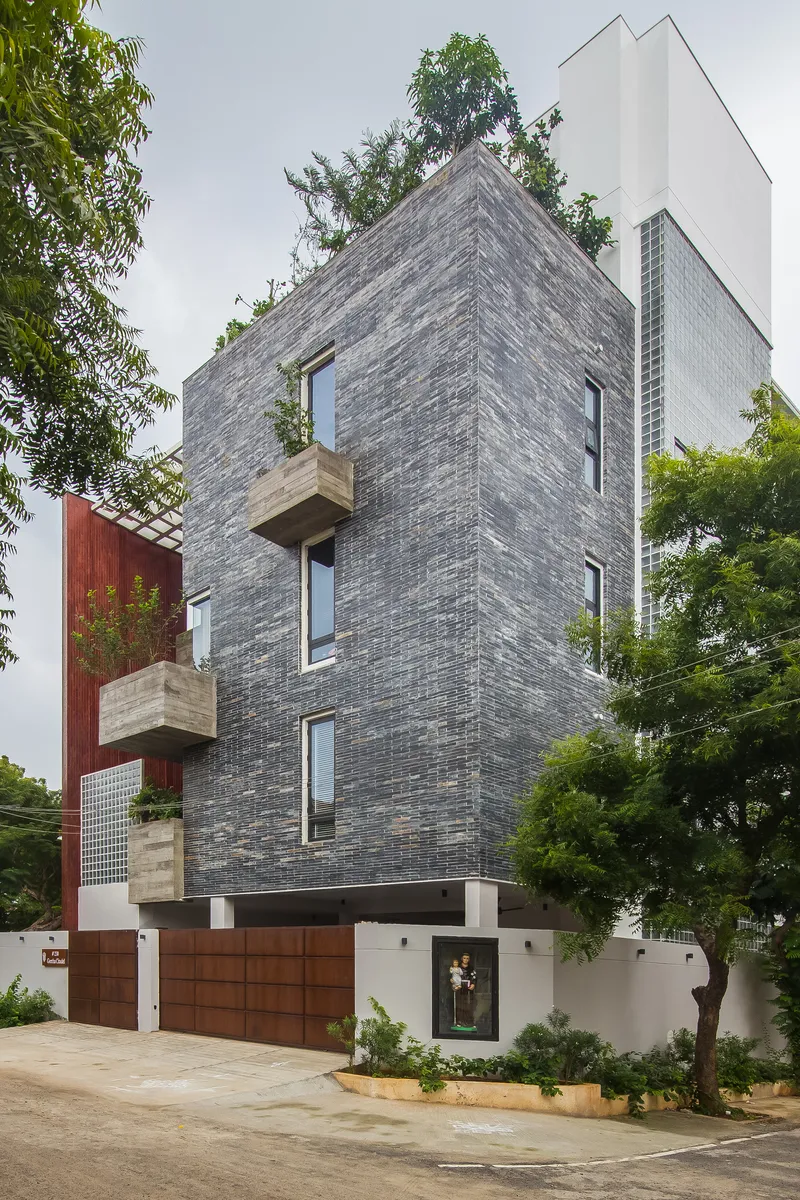
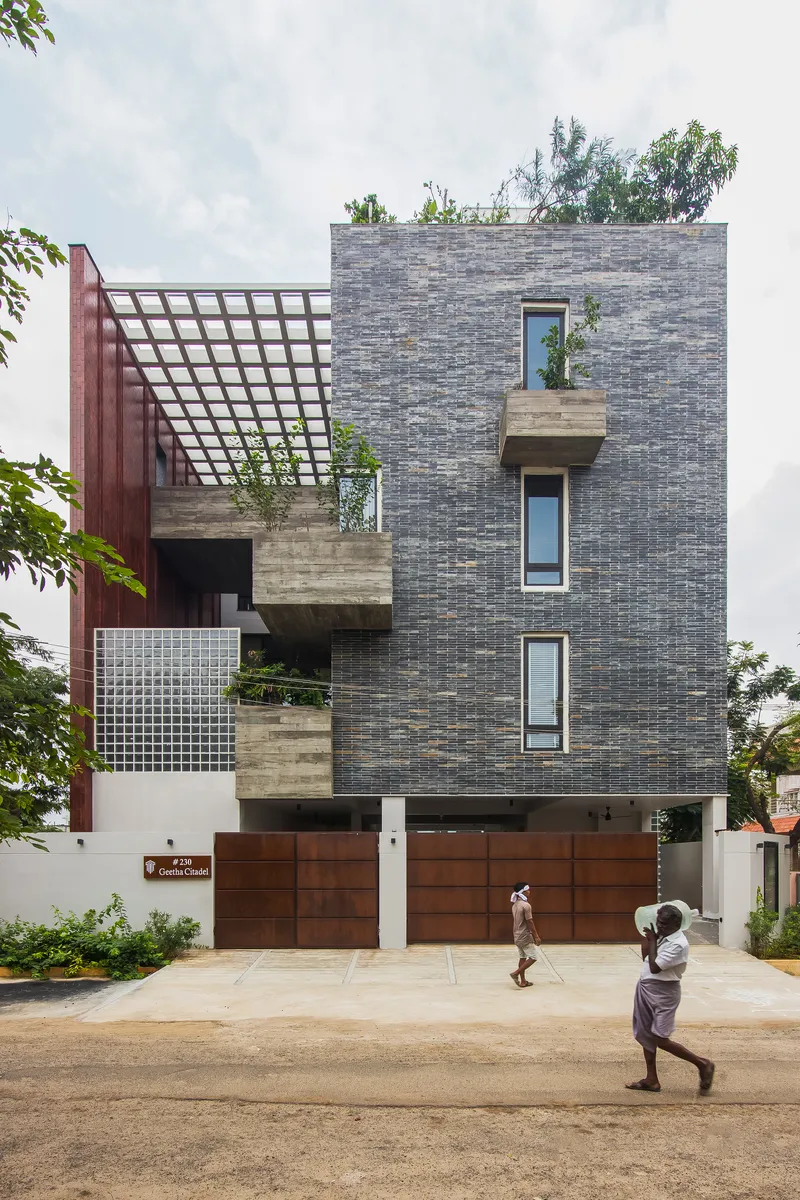
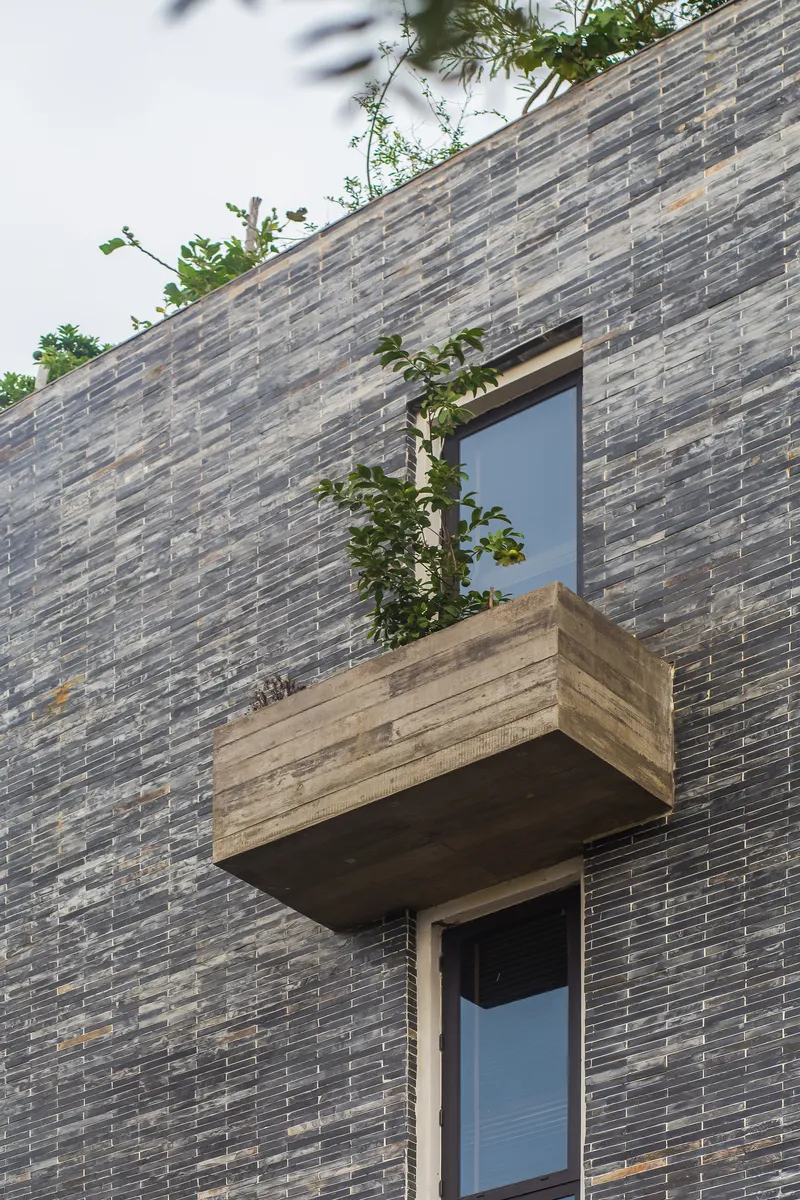
From the corner, the house reads as a compact tower, its stacked volumes stepping and projecting in section. The overcast Chennai sky flattens the grey slate into a single monochromatic mass, making the green of the rooftop garden and the warm timber of the pergola stand out sharply. Pedestrians pass below a generous cantilevered balcony that shades the sidewalk, a small civic gesture in a neighborhood where shade is a genuine resource.
The diagonal timber grid at the top floor acts like a crown, filtering light into the uppermost terrace while identifying the house as something distinct on the skyline. It is a compositional move that keeps the building from ending abruptly and gives the rooftop office a sense of enclosure without walls.
Courtyard and Water Body
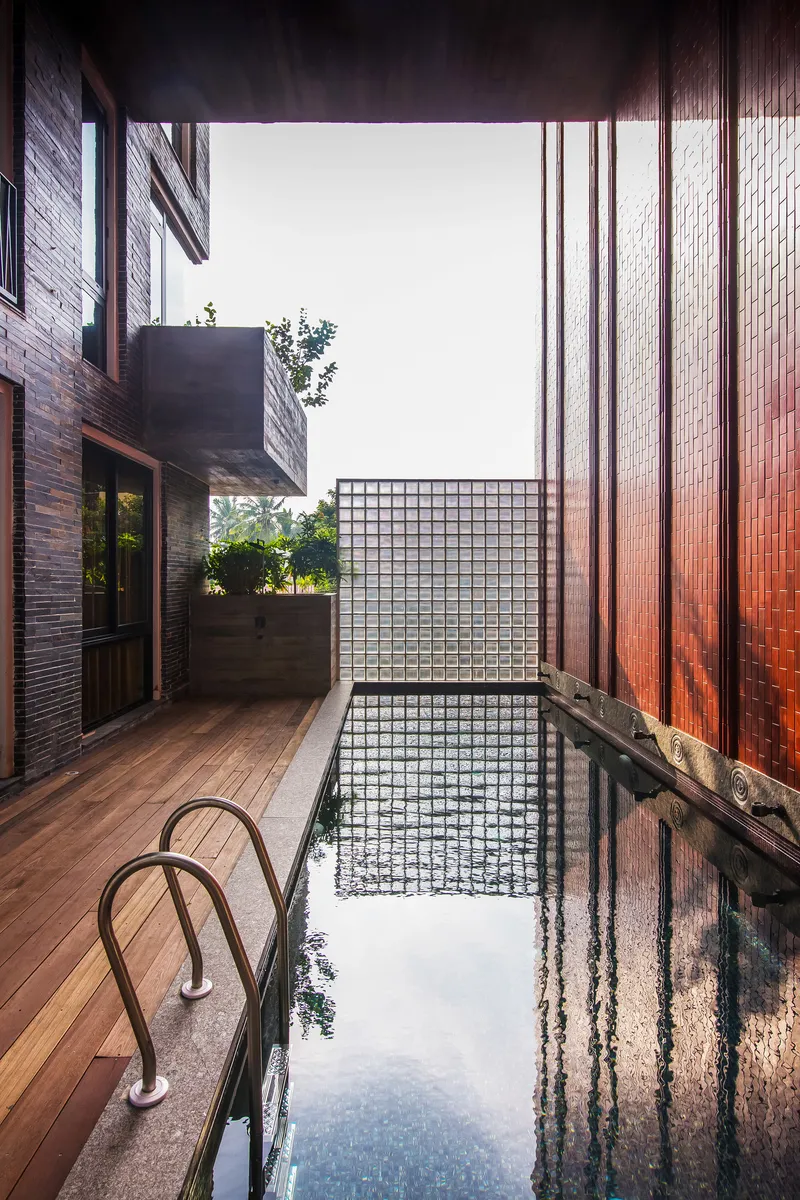
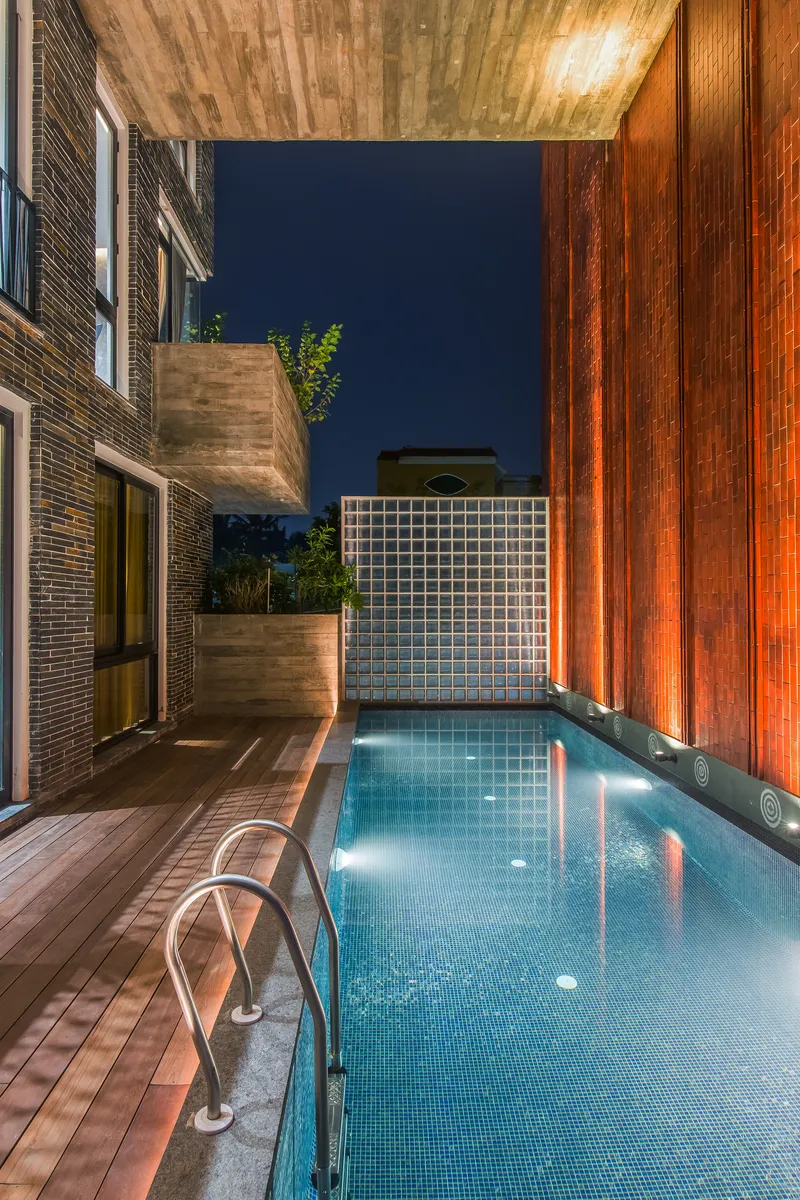
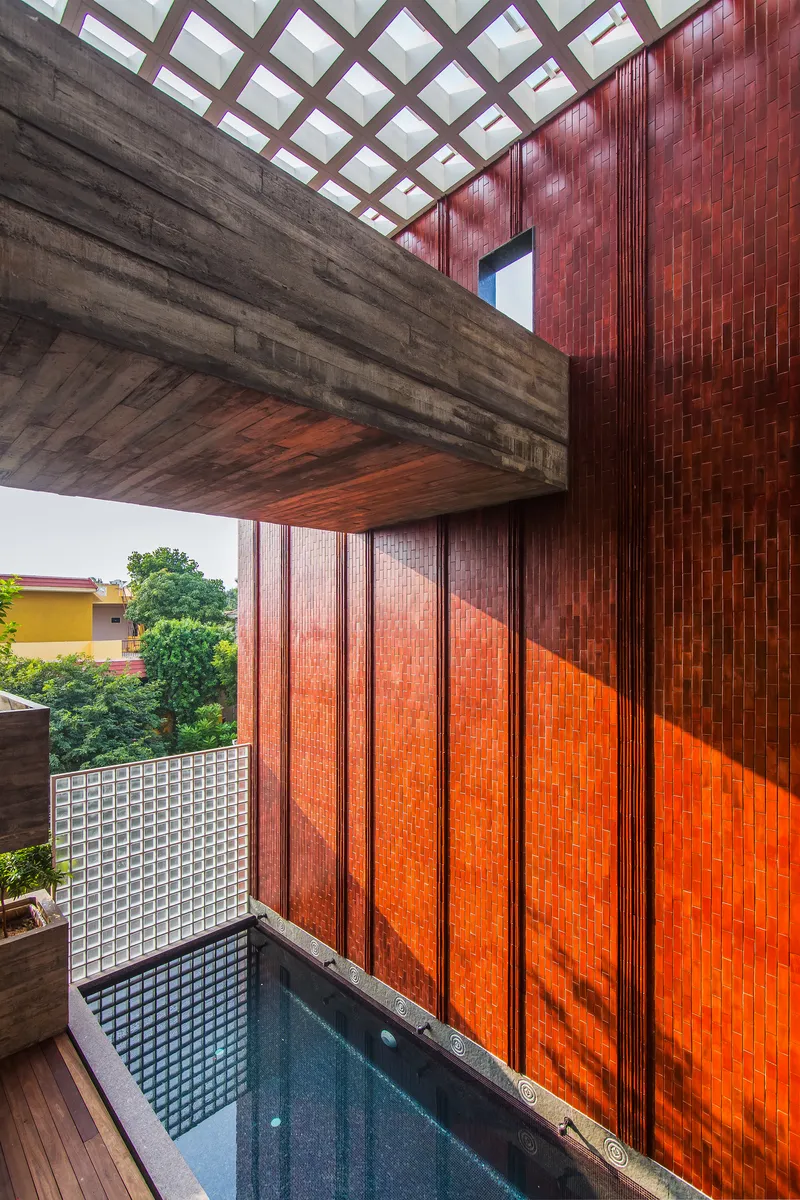
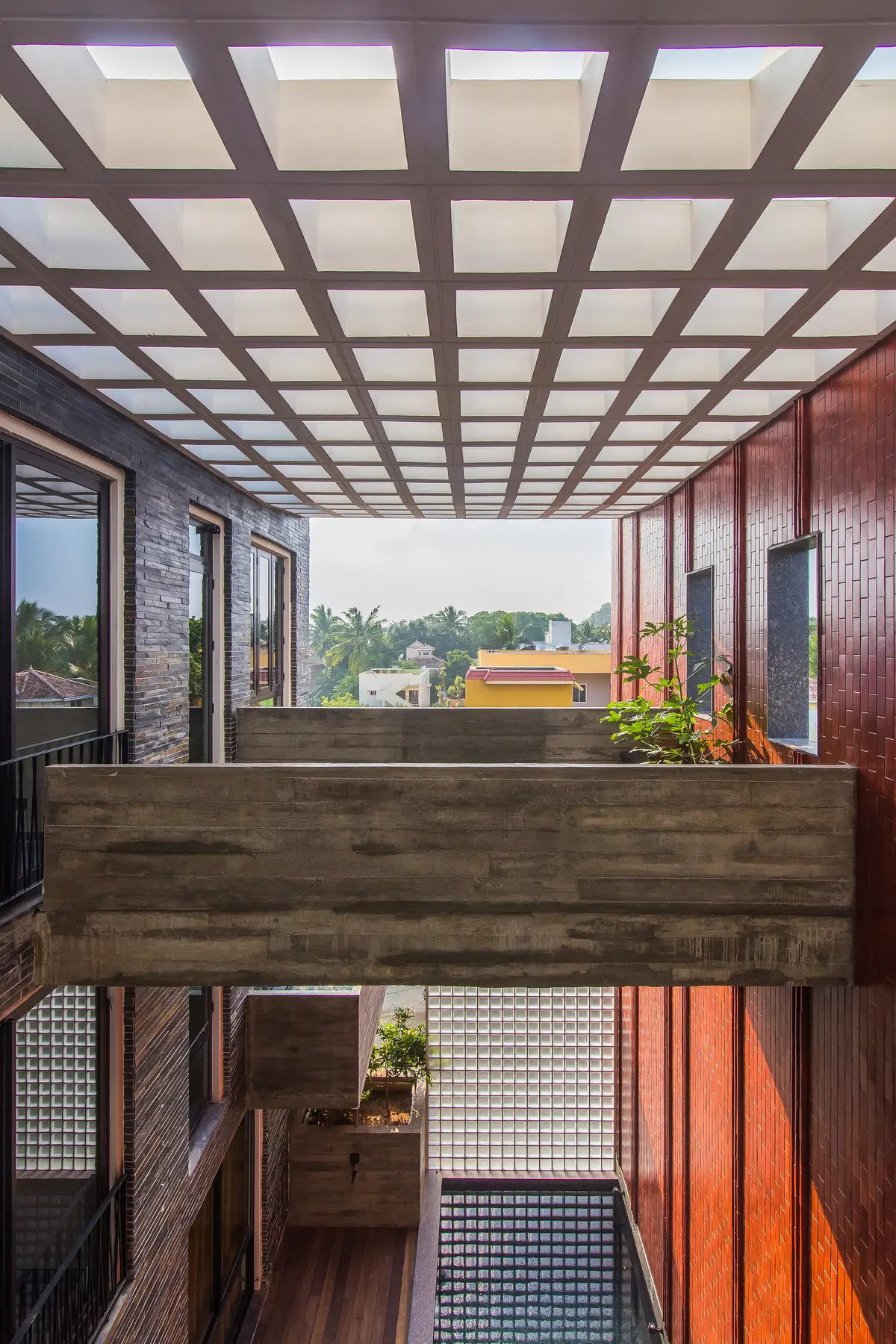
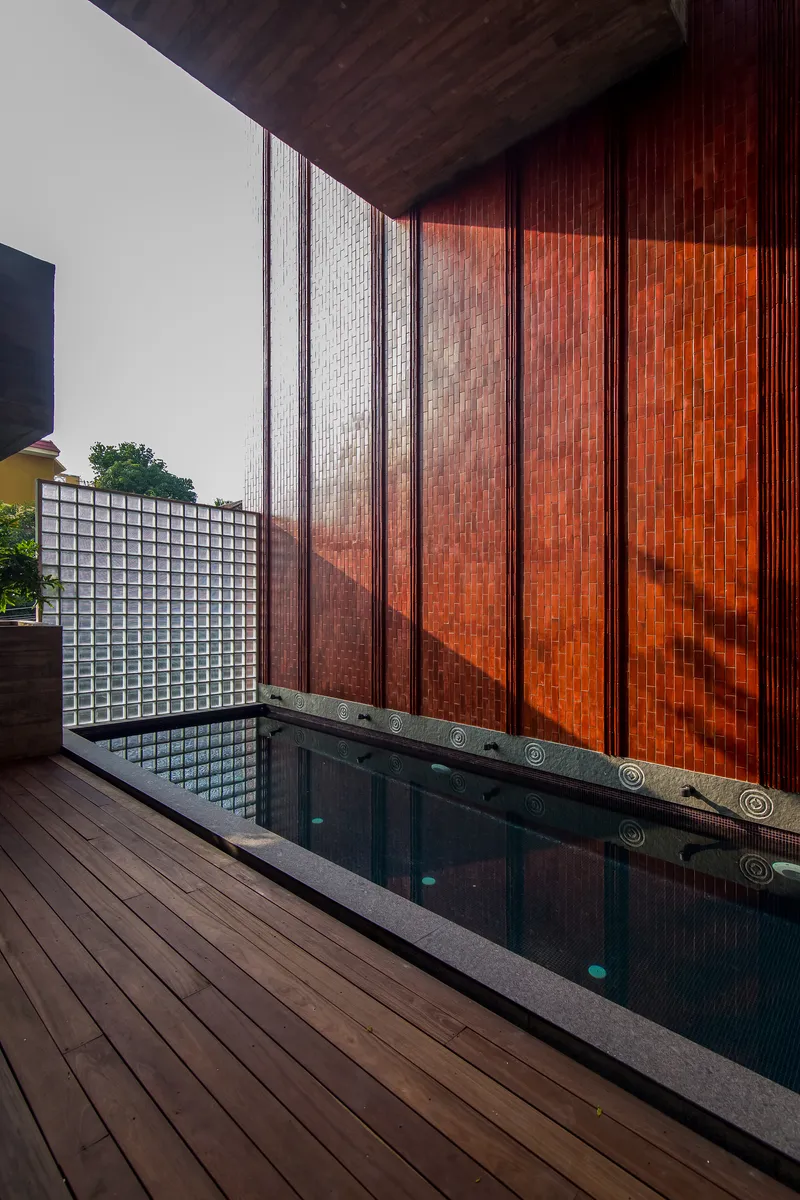
The narrow courtyard pool is the thermal and spatial engine of the house. Squeezed between the main living wing and a terracotta-clad wall, it introduces evaporative cooling at the heart of the plan. Timber decking lines its edges, and cantilevered concrete planters hover above, casting moving shadows across the water throughout the day. At twilight, the pool becomes a reflective surface that amplifies whatever light remains in the sky, turning a utilitarian climate device into something genuinely atmospheric.
Glass-block screens separate the pool from interior rooms without cutting off visual connection. They let diffused light pass through while maintaining privacy, a strategy that recalls traditional jali screens reinterpreted through an industrial material. The courtyard void extends vertically through a gridded skylight above, pulling hot air upward and out.
Bridges and Interior Circulation
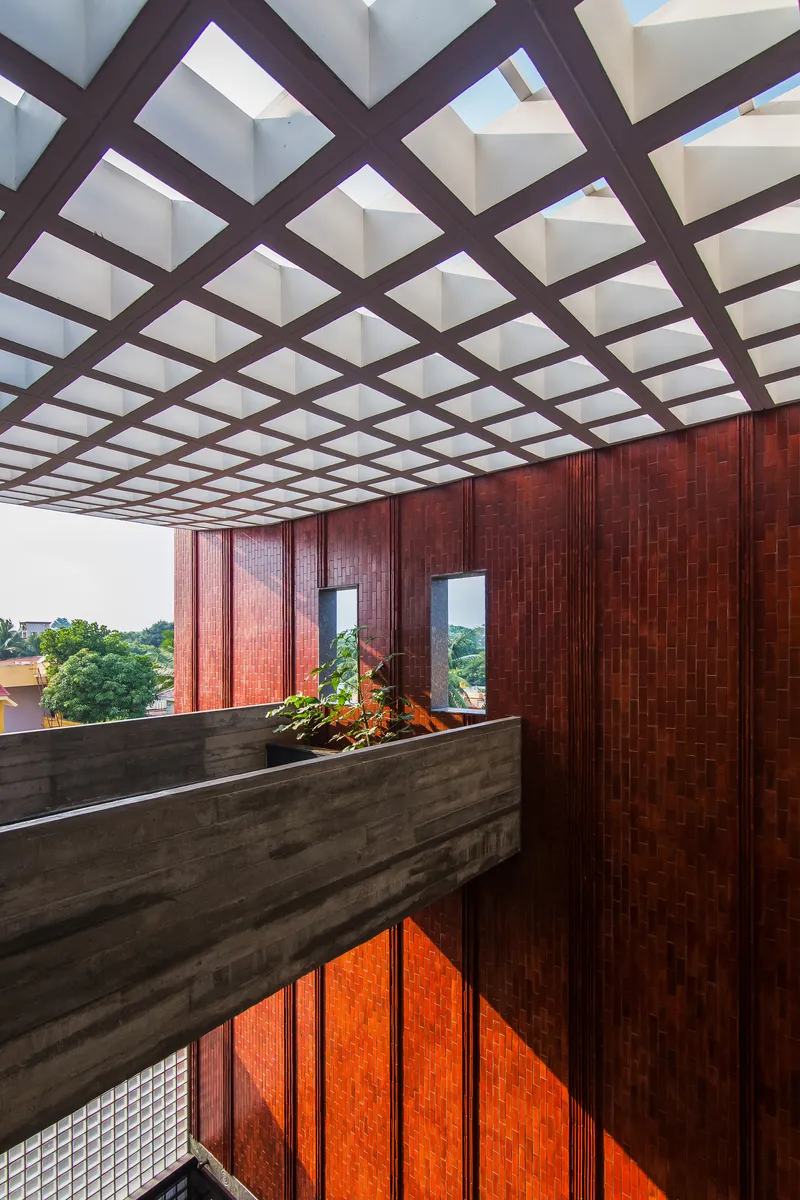
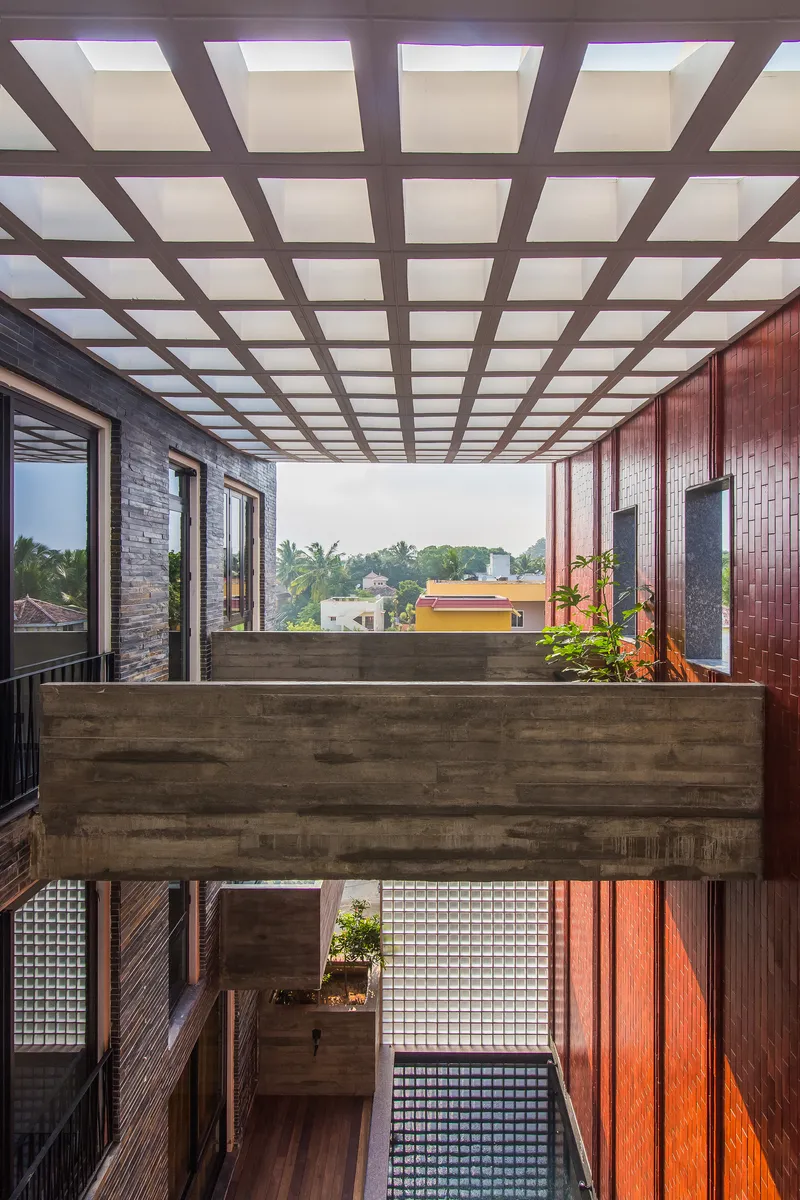
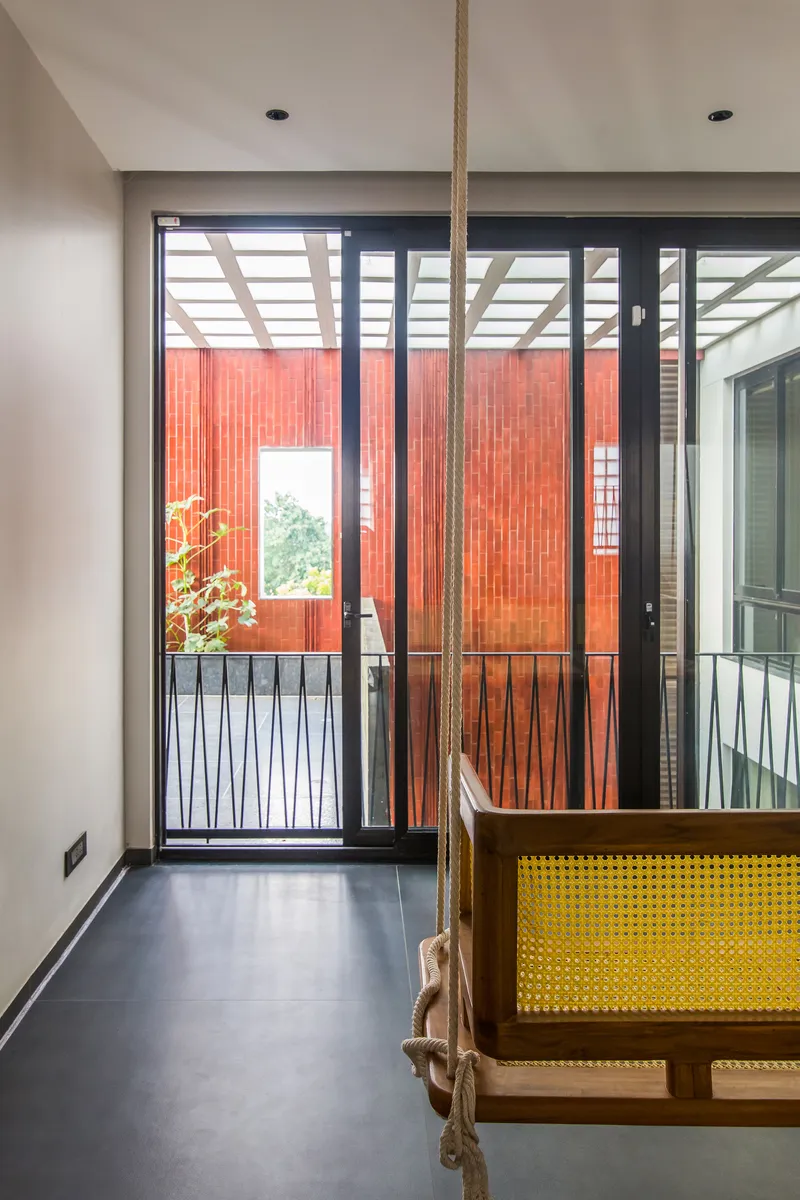
On the upper floors, concrete bridges span the courtyard void, connecting the bedroom wing to the circulation core. These bridges are more than connectors. They are moments of pause where you look down into the planted courtyard or up through the diagonal timber grid ceiling. The woven terracotta tile walls that line one side of the bridge bring the exterior material palette indoors, blurring the boundary between inside and outside.
The ground-level corridor, with its rope swing and glazed doors opening onto the courtyard, captures the house's casual warmth. It is a house designed for movement, where vertical circulation through lift and staircase is complemented by these horizontal crossing points that make you constantly aware of the courtyard below and the sky above.
Interiors: Color, Light, and Material Dialogue
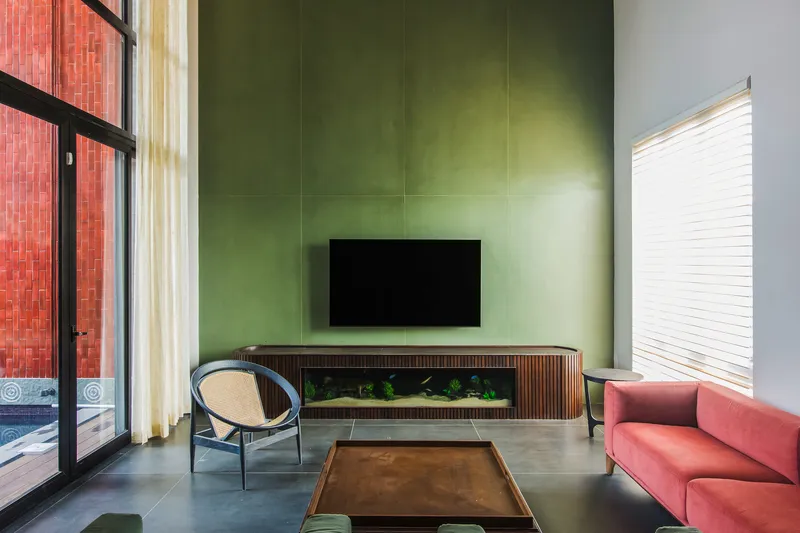
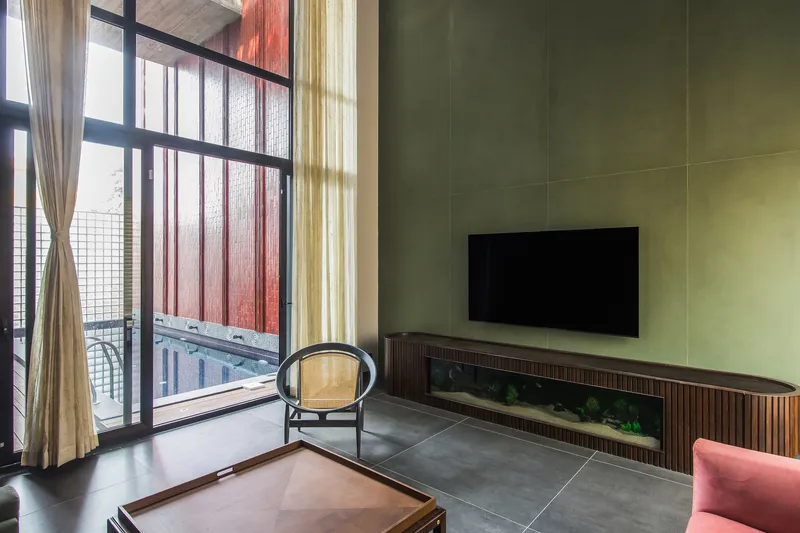
Inside, Studio SKAI deploys color with restraint but conviction. The living room pairs olive green wall panels with a built-in aquarium, its blue-green glow acting as a second window onto an underwater landscape. Glazed doors open directly to the terracotta courtyard, setting up a warm-cool contrast between the reddish exterior and the muted interior. In another room, yellow paneling and glass-block balcony doors filter light through pink and beige curtains, creating a layered luminosity that shifts with the hour.
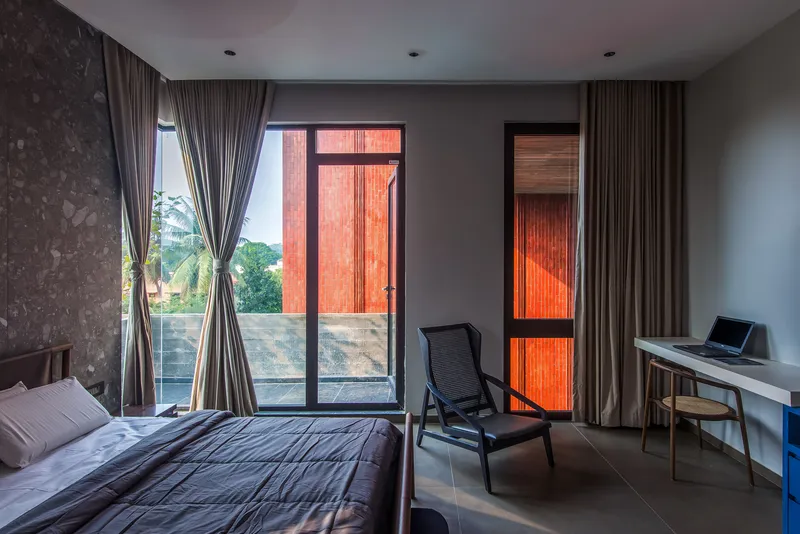
The bedroom at dusk is perhaps the most striking interior moment: translucent orange screens in the balcony doors and windows turn the entire room into a lantern. It is a simple detail, a colored screen, but it transforms the relationship between the room and the street, giving the occupant a sense of enclosure while broadcasting a warm glow outward.
The Rooftop and Planted Terrace
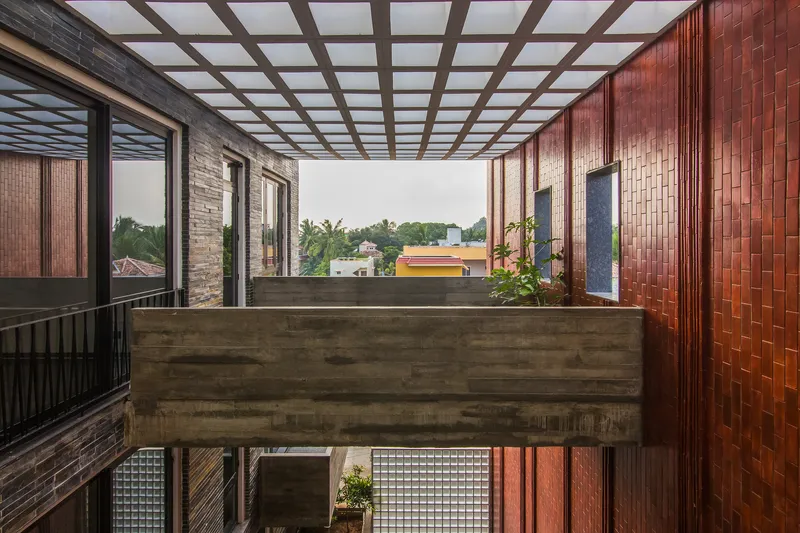
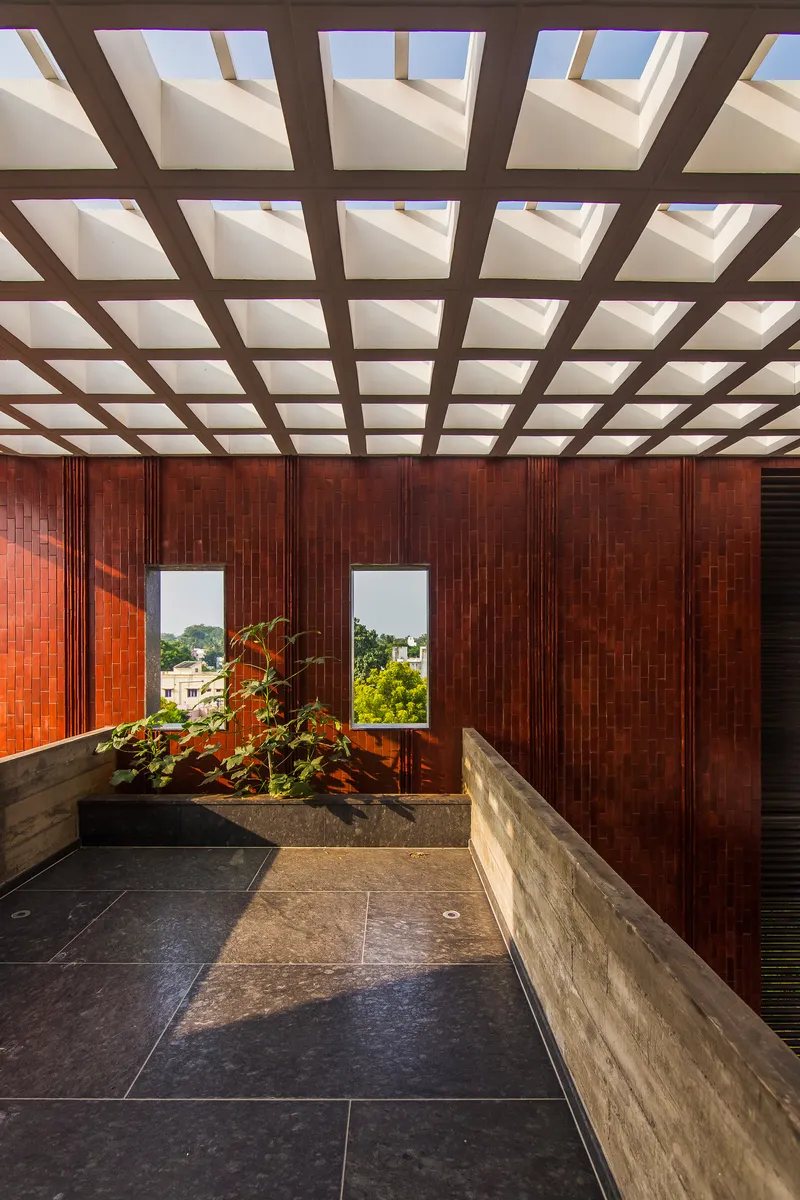
The rooftop private office sits beneath a timber grid pergola, its woven reddish-brown tile walls echoing the terracotta used below. From here, the view extends across Chennai's rooftops, a panorama of water tanks, satellite dishes, and laundry lines that reminds you how tightly this house is embedded in its neighborhood. The green roofing strategy adds insulation to the topmost slab, reducing heat gain in the rooms directly below.
On the upper terrace, vertical timber slats enclose a planted bed beneath a coffered skylight grid. The slats modulate breeze and light, creating a sheltered garden room that feels miles away from the street below. It is a private retreat within a private house, the quietest room in the vertical stack.
Plans and Drawings
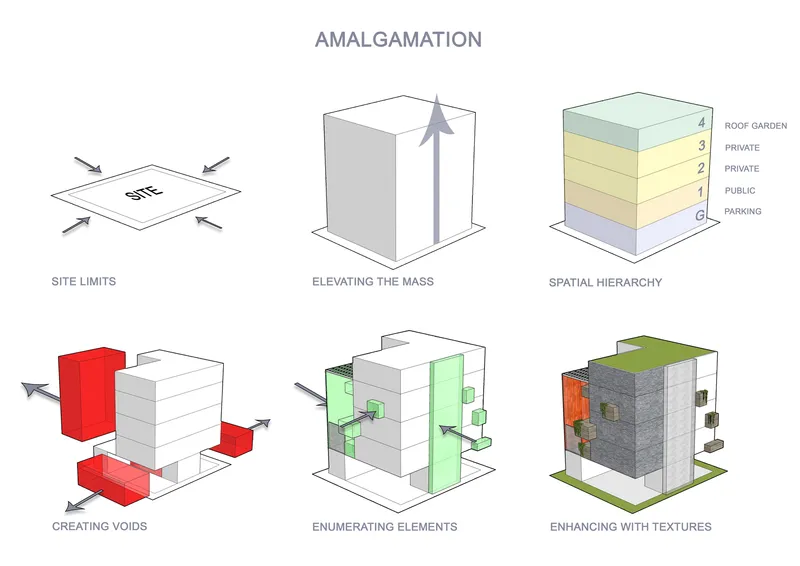
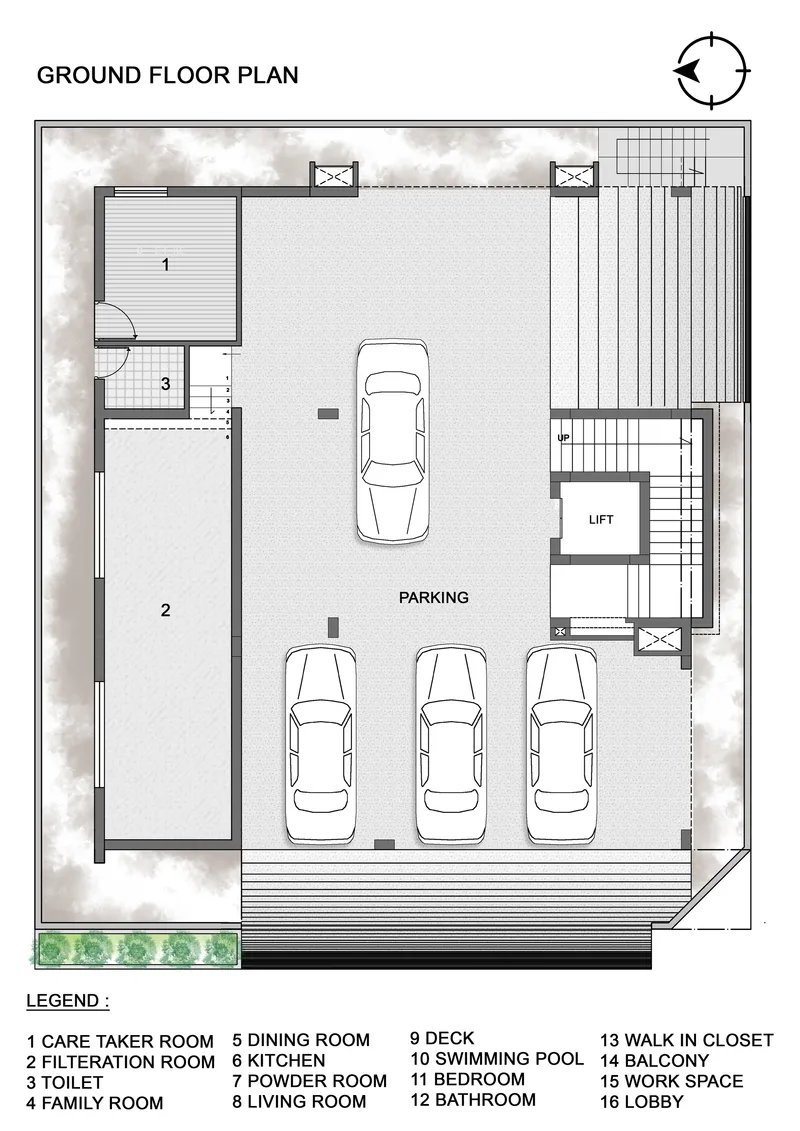
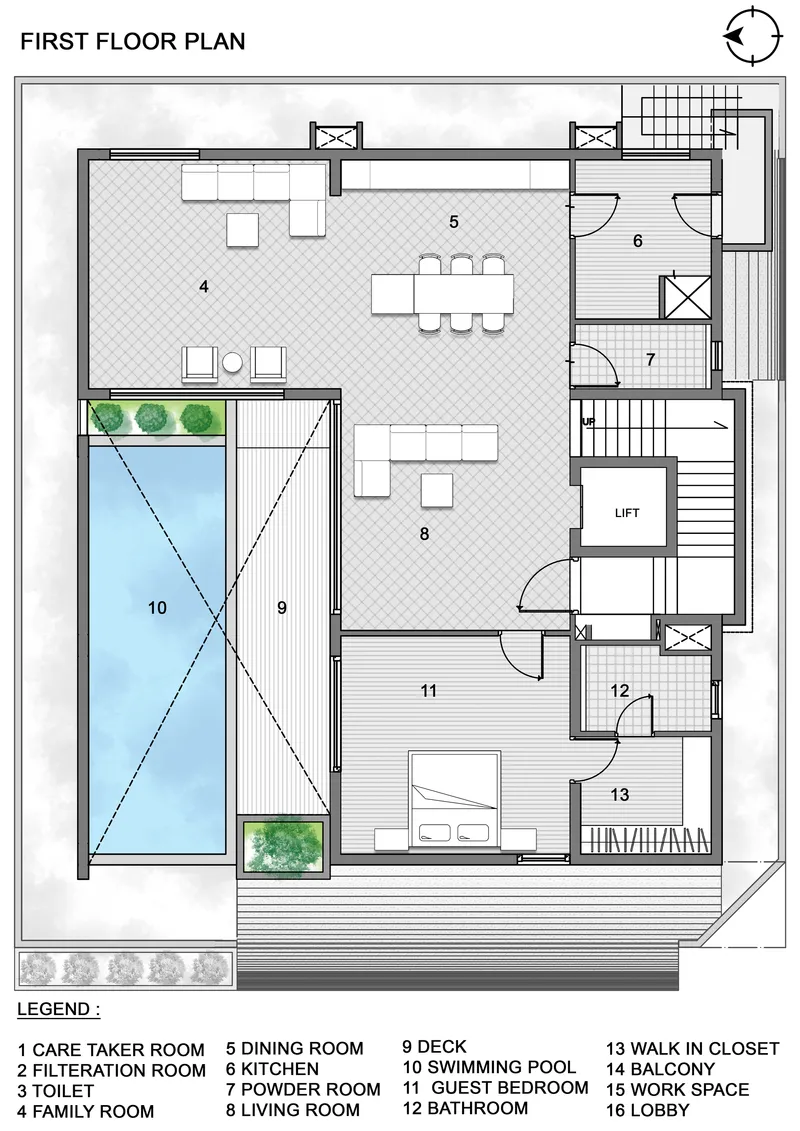
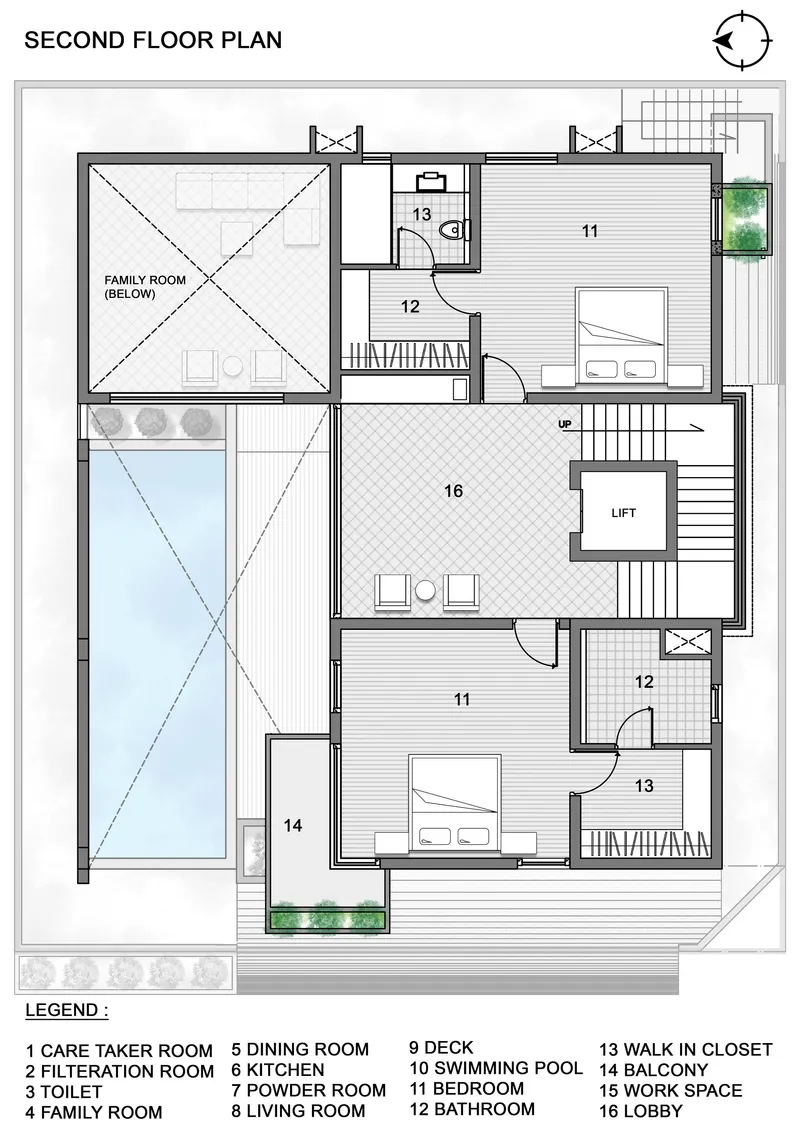
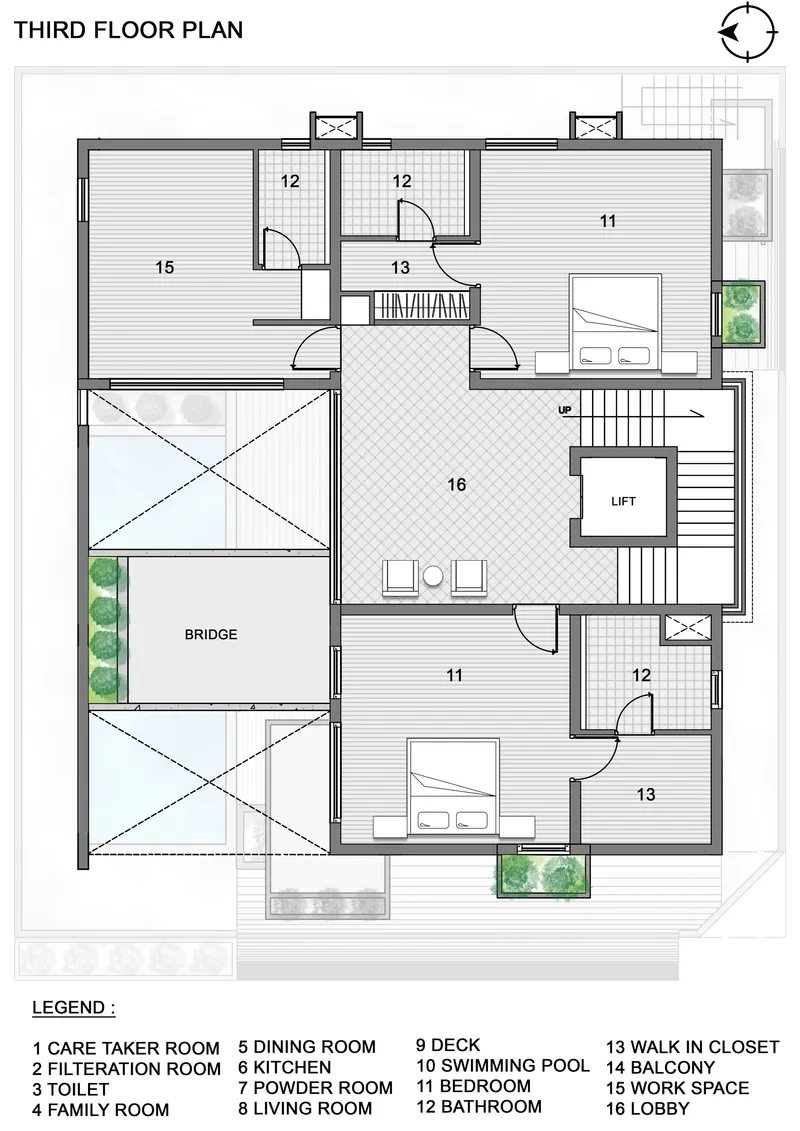
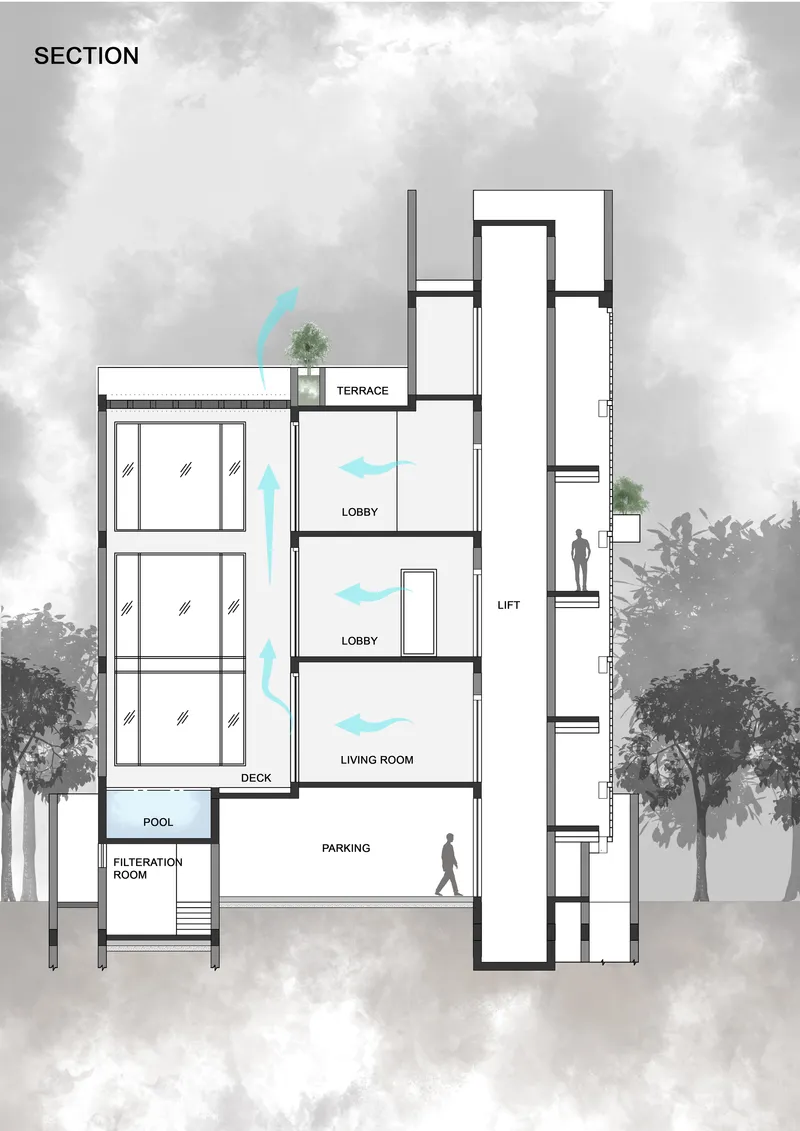
The massing diagram traces a clear sequence from site-limit extrusion through volumetric subtraction to the final articulation of voids and textures. It is a useful reminder that the house's apparent complexity follows a disciplined logic. The plans reveal how efficiently the program is stacked: parking and services at ground level, communal living and the courtyard pool at the raised first floor, bedrooms on the second and third floors with bridges and balconies overlooking the central void.
The section drawing is especially informative, with arrows indicating natural ventilation flow through the courtyard void and out the rooftop. It demonstrates that the central courtyard is not a decorative gesture but a calibrated environmental device: hot air rises through the stacked lobbies and escapes at the top, while cooler air is drawn in at the pool level. The surrounding trees shown in section reinforce the strategy, shading the lower floors and buffering the house from its dense surroundings.
Why This Project Matters
Ilainayam House matters because it refuses to choose between tradition and modernity, or between environmental performance and material richness. In a city where new construction often defaults to flat rendered walls and sealed, air-conditioned interiors, Studio SKAI has built a house that earns its comfort through spatial intelligence: a courtyard that cools, bridges that ventilate, and facades that shade. The passive strategies are not afterthoughts bolted onto a form; they are the form.
More broadly, the house demonstrates that textural generosity is not the same as decorative excess. Every material here, from the quarry slate to the terracotta tile to the glass block, does climatic and spatial work. The result is a home that feels handmade and considered in a context where speed and economy usually win. For dense urban sites across South Asia and beyond, it offers a compelling argument: that the courtyard house, compressed vertically and built with contemporary craft, remains one of the most resilient residential typologies we have.
Ilainayam House by Studio SKAI, Chennai, India. 650 m², completed 2022. Photography by Little Attic.
About the Studio
Share Your Own Work on uni.xyz
If projects like this are the kind of work you want to make, uni.xyz is a place to publish your own, find collaborators, and enter design competitions.


Popular Articles
Popular articles from the community


longwave studio Reorganizes a 112 m² Tainan Apartment Around the Daily Routines of a Family and Two Cats
In Tainan, Taiwan, birch plywood, rust-red furniture and a freestanding plaster wall link arrival, storage, work and family life in one apartment.

David Ortega Stacks a Two-Story Mexico City Penthouse Around a Steel Stair and a Pergola-Shaded Roof Terrace
In Colonia Roma, a 300 m² penthouse uses oak joinery, a planted steel stair and a slatted roof pergola to make a new-build apartment feel like a house.

Architekt Andreas Gruber Scatters 23 Dark Timber Chalets Across a South Tyrolean Forest Edge
In Molini di Tures, Amonti Chalets breaks a resort into a hamlet of gabled timber houses, with parking, storage and services pushed into the slope.

Juan García Correa, John González and Claudia Rueda Sink a Circular Amphitheater into a Manizales Engineering Building
On the La Nubia campus in Manizales, Colombia, the S1 Building folds labs and offices into a hillside of ramped lawns that double as a campus route.

Similar Reads
You might also enjoy these articles


LAVA Architecten Gives Vocational Education a Sawtooth-Roofed Face on a Mechelen School Campus
In Mechelen, Belgium, a 2,053 m² STEM school on a 6×6 m grid turns workshops and classrooms into rooms that can be rearranged as teaching changes.

KEMA Studio Turns a Derelict Marvila Attic into a 60 m² Lighthouse Apartment Above Lisbon
In Lisbon's Marvila district, a rebuilt roof, four skylights and two plywood volumes turn an unlivable attic into a bright home facing the Tagus.

Pixel Gardens: One Repeated Module Stacked Into a Terraced Social Housing Tower for Famagusta
Salem Bader's shortlisted housing tower builds a vertical neighbourhood from one repeated module, offsetting units to carve terraces, light and air.

Bao Huynh Watercolor Atelier: A Serene Art Retreat in Hội An
Bao Huynh Watercolor Atelier in Hội An blends multifunctional art spaces, sustainable design, local materials, and family-friendly living in a serene environment.

Explore Residential Building Competitions
Discover active competitions in this discipline

Comments (0)
Please login or sign up to add comments
No comments yet. Be the first to comment!