
Studio YUDA and Studio NOR Stack a 17-Meter Book Mountain Inside a Shanghai Gymnasium
A former ping-pong academy on the Shanghai University of Sport campus becomes a landscape of climbable blue timber peaks and reading caves.

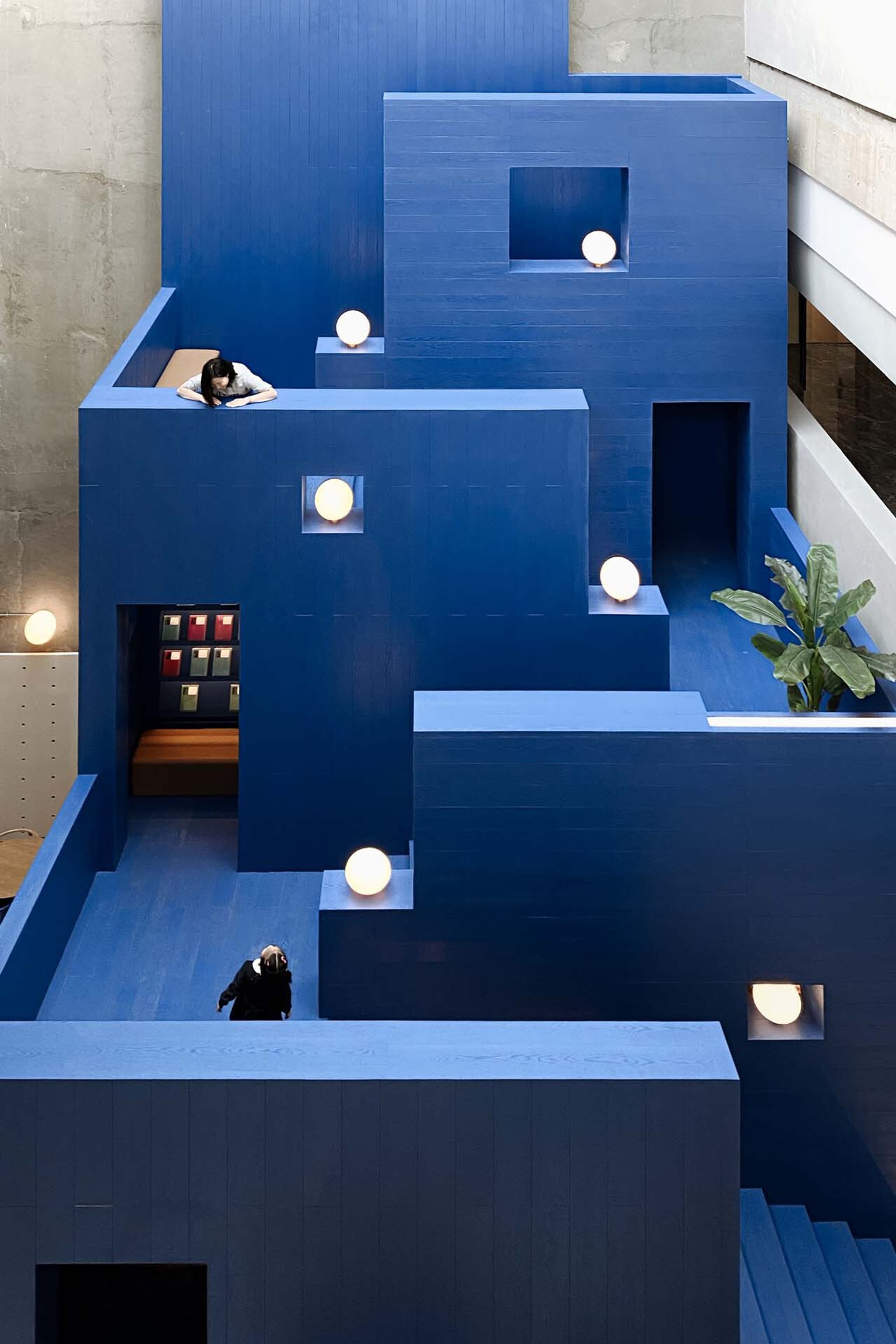
A bookstore that asks you to climb it is worth paying attention to. The LVWA Bookstore, designed by Studio YUDA and Studio NOR under the lead of architects Yuchen Guo and Boyuan Jiang, occupies the former Ping-Pong Academy Building on the campus of the Shanghai University of Sport. Rather than flatten the rough, three-story shell into conventional retail, the team inserted a family of blue timber volumes that rise vertically through an existing skylight atrium, peaking at 17 meters. The result is a 600 square meter interior landscape where bookshelves double as staircases, caves become reading rooms, and the act of browsing becomes genuinely athletic.
The design borrows from traditional Chinese garden practice, specifically the art of mountain-stacking, where scholars arranged rocks to evoke entire landscapes in miniature. Here, 15 small "book mountains" populate the ground floor's four interconnected rooms, serving simultaneously as shelving, seating, bar counters, and podiums. A central peak houses three carved-out caves and four reading platforms linked by stepped circulation. The concept collapses the distance between a campus sports culture and the contemplative world of books: both demand physical engagement, and the architecture insists you move through it on those terms.
The Central Peak
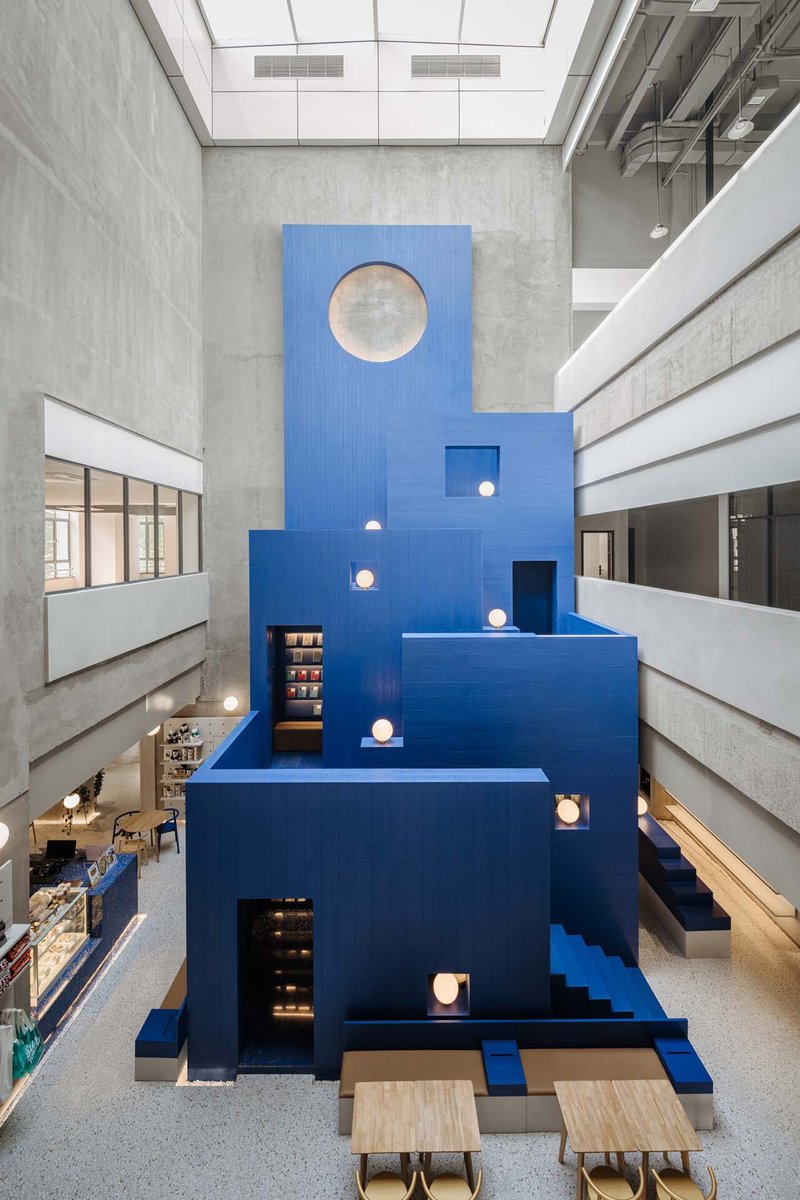
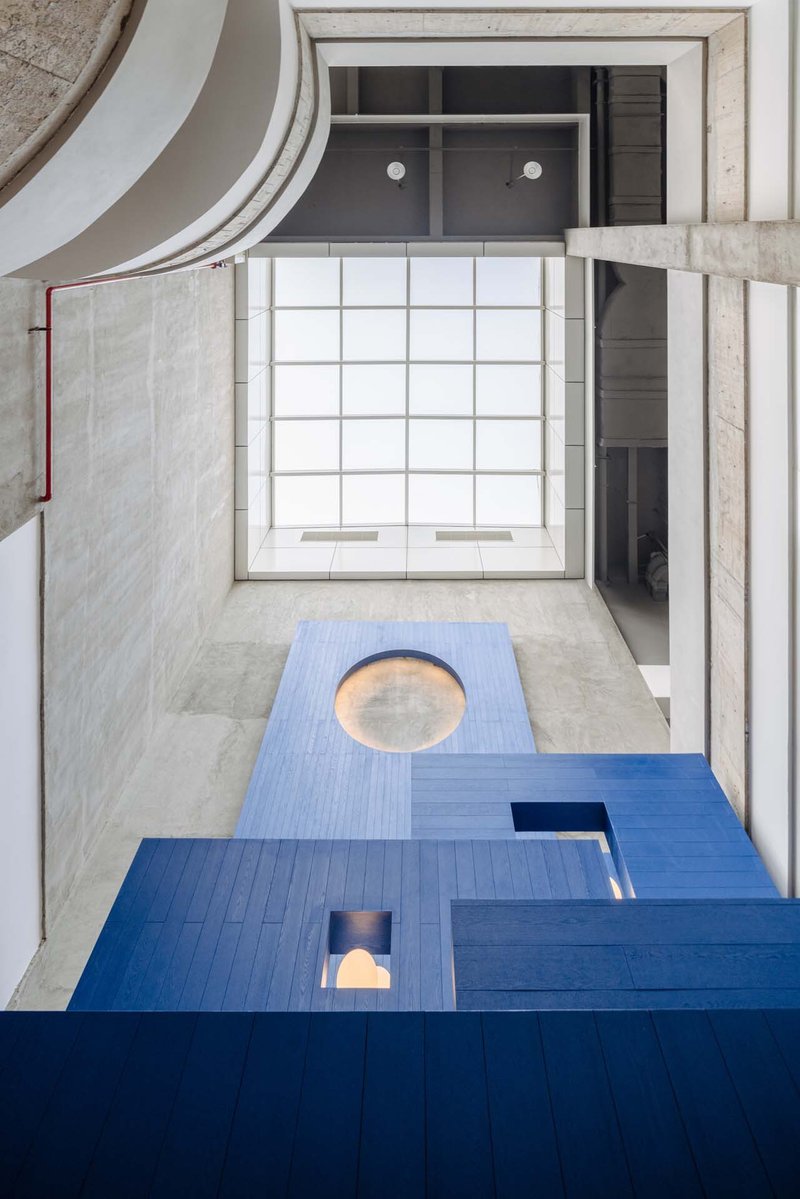
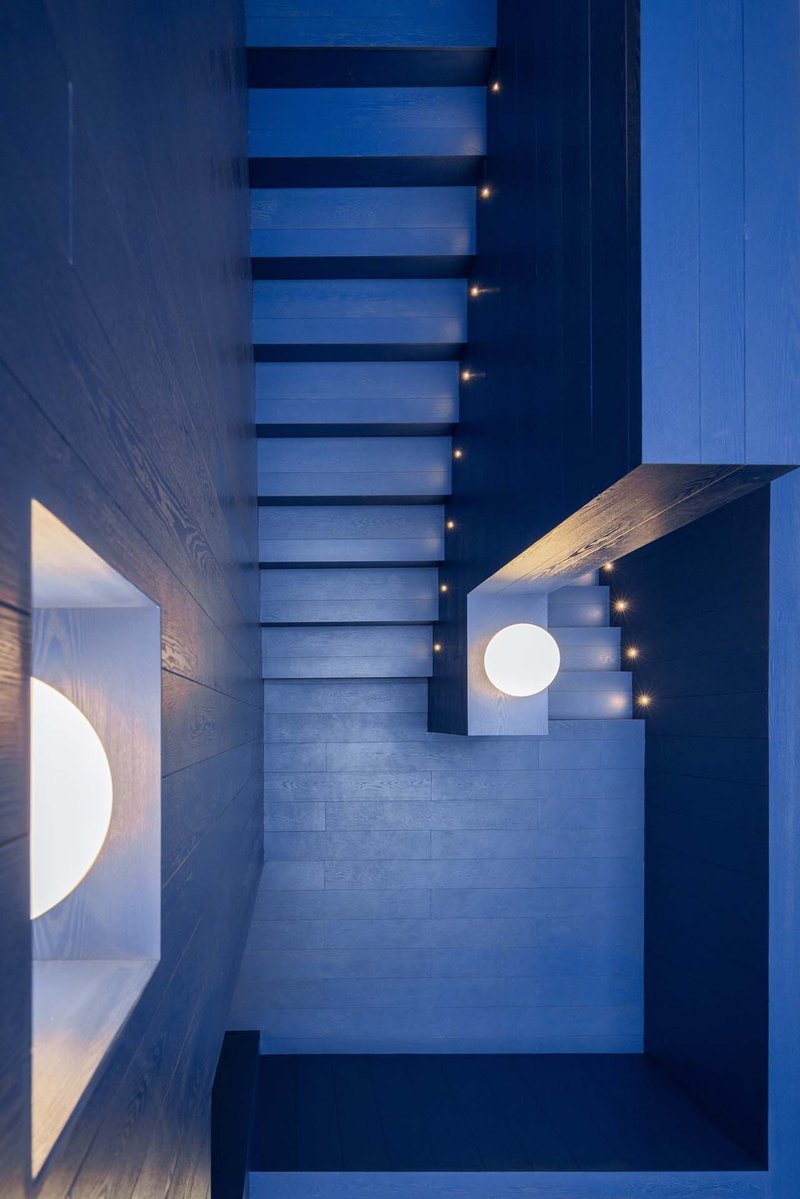
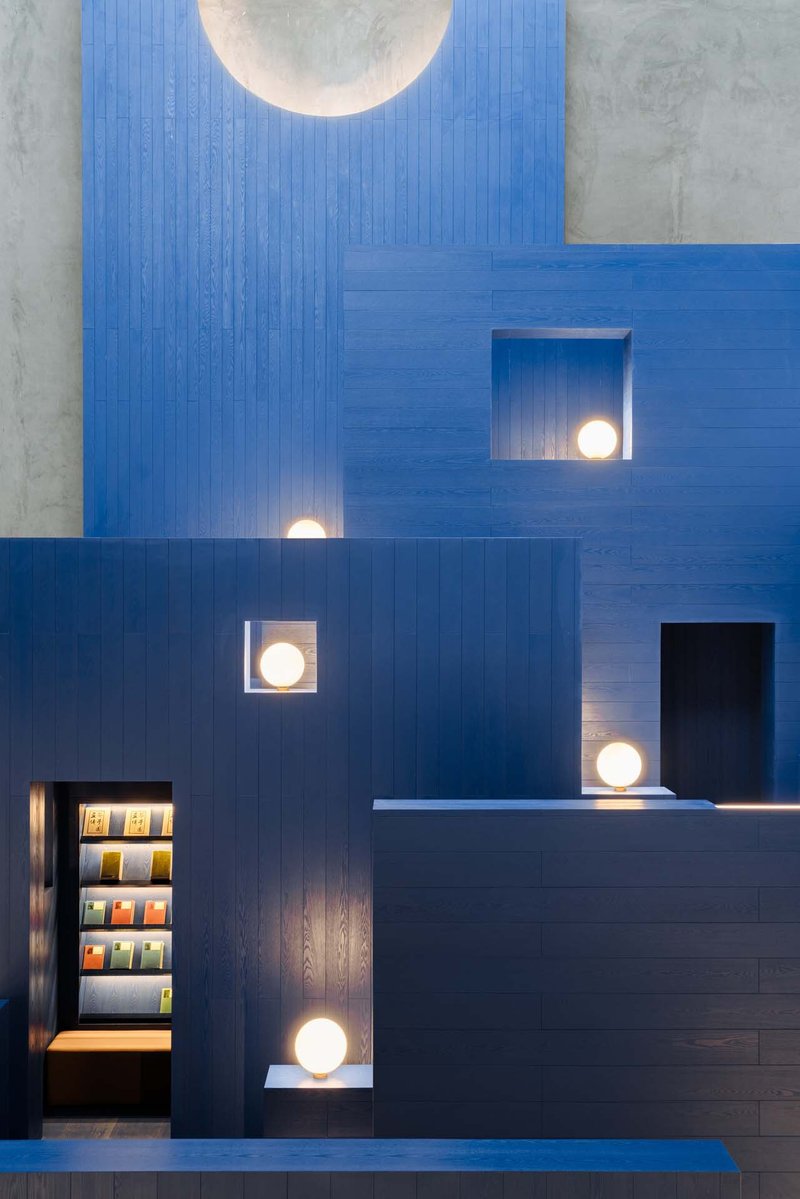
The 13-meter main peak is the gravitational center of the entire project. Wrapped in blue-stained timber, it rises through the existing atrium into a translucent gridded skylight that floods the structure with natural light. A circular opening at its summit functions as a kind of oculus, pulling the eye upward and channeling light down through the stepped interior. The suspended staircase within creates an almost theatrical experience: at dusk, illuminated treads glow through circular apertures, turning the structure into a lantern visible from above.
What makes this central volume work is its porosity. It is not a tower you ascend and leave; it is riddled with openings at different scales that frame views back into the surrounding book rooms and out to the campus beyond. The architecture keeps you oriented even as it surprises you with each landing.
Caves and Platforms
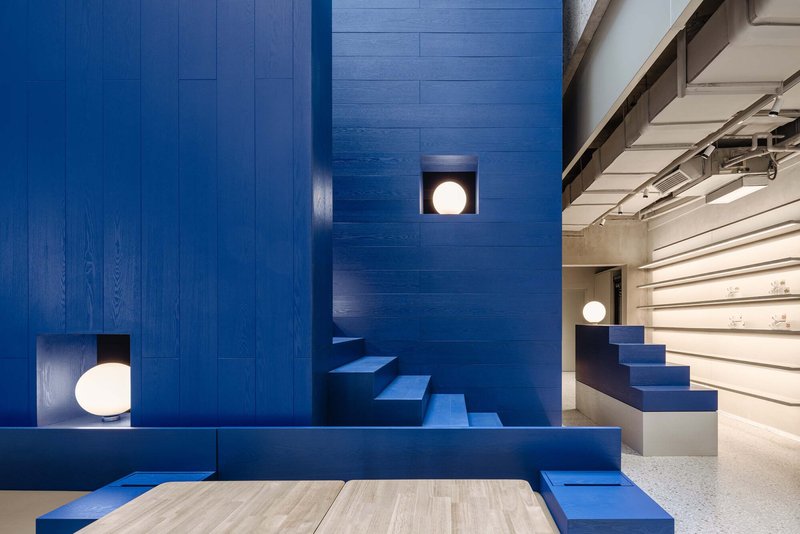
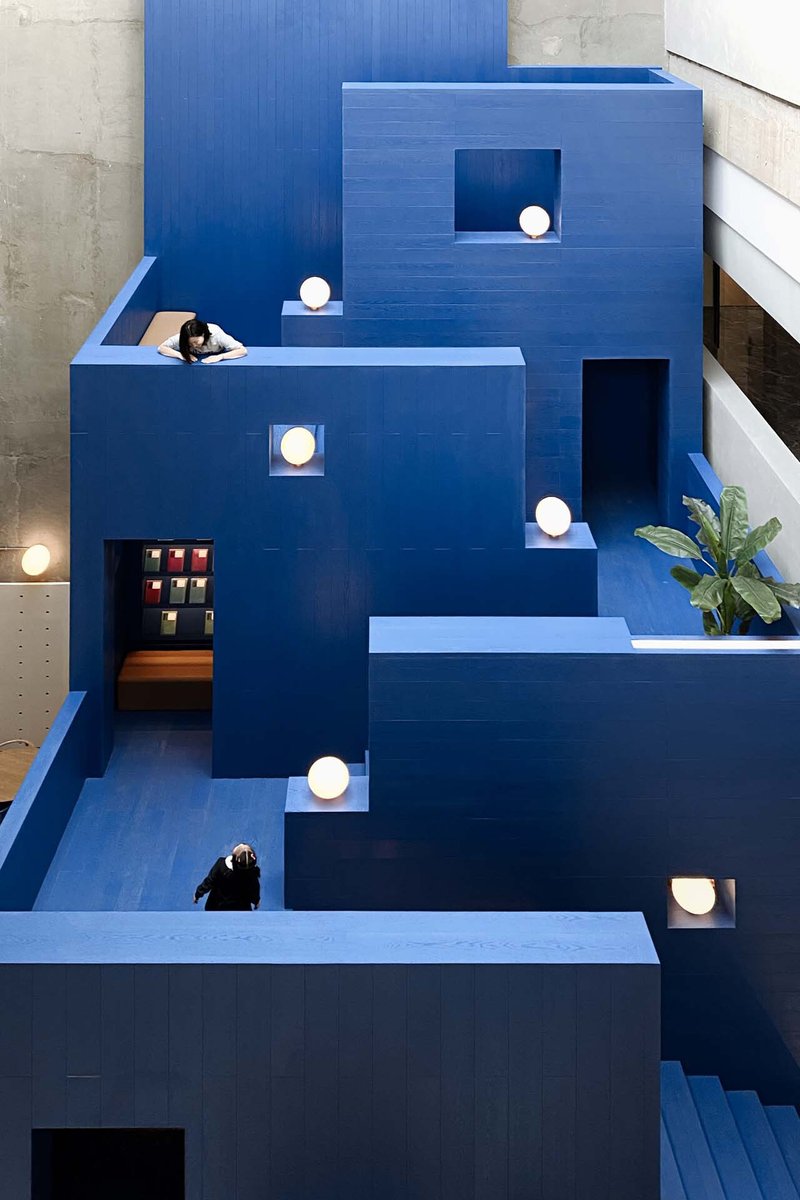
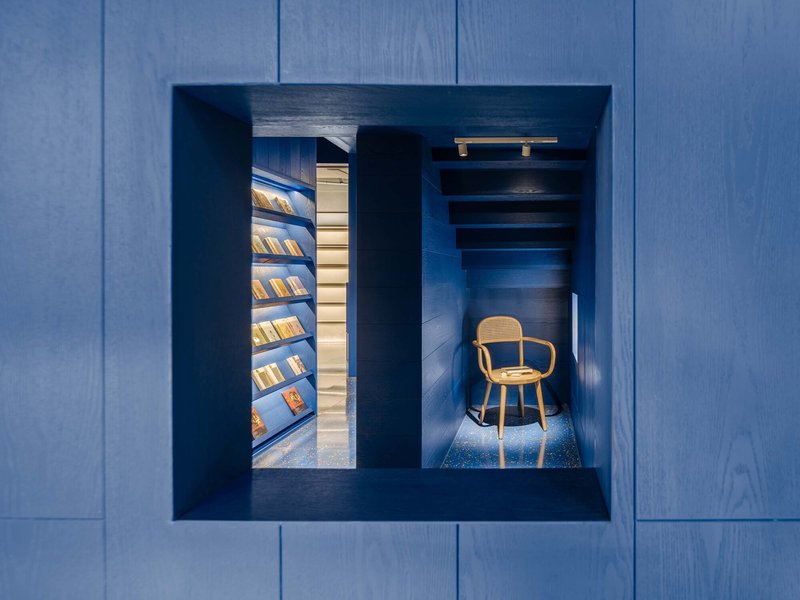
Inside the main peak, three "caves" offer intimate reading alcoves carved out of the timber mass. Circular porthole lights punctuate the blue-clad walls, giving each nook a submarine quality that contrasts with the airy atrium just outside. The stepped platforms connecting these caves are sized for lounging rather than rushing through, and the presence of a resident cat in the photographs feels entirely appropriate. These are spaces that reward lingering.
The framed views through the blue paneling deserve specific mention. The architects treat every wall opening as a composition, layering glimpses of illuminated shelves, seated readers, and bentwood chairs into depth-rich vignettes. The effect recalls the sequential revealing of a Chinese garden, where you never see everything at once.
The Ground Floor Rooms
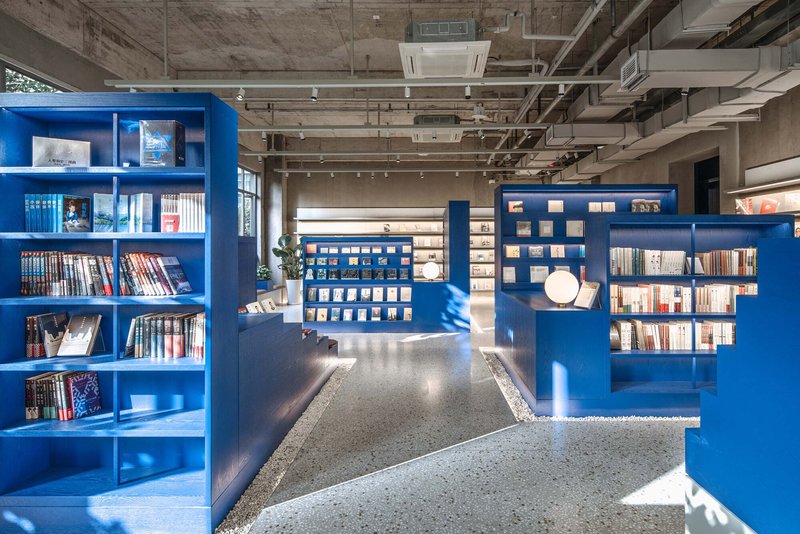
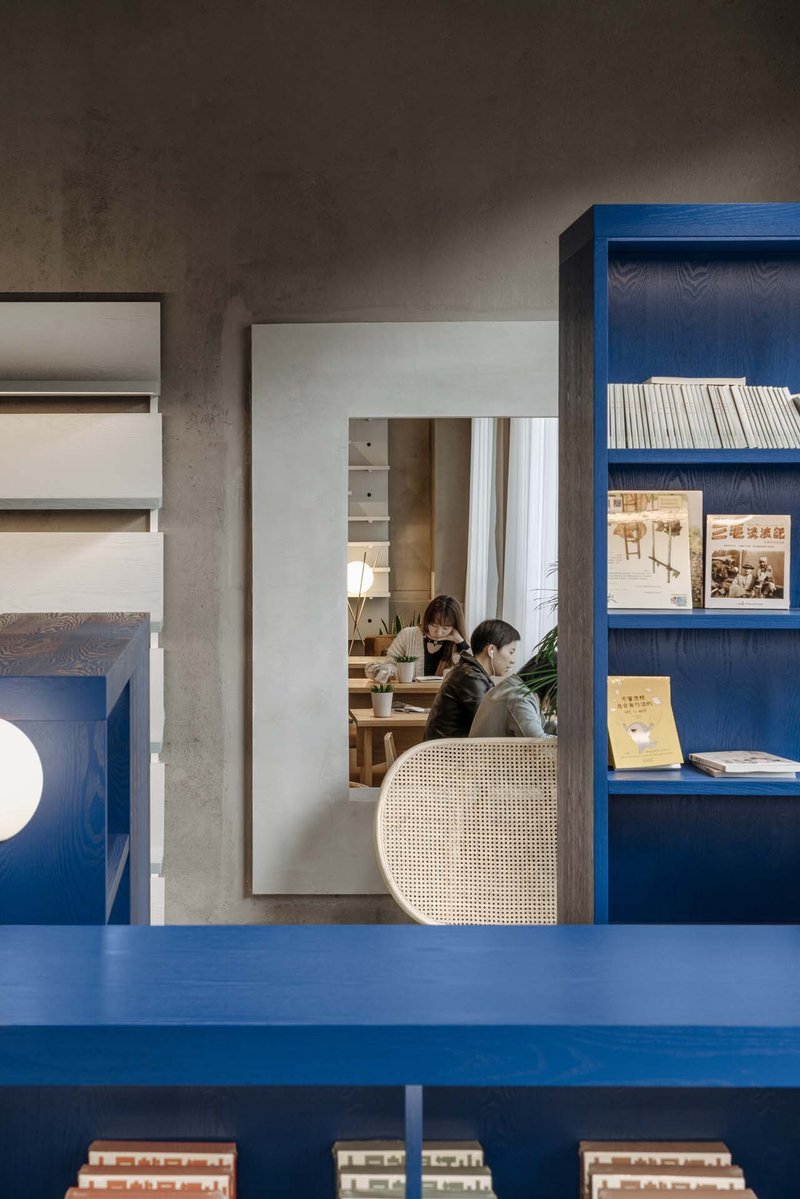
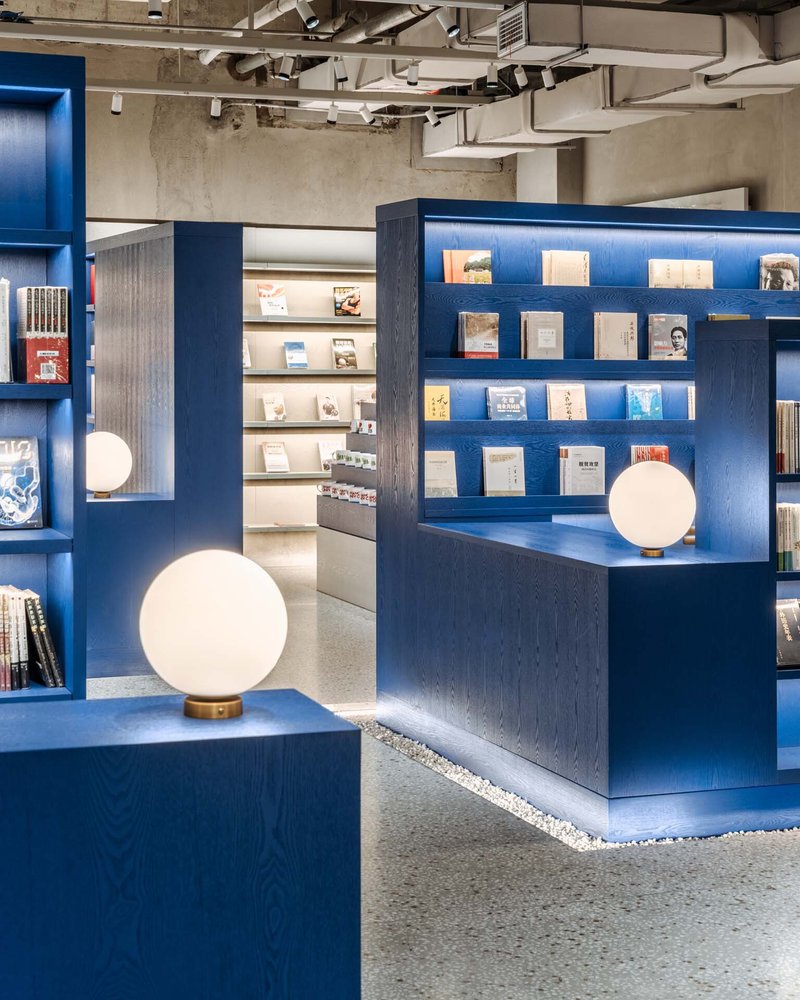
The ground floor is organized as four interconnected small spaces with entrances and exits on all sides, resisting any single reading of the plan. Freestanding blue shelving units populate the rooms beneath exposed concrete ceilings and visible mechanical systems, a decision that keeps the original building's industrial character legible. The contrast between raw concrete above and precise blue joinery below gives the interiors a productive tension: you are always aware that something new has been inserted into something old.
Spherical pendant lamps on brass bases sit atop the shelving units, their warm glow softening the hard geometry of the timber volumes. The lighting strategy throughout is layered: track lights for merchandise, backlit shelves for display, and globe pendants for atmosphere. It never feels overlit, which is a small miracle for a retail space.
Corridors and Thresholds
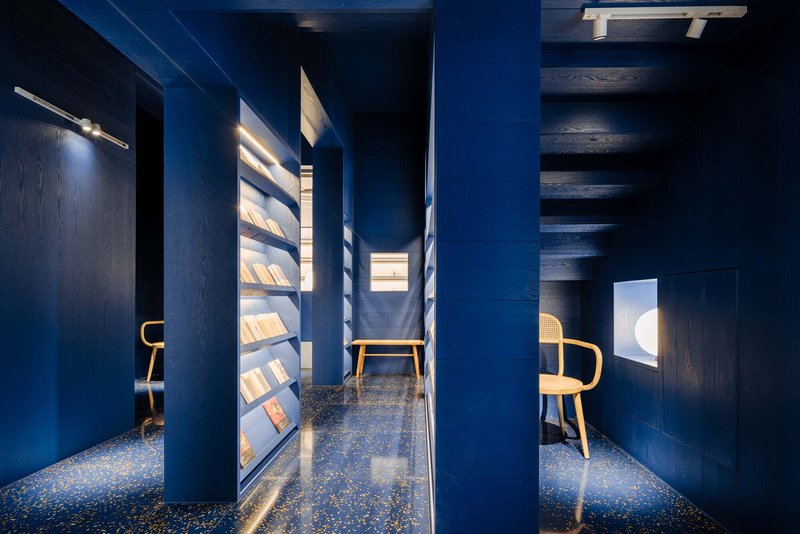
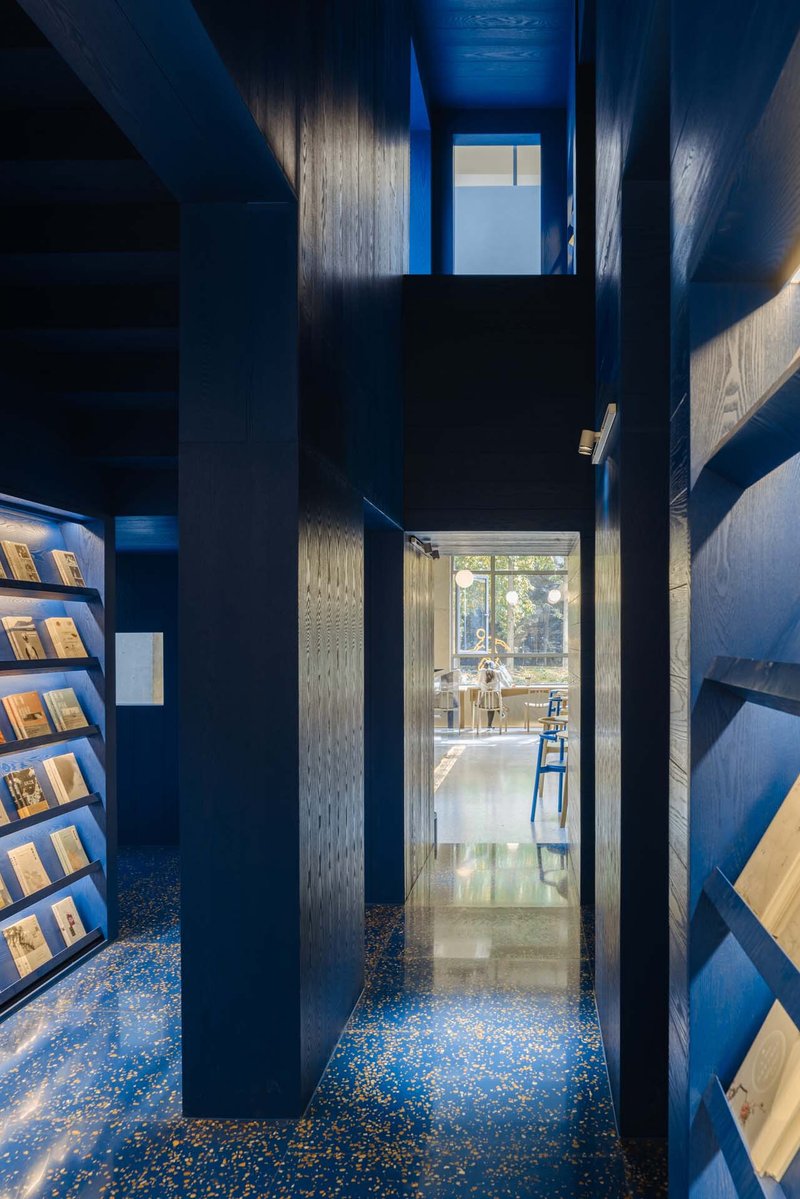
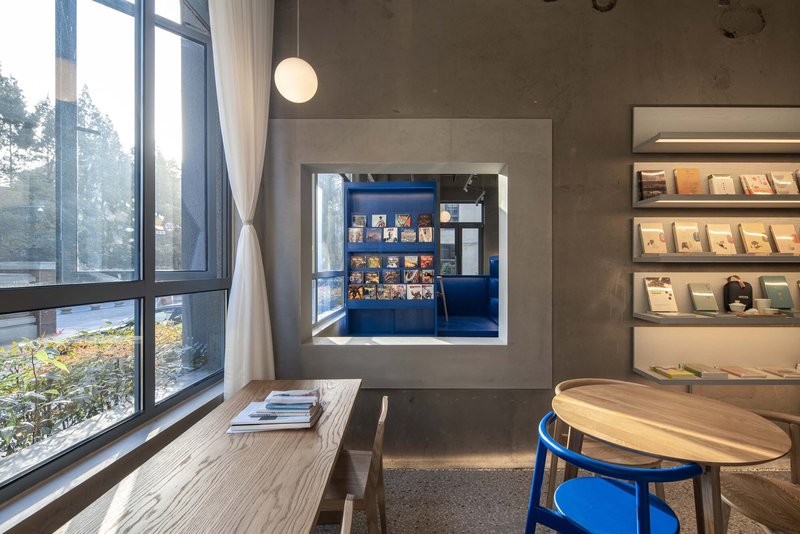
Circulation is not treated as leftover space here. Narrow corridors with blue terrazzo flooring and dark timber walls become reading passages in their own right, with illuminated book displays integrated into the wall surfaces. The terrazzo, which reappears at the cafe counter and on the floor of the main atrium, acts as a material thread stitching the diverse rooms together.
One of the most compelling moments occurs at a reading nook where a timber bench faces a framed window into the blue bookshop on one side and a garden view on the other. The architects use depth of field as a design tool: the eye moves through layers of interior and exterior, never quite settling. Walls throughout are finished in gray real stone paint, a neutral backdrop that lets the blue timber do all the talking.
Cafe, Lecture Hall, and Flexible Program
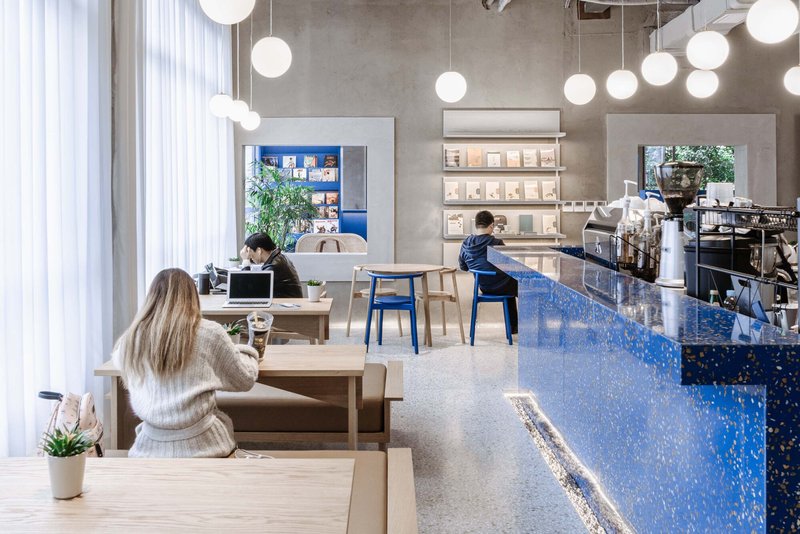
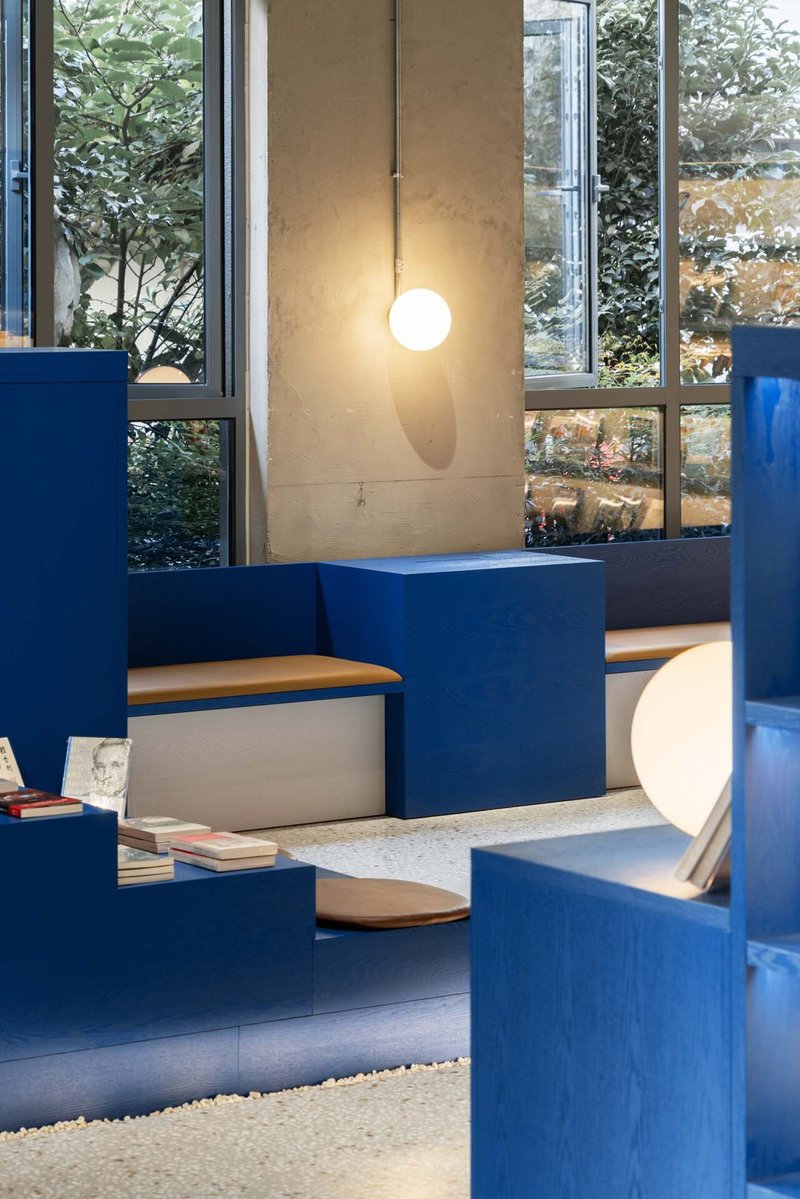
The bookstore is more than a bookstore. A cafe with a blue terrazzo counter and white globe pendants occupies one room, drawing campus visitors who may not have come to buy a book but end up browsing anyway. Seating platforms beside floor-to-ceiling windows open onto a courtyard, blurring the boundary between interior retail and campus life.
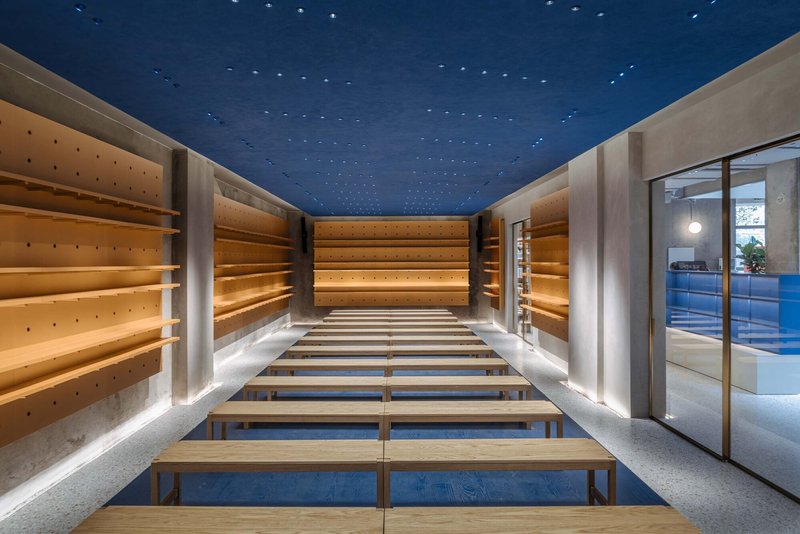
A dedicated lecture hall can switch between exhibition and event configurations. The benches are designed to function as shelves when stacked vertically, a clever piece of furniture engineering that keeps the room from sitting idle between programs. This kind of pragmatic flexibility matters in a university context where budgets are tight and space is contested. The perforated blue ceiling in the retail zone, backlit from above, extends the mountain metaphor overhead and keeps the visual language consistent even in the most utilitarian corners of the project.
Material and Color
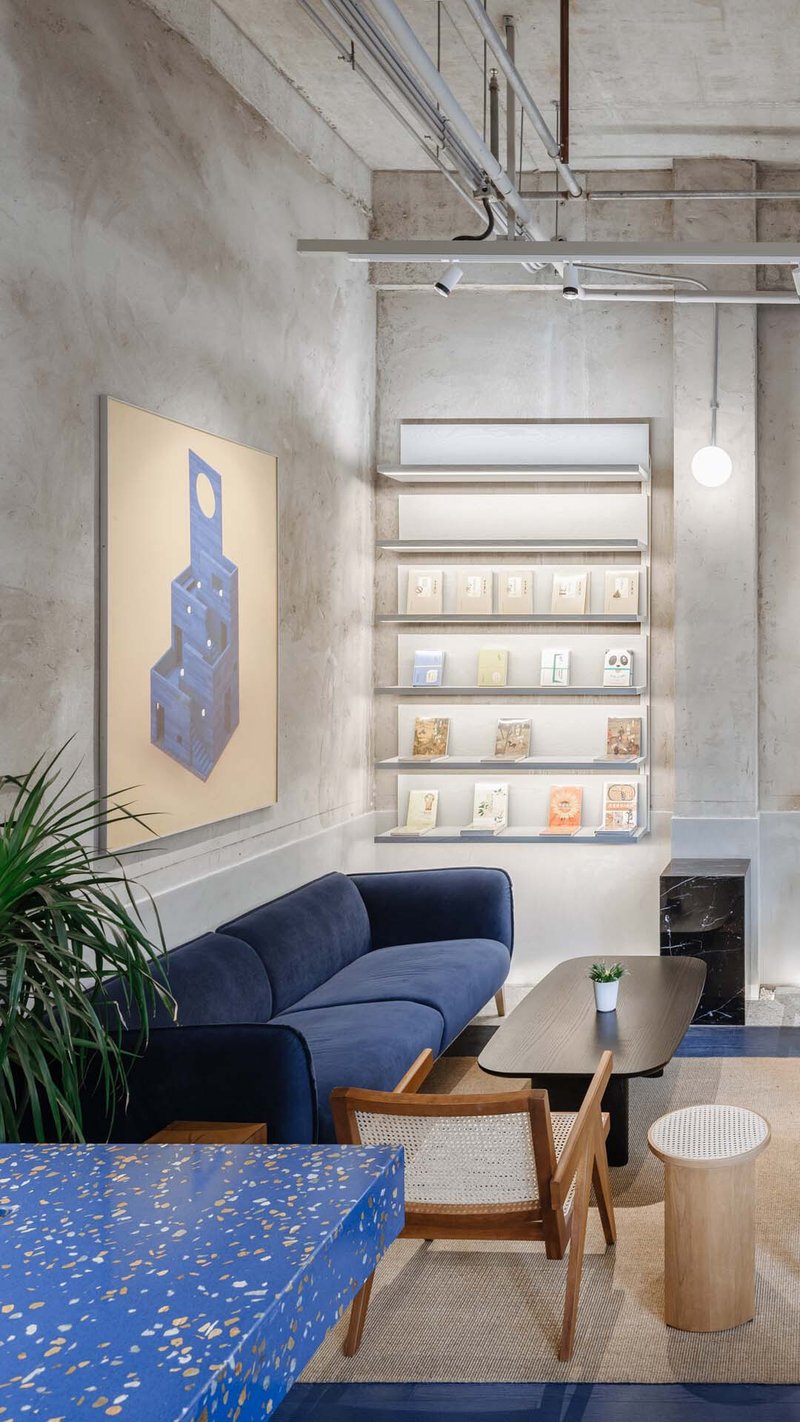
The overwhelming commitment to a single blue hue could have been disastrous. Instead, it works because the architects modulate it through material variation: smooth paint on walls, stained grain on timber, polished terrazzo on floors. Gold and brown furniture accessories introduce warmth where it is needed, particularly in the cafe and at reading desks. The perforated panel display racks break the solidity of the timber surfaces with patterned light.
At dusk, the niched spherical lamps glow against the blue wood paneling in a way that makes the entire project feel like a scaled-up piece of furniture. The metal door that marks the main entrance reads almost as a cabinet latch. Scale is constantly ambiguous here: are you entering a building or opening a very large book?
Plans and Drawings
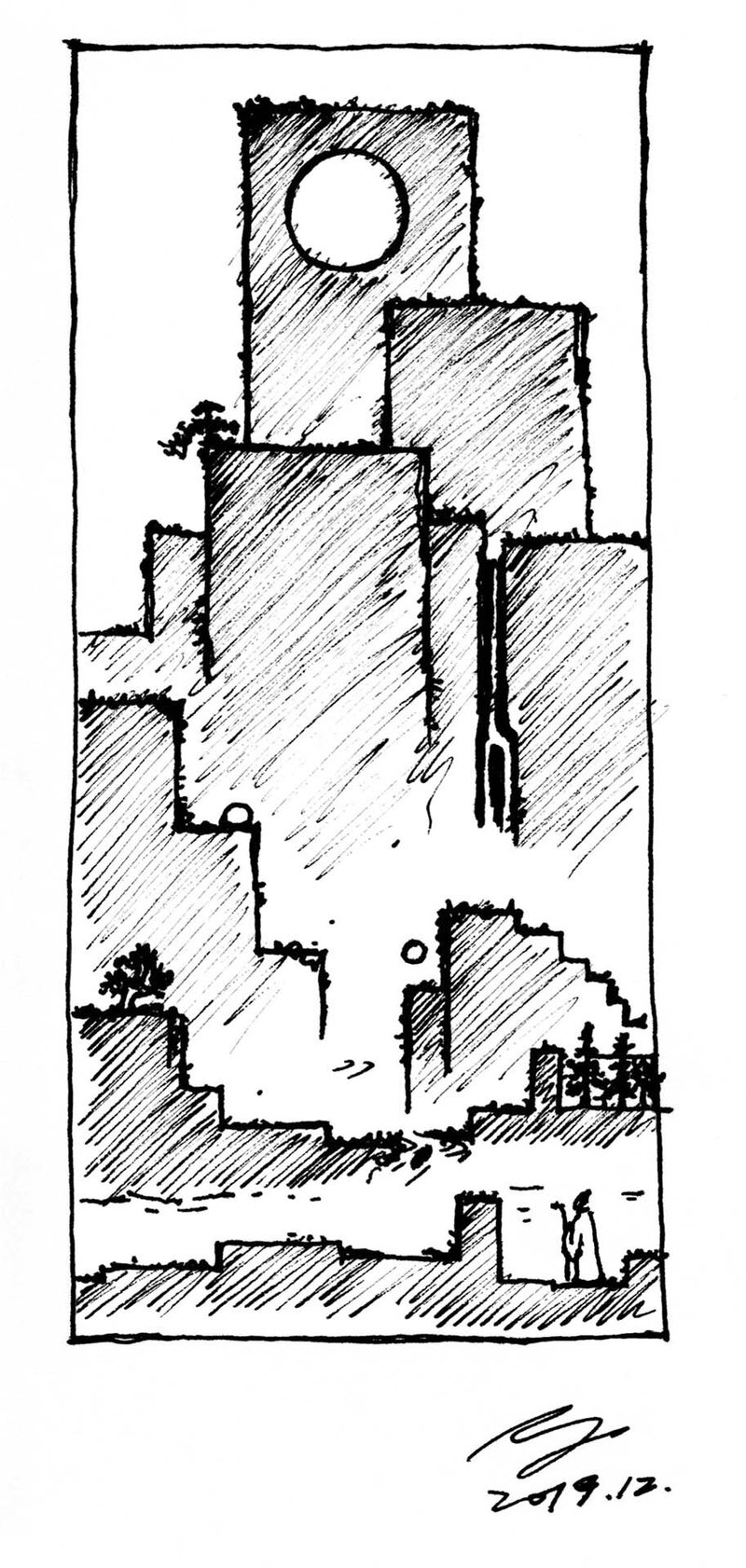
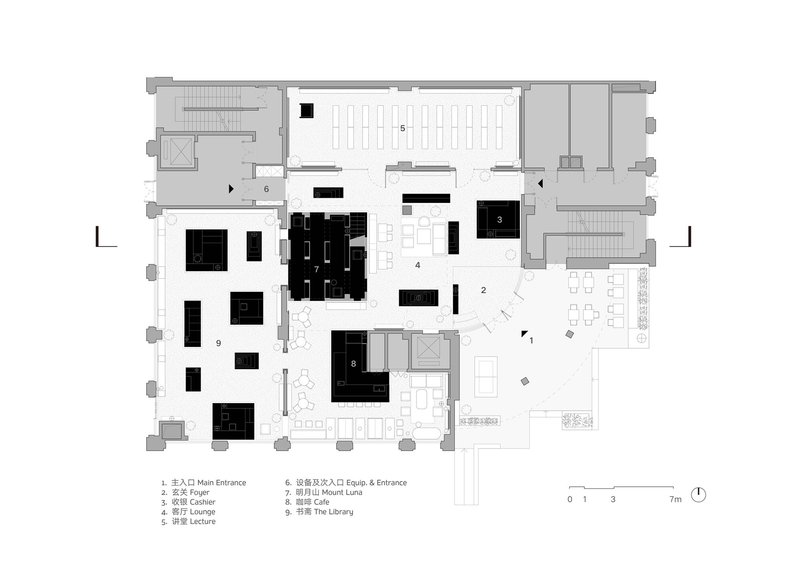
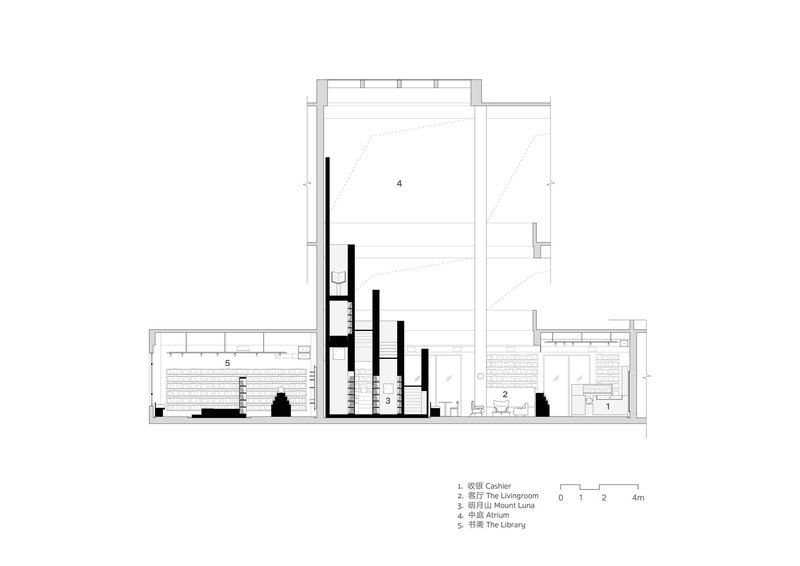
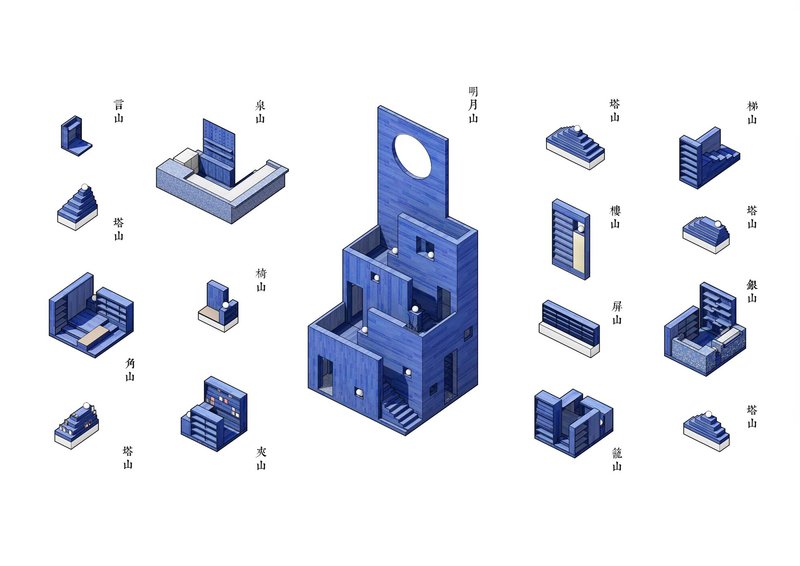
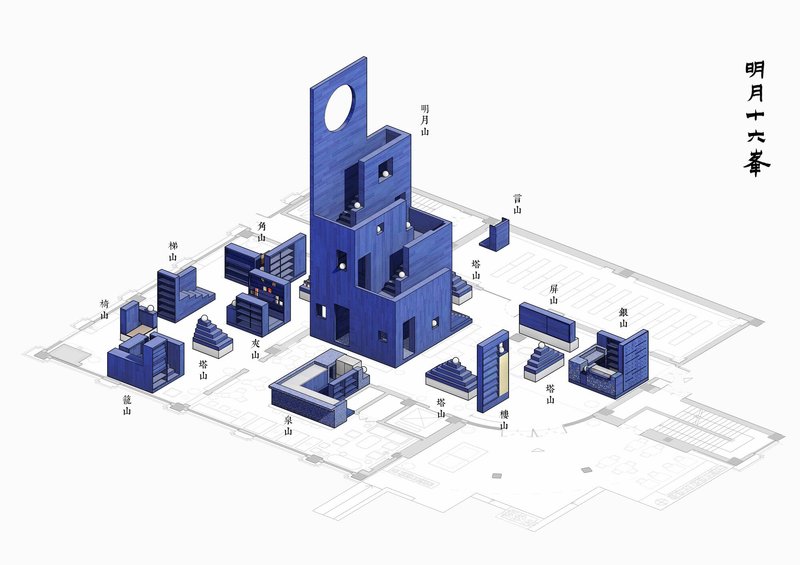
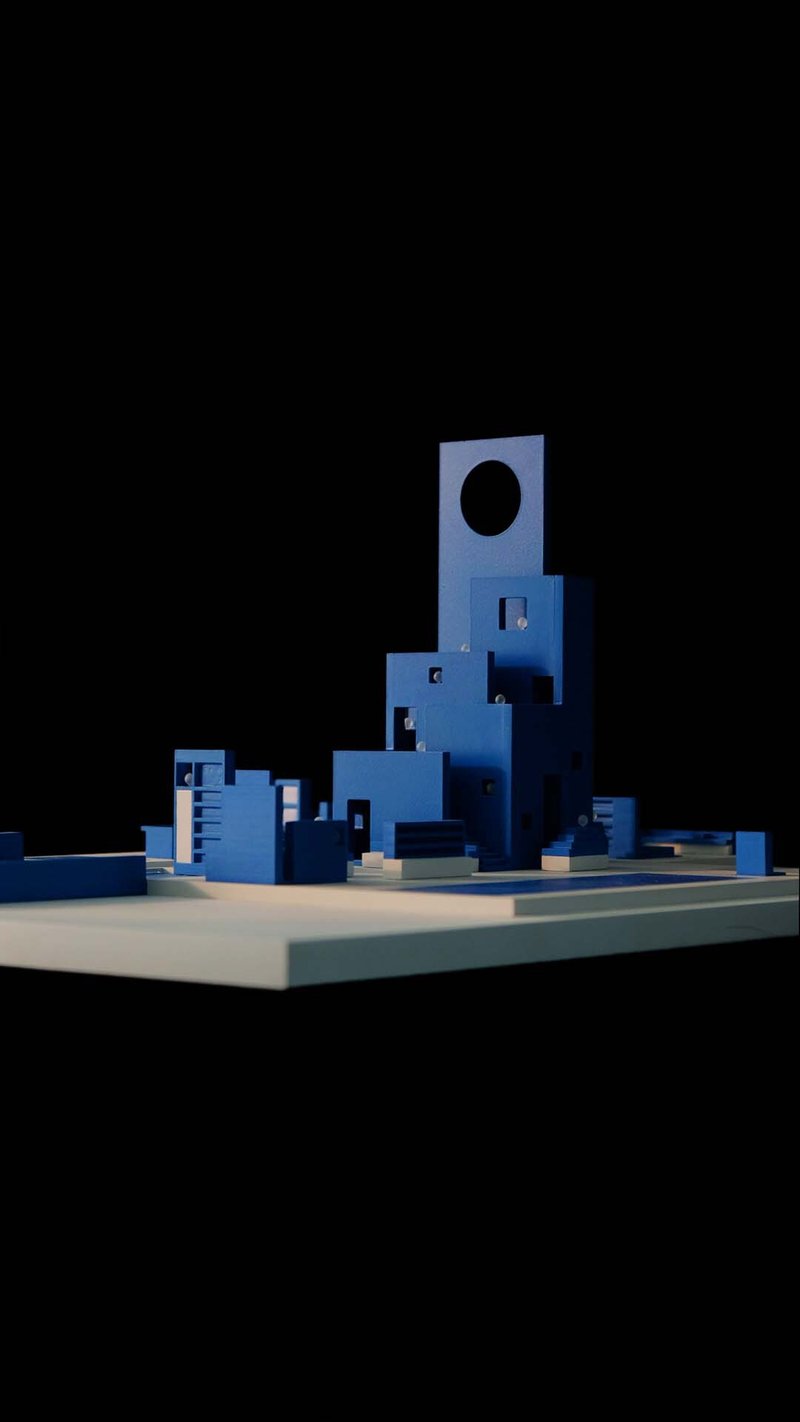
The floor plan reveals the four-room ground floor organization with entrances on every side, confirming the project's resistance to a single axis. The section drawing is where the vertical ambition becomes clearest: the stepped interior void of the main peak ascends through the full height of the existing building, with adjacent library spaces tucked beneath existing floor slabs. The isometric and axonometric drawings label each component as a distinct volume gathered around the central tower, reinforcing the mountain-cluster reading of the plan.
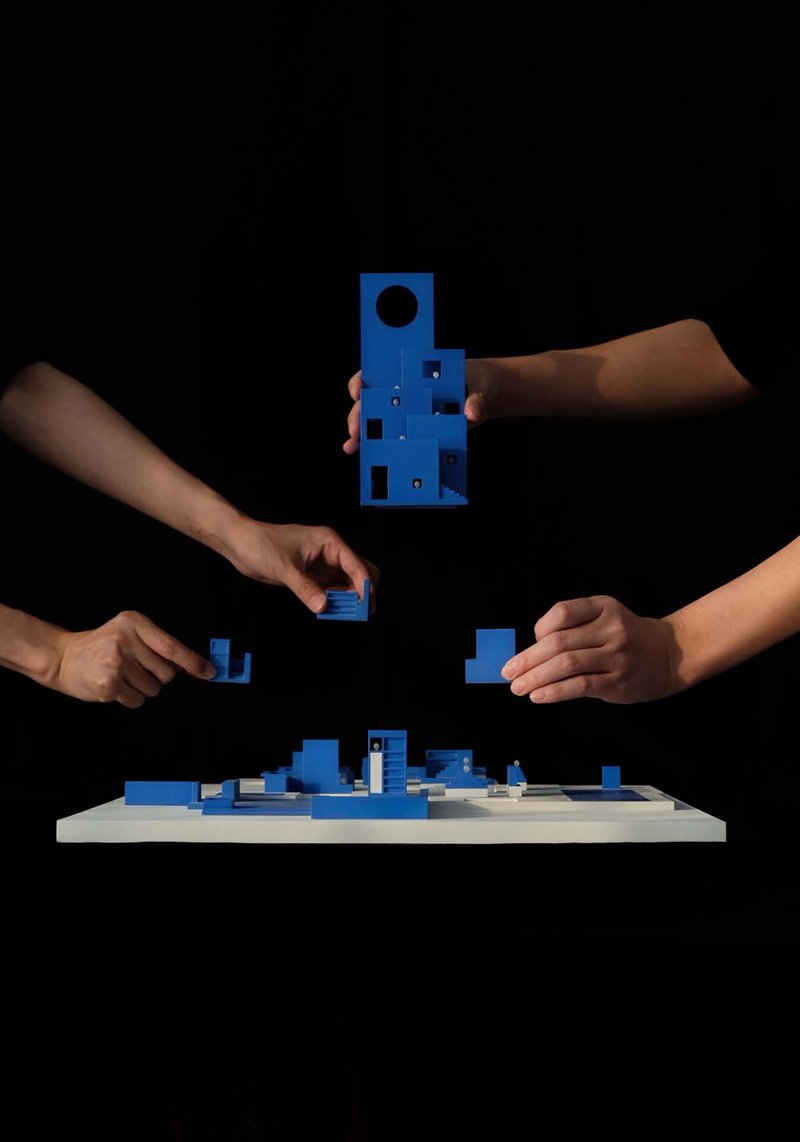
The physical model and assembly photographs are unusually revealing. Blue modular components fit together above a white base, demonstrating that the timber volumes were conceived as discrete, insertable pieces rather than continuous surfaces. This prefabrication logic likely helped manage construction inside an occupied campus building. The model under dramatic side lighting also captures something the photographs sometimes miss: how sharply the central tower with its circular portal stands against its surroundings, a topographic anomaly in a flat institutional landscape.
Why This Project Matters
Campus bookstores rarely receive this level of architectural investment, and even more rarely do they earn it. The LVWA Bookstore succeeds because it takes a genuinely original spatial idea, the climbable book mountain, and executes it with material discipline and programmatic intelligence. Every element does double duty. Shelves are stairs. Benches become display racks. A rough gymnasium shell becomes a garden of reading caves. The project demonstrates that interior renovation can produce spatial experiences as powerful as any new-build, particularly when the architects treat the existing structure as a found landscape rather than a problem to conceal.
There is also a broader lesson about cultural infrastructure on university campuses. By rooting the design in the Chinese garden tradition of mountain-stacking and connecting it to the campus's sports identity, Studio YUDA and Studio NOR produced a space that feels specific to its place and institution rather than exportable to any city. That specificity is what will keep students climbing these blue peaks long after the novelty fades.
LVWA Bookstore by Studio YUDA and Studio NOR, lead architects Yuchen Guo and Boyuan Jiang. Shanghai, China. 600 m². Completed 2020. Photography by CreatAR Images.
About the Studio
Share Your Own Work on uni.xyz
If projects like this are the kind of work you want to make, uni.xyz is a place to publish your own, find collaborators, and enter design competitions.




Popular Articles
Popular articles from the community

LGA Architectural Partners Build Toronto's First Multiplex Condo on a Single-Family Lot
Ulster House packs five zero-carbon units into a Harbord Village lot, proving gentle density can be market-ready and livable.
Etea and Ghostframe Carve a Surreal Domestic World from Arches and Circles in Mérida
Casa Eclipse wraps 385 square meters of sculptural living space around a lush courtyard pool in Mexico's Yucatán Peninsula.
Reincarnation Weaves a Three-Story Retreat into the Green Landscape of Rural Bangladesh
Ara Manor in Narsingdi dissolves the line between domestic architecture and its lush surroundings through screens, courtyards, and planted rooftops.
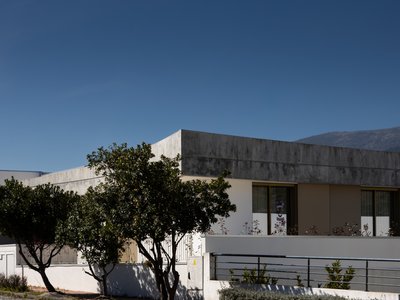
PLATAFORMArq Folds a Concrete Roof Over the Portuguese Mountains in House #474
A 220-square-meter residence in Teixoso, Portugal, wraps board-formed concrete into an angular canopy that frames the Serra da Estrela foothills.

Similar Reads
You might also enjoy these articles

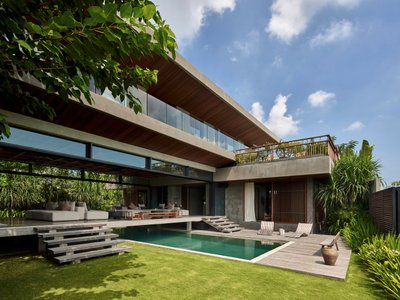
Freebird Residence by Alexis Dornier: A Tropical Modernist Sanctuary in Bali
Floating living pavilion above pool anchors H-shaped tropical villa, blending Japanese minimalism, sustainable strategies, lush landscape, and sculptural interiors.
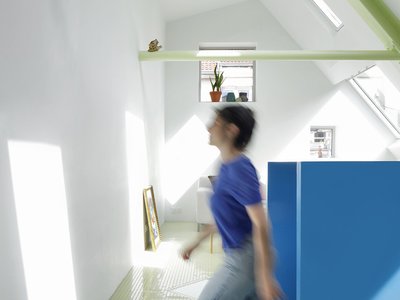
127af Flips a Tiny Bagnolet Rowhouse Upside Down with a Handcrafted Roof Extension
A 55-square-meter terraced house on the edge of Paris gains a luminous upper living floor through lightweight timber and steel.
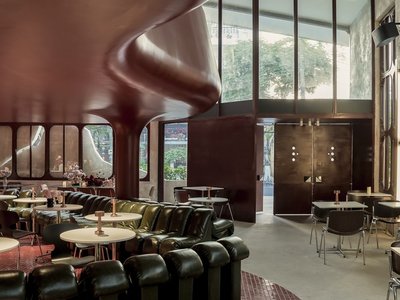
1.61 Design Workshop Wraps a 600-Square-Meter Café in Vietnam in Sculptural Burgundy Drama
Reden Café & Bistro pairs a helical staircase, mosaic floors, and deep red interiors to rethink Vietnamese hospitality space.

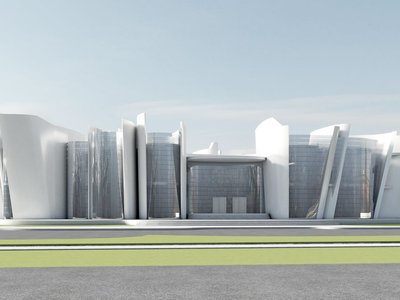
The Unbound Brain: A School Shaped by Cognitive Architecture
Cylindrical learning pods radiate like neurons from a central cortex, turning the floor plan into a spatial model of human thought.


Explore Architecture Competitions
Discover active competitions in this discipline




The International Standard for Design Portfolios


The Global Benchmark for Architecture Dissertation Awards


The Global Benchmark for Graduation Excellence


Challenge to reimagine the Iron Throne
Comments (0)
Please login or sign up to add comments
No comments yet. Be the first to comment!