
Studiocolnaghi Wraps a U-Shaped Concrete Home Around a Pool Terrace in Southern Brazil
Aspen House in Gramado uses solid side facades and a courtyard plan to balance privacy with sweeping valley views.


Gramado sits in the highlands of southern Brazil, a town of temperate forests, araucaria pines, and fog. It is not the kind of setting where you expect to find a poolside courtyard house, and that tension between a cool mountain climate and a generous outdoor living program gives Aspen House its particular edge. Designed by Studiocolnaghi, led by architects Ana Colnaghi and Sabrina Hennemann, this 1,060 m² residence uses the slope of its site to embed a layered domestic program that turns inward while still reaching out toward distant valley views.
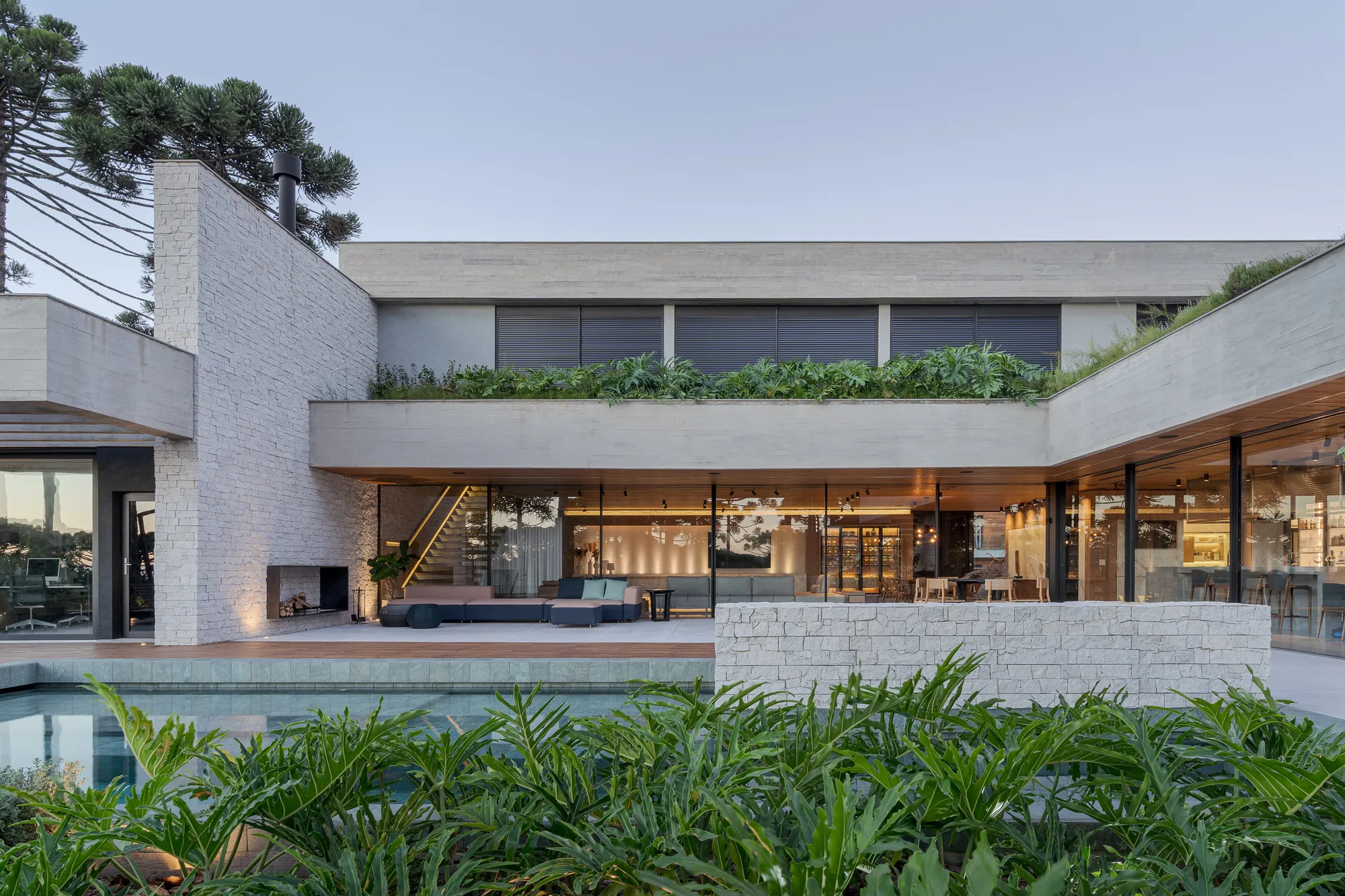
The smartest decision here is organizational. The ground floor wraps into a U-shape that captures a swimming pool and timber deck at its center, creating a private micro-landscape shielded from neighbors by largely solid flanking walls. Then a linear upper bar stretches across the top, housing bedrooms that open to the valley on the far side. It is a two-move plan: introverted on the ground, extroverted above. The result is a house that gives its occupants both enclosure and horizon, depending on which floor they happen to occupy.
Entry and Street Facade
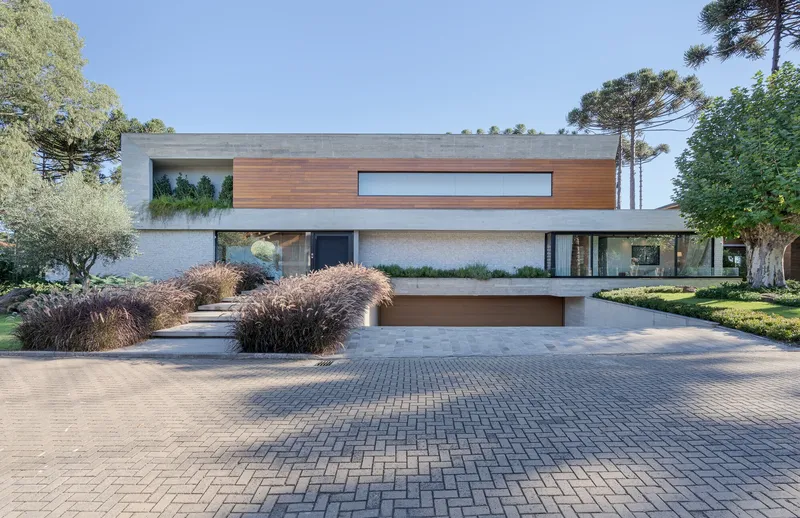
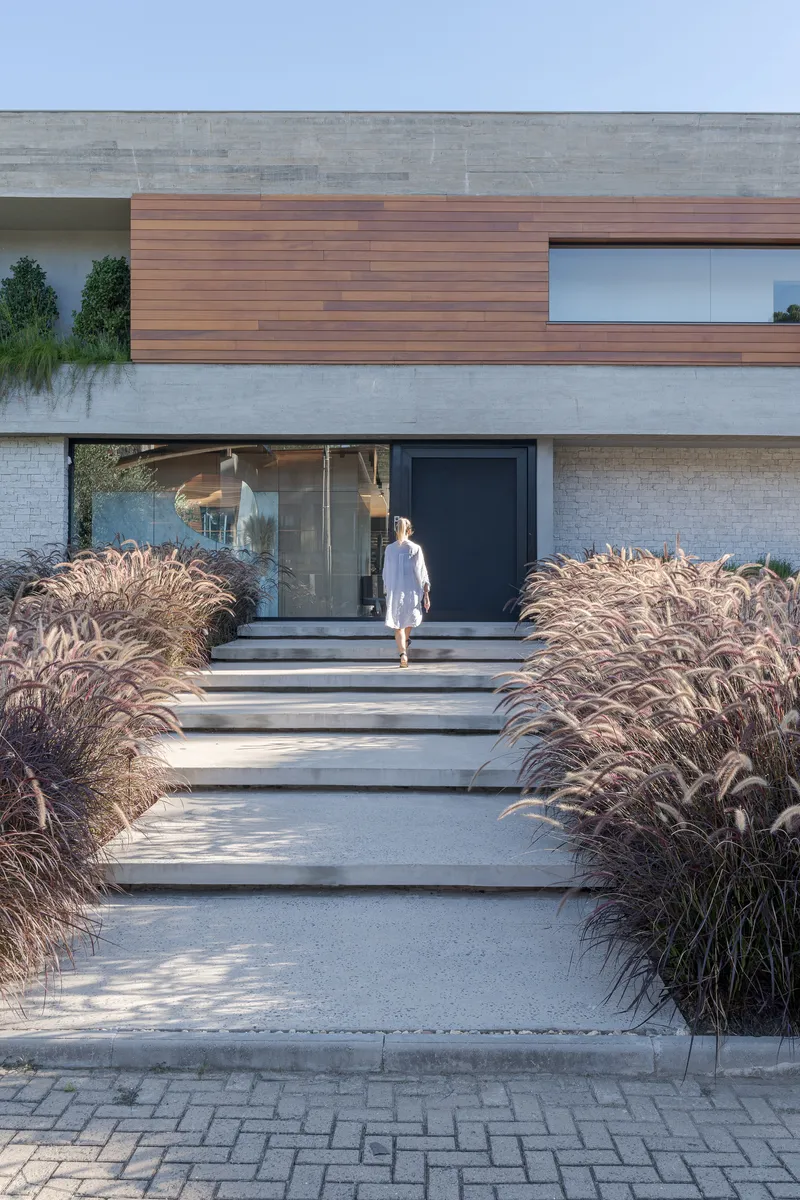
From the street, Aspen House is deliberately restrained. White brick forms a grounded base, and above it a band of horizontal timber cladding signals domestic warmth without giving anything away. The entry sequence is compressed: you walk between beds of dried ornamental grasses, ascend a few steps, and arrive at a dark, recessed doorway that creates a threshold of shadow before the interior opens up. It is a classic architectural move, tightening space before releasing it, and it works here because the facade is serious enough to sell the payoff.
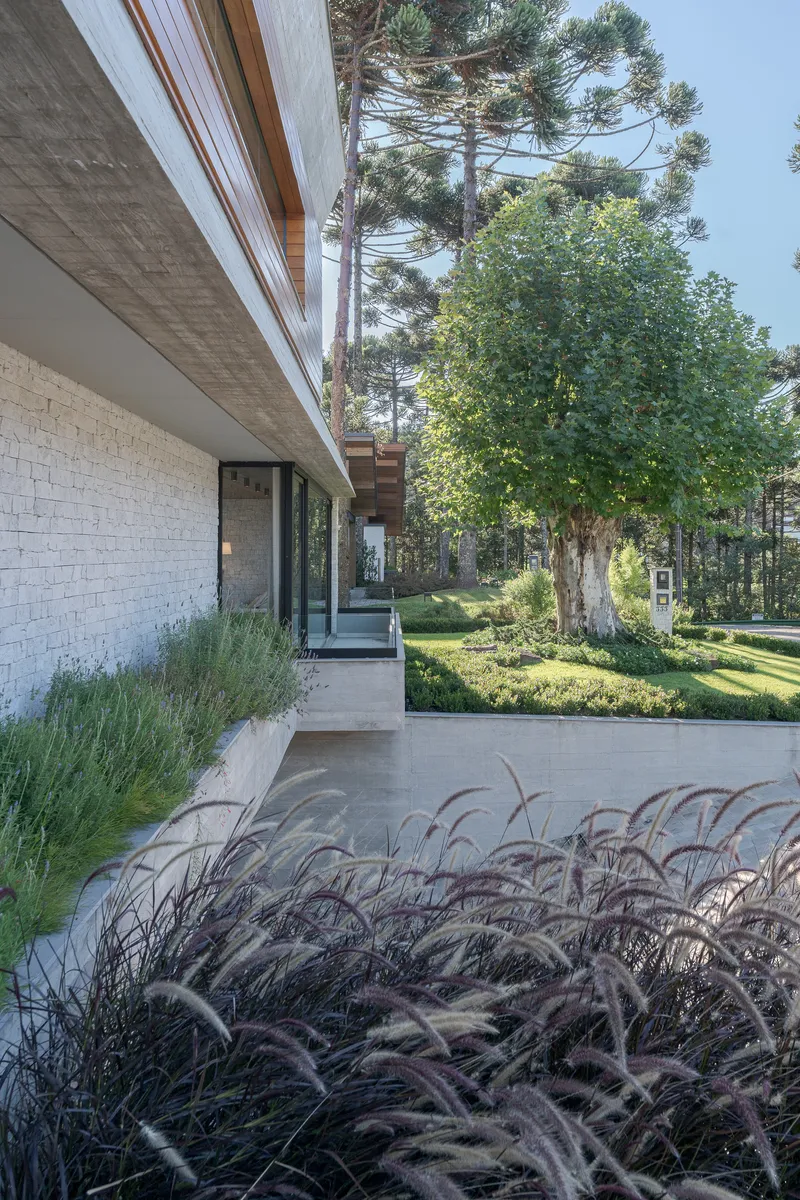
The side facades are mostly solid. Privacy from adjacent properties was a primary driver, and rather than relying on curtains or frosted glass, Studiocolnaghi simply closed the walls and let the courtyard do the work of bringing light and air into the plan. Seasonal planting in raised beds along the base offers a changing color palette throughout the year, softening the masonry without compromising its protective role.
The Courtyard Pool as Organizing Device
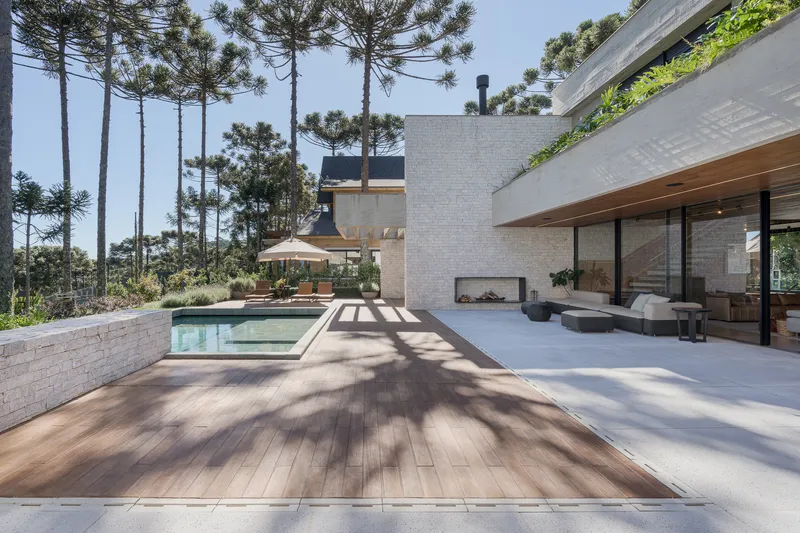
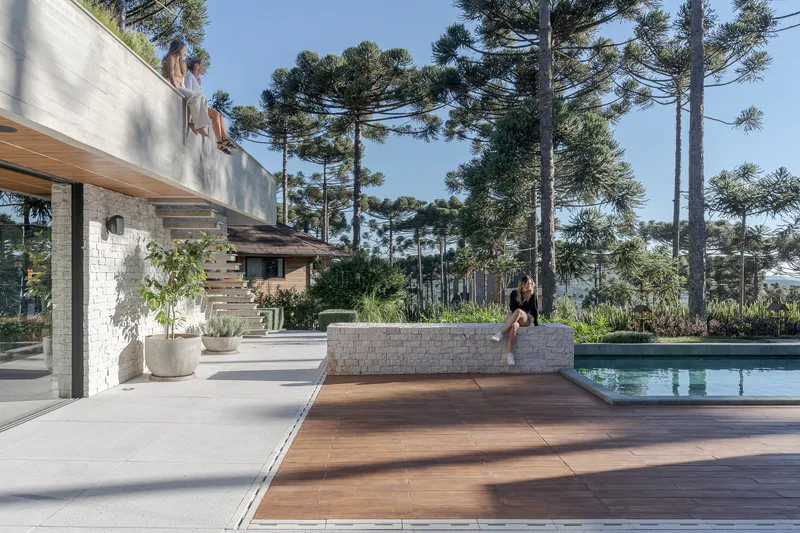
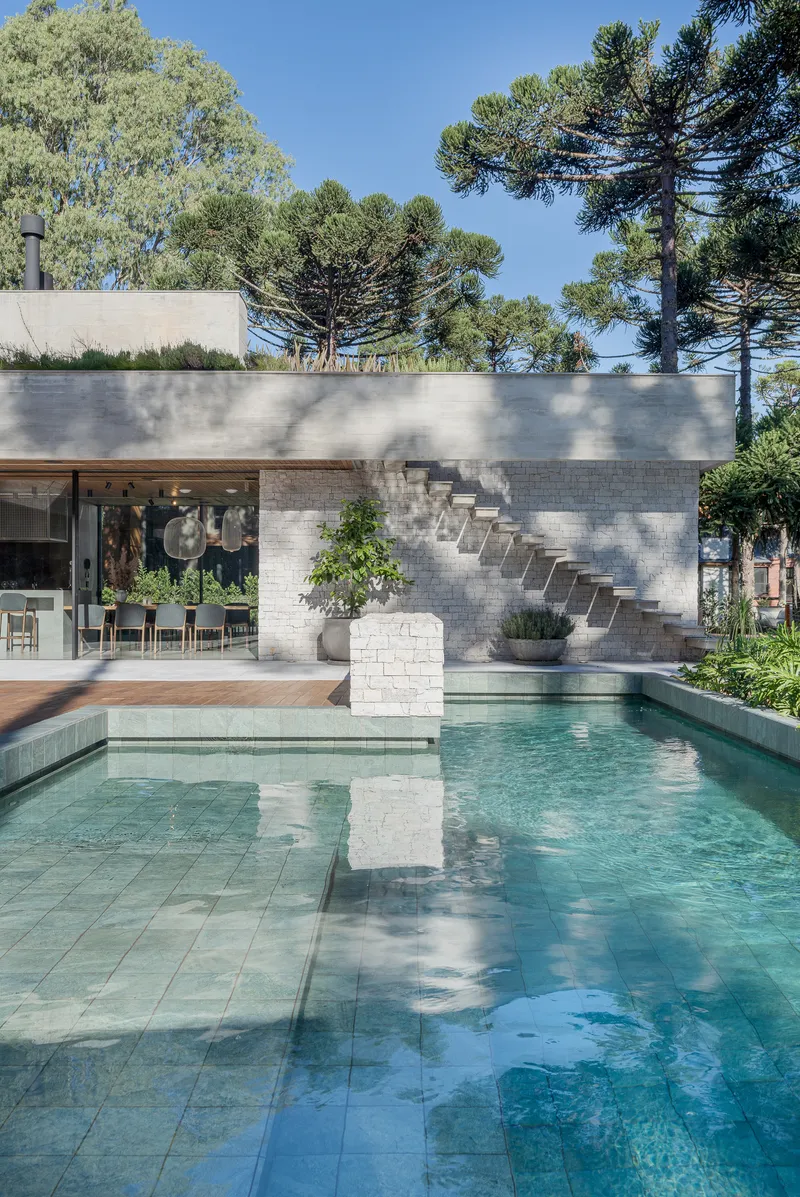
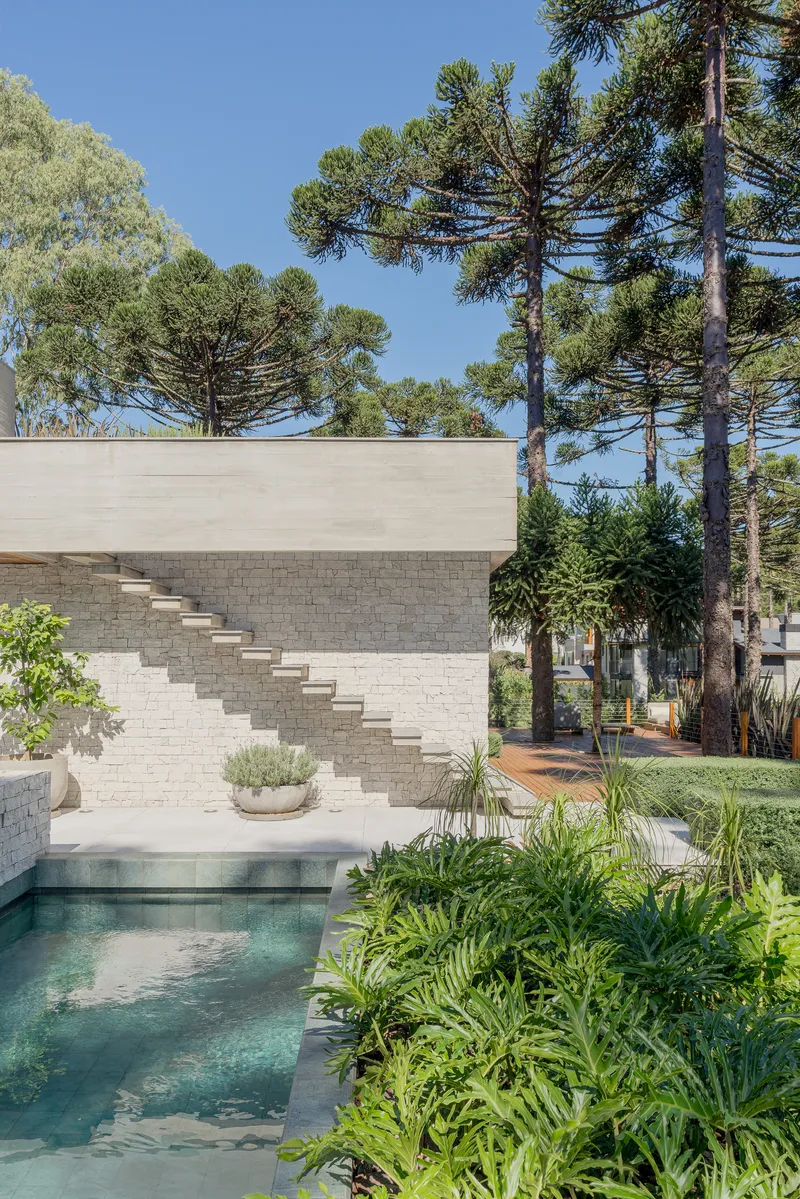
The pool terrace is the heart of the house and its best space. Surrounded on three sides by the U-shaped ground floor, it sits beneath the canopy of existing araucaria pines whose tall, clean trunks filter light into dappled patterns across the timber deck. The interplay between the hard geometry of the pool, the warm planking, and the vertical rhythm of the tree trunks is genuinely compelling. Gabion retaining walls and planted concrete surfaces handle the grade change at the rear, turning the slope into a feature rather than an obstacle.
An exterior staircase ascends along the white masonry wall beside the pool, connecting the courtyard level to the upper bedroom bar. Its placement reinforces the courtyard as a hub: you do not pass through a corridor to reach the bedrooms, you step outside, climb an open stair, and arrive on a second register that looks back down over the landscape you just left. Circulation becomes an experience of the house rather than a neutral connector.
Landscape and Topography
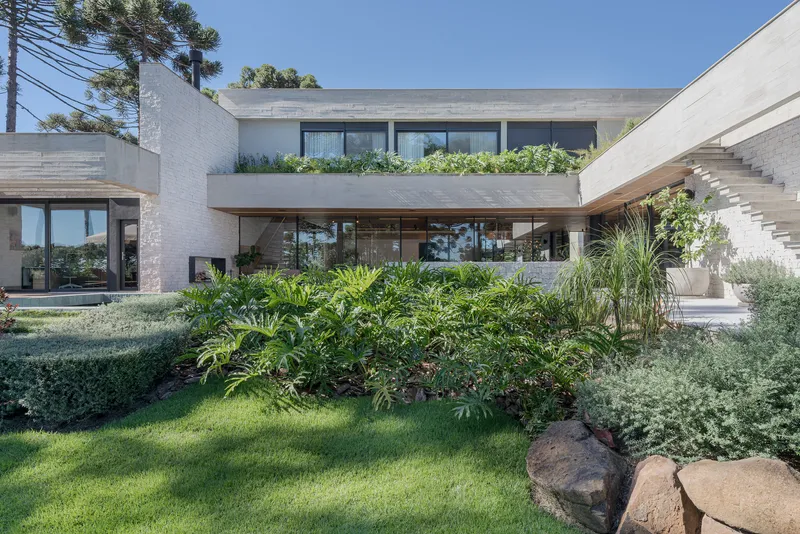
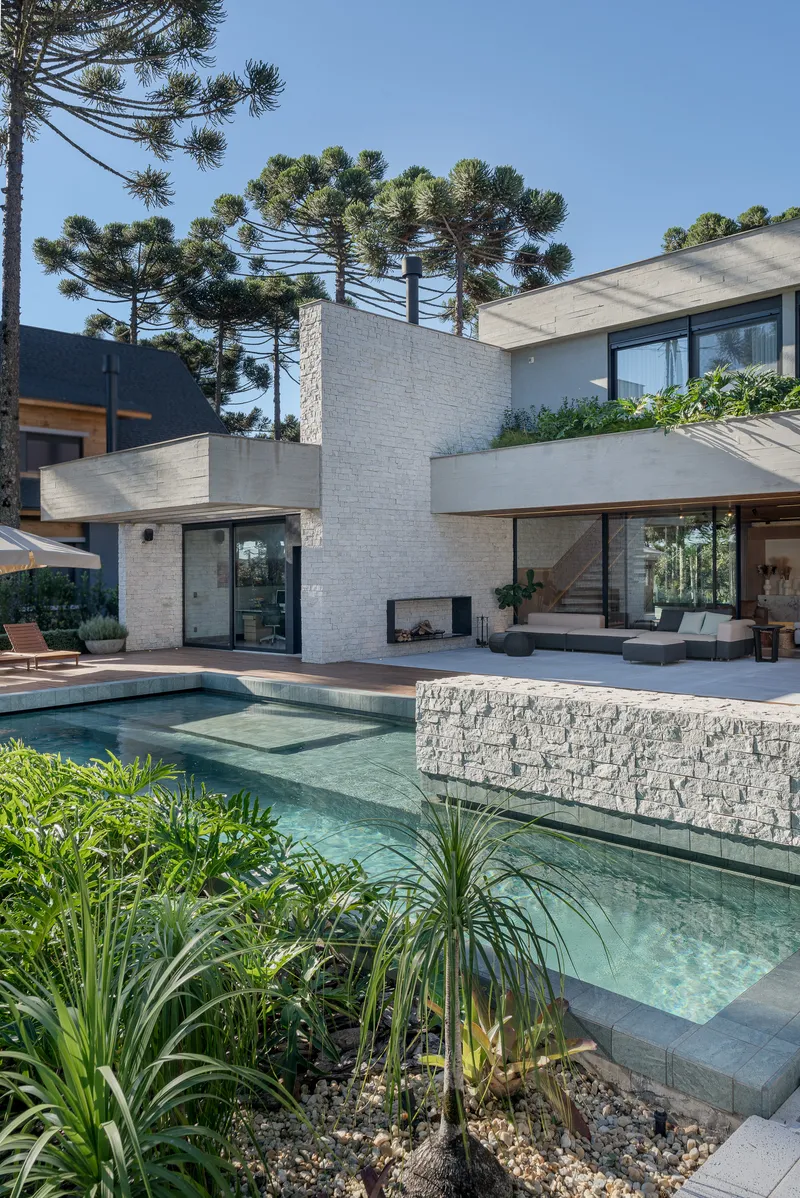
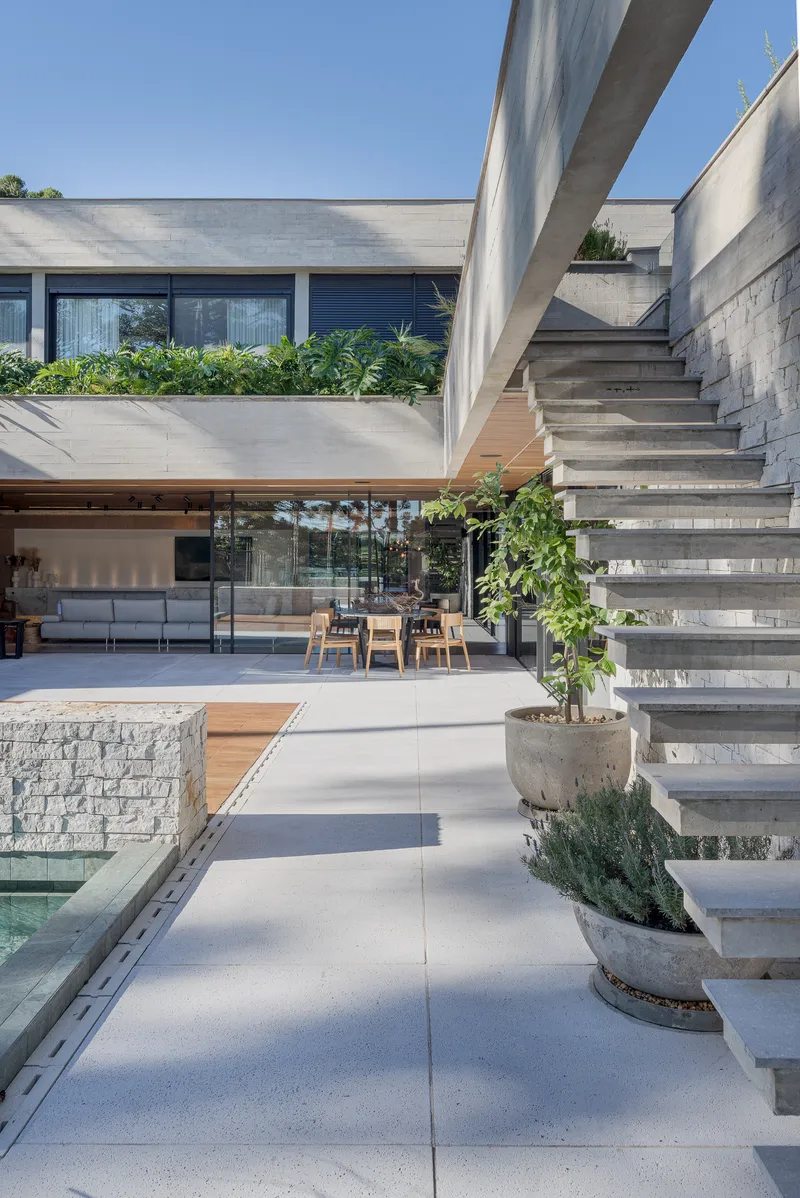
Gramado's topography could easily have been bulldozed flat for a house of this scale, but Studiocolnaghi chose to work with it. The multilevel pool terrace, gabion walls, and cantilevered concrete staircase with planted risers all read as landscape architecture as much as building. Vegetation is not decorative afterthought: flower boxes trace the entry path, ornamental grasses define edges, and the towering araucaria pines, preserved in place, establish a vertical scale that the architecture deliberately defers to.
The rear elevation, visible across the poolside landscaping at dusk, reveals how the planted roof terrace and stepped massing integrate into the hillside. From this angle, Aspen House looks less like a freestanding object and more like a series of inhabited retaining walls, which is exactly the right instinct for a sloped site in a forested highland town.
The Slatted Timber Ceiling and Social Spaces
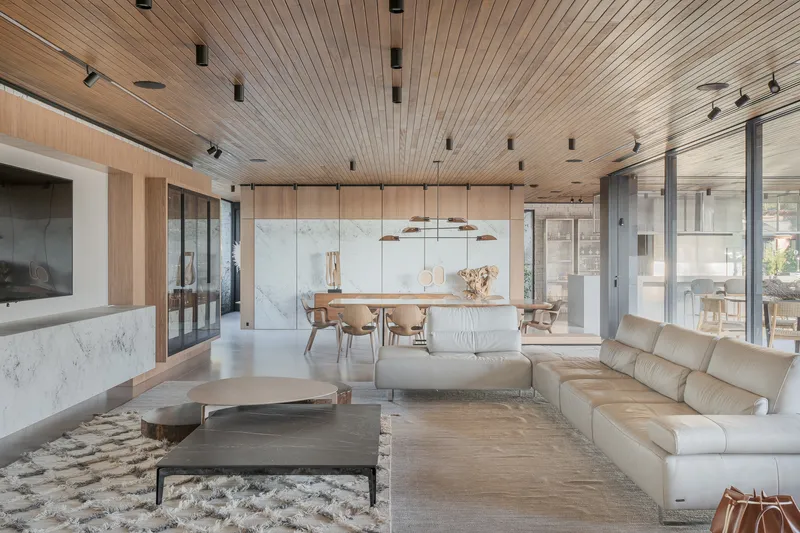
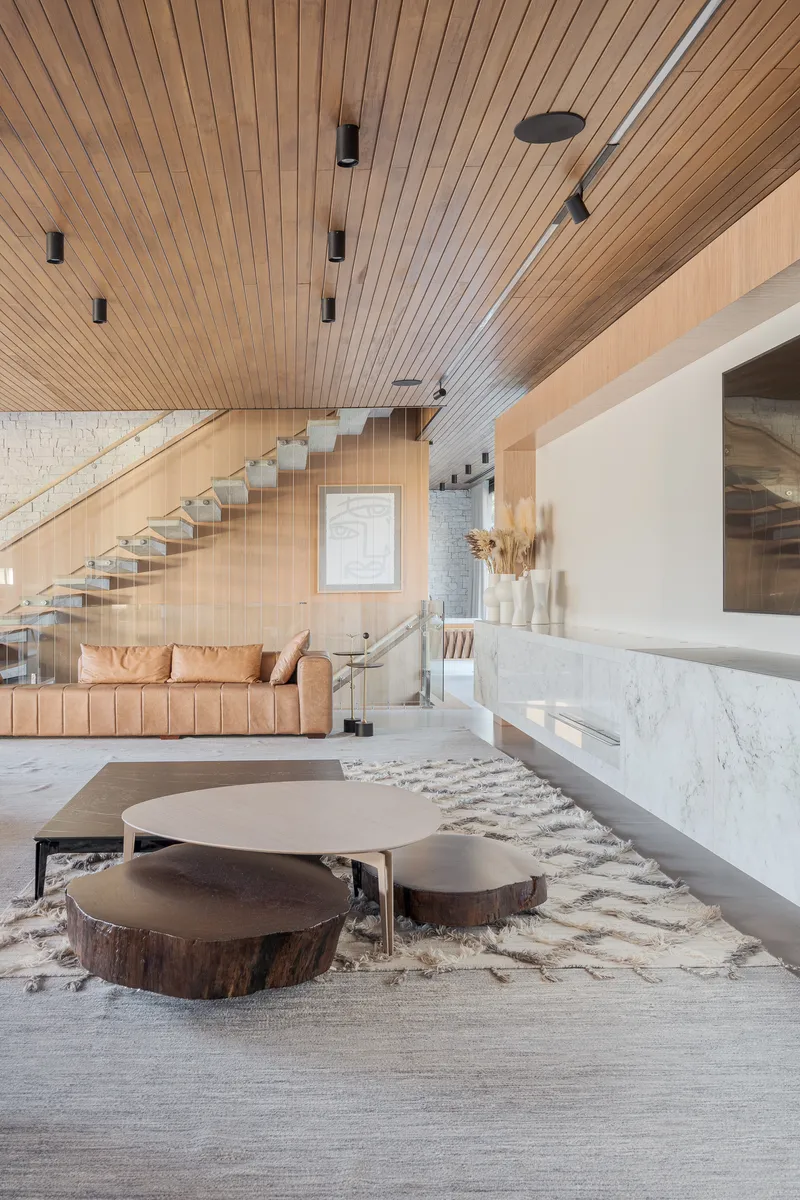
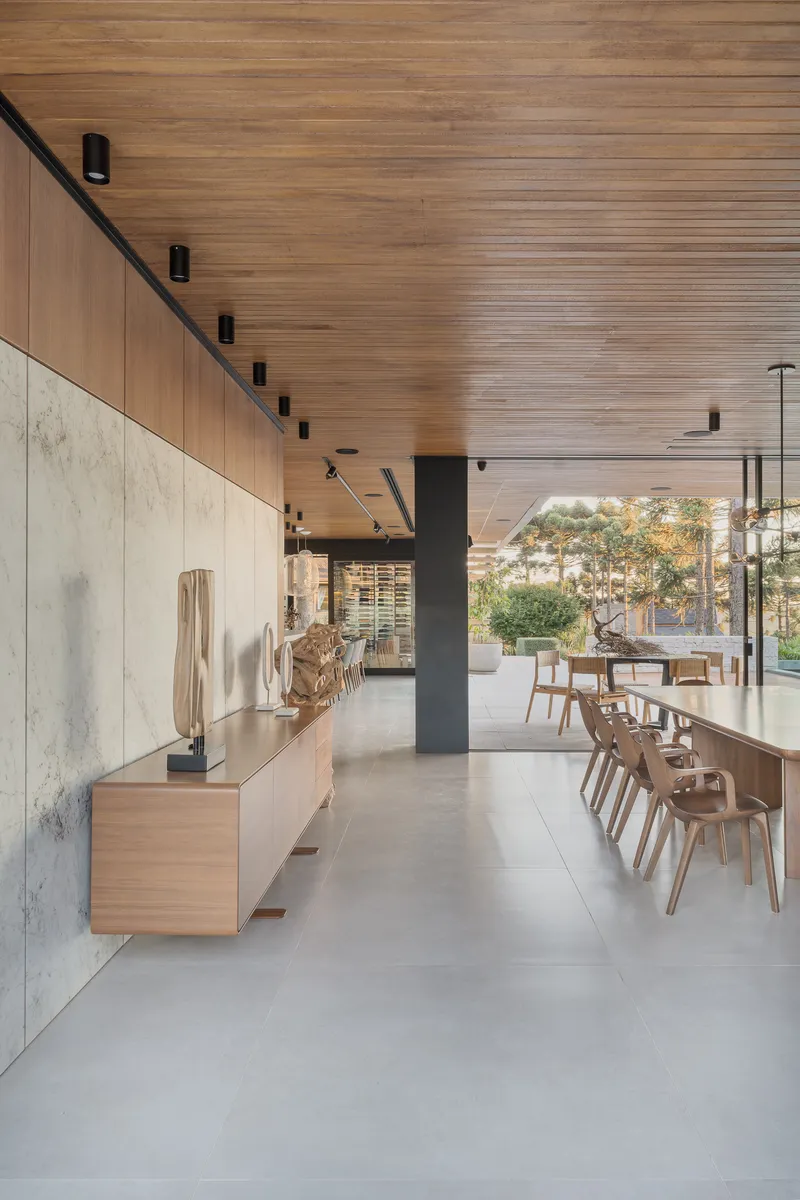
Inside, a continuous slatted wood ceiling is the dominant material gesture. It runs unbroken from the living room through the dining space and out toward the glazed openings facing the courtyard, pulling the eye horizontally and making the social zone feel larger than its already generous footprint. Pendant lights hang at varying heights beneath it, and track lighting runs along black rails embedded in the slats. The effect is warm and directional: the ceiling tells you where to go.
The double-height living room uses this ceiling to amplify vertical drama. A floating glass-and-timber staircase rises against a white brick wall, connecting the social floor to the bedroom level. The staircase is elegant without being fragile. Its transparency keeps the double-height volume feeling open, while the solid wood treads tie it back to the overhead ceiling plane. It is a detail that holds the whole interior together.
Kitchen, Dining, and the Threshold Moments
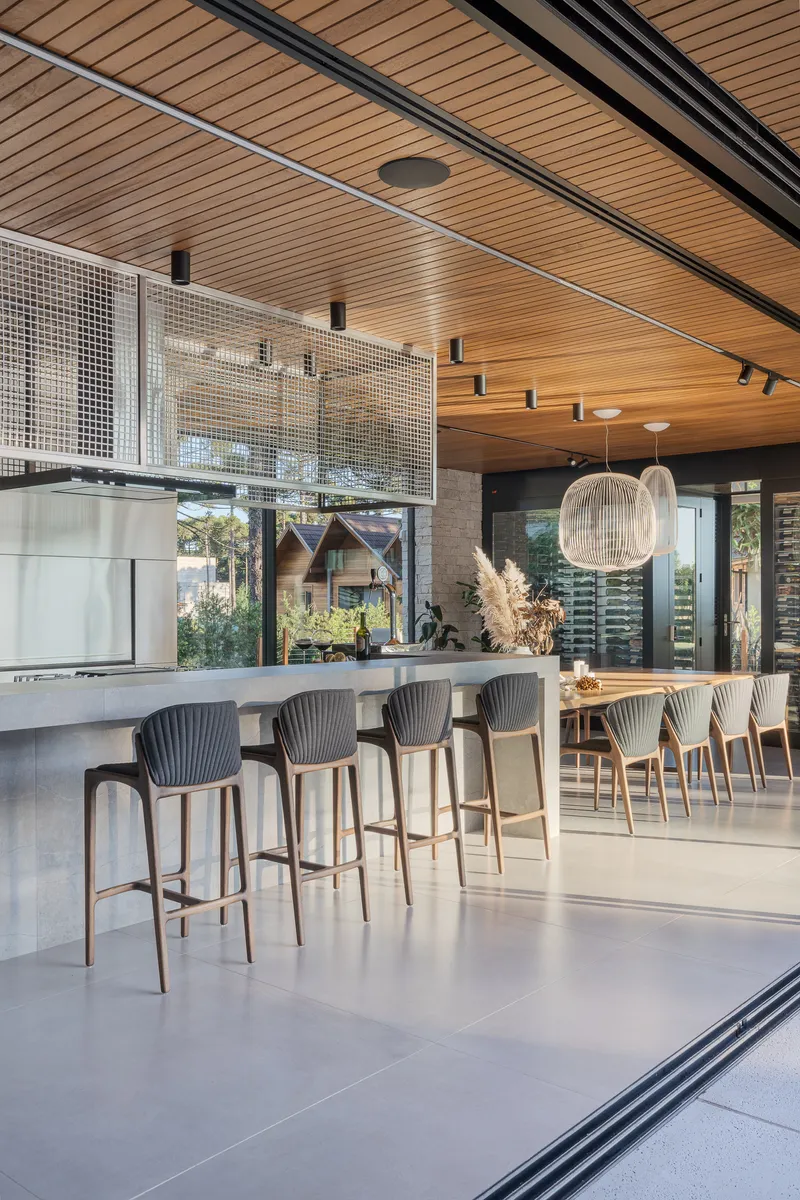
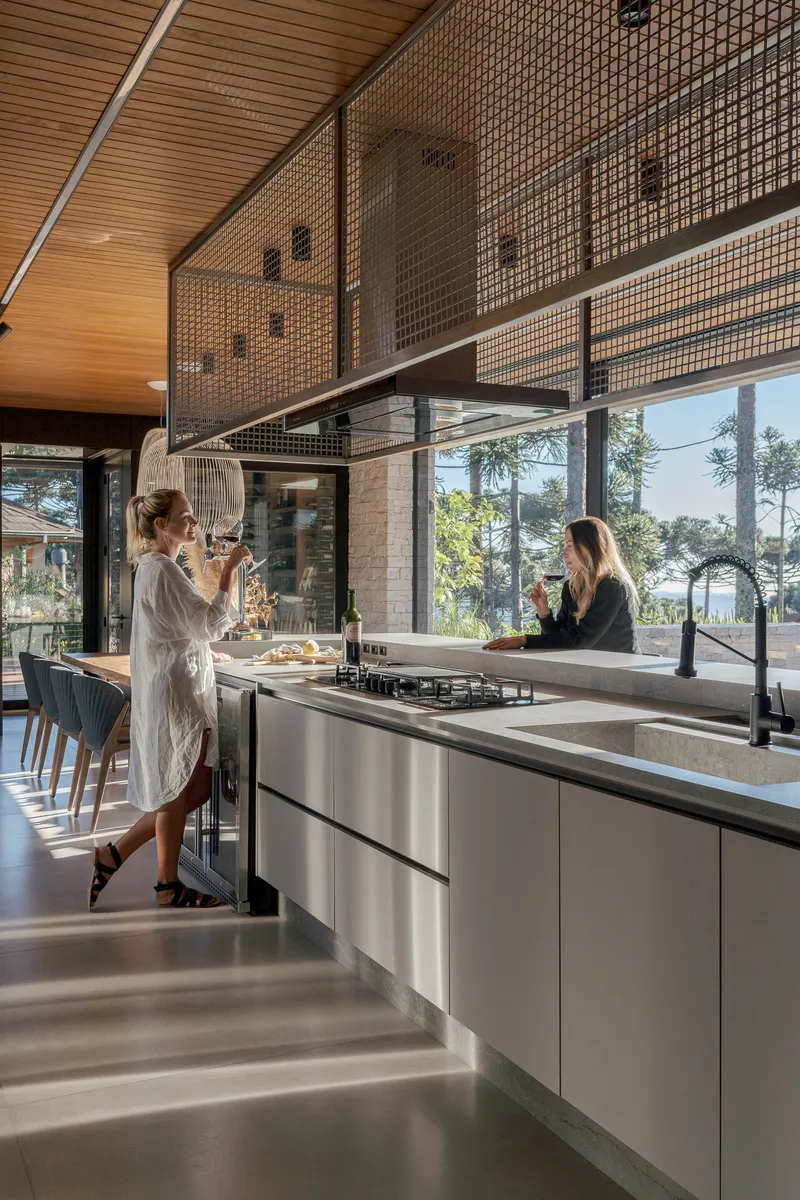
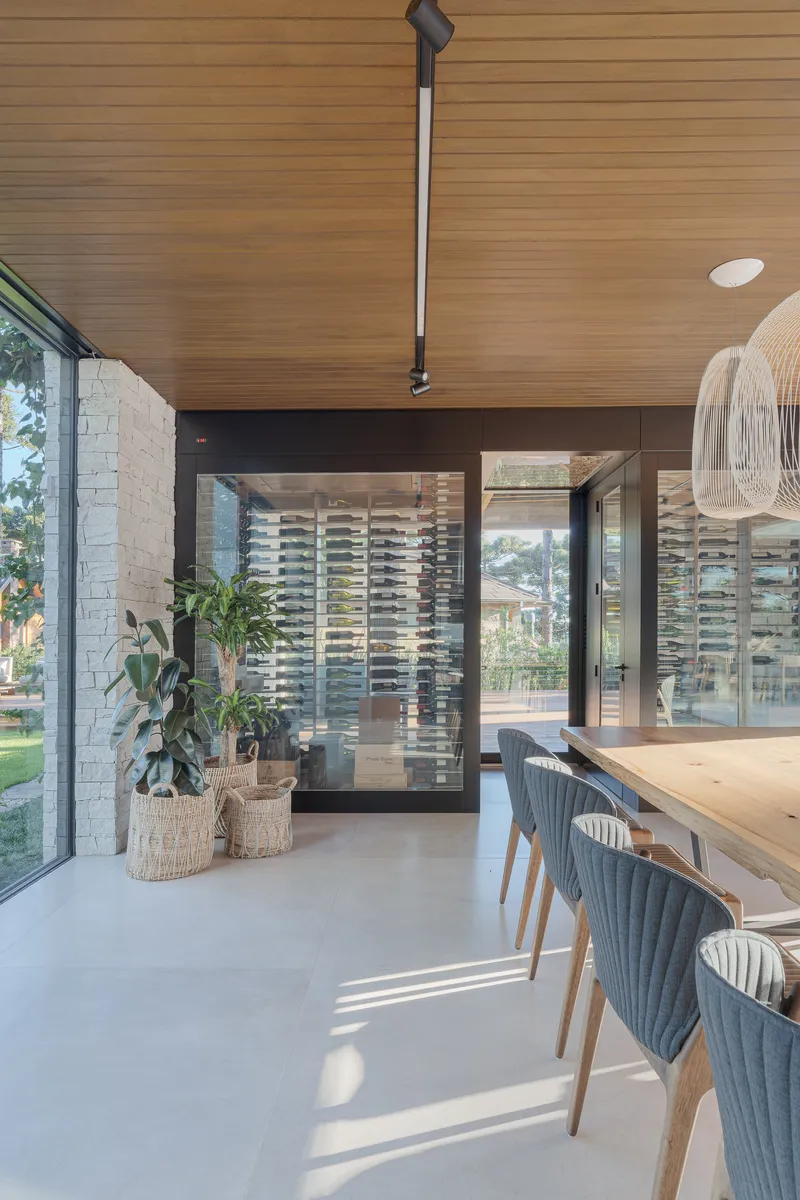
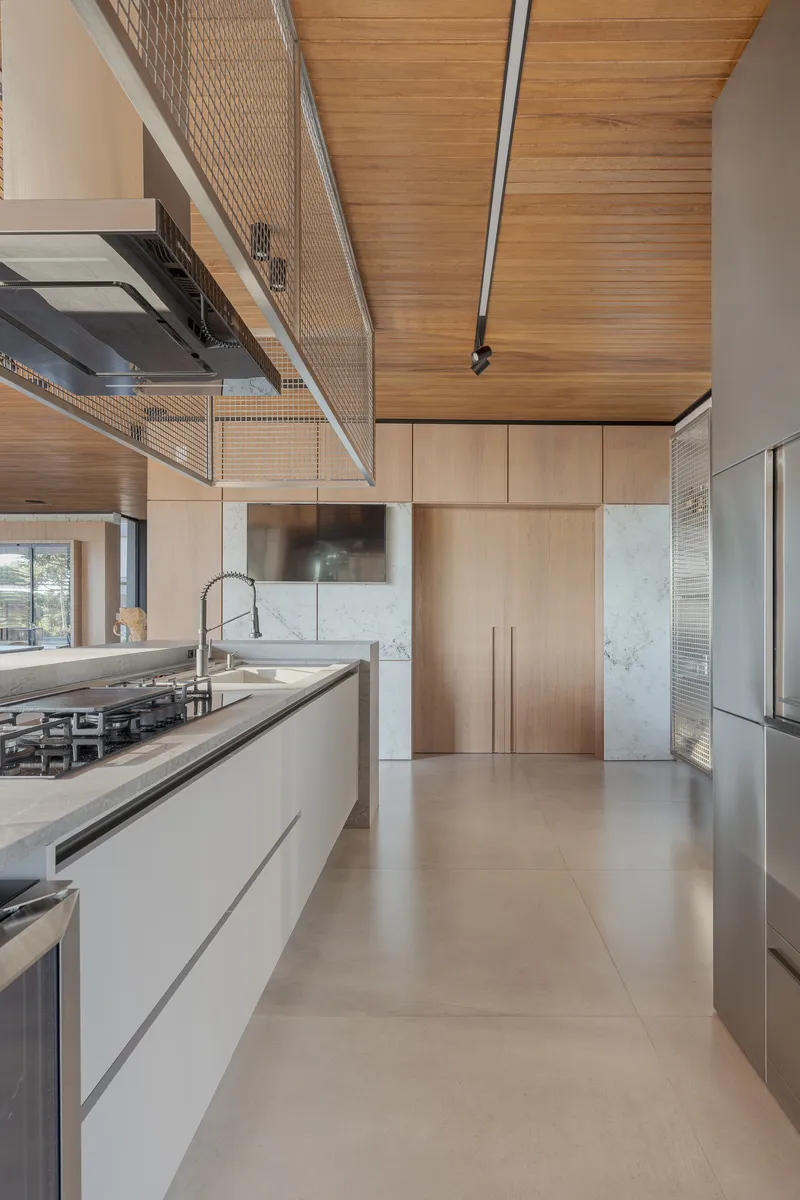
The kitchen occupies a generous island configuration with bar seating beneath the same slatted ceiling, making it part of the continuous social landscape rather than an isolated service room. A metal mesh screen suspends above one counter, adding a layer of tactile texture and filtering views to the mezzanine above. The stone countertops and dark cabinetry ground the palette against the lighter wood tones overhead.
What lifts these spaces beyond their specification is the way Studiocolnaghi handles the thresholds between inside and out. At the corner where the dining area meets the terrace, a white brick wall, a potted plant, and a shift in floor material mark the transition without a door or a step. You sense the change in air temperature and light quality rather than hitting a physical barrier. The gourmet area and wine cellar sit adjacent, reinforcing the ground floor as a zone for extended social life.
Upper Level and Private Rooms
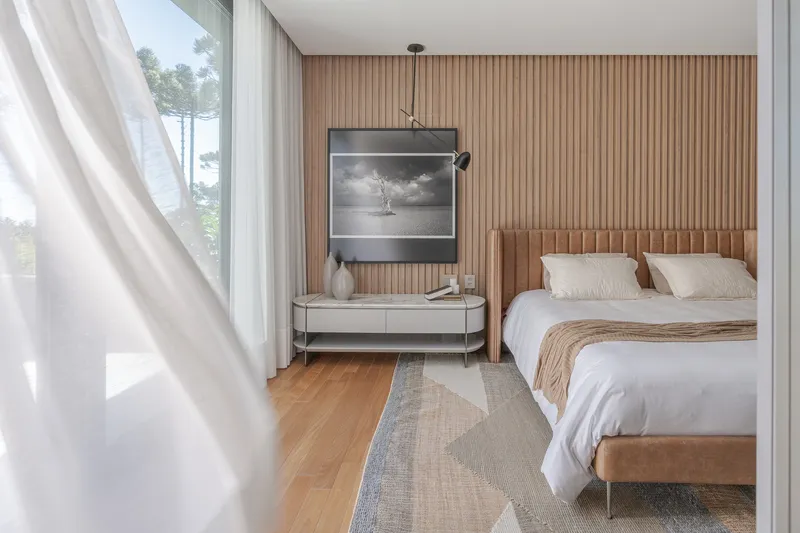
The upper floor follows a linear bar form, and its mostly closed front facade presents a single horizontal glass surface to the valley. Bedrooms open to that view, with vertical wood slat walls, upholstered headboards, and white curtains filtering daylight into soft, even illumination. The material palette shifts from the social floor's concrete and timber to softer fabrics and lighter tones, signaling a move from communal energy to personal retreat.
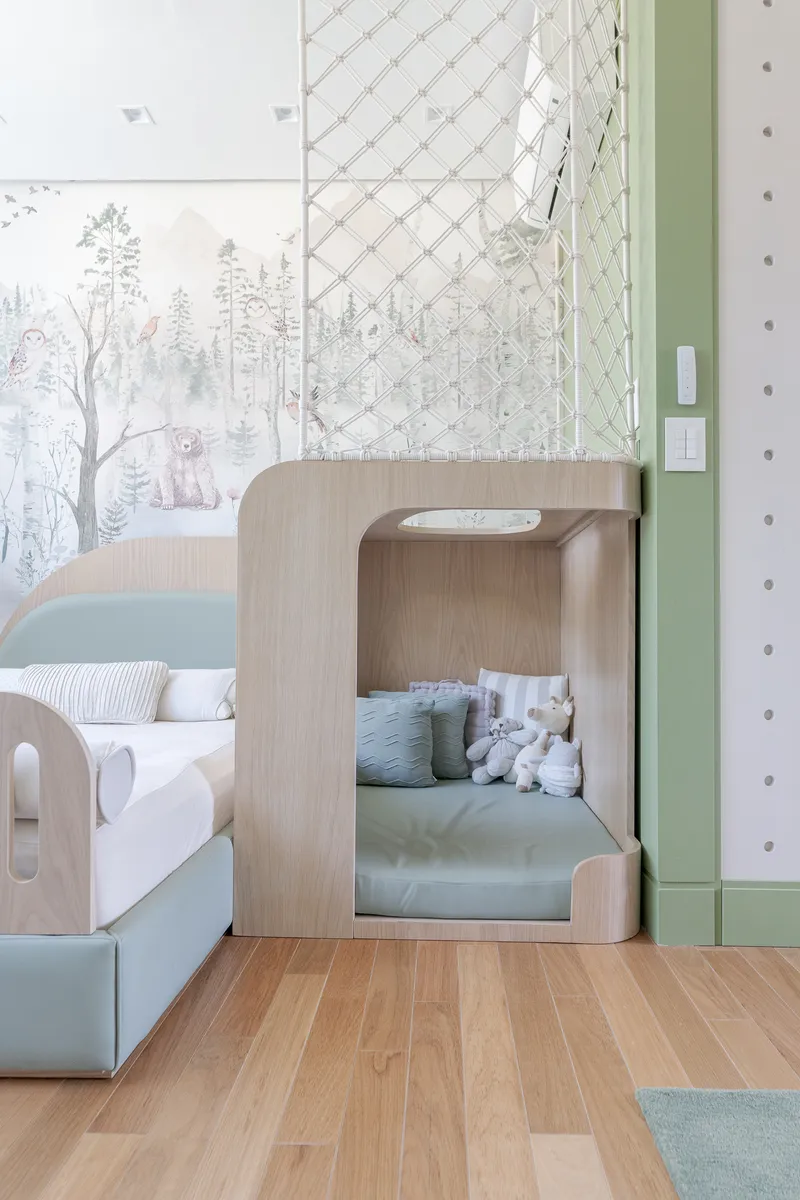
A curved timber play nook with a built-in bed, a wallpaper mural, and a mesh safety panel shows the care taken in the children's rooms. The double-height kitchen below is visible through metal mesh balustrades, keeping the upper level connected to the life of the house even from a private vantage. This vertical transparency is a small but important decision: it lets the house breathe between floors rather than stacking sealed boxes.
Joinery and Material Details
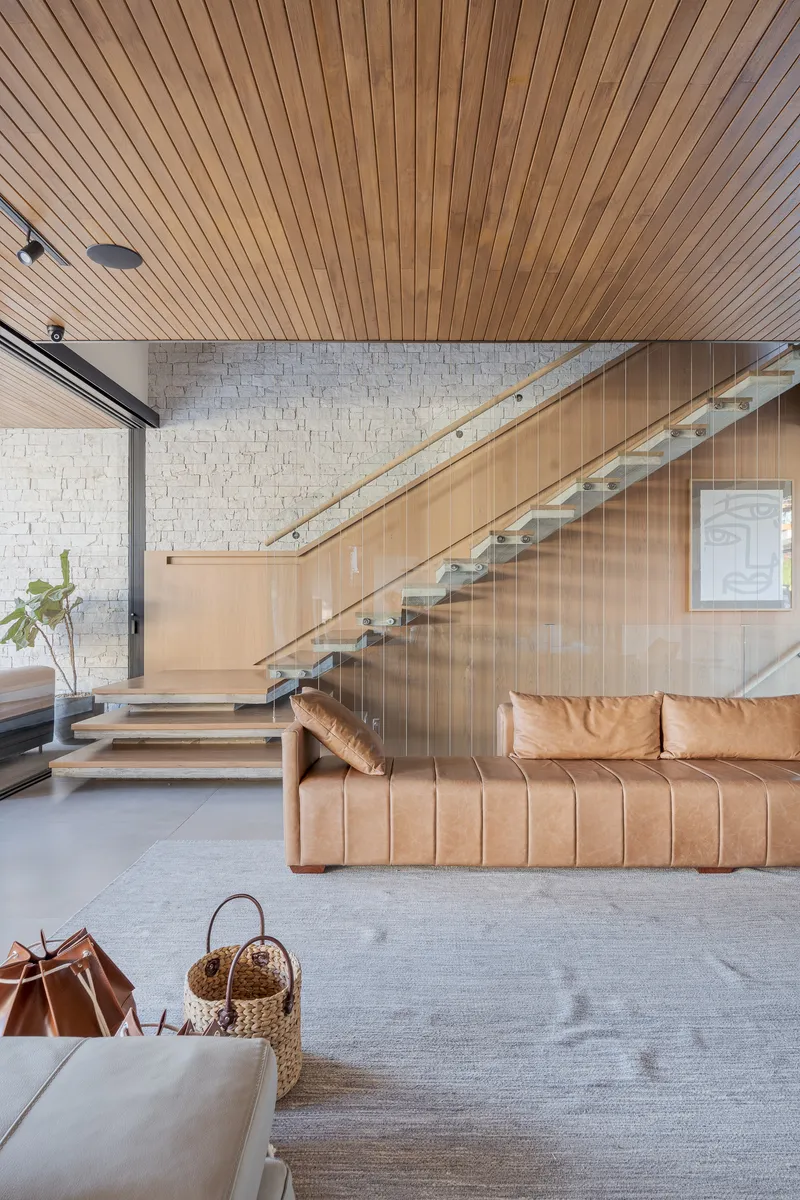
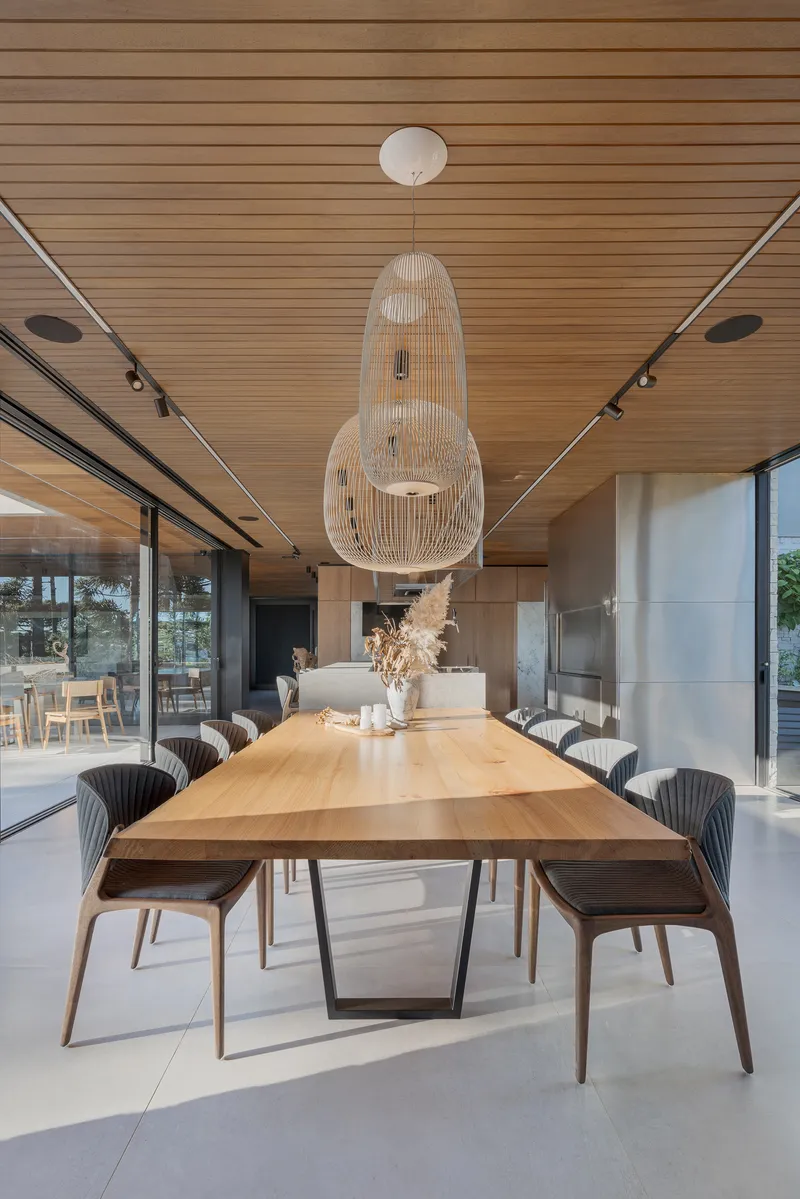
The floating staircase deserves a closer look. Solid timber treads are bonded to a glass balustrade that almost disappears against the white brick wall behind. The detail is clean enough that the stair reads as a piece of furniture suspended in the volume rather than a structural element attached to it. Overhead, the pendant light fixture centered beneath the continuous slatted ceiling anchors the dining table below and creates a moment of vertical intimacy within the horizontal expanse.
Throughout the house, concrete, wood, and natural stone are balanced carefully. No single material dominates. Concrete handles structure and retaining, wood delivers warmth and continuity, and stone provides weight where surfaces meet hands. It is a disciplined material strategy that avoids the common trap of residential projects: reaching for one too many finishes.
Storage and Interior Detailing
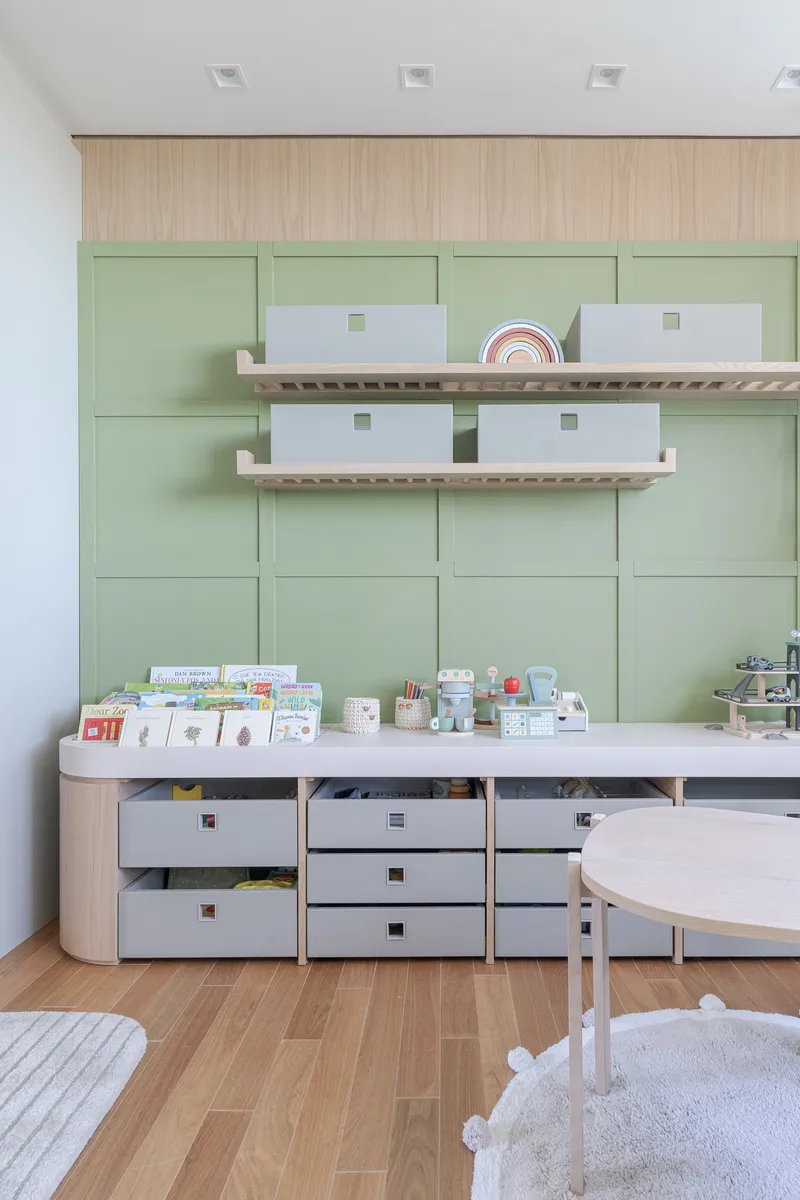
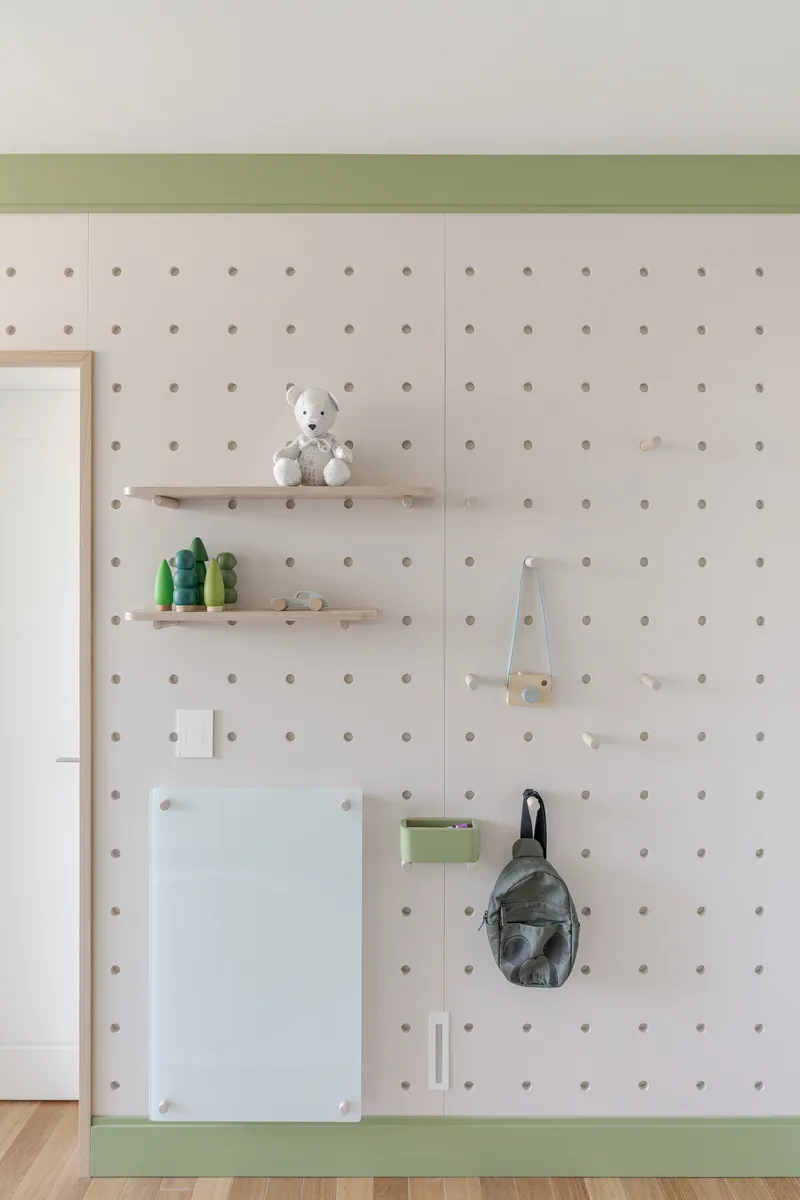
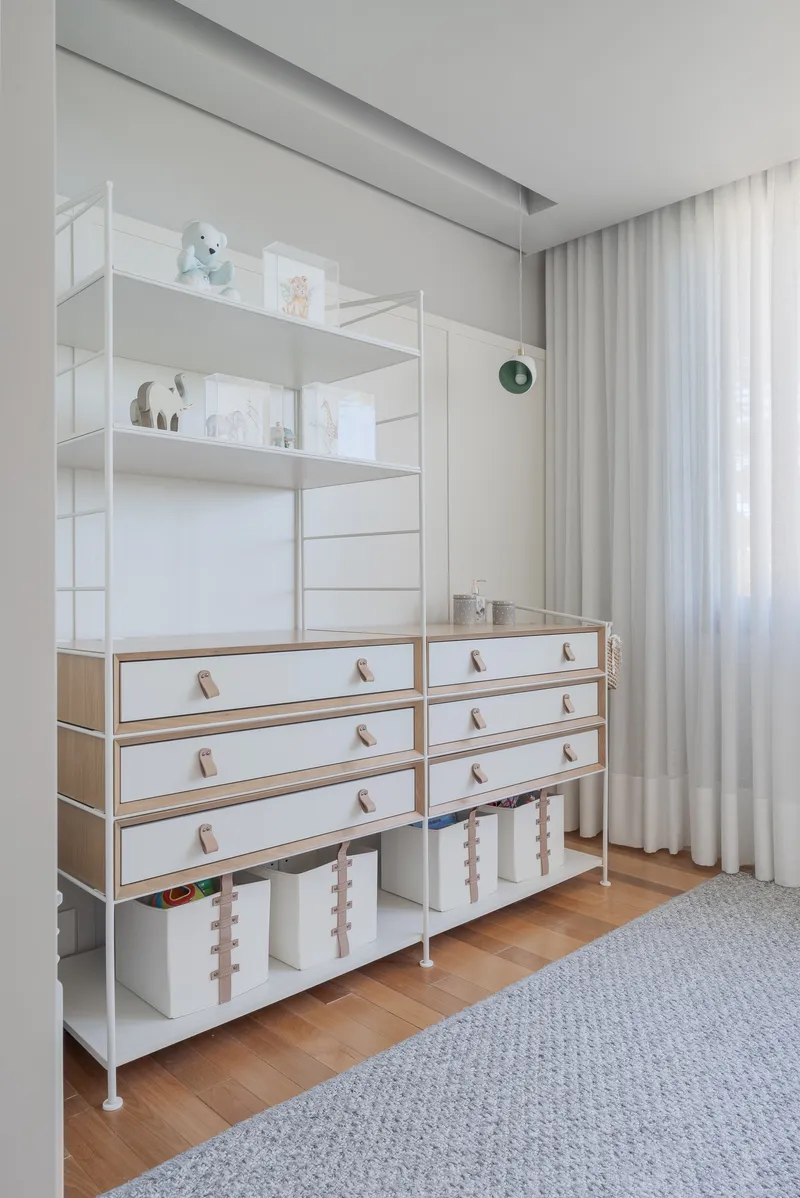
The interior detailing extends to custom storage and joinery. Pale green cabinetry with floating timber shelves, pegboard walls with timber trim, and freestanding shelving units with timber-edged drawers show a commitment to designing every surface rather than defaulting to off-the-shelf solutions. The green baseband detail is a subtle touch that adds color without turning decorative. These rooms are quieter than the social spaces, but they carry the same design intelligence.
Plans and Drawings
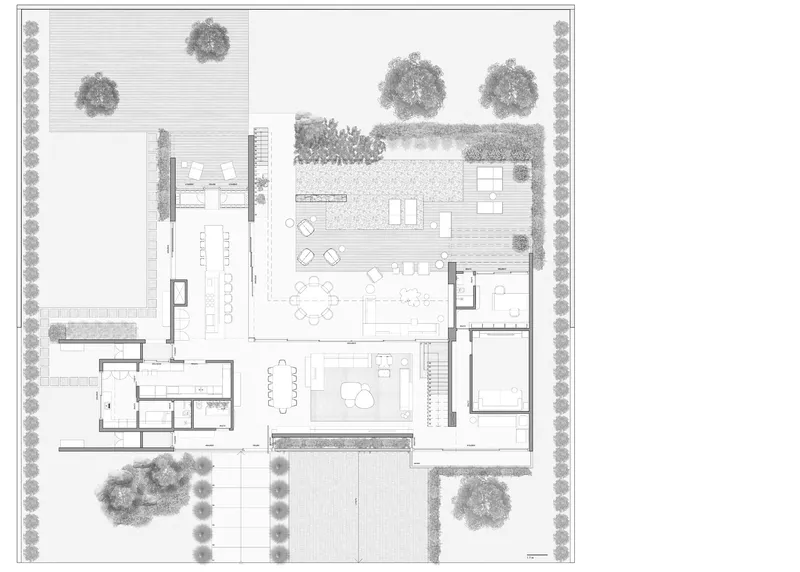
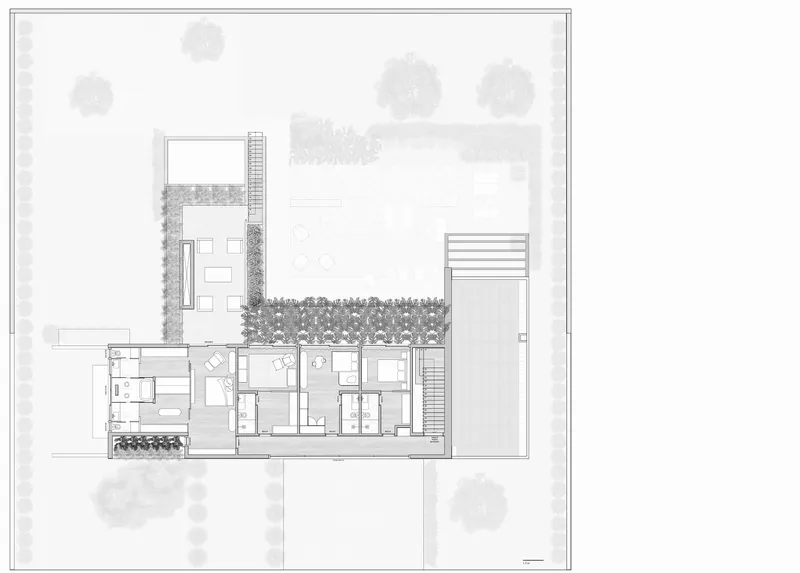
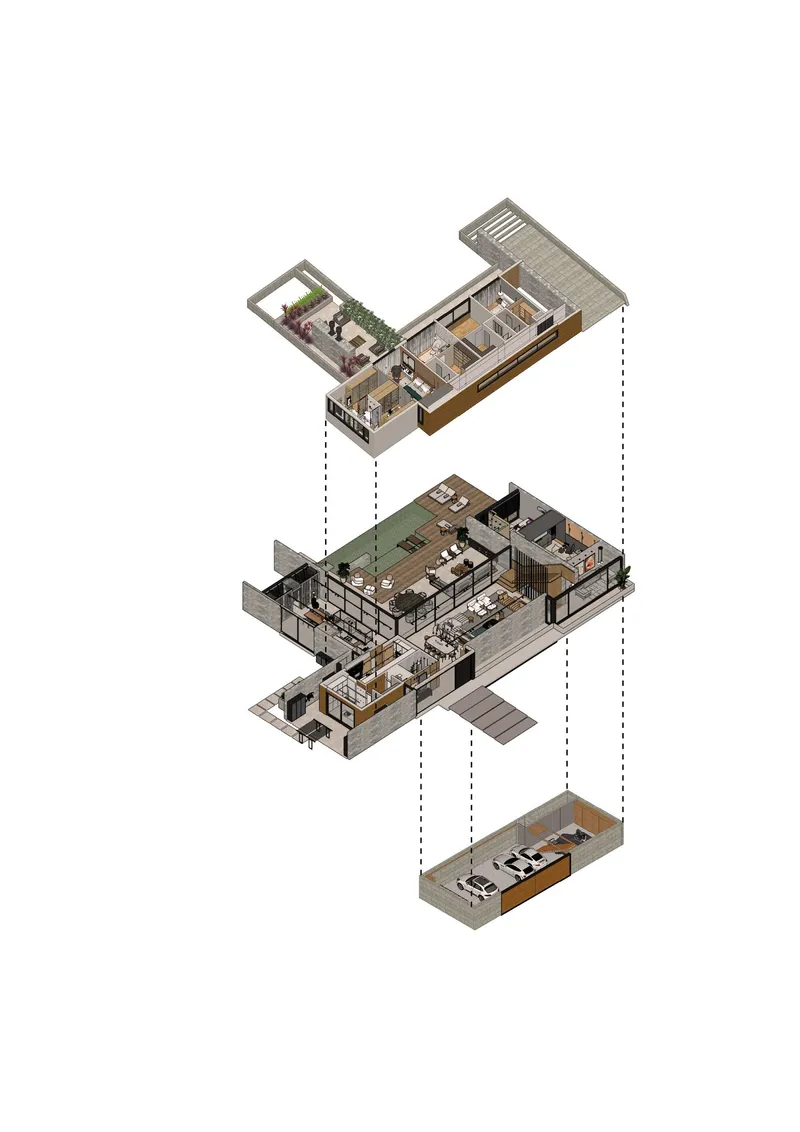
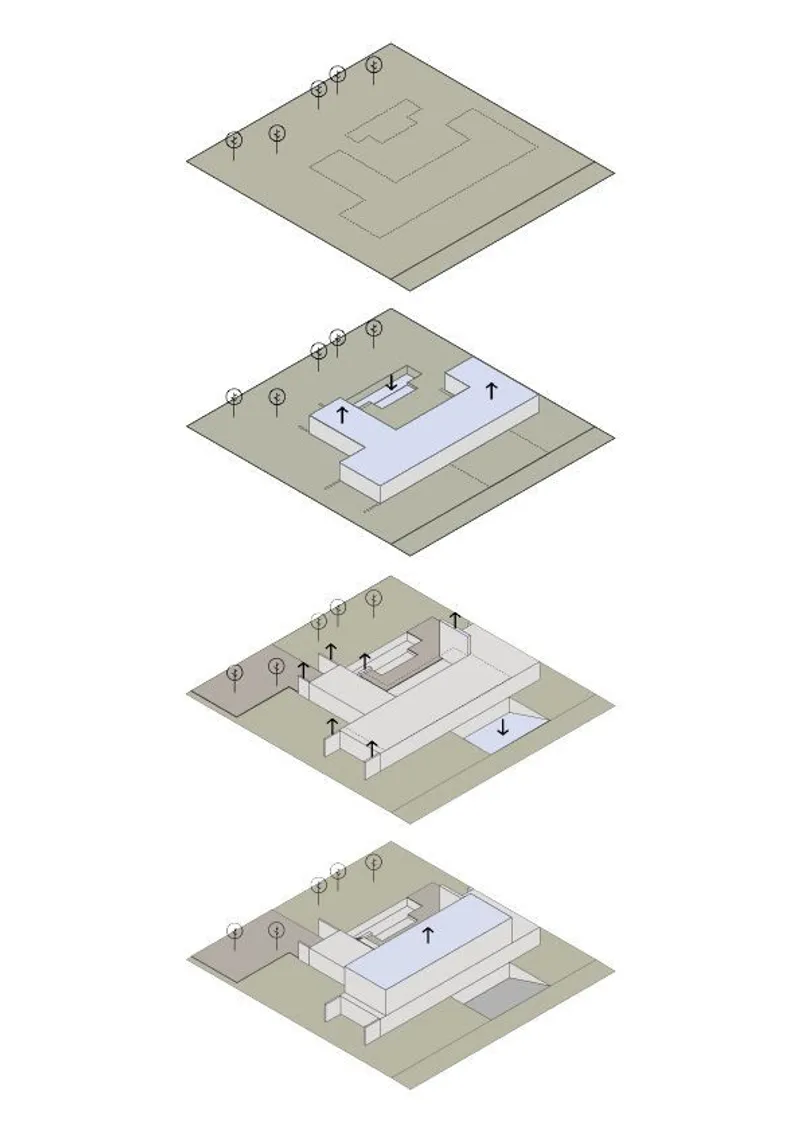
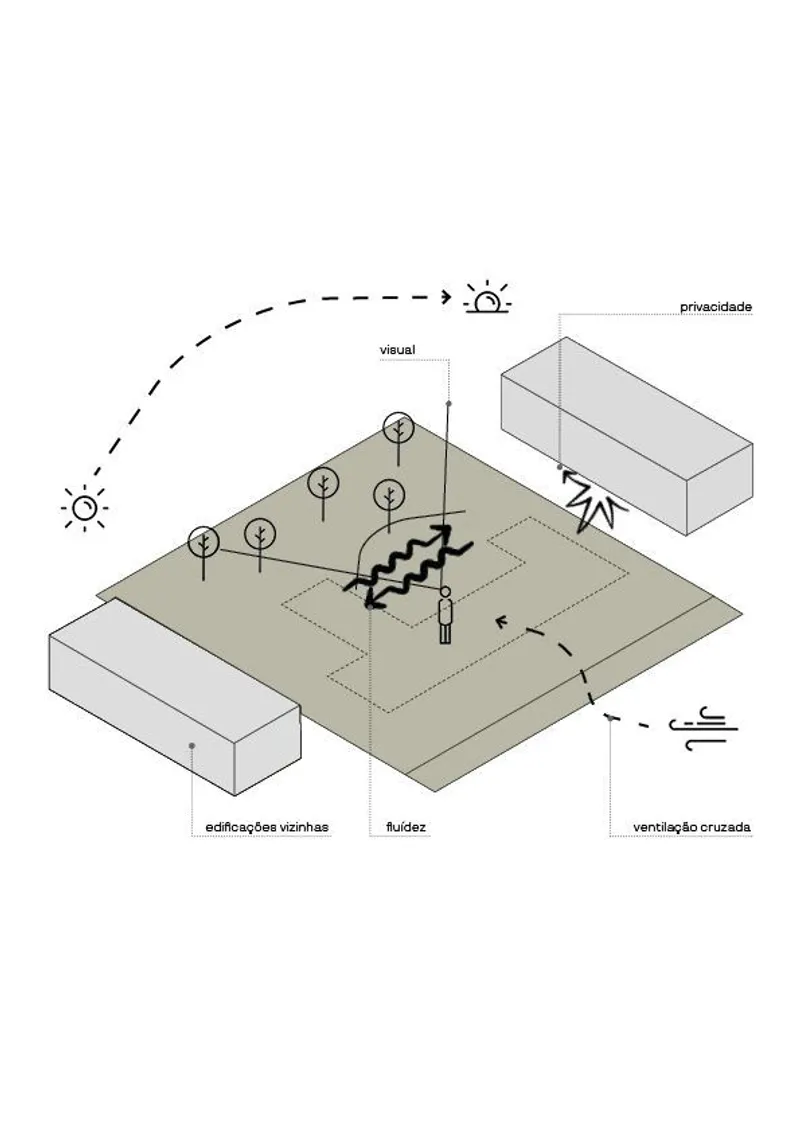
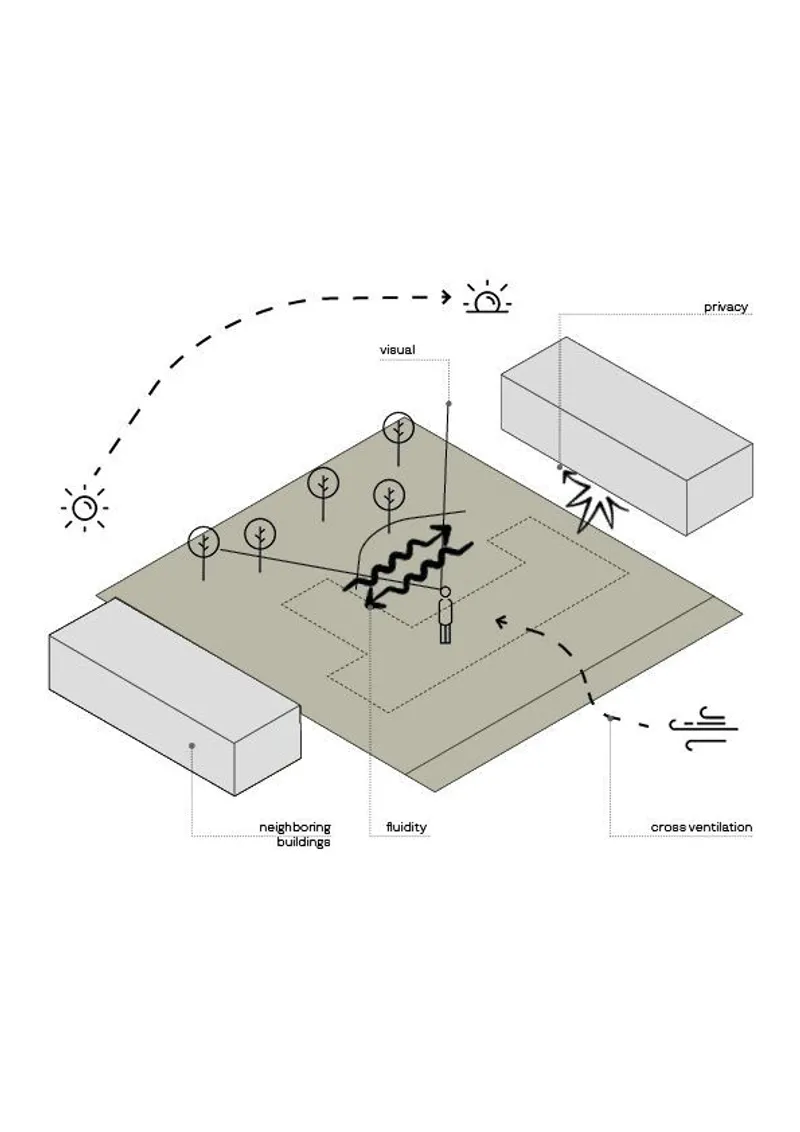
The floor plans confirm the U-shaped ground floor enclosing the courtyard, with the upper bedroom bar laid across the top. The exploded axonometric drawing reveals three distinct levels connected by stairs at both interior and exterior positions. More revealing are the diagrammatic sequences: the massing development shows how the architects broke a single volume into displaced bars to create the courtyard, while the isometric site diagrams map sun path, prevailing wind, cross-ventilation pathways, and visual relationships to neighboring buildings. These drawings make the environmental logic legible. The house is not just shaped for views; it is oriented for passive climate performance in a highland setting.
Why This Project Matters
Aspen House is a residential project that takes its context seriously without making a spectacle of that seriousness. The U-shaped plan, the preserved araucaria pines, the solid side facades, and the slope-responsive section are all decisions that emerge from specific site conditions rather than stylistic preference. In a market saturated with open-plan glass boxes that treat landscape as backdrop, this house does something more considered: it frames landscape, filters it, and in places, physically captures it within its walls.
Studiocolnaghi has produced a house that operates on two registers simultaneously. On the ground, it is inward, social, and protected. Above, it is outward, private, and panoramic. That duality gives the building a richness that most single-family houses never achieve. Gramado may be a small highland town, but the architectural thinking on display here is anything but provincial.
Aspen House by Studiocolnaghi (Ana Colnaghi and Sabrina Hennemann), Gramado, Brazil. 1,060 m². Completed 2020. Photography by Vinicius Ferzeli.
About the Studio
Share Your Own Work on uni.xyz
If projects like this are the kind of work you want to make, uni.xyz is a place to publish your own, find collaborators, and enter design competitions.




Popular Articles
Popular articles from the community


Hill & Cross Opera: Sculptural Opera House Architecture Shaped by Tallinn’s Landscape and Identity
Hill & Cross Opera reimagines opera house architecture in Tallinn through its sculptural hill, civic plaza, glass wave and a luminous cross.

The Ocean Hive: Sustainable Architecture for a Self-Sufficient Civilization at Sea
The Ocean Hive imagines sustainable architecture at sea, where modular habitats, algae, wave power and ocean waste sustain a growing colony.

Riyadh For All: Intergenerational Urban Design for Active Aging in Rabat
Riyadh For All reimagines urban design in Rabat with intergenerational co-living, adaptive courtyards, and Moroccan cultural exchange today.

The Musturak Paradise: Senior Living Architecture for a Connected Future in Temara, Morocco
The Musturak Paradise reimagines senior living architecture in Temara via private homes, social spaces, culture, community, and shared care.


Similar Reads
You might also enjoy these articles

Bao Huynh Watercolor Atelier: A Serene Art Retreat in Hội An
Bao Huynh Watercolor Atelier in Hội An blends multifunctional art spaces, sustainable design, local materials, and family-friendly living in a serene environment.

Atelier Macri Concept Store Interior Design by CASE-REAL
Atelier Macri store features a "ko" counter, walnut wood details, cork displays, blending retail, gallery, and seamless customer experiences.

Manuel Vargas Izquierdo Stadium and High-Performance Sports Center: Architectural Excellence in Jalpa de Méndez
The Manuel Vargas Izquierdo Stadium blends sustainable design, inclusive sports facilities, and cultural-inspired architecture, revitalizing Jalpa de Méndez’s public spaces.

KAKR Buluh Awar Hall: Revitalizing Community and Ecology Through Bamboo Architecture
Community built bamboo hall revitalizes Buluh Awar village, empowering youth, restoring ecology, celebrating vernacular craftsmanship through sustainable architecture and culture.


Explore Commercial Buildings Competitions
Discover active competitions in this discipline



Challenge to design a barrier free sports center


Challenge to design an outdoor ice-rink and park
Comments (0)
Please login or sign up to add comments
No comments yet. Be the first to comment!