
STUDIOTAMAT Turns a Fragmented Roman Apartment into a Flowing Sequence of Rooms and Books
In Rome's Flaminio district, a 115 sqm apartment sheds its rigid partitions for burgundy glass screens and custom oak joinery.


Most Roman apartments of a certain vintage share the same affliction: rooms carved into small, disconnected cells that serve a hierarchy nobody lives by anymore. Casa Continua, completed in 2026 by STUDIOTAMAT, takes a 115 square meter flat in the Flaminio district, owned by its inhabitant for over thirty years, and dissolves the partitions that once kept its spaces apart. The result is not an open plan in the contemporary developer sense. It is something more disciplined: a continuous sequence of thresholds, each one framed by custom joinery, reeded glass, and a persistent burgundy line that stitches the entire apartment together at ceiling height.
What makes the project genuinely interesting is its refusal to choose between openness and enclosure. The kitchen, once relegated to a minor, isolated room, now sits at the center of the plan as a semi-transparent pavilion wrapped in burgundy metal and glazed partitions. Structural columns that might have been hidden are instead celebrated, paired and curved, becoming the armature for built-in bookshelves, window seats, and reading alcoves. The apartment had to house thousands of accumulated books, and STUDIOTAMAT treated that constraint not as a storage problem but as the organizing logic for the entire interior.
Thresholds, Not Walls
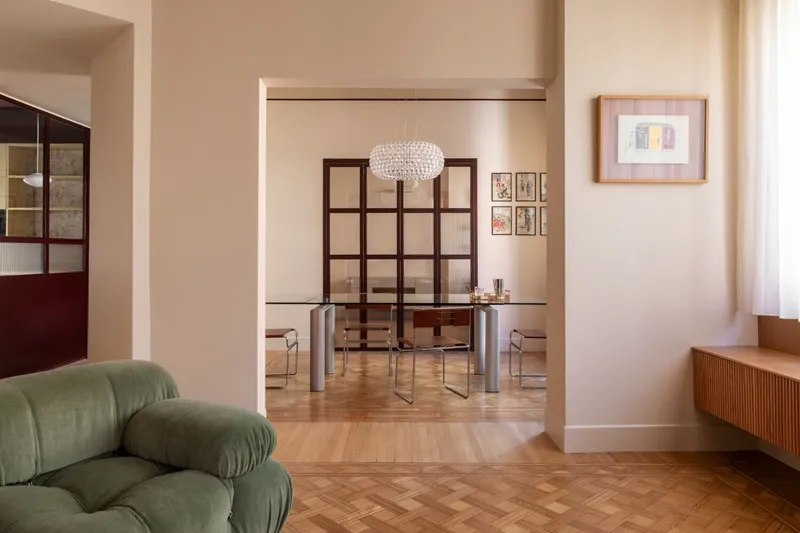

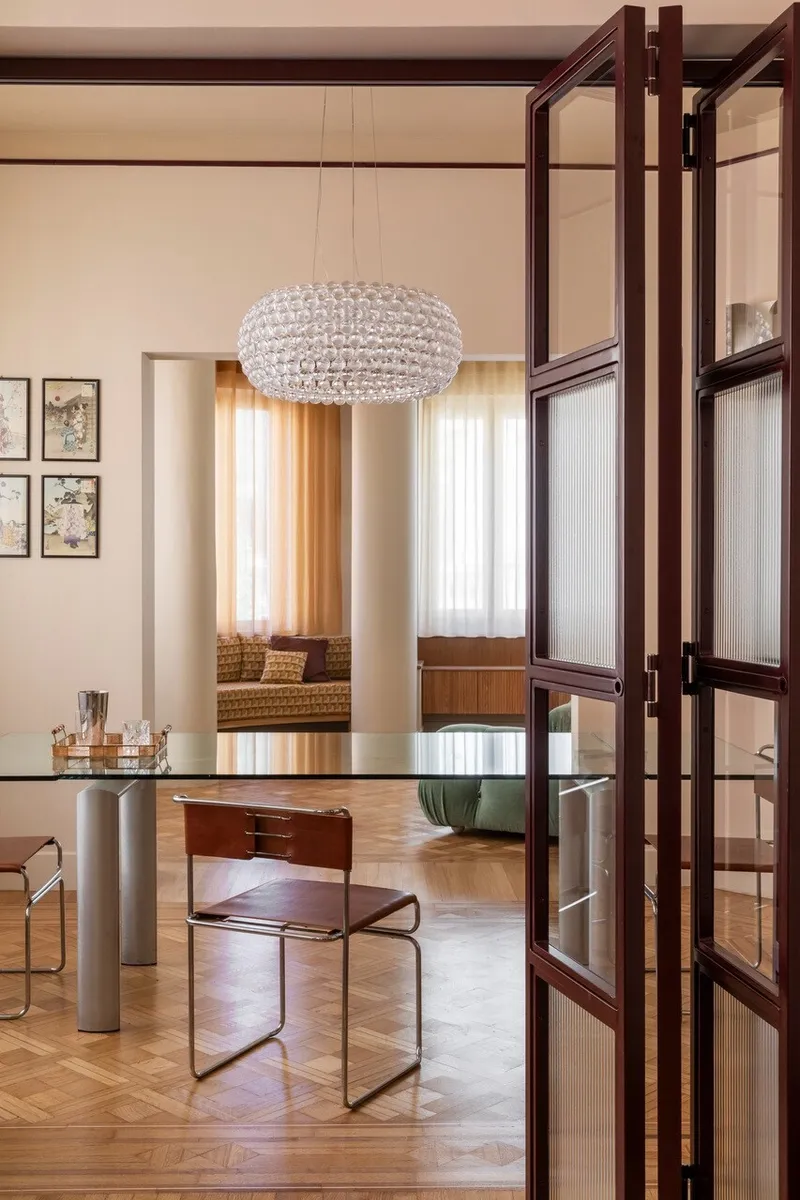
The apartment's former layout relied on solid partitions to separate living from dining, dining from kitchen, bedroom from corridor. STUDIOTAMAT replaced these hard boundaries with a vocabulary of folding screens, gridded timber panels, and glazed doors that can be opened or closed depending on the moment. A dark wood folding screen unfolds to reveal the dining area, its glass-topped table catching light from both sides. The effect is cinematic: you are always looking through one room into another, and each threshold frames a different composition.
The precision of the joinery is what elevates this from a renovation into something closer to cabinetmaking at architectural scale. Every panel, every hinge, every meeting point between oak and glass has been detailed to read as furniture rather than construction. The apartment feels tailored, in the literal sense of the word.
The Kitchen as Pavilion
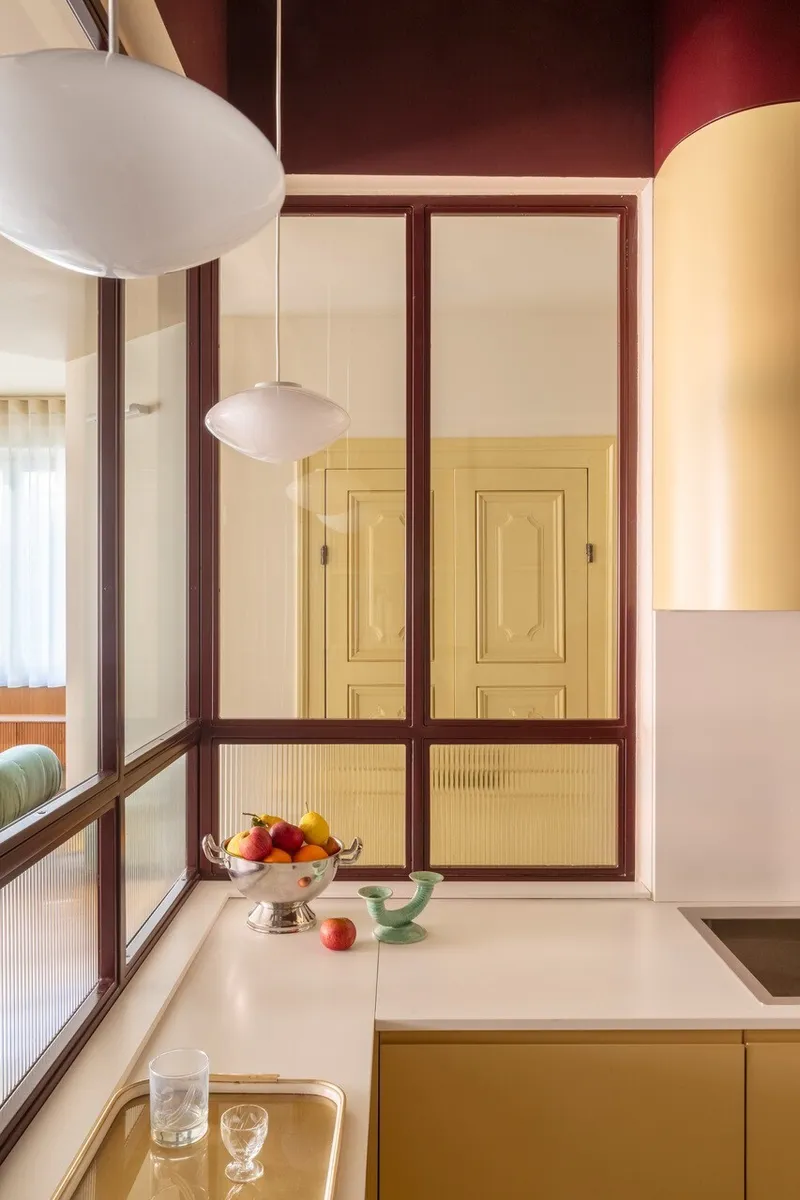
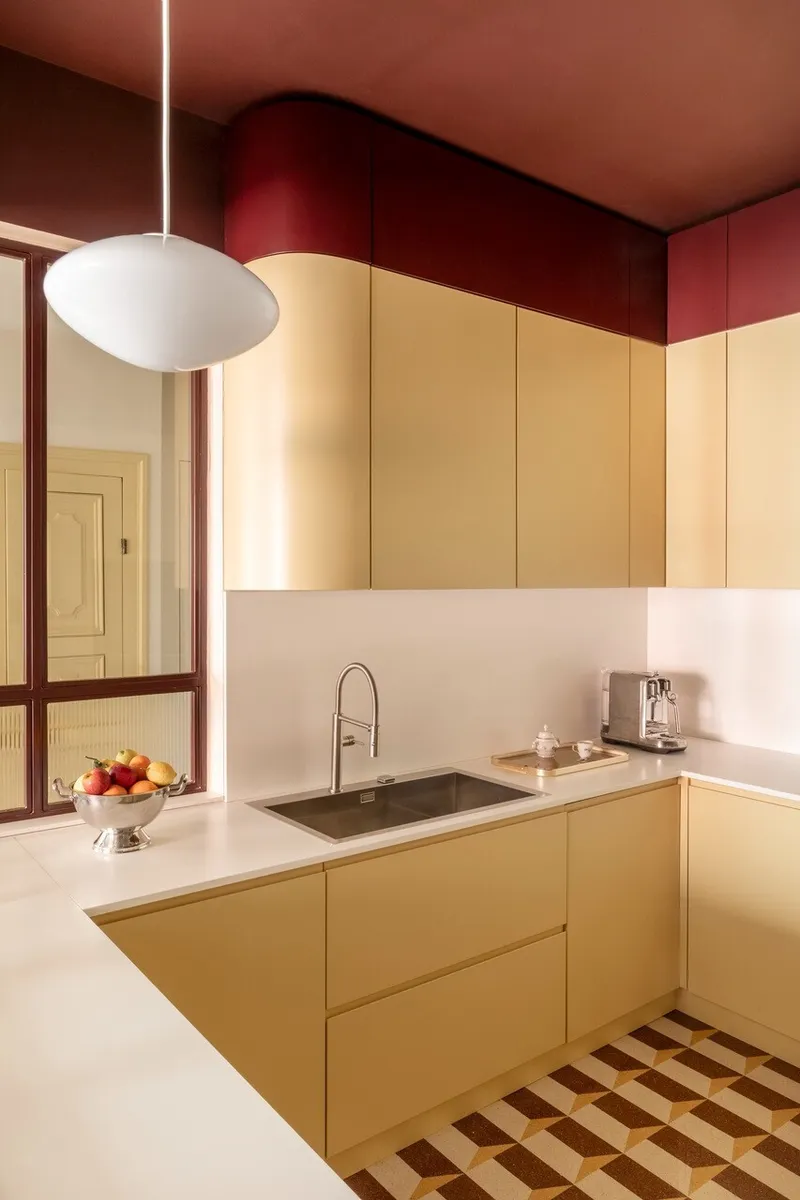

Repositioning the kitchen at the heart of the plan is the project's boldest move. Enclosed by burgundy-framed reeded glass partitions, it reads as a room within a room, a lantern that glows with activity while allowing the surrounding spaces to register its presence without being overtaken by it. The glass is textured enough to soften views but transparent enough to let pendant lights and silhouettes filter through. It is a kitchen you inhabit, not one you retreat to.
Inside, the color palette shifts. Pale yellow cabinetry sits beneath a deep burgundy ceiling, an unexpected inversion that gives the compact space its own identity. The geometric terrazzo floor tiles underfoot reinforce the pavilion's autonomy from the restored herringbone parquet that runs through the rest of the apartment. STUDIOTAMAT uses material change rather than walls to signal that you have crossed into a different zone.
Columns and Custom Joinery


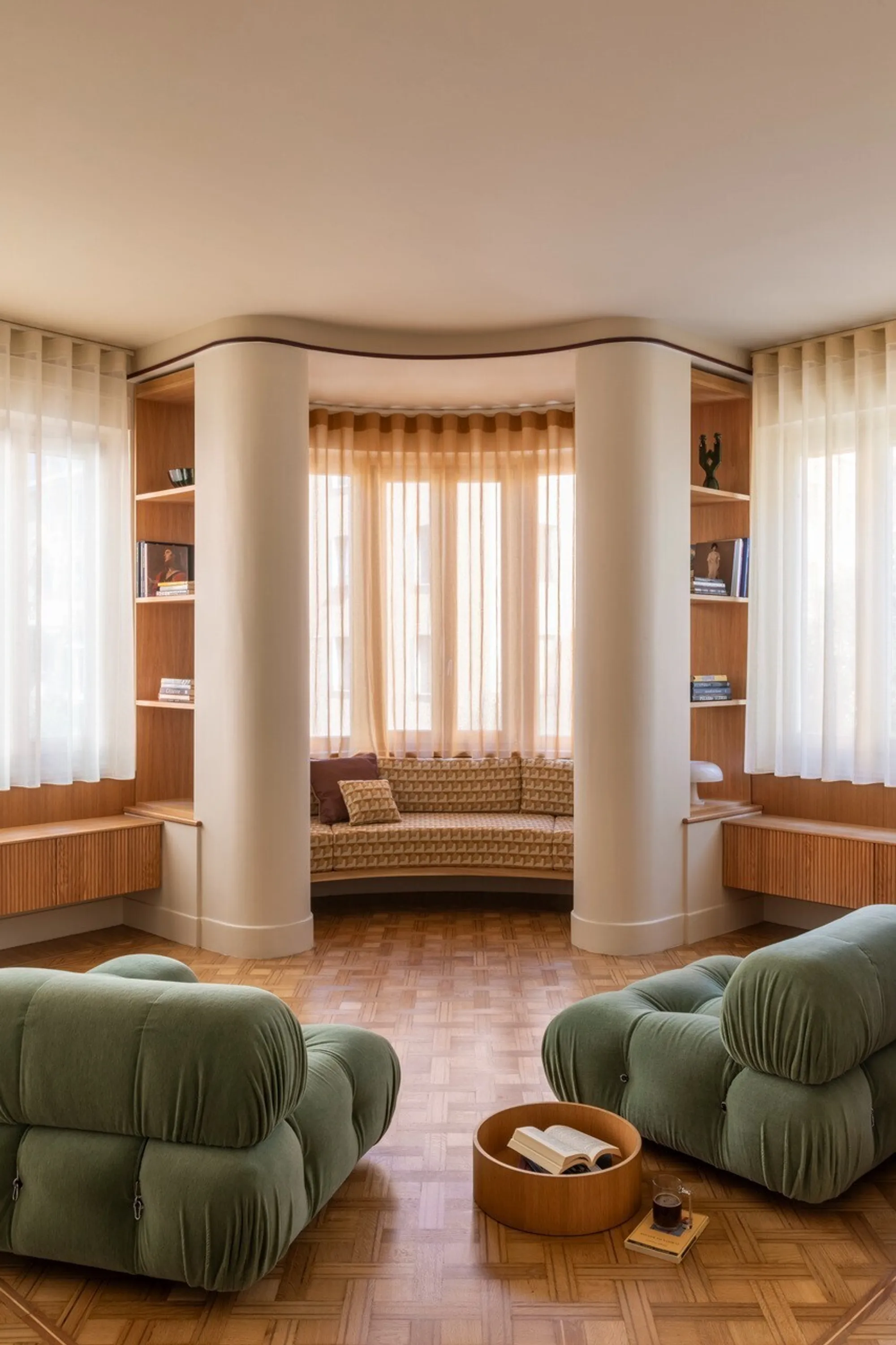
The structural columns that march through the apartment could easily have been boxed in or disguised. Instead, they are paired, curved at their bases, and wrapped in white plaster that makes them read as deliberate compositional elements. Between them, STUDIOTAMAT inserts built-in oak shelving, window seats, and cabinetry that turns each column bay into a functional alcove. The symmetry of the paired columns flanking a curtained bay window, with herringbone parquet stretching between them, is one of the apartment's most resolved moments.
Sheer curtains filter the Roman light into something softer, while the timber joinery warms what could otherwise be an austere arrangement. The window seats are generous enough to actually sit in, lined with cushions and backed by shelves. These are spaces designed for reading, not for display.
A Library Disguised as a Home


Thousands of books need a strategy, not just shelves. STUDIOTAMAT distributes them throughout the apartment, integrating bookshelves into every available vertical surface: beside glazed door panels, wrapping around columns, lining corridors. A maroon-painted reading nook in one corner packs volumes floor to ceiling alongside a comfortable chair, creating the kind of intimate pocket that makes a home feel genuinely lived in. The books are not decorative props; they are the reason the joinery exists.
The restored original parquet flooring connects these library moments, its herringbone pattern providing a consistent ground plane against which the varied timber, glass, and painted surfaces can play. Where new terrazzo appears, it signals a shift in program. Where parquet persists, you know you are in the territory of dwelling and reading.
Private Quarters

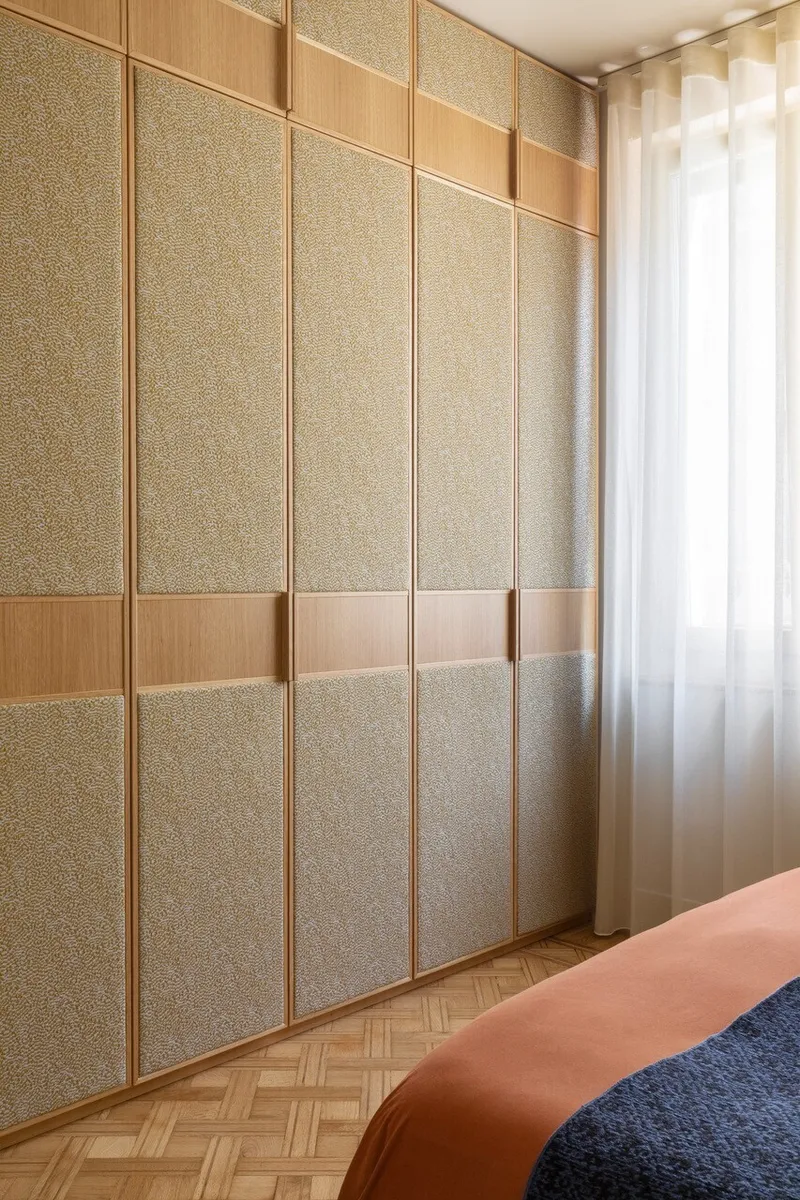
The bedroom maintains the apartment's material vocabulary while dialing down its transparency. A gold velvet headboard introduces a richer tactile register, and the pendant light above the bedside table keeps the warm, domestic scale established elsewhere. Floor-to-ceiling oak wardrobes line one wall, their central panels upholstered in Filigrana fabric by l'Opificio, the textile's geometric pattern echoing the terrazzo found in other rooms. It is a subtle move that ties the private spaces back to the public ones without making the connection literal.
Sheer curtains reappear here, and the herringbone parquet continues unbroken from the living areas. The bedroom does not feel like a separate apartment; it feels like a quieter room in the same continuous sequence.
Materiality in the Margins


Two of the apartment's most telling details appear in its transitional spaces. A corridor connecting the kitchen to the hallway is lined with a floral wallpaper panel and a chequered floor that signals passage rather than habitation. Nearby, a staircase clad in alternating travertine tiles rises beside a gridded metal door, its checkerboard pattern giving weight and texture to what is typically the most neglected part of a Roman residential building. The rationalist entrance hall of the building itself seems to have informed these choices: STUDIOTAMAT reads the context and responds with materials that honor the building's mid-century character while remaining unmistakably contemporary.
The thin burgundy line that runs high along the walls throughout the apartment deserves special mention. It is a simple graphic device, almost a cornice in color rather than plaster, that visually aligns zones of different heights and functions. It is the thread that makes Casa Continua continuous.
Why This Project Matters
The prevailing instinct in residential renovation is demolition: knock down walls, pour a concrete floor, install a kitchen island, call it open plan. Casa Continua demonstrates that there is a more intelligent way to liberate a compartmentalized apartment. STUDIOTAMAT preserves the idea of rooms while removing the isolation between them. Every intervention, from the reeded glass partitions to the folding timber screens, offers a gradient between open and closed, visible and veiled. The apartment breathes without losing its capacity for intimacy.
More importantly, this is a project that takes its client's life seriously. The thousands of books are not a footnote; they are the generative constraint that shapes the joinery, the alcoves, the reading nooks, the entire spatial logic. In an era of interiors designed for photography, Casa Continua is an interior designed for habitation, and it happens to photograph beautifully because its logic is legible from every angle.
Casa Continua by STUDIOTAMAT, Roma, Italy. 115 m², completed 2026. Photography by Serena Eller - Ellerstudio.
About the Studio
Share Your Own Work on uni.xyz
If projects like this are the kind of work you want to make, uni.xyz is a place to publish your own, find collaborators, and enter design competitions.




Popular Articles
Popular articles from the community


EW PARK: Sustainable Architecture Reimagines the Future of Urban Parking
EW PARK reimagines city parking as a modular wooden tower combining automation, solar energy, electric mobility, and adaptable urban design.

Co-Life: Senior Housing Design That Reconnects Older Adults With the City
Co-Life reimagines senior housing design through healing gardens, shared streets, workshops, and a sustainable community across generations.

Co-life: Sustainable Architecture for Age-Friendly Community Living
Co-life reimagines sustainable architecture for seniors through courtyards, rammed earth, shared gardens, and spaces designed for belonging.

AL-JANNAH: Sustainable Architecture and Permaculture for Afghan Widows
AL-JANNAH uses sustainable architecture and permaculture to create resilient oasis of housing, learning, work and renewal for Afghan widows.


Similar Reads
You might also enjoy these articles

Bao Huynh Watercolor Atelier: A Serene Art Retreat in Hội An
Bao Huynh Watercolor Atelier in Hội An blends multifunctional art spaces, sustainable design, local materials, and family-friendly living in a serene environment.

Atelier Macri Concept Store Interior Design by CASE-REAL
Atelier Macri store features a "ko" counter, walnut wood details, cork displays, blending retail, gallery, and seamless customer experiences.

Manuel Vargas Izquierdo Stadium and High-Performance Sports Center: Architectural Excellence in Jalpa de Méndez
The Manuel Vargas Izquierdo Stadium blends sustainable design, inclusive sports facilities, and cultural-inspired architecture, revitalizing Jalpa de Méndez’s public spaces.

KAKR Buluh Awar Hall: Revitalizing Community and Ecology Through Bamboo Architecture
Community built bamboo hall revitalizes Buluh Awar village, empowering youth, restoring ecology, celebrating vernacular craftsmanship through sustainable architecture and culture.


Explore Re-Generative Competitions
Discover active competitions in this discipline



Challenge to reimagine the Iron Throne


Photograph architecture without architects


Illustrate the lost glory of Angkor Wat - Render Challenge


Design challenge to reuse E-waste
Comments (0)
Please login or sign up to add comments
No comments yet. Be the first to comment!