

Super-Farm: Collapsing the Distance Between City Life and Agriculture
A fractal agricultural architecture embeds geodesic domes, rotating ring systems, and closed-loop eco-cycles directly into the urban fabric.


What if a city could grow its own food not on its periphery, but threaded through its streets, plazas, and neighborhoods? Super-Farm takes that provocation seriously, proposing a fractal agricultural infrastructure that can be superimposed onto any city. The design fuses geodesic domes, rotating ring structures, and a closed-loop waste cycle into a single architectural system where planting, harvesting, decomposition, and community education happen within walking distance of each other. The result is less a building and more a productive landscape, one that collapses the conventional supply chain into what the designers call a "wormhole of production."
The project was developed by Madhan Kumar Kandasamy, Roahan Viswanathan, Sonali Rane, and Mantavya Agarwal. Rather than treating urban farming as a rooftop afterthought, the team envisions a scalable, adaptable system of circular farming structures that can be rearranged and resized according to local climatic conditions. It is an ambitious proposition: architecture not as shelter alone, but as an active engine of ecological balance and food sovereignty.
Triangulated Steel and Spherical Greenhouses Along a Pedestrian Spine
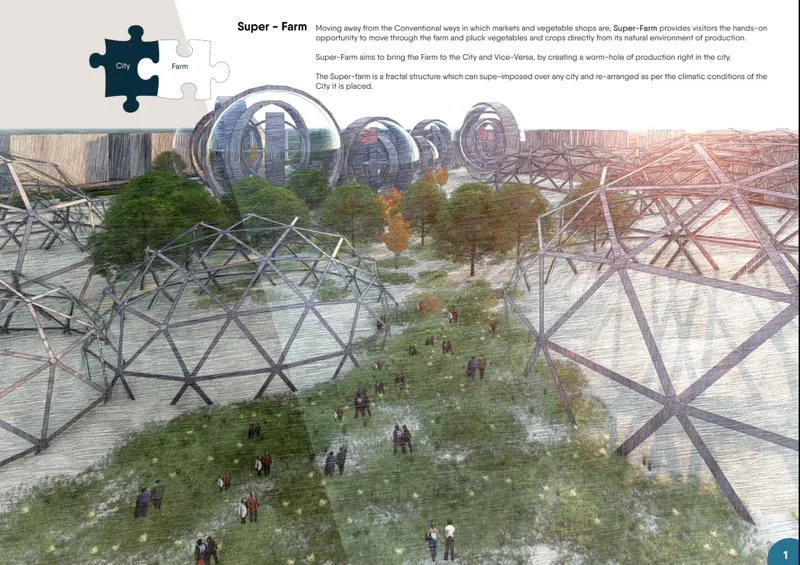
The aerial rendering reveals a pedestrian pathway flanked by triangulated steel frame structures, beyond which spherical greenhouse modules sit within a planted landscape. The pathway is not a corridor to pass through quickly; it is designed as an immersive journey through food production. Visitors walk through the farm, plant seeds, nurture crops, and harvest fresh produce directly from its growing environment. The triangulated frames suggest a modular logic that could extend, contract, or reconfigure across different sites, while the greenhouses create controlled microclimates for year-round cultivation.
A Circular Masterplan on a Triangular Plot
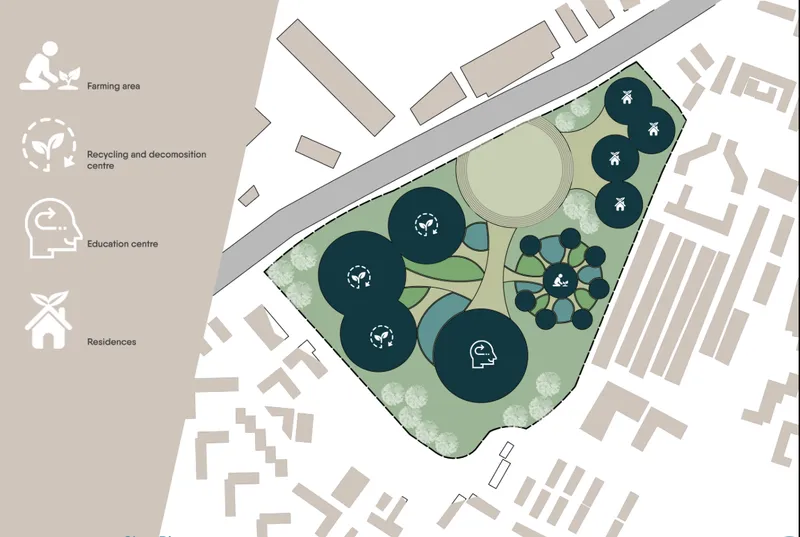
The site plan distributes circular volumes across a triangular plot, surrounded by green space and existing urban context. Farming areas, recycling and decomposition centers, education hubs, and residences are all integrated into the layout. The circular geometries are not decorative; they reflect the project's fractal logic, where each module mirrors the organization of the whole. Green buffers separate the agricultural zones from the surrounding city, but the intent is permeability, not isolation. The plan reads as a productive ecosystem embedded within, not fenced off from, the neighborhood around it.
What makes this multifunctional layout compelling is its refusal to separate program types into discrete zones. Learning spaces sit alongside composting facilities. Residences abut working farmland. The adjacencies are deliberate: they ensure that citizens experience the full arc of the Eco-Cycle firsthand, from seed to harvest to decomposition and back again.
Domed Sections and the Scale of Interior Landscapes
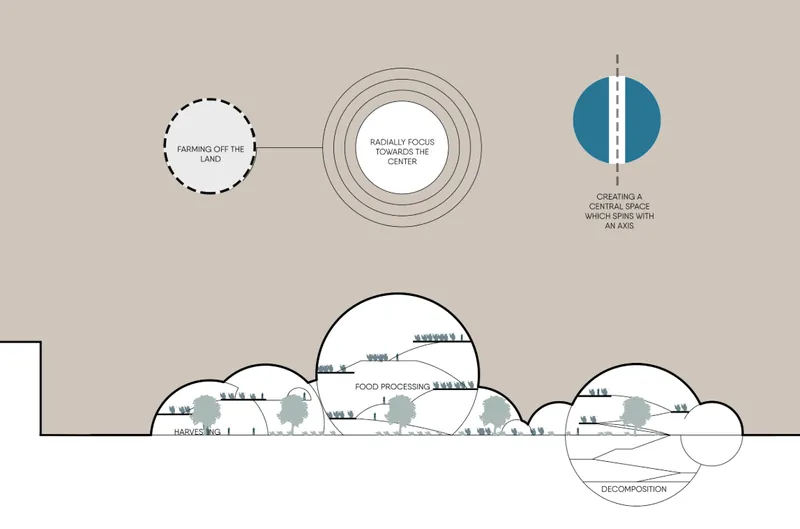
The section drawing cuts through domed structures at varying scales, revealing internal program zones and a continuous ground-plane landscape that threads beneath them. Some domes are large enough to house full farming operations; others are scaled to education or community gathering. The section makes clear that the ground plane is itself a designed surface, with landscaping, pathways, and grading that guide movement and manage water. The domes are not simply enclosures; they establish distinct microclimates, allowing the same site to support different crop types or seasonal cycles simultaneously.
Proto-Gyre: Anatomy of a Rotating Ring System
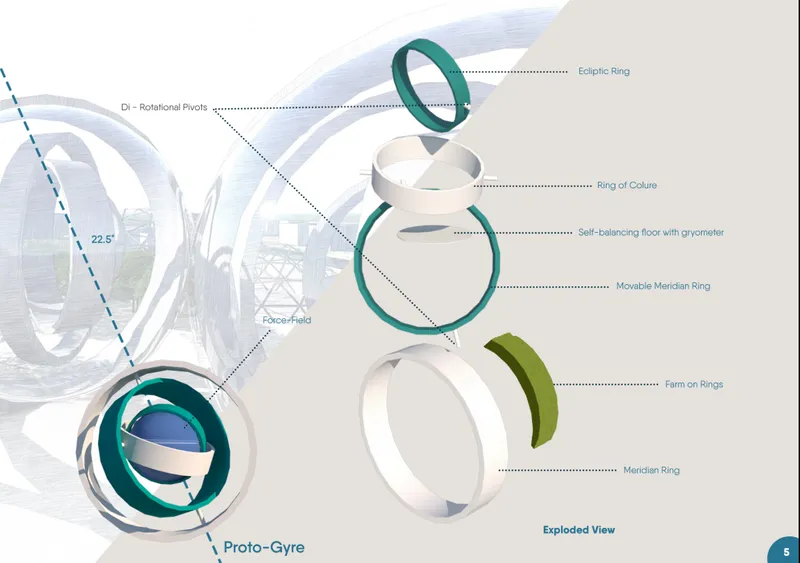
The exploded axonometric diagram breaks down the Proto-Gyre system into its layered components: rotational pivots, self-balancing floors, and flexible meridian rings, each labeled with its functional role. The rotating ring structure is the project's most technically ambitious element. By rotating, the rings maximize light exposure across planted surfaces and enable spatial configurations that a static structure could not achieve. The self-balancing floors maintain level growing surfaces regardless of ring orientation, a critical detail for any system that needs to support soil, water, and root structures in motion.
This is where Super-Farm moves beyond pastoral idealism into genuine technical speculation. The meridian rings introduce structural flexibility that allows the system to adapt to different crop loads, seasonal angles of sunlight, and even shifts in programmatic demand. Whether it could be built at the scale shown is an open question, but the diagram is precise enough to suggest the designers have thought through the engineering logic, not just the visual effect.
Why This Project Matters
Most urban farming proposals treat agriculture as an amenity: rooftop gardens, vertical planters, community plots tucked into leftover spaces. Super-Farm rejects that approach entirely. It positions farming as primary infrastructure, equal in architectural ambition to housing, transit, or civic buildings. The closed-loop Eco-Cycle, where waste is decomposed, recycled, and returned to the soil, is not an add-on feature but the organizing principle of the entire plan. Farmers remain at the center of this cycle, maintaining continuity while citizens participate in the process around them.
The fractal adaptability of the design is its most provocative claim. A system that can be rescaled and reconfigured for any city and any climate is, of course, a conceptual ideal. But the value of Super-Farm lies precisely in the boldness of that ideal. By imagining architecture as a productive, self-sustaining ecosystem rather than a static container, Kandasamy, Viswanathan, Rane, and Agarwal offer a compelling argument for what urban design could prioritize if it took food, waste, and ecological resilience as seriously as floor area and circulation.
View the Full Project
About the Designers
Designers: Madhan Kumar Kandasamy, Roahan Viswanathan, Sonali Rane, Mantavya Agarwal
Enter a Design Competition on uni.xyz
uni.xyz runs architecture and design competitions year-round that reward proposals with spatial conviction and real site intelligence.
Project credits: Super-Farm by Madhan Kumar Kandasamy, Roahan Viswanathan, Sonali Rane, Mantavya Agarwal.


Popular Articles
Popular articles from the community


Juan García Correa, John González and Claudia Rueda Sink a Circular Amphitheater into a Manizales Engineering Building
On the La Nubia campus in Manizales, Colombia, the S1 Building folds labs and offices into a hillside of ramped lawns that double as a campus route.

Jaramillo Van Sluys Arquitectura and Urbanismo Turn a Demolished Registry Lot in Quito into an Orchard Plaza
In Quito's Centro Histórico, a 2,800 m² plaza exposes the San Agustín convent wall and redraws its lost Augustinian orchard in volcanic stone.

David Macias Steps a Doorless Stone and Plaster House Down a Tropical Colombian Hillside
In the humid hills of Colombia, Threshold House replaces the front door with an open void and terraces its 850 m² down the slope instead of fighting it.

U.GA Architects Wraps an Oval Rooftop Pool in Curved Board-Formed Concrete on Busan's Jeollidan-gil
In Busan's Jeonpo-dong, a 454 m² mixed-use block stacks a neighborhood facility, guest rooms and an oval rooftop pool inside spiraling concrete walls.

Similar Reads
You might also enjoy these articles

Gil Mello Arquitetura Tilts a Single Roof Toward the Waterfalls on a Plateau Above Aiuruoca, Brazil
In Aiuruoca, Minas Gerais, a 200 m² house of local labor and reclaimed poles pairs a low valley veranda with a tall mountain one.
U.GA Architects Wraps an Oval Rooftop Pool in Curved Board-Formed Concrete on Busan's Jeollidan-gil
In Busan's Jeonpo-dong, a 454 m² mixed-use block stacks a neighborhood facility, guest rooms and an oval rooftop pool inside spiraling concrete walls.

Felipe Hess Arquitetos Turns a Blind Stone Wall to the Street and Opens a Brazilian House onto a Courtyard and Canal
A canal-front house in Brazil hides behind painted stone and planting, then opens to an olive-tree courtyard, a reed-ceilinged porch and a curving pool.
David Macias Steps a Doorless Stone and Plaster House Down a Tropical Colombian Hillside
In the humid hills of Colombia, Threshold House replaces the front door with an open void and terraces its 850 m² down the slope instead of fighting it.


Comments (0)
Please login or sign up to add comments
No comments yet. Be the first to comment!